>>> Toll Brothers beats by $0.23, beats on revs; narrows FY18 guidance

Toll Brothers beats by $0.23, beats on revs; narrows FY18 guidance
  • Reports Q3 (Jul) earnings of $1.26 per share, $0.23 better than the S&P Capital IQ Consensus of $1.03; revenues rose 27.3% year/year to $1.91 bln vs the $1.81 bln S&P Capital IQ Consensus.
  • Net signed contracts value was $2.03 billion -- up 12%; contract units were 2,316 -- up 7%
  • Per-community net signed contracts were 8.10 units per community -- up 18%
  • Backlog value at third-quarter end rose to $6.48 billion -- up 22%; units totaled 7,100 -- up 13%
  • Adjusted Gross Margin, which excludes interest and inventory write-downs, was 24.3%
  • Guidance:
    • Full FY 2018 deliveries of between 8,100 and 8,400 units (Prior between 8,000 and 8,500 units) with an average price of between $835,000 and $860,000 (Prior $830,000 and $860,000); sees FY18 revs of $6.76-7.22 bln vs. $7.01 bln S&P Capital IQ Consensus.
    • Sees fourth-quarter deliveries of between 2,550 and 2,850 units with an average price of between $840,000 and $870,000
    • FY Adjusted Gross Margin of approximately 24.0% of revenues (Prior between 23.75% and 24.25%), consistent with the mid-point of its previous guidance range; fourth-quarter Adjusted Gross Margin of approximately 24.8%

>>> HD US - Discloses subpoena for documents from previously disclosed investiga

Discloses subpoena for documents from previously disclosed investigation by the EPA civil enforcement division - filing
- As previously reported, in February 2018 we received a letter from the California South Coast Air Quality Management District ("SCAQMD") regarding allegations that we sold certain non-compliant paint thinners and solvents from 2010 to 2015 in violation of applicable rules. In the second quarter of fiscal 2018, we resolved the matter with SCAQMD, and the vendor from whom we purchased the products paid a settlement on our behalf.
- As previously reported, in January 2017, we became aware of an investigation by the EPA’s criminal investigation division into our compliance with lead-safe work practices for certain jobs performed through our installation services business. We have also previously responded to civil document requests from several EPA regions. In the second quarter of fiscal 2018, we received a subpoena for documents from the EPA civil enforcement division. We are continuing to cooperate with the EPA.

WSJ : AXA’s Deal Fallout Creates a Buying Opportunity

AXA’s Deal Fallout Creates a Buying Opportunity
The insurance giant shocked investors with off-script megadeal for XL Group but sense should start to show soon

A huge acquisition out of the blue is a surefire way to leave your shareholders shell-shocked. Insurance giant AXA AXAHY -0.28% SA did just this in March with its $15 billion deal for XL Group of the U.S. But as investors get over their shock, shares of the French company should rebound.
Thomas Buberl did promise radical change when he became AXA chief executive in 2016, but investors were expecting investment in digital technologies and smaller deals to boost its property, casualty and health businesses. A year later AXA unveiled plans to list its U.S. life arm, AXA Equitable, a capital-hungry business unconnected to the rest of the group. The initial public offering would raise up to $4 billion that investors expected would fund share buybacks and investment in growth.
Then Mr. Buberl dropped his bombshell: Small deals and buybacks were off, and instead he had negotiated one of the industry’s biggest takeovers in years.
AXA’s stock fell 10% that day. After three weeks, its valuation had fallen from 10 times forecast earnings, in line with Italy’s Generali and not far behind Allianz of Germany, to just 8 times earnings. This discount has remained.
Heard on the Street's Summertime Stocks Picks Leaderboard
STOCK WRITER POSITION RETURN
Skechers Jakab Buy 1.6%
AMD Gallagher Buy 1.4%
BMW Wilmot Buy 0.1%
Abbott Labs Grant Buy -0.1%

AXA bought XL to fill in one swoop the gaps in the coverage it can offer to large corporations. Along with the sale of its U.S. life business, the move will reshape AXA’s earnings. Life and savings in the future will account for 35% of pretax profits, down from 43% today.

One reason investors were unhappy with the deal is that a flood of yield-seeking capital has flowed into alternative forms of reinsurance, putting pressure on pricing throughout the property-insurance industry. To counter this, Mr. Buberl pledged to cut the group’s exposure to reinsurance. At the same time, higher interest rates may cause investors to shift money back to more traditional investments.

A bigger share of profits from general insurance than from life should give AXA a higher valuation, argues Mr. Buberl. Simply returning to the same valuation as Generali would lift the stock price by about 10% on current prices.
This isn’t far-fetched: At Zurich Insurance Group and Allianz, life business accounted for 31% and 37%, respectively, of first-half profits, and investors value Zurich and Allianz more highly than AXA. Similarly in the U.S., Chubb and Travelers trade at a premium overMetLife and Prudential Financial .

The problem for AXA investors isn’t so much with Mr. Buberl’s strategy; they also worry about the extra debt needed and how that might strain AXA’s balance sheet. But AXA is dealing with the debt question. The sale of an old European life book helped AXA improve its debt-reduction target at half-year results this month.
The missing piece is what this all means for capital returns. General insurance produces more cash profits more quickly than long-term life business and that should boost AXA’s ability to pay dividends. Mr. Buberl pledged more detail on this at AXA’s investor day in November.

Mr. Buberl should be able to show that AXA’s radical remaking means more cash before the year is out. His boldness has brought risks, but before long should also bring rewards.

WWD : Chanel Enters Budding Men’s Makeup Market (...)

Chanel Enters Budding Men’s Makeup Market
The three-product range will be launched in South Korea on Sept. 1.

PARIS — Chanel is the latest brand to dive into the swelling men’s makeup market.

The French house said on Monday that it will introduce its first color cosmetics line for guys, a three-product range, starting in South Korea on Sept. 1.

The collection includes a tinted fluid, coming in four shades; a matte moisturizing lip balm, and an eyebrow pencil in four colors.

Boy de Chanel makeup will then be rolled out to the rest of the world in November on the house’s e-commerce platforms. And from January, it will be available in Chanel boutiques.

Chanel’s Boy franchise, which already counts products such as handbags and a perfume, is named after Boy Capel, the lover and muse of Gabrielle Chanel.

“Just as Gabrielle Chanel borrowed elements from the men’s wardrobe to dress women, Chanel draws inspiration from the women’s world to write the vocabulary of a new personal aesthetic for men,” the company said in a statement. “Lines, colors, attitudes, gestures…There is no absolutely feminine or masculine prerequisite: Style alone defines the person we wish to be.”

Chanel executives could not be reached for further comment on Monday.

Although the brand does carry some products for men — including scents, such as Bleu de Chanel and Egoïste; skin care; and a smattering of fashion items — Chanel is primarily female-focused. Still, the world is changing, with much of what used to be considered gender-bending now flowing swiftly into the mainstream, and makeup for guys is no exception. Brands are taking note.

“The Korean market is one of the most interesting as far as [males are] concerned because they have a relation to beauty that is different,” said Leïla Rochet Podvin, founder and chief executive officer of Paris-based trends and consulting agency Cosmetics Inspiration & Creation.

Their open-mindedness makes South Korea’s men’s grooming market the largest in the world, with retail sales hitting $1.05 billion in 2017, according to Euromonitor International statistics.

“On a broader perspective, internationally, the male market is changing because of the influx of the younger, Millennial generation,” Rochet Podvin continued, adding that age group loves transformation.

Alex Dalley, founder of MMUK Man, the U.K.-based men’s makeup and skin-care brand and e-tailer, agreed that social media, like Instagram, has caused many to feel they must put their best face forward. And that has helped spur the trend in men’s makeup and beauty products.

After launching his brand in 2011, with about six products and marketing skewed toward the male gay community, MMUK Man has grown to more than 40 products purchased by a wide demographic. Foundations are the label’s bestsellers, followed by concealers, mascara (dubbed “Manscara”), beard filler, BB cream and anti-shine powders.

Thanks to the growing demand, MMUK Man is also expanding its European reach, with distribution centers and local online platforms starting up in France, Germany, the Czech Republic and Slovakia on Oct. 1.

Asos.com is catering to the budding men’s makeup market, as well. Last September, the online retailer changed how products are filtered. So now, for instance, via the men’s section it is possible to access the Face + Body category, where items for guys are found and each product listed in Asos’ Face + Body category for women filters through, too.

“So many retailers and many brands have suggested for so long that if you’re a guy you’re probably not going to be shopping for face products, and you’re probably not going to be shopping a purple glitter eye. But actually, we’ve moved on, we’ve evolved — and that’s not the case,” an Asos spokeswoman said.

Asos is hitting the labs, too. “We’re in the process of creating a skin-care and cosmetics line, which is coming out in Q1 of next year, and it will be a genderless range as a whole,” said the spokeswoman.

Some mavericks dipped into the men’s makeup market well before today, with limited success. Jean Paul Gaultier was one. He famously plunged into the category in 2003, with the Le Male Tout Beau Tout Propre line, which included eyeliner, bronzing powder and roll-on lip gloss.

Four years later, that was discontinued and replaced with a range called Monsieur, which had color cosmetics and skin-care products for men.

(TechCrunch) Stratolaunch announces new launch vehicles and reusable space plane

Stratolaunch announces new launch vehicles and reusable space plane
Stratolaunch, the commercial space firm founded by Paul Allen back in 2011, has revealed a bit more of its plan for taking payloads to orbit via one of the world’s biggest planes. It’s now working on a pair of its own rocket-powered launch vehicles, and is in the early phases of creating a reusable, crew-capable space plane.
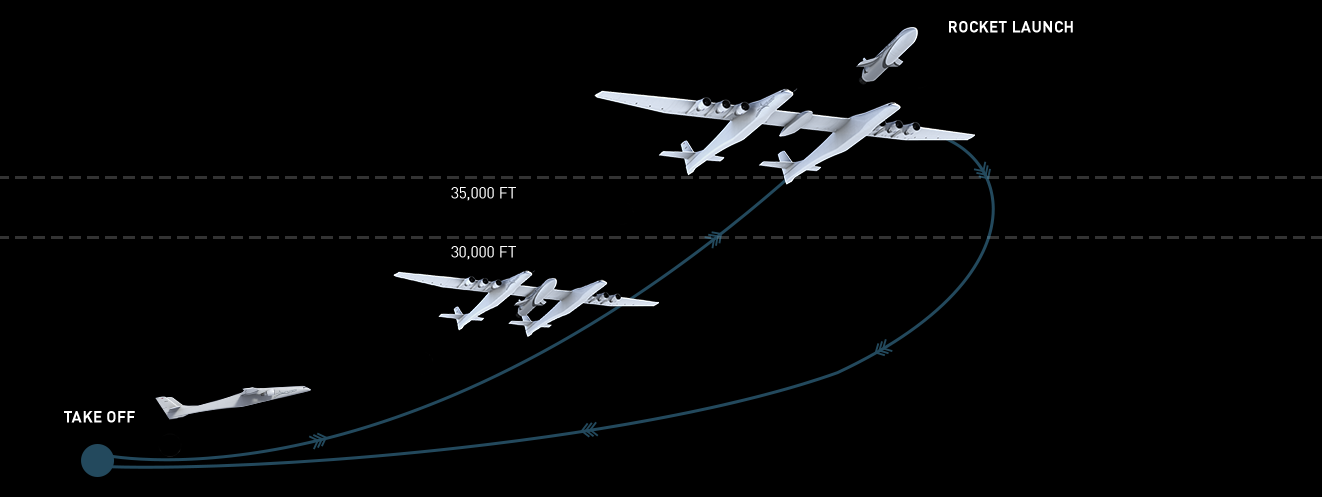
The company’s main claim to fame so far is the unnamed aircraft that will be doing the heavy lifting. Its 385-foot wingspan is the world’s largest — but it’s necessary to provide room in the middle for its intended launch vehicle cargo.
The Stratolaunch technique is in some ways similar to that being pursued by Virgin Galactic: use a big plane to get a rocket off the ground and past the worst of the atmosphere, which then drops off and fires up on its own. Looks like this:
It saves fuel and is in some ways safer and more reliable, as there’s no need to worry about the weather or other low-altitude problems.
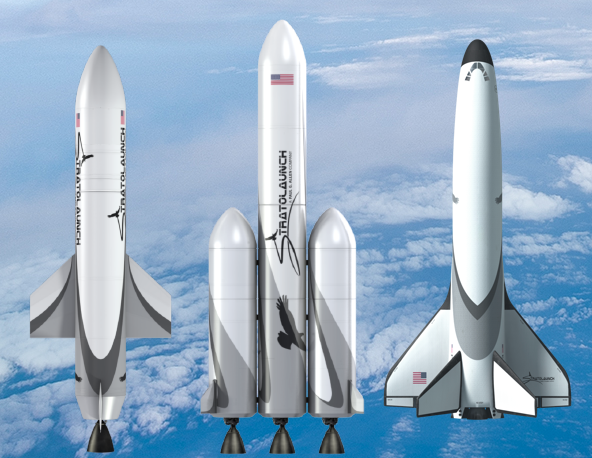
Until this announcement it wasn’t clear just what that rocket-powered craft would be, except Orbital ATK’s proven but relatively diminutive Pegasus. Today’s announcement makes it clear that Stratolaunch intends to provide a variety of in-house options.
Left to right: MLV, MLV Heavy and Space Plane
First is the Medium Launch Vehicle or MLV, which will carry up to 3,400 kilograms up to a 400 kilometer orbit; then there’s its big sibling, the imaginatively named MLV Heavy, which with two additional cores can lift up to 6,000 kilograms. The former is aiming for deployment in 2022, while the latter has no date as yet.
More interesting is the Space Plane, which like the military’s X-37B is a reusable spacecraft meant for taking things to space and bringing them back. A “follow-on variant” will be crew-capable, Stratolaunch claims. Right now this thing is basically just a concept, though: it’s in the “design study” phase. But it wouldn’t be announced alongside real vehicles if the team wasn’t serious about it.
You can expect the first flights with Pegasus-powered launches to take place in 2020 if the company holds to its timeline. That may be a bit ambitious considering the main aircraft has yet to take to the air, let alone be tested and fitted for these flights, but ambitious is kind of the name of the game in the space industry.

>>> Charles Voegele Austria draws four potential investors

Charles Voegele Austria draws four potential investors

Charles Voegele Austria, the insolvent Austria-based fashion retailer, has attarcted four interested parties, Textilwirtshaft reported.
The German trade publication cited insolvency administrator Norbert Scherbaum (Scherbaum Seebacher) who confirmed there are four investors interested, but did not reveal their identities.
The offers were due to be examined at a creditor meeting on Monday (20 August), the report noted. The report said the ideal scenario would be for one investor to acquire the Charles Voegele units in Hungary, Slovenia and Austria which have a total of 700 employees.
Fussl Modestrasse is thought to be interested in the Charles Voegele Slovenia business as is Tengelmann, the report stated.
Charles Voegele Austria is a subsidiary of Switzerland-based Charles Voegele Holding.
Link to original article (German)