FT : Didi Chuxing loses Rmb4bn in first half of year

Didi Chuxing loses Rmb4bn in first half of year
China ride-hailing company is paying out billions of dollars annually in subsidies

Chinese ride-hailing giant Didi Chuxing made a net loss of more than Rmb4bn ($580m) in the first half of the year, and is still paying out billions of dollars annually in subsidies two years after winning an expensive battle with Uber.

The figures were disclosed in a letter last week to employees by chief executive Cheng Wei, which was leaked to domestic media. A person familiar with its contents confirmed the authenticity of the letter, which gives a glimpse into the financial state of the company after its purchase of Uber’s China operations in 2016.

Mr Cheng wrote the letter as the company faces fierce criticism following two murders this year of female passengers by Didi drivers.

“We are definitely not an evil company, and definitely not one focused on profits above all else,” he said, arguing that this was because six-year-old Didi has not turned a profit since it was founded and instead gave out Rmb11.7bn in subsidies to drivers and passengers in the first half of this year.

“We will invest our revenues in safety and the [user] experience,” Mr Cheng wrote.

Defending the online ride-hailing sector, he added: “We can see that the rate of incidents is far lower than that for the traditional taxi industry.”

Didi has promised to focus on safety rather than unbridled growth after a 20-year-old woman was raped and killed by a driver for Hitch, the company’s carpooling platform, in the coastal city of Wenzhou three weeks ago. Her death followed the murder in May of another woman using the service.

Didi faces a driver shortage in China’s major cities, where migrant workers — the bulk of its workforce — are prohibited from driving for the platform. The company told the Financial Times this year that it was making “very low” profits, and had no immediate plans to raise them.

The company, which claims 550m registered users — more than half of China’s mobile-internet users — and 30m drivers, was valued at $56bn last year.

In his letter, Mr Cheng said Didi takes an average of only 16 per cent from each order placed on its platform, which falls to 1.6 per cent after deducting the cost of subsidies.

In March, Didi had roughly $12bn cash on hand. It is drawing on that reserve not only to subsidise rides in China but also to compete internationally with Uber by expanding in Mexico and Brazil.

Didi has raised more than $17bn in the past two years from investors including major backer SoftBank, the Japanese technology conglomerate that is also the biggest investor in Uber.

The Beijing based company has a near monopoly on ride-hailing services in China. For the past year, the biggest threat to its dominance was the food delivery giant Meituan Dianping, which has started ride-hailing services in the cities of Shanghai and Nanjing.

But Meituan, which is pursuing an initial public offering in Hong Kong looking to raise as much as $4.4bn, said last week in its updated prospectus that “based on current market dynamics” — likely a reference to heightened government scrutiny of the sector following the Didi murders — it would not expand the service further.

WSJ : The 5G Race: China and U.S. Battle to Control World’s Fastest Wireless Int

The 5G Race: China and U.S. Battle to Control World’s Fastest Wireless Internet
At stake are billions of dollars in royalties, a head start in developing new technologies and national security

The early waves of mobile communications were largely driven by American and European companies. As the next era of 5G approaches, promising to again transform the way people use the internet, a battle is on to determine whether the U.S. or China will dominate.

Equipment makers and telecom operators in both countries are rushing to test and roll out the next generation of wireless networks, which will be as much as 100 times faster than the current 4G standard. Governments are involved as well—with China making the bigger push.

The new networks are expected to enable the steering of driverless cars and doctors to perform complex surgeries remotely. They could power connected appliances in the so-called Internet of Things, and virtual and augmented reality. Towers would beam high-speed internet to devices, reducing reliance on cables and Wi-Fi.

At the Shenzhen headquarters of Huawei Technologies Co., executives and researchers gathered in July to celebrate one of its technologies being named a critical part of 5G. The man who invented it, Turkish scientist Erdal Arikan, was greeted with thunderous applause. The win meant a stream of future royalties and leverage for the company—and it marked a milestone in China’s quest to dominate the technology.

At a Verizon Communications Inc. lab in Bedminster, N.J., recently, computer screens showed engineers how glare-resistant window coatings can interfere with delivering 5G’s superfast internet into homes. A model of a head known as Mrs. Head tested the audio quality of new wireless devices. Verizon began experimenting with 5G in 11 markets last year.

Nearby, in Murray Hill, N.J., Nokia Corp. engineers are testing a 5G-compatible sleeve that factory workers could wear like an arm brace during their shifts to steer drones or monitor their vital signs. The company began its 5G-related research in 2007.

While the economics of 5G are still being worked out, boosters say the potential payoffs are immense. Companies that own patents stand to make billions of dollars in royalties. Countries with the largest and most reliable networks will have a head start in developing the technologies enabled by faster speeds. The dominant equipment suppliers could give national intelligence agencies and militaries an advantage in spying on or disrupting rival countries’ networks.

“As we face the future, we know deep down that the birth of 5G standards represents a new beginning,” Huawei’s chairman, Eric Xu, told the audience at the company event.

Hans Vestberg, Verizon’s chief executive officer, speaks of the technology in equally dramatic terms. “We are strong believers that 5G [will have] a very transformative effect on many things in our society,” he said. “Consumer, media, entertainment…whole industries.”

By some measures, China is ahead. Since 2013, a government-led committee has worked with China’s mobile carriers and gear-makers on testing and development. The state-led approach, combined with an enormous domestic market, ensures that Chinese companies such as Huawei will sell large quantities of 5G equipment and gain valuable experience in the process.

In the U.S., where the government typically avoids mandating and coordinating efforts by the private sector, much of the experimentation has been led by companies such as AT&T Inc., Verizon, Samsung Electronics Co. and Nokia. Last week, tech companies including Intel Corp. and Cisco Systems Inc. argued in comments filed to the U.S. Trade Representative that proposed tariffs would raise the cost of routers, switches and other goods, slowing development of 5G.

Three of the major carriers plan to roll out 5G service in select cities later this year, though most mobile devices compatible with the new network won’t be ready until early 2019.

The race to 5G has come with tit-for-tat regulatory moves aimed at securing each country’s advantage. In March, the Trump administration blocked Singapore-based Broadcom’s acquisition of U.S. chip giant and 5G leader Qualcomm Inc., citing concerns that Broadcom would cut the company’s research and development funds and allow Chinese companies to pull ahead in 5G.

In July, China squelched Qualcomm’s planned acquisition of Dutch chip maker NXP Semiconductors NV, a deal that would have helped Qualcomm profit from 5G investments in new markets such as connected cars.

Much of the U.S. unease stems from the rising clout of Huawei, which was labeled a national-security threat, along with ZTE Corp. , by a Congressional panel in 2012 that said those firms’ equipment could be used for spying on Americans. In August, aligning itself with the U.S., Australia said it was banning Huawei and ZTE equipment from its 5G network. Other U.S. allies are studying similar bans.

Huawei and ZTE have consistently denied providing government agencies with backdoor access to their products. Beijing has likewise pushed to replace or sideline U.S. high-tech firms within China’s networks on fears of espionage.

China has made 5G a priority after failing to keep pace with Western countries in developing previous generations of mobile networks. The U.S. dominated 4G, built in the late 2000s, much in the same way Europeans controlled 3G standards. The American lead in 4G has been a boon to companies such as Apple Inc. and Qualcomm, and helped give rise to a host of consumer smartphone applications from the U.S.

Since 2015, China has built about 350,000 cell sites, compared with fewer than 30,000 in the U.S., according to an August study by consulting firm Deloitte. It also noted China has 14.1 sites for every 10,000 people, compared with 4.7 in the U.S. That matters for 5G, because the new networks will require much larger numbers of cell sites than 4G.

The physical manifestation of China’s push is a government-run 5G lab near the Great Wall north of Beijing. The sprawling facility is festooned with base stations and prototype mobile devices, with indoor and outdoor facilities for each of the major Chinese carriers and equipment makers, according to engineers and executives who have visited the site.

Trials are coordinated by a consortium of tech firms, universities and research institutes that operate under China’s Ministry of Industry and Information Technology. The group aims to wrap up tests by the end of the year.

After those trials conclude, state-run carrier China Mobile , the world’s largest mobile operator by subscribers, will follow up with its own tests in 17 cities, according to Chih-Lin I, a former Bell Labs researcher and the company’s chief scientist of mobile technologies. China’s 5G service is expected to be ready for commercial use by 2020.

The faster generation of networks relies on sophisticated technology that allows wireless airwaves to be used more efficiently. Plans call for it to run on high-frequency millimeter waves, which can handle more data but can’t travel as far as lower-frequency waves used by older networks. That means 5G will rely on clusters of antennae as well as decentralized data centers close to consumers and businesses—requiring big investments in infrastructure. The networks are expected to have the speed and responsiveness needed for advances such as driverless cars, which must instantaneously communicate with traffic signals, other cars and their surroundings.

China’s bid to steer the 5G future depends heavily on setting technical standards the rest of the world will have to follow—and pay royalties and licensing fees to use. It has played an aggressive role in the international telecom industry collective that sets global standards.

Experts inside and outside China expect Qualcomm and other Western firms to end up with a majority of the essential patents once the standards are fully determined, but China is making progress.

In 2009, as Huawei’s 5G push began, it recruited Tong Wen, a former senior researcher at now-defunct equipment maker Nortel Networks Corp., to set up a research lab in Ottawa. While flipping through an academic journal, Mr. Tong had stumbled on “polar coding,” a novel method for correcting errors in data transmission invented by Mr. Arikan, the Turkish scientist.

Huawei poured resources into developing it, and the government leaned on Chinese companies to vote for it en masse at a key standard-setting meeting at the Peppermill Resort in Reno, Nev., in 2016. The result was a tense fight that lasted past midnight with proponents of a rival technology favored by most Western firms, according to one standards expert who was there.

“The Chinese decided this was important,” the expert said. “This was one of the biggest political battles we’ve ever seen.”

The meeting ended with a compromise: Polar codes will be adopted for part of the standard, giving Huawei ownership of a critical patent. The company has spent more than $1 billion on 5G research and development so far.

The U.S. government has stopped short of mandating efforts by the private sector, opening the door to more diffuse outcomes determined by the work of individual companies. In January, a senior National Security Council official floated the idea of rivaling Beijing with a government-led effort to build a nationalized wireless network, but regulators and officials said it was too expensive and unrealistic.

Earlier this month, the Federal Communications Commission announced a plan to speed up the build-out of 5G networks by overriding some local rules and fees governing the deployment of small cellular transmitters, an important component of the infrastructure. The plan is expected to win approval in late September.

The government has funded some academic research that has paved the way for commercial technologies. One agency, the National Science Foundation, is coordinating an effort to build test beds for 5G and future generations of wireless networks.

“The United States is very much behind in this space” relative to Europe, South Korea, Japan and China, said a 2015 internal NSF report on 5G network development.

Thyaga Nandagopal—a former researcher at Bell Labs who is a director at the foundation—is leading the test bed project, in which companies, academics and government agencies will be able to test 5G and other wireless network applications in tandem. Nearly 30 U.S., European and Asian companies have committed $50 million of capital and equipment over the next seven years, while the U.S. government has pledged to invest another $50 million. In New York, an NSF-funded site run by academic institutions including Columbia University aims to launch a small pilot phase by the beginning of January.

Mr. Nandagopal said that China’s coordinated investments have put it in a “pretty good pole position” but that the NSF’s efforts are focused on wireless developments after 2020, rather than the early years of 5G deployment.

“We can invest our money strategically and still get better results than anyone else,” he said.

Some American telecom companies are staking claims to rooftops and light poles where they can position small cells that enable the faster networks, and pressing equipment and device makers to create 5G-compatible products.

For all the investment, industry experts note the standards for 5G aren’t fully written and wireless carriers are still figuring out how they can best profit from the service.

At a 5G forum in Santa Clara, Calif., in July, Henning Schulzrinne, a former chief technology officer at the FCC, said operators would also have to find a way to drastically reduce the cost of data to make applications such as augmented or virtual reality affordable enough to sell to consumers over 5G. Some of those applications could work using 4G or Wi-Fi instead.

“Who’s going to stream AR or VR if it’s going to cost them $10 per minute?” he said.

John Donovan, chief executive of AT&T’s communications business, said the company’s researchers have been among the most prolific writers of 5G standards, but it is being cautious as it puts the technology in the field.

“To deploy technology in advance of need, before the use cases are there—you’re wasting money,” he said.

Executives at Huawei have also sought to temper 5G expectations. Before an audience of analysts at an annual meeting at the Shenzhen headquarters in April, Mr. Xu, Huawei’s chairman, said that “the entire industry and also governments around the world have regarded 5G too high, to the extent that it’s going to be the digital infrastructure for everything.”

Huawei and China Mobile will push ahead with 5G on a large scale regardless, according to executives from both companies.

“5G is such an important strategic project for China—kitchen sink, all the resources,” said Edison Lee, a telecom analyst at investment bank Jefferies in Hong Kong. “Because if they get their foot in the door for 5G, they get their foot in the door of 6G, 7G, 8G.”

BusinessOfFashion : How Selfies, the Sharing Economy and Sugar Daddies Are Boost

Influencers taking selfies in Milan | Source: Shutterstock

>>> Russian rouble weakens to Rbs70 for first time since 2016


Russia’s rouble weakened to more than Rbs70 per dollar for the first time in almost two-and-a-half years on Monday, as investors extended a sell-off in the currency fuelled by concerns over the independence of its central bank.

The Russian currency traded as low as Rbs70.115 against the dollar, around 0.2 per cent lower on the day and its weakest since March 2016.

Emerging-markets assets have been under pressure for months, as a stronger buck has put pressure on dollar denominated debt in countries such as Argentina and Turkey.

Russia has little hard currency debt, a current account surplus, low inflation and benefits from rising oil prices, Goldman Sachs’ analysts note. But despite that, the country — and the currency — has come under additional pressure from US and EU sanctions, and domestic, as well as geopolitical, risks have been rising.

While the central bank governor Elvira Nabiullina has resisted cutting rates, prime minister Dmitry Medvedev last week called for rate cuts ahead of the next interest rate decision on Friday.

“This interference in monetary policy came at the worst possible time and has weighed heavily on the rouble,” said Commerzbank analyst Ulrich Leuchtmann in a note published last Thursday following Mr Medvedev’s intervention.

He asks: “Does Medvedev want to emulate the Turkish president, whose demands for low interest rates have caused his currency to crash? Remember: The rouble has lost from the beginning of the year to Medvedev’s statements almost 19% against the dollar, in August alone almost 10%.”

Ms Nabiullina pushed back against Mr Medvedev’s calls for looser monetary policy, reasserting the central bank’s independence. But, Commerzbank added, “Without Medvedev, the rouble might have been able to recover with Nabiullina’s statements. In the end, Medvedev destroyed part of the confidence that the central bank had laboriously earned. Bank Rossii must – if the EM-wide devaluation pressure continues – react more strongly with monetary policy measures, which could increase negative side effects on the real economy.”

9to5 : Everything to expect at Apple’s September 12th ‘Gather round’ event


We’re less than a week away from Apple’s ‘Gather around’ event at Steve Jobs Theater. The event is slated to take place on September 12th at 10AM PT/1PM ET, with Apple expected to introduce three new iPhone models, a new Apple Watch, and more.
Read on for our full roundup of everything to except at Apple’s September 12th event…

iPhone Xs
First and foremost, Apple will introduce the iPhone Xs with a 5.8-inch OLED display. This device serves as a successor to the iPhone X introduced last year and will feature a similar design, but be available in a new gold color option.
The iPhone Xs is expected to focus on camera and performance improvements, according to reports. Pricing remains somewhat unclear, with some reports indicating the iPhone Xs will start at $800 and others suggesting a slightly higher $899 price point. Either way, expect the iPhone Xs to be slightly cheaper than the current iPhone X. It’s expected to be available for pre-order on September 14th and released on September 21st.
Read everything we know about the iPhone Xs right here in our complete roundup.
iPhone Xs Max
Joining the iPhone Xs this year is what sources tell us will be called the iPhone Xs Max. This device is expected to feature a 6.5-inch OLED display, but be similar in overall size to the iPhone 8 Plus. Supply chain schematics indicate the iPhone Xs Max will clock in at 157.53mm by 77.44 mm by 7.85 mm thick, making it both narrower and shorter than the iPhone 8 Plus, but with a larger display.
Like the iPhone Xs, the iPhone Xs Max will also be available in a new gold color option, as well as the traditional silver and space gray. Pricing is expected to start at $999 for the base storage model and increase for from there. The iPhone Xs Max will almost certainly be available for pre-order on September 14th and released on September 21st.
Read everything we know about the iPhone Xs Max right here in our complete roundup.
6.1-inch LCD iPhone
Last but certainly not least, Apple is will likely introduce a new 6.1-inch LCD iPhone with a design akin to that of the iPhone X. Naming for this device is unclear, but it could be the iPhone 9, iPhone Xr, iPhone Xc, or anything else. The 6.1-inch LCD model will measure 150.91 mm by 75.72 mm by 8.47 mm thick, according to leaked schematics. That compares to the iPhone Xs Max at 157.53 mm by 77.44 mm by 7.85 mm and the iPhone Xs at 143.6 mm by 70.9 mm by 7.7 mm thick.
The main differentiator of the 6.1-inch iPhone will be its price. The device will serve as the cheapest way to the iPhone X bezel-less design, with Apple saving some money by using an LCD display instead of OLED, and opting for a single lens camera system as opposed to a dual-lens.
The 6.1-inch iPhone will likely be available in a range of color options, as well – including black, white, blue, red, and orange. A recent report suggested the device will start at $699 in terms of pricing. While it is expected to be announced at Apple’s September 12th event, the 6.1-inch iPhone might be delayed until November for purchase.
Read everything we know about the 6.1-inch LCD iPhone right here in our complete roundup.
Apple Watch Series 4
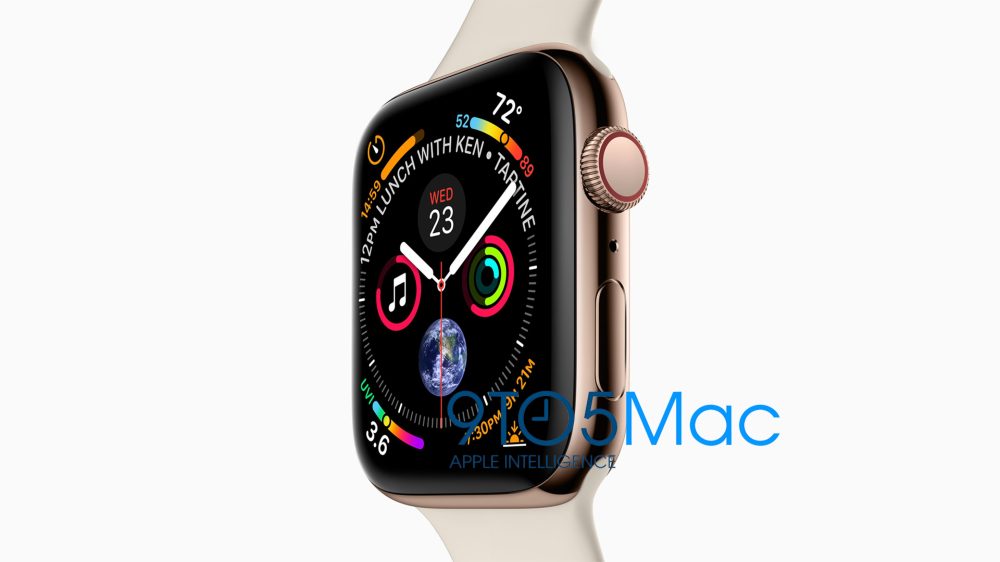
Moving on from the iPhone, Apple next week will unveil what will likely be called the Apple Watch Series 4. This upgrade will bring a larger display, as we showcased in the above marketing image. The new Apple Watch screen will be roughly 15 percent bigger than the current Apple Watch Series 3. In terms of resolution, the Apple Watch Series 4 will likely feature a resolution of 384×480 for the 42mm model, which compares to 312×390 for the Apple Watch Series 3.
Other than a larger display, the Apple Watch Series 4 will feature a modified digital crown, as seen in the image above. The red dot indicating LTE support has seemingly be dropped in favor of a more subtle red ring. Further, there’s a new hole between the side button and Digital Crown, which is likely a microphone for features such as improved Hey Siri.
If precedent is any indication, the Apple Watch Series 4 will be available for pre-order on September 14th and released on September 21st.
Read everything we know about the Apple Watch Series 4 right here in our complete roundup.
AirPods 2
AirPods are also slated to get an update this year. While Apple is said to have a premium pair of AirPods in the works for 2019, this year is expected to offer a modest upgrade to the existing AirPods.
Bloomberg has reported that AirPods will be updated this year with support for ‘Hey Siri,’ which will make it easier for users to do things such as control volume, audio playback, and more. In addition to ‘Hey Siri,’ the new AirPods are said to feature an updated wireless chip from Apple, making it easier to manage Bluetooth connections.
By all indications, the 2018 AirPods will come in at the same $159 as the first-generation AirPods did. Next year’s premium model, however, will likely be more expensive.
AirPower
In addition to its flagship hardware, we hope September 12th will also bring the much-anticipated release of AirPower. Apple originally teased AirPower back at its September 2017 event, but didn’t offer details such as pricing and availability.
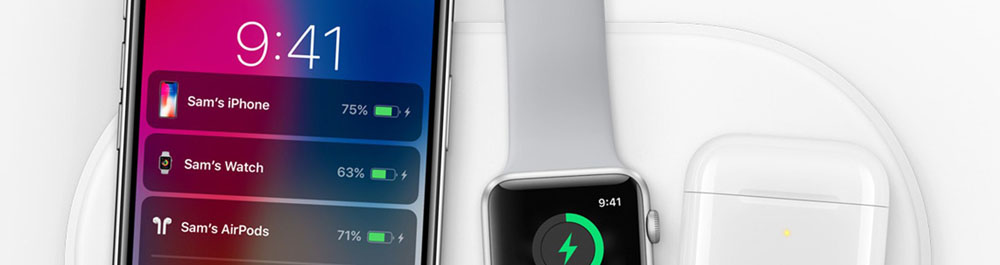
AirPower will allow users to charge their iPhone, Apple Watch, and AirPods on a single charging mat. Apple Watch Series 3 and later is supported, as is iPhone 8 and later. AirPods will require an updated wireless charging-enabled case to work with AirPower – but Apple has said it will offer such a case for older AirPods, as well.
Pricing for AirPower remains unclear, but a recent supply chain report suggested a $160 price tag for the charging accessory. Ideally, AirPower will ship alongside new iPhones and Apple Watch on September 21st, but that’s unclear at this point.
Other Accessories
In addition to its array of new hardware, Apple will almost certainly unveil its new fall collection of accessories. This will include new iPhone case colors, new Apple Watch bands, and more. Apple has regularly treated its accessory portfolio similar to a fashion line, rolling out new color options as the seasons change.
Wildcards
New Macs?
Apple is rumored to have a wide collection of new Macs in store for the remainder of 2018, despite just recently refreshing the MacBook Pro with Touch Bar. What’s unclear, however, is whether or not these new Macs will be released in September or October. There’s precedent for both options, as Apple has previously held a separate event in October for additional product announcements after the iPhone.
Most recently, Digitimes reported that Apple has a $1200 MacBook slated for a September announcement. Several reports over recent months have indicated Apple’s plans for a lower-cost MacBook, with Bloomberg recently adding that the device will feature a Retina display with a design similar to the current MacBook Air. Nonetheless, there’s a lot we don’t know about the 13-inch MacBook, despite a slew of rumors and reports.
Further, reports indicate Apple has a new Mac mini slated for introduction this year. While the Mac mini has typically represented the cheapest way to enter the macOS ecosystem, Bloomberg recently reported that this year’s Mac mini will instead target pro users and be more expensive than the current Mac mini, which starts at $499.
Last but not least, new iMacs are also expected this year. While specifics are unclear here, Ming-Chi Kuo suggests that the new iMacs will feature “significant display-performance upgrades.”
iPad Pros?
The other major wildcard for Apple’s 2018 is the iPad Pro. A slew of reports suggest Apple has a pair of new iPad Pro models in the works for this year, but it’s unclear whether they will be unveiled in September or October of this year.
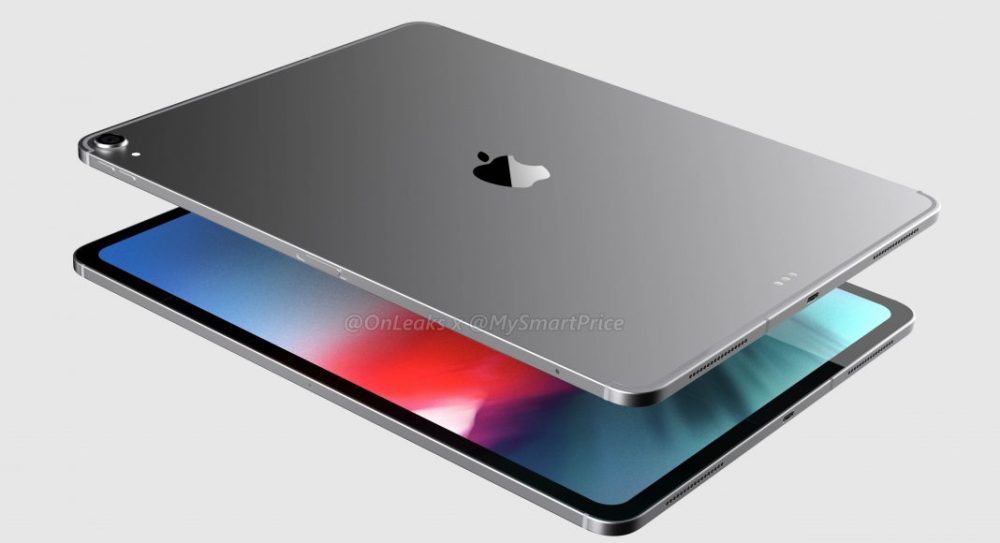
Apple is likely refreshing both the 10.5-inch and 12.9-inch iPad Pros to include a new edge-to-edge display with support for Face ID. The 12.9-inch model is expected to feature the same screen size, but with an overall smaller body thanks to the reduced bezels. Meanwhile, the 10.5-inch model is expected to become 11-inces as Apple keeps the same body size, but stretches the screen closer to the edges.
Further, the iPad Pros introduced this year will move the Smart Connector to the back of the device. While it’s unclear how exactly this will work, renders based on leaked schematics have shown the new placement of the Smart Connector.
Read everything we know about the new iPad Pro models in our full roundup right here.
Wrap up
While there is a lot we know about Apple’s September 12th event, there’s also a lot we don’t know. The event will bring the introduction of the iPhone Xs, iPhone Xs, and the 6.1-inch LCD iPhone. Further, we’ll see the Apple Watch Series 4 and hopefully new AirPods and AirPower.
On the other hand, whether or not we see new Macs and iPad Pros is unclear. While it’s certainly a possibility, it would not be unprecedented for Apple to hold another event in October to showcase these devices. In 2016, Apple held its normal September iPhone event, then another event in October to introduce its new MacBook Pro line.
Either way you look at it, September 12th is going to be a big day for Apple fans. Even though it’s an ‘s’ year for the iPhone in naming, it’s clear there are quite a few changes in store – including the introduction of two completely brand new devices.
What are you most excited to see next week? Let us know down in the comments!