Recode : Peloton now has more U.S. customers than SoulCycle, new data suggests

Peloton now has more U.S. customers than SoulCycle, new data suggests - Link : http://bit.ly/2KQVrVI

Tech-based home fitness companies are having a heyday.
Peloton appears to have finally pulled ahead in the race to be the most popular exercise-bike company.
Peloton had 4 percent more U.S. customers than SoulCycle last quarter, more than doubling its subscriber base over the last year, according to new data from Second Measure, a company that analyzes billions of anonymized debit and credit card purchases from all major cards. The number of people who made a SoulCycle purchase via debit and credit card in the third quarter declined nearly 10 percent year over year, according to Second Measure.


That’s a marked change from the beginning of 2017, when SoulCycle — which earlier this year withdrew its 2015 application to become a public company — had approximately three times as many customers as Peloton, according to Second Measure. Peloton, which plans to go public in 2019, was most recently valued at $4 billion.
Data from a second company, M Science — which is owned by Leucadia Investments, a division of Jefferies Financial Group — largely confirmed Second Measure’s findings. Its analysis of anonymized credit and debit card purchases from millions of Americans showed Peloton more than doubling its consumer count while SoulCycle’s declined 8 percent (versus Second Measure’s recorded dip of 9.8 percent) from Q3 2017 to Q3 2018.


A SoulCycle spokesperson provided Recode with the following statement contesting the data:
“The data is not only incomplete, it’s wrong. SoulCycle is highly profitable. Studio revenue has increased year over year, paid rides are up, total rides are up and our active ridership has not decreased. We’re also seeing an increase in the number of classes our active riders take each month. We’ve recently opened two new studios in Las Vegas and Denver, bringing our total to 90 studios in North America. Our growth in consumers and in revenue shows nothing can replicate our immersive and category-defining experience.”
SoulCycle considers “active riders” to be people who’ve attended a class anytime in the previous 12 months.


Peloton confirmed that its user base has doubled since last year. The company has also been running an aggressive TV advertising campaign this holiday season in an attempt to build on that growth.
Both research companies counted individuals who made at least one credit or debit card purchase at SoulCycle or Peloton within each quarter. These numbers were indexed to the number of Peloton customers observed in Q1 2017.
Both fitness companies revolve around stationary bikes, but Peloton’s are purchased for in-home use — a notable $2,000 barrier to entry — and its customers pay a monthly fee to access live and prerecorded classes on the bike’s built-in monitor. SoulCycle’s own growth barrier is that classes only occur at its 90 gyms, which are located predominantly in affluent communities along the coasts.
Last fall, Peloton introduced a 39-month financing option at $97 per month for both the bike and monthly subscription. That meant people could own and use a Peloton for a monthly fee equivalent to the cost of three SoulCycle classes ($30-$40 apiece, depending on the location). Some financing options don’t show up in this data because the financing company’s name would appear in billing statements instead of Peloton’s.
Consumers who don’t have a Peloton device can pay about $20 a month to use the app to stream a variety of workout classes that don’t require Peloton hardware. These people would be included as Peloton customers in the data as well, unless they pay through iTunes since the merchant would be Apple.

Second Measure’s and M Science’s data counts SoulCyclers who made a purchase in a given quarter. So for those members who purchase a large package of classes in one quarter but are still using it in a subsequent quarter, they are only counted for the quarter in which they make a purchase. However, the most common SoulCycle class purchases are single-class passes that expire in 30 days, SoulCycle said.
The data includes purchases made in-store, online or through the apps — basically anything that would include “Peloton” or “SoulCycle” on a billing statement.
Peloton and SoulCycle are part of growing health cluband fitness equipment markets that are increasingly getting attention from entrepreneurs and tech investors. Peloton has raised a total of nearly $1 billionfrom venture capital investors. It brought in nearly $400 million in revenue in 2017 and is on track to bring in $700 million this year.
Other startups are betting that they too can use technology to pull people out of gyms and reimagine home workouts. Just this fall, Mirror — a $1,500 smart TV screen that connects to live and prerecorded classes — announced a new $25 million in funding. Tonal, a similar product that includes resistance bands, also recently raised venture funding.

FT : Rejecting Brexit deal would threaten stability of London, Treasury minister

Rejecting Brexit deal would threaten stability of London, Treasury minister says

Members of parliament who refuse to back Theresa May’s Brexit deal threaten to imperil the stability of the City of London, the economic secretary to the Treasury has warned.

Speaking to a room of bankers and City figures at the FT Banking Summit, John Glen said he hoped MPs recognised that rejecting the agreement would plunge the UK’s financial centre into a protracted period of uncertainty.

“I am confident and hopeful that my colleagues understand that rejecting this deal will take us back to square one,” he said.

“It would prolong the uncertainty and turbulence which threatens the unity of our country and stability of the City.”

The warning comes as the UK government embarks on the final week of a frenzied campaign of domestic diplomacy to try to shore up political support for Mrs May’s deal ahead of a crunch vote in parliament next Tuesday.

Mr Glen insisted that the deal was “good for the City” and that London would enjoy a level of access to the EU that was unparalleled for a so-called third country.

“The relationship will be of greater depth than any other the EU currently has with a third country in financial services,” he said.

The minister’s remarks appeared to promise a deeper partnership than outlined in the political declaration on the UK’s future relationship with the EU, which was published last month.

The declaration said the UK and EU would have “equivalence frameworks” that would allow them to declare that Britain’s regulatory and supervisory regime was “equivalent for relevant purposes.”

However, Mr Glen said the deal “significantly improves on the existing equivalence regime to allow for a continued close relationship, in recognition of the fact that the UK financial services hub is a European asset, as much as a British one.”

Mr Glen also provided a more precise timetable for the agreement of any new equivalence regime, saying that would be completed at least six months before the end of the implementation period to give businesses “critical time and certainty”.

Despite extolling the benefits of close co-operation with the EU, Mr Glen also touted Mrs May’s Brexit deal as a chance for the City to capitalise on “new vistas of opportunity” with the “world’s fastest growing economies”.

And in remarks that might be interpreted as a sign that the UK could adopt a lighter touch regulatory regime after Brexit, he promised “lower compliance costs and more efficient capital structures” for banks.

>>> Gold to copper: Metals look upward with potential peak greenback

Gold to copper: Metals look upward with potential peak greenback
This analysis is by Bloomberg Intelligence analyst Mike McGlone. It appeared first on the Bloomberg Terminal.
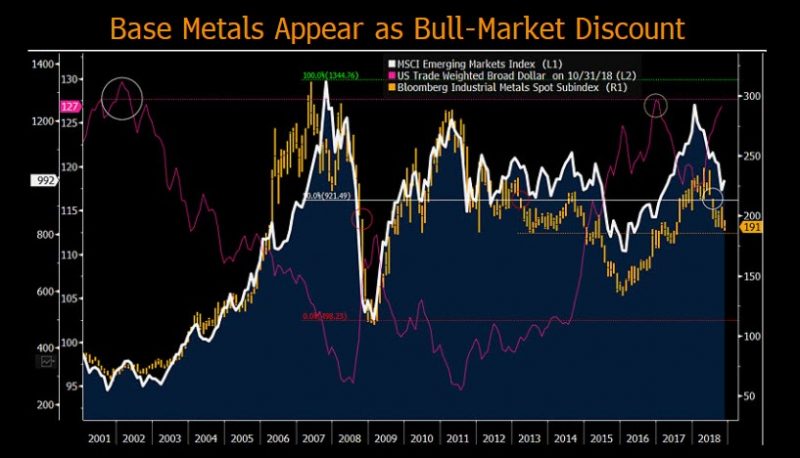
Metals should be primary beneficiaries of an imminent greenback peak, with normalization in U.S. stock-market outperformance, Federal Reserve tightening near a finish and the trade-weighted broad dollar approaching multiyear highs. Though the dollar tops the list of this year’s best performing major assets, gold and copper show divergent strength. Industrial metals appear to be at a discount in a bull market with favorable demand vs. supply conditions.
Indications from precious metals, notably gold, offer a setup that’s similar to natural gas before its big rally. Bound to historically compressed trading ranges with many typical pressure factors nearing multiyear extremes, precious metals appear close to a maximum loss of faith vs. the strong stock market and greenback.
Aluminum to zinc: Base metals favored vs. unsustainable trends
The primary culprits that often pressure industrial metals prices are near inflection levels of their own, increasing the likelihood of upside potential in base metals, in our view. Copper appears especially difficult to submerge, with its November rebound (absent further dollar gains) offering a sign of recovery.
Base metals decline appears overdone
Sustained dollar gains and declines in emerging-market (EM) stocks are what’s needed to keep the industrial metals down. Mean reversion in these trends and a recovery in the metals are more likely, in our view. There’s limited appreciation potential in the trade-weighted broad dollar, which is near its 2016 and 2002 peaks. The metals’ recovery potential appears greater than further downside risks on similar potential for back-and-fill maneuvering in the greenback.
The MSCI Emerging Markets Index and Bloomberg Industrial Metals Spot Subindex are down about 15% in 2018. EM stocks remain above the halfway point of the 2007-09 bear market; metals are below. Since 2000, industrial metals’ annual correlations are 0.86 to EM equities and minus 0.67 to the dollar.
Metals demand vs. supply indicate price discount
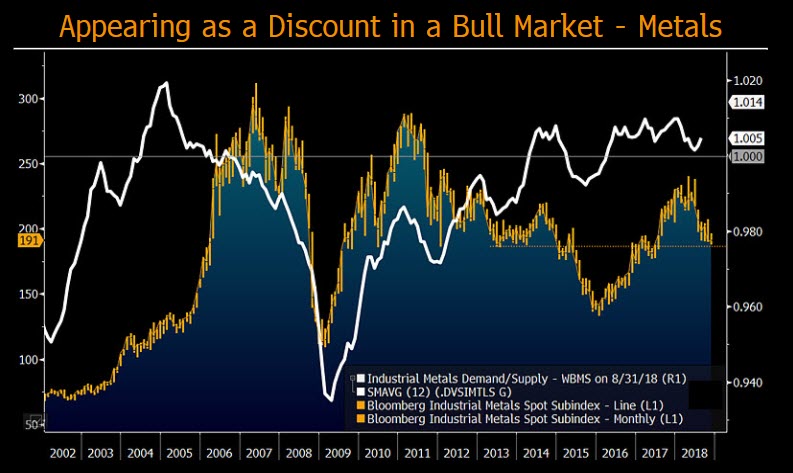
Industrial metals are discounted relative to favorable demand vs. supply. Our analysis of World Bureau of Metal Statistics demand vs. supply datasets for copper, aluminum, nickel and zinc show the ratio improving above par and for the longest period in the database since 1995. The Bloomberg Industrial Metals Spot Subindex’s discount appears unusual. Pricing for what appears to be a worst-case scenario tips the probability in favor of a recovery once the worst fears of a China slowdown and U.S.-trade tensions are alleviated.
The subindex indicates what some analysts might describe as an oversold condition. The gauge gapped down in July at a similar level as in 2013. That gap marked the peak in 2014 as metals recovered, then succumbed to plunging crude oil.
Bloomberg Commodity Outlook

WSJ : China’s Alibaba Takes On Amazon in European Cloud

China’s Alibaba Takes On Amazon in European Cloud
Competition shows how Chinese internet firms and Silicon Valley now view Europe as a battleground

Alibaba Group Holding Ltd. of China and Amazon.com Inc. AMZN 4.86% are squaring off in Europe—and not just in e-commerce, but also in the quickly growing cloud-computing industry.

The competition with Amazon, the world’s biggest cloud-computing player, is a sign of how Europe is turning into a battleground between Chinese tech giants and Silicon Valley.

“Europe is very strategic for us because a lot of European countries are quite advanced markets,” said Yeming Wang, who runs Alibaba’s European cloud business.

Cloud computing is an important growth engine for Alibaba and Amazon. Amazon Web Services is one of the U.S. company’s biggest profit drivers, while revenue at the Chinese company’s cloud business more than doubled to about $2.1 billion during fiscal 2018.


Alibaba opened its second and third European cloud-computing centers in October—both in London—and is trying to build the customer base for its cloud division. However, it is still a small competitor outside Asia. Its world-wide infrastructure as a service market share rose to 4.6% in 2017, up from 3.7% the year before—well below Amazon’s 51.8% share of the market, according to research firm Gartner. The firm says Alibaba’s share in Europe last year was just 0.3%.

Amazon—which also faces cloud competition from Microsoft Corp. and Alphabet Inc.’s Google—isn’t standing still. It announced a new AWS data center in Italy last month and said in October that it would add jobs in the U.K. to work for the division. Microsoft declined to comment, while Amazon and Google didn’t respond to requests for comment.

China’s internet giants are increasingly looking to Europe for growth amid heightened tensions with the U.S. over trade and concerns about the Chinese government’s influence on companies from the country.

Growing resistance from the U.S. has been a factor in JD.com Inc.’s focus on other Western markets, said Yuguang Han, a senior product manager for data and supply chain at the online retailer. “For the long-term strategic plan, you do not want to put eggs in one basket,” he said.

Earlier this year, JD.com executives said the company planned to open an artificial-intelligence lab in Cambridge, England, and that it would invest €1 billion ($1.13 billion) over two years to build a delivery network in France.

Its relations with America soured in September when its billionaire founder was arrested in the U.S. on suspicion of rape. He denied wrongdoing and has since returned to China. Some JD.com scientists were this year denied U.S. visas for a research trip to Silicon Valley, Mr. Han said.

Tencent Holdings Ltd. , which runs China’s ubiquitous WeChat messaging service, also has bolstered its presence in Europe. In October it formed a partnership with a London health-care company to develop artificial intelligence to diagnose Parkinson’s disease. It also has signed partnerships with a U.K. government department and the BBC—with which it has co-produced a documentary—and plans to develop a British version of one of its mobile racing games.

China’s internet giants are still small in Europe, but analysts say they could eventually challenge the dominance of U.S. tech giants on a continent that hasn’t produced its own leading internet company.

European countries “are less likely to throw out Chinese tech investment and joint-venture opportunities as they seek to nurture their own technology sector within the digital single market and stand up to the U.S. giants," said Jamie MacEwan at Enders Analysis.

However, Alibaba’s expansion into the European cloud-computing business reflects both the promise and challenges of the European market.

Alibaba is dominant in China, with a 47% share of the cloud-computing market, but has a small presence outside Asia. In Europe, it has offered discounts to try to lure customers from rival services.

Many companies use multiple cloud providers, and Alibaba’s European expansion could pose headwinds for the major cloud businesses of Microsoft and Google, said Forrester Research analyst Paul Miller.

Alibaba’s Mr. Wang, who previously oversaw Huawei Technologies Co.’s European expansion, said the company is targeting European businesses that could benefit from its e-commerce expertise, as well as companies that want to expand to China.

At the same time, Mr. Wang said some potential customers ask about whether the Chinese government could order Alibaba to hand over information. Mr. Wang said he tells them that Alibaba complies with the laws of the country in which it is doing business.

“Everyone is talking about if it’s good to engage with Alibaba Cloud,” said Francois Chazalon, chief marketing officer at Paris-based Linkbynet, a cloud-computing firm that uses Alibaba’s service and provides it to customers.

“They are worried about IP [intellectual property] and data security and the Chinese government behind them. But in the end, you want to do business. It is a balance between risk management and business development,” Mr. Chazalon said.

Mr. Miller, the Forrester analyst, said many of his European clients are conducting due diligence and security checks with Alibaba’s cloud service, and he expects more European companies to move nonsensitive data to Alibaba in the next two to three years.

Some European companies are avoiding Alibaba for commercial reasons: It is unproven in Europe, and there is no reason to use it now unless they want to go to China.

“They showed us all the services they have, super popular in China, just like Amazon. But the reality is nobody is using it here in Europe,” said Rebecca Blackmore, marketing manager at OutSystems UK. The software firm chose not to use the service.
Reuters - Nissan delays decision on Ghosn successor

Nissan delays decision on Ghosn successor

TOKYO (Reuters) - Nissan Motor Co (7201.T) failed on Tuesday to nominate a successor to Carlos Ghosn as chairman in the wake of his arrest and dismissal for alleged financial misconduct last month, a source familiar with the situation said.

Ghosn could remain in detention until the end of the year because Tokyo prosecutors plan to rearrest him on a fresh claim of understating his income, the Sankei newspaper reported earlier on Tuesday.

A three-member panel of external Nissan directors put off a decision on recommending a replacement for the jailed Ghosn.

The carmaker declined to comment.

Ghosn’s arrest to face accusations including the under-reporting of income has triggered new attempts by Nissan to weaken Renault’s control of their Franco-Japanese alliance.

Renault’s board is due to meet on Wednesday to discuss the crisis, two sources with knowledge of the matter told Reuters.

Ghosn, 64, was the architect of the alliance and one of the best known figures in the car industry.

Nissan has tasked former trade and industry official Masakazu Toyoda, retired Renault SA (RENA.PA) executive Jean-Baptiste Duzan and race car driver Keiko Ihara with the selection of a new chairman, which is to be submitted to the rest of the board at their next meeting on Dec. 17. Changes to the board must be approved by shareholders.

Ghosn has been detained in Tokyo since his Nov. 19 arrest on suspicion of conspiring with former Nissan Representative Director Greg Kelly to understate his compensation by about half of the actual 10 billion yen ($88 million), over five years from 2010. Tokyo authorities on Friday extended their detention until the maximum Dec. 10 for the alleged crime.

Citing unnamed sources, the Sankei daily said prosecutors plan to arrest Ghosn and Kelly on Dec. 10 for the same crime covering the period from 2015 to 2017, during which the suspects allegedly understated Ghosn’s income by about 4 billion yen.

If authorities approve the maximum detention for that case, Ghosn and Kelly would remain in custody until Dec. 30, the paper said.

The Tokyo prosecutors’ office declined to comment on the report.

Ghosn has been unable to respond to the allegations, which public broadcaster NHK has said he has denied. Calls to Ghosn’s lawyer, Motonari Otsuru, at his office went unanswered.

In Japan, crime suspects can be kept in custody for 10 days and that can be extended for another 10 days if a judge grants prosecutors’ request for extension. At the end of that period, prosecutors must file a formal charge or let the suspect go.

However, they can also arrest suspects for a separate crime, in which case the process starts over again. This process can be repeated, sometimes keeping suspects detained for months without formal charges and without bail.

WSJ : Cash’s Star Shines in a Tumultuous Year for Global Markets

Cash’s Star Shines in a Tumultuous Year for Global Markets
U.S. cash and cash equivalents are on track to be some of the best-performing assets in 2018


In a year of anemic returns and wild gyrations across most markets, cash is a star.

U.S. cash and cash equivalents are on track to be some of the best-performing assets in 2018, enticing money managers struggling with a rare synchronized downturn in stocks, commodities and bond markets. Rising returns on cash make it more appealing for investors to move out of other investments, risking a turning point for markets as the global economy shows signs of slowing and the Federal Reserve slowly normalizes interest rates.

“For the first time in a long time, cash is interesting again,” said Hani Redha, a multiasset portfolio manager at PineBridge Investments, which is now considering allocations to cash.

One popular cash proxy—the S&P U.S. Treasury Bill 3-6 Month Index, which measures the performance of U.S. Treasury bills maturing within three to six months—has returned 1.7% so far this year. That comes against a background of lower and even negative returns on most assets this year, including global stocks, high-yield and investment-grade corporate bonds, long-term government debt and a range of commodities.

There appears to be room to add more to cash positions: Fund managers’ cash levels stood at 4.7% in November—slightly above the average of the past 10 years, but below the 5.1% levels reached in September and October, according to Bank of America Merrill Lynch.

For most of the past decade, holding cash or cash-like instruments such as certificates of deposit or short-dated Treasury bills has failed to pay off. A person who invested $100 in the S&P 500 about 10 years ago would have about $396 by now, compared with roughly $104.50 on the same investment in cash.

This year has been different: The MSCI ACWI of global stocks is down 3% since the start of 2018 and the S&P 500 in November dipped into negative territory for the year, and was trailing cash for most of the fall until a recent bounce. The Bloomberg Barclays Global Aggregate Index of government and corporate bonds is down 3.2% on the year.

The return of cash as a viable alternative signals a major change in investor sentiment and poses a risk to the nearly 10-year bull market in stocks.

For years, a key pillar of the bull market in stocks was the TINA effect, wherein “there is no alternative” to stocks. Equities, even if expensive, were seen as the right way to go since other asset classes offered worse returns.

But after nearly a year of weak returns and roller-coaster markets, that paradigm appears to be shifting.

“TINA has disappeared, and now you have TIRA: there is a real alternative,” said Fabrizio Quirighetti, head of multiasset at SYZ Asset Management. He has moved allocations of cash-like instruments up to 10% of conservative portfolio strategies, up from nearly 0% two months ago.

“It’s acting a little bit like a magnet: draining some liquidity out of risky assets that are not yielding enough or not rewarding enough going forward,” he said.

If cash manages to outperform stocks and bonds this year, that would mark the first time since 1992, according to analysts at Bank of America Merrill Lynch.

Even gold, which has traditionally benefited in times of market stress and has been used to protect portfolios when stocks are declining, has fallen about 5% this year, while cryptocurrency bitcoin has dropped about 80% from its peak.

Only a handful of investments have done better than U.S. cash so far this year, including Israeli and Brazilian equities, and cocoa.

The moves come amid a series of headwinds for stocks and other risky assets: recent readings on global growth have slowed down, global trade is in flux and U.S. corporate earnings growth is forecast to slow in 2019 to around 9% after rising 22% in 2018, according to FactSet estimates.

The Federal Reserve, meanwhile, has continued to signal another interest-rate increase in December—the fourth U.S. rate rise this year—and more in 2019, putting pressure on stocks and bonds.

“You have the slowing of earnings, the slowing of economic growth—the only thing that’s not slowing is the Fed’s appetite to raise rates,” said Mike Thompson, who runs $37 billion in assets under advisory at S&P Investment Advisory Services. Choosing assets this year has gone “from picking the best story” to picking the least bad, he said.

Cash typically benefits from rising interest rates as its returns climb in tandem with the fed-funds rate. It also tends to outperform when investors fear further losses in other markets, withdrawing their investments.

In total-return terms, which include dividend payouts, the S&P 500 at times this month has trailed cash, though is now outperforming for the year after a recent bounce. But while stocks have been massively volatile this year, cash is totally safe, which still makes it more attractive for many in comparison.