>>> Intuitive Surgical misses by $0.11

Intuitive Surgical misses by $0.11, reports revs and da Vinci procedures in line with pre-announcement; will guide for FY19 da Vinci procedures on conference call at 16:30 ET (536.12 +6.17)

Reports Q4 (Dec) earnings of $2.96 per share, excluding non-recurring items, $0.11 worse than the S&P Capital IQ Consensus of $3.07; revenues rose 17.3% year/year to $1.05 bln vs the $1.05 bln S&P Capital IQ Consensus (in line with pre-announcement).
Worldwide da Vinci procedures grew approximately 19% (in line with pre-announcement) compared with the fourth quarter of 2017, driven primarily by growth in U.S. general surgery procedures and worldwide urologic procedures.
The Company shipped 290 da Vinci Surgical Systems compared with 216 in the fourth quarter of 2017.
Co will guide for FY19 da Vinci procedures on conference call at 16:30 E

>>> US Close Dow -0.09% S&P +0.14% Nasdaq +0.68% Russell +0.70%


Stock Market Wrap Up: Wall Street Mixed as Growth Concerns Limit Gains

The S&P 500 eked out a gain of 0.1% on Thursday as it wavered between small gains and losses throughout the day. Another round of better-than-expected corporate earnings coupled with ongoing global growth concerns contributed to a mixed session on Wall Street.

The Dow Jones Industrial Average lost 0.1%, the Nasdaq Composite gained 0.7%, and the Russell 2000 gained 0.7%.

Some discouraging commentary from Commerce Secretary Wilbur Ross and European Central Bank President Mario Draghi helped temper buying interest.

Specifically, Mr. Ross said the U.S. and China are still "miles and miles" from reaching a trade deal, and Mr. Draghi acknowledged that significant stimulus is still needed for the eurozone. These comments stirred concerns about the pace of future economic growth, which in turn stirred concerns about the pace of future earnings growth.

Nevertheless, the cyclical information technology (+0.9%), energy (+0.6%), and industrial (+0.6%) sectors managed to outperform the broader market. Conversely, the consumer staples (-1.3%), health care (-0.9%), and material (-0.6%) sectors were the lone groups to finish in the red.

The Philadelphia Semiconductor Index was a notable pocket of strength on Thursday, rising 5.7% on the back of some strong earnings reports. The outperformance in chip stocks underpinned the strength in the heavily-weighted tech sector and the tech-heavy Nasdaq.

Heavyweight component Texas Instruments (TXN 102.09, +6.60) rose 6.9%, while Lam Research (LRCX 161.20, +21.87, +15.7%), Xilinx (106.06, +16.51, +18.4%), and Teradyne (TER 36.04, +4.11, +12.9%) each surged well over 10% following their earnings reports.

In addition, better-than-feared earnings and guidance from the transport stocks, particularly the airlines, helped lift the Dow Jones Transportation Average (+1.1%) and the industrial sector.

American Airlines (AAL 33.66, +2.01, +6.4%), Southwest Air (LUV 54.21, +3.19, +6.3%), JetBlue (JBLU 18.12, +0.88, +5.1%), and Union Pacific (UNP 160.34, +6.01, +3.9%) all beat earnings and revenue estimates.

On the other hand, McCormick (MKC 124.35, -14.65) was a bit of a story stock, dropping 10.5% after it missed Q4 top and bottom-line estimates and guided fiscal 2019 earnings and revenue below consensus. Its poor performance was a huge drag on the consumer staples sector (-1.3%).  Another story stock was PG&E (PCG 13.95, +5.96, +74.6%), which surged late in the day on a report that a California investigation cleared the company from issues surrounding the 2017 Tubbs wildfire.

U.S. Treasuries ended on a higher note, pushing yields lower across the curve. The 2-yr yield decreased three basis points to 2.56%, and the 10-yr yield decreased four basis points to 2.71%. The U.S. Dollar Index rose 0.4% to 96.53, benefiting at the expense of the euro, which fell on the back of Mr. Draghi's cautious-minded remarks. WTI crude rose 1.0% to $53.15/bbl.

Reviewing Thursday's economic data, which included the weekly Initial and Continuing Claims report and the Conference Board's Leading Economic Index for December:

  • Weekly initial claims decreased by 13,000 to 199,000 (consensus 217,000) for the week ending January 19. That is the lowest level of initial claims since November 15, 1969. Continuing claims for the week ending January 12 dropped by 24,000 to 1.713 million.
    • The key takeaway from the report is that the low level of initial claims is reflective of a tight labor market.
  • The Conference Board's Leading Economic Indicators Index decreased 0.1% in December (consensus -0.1%) after increasing 0.2% in November. The Leading Indicators report for December included estimates for manufacturers' new orders for consumer goods and materials for November and December and Building Permits for December due to the ongoing partial government shutdown. The Conference Board will not release its annual benchmark revision of indicators until underlying data become available once the government reopens.
    • The key takeaway from the report is that the Conference Board sees a path to GDP growth slowing to 2.0% by the end of 2019.

Investors will not receive any notable economic data on Friday.

  • Russell 2000 +8.6% YTD
  • Nasdaq Composite +6.6% YTD
  • S&P 500 +5.4% YTD
  • Dow Jones Industrial Average +5.3% YTD

>>> Intel beats by $0.06, misses on revs; guides Q1 below consensu

Intel beats by $0.06, misses on revs; guides Q1 below consensus; guides FY19 EPS in-line, revs below consensus; increases dividend 5% (49.76   +1.82)

  • Reports Q4 (Dec) earnings of $1.28 per share, excluding non-recurring items, $0.06 better than the S&P Capital IQ Consensus of $1.22; revenues rose 9.4% year/year to $18.66 bln vs the $19.02 bln S&P Capital IQ Consensus. 
  • The PC-centric business (CCG) was up 10% to $9.8B in the fourth quarter due to continued strong demand for Intel's higher performance products and strength in commercial and gaming. CCG expanded its product portfolio for 2019 with the recent launch of new 9th Gen Intel Core processors and unveiled "Ice Lake" the upcoming, 10nm-based PC processor, which is expected to be in OEM systems on shelves for holiday, 2019.
  • Collectively, Intel's data-centric businesses grew 9% YoY in the quarter and 20% YoY in 2018. In the fourth quarter, DCG achieved 24% cloud segment growth and 12% communications service provider segment growth while enterprise revenue declined 5%. Intel recently announced that the new "Cascade Lake" family of high performance Intel Xeon processors with advanced AI and memory capabilities is now shipping.
  • Fourth-quarter Internet of Things Group (IOTG) revenue declined 7% YoY. However, excluding Wind River, which Intel divested in the second quarter, fourth-quarter IOTG revenue was up 4% YoY despite supply tightness. Record quarterly revenue in Intel's memory business (NSG) was up 25% YoY. Intel's Programmable Solutions Group (PSG) also achieved record quarterly revenue, up 8% YoY driven by strength in the data center and communications market segments. Mobileye fourth-quarter revenue of $183 million was up 43% YoY as customer momentum continued. In 2018, Mobileye achieved 28 new design wins and 78 vehicle model launches
  • Co issues downside guidance for Q1, sees EPS of $0.87, excluding non-recurring items, vs. $1.01 S&P Capital IQ Consensus; sees Q1 revs of ~$16.0 bln vs. $17.38 bln S&P Capital IQ Consensus.
  • Co issues guidance for FY19, sees EPS of $4.60, excluding non-recurring items, vs. $4.54 S&P Capital IQ Consensus; sees FY19 revs of $71.5 bln vs. $73.22 bln S&P Capital IQ Consensus.
  • Board of directors has approved a five% increase in its cash dividend to $1.26 per-share on an annual basis.

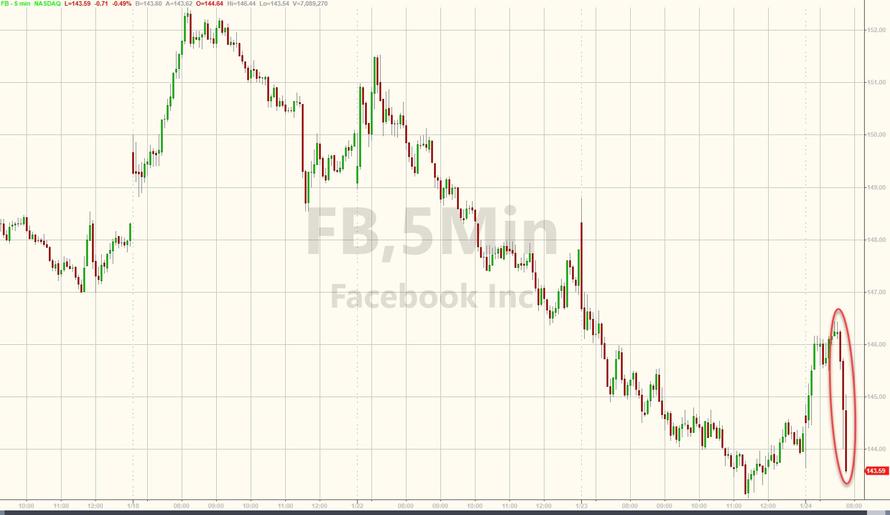
(ZH) Facebook Slides After Report Claims 50% Of Its Users Are Fake

Facebook Slides After Report Claims 50% Of Its Users Are Fake
As bad as things have been for Facebook since the Cambridge Analytica scandal broke one year ago, one team of researchers think the reality of the company's circumstances is even more dire than investors realize.
In a report published Thursday by PlainSite, an independent research shop, analysts calculated that Facebook CEO Mark Zuckerberg has been regularly lying to investors and the public about the company's user metrics, and that the company could be overestimating the number of users by as much as 50%.
The team detailed their findings in a 70-page report published on their website.
Facebook has been lying to the public about the scale of its problem with fake accounts, which likely exceed 50% of its network. Its official metrics—many of which it has stopped reporting quarterly—are self-contradictory and even farcical. The company has lost control of its own product.
Ultimately, this is just the latest sign that Facebook - formerly one of the world's most successful companies - is doomed to go the way of CompuServe and AOL.
FB shares are sliding as the report makes the rounds.
Read the full report below:

>>>FB - INVESTIGATION: OVER 50% OF FACEBOOK ACCOUNTS FAKE

https://www.plainsite.org/realitycheck/facebook.html
Executive Summary
On paper, Facebook, Inc. (NASDAQ: FB) is one of the most successful companies in history. With a market capitalization that peaked at over $600 billion, Facebook has been the envy of blue chip executives, entrepreneurs, and venture capitalists since it exploded onto the global stage. Facebook claims to have over 2 billion Monthly Active Users (MAUs), to a large extent determines which media outlets live and die, connects friends and family members across continents, and is nearly its own sovereign nation.
What seems too good to be true often is. The zeitgeist has changed markedly since 2007, when the company was the obsession of virtually every Silicon Valley investor, having built its Platform to make the world "more open and connected." Yet as bad as things have been of late for Facebook, with endless privacy breaches and Russian interference in the 2016 presidential election hanging over Menlo Park like a spectre, we believe that the situation is far worse than investors realize. Facebook has been lying to the public about the scale of its problem with fake accounts, which likely exceed 50% of its network. Its official metrics—many of which it has stopped reporting quarterly—are self-contradictory and even farcical. The company has lost control of its own product.
Fake accounts affect Facebook at its core in numerous ways:
  • Its customers purchase advertising on Facebook based on the fact that it can supposedly target advertisements at more than 2 billion real human beings. To the extent that users aren’t real, companies are throwing their money down the drain.
  • Fake accounts click on advertising at random, or "like" pages, to throw off anti-fraud algorithms. Fake accounts look real if they do not follow a clear pattern. This kind of activity defrauds advertisers, but rewards Facebook with revenue.
  • Fake accounts often defraud other users on Facebook, through scams, fake news, extortion, and other forms of deception. Often, they can involve governments.
Preaching that programmers should "move fast and break things," CEO Mark Zuckerberg has clarified over time that growth at any cost is his only priority. But documents recently revealed show that since 2012, management has worried about where it can find more warm bodies to sign on. Fake accounts have been keeping the company that Columbia professor Tim Wu has called an "attention merchant" afloat. The cost of Zuckerberg’s dissembling, dating all the way back to 2004, has accrued, and is finally coming due. Accordingly, it is increasingly likely that Facebook will go the way of AOL, CompuServe, and Prodigy—if legal liability doesn’t bankrupt it first.

>>> Elliott expresses doubts over Thyssenkrupp split - source - Reuters News

Elliott expresses doubts over Thyssenkrupp split - source - Reuters News

24-Jan-2019 14:23:48

FRANKFURT, Jan 24 (Reuters) - Activist fund Elliott has expressed doubts over Thyssenkrupp's TKAG.DE plans to split in two in a letter sent to the conglomerate's chief executive last month, a person familiar with the matter told Reuters.

"We have our doubts whether the proposal has the desired positive effects," Elliott said in the letter, the person said.

Elliott was not immediately available for comment. A spokesman for Thyssenkrupp declined to comment.

Manager Magazin first reported about the letter's existence.

>>> US Gapping down

Gapping down
In reaction to disappointing earnings/guidance
:

  • BGG -11.4%, MKC -10.8%, UMPQ -6.5%, PTC -5.5% (also announces retirement of CFO Andrew Miller in Fiscal 2019), CTXS -5.5%, LVS -3.3%, BMY -1.7%, FFIV -1.2%

Other news:

  • URGN -8.6% (prices offering of 3,658,537 ordinary shares at at $41.00 per share)
  • WVE -7.9% (announces proposed public offering of ordinary shares; size not disclosed)
  • NCNA -4.8% (to sell $75 mln of American Depositary Shares in underwritten U.S. public offering)
  • EHTH -2.9% (prices offering of 2.4 mln shares of its common stock at $48.50 per share)
  • HSIC -1.2% (Henry Schein discloses that Mars plans to consolidate veterinary distribution purchases with one of Henry Schein's U.S. based distribution competitors)
  • VRTX -1.1% (announces that Ian Smith has been terminated as COO and Interim CFO, effective immediately)
  • WYNN -0.9% (following LVS earnings)

Analyst comments:

  • GOOS -3.3% (downgraded to Market Perform from Outperform at Wells Fargo)
  • CTL -3% (downgraded to Sell from Neutral at Guggenheim)
  • PETX -2.8% (downgraded to Mkt Perform from Outperform at William Blair)
  • MDLZ -1.6% (downgraded to Hold from Buy at Berenberg)
  • CACC -1.3% (initiated with Sell at BTIG)

>>> US Gapping up

Gapping up
In reaction to strong earnings/guidance
:

  • XLNX +10.5%, SLM +9.2%, STM +8.9%, TXT +8.8%, AZPN +7.1%, LRCX +6.4%, AAL +5.8%, TAL +5.7%, JBLU +4.9%, URI +4.3%, TER +4%, ADTN +3.5%, LUV +3.4%, CCI +2.3%, VAR +2.2%, RCI +2.2%, CMRE +2.1%, TXN +1.7%, CP +1.3%, AEP +0.6%, F +0.4%

Select semiconductor related names showing strength:

  • AMAT +4%, MU +3.6%, ICHR +3%, NVDA +2.8%, WDC +2.5%, SMH +2.5%, KLAC +2.4%, SOXX +2.3%, AMD +2.3%, CY +2%, MXIM +1.9%, AVGO +1.8%

Other news:

  • NLSN +1.2% (jumps on NY Post report the company is restarting an auction to sell itself)

Analyst comments:

  • DLTH +3.2% (upgraded to Buy from Neutral at DA Davidson)
  • LPSN +2.9% (upgraded to Outperform from Perform at Oppenheimer)
  • KMB +0.5% (upgraded to Equal-Weight from Underweight at Morgan Stanley)

>>> US Early premarket gappers

Early premarket gappers

Gapping up:

  • XLNX +10.5%, STM +9.4%, AZPN +8.8%, SLM +8.5%, LRCX +7.2%, TAL +5.7%, LUV +5.2%, AMAT +4.5%, URI +4.3%, TER +4%, MU +3.2%, KLAC +3.1%, TXT +3%, ICHR +3%, TXT +3%, SMH +2.7%, WDC +2.3%, CCI +2.3%, VAR +2.2%, CMRE +2.1%, AMD +2%, MXIM +1.9%, SOXX +1.5%, TXN +1.4%, CP +1.3%, NLSN +1.2%, AVGO +1.2%, CY +0.8%

Gapping down:

  • BGG -11.4%, URGN -9.4%, WVE -8.5%, UMPQ -6.5%, PTC -5.8%, CTXS -5.4%, NCNA -4.8%, MKC -3%, LVS -2.3%, CACC -1.3%, HSIC -1.2%, FFIV -1.2%, VRTX -1.1%, WYNN -0.9%, F -0.8%