Hess beats by $0.07, beats on revs (51.87)
- Reports Q4 (Dec) loss of $0.31 per share, excluding non-recurring items, $0.07 better than the S&P Capital IQ Consensus of ($0.38); revenues rose 30.3% year/year to $1.68 bln vs the $1.49 bln S&P Capital IQ Consensus
- Oil and gas production averaged 267,000 barrels of oil equivalent per day (boepd), excluding Libya; Bakken net production was 126,000 boepd, up 15 percent from 110,000 boepd in the year-ago quarter
- Oil and gas proved reserves at December 31, 2018, which are subject to final review, were 1,192 million boe, compared with 1,154 million boe at December 31, 2017
2019 Guidance:
- E&P capital and exploratory expenditures are expected to be $2.9 billion
- Oil and gas production, excluding Libya is forecast to be in the range of 270,000 to 280,000 boepd, compared to full year 2018 net production, excluding Libya and assets sold, of 248,000 boepd
Gapping down
In reaction to disappointing earnings/guidance:
- JNPR -11.7% (also announces dividend increase and $300 mln accelerated share repurchase program), EGHT -11.2%, TUP -8.2%, ALGN -6.6%, COHR -6.4%, MSTR -6% (also expects to report a material weakness in its internal control over financial reporting in upcoming 10-k), MKSI -6%, MITK -4%, ILMN -3.2%, BSBR -3.2%, HA -3%, MXIM -2.9%, T -2.8%, AMGN -2.4%, IPHI -2.4%, SIMO -2.3%, NVS -2.1%, WNC -1.5%, AX -1.2%, SAN -0.9%
Other news:
- ACIU -44.1% (AC Immune discontinues Phase III CREAD 1 and 2 studies of Crenezumab in Alzheimer's disease)
- TRVN -14.2% (entered into securities purchase agreements with two healthcare-focused institutional investors, pursuant to which Trevena agreed to sell 10 mln common shares at $1.00/share)
- RWT -2.7% (prices 10 mln shares of common stock at $15.60 per share)
- FHB -2.6% (prices secondary offering of approx. 24.9 mln shares of common stock for total gross proceeds of approx. $652.6 mln)
- NIO -1.3% (announces offering of $650 mln in aggregate principal amount of convertible senior notes due 2024; lightly traded)
Analyst comments:
- AKS -1.8% (downgraded to Underperform from Buy at BofA/Merrill)
- AGN -1.6% (downgraded to Equal-Weight from Overweight at Morgan Stanley)
- WHR -1.5% (downgraded to Mkt Perform from Outperform at Raymond James)
- CIEN -1% (downgraded to Neutral from Buy at BofA/Merrill),
Gapping up
In reaction to strong earnings/guidance:
- AMD +10.4%, OSK +8.5%, SYK +7.4%, MRCY +6.7%, ANTM +6.7%, BA +6.7%, AAPL +5.3%, ALLY +5.3%, CHT +4.3%, FCF +3.6% (also increases quarterly dividend to $0.10/share from $0.09/share), ADP +3%, ASX +2.9%, GLOP +2.9%, BABA +2.8%, SIRI +2.8%, TMO +2.5%, GD +2.3%, KLAC +2%, SMG +1.9%, CHKP +1.1%, IR +1%
M&A news:
- MLNX +13.2% (Intel (INTC) said to have recently made a $6 bln cash & stock bid for Mellanox, according to Calcalist)
- P +1% (receives stockholder approval for acquisition by Sirius XM [SIRI])
Other news:
- CONN +10.6% (to join S&P SmallCap 600)
- VALE +7.2% (announces decommissioning of all its upstream tailings dams)
- CZR +2.9% (to join S&P MidCap 400)
- SIRI +2.8% (adds $2 bln to stock repurchase program)
- GBT +2.2% (lightly traded; announces publication of voxelotor data in Blood publication)
- PDS +1.9% (updates 2019 strategic priorities, capital expenditure, and debt repayments),
Analyst comments:
- PLUG +2.9% (upgraded to Neutral from Sell at ROTH Capital)
- ZNGA +2.3% (initiated with a Buy at Goldman)
- TTWO +2% (initiated with a Buy at Goldman)
- LNT +1.1% (upgraded to Outperform from Market Perform at Wells Fargo)
Early premarket gappersGapping up:
- CONN +10.6%, AMD +8.6%, VALE +5.4%, AAPL +5.4%, SYK +4.3%, MRCY +3.7%, FCF +3.6%, CZR +3.5%, ASX +2.9%, ANTM +2.7%, GBT +2.2%, PDS +1.9%, P +1%, EBAY +0.9%, KLAC +0.9%, CHRW +0.5%
Gapping down:
- EGHT -14.6%, JNPR -10.6%, ALGN -6.6%, MSTR -6%, COHR -5.7%, ILMN -4.8%, MKSI -4%, MITK -4%, HA -3.4%, MXIM -2.9%, RWT -2.8%, FHB -2.5%, AMGN -2.5%, IPHI -2.4%, SIMO -2.3%, NVS -2.2%, WNC -1.5%, AX -1.2%, SAN -1.1%
Anthem beats by $0.24, reports revs in-line; guides FY19 EPS above consensus, revs above consensus (272.71)
- Reports Q4 (Dec) earnings of $2.44 per share, excluding non-recurring items, $0.24 better than the S&P Capital IQ Consensus of $2.20; revenues rose 3.8% year/year to $23.3 bln vs the $23.27 bln S&P Capital IQ Consensus.
- The benefit expense ratio was 86.8 percent in the fourth quarter of 2018, a decrease of 180 basis points from 88.6 percent in the prior year quarter
- Co issues upside guidance for FY19, sees EPS of greater than $19.00, excluding non-recurring items, vs. $17.61 S&P Capital IQ Consensus; sees FY19 revs of ~$100 bln vs. $97.64 bln S&P Capital IQ Consensus.
- Benefit expense ratio is expected to be in the range of 86.2% plus or minus 30 basis points.
- On January 29, 2019, the Audit Committee declared a first quarter 2019 dividend to shareholders of $0.80 per share, up from $0.75 per share
Thermo Fisher beats by $0.07, beats on revs (236.90)
- Reports Q4 (Dec) earnings of $3.25 per share, excluding non-recurring items, $0.07 better than the S&P Capital IQ Consensus of $3.18; revenues rose 7.6% year/year to $6.51 bln vs the $6.26 bln S&P Capital IQ Consensus.
- The company will provide 2019 financial guidance on its earnings conference call this morning at 8:30 a.m. Eastern time
This is an interesting move as it greatly increases the reach of Molotov and opens up some new opportunities when it comes to internationalization, content and more.
Molotov is an over-the-top streaming platform in France. You can find all major TV channels, stream live content and watch replays for free. There are optional subscriptions to unlock more features, such as cloud recordings and premium channels.
The service is available on all major platforms — desktop, mobile, tablet, Apple TV, Android TV, Amazon Fire TV, smart TVs from Samsung, LG, Panasonic, etc. It is one of the most popular apps on tvOS and Android TV, always at the top of the stores with Netflix and myCanal.
When I last covered Molotov, the company told me that it has 7 million users in France. Every day, 1.2 million users watch something on Molotov. They stream a total of 1.1 million hours of content. As you can see, those Molotov sessions can be quite long.
Altice currently operates in France under the name SFR, Israel, Portugal, Dominican Republic and the U.S. following the acquisition of Cablevision. Like many telecom companies, Altice and its founder Patrick Drahi also has invested in content and media.
The company owns NextRadioTV (BFM TV, BFM Business, BFM Paris, RMC Story and RMC Découverte). It operates premium sports channels as the company currently has the distribution rights of the Premier League in France. It owns different newspapers and magazines, such as Libération and L’Express.
Interestingly, Altice has also acquired video adtech company Teads. You could already imagine new monetization opportunities for Molotov and Teads.
As Altice has already negotiated distribution rights with every TV network in France for its own set-top boxes, you can imagine a better offering on Molotov in the coming months. For instance, you could imagine being able to subscribe to Canal+ or BeIN Sports from Molotov.
Molotov had raised around $35 million from Idinvest (Benoist Grossmann), Sky, TDF, Cherry Tree Invest and others. While the service will remain available to everyone even if you’re an Orange subscriber for instance, SFR customers will get an extended version of Molotov for free. Altice will keep the name Molotov.
Molotov co-founder and CEO Jean-David Blanc will remain at the head of Molotov. With this open approach, Altice doesn’t just want to integrate the service into its offering. Molotov will remain an independent service and grow independently from Altice’s telecom operations.
Facebook pays teens to install VPN that spies on them
Desperate for data on its competitors, Facebook has been secretly paying people to install a “Facebook Research” VPN that lets the company suck in all of a user’s phone and web activity, similar to Facebook’s Onavo Protect app that Apple banned in June and that was removed in August. Facebook sidesteps the App Store and rewards teenagers and adults to download the Research app and give it root access to network traffic in what may be a violation of Apple policy so the social network can decrypt and analyze their phone activity, a TechCrunch investigation confirms.
Facebook admitted to TechCrunch it was running the Research program to gather data on usage habits, and it has no plans to stop.
Since 2016, Facebook has been paying users ages 13 to 35 up to $20 per month plus referral fees to sell their privacy by installing the iOS or Android “Facebook Research” app. Facebook even asked users to screenshot their Amazon order history page. The program is administered through beta testing services Applause, BetaBound and uTest to cloak Facebook’s involvement, and is referred to in some documentation as “Project Atlas” — a fitting name for Facebook’s effort to map new trends and rivals around the globe.
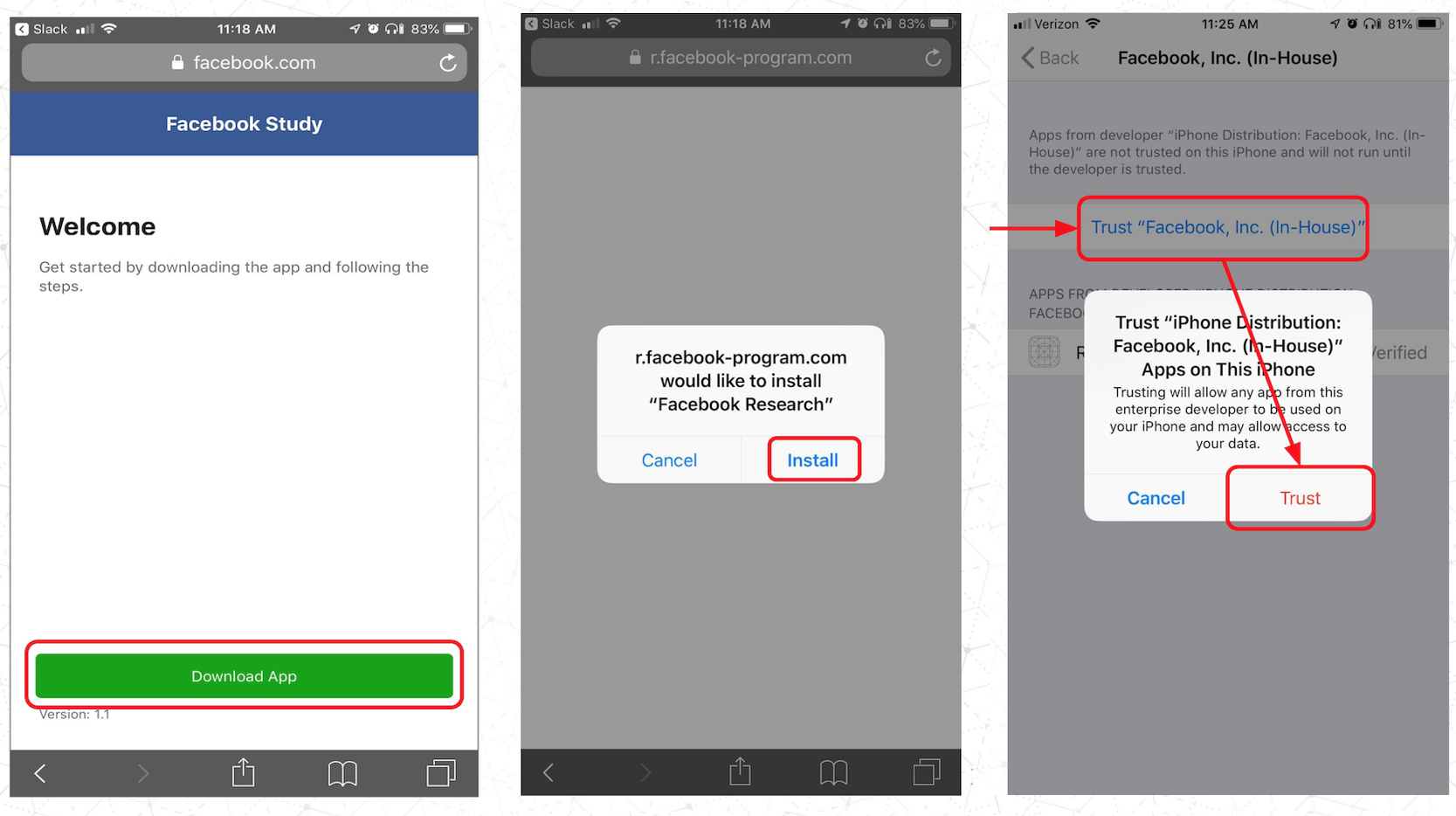
Facebook’s Research app requires users to ‘Trust’ it with extensive access to their data
We asked Guardian Mobile Firewall’s security expert Will Strafach to dig into the Facebook Research app, and he told us that “If Facebook makes full use of the level of access they are given by asking users to install the Certificate, they will have the ability to continuously collect the following types of data: private messages in social media apps, chats from in instant messaging apps – including photos/videos sent to others, emails, web searches, web browsing activity, and even ongoing location information by tapping into the feeds of any location tracking apps you may have installed.” It’s unclear exactly what data Facebook is concerned with, but it gets nearly limitless access to a user’s device once they install the app.
The strategy shows how far Facebook is willing to go and how much it’s willing to pay to protect its dominance — even at the risk of breaking the rules of Apple’s iOS platform on which it depends. Apple could seek to block Facebook from continuing to distribute its Research app, or even revoke it permission to offer employee-only apps, and the situation could further chill relations between the tech giants. Apple’s Tim Cook has repeatedly criticized Facebook’s data collection practices. Facebook disobeying iOS policies to slurp up more information could become a new talking point. TechCrunch has spoken to Apple and it’s aware of the issue, but the company did not provide a statement before press time.
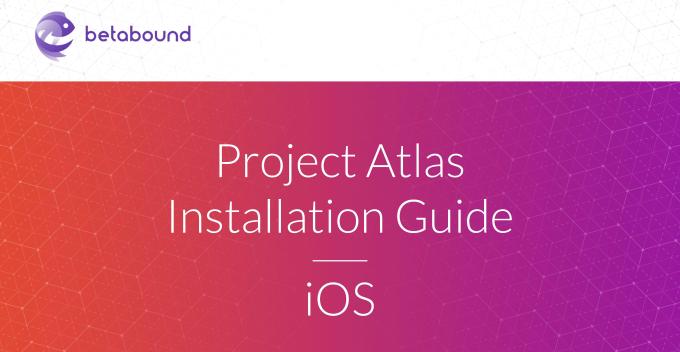
Facebook’s Research program is referred to as Project Atlas on sign-up sites that don’t mention Facebook’s involvement
“The fairly technical sounding ‘install our Root Certificate’ step is appalling,” Strafach tells us. “This hands Facebook continuous access to the most sensitive data about you, and most users are going to be unable to reasonably consent to this regardless of any agreement they sign, because there is no good way to articulate just how much power is handed to Facebook when you do this.”
Facebook’s surveillance app
Facebook first got into the data-sniffing business when it acquired Onavo for around $120 million in 2014. The VPN app helped users track and minimize their mobile data plan usage, but also gave Facebook deep analytics about what other apps they were using. Internal documents acquired by Charlie Warzel and Ryan Mac of BuzzFeed News reveal that Facebook was able to leverage Onavo to learn that WhatsApp was sending more than twice as many messages per day as Facebook Messenger. Onavo allowed Facebook to spot WhatsApp’s meteoric rise and justify paying $19 billion to buy the chat startup in 2014. WhatsApp has since tripled its user base, demonstrating the power of Onavo’s foresight.
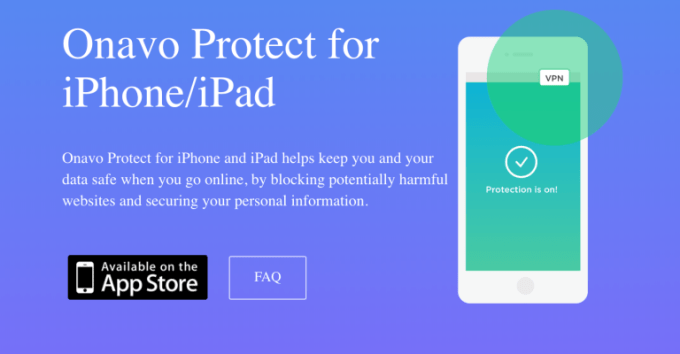
Over the years since, Onavo clued Facebook in to what apps to copy, features to build and flops to avoid. By 2018, Facebook was promoting the Onavo app in a Protect bookmark of the main Facebook app in hopes of scoring more users to snoop on. Facebook also launched the Onavo Bolt app that let you lock apps behind a passcode or fingerprint while it surveils you, but Facebook shut down the app the day it was discovered following privacy criticism. Onavo’s main app remains available on Google Play and has been installed more than 10 million times.
The backlash heated up after security expert Strafach detailed in March how Onavo Protect was reporting to Facebook when a user’s screen was on or off, and its Wi-Fi and cellular data usage in bytes even when the VPN was turned off. In June, Apple updated its developer policies to ban collecting data about usage of other apps or data that’s not necessary for an app to function. Apple proceeded to inform Facebook in August that Onavo Protect violated those data collection policies and that the social network needed to remove it from the App Store, which it did, Deepa Seetharaman of the WSJ reported.
But that didn’t stop Facebook’s data collection.
Project Atlas
TechCrunch recently received a tip that despite Onavo Protect being banished by Apple, Facebook was paying users to sideload a similar VPN app under the Facebook Research moniker from outside of the App Store. We investigated, and learned Facebook was working with three app beta testing services to distribute the Facebook Research app: BetaBound, uTest and Applause. Facebook began distributing the Research VPN app in 2016. It has been referred to as Project Atlas since at least mid-2018, around when backlash to Onavo Protect magnified and Apple instituted its new rules that prohibited Onavo. [Update: Previously, a similar program was called Project Kodiak.] Facebook didn’t want to stop collecting data on people’s phone usage and so the Research program continued, in disregard for Apple banning Onavo Protect.

Facebook’s Research App on iOS
Ads (shown below) for the program run by uTest on Instagram and Snapchat sought teens 13-17 years old for a “paid social media research study.” The sign-up page for the Facebook Research program administered by Applause doesn’t mention Facebook, but seeks users “Age: 13-35 (parental consent required for ages 13-17).” If minors try to sign-up, they’re asked to get their parents’ permission with a form that reveal’s Facebook’s involvement and says “There are no known risks associated with the project, however you acknowledge that the inherent nature of the project involves the tracking of personal information via your child’s use of apps. You will be compensated by Applause for your child’s participation.” For kids short on cash, the payments could coerce them to sell their privacy to Facebook.
The Applause site explains what data could be collected by the Facebook Research app (emphasis mine):
“By installing the software, you’re giving our client permission to collect data from your phone that will help them understand how you browse the internet, and how you use the features in the apps you’ve installed . . . This means you’re letting our client collect information such as which apps are on your phone, how and when you use them, data about your activities and content within those apps, as well as how other people interact with you or your content within those apps. You are also letting our client collect information about your internet browsing activity (including the websites you visit and data that is exchanged between your device and those websites) and your use of other online services. There are some instances when our client will collect this information even where the app uses encryption, or from within secure browser sessions.”
Meanwhile, the BetaBound sign-up page with a URL ending in “Atlas” explains that “For $20 per month (via e-gift cards), you will install an app on your phone and let it run in the background.” It also offers $20 per friend you refer. That site also doesn’t initially mention Facebook, but the instruction manual for installing Facebook Research reveals the company’s involvement.
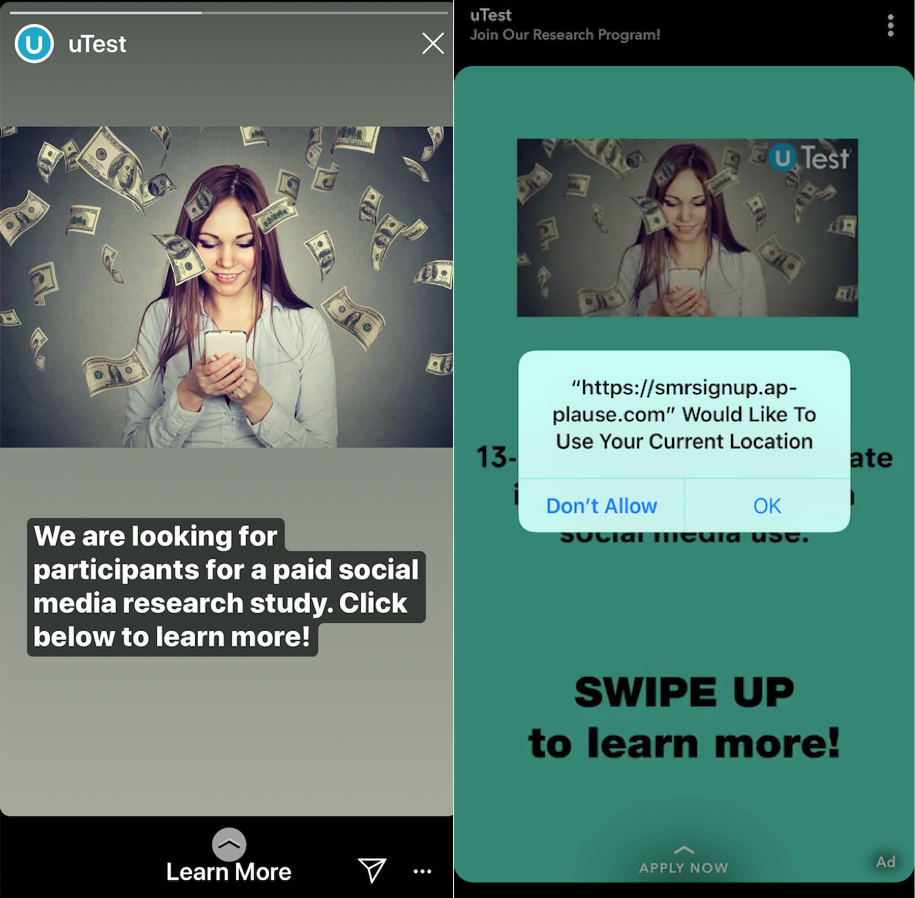
Facebook’s intermediary uTest ran ads on Snapchat and Instagram, luring teens to the Research program with the promise of money
Facebook seems to have purposefully avoided TestFlight, Apple’s official beta testing system, which requires apps to be reviewed by Apple and is limited to 10,000 participants. Instead, the instruction manual reveals that users download the app from r.facebook-program.com and are told to install an Enterprise Developer Certificate and VPN and “Trust” Facebook with root access to the data their phone transmits. Apple requires that developers agree to only use this certificate system for distributing internal corporate apps to their own employees. Randomly recruiting testers and paying them a monthly fee appears to violate the spirit of that rule.
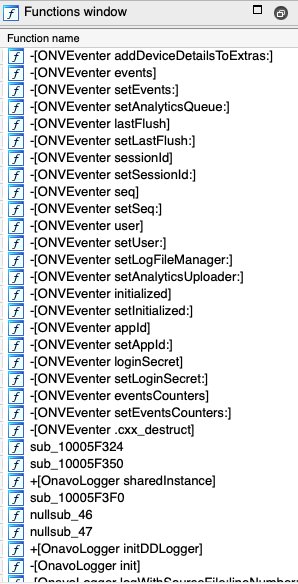
Security expert Will Strafach found Facebook’s Research app contains lots of code from Onavo Protect, the Facebook-owned app Apple banned last year
Once installed, users just had to keep the VPN running and sending data to Facebook to get paid. The Applause-administered program requested that users screenshot their Amazon orders page. This data could potentially help Facebook tie browsing habits and usage of other apps with purchase preferences and behavior. That information could be harnessed to pinpoint ad targeting and understand which types of users buy what.
TechCrunch commissioned Strafach to analyze the Facebook Research app and find out where it was sending data. He confirmed that data is routed to “vpn-sjc1.v.facebook-program.com” that is associated with Onavo’s IP address, and that the facebook-program.com domain is registered to Facebook, according to MarkMonitor. The app can update itself without interacting with the App Store, and is linked to the email address PeopleJourney@fb.com. He also discovered that the Enterprise Certificate indicates Facebook renewed it on June 27th, 2018 — weeks after Apple announced its new rules that prohibited the similar Onavo Protect app.
“It is tricky to know what data Facebook is actually saving (without access to their servers). The only information that is knowable here is what access Facebook is capable of based on the code in the app. And it paints a very worrisome picture,” Strafach explains. “They might respond and claim to only actually retain/save very specific limited data, and that could be true, it really boils down to how much you trust Facebook’s word on it. The most charitable narrative of this situation would be that Facebook did not think too hard about the level of access they were granting to themselves . . . which is a startling level of carelessness in itself if that is the case.”
“Flagrant defiance of Apple’s rules”
In response to TechCrunch’s inquiry, a Facebook spokesperson confirmed it’s running the program to learn how people use their phones and other services. The spokesperson told us “Like many companies, we invite people to participate in research that helps us identify things we can be doing better. Since this research is aimed at helping Facebook understand how people use their mobile devices, we’ve provided extensive information about the type of data we collect and how they can participate. We don’t share this information with others and people can stop participating at any time.”

Facebook’s Research app requires Root Certificate access, which Facebook gather almost any piece of data transmitted by your phone
Facebook’s spokesperson claimed that the Facebook Research app was in line with Apple’s Enterprise Certificate program, but didn’t explain how in the face of evidence to the contrary. They said Facebook first launched its Research app program in 2016. They tried to liken the program to a focus group and said Nielsen and comScore run similar programs, yet neither of those ask people to install a VPN or provide root access to the network. The spokesperson confirmed the Facebook Research program does recruit teens but also other age groups from around the world. They claimed that Onavo and Facebook Research are separate programs, but admitted the same team supports both as an explanation for why their code was so similar.
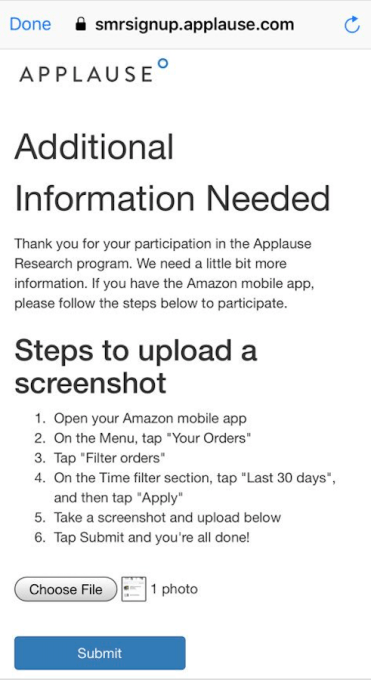
Facebook’s Research program requested users screenshot their Amazon order history to provide it with purchase data
However, Facebook claim that it doesn’t violate Apple’s Enterprise Certificate policy is directly contradicted by the terms of that policy. Those include that developers “Distribute Provisioning Profiles only to Your Employees and only in conjunction with Your Internal Use Applications for the purpose of developing and testing”. The policy also states that “You may not use, distribute or otherwise make Your Internal Use Applications available to Your Customers” unless under direct supervision of employees or on company premises. Given Facebook’s customers are using the Enterprise Certificate-powered app without supervision, it appears Facebook is in violation.
Facebook disobeying Apple so directly could hurt their relationship. “The code in this iOS app strongly indicates that it is simply a poorly re-branded build of the banned Onavo app, now using an Enterprise Certificate owned by Facebook in direct violation of Apple’s rules, allowing Facebook to distribute this app without Apple review to as many users as they want,” Strafach tells us. ONV prefixes and mentions of graph.onavo.com, “onavoApp://” and “onavoProtect://” custom URL schemes litter the app. “This is an egregious violation on many fronts, and I hope that Apple will act expeditiously in revoking the signing certificate to render the app inoperable.”
Facebook is particularly interested in what teens do on their phones as the demographic has increasingly abandoned the social network in favor of Snapchat, YouTube and Facebook’s acquisition Instagram. Insights into how popular with teens is Chinese video music app TikTok and meme sharing led Facebook to launch a clone called Lasso and begin developing a meme-browsing feature called LOL, TechCrunch first reported. But Facebook’s desire for data about teens riles critics at a time when the company has been battered in the press. Analysts on tomorrow’s Facebook earnings call should inquire about what other ways the company has to collect competitive intelligence.

Last year when Tim Cook was asked what he’d do in Mark Zuckerberg’s position in the wake of the Cambridge Analytica scandal, he said “I wouldn’t be in this situation . . . The truth is we could make a ton of money if we monetized our customer, if our customer was our product. We’ve elected not to do that.” Zuckerberg told Ezra Klein that he felt Cook’s comment was “extremely glib.”
Now it’s clear that even after Apple’s warnings and the removal of Onavo Protect, Facebook is still aggressively collecting data on its competitors via Apple’s iOS platform. “I have never seen such open and flagrant defiance of Apple’s rules by an App Store developer,” Strafach concluded. If Apple shuts the Research program down, Facebook will either have to invent new ways to surveil our behavior amidst a climate of privacy scrutiny, or be left in the dark.
Stocks in Asia drifted on Wednesday as the earnings season rolled on and investors awaited the Federal Reserve’s policy meeting. The pound lifted from its lows reached in wake of lawmakers’ vote to renegotiate the Brexit withdrawal agreement with Brussels.
Stocks in Japan slid, while they rose in South Korea and Australia, and fluctuated in narrow ranges elsewhere. U.K. equity futures climbed, while European contracts were little changed. Gains waned in American equity futures, having earlier been buoyed by Apple Inc.’s forecast that showed stability after a tough end to last year. The yuan climbed to the highest since July as U.S.-China trade talks get underway in Washington. Treasury yields were steady.
USAfter Hours AMD +9%, AAPL +6% rise while EGHT -8%, ALGN -7% move lower after earnings
Nikkei -0.52% Hang Seng +0.07% CSI -0.73% Shanghai -0.67%Shewnzen -1.26%
Eur$ 1.1430 CNH 6.7339 CNY 6.7146 JPY 109.29 GBP 1.3086 CHF 0.9956 RUB 66.1038 TRY 5.3203 WTI$ 53.27 -0.06%
S&P -0.10% EuroStoxx -0.10% FTSE +0.37% Dax -0.17% SMI -0.45%
Macro :
- U.K. Parliament Rips Up Brexit Deal and Sends May Back to Talks
Keep an eye on :
- ADEN SW : Robert Half Fourth Quarter EPS Beats Highest Estimate RHI +3%
- AENA SM : Aena Wants to Operate Six More Colombian Airports: Expansion
- ATE FP : Alten FY Rev. Beats Est.; Sees Satisfactory Growth in 2019
- ASY FP : Assystem Signs Contract With Rosatom for Akkuyu Nuclear Plant
- ATO FP : Atos to Distribute Worldline Shrs to Hldrs; FY Op. Margin 10.3%
- BAMNB NA : Amsterdam Airport, Dutch Builders Sign Long-Term Contracts
- SAN SM : Banco Santander Fourth Quarter Net Income Beats Highest Estimate
- BPOST BB : Belgian Government Examining Bpost Distribution Contract: L’Echo
- COM GY : comdirect Full Year Pretax Profit Misses Estimates
- DANSKE DC : BlackRock Has Cut Its Holding in Danske Bank to Less Than 5%
- EDF FP : France’s CRE Proposes 5.9% Hike in Regulated Electricity Tariff
- EDF FP : French Electricity Consumption Stable in 2018: RTE’s Brottes
- EDF FP : EDF Valuation High, Even With Carbon Transformation: Berenberg
- RLD SW : Edmond de Rothschild Suisse Cuts About 20 Jobs in Geneva: TdG
- EDP PL : EDP Renovaveis Says Electricity Production Rose 3% in 2018
- EMGS NO : EMGS Fourth Quarter Ebitda $0.6 Mln
- EMMN SW : Emmi Full Year Sales Meet Estimates
- FCA IM : Fiat Chrysler Says New Pickups Receive Emissions Certification
- HBW FP : Hubwoo Names Timothy Sykes New Chairman of Board & CEO
- IDEX NO : IDEX Offering Prices 53.4m Shares at NOK4/Share
- ISP IM : Intrum’s Intesa Sanpaolo Transaction Was Completed Early Dec.
- INTRUM SS : Intrum Fourth Quarter Adjusted Ebit Beats Highest Estimate
- KPN NA : KPN 4Q Adjusted Ebitda From Continuing Ops Meets Est.
- LDO IM : Italy May Be Mulling Leonardo, Fincantieri Merger: Messaggero
- MC FP : U.S. Luxury Stocks Rise After LVMH Organic Sales Top Estimates
- MC FP : Arnault Says Main Concern Is Strength of Economy in Medium-Term,
- LUPE SS : Lundin Petroleum Proposes Raised Dividend, New Payout Policy
- LONN SW : Lonza Names Funk CEO, Sees Year of ‘Significant’ Investment
- LSE LN : LSE Buys 4.92% Stake in Euroclear for EUR278.5M
- MC FP : LVMH 4Q Fashion & Leather Beats Est.; To Increase Div. By 20%
- MC FP : *LVMH SAYS SEPHORA GAINING MARKET SHARE IN U.S.
- NOVN SW : Novartis 4Q Core EPS, Core Net Income Miss Estimates
- NNIT DC : NNIT Full Year Net Income Meets Estimates
- RATOB SS : Ratos Sets New Organizational Structure Focused on Sectors: DI
- RNO FP : Nissan, Renault Are Said to Hire Auditor to Run Alliance Probe
- RIEN SW : Rieter Full Year Sales Beat Highest Estimate
- ROG SW : Genentech’s Crenezumab Unlikely to Meet Primary Endpoint
- SFER IM : Salvatore Ferragamo 4Q Revenue Misses Estimates; China Retail Up
- SFER IM : Ferragamo 4Q Sales Weak, China Performance Positive: Analysts
- SEBA SS : SEB Says It Can’t Rule Out Risk Cum-Cum Trades May Cause Losses
- SIE GY : Siemens 1Q Profit Misses Estimates on Power and Gas Slump
- GLE FP : SocGen Said to Plan Investment Bank Job Cuts After Trading Slump
- STAN LN : StanChart Says Still In ‘Constructive’ Talks on Sanctions Probe
- SEV FP : Suez Valuation Premium ‘Overdone,’ Rating Cut: Morgan Stanley
- TAP LN : Taptica, RhythmOne in Advanced Talks on Potential Merger: Sky
- TEL NO : Telenor 4Q Ebitda Misses Lowest Estimate, Proposes Share Buyback
- UTDI GY : United Internet Founder Pleads for 5G Cooperation: Handelsblatt
- VOLVB SS : Volvo Raises Dividend to SEK5, Proposes Extra SEK5 Dividend (1)
- VOW3 GY : VW’s Traton Truck Unit Said to Head for IPO as Early as April
- WRT1V FH : Wartsila Fourth Quarter Ebit Misses Estimates
- WDI GY : Wirecard Fourth Quarter Ebitda Meets Estimates
- WLN FP : Worldline: Worldline Board of Directors unanimously welcomes planned change in ownership structure 30Jan.2019, Worldline Full Year Revenue 1.2% Above Estimates