Smith & Nephew in talks to buy NuVasive for over $3bn
FTSE 100 medical devices maker considers acquisition of spinal surgery specialist
Arash Massoudi in London and Eric Platt in New York
Smith & Nephew has held talks to buy NuVasive, a maker of medical instruments used in spinal surgery, in a deal that would be worth more than $3bn and mark the largest acquisition by the British medical devices group, people with direct knowledge of the talks said.
The exact terms of any discussions could not be learned and talks between the two sides may fall apart, these people said. It is possible that the revelation of the talks may lead the discussions to end.
If a deal is reached, the acquisition would signify the first major move by S&N’s chief executive Namal Nawana since he took up the post less than a year ago.
In short order, Mr Nawana has overhauled much of the FTSE 100 company’s executive leadership and begun to discuss using dealmaking as a way to grow in businesses adjacent to its existing product lines in orthopaedic reconstruction, sports medicine and wound care.
California-based NuVasive has a market value of roughly $2.5bn, excluding debt of about $500m. The company’s share price has declined 32 per cent from an October high, when it named a new chief executive. NuVasive shares climbed 24 per cent in after-hours trading on Friday after the Financial Times reported the talks.
Meanwhile, S&N shares have risen 23 per cent over the past year, giving the company a market value of £13.3bn. The deal would marry S&N, known for making hip and knee replacements, with a faster growing business.
S&N declined to comment. NuVasive said the company “does not comment on market speculation or rumours”.
NuVasive reported a 5 per cent rise in sales to $1.1bn in 2018, before acquisitions and shifts in currencies, eclipsing the 2 per cent underlying revenue increase recorded last year by 163-year-old S&N. The results from NuVasive nonetheless fell short of Wall Street expectations, which weighed on its shares. Analysts with UBS warned in January that the spinal surgery market was at risk of slowing.
On a call with analysts this week, Mr Nawana said that S&N was looking at deals “to get access to adjacent markets, and where there’s a good strategic fit”. He said that the company’s low level of gearing and strong cash conversion gave it the capacity to proceed with dealmaking.
The company’s chief financial officer added that investors should expect the group to maintain its investment grade credit rating but that its ratio of net debt to earnings before interest tax depreciation and amortisation may rise to between 2 and 2.5 times, up from its current level of about 0.8 at the end of 2018.
The UK group has faced pressure from activists including Paul Singer’s Elliott Management to shed underperforming businesses, and has itself often been touted as a possible takeover target by larger US rivals. S&N’s board is led by chairman Roberto Quarta, the private equity executive, who also heads the board of advertising and marketing group WPP.
Mr Nawana has a history as a dealmaker. He led the turnround of medical diagnostics maker Alere before overseeing its sale to Abbott in 2017 for $7.8bn including debt. The sale of the business initially ran into trouble however, with Abbott ultimately agreeing to buy the company at a lower price after Alere received a grand jury subpoena from the US Department of Justice over its sales practices and delayed filing an annual report with securities regulators.
Before Alere, Mr Nawana spent more than 15 years at Johnson & Johnson, including time as president of its DePuy Synthes spine business.
New Photos Show Russia's First Hypersonic Space Drone

Sputnik has obtained new images of a secret prototype of Russia's reusable single-engine hypersonic spacecraft.
Russian firm International Scientific Optical Network (ISON) has been tasked with designing and manufacturing the space drone for Roscosmos State Corporation for Space Activities, also known as Roscosmos, is a state corporation responsible for the space flight and cosmonautics program for the Russian Federation. The space drone is expected to complete test flights in 2023. Russia has been extremely vocal about their hypersonic missiles and fifth-generation jet fighters. However, this is the first time we are learning about this hypersonic space drone.

The drone will use old Russian-made parts, including a variant of the 14D30 rocket booster found in the upper stage of a Briz-M space launch vehicle as its primary means of thrust, Yuri Bakhvalov, ISON's director, told RIA Novosti.
Based on the dimensions of the Briz-M, the spacecraft is smaller than the US Air Force's Boeing X-37 and the US Defense Advanced Research Projects Agency's XS-1 reusable spacecraft.
The infographic explains how a heavily modified Myasishchev M-55 research plane (NATO reporting name: Mystic-B) will carry the drone to an altitude between 80,000 and 100,000 feet, then will be air-launched and travel at Mach 7, or roughly 5,370 mph - more than 4.4 times as fast as the Lockheed Martin F-35 Lightning II stealth fighter, to low Earth orbit.
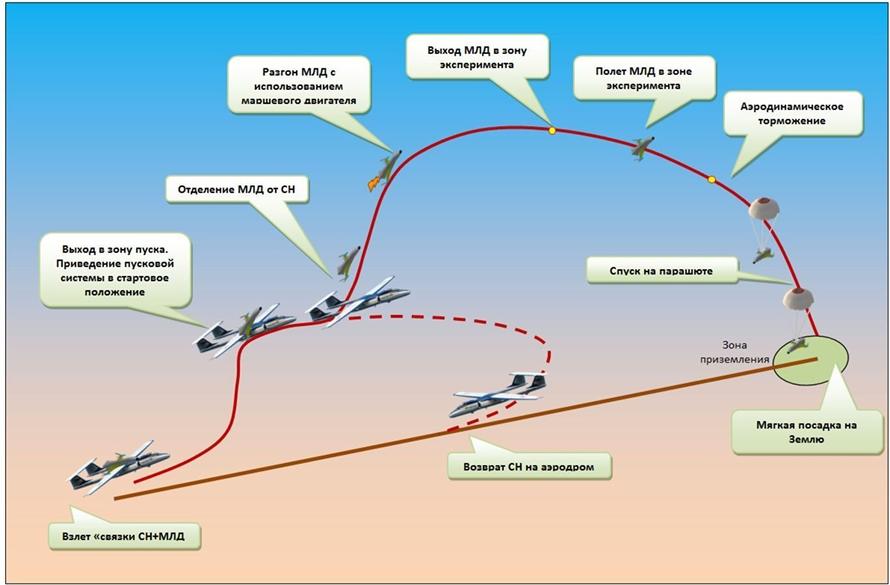
The concept art shows a rocket-like cylinder fuselage with a delta wing configuration. Both wings are outfitted with vertical stabilizers pointing up from the edge of each wingtip. The spacecraft has a launch-life of about 50 times, according to RIA Novosti, but there is no internal payload bay for releasing weapons into orbit.
Once the mission is completed, the spacecraft will return to Earth by deploying a series of parachutes.
Russia's RIA Novosti news agency reports:
“At the development stage, the project received 25 million rubles (£293,470) of investment from the Project Technika Corporation, as well as 30 million (£352,165) from the Skolkovo Foundation as a grant.”
And to think one (defective) F35 costs US taxpayers $85 million.
According to Bakhvalov, there will be five tests of the spacecraft in 2023.
Additional information pertaining to the hypersonic space drone is scant. However, after comparing the artist's conception of the space drone to the US Air Force and DARPA's latest creations, it seems that Cold War 2.0 is more than underway, and this time the most advanced weapons are being designed for a conflict in the heavens.
Biggest risk to quant funds is loss of confidence, says QMA chief
Computer-driven investment strategies lost 5.6 per cent in 2018
Computer-driven funds must stick with their strategies after a tough year in 2018, said Andrew Dyson, chief executive of QMA.
Mr Dyson, who leads the quant unit of PGIM, Prudential Financial’s funds arm, said underlying market conditions were no great threat to quantitative investment strategies.
“The much bigger risk is that we lose confidence and row back,” he told the Financial Times. “That’s the biggest psychological risk.”
Quant funds as a whole lost 5.6 per cent last year, according to data from HFR. They were stung particularly in February, October and December — months marked by heavy declines in stock markets and also at times by unusual parallel losses in bonds.
Several of QMA’s funds posted double-digit losses, including its International Equity, Mid-Cap Value and Small-Cap Value funds. Its US Core Equity strategy underperformed its benchmark by more than 2 percentage points, after four years of outperformance.
Nevertheless, QMA announced in November that it had bought Wadhwani Asset Management — a computer-driven hedge fund named after founder Sushil Wadhwani, a former banker and Bank of England policymaker. That deal completed in January and Mr Dyson said integration was going well.
QMA is not looking for more purchases, Mr Dyson said, with “no sprees, no hunts” for new targets. However, it is not changing its typical investment style despite violent shake-ups in core markets and periods where traditional relationships between assets have stumbled, upending widely used hedging strategies.
“Last year was difficult for value strategies,” Mr Dyson said. “It was very unusual because diversification did not harm but it did not help.
“The art is to stick to it. If you did, you are already benefiting this year.” QMA’s worst-performing funds in 2018 started the new year much brighter.
“I absolutely do not see” that underlying market conditions have changed in a way that makes quant strategies unworkable, he said, arguing that wobbles were inevitable now that central banks’ market stimulus is being withdrawn. “You stick to your guns,” he said. “If you start chasing the game, then you have lost.”
Gilead seen expanding through smaller deals – bankers
- Buys to offset possible Hep-C declines
- Vertex plausible large cap target
Gilead Sciences (NASDAQ:GILD), which became a leader in hepatitis C treatment through its acquisition of Pharmasset in 2012, will likely expand its drug portfolio with smaller acquisitions rather than large, transformative deals, two industry bankers said.
The Foster City, California-based company, which sells two major hepatitis C drugs, Sovaldi and Harvoni, appears to be on the acquisition trail to bolster its portfolio.
CEO John Martin said on its 30 April earnings call that “it would be a good time to consider a wide range of things” to expand through deals. “We are open to suggestions,” he said.
Citibank analysts, in a note, said “there is no question that Gilead will likely undertake M&A to further acquire future growth.”
One industry banker, who has worked on several deals involving Gilead, said he expects Gilead to pursue smaller deals because “you don’t need a big deal to get value.” He called the company “very disciplined” in extracting suitable purchase prices at a time when biotech assets can be “very overvalued”.
In 2011, Gilead acquired Pharmasset for USD 10.3bn in its largest deal to date, which formed the basis of its highly successful hepatitis C franchise, which includes Sovaldi and its successor drug Harvoni. It purchased Triangle Pharmaceuticals in 2003 for USD 464m, boosting its franchise for HIV and hepatitis B drugs.
Gilead generated 1Q revenue of USD 7.6bn, up 52% from 1Q14, largely on the success of Harvoni, a Hep-C treatment that was approved in October 2014 and rocketed up to post USD 3bn in sales in the first quarter.
Gilead reported cash and cash equivalents of USD 14.5bn at quarter end, up from USD 11.7bn a year ago.
A second industry banker said Gilead has various options for its ballooning cash pile including expanding dividends or share buybacks. In February, the company authorized a USD 15bn share buyback program, adding to a previous USD 5bn buyback, of which USD 3bn was unused.
But the second banker said Gilead will “most likely” lean towards acquisitions, including in liver treatments and viral diseases like hepatitis B, which is still poorly treated.
Both bankers agreed that it is plausible that Vertex Pharmaceuticals (NASDAQ:VRTX), which has a market value of USD 30.5bn, could be on Gilead’s radar screen. Vertex is a major player in the treatments for cystic fibrosis.
But both said smaller deals are more likely. Gilead has made several such deals recently, including buying EpiTherapeutics, a cancer drug developer, for USD 65m, announced 6 May.
One Gilead investor said he thinks Gilead needs to make acquisitions because its hepatitis C franchise “is probably going to peak this year and they will have to fill in the gap.” The company is facing growing hepatitis C competition from Abbvie (NYSE:ABBV) and an expected challenge from Merck (NYSE:MRK).
The investor said he would “rather see them doing a number of smaller deals rather than a big one” because larger mergers are a major distraction for management in terms of integrating staff and combining resources.
Citibank analysts said plausible Gilead acquisition candidates could include Intercept (NASDAQ:ICPT), which has long been rumored to be on Gilead’s radar screen because both companies are developing treatments for NASH, or nonalcoholic steatohepatitis, which can lead to liver failure. The company has a market value of USD 6.3bn, well within Gilead’s purchasing power.
But Gilead has already bolstered its NASH program with the January purchase of Phenex Pharmaceutical’s NASH assets in a deal worth up to USD 470m.
Other possible Gilead acquisition candidates cited by Citibank analysts include Clovis Oncology (NASDAQ:CLVS), Medivation(NASDAQ:MDVN) and Tesaro (NASDAQ:TSRO), all of which specialize in oncology drug development.
A spokesperson for Gilead declined to comment.
The Foster City, California-based company, which sells two major hepatitis C drugs, Sovaldi and Harvoni, appears to be on the acquisition trail to bolster its portfolio.
CEO John Martin said on its 30 April earnings call that “it would be a good time to consider a wide range of things” to expand through deals. “We are open to suggestions,” he said.
Citibank analysts, in a note, said “there is no question that Gilead will likely undertake M&A to further acquire future growth.”
One industry banker, who has worked on several deals involving Gilead, said he expects Gilead to pursue smaller deals because “you don’t need a big deal to get value.” He called the company “very disciplined” in extracting suitable purchase prices at a time when biotech assets can be “very overvalued”.
In 2011, Gilead acquired Pharmasset for USD 10.3bn in its largest deal to date, which formed the basis of its highly successful hepatitis C franchise, which includes Sovaldi and its successor drug Harvoni. It purchased Triangle Pharmaceuticals in 2003 for USD 464m, boosting its franchise for HIV and hepatitis B drugs.
Gilead generated 1Q revenue of USD 7.6bn, up 52% from 1Q14, largely on the success of Harvoni, a Hep-C treatment that was approved in October 2014 and rocketed up to post USD 3bn in sales in the first quarter.
Gilead reported cash and cash equivalents of USD 14.5bn at quarter end, up from USD 11.7bn a year ago.
A second industry banker said Gilead has various options for its ballooning cash pile including expanding dividends or share buybacks. In February, the company authorized a USD 15bn share buyback program, adding to a previous USD 5bn buyback, of which USD 3bn was unused.
But the second banker said Gilead will “most likely” lean towards acquisitions, including in liver treatments and viral diseases like hepatitis B, which is still poorly treated.
Both bankers agreed that it is plausible that Vertex Pharmaceuticals (NASDAQ:VRTX), which has a market value of USD 30.5bn, could be on Gilead’s radar screen. Vertex is a major player in the treatments for cystic fibrosis.
But both said smaller deals are more likely. Gilead has made several such deals recently, including buying EpiTherapeutics, a cancer drug developer, for USD 65m, announced 6 May.
One Gilead investor said he thinks Gilead needs to make acquisitions because its hepatitis C franchise “is probably going to peak this year and they will have to fill in the gap.” The company is facing growing hepatitis C competition from Abbvie (NYSE:ABBV) and an expected challenge from Merck (NYSE:MRK).
The investor said he would “rather see them doing a number of smaller deals rather than a big one” because larger mergers are a major distraction for management in terms of integrating staff and combining resources.
Citibank analysts said plausible Gilead acquisition candidates could include Intercept (NASDAQ:ICPT), which has long been rumored to be on Gilead’s radar screen because both companies are developing treatments for NASH, or nonalcoholic steatohepatitis, which can lead to liver failure. The company has a market value of USD 6.3bn, well within Gilead’s purchasing power.
But Gilead has already bolstered its NASH program with the January purchase of Phenex Pharmaceutical’s NASH assets in a deal worth up to USD 470m.
Other possible Gilead acquisition candidates cited by Citibank analysts include Clovis Oncology (NASDAQ:CLVS), Medivation(NASDAQ:MDVN) and Tesaro (NASDAQ:TSRO), all of which specialize in oncology drug development.
A spokesperson for Gilead declined to comment.
Clovis Oncology to seek diagnostic partner, CEO says
Clovis Oncology (NASDAQ: CLVS), a Boulder, Colorado-based biotechnology company, plans seek a diagnostic partner for its recently acquired drug candidate Lucitanib later this year, according to Patrick Mahaffy, CEO.
Part of the drug development strategy initiated by Clovis involves identifying and selecting a specific subset of patients most likely to benefit from a certain therapy, said Mahaffy, following an investor presentation earlier this year. The partner develops a companion diagnostic test in tandem with the early clinical work (Phase I or Phase II trial) that Clovis conducts to advance the drug candidate, such as Lucitanib. The companion diagnostic test is then validated in later, pivotal studies to demonstrate its ability to identify the subset of patients.
Mahaffy said Clovis typically enters into an agreement in which the partner will have rights to market the companion diagnostic test once the drug is approved. The partner may also receive royalties based on sales of the drug, added the CEO. Clovis, however, does not assign any marketing rights for the drug to the diagnostic partner.
Clovis, with a market cap of USD 3bn, has already entered diagnostic partnerships with Qiagen and Foundation Medicine. In the Qiagen partnership, Clovis is developing CO-1686, an oral epidermal growth factor receptor (EGFR), covalent inhibitor now in Phase I/II development. CO-1686 is designed to treat non-small cell lung cancer (NSCLC) patients with initial activating EGFR mutations, as well as the T790M dominant-resistance mutation.
With its three drug candidates – CO-1686, rucaparib and Lucitanib – Clovis is developing cancer treatments it asserts will deliver the right therapy to the right patient at the right time.
Rucarparib is in Phase II and Phase III studies as a treatment of platinum sensitive, relapsed ovarian cancer. Foundation Medicine is developing the companion diagnostic for rucaparib, an oral, small molecule poly (ADP-ribose) polymerase (PARP) inhibitor.
Clovis acquired Lucitanib last November through its USD 200m purchase of EOS SpA (Ethical Oncology Science), a privately held Italian biopharmaceutical company. Clovis paid USD 190m in stock and USD 10m in cash to acquire EOS. With Lucitanib, Clovis is advancing a Phase II trial designed to treat breast and lung cancer. The drug is an oral tyrosine kinase inhibitor that targets fibroblast growth factor receptors (FGFR)1-2, vascular endothelial growth factor receptors (VEGFR)1-3, and platelet-derived growth factor (PDGF) receptors alpha and beta.
Clovis said at the time of the EOS acquisition that Lucitanib is unique in its pattern of clinical inhibition of both FGFR and VEGFR tyrosine kinases, enabling the company to identify unique subsets of cancer patients who can benefit from the drug.
Clovis owns rights to Lucitanib in the US and Japan, while Servier retains the rights to the drug in Europe through an earlier partnership with EOS. Clovis owns worldwide rights to CO-1686 and rucaparib.
One of the first cancer drugs introduced to the market with a companion diagnostic was Pfizer’s Xalkori (crizotinib), which received approval to treat a subset of NSCLC patients in 2011. Worldwide sales of the drug nearly doubled to USD 89m in 2013, an increase from the USD 45m recorded by Xalkori in 2012.
An Italian Tire Maker With a High-Performance Stock
Pirelli could provide investors with a smooth ride higher.
The stock (ticker: PIRC.Italy) looks set to rise in the next 12 months, propelled by rising earnings as the company shifts to higher margin products and benefits from the increased demand for performance tires. In addition to a roughly 20% gain, a rising dividend should add 4.5% next year for a total return of about 25%.
“Pirelli is in the right spot in terms of where consumers are going,” says Brian Beitner, managing partner at Chautauqua Capital Management, which owns the stock. “Where the market is going is toward the need for high-performance tires, and Pirelli is much more of a pure play than other companies.”
That shift away from standard tires is the key to Pirelli’s strategy and stock price. “We have positioned ourselves in the high-value market,” said Marco Tronchetti Provera, Pirelli’s executive vice chairman and CEO, in a recent conference call. “This segment has a very healthy growth, in the past but also in the future.”
More important, there’s more growth and margin in high-value tires than standard tires.
“We expect Pirelli to deliver 18% earnings growth this year,” states a recent report from UBS. It notes “strong earnings growth momentum” and some added “upside” if its interest costs fall. Pirelli’s profits could be far higher as the company refinances its debt load.
UBS has a 12-month price target of seven euros ($7.98) on the stock, around 20% above its recent price of €5.82. A recent report from JPMorgan Cazenove has a more modest target of €6.60. UBS sees the dividend rising from 3.8% this year to 4.5% and 5.2% in 2020 and 2021, respectively.
The stock trades at a slight premium to its competitors, but the difference doesn’t reflect Pirelli’s far greater potential for gains. Pirelli trades at a forward price/earnings ratio of 9.8, versus 8.3 for Michelin (ML.France), and 6.5 for Goodyear Tire & Rubber (GT), according to data from Morningstar.
However, gross margins at Pirelli have stayed consistently above 60% since 2012, while those for Michelin and Goodyear are closer to 30% and 20%, respectively. A major reason for those fatter margins is the product mix. Pirelli’s revenue for high-value products hit 64.5% of the total in the first three quarters of 2018 versus 58.1% in the same period a year before, according to company financial statements.
Consumers are more concerned about safety than price when buying tires, according to the UBS report. “Pirelli has the highest exposure to premium [tires] and, therefore, is best positioned to benefit from these trends.”
In part that is because Pirelli partners with auto makers to design the tires specifically for each vehicle. “You are encouraged to replace [a tire with] the same tire because it’s literally made for the car,” says Chautauqua’s Beitner.
Read more: Pirelli Spins Its Wheels After a Premium IPO
Some misconceptions may temporarily dog the stock. The fact that Italy’s economy is contracting is a red herring. Yes, Pirelli’s calls Italy home, but it’s a multinational firm with operations and sales across the globe. Europe accounts for 44% of revenues, according to the company’s interim financial report from 2018. Sales in North America and Asia-Pacific together total 36%.
Another misconception is that tire sales are cyclical like car purchases. “It’s about miles driven not about vehicles sold,” says Beitner.
There are risks. The luxury sector might not deliver the growth expected, and the company’s efforts to reduce its exposure to “standard” tires could stall. Also, costs of raw materials such as rubber could eat into margins.
Still, Pirelli’s potential outweighs the risk.
This Global Money Manager Sat on Cash and Gold for 2 Years. Now He’s Snapping Up Stocks.
Abhay Deshpande is the kind of value investor who tends to take the glass half-empty approach, worrying about what can go wrong more than what can go right. But Deshpande is optimistic right now. In fact, he has been on his biggest shopping spree since founding the Centerstone Investors fund firm in 2016, after a 15-year career at First Eagle Investment Management.
That’s a big change for a global value manager who has held up to 25% in cash and gold for much of the 2½-year life of Centerstone, which oversees $570 million.
Deshpande, 48, earned his spurs working with such value greats as David Herro of Oakmark Funds and Jean-Marie Eveillard at First Eagle; Deshpande helped manage some $98 billion at that firm. He looks for value among stocks of all sizes and from most regions of the world. If he can’t find enough that’s enticing, he won’t hesitate to park money in cash or gold. Avoiding losses is a top priority.
The strategy has served him well during downturns, but can make him look out of step when markets are on a tear. The Centerstone International fund (ticker: CSIAX), for example, beat 84% of its foreign-blend peers over the past year, but it came in near the bottom of that category in 2017, when markets were ebullient, according to fund-tracker Morningstar. We spoke with Deshpande by phone recently, and discussed his shopping list, the current state of value investing, and why, in his view, concerns about a global recession are misplaced.
Abhay Deshpande: The last time I bought aggressively was in the summer of 2011, so it has been a while. International indexes weakened much more than the U.S. [over the past year], and the gap in valuations between the two is as high as I can remember. I’m now less about making a value case than a case for international investing. We are finding more things to do—and it’s not necessarily in “value” stocks.
Value investing has struggled for more than a decade. What’s the problem?
Some of it has to do with quantitative easing and all of the stimulus we had. Zero percent interest rates provided free money to technology companies, which grew like weeds. The other is how people gauge value. The value of intangibles is important for value investing, but that isn’t easy to assess for value guys who grew up looking at balance sheets. [Some] have not recognized how the value of corporations—like franchise value and brands—has shifted off-balance sheet, and then have made the additional error of not seeing how the margin of safety has changed.
That’s a key concept in value investing—buying something cheap enough so there is some cushion if the thesis doesn’t pan out. How has it changed?
The margin of safety was just price-based before, but now you have to be careful that there is no Amazon threat, for example, or that you are not stuck in dying retail channels. We spend a lot more time looking at margin of safety in terms of what is the strength of the management, business, and franchise—and how defensible it is. Also, using intrinsic value—or the private-market value of a business—was a successful strategy in an era of globalization and cross-border transactions, when many industries were rolled up and smaller companies disappeared through consolidation. The large number of takeouts provided a useful benchmark to estimate intrinsic value for other companies.
And now?
The trends of globalization and those types of deals have slowed remarkably because there isn’t much left to consolidate—for example, in the beer industry—which means that the multiples on the few deals that are done are less reliable as a guide for estimating intrinsic value. We still use them as a guide, but we put more emphasis on potential returns through the sustainability of a business and earnings power.
Putting that into practice, where are you finding opportunities?
We are finding a lot in emerging markets and Europe. For example, we bought Cielo [CIOXY] in Brazil. It connects merchants with banks through terminals, and is the leading player with 45% market share. The market has become more competitive with some smaller rivals coming in. But we think its market-share erosion will slow as the company uses its scale advantage to compete against newer entrants. The stock is trading for less than nine times earnings, with a 14% dividend yield. We tend to not hedge the currency in emerging markets, and the real is down by 50%. There are three ways to win if you are patient: the business stabilizing, the dividend, and the currency recovering.
Chinese internet stocks have been beaten up a lot. Are they of interest?
If you read the documents that represent the companies’ organizational structure, and the financial documents, you see that most of these big Chinese-listed companies are organized through variable interest entities [a legal corporate structure, it allows foreign investors to invest in sectors that the Chinese government restricts]. Like Enron.
Are you saying these stocks are like Enron, which went bankrupt after an accounting scandal?
These structures can mean two different things to two different people. For the Chinese, it is a way to ensure that foreigners don’t have any claims or rights to any of the assets that, say, Alibaba Group Holding [BABA] uses. I’m not saying it’s a fraud, but as a fundamental investor, what do I own? I just passed.
What have you found in Asia?
We also own Genting [GENT.Malaysia], a holding company whose main assets are other publicly listed companies, mostly casinos in Singapore and Malaysia and a bunch of land. The stock is trading at 50% of the holding company value amid a string of bad luck. The Malaysian government increased the casino-license fees—that came as a complete surprise. Then, in Malaysia, the company was building a 20th century Fox Theme Park. But after Disney bought Fox, Disney pulled out. But the theme park is still going to happen. I’ve known the family that runs Genting for 20 years. They have been shareholder-friendly and good managers. They have great assets—a duopoly with the Singapore casino, a monopoly in Malaysia, and plantations.
How concerned are you about China’s slowdown?
China has started to engineer a slowdown. As opaque as everything is, China seems to be doing what is required for a controlled landing. I’m concerned, but for 20 years people have been predicting that China is going to blow up. Most of those people haven’t even been to China and don’t have a sense of the development that has happened. For now, it’s wait and see. We are buying companies that are directly hurt by people assuming a global recession. We don’t think that is going to happen.
Why not?
A global recession is rare. We are having an industrial recession. It started with China and moved to Germany and through China’s production machine in places like Korea and Taiwan. No question, growth rates are slowing. But look at Fastenal ’s [FAST] growth [monthly sales gains rose two percentage points, to 15%]. That doesn’t sound like a recession. We look at unemployment claims and continuing claims—and those are improving. It’s going to be volatile, but this is the kind of environment where you want to start investing.
What do you want to own in the U.S.?
We bought Mohawk Industries [MHK], which went down in sympathy with housing-related stocks. Its margins are also under pressure, as it opened new facilities and had to build up demand, so it is in the penalty box. But it has a strong management, a good business with a strong franchise that is the lowest-cost option in the industry, and a decent balance sheet. If you look at just its price/earnings ratio, it’s cheap. But that’s not enough anymore. We want an indication there is a durable business underpinning the stock, strong management working for us, and a balance sheet that can survive any sort of stress.
European stocks have been hit hard, and you pointed to Brexit as a key risk last year. Now what?
My top concern was Europe last fall. I don’t think continental Europe appreciates how dangerous and rough a nasty divorce is for themselves. The same thing happened during the financial crisis, with the bureaucrats in Brussels thinking they were going to be fine; then, some German banks went bankrupt. But now, with [British Prime Minister] Theresa May winning the vote of confidence in December, the worst outcome has been avoided and the risk has diminished. We haven’t found much to own in Britain, but we are finding things in Europe.
Such as?
We own ISS [ISS.Denmark], a Danish company that provides cleaning, catering, and property maintenance. The stock has been hit, as the management is trying to sign longer-term, more-comprehensive contract and get out of shorter, one-off contracts. That has hurt sales in the near term. This isn’t sitting well with Wall Street because it expects growth, but the company should have higher margins by 2020 and extend the duration of the business. Its five-year contracts, for example, have 90% retention rates. The stock is around 189 Danish kroner and we think it is worth 255.
But if Germany’s economy is slowing down, doesn’t that hurt the outlook for employment—and the offices that ISS helps manage?
Germany’s not in a recession, just a slowdown. And when Germany did have a manufacturing recession, companies just reduced hours, instead of laying people off, which still means a need for facilities management.
What is your most contrarian holding?
We own Compagnie Financière Richemont [CFR.Switzerland], which is down 25% over the past year. I prefer brands that can control their inventory and pricing. Richemont sells its jewelry—brands like Cartier and Van Cleef & Arpels—to its own boutiques, but its watches are a wholesale business, sold to retailers. What it has tried to do recently is buy its excess inventory from retailers to preserve the value of the watches and brand. Though it is not immune, Richemont is less impacted by digital watches because Richemont’s watches are usually the only piece of jewelry that guys have. That said, it’s doubtful that Richemont returns to the margin levels created during strong demand from Chinese consumers before the country’s corruption crackdown. But there is no evidence that the franchise is worthless. It pays a 2.3% dividend yield, and if you adjust for buybacks and such, it is trading at 13 times operating profits. Cartier by itself is worth that.
Thanks, Abhay.