WSJ : Stocks, Bonds, Oil, Bitcoin Are All Up. The Everything Rally Is Back, Worr

Stocks, Bonds, Oil, Bitcoin Are All Up. The Everything Rally Is Back, Worrying Some Investors.
Nearly 90% of 70 financial asset classes posted positive total returns this year through April

Bouncing Back
Only 11% of asset classes have posted negative total returns in 2019 after last year's record high.


After a brutal 2018, it has been nearly impossible for investors to lose money this year. If it sounds too good to be true for the rest of 2019, it just might be.

Stocks, bonds, credit markets, commodities and even cryptocurrencies have all risen in 2019, with some asset classes such as U.S. equities recently scaling fresh record highs.

Nearly 90% of the 70 financial asset classes tracked by Deutsche Bank posted positive total returns in U.S. dollar terms this year through April, according to the firm’s strategists Jim Reid and Craig Nicol. Total returns capture the effects of both price movements and cash received, such as dividends or bond coupons.

SHARE YOUR THOUGHTS
Are you worried that financial markets seem to be moving more in tandem than ever before? Join the conversation below.

The performance represents a remarkable turnaround from 2018, when a record high 87% of assets fell for the year. And the uniformity is high by historical standards: In an average year, roughly 70% of financial assets tend to rally, Deutsche Bank says, using data that goes back to 1901.

“It’s been like a bungee jump on a slingshot,” Peter Atwater, a research analyst and an adjunct lecturer at the College of William & Mary, said of the speed of the recent recovery. He said he was “very troubled by the correlation” between asset classes and by the accompanying drop-off in volatility.

The links between markets appear to be growing. Last year’s swoon came after the broadest rally ever in 2017, when only 1% of assets fell. And six of the most widespread rallies on record have been clustered since 2000.

“The markets are more closely tied together than they’ve ever been before,” said Michael Parker, director of research and head of strategy for Asia-Pacific at Bernstein Research in Hong Kong. He said this phenomenon makes sense: “In a globalized world with a free flow of goods, services, people, ideas and capital, you’d think there should be a greater degree of correlation with all of this stuff.”


Investors betting that this broad upturn will continue could be in for a shock. The across-the-board rally is driven in large part by assumptions about monetary policy and trade that could quickly unravel. Recent history suggests as much. Markets started hot last year but ultimately soured.

Investors credit the snapback in 2019 to the Federal Reserve’s putting its rate increases on pause, as well as decent global economic growth and tempered signs of inflation. Stocks have benefited from better-than-expected U.S. earnings and more-reasonable valuations at the start of the year following the fourth-quarter selloff, analysts and investors say.

“This earnings season hasn’t been nearly as problematic as people were expecting,” said Shawn Cruz, manager of trading strategy at TD Ameritrade .

Others have placed bets that the U.S. and China’s trade negotiations will eventually lead to some sort of agreement.

Ben Phillips, chief investment officer at EventShares, said his firm bought shares of Skyworks Solutions Inc. and NXP Semiconductors NV in the past few weeks. Both are semiconductor companies that do business in China, and Mr. Phillips believes they will fare well as trade tensions ease.

In the U.S., the S&P 500 has risen nearly 18% this year, boosted by strong earnings from such technology companies as Facebook Inc., Twitter Inc. and Amazon.com Inc. China’s Shanghai Composite is up 23% after a recent pullback, while indexes in Japan and Hong Kong have climbed by double-digit percentages.

Even in Europe, for years an unloved corner of the global stock market, the benchmark Stoxx Europe 600 index has risen 16%.

Elsewhere, oil prices have rebounded, helping to lift the S&P GSCI commodity index up 18%.

Global bond prices have risen, and cryptocurrencies have been among the biggest winners of all, with bitcoin rallying more than 50% and recently reclaiming $5,000 after last year’s bust.

Matt Pecot, the head of equities for Asia-Pacific at Barclays in Hong Kong, said part of the reason for the synchronized moves could be the bank restructuring that has led many firms to cut back on various trading desks. In the past, those desks could have helped to cushion some large market moves across asset classes, he said.

“That shock absorber isn’t there anymore,” Mr. Pecot said. “And it’s making the system as a whole more volatile.”

Such cutbacks have reduced liquidity, or the ability to trade securities in sizable quantities without large price moves. That would tend to make market moves sharper, which could in turn prompt investors to sell out of positions in other assets.

Some investors are looking at the year’s rally with caution.

Wells Fargo Investment Institute recommends that clients neither add to nor reduce positions in U.S. stocks, saying investors risk taking a hit if the global economy weakens.

FT : Algeria police arrest brother of former leader Bouteflika Reported move on

Algeria police arrest brother of former leader Bouteflika
Reported move on Said is part of army efforts to appease protesters pressing for reforms

Police in Algeria are reported to have arrested Said Bouteflika, the younger brother of Abdelaziz Bouteflika, the former president who was forced by the army to step down last month after weeks of protests against his rule.

The arrest of Mr Bouteflika and two former intelligence chiefs, Mohamed Mediene and Bachir Athmane Tartag, was reported on Saturday by the private Ennahar television, which is usually well-informed on security issues.

Said Bouteflika, who served as presidential adviser, wielded great power by virtue of his position as gatekeeper to his ailing brother, who suffered a stroke in 2013 which paralysed him and impaired his ability to speak.

He was seen as the linchpin of an opaque clique of politicians and business leaders who influenced decision-making at the top of the gas-exporting north African country. There was speculation that he wanted to succeed his brother as president.

His arrest appears to be part of a campaign by Ahmed Gaid Salah, the army chief of staff, to try to appease protesters who continue to press for an overhaul of the political system even after the resignation of the former president.

Protests were sparked in February by the decision of the former president to seek a fifth term in office despite his poor state of health. Angry Algerians saw it as a sign that Mr Bouteflika’s entourage wanted to continue to govern in his name.

At least four businessmen close to the former president were arrested last month in what was seen as an anti-corruption drive aimed at placating public anger.

Gen Salah also suggested last month that Said Bouteflika and Gen Mediene, a retired intelligence chief, were part of a conspiracy to subvert the constitution and prevent the army from resolving the crisis in Algeria.

There had been reports in the Algerian press, just before Gen Salah forced Mr Bouteflika to resign, of a meeting between Gen Mediene and Said Bouteflika to discuss arrangements for a transition.

Algerian analysts said at the time that Gen Salah saw the meeting and the return on the scene of Gen Mediene, a former rival, as a plot against him.

The former intelligence chief who served for 25 years until he retired in 2015 was once seen as the most powerful man in the country or “the God of Algeria” as he reportedly described himself on one occasion. He was forced into retirement after a major reorganisation of the intelligence service in the course of a lengthy power struggle pitting him against the former president backed by Gen Salah.

>>> ASML - US court issues final judgment in favor of ASML against XTAL - $845 m

US court issues final judgment in favor of ASML against XTAL - $845 million awarded will be uncollectable, but ASML will own XTAL IP

Announces that the Santa Clara County Superior Court entered its final judgment in favor of ASML against XTAL, Inc. and awarded ASML the amount of $845 million as well as an injunction.

The judgment finalizes the verdict returned by the jury on 28 November 2018. The jury found that XTAL’s conduct as to all counts was malicious, entitling ASML to an award of punitive damages on all five counts pleaded against XTAL.

The primary driver behind the jury’s verdict and the $845 million final judgment were saved research and development costs by XTAL, due to XTAL’s theft of trade secrets, inducing former employees to breach their contracts with ASML, aiding and abetting former employees to breach their fiduciary duty of loyalty to ASML, and multiple violations of California’s Computer Data Access and Fraud Act.

ASML did not claim much in the way of out-of-pocket damages which were a minor element of the award.

The judgment will be uncollectable as XTAL is in bankruptcy, but under a settlement arrangement ASML will end up owning most, if not all, of XTAL’s intellectual property (IP) through the bankruptcy process.

In addition to the $845 million judgment, the trial court issued an injunction. The injunction orders XTAL not to conduct any software development activities on its software products that ASML alleged are contaminated with ASML’s IP, grants ASML explicit permission to reach out to actual or potential customers of XTAL and inform them of the jury’s verdict and result of the lawsuit, and bars XTAL from continued work in the same field of business as Brion for a certain period of time.

ASML has been meanwhile working to ensure that the customers of ASML Brion that XTAL initially lured away, or tried to lure away, continue to be supported with computational lithography products from ASML, despite the disruption caused by XTAL.

There was a delay between the jury reaching a verdict in November 2018 and the final judgment being entered on 3 May 2019, due to XTAL’s attempt to avoid it by filing for bankruptcy before the trial court could enter its final judgment. In the bankruptcy case, XTAL sought to sell its intellectual property, which ASML had shown at trial was contaminated with ASML’s trade secrets. The bankruptcy court granted ASML’s motions and sent the case back to the trial court, so that it could enter the final judgment, which it has now done.

The settlement arrangement which was approved by the bankruptcy court provides certainty and brings closure to all the proceedings between the parties, including the trial court, appellate court, bankruptcy court, and arbitrations, in addition to ASML being awarded most, if not all, of XTAL’s IP.

>>> Barrons weekend summary: positive features on OXY, BURL; cautious on UBER

Barrons weekend summary: positive features on OXY, BURL; cautious on UBER
* Cover story: The millennial generation—consumers in their mid-20s and 30s—is overtaking the baby boomers as the largest generation of shoppers in history, and by 2020, millennial spending will account for $1.4T in U.S. retail sales, according to Accenture; Maturing millennials will lift spending for all sorts of industries and companies—a powerful demographic tide that should continue rising as the population grows and workers enter their prime earning years.

* Features: 1) Positive on OXY: Shares of the company are the best play in the takeover battle over APC, because even if the company loses the takeover contest to CVX, its shareholder would be the winners for three reasons: a potential relief rally in its shares; the possibility an activist investor could surface and try to scuttle the bid and either break up the company or urge a sale; Occidental shareholders could vote down the deal; 2) There may be more similarities than differences among millennials, baby boomers, and Generation X: all three groups have increased “showcasing,” or examining merchandise at a retail store and then shopping for the lowest price online, according to an Accenture survey; 3) Positive on BURL: Retailer is upgrading its stores to appeal to a broader swath of price-conscious shoppers, and occupies a rare retailing bright spot that has been mostly immune to AMZN’s price cutting, and it benefits as designers and vendors look to offset slumping department store sales; 4) Cautious on Uber: Ride-hailing company is less an AMZN and more a glorified version of LYFT—and with revenue growth slowing, increasing competition, profitability nowhere in sight, and legal and regulatory risks, investors may want to say away from the IPO; 5) The Committee on Foreign Investment in the United States, or Cfius, vets foreign buyers of U.S. assets on national security grounds, and is gaining the kind of power that threatens to reshape U.S. mergers and acquisitions in cross-border deals.

* Tech Trader: Cautious on GOOGL: Tech giant faces a sudden slowdown in its advertising business, but investors know very little about the problem—the company’s vague disclosures worked fine when growth was booming, but it’s problematic when the tide turns; Watching AAPL suppliers’ stock prices to get a real-time read on iPhone demand seems like a good idea, but will cease to be so once everybody in the market follows suit.

* Trader: Lori Calvasina of RBC Capital Markets recommends moving out of industries with high valuations such as software and semiconductors and into cheaper ones such as financials, while Verdence Capital’s Megan Horneman recommends holding extra cash; Positive on CHDN: Horse racing isn’t a growth industry, but the company has done an excellent job boosting revenues and profits at its Churchill Downs track through marketing efforts and $100M in improvements.

* Interview: Roger Ferguson, president and chief executive officer at TIIA, talks about hos a 401(k) holder can replicate a defined-benefit pension, and why providing retirement plans for teachers and nurses is important.

* Profile: Jon Cheigh, head of global real estate investment at CNS and lead manager of the Cohen & Steers Global Realty Shares fund, looks for managers with a track record of using debt prudently, allocating capital smartly, and balancing great projects with sensible investment decisions and sound operations (top 10 holdings: UDR, PLD, WELL, CK Asset Holdings, ESS, EXR, Deutsche Wohnen, INVH, Link Reit, Realty Income).

* ETF Special Report: 1) Financial advisors are using exchange traded funds to do everything from constructing cheap, tax-efficient passive portfolios to making sophisticated investment bets that express market views without the need to pick individual stocks; 2) Ron Vinder, a Morgan Stanley Private Wealth Management advisor, became a major proponent of passive investing, and can now focus on asset-allocation decisions and helping clients stick to their plans; 3) Barron’s assembled 19 of the nation’s top advisors, asked them how they use ETFs, and presents their top strategies, which cover a wide range of approaches; 4) Barron’s publishes a 2007 article by investing guru John Bogle that had never seen the light of day, and which offers “an unassailable argument in favor of low-cost, broadly diversified index investing”; 5) Investors hoping to increase their exposure to commodities should consider exchange-traded funds instead of playing the futures market or by purchasing physical bars of bullion—ETFs are simple, and can help reduce overall risks and add to returns; 6) Positive on PRF, VLUE, QVAL: Today’s value ETFs don’t define value using the standard metrics—they incorporate criteria used by active managers, and tend to have bigger allocations to tech stocks and less traditional value fare like financials and energy; 7) As disruptive technologies change our economy, old-economy sectors like retail and financials are cheap for long-term, secular reasons—and ETF investors should think twice before buying sectors that look statistically cheap, but are exposed to secular risk.

* European Trader: Cautious on Tesco: Retailer had a sudden fall, but new management, a smart acquisition, and a focus on rebuilding its core UK business has boosted the stock, which has further upside.

* Emerging Markets: Mexican assets have been volatile since voters elected president Andres Manuel Lopez Obrado, and it remains unclear which side of him will prevail: the combative socialist spouting expensive promises and leveling rhetoric, or the pragmatic administrator who ran a tight fiscal ship as mayor of Mexico City.

* Commodities: Gold prices fell in April and have now given back their gains for the year, but they could still climb 20 percent in 2019.

* Streetwise: Positive on FB: Social site’s growth outlook is straightforward: There’s a massive disconnect between time spent online and ad dollars spent there, but that will change, and Facebook will sop up much of the growing spending. Related ( GOOG OXY BURL APC FB GOOGL UBER LYFT LOVE FTCH )

FT : ThyssenKrupp-Tata merger at risk of being blocked Regulator believes deal l

ThyssenKrupp-Tata merger at risk of being blocked
Regulator believes deal lead to less choice and higher steel prices

The landmark steel merger between Germany’s ThyssenKrupp and India’s Tata Steel looks increasingly likely to be blocked by Brussels unless the companies offer greater concessions, according to three people familiar with the matter.

EU antitrust regulators are concerned that the 50:50 joint venture — which would create Europe’s second-largest steel producer — would lead to less choice and higher prices for steel used in the car industry, electrical products — such as transformers — as well as the coated steel used for food packaging and aerosol cans. 

The EU has already provoked the ire of the German and French governments when it blocked the proposed rail merger between Siemens and Alstom on competition grounds in February. The hope had been to create a European champion to rival Chinese rail competitors, but Brussels vetoed the deal saying that the two companies “were not willing to address our serious competition concerns” by offering greater concessions.

Margrethe Vestager, EU competition commissioner, must decide on the steel deal at an intensely political time in Brussels. Elections for the European Parliament take place this month and many of the key executive positions in Brussels are waiting to be filled.

Steel industry experts say consolidation is vital in the face of overcapacity, cheap imports and US tariffs. However, EU regulators believe the continent’s industry is already highly concentrated; they forced ArcelorMittal to make significant divestments to gain regulatory approval for its acquisition of Italian steelmaker Ilva last year. 

Talks between ThyssenKrupp, Tata Steel and EU officials continue and an improved offer is possible. However, difficulties persist. Tata’s labour unions in the Netherlands and UK are concerned they are giving up too much and have threatened not to support the deal.

Further disposals from ThyssenKrupp could undermine the logic of the deal, two people familiar with the matter said, as the company had already enhanced its offer in early April and there was now little leeway left. 

The two companies recently proposed a ‘remedy package’ with offers to sell factories that make hot-dip galvanised steel for automotive and packaging.

Rivals, customers and other market participants have told EU officials that the offer falls far short of what is needed to ensure that the combined group is not too powerful, according to people familiar with the process. 

“Steel is a crucial input for many of the goods we use in our everyday life, and competitive steel prices are vital for the European economy,” said Ms Vestager in October when she opened the probe. “Industries dependent on steel employ over 30m people in Europe and we must be able to compete in global markets.” 

ThyssenKrupp said: “There are still various ways to adjust the commitments already made, without compromising on the economic logic of the joint venture. Next week, there will be a further discussion with commissioner Vestager on the assessment of the commitments by the commission. 

A spokesperson for the Tata Steel group said: “Tata Steel and ThyssenKrupp believe the comprehensive package of solutions proposed do address the concerns expressed by the European Commission, while also supporting the industrial logic of the joint venture and the interests of all our stakeholders.”

EU officials declined to comment.

Ms Vestager must announce her decision by June 17, though in practice she must finalise her decision several weeks before the announcement. 

The deal was agreed in September 2017, with the groups saying they could save up to €600m a year. 

The stakes are high for Thyssenkrupp, whose shares are languishing near a seven-year low despite years of pressure from activist investors Cevian Capital and Elliott Management.

Some investors say ThyssenKrupp’s broader plan to split into two entities — essentially separating its steel businesses from its capital goods divisions — is contingent on the merger with Tata.

If the deal fails to get a green light, then the overall strategy of the group would be in doubt, which could lead to the exit of ThyssenKrupp’s newly installed CEO Guido Kerkhoff, said Ingo Speich, head of corporate governance at Deka Investment, which owns 5m shares in ThyssenKrupp.

“Faith in the management and the success of the split are closely linked,” Mr Speich added. “If you want to change the strategy you have to change the management.”

(ZeroHedge) The Fed & The T-Bill Lie: The Financial System Is Not Fixed & The Gl

The Fed & The T-Bill Lie: The Financial System Is Not Fixed & The Global Economy Is In Danger

When all this federal funds business started, the effective federal funds (EFF) rate was pretty well established at 16 bps above the RRP “floor.” It had been that way, consistently, all throughout Reflation #3, all throughout 2017. So consistent, that dependable spread was a very solid indication of reflation.
As of yesterday, EFF was…16 bps above RRP. It’s not at all the same, though. In between December 2017 and now, the Federal Reserve has instituted three “technical adjustments” to IOER. In other words, IOER has been reduced by 15 bps just to get EFF back to where it was when all this mess began.
This is no small thing.

Nor is yesterday’s move. IOER was reduced 5 bps while EFF dropped only 4. That means EFF would still have been above where IOER was Wednesday, and it’s now 6 bps ahead of it. There’s an inexplicable upward pull, some tightness-like gravity which has latched onto the federal funds market of all things.
Some are now trying to blame the Federal Home Loan Banks (FHLB); how quickly the tax refund/money market fund excuse meekly fades down the memory hole. These are practically all that’s left of the federal funds market so they make for an easy mark. The new thinking goes like this: FHLB’s are chasing repo rates. Since repo is higher than federal funds, the absence of what’s being used by the FHLB’s to chase repo means there’s not enough left in federal funds.
First of all, there is no law that states only the FHLB’s may offer liquidity in federal funds. They’re only there because they are prohibited from getting paid IOER. Any dealer can go into that market and provide the same thing – if it so desires. Why get paid IOER when there’s an entire range of federal funds offering fatter rates.
So, even if the FHLB’s are leaving federal funds dry, where are the other dealers who should pick up the slack?
And that still leaves us with the supposed mystery surrounding repo. If FHLB’s are in pursuit of GC rates, why are GC rates where they are? Secured interbank interest should not be so much more than unsecured, let alone persist this way.
Back in March 2018, the FOMC finally spoke up about all this. They blamed, if you remember, Donald Trump. Not directly, but in the esteemed estimation of FOMC officials reckless tax reform had meant a bigger fiscal deficit which the Treasury Department would have to fund by issuing more T-bills. A deluge, many called it.
The FOMC minutes for that March 2018 meeting said:
In short-term funding markets, increased issuance of Treasury bills lifted Treasury bill yields above comparable-maturity OIS rates for the first time in almost a decade. The rise in bill yields was a factor that pushed up money market rates and widened the spreads of certificates of deposit and term London interbank offered rates relative to OIS rates.
And by making dealers have to absorb so much of the new bills at auction, there was less spare liquidity in repo, too. Convenient.
I’ve seen some pretty brazen lies over the years, but this was one of the most egregious. I wrote the day after the meeting minutes were released:

Understand what they are saying here. The FOMC is trying to claim that LIBOR is up because T-bill rates are; the latter are monetary equivalents. Bill rates are higher because of, purportedly, tax reform and the Trump budget. In other words, a heavier supply of bills at auction would lead to rising bill yields and therefore as money equivalents other money market rates would move up, too, including LIBOR.
That’s crap.
Indeed it is. That hasn’t stopped the bill lie from being perpetuated especially now in trying to explain repo in order to go backdoor to EFF. With federal funds being so publicly wayward, it can’t just be ignored.
The bill rate spread was nothing more than markets adjusting to Jay Powell’s expected rate increases. But let’s assume anyway that it was the deluge. That might account for what I’ve marked above as Euro$ #4a and Euro$ #4b, but how then does anyone explain Euro$ #4c; the very market conditions we are now discussing?
There is no unusual spread indicated by bill yields, and over the last four plus months LIBOR has fallen (vindicating, very importantly, the eurodollar futures curve and an entirely different interpretation of things). And yet, dating back to the end of February 2019, the repo rate is up again which so happens to coincide with EFF breaking above IOER and then really moving higher; leading to this third technical adjustment.
We should also note what was going on elsewhere in the last days and week of February, how broader funding/money markets were behaving as this Euro$ #4c/EFF kerfuffle developed:
In short, LIBOR not rising, T-bill rates not unusual, but a lot of the other stuff the FOMC and mainstream ignore which was screaming that something was coming (again). In UST futures, investors were running to the long bond to be hedged against illiquidity more broadly. In gold and repo, collateral breakdown which really doesn’t ever coincide with good working market conditions. Also illiquidity.
Getting back to where we were before this digression and review, if FHLB’s are leaving federal funds high and dry for the fatter, lower risk returns of repo, you still have to account for repo in the first place. Where are the dealers in both federal funds and repo?
It’s not the T-bill deluge keeping them on the sidelines, and it never really was. There was a lot of evidence before, and there’s even more now.
The Federal Reserve lied about it all along because they knew the lie would be repeated over and over and over. Recall the mainstream narrative: the Fed first fixed the financial system which then allowed them to heal the economy. It had to be in that order. Can’t have anything so glaring as federal funds raise questions about the first part lest people start to really ask questions about the second.
Back to what I wrote last year:
Instead, they deliberately throw out this seemingly nondescript reference because it will serve as a de facto official explanation (without appearing to make a big deal out of it) while at the same time they know it will never be challenged. Even though it is, again, demonstrably false, the mainstream media and almost every form of financial commentary is deathly afraid of something like OIS; they don’t understand it, they believe nobody else does, so therefore if the Fed says something about it, then it must be so.
Demonstrably false. It was that all the way back in March 2018 and I think in May 2019 it’s even more so. Where’s the money? Where are the dealers who are the money?
The financial system is not fixed and it never was. And without a monetary system in good working order you better believe the (global) economy is in danger. Again.

(ZeroHEdge) SocGen Slams That "Other" VIX Chart And Reveals The "Most Important

SocGen Slams That "Other" VIX Chart And Reveals The "Most Important Driver Of Long-Term Volatility"

We first showed it back in November 2017. Back then, with the VIX plumbing record single-digit lows, Morgan Stanley's contrarian permabear, chief equity strategist Michael Wilson, showed an especially controversial chart and issued a forecast that was eerie in two aspects: he laid out his "base case" target for the S&P500 of 2,750 (which was almost to the dot where the S&P5090 closed 2018) and - more importantly - at a time of record low volatility, Morgan Stanley predicted that the VIX, which then was the lowest it has ever been, would soar to 30.
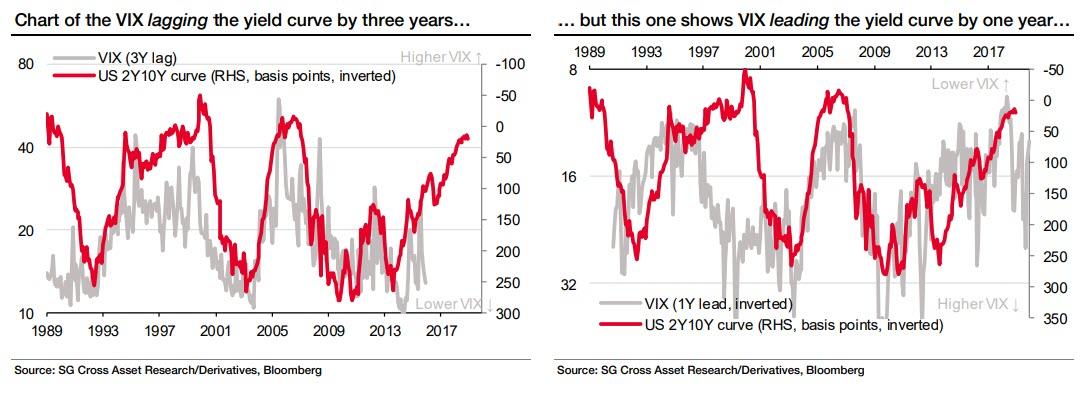
Wilson's downbeat, if especially accurate assessment - the VIX indeed soared by the most on record just two months later - was based on one infamous chart which illustrated the relationship between equity volatility and the economic cycle. It showed that the 2s-10s yield curve tends to lead the VIX by 2 ½ years. This is what Wilson said at the time:
You will notice that in the past 6 months, this impressive 25 year relationship has broken down with the VIX continuing to significantly fall even though the curve flattening that began 3 years ago would have suggested a rise by now. We think this is a reflection of the very supportive fundamental environment described above and the "give up" by traders who have succumbed to the trend and even turned to methodically selling volatility. Furthermore, many retail products have been created to sell vol and may have exacerbated the trend and overshoot to the downside. As economic data and earnings estimate dispersion increases next year, the underlying trend will likely reverse and these products will only serve to make the reversal more persistent than what we have experienced the past few years.
As we said back then, the chart shown below, "indicates that if historical correlation is maintained, the VIX should be just shy of 30, a level which would have catastrophic consequences for virtually all vol-selling funds, including retail investors, active today."

Two months later, Wilson was proven right when virtually every vol seller had gotten wiped out following the historic Feb 5, 2018 VIXtermination event, which annihilated most if not all inverse VIX ETPs as equity vol suffered its biggest explosion on record.
It wasn't just Morgan Stanley that relied on this chart showing the stretched correlation between the VIX and the yield curve. A few months later, it was Bank of America's turn, and in its rather gloomy preview of 2019 stock performance, in January BofA said that , "a flattening in the yield curve over the last three cycles has preceded rising volatility by about three years, as shown in Chart 1." As a result, BofA's chief equity strategist Savita Subramanian "expects a more volatile backdrop for US stocks in the coming years" and believes that as a result, "it will be important to own stocks less sensitive to this and other macro factors."
So first it was Morgan Stanley, then Bank of America that based a core part of their gloomy forecast, predicting a surge in volatility, on the correlation between the yield curve and the VIX.... and yet, as SocGen writes in a Friday note, both banks are dead wrong for basing their predictions on what the French bank believes is nothing more than a spurious correlation.
As a seemingly disturbed SocGen derivatives strategist Jitesh Kumar writes on Friday, "in recent months we have seen different versions of the chart below left doing the rounds" referring also to the charts above. What troubles Kumar is that the chart "is being used to argue that equity volatility will rise in the future because the yield curve is now flattening" and that "the rationale being used is that a flattening yield curve reflects a downward trajectory in growth and increasing risk aversion, so leading to higher volatility in risky assets. The corollary is also held: that a steepening yield curve reflects increasing growth expectations and greater risk appetites, with a dampening effect on volatility."
To the SocGen strategist, such conventional wisdom is nothing but garbage, and as he writes, he "cringes every time we hear this ‘flattening curve’ rationale for higher volatility" and here is why:
The yield curve historically starts this flattening as the economy reaches the middle (uneventful) phase of the business cycle. In this boring phase, when investors are unable to enjoy capital gains on risk assets or sharp moves on safe assets, they start a hunt for yield, which in turn compresses volatility (selling volatility generates yield). Therefore, in our view, a flattening yield curve is consistent with lower, not higher, volatility parameters. We observe that sharply steepening yields have typically resulted from the Fed cutting rates aggressively, and therefore most of the initial steepening is due to a deteriorating growth outlook (not an improving one), and this is in turn accompanied by higher volatility.
So how and why did both Morgan Stanley and Bank of America get fooled by what has recently become one of the anchor cross-asset correlation charts? Simple: to SocGen, this is nothing but as case of spurious correlation, as the bank illustrates in the following two charts.
The chart below left is the one being widely circulated as evidence for the flattening yield curve theory. As the French bank concedes, "by pushing the VIX curve back by three years it does suggest some causality between the two series. However, using the exact same data, the chart on the right below brings us to a completely opposite conclusion. In this chart we have brought the VIX curve forward by one year and flipped the VIX axis upside down. This now shows the VIX leading the yield curve, and this instead suggests that it is a lower VIX that leads to a flatter yield curve."
Ah, the endless pleasure of trying to isolate cause and effect in a market where the VIX used to be a function of underlying volatility, and has since become the catalyst for market moves, ever since VIX futures started trading years ago. So which came first, the chicken or the egg, the surge in the VIX or the plunge in the market?

To SocGen, the answer is clear, and as the bank notes, "just by playing around with the two time series we can demonstrate that the VIX both lags and leads the US yield curve, and that a flatter yield curve can lead to either higher or lower volatility. Hence, we see no real sense in juxtaposing those two time series in this way."
Which, however, is not to say that SocGen is complacent about what various signals say about the future trajectory of volatility. Just the opposite. The only thing that SocGen does want to highlight is the "futility in trying to correlate the yield curve against the level of volatility" as "neither of the above charts indicate a meaningful relationship, in our view."
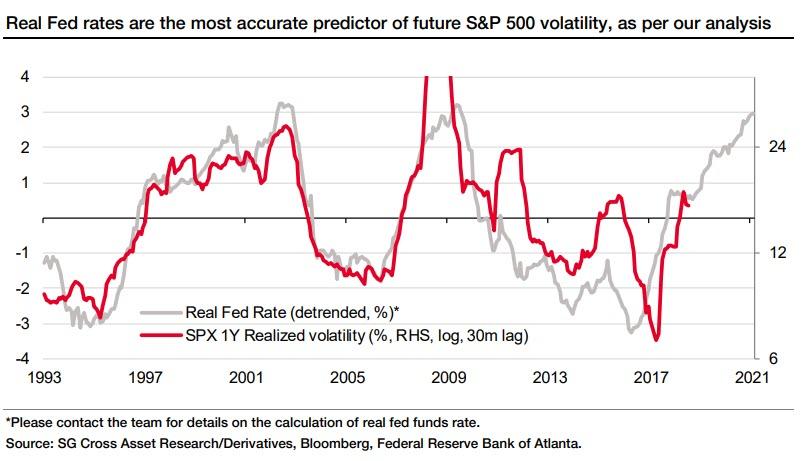
But if not the yield curve, then what, if anything, can server as a leading indicator of vol? It is here that SocGen makes a bold assertion: keep an eye on the real fed funds rate for the future of realized vol (and what that relationship indicates, is that vol is about to explode higher), to wit:
The key takeaway from our work over the past few years analysing the impact of macro factors on equity volatility is that it is the real central bank policy rate that drives the (subsequent) volatility in equities. We first identified this as an important driver almost ten years ago. We have continued to follow this parameter closely and it was one of the reasons we called a turnaround in volatility in 2H17.
Curiously, just like the yield curve effect on VIX - whether it is real or not - lags by 30 months according to conventional wisdom, so the increase in real central bank policy rates also takes a few years, or 30 months as well, to feed through to the economy – even Fed Chairman Powell expressed this view last year, or as SocGen summarizes, "Higher real policy rates are followed by higher equity volatility and vice versa" and while the QE period has distorted the tight fit these two parameters had in the 1990s, SocGen notes that "the inflexion points have overall been forecast quite accurately by our real rates model. This framework also correctly forecasts equity volatility in Europe"
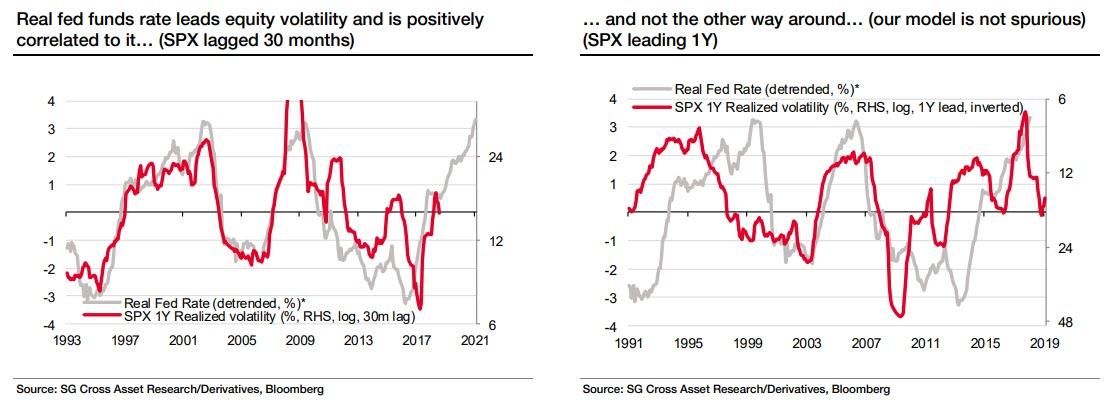
But can someone accuse the SocGen model of the same spurious correlation that the French bank accuses its peers such as BofA and MS in using the correlation between vol and the yield curve? Or, as Kumar concedes, "what about the robustness of our real rates model – is it also susceptible to ‘accidental’ correlations? Would we also get a spurious chart if we inverted one of the vertical axes and tweaked the lead/lag on our model (see charts below)?"
His answer: "we find that doing this does not in any way disprove the informational value of our model"...
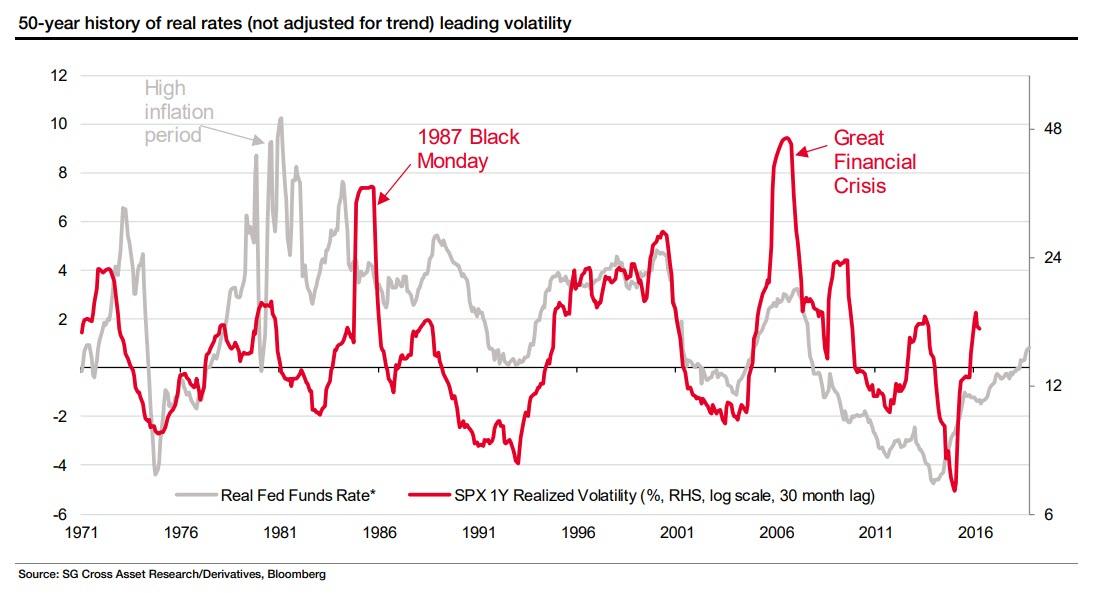
... and, in fact, given we have data going further back, we can extend the analysis to 1971 to see if the model still shows some relationship between real rates and equity volatility. We observe, to our encouragement, that the relationship has held for the past five decades (barring periods of volatile inflation during early and late 1970s due to oil shocks).
Assuming the "alternative" SocGen explanation is accurate, what are the implications? Here it is, from the horse's mouth:
Our existing framework detrends real fed funds rates over the past 30 years (which has been trending down throughout this period) in the comparison with equity volatility, as it enhances our ability to gauge the level of future volatility. If Albert Edwards is indeed correct in his “Ice Age” theory that the 10y T-bond rate will end this cycle at minus 1%, equity volatility has some room to run, as it implies that the current level of rates is too high.
In other words, there is at least agreement on one thing: whether one uses the - allegedly inaccurate - yield curve to predict volatility, or instead one projects the VIX based on the real Fed rate, volatility is set to explode in the coming months. And that is, at the end of the day, all that matters.

WSJ : French as It’s Now Really Spoken An American in Paris discovers a language

French as It’s Now Really Spoken
An American in Paris discovers a language that’s part English, part African, part Arabic—and fully French

I’ve lived in France long enough now to realize the French never really say oui like we think they say it. More often than not, they pronounce it wayh, and it’s usually with an inhale, as if they’re talking while taking a drag on a cigarette. Which is often the case.

But starting around 2015, what I heard from my daughter Bibi and my son Otto had nothing to do with oui or wayh. They were saying wesh.

Wesh wasn’t quite the same “yes” one would use to respond to a question—it had a few variants and was often a tack-on word to something said before. T’es nul wesh (you suck, you know), Bibi would remind Otto at breakfast. Ta gueule wesh (shut up, OK?), Otto would then respond while slurping his cereal.

Wesh, I learned, is a derivative of oui mixed with the Algerian and Moroccan Berber expression ach, which means “what.” Wherever or however you want to say it, wesh has taken over the French language, and it’s become the most emblematic expression of urban French. If you listen to a conversation of kids in my neighborhood, it’s possible you may hear four or five weshes per minute. It’s in every rap song. A lot of reality TV stars or soccer stars drop wesh here and there, and since these are the people my son and I both idolize, I want to speak like them.

But wesh and other slang words stir up a strong reaction in many French speakers. Éric Zemmour, a best-selling French writer and political commentator, wrote in Le Figaro last year that the “French language is a masterpiece in peril,” and that linguistic change is “set on destroying, one after the other, our secular institutions of French identity.”

When you look up wesh in Wiktionnaire, the online Francophone dictionary, the definition is accompanied by a note: “spoken by a certain population [living in] certain suburbs.” The clear implication is that the word belongs to minority and immigrant populations. But it doesn’t: Wesh is everywhere, because its speakers are everywhere. France is the most diverse country in Europe, and our neighborhood (Paris’s 10th arrondissement) is the most diverse in France, home to people from more than 180 countries, 28% of whom are (like me) first-generation immigrants. Hearing certain words on a daily basis, words I know will never make it into the dictionnaire, I can see how the French response to wesh comes down to its complicated feelings about culture, class and race.

Maybe there is a parallel between the way France won’t allow itself to appreciate the wesh richness the country has to offer and the way it sometimes undervalues the vital contributions millions of immigrants living here have made. Kind of like the way many cheered on the French national soccer team’s World Cup victory while downplaying the African origins of the majority of the team; or how French cuisine is constantly promoted abroad in the classic confit and cassoulet way, yet back home the number one dish preferred by the French themselves is (drum roll please)….couscous.

Wesh has been ushered into our house with myriad other words I never would have thought would work in France. There’s swag as in T’as le swag, Papa (You’ve got swag, Dad!) or thug, but Otto and Bibi pronounce it without the “th,” so it comes over as tug, as in tugboat, which of course makes me laugh. Then there’s bledard, which means nerd. Bledard comes from the West African term bled, meaning small town. Basically, if somebody’s a bledard in Paris, he has small-town tastes and doesn’t understand what’s cool.

What is cool is to say the word Staive (pronounced stah-ife) which takes the French expression “C’est ta vie” (that’s your life) and plays it at double speed. Staive is the equivalent of “whatever dude,” and it’s used systematically by one of our kids whenever the other announces he or she just received a good grade.

There’s also khey, which is a version of the Arabic word for brother. The kh normally should be pronounced like the j in Spanish, but since most French people have trouble with this, they start their kheys with an r, so it comes across as rhey. Rhey became standard usage for me last year when I stumbled on the French rapper Algerino’s hit song “Wesh Rhey.”

Sometimes my French-born wife Anais, who speaks French the way a concert pianist plays—tough words like serrurier (locksmith) or vétérinaire (veterinarian) rolling off her tongue like a Chopin nocturne—will squint and look to me to decode what the kids are saying. And it’s then that I realize I can be just as fluent as she is, maybe even better.

For her 12th birthday, Bibi hosted her first boum (pronounced boom but spelled with the letter u, and don’t ask why). Boums are starter parties for French adolescents and pre-adolescents, and yours truly was asked to DJ, which meant I was simply a chaperone who helped out if there was a technical difficulty, but I was not supposed to touch the music, ever. And it was during this party, me with the laptop trying to be invisible, watching all these sweaty mixed-up kids from the Tenth shouting out their bledards, tugs and rheys, that I realized my story with the French language had come full circle.

I arrived here with the hope of mastering classic French, only to walk away with a 21st-century version, one found on Snapchat, in schoolyard insults and rap lyrics; a French that’s part English, part African, part Arabic and fully French.

And thanks to all of this Staive weshness, I’ve fallen in love with the French language again. For me, this new French is the real French, the language I’ve always gravitated toward—probably because, as an immigrant, it’s the language I encounter most. (I also happen to understand it better than most of my French friends, which makes me ze cool dad.) Words like these have taught me what it truly means to master a language. It’s where the pride and love you have for your home comes through with an ease and dexterity and, wesh, a fluency that’s all your own.