- Nokia (NOA3 TH) +1.5%
- Nokia at Non-Deal Roadshow Hosted By Kepler Cheuvreux Today
- Carl Zeiss Meditec (AFX TH) +1.1%
- Carl Zeiss Meditec First Half Ebit EU110.4 Mln
- Suez (SZ1 TH) +0.9%
- Atlantia (AU9 TH) -3.1%
- Siltronic (WAF TH) -3.1%
- Nemetschek (NEM TH) -3.1%
- MorphoSys (MOR TH) -3.1%
- AMS (DQW1 TH) -3.2%
- H&M (HMSB TH) -3.2%
- Richemont (RITN TH) -3.5%
- Hochtief (HOT TH) -3.5%
- Watch Hochtief; Shares of Australian Unit Cimic Plunge Overnight
- Hella (HLE TH) -4.1%
- Delivery Hero (DHER TH) -4.1%
- Delivery Hero Cut to Hold at Commerzbank; Price Target 43 Euros
SocGen Slams That "Other" VIX Chart And Reveals The "Most Important Driver Of Long-Term Volatility"

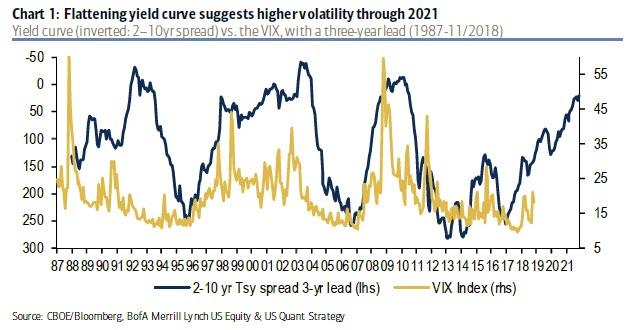
We first showed it back in November 2017. Back then, with the VIX plumbing record single-digit lows, Morgan Stanley's contrarian permabear, chief equity strategist Michael Wilson, showed an especially controversial chart and issued a forecast that was eerie in two aspects: he laid out his "base case" target for the S&P500 of 2,750 (which was almost to the dot where the S&P5090 closed 2018) and - more importantly - at a time of record low volatility, Morgan Stanley predicted that the VIX, which then was the lowest it has ever been, would soar to 30.
Wilson's downbeat, if especially accurate assessment - the VIX indeed soared by the most on record just two months later - was based on one infamous chart which illustrated the relationship between equity volatility and the economic cycle. It showed that the 2s-10s yield curve tends to lead the VIX by 2 ½ years. This is what Wilson said at the time:
You will notice that in the past 6 months, this impressive 25 year relationship has broken down with the VIX continuing to significantly fall even though the curve flattening that began 3 years ago would have suggested a rise by now. We think this is a reflection of the very supportive fundamental environment described above and the "give up" by traders who have succumbed to the trend and even turned to methodically selling volatility. Furthermore, many retail products have been created to sell vol and may have exacerbated the trend and overshoot to the downside. As economic data and earnings estimate dispersion increases next year, the underlying trend will likely reverse and these products will only serve to make the reversal more persistent than what we have experienced the past few years.
As we said back then, the chart shown below, "indicates that if historical correlation is maintained, the VIX should be just shy of 30, a level which would have catastrophic consequences for virtually all vol-selling funds, including retail investors, active today."

Two months later, Wilson was proven right when virtually every vol seller had gotten wiped out following the historic Feb 5, 2018 VIXtermination event, which annihilated most if not all inverse VIX ETPs as equity vol suffered its biggest explosion on record.
It wasn't just Morgan Stanley that relied on this chart showing the stretched correlation between the VIX and the yield curve. A few months later, it was Bank of America's turn, and in its rather gloomy preview of 2019 stock performance, in January BofA said that , "a flattening in the yield curve over the last three cycles has preceded rising volatility by about three years, as shown in Chart 1." As a result, BofA's chief equity strategist Savita Subramanian "expects a more volatile backdrop for US stocks in the coming years" and believes that as a result, "it will be important to own stocks less sensitive to this and other macro factors."

So first it was Morgan Stanley, then Bank of America that based a core part of their gloomy forecast, predicting a surge in volatility, on the correlation between the yield curve and the VIX.... and yet, as SocGen writes in a Friday note, both banks are dead wrong for basing their predictions on what the French bank believes is nothing more than a spurious correlation.
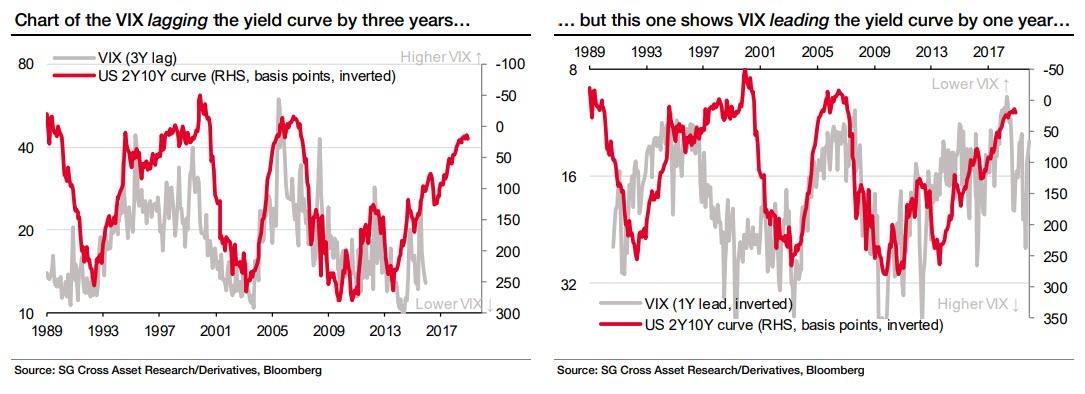
As a seemingly disturbed SocGen derivatives strategist Jitesh Kumar writes on Friday, "in recent months we have seen different versions of the chart below left doing the rounds" referring also to the charts above. What troubles Kumar is that the chart "is being used to argue that equity volatility will rise in the future because the yield curve is now flattening" and that "the rationale being used is that a flattening yield curve reflects a downward trajectory in growth and increasing risk aversion, so leading to higher volatility in risky assets. The corollary is also held: that a steepening yield curve reflects increasing growth expectations and greater risk appetites, with a dampening effect on volatility."
To the SocGen strategist, such conventional wisdom is nothing but garbage, and as he writes, he "cringes every time we hear this ‘flattening curve’ rationale for higher volatility" and here is why:
The yield curve historically starts this flattening as the economy reaches the middle (uneventful) phase of the business cycle. In this boring phase, when investors are unable to enjoy capital gains on risk assets or sharp moves on safe assets, they start a hunt for yield, which in turn compresses volatility (selling volatility generates yield). Therefore, in our view, a flattening yield curve is consistent with lower, not higher, volatility parameters. We observe that sharply steepening yields have typically resulted from the Fed cutting rates aggressively, and therefore most of the initial steepening is due to a deteriorating growth outlook (not an improving one), and this is in turn accompanied by higher volatility.
So how and why did both Morgan Stanley and Bank of America get fooled by what has recently become one of the anchor cross-asset correlation charts? Simple: to SocGen, this is nothing but as case of spurious correlation, as the bank illustrates in the following two charts.
The chart below left is the one being widely circulated as evidence for the flattening yield curve theory. As the French bank concedes, "by pushing the VIX curve back by three years it does suggest some causality between the two series. However, using the exact same data, the chart on the right below brings us to a completely opposite conclusion. In this chart we have brought the VIX curve forward by one year and flipped the VIX axis upside down. This now shows the VIX leading the yield curve, and this instead suggests that it is a lower VIX that leads to a flatter yield curve."
Ah, the endless pleasure of trying to isolate cause and effect in a market where the VIX used to be a function of underlying volatility, and has since become the catalyst for market moves, ever since VIX futures started trading years ago. So which came first, the chicken or the egg, the surge in the VIX or the plunge in the market?
To SocGen, the answer is clear, and as the bank notes, "just by playing around with the two time series we can demonstrate that the VIX both lags and leads the US yield curve, and that a flatter yield curve can lead to either higher or lower volatility. Hence, we see no real sense in juxtaposing those two time series in this way."
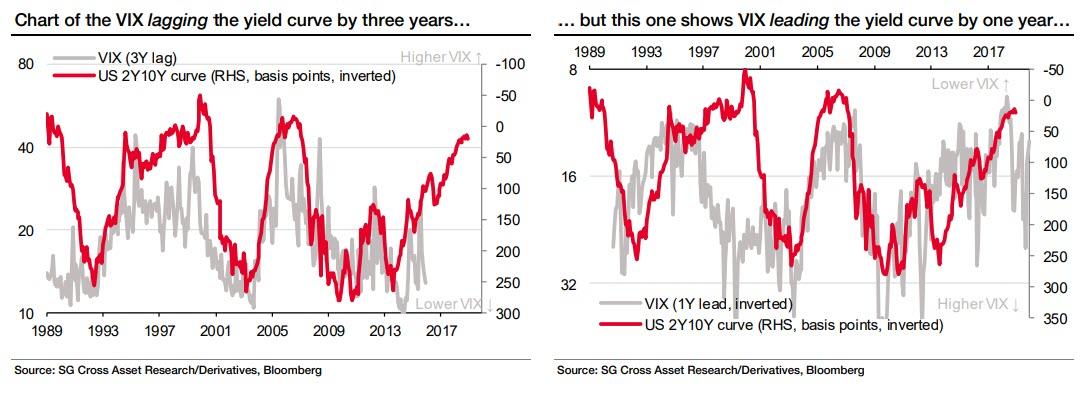
Which, however, is not to say that SocGen is complacent about what various signals say about the future trajectory of volatility. Just the opposite. The only thing that SocGen does want to highlight is the "futility in trying to correlate the yield curve against the level of volatility" as "neither of the above charts indicate a meaningful relationship, in our view."
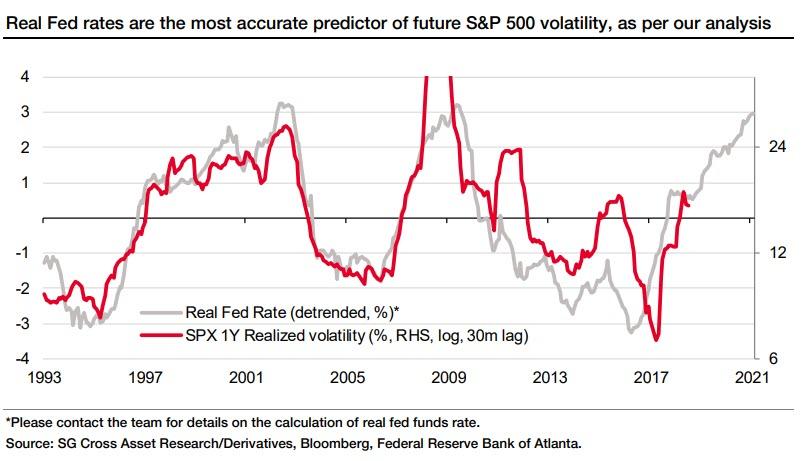
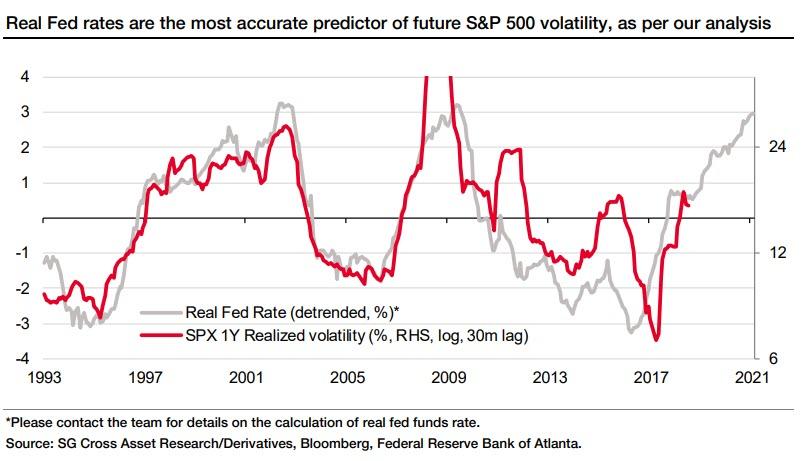
But if not the yield curve, then what, if anything, can server as a leading indicator of vol? It is here that SocGen makes a bold assertion: keep an eye on the real fed funds rate for the future of realized vol (and what that relationship indicates, is that vol is about to explode higher), to wit:
The key takeaway from our work over the past few years analysing the impact of macro factors on equity volatility is that it is the real central bank policy rate that drives the (subsequent) volatility in equities. We first identified this as an important driver almost ten years ago. We have continued to follow this parameter closely and it was one of the reasons we called a turnaround in volatility in 2H17.
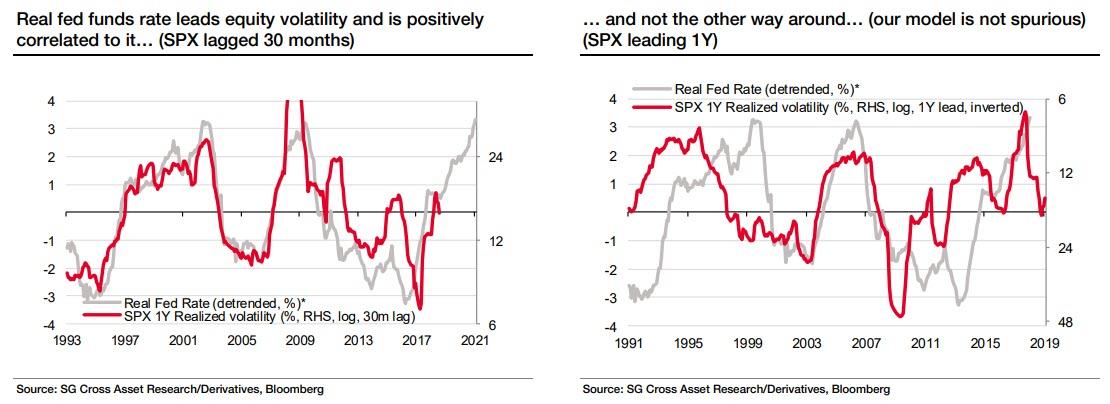
Curiously, just like the yield curve effect on VIX - whether it is real or not - lags by 30 months according to conventional wisdom, so the increase in real central bank policy rates also takes a few years, or 30 months as well, to feed through to the economy – even Fed Chairman Powell expressed this view last year, or as SocGen summarizes, "Higher real policy rates are followed by higher equity volatility and vice versa" and while the QE period has distorted the tight fit these two parameters had in the 1990s, SocGen notes that "the inflexion points have overall been forecast quite accurately by our real rates model. This framework also correctly forecasts equity volatility in Europe"
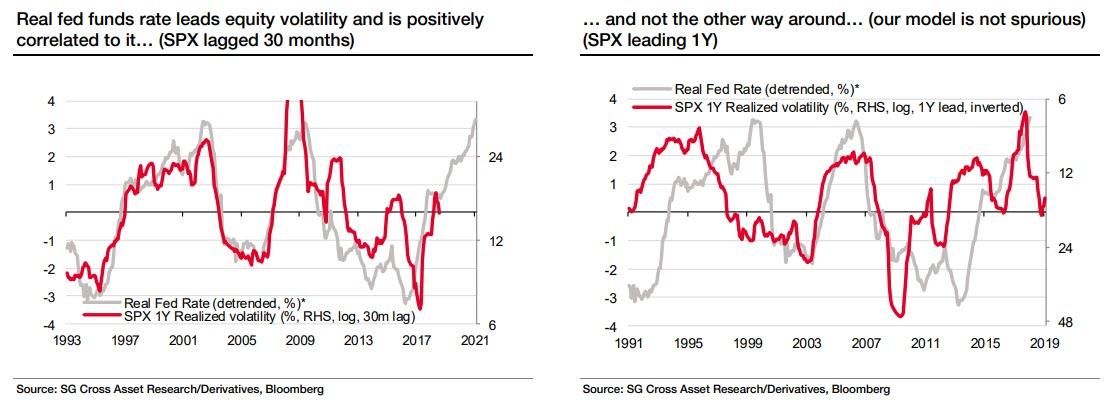
But can someone accuse the SocGen model of the same spurious correlation that the French bank accuses its peers such as BofA and MS in using the correlation between vol and the yield curve? Or, as Kumar concedes, "what about the robustness of our real rates model – is it also susceptible to ‘accidental’ correlations? Would we also get a spurious chart if we inverted one of the vertical axes and tweaked the lead/lag on our model (see charts below)?"
His answer: "we find that doing this does not in any way disprove the informational value of our model"...
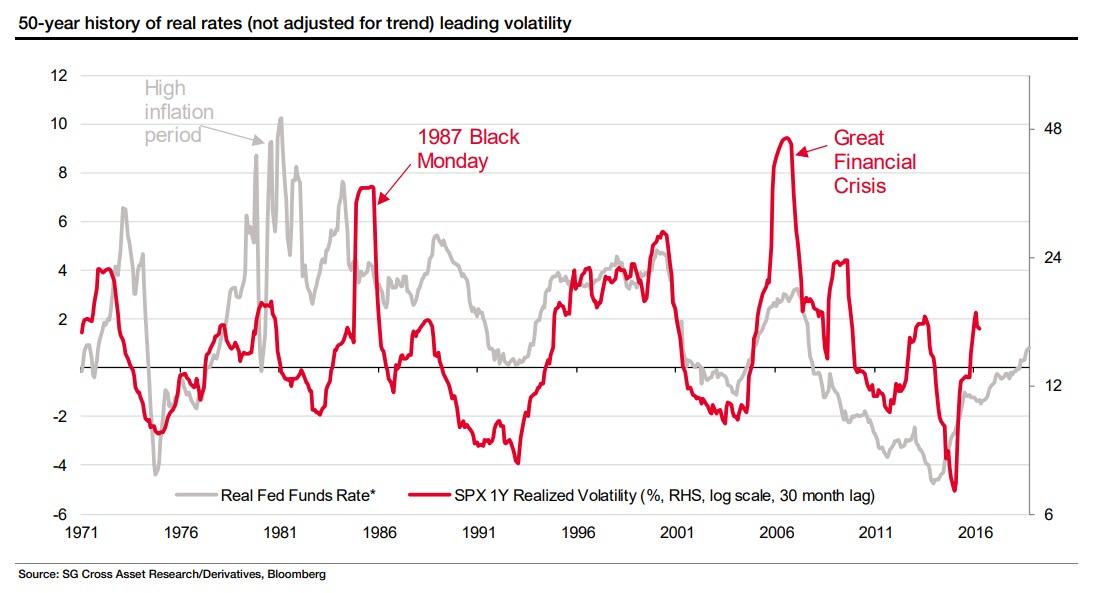
... and, in fact, given we have data going further back, we can extend the analysis to 1971 to see if the model still shows some relationship between real rates and equity volatility. We observe, to our encouragement, that the relationship has held for the past five decades (barring periods of volatile inflation during early and late 1970s due to oil shocks).
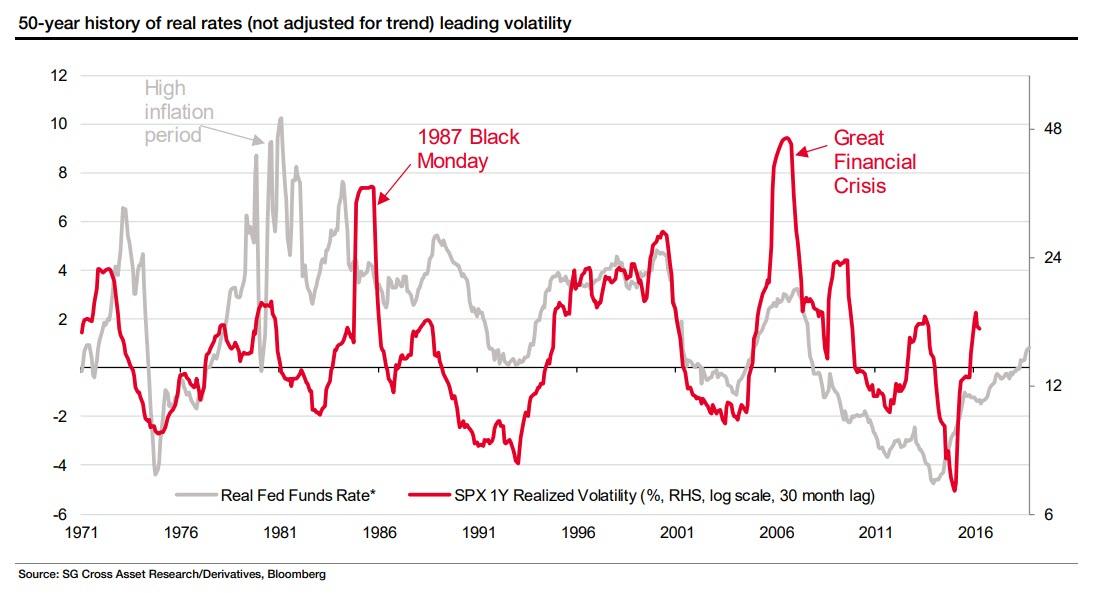
Assuming the "alternative" SocGen explanation is accurate, what are the implications? Here it is, from the horse's mouth:
Our existing framework detrends real fed funds rates over the past 30 years (which has been trending down throughout this period) in the comparison with equity volatility, as it enhances our ability to gauge the level of future volatility. If Albert Edwards is indeed correct in his “Ice Age” theory that the 10y T-bond rate will end this cycle at minus 1%, equity volatility has some room to run, as it implies that the current level of rates is too high.
In other words, there is at least agreement on one thing: whether one uses the - allegedly inaccurate - yield curve to predict volatility, or instead one projects the VIX based on the real Fed rate, volatility is set to explode in the coming months. And that is, at the end of the day, all that matters.
* NYT (Saturday): Though the economy is humming, the current expansion doesn’t resemble past booms—the Great Recession continues to resonate, and even after 10 years of growth, the euphoria of the tech sector of the late 1990s or of the real estate market in the 2000s is conspicuously absent; Donald Trump telephoned Russian president Vladimir Putin Friday for what both men described as a lengthy, positive conversation, in which they dismissed two years of investigations into Russia’s intervention in the 2016 presidential campaign as a hoax; Democrats, hungry for a sweep of power in Washington, are confronting a harsh reality: Top-tier candidates such as Stacey Abrams of Georgia, Cindy Axne of Iowa, and Joaquin Castro of Texas are refusing to run for the Senate, likely because they would rather run for president; A growing body of research suggests that warming temperatures linked to climate change may significantly shrink the range where it’s possible to make maple syrup; Brazilian president Jair Bolsonaro will cancel a trip to New York this month following weeks of controversy over the Brazilian-American Chamber of Commerce’s decision to honor the far-right leader at its gala this year; A team of international investigators shut down an online marketplace for illegal drugs, weapons, stolen data and other contraband with more than one million customer accounts, illustrating how crime fighting has increasingly become a battle in cyberspace; All across Hungary, which has near-record low unemployment and one of the fastest-growing economies in Europe, there are not enough workers, and companies seeking immigrants to fill spots are being hampered by nationalist policies of prime minister Viktor Orban; (Sunday): The FTC agreed months ago it wanted to pursue a historic penalty against FB that would show the agency’s teeth, but the members are split on the size and scope of the tech company’s punishment, according to insiders, and whether chief Mark Zuckerberg should also be penalized; Two of China’s 34 regions are quietly leading a boom in cultivating cannabis to produce cannabidiol, or CBD, the nonintoxicating compound that has become a consumer health and beauty craze in the United States and beyond, even though cannabidiol has not been authorized for consumption in China because of its tough drug laws; A survey by Temple University’s Hope Center for College, Community and Justice indicated that 45 percent of student respondents from over 100 institutions said they had been food insecure—which means having limited or uncertain access to food—in the past 30 days; Sunday Business: Lead story reports that former Uber chief Travis Kalanick wanted to be part of the group ringing the opening bell on the New York Stock Exchange when they company goes public, but current CEO Dara Khoshrowshahi denied the request, as many people in the company still see Kalanick as a toxic liability.
* WSJ (Weekend): The Trump administration is ramping up its feud with the Fed over interest rates and how to manage the economy at a time of strong growth and historically low unemployment; +/- BA: Aerospace giant limited the role of its own pilots in the final stages of developing the 737 MAX flight-control system implicated in two fatal crashes, departing from a longstanding practice of seeking their detailed input; Students who apply to college with the help of an online platform that shows where their peers were accepted or rejected are more likely to get into their own choices—but they also may be deterred from applying to highly selective schools; Florida lawmakers passed a divisive bill to implement a voter-approved constitutional amendment that restored voting rights to an estimated 1.4M people with felony convictions; The National Institutes of Health has reversed course and will permit two senior doctors to speak with investigators regarding patient-safety issues in a nationwide sepsis trial; +/- Uber: As the ride-hailing startup prepares to go public in one of the largest tech IPOs ever, chief Dara Khosrowshahi is trying to sell Wall Street on his vision that Uber will become the dominant force in all forms of transportation—but it’s unclear whether the rhetoric matches reality; The government-backed Ginnie Mae is taking steps to curb repeated mortgage refinancings it says are hurting both borrowers and investors, and may bar some loans backed by the Department of Veterans Affairs from inclusion in its flagship bonds; A decade after Uber was founded, it and other gig economy companies “find themselves between the rock of ongoing losses and the hard place of a tight labor market”; Dark pools, private trading platforms, typically geared toward big investors, have enjoyed growing market share this year—the share of U.S. stock trades executed on such off-exchange venues rose to 38.6% in April, the highest level in more than a year; H.O.T.S.: JBLU’s move to fly daily to London from New York City and Boston could set the stage for a new air revolution—or so many in the aviation industry are betting; The April jobs report makes it plenty clear the Federal Reserve isn’t likely to cut rates anytime soon—but it’s always possible it could raise them; Huge declines in Chinese pork production due to swine fever will boost demand for other proteins from othe places.
* FT (Weekend): Front page story reports that investors are flocking to synthetic collateralized debt obligations, a complex debt derivative produce blamed for amplifying losses during the financial crisis, but which investors now say are safer because they aren’t backed by subprime mortgages; Model aircraft enthusiasts have become an unexpectedly powerful opponent of rules that would allow widespread commercial drone flying, which would likely add onerous rules to their hobby; Lex Column: Until last year, company voluntary arrangements use was falling in England and Wales, but for landlords like Intu, the pain from CVAs will rise in line with their growing use; For Adidas, marketing savvy such as adding pop star Beyoncé to the brand is increasingly important for its battle with rival NKE; “Bernie Sanders is not U.S. president yet, but he is forcing a confrontation with corporate America” with his plan for a single payer health system; Comment: “The window of opportunity for flogging lossmaking growth companies with minimal future visibility to retail investors isn’t shut yet,” says Merryn Somerset Webb. “But everyone knows it can’t open wider, however good some of the companies may be.”
* NY POST (Saturday): +/- CBS: Network “is in chaos amid a massive shake-up at the network’s news division that will have Gayle King crowned queen of the morning show as soon as Monday”; Super Bowl LIV, which will take place on February 2, will run longer commercial breaks than in previous years, but less often; (Sunday): UFC lightweight champion Conor McGregor is prepping for life outside the ring by launching an Irish whiskey called Proper No. Twelve, which will take on Jameson’s, the category leader, owned by Pernod-Ricard
Banca Carige close to falling under control of BlackRock
BlackRock [NYSE:BLK] is close to gaining control of Banca Carige [BIT:CRG], the Italian-language daily Il Sole 24 Ore reported.
The report cited as evidence the public backing given to BlackRock by the Italian Minister of Economy Giovanni Tria.
The report said that the Bank of Italy has also given its approval to a takeover by BlackRock.
The article added that as BlackRock's proposal is the only one on the table, a deal is expected to be announced in the next few hours.
The item noted that the rescue of Carige will take place with a EUR 720m recapitalisation,
As previously reported, following the recapitalisation, BlackRock will hold 45% of Carige.
Atlantia could take 20% stake in Alitalia
Italian infrastructure group Atlantia [BIT:ATL] could take a 20% stake in insolvent airline Alitalia, the Italian-language daily La Stampareported. The unsourced report said that advisors on the matter are looking at Atlantia investing EUR 200m-EUR 220m instead of EUR 300m, while QuattroR would invest a further EUR 80m-EUR 100m to take a 10% stake.
The report added Ferrovie dello Stato (FS) would take a 30% stake, US airline Delta [NYSE:DAL] 15% and the Italian government 15%. The source was not clear on which parties would take the remaining 10% required to complete Alitalia's recapitalisation.
Most previous reports had claimed that the government was pressuring Atlantia to take a 40% holding in Alitalia.
As reported, Alitalia has EUR 500m remaining of a EUR 900m bridge loan provided by the Italian government.
Whitbread shareholder Elliott Advisors pushes for hotel disposals - report
Whitbread [LON:WTB], shareholder Elliott Advisors wants the FTSE-100 leisure company to sell hotel property assets, The Sunday Telegraph reported. The newspaper cited City sources who said Elliott, an activist investment firm, wants Whitbread to dispose of 10%-15% of its hotels and to remain “openminded” about its other hotels.
Premier Inn, the UK’s biggest hotel chain, is Whitbread’s main business. The company owns the majority of its hotels, while many of its major rivals have sold properties to focus on an asset light business model, the article said. Selling properties while focusing on brands frees up cash to invest elsewhere, the item added.
Elliott is understood to be growing frustrated by Whitbread’s strategy of owning hotel properties and believes that it is pushing Whitbread’s share price down, leaving the company vulnerable to a hostile bid, the item continued.
Whitbread’s hotel properties are worth GBP 5.8bn (EUR 6.81bn), according to the newspaper.
Those close to Elliott say it and several other investors would like to see Premier Inn manage hotels other than its own, the report said.
Whitbread’s Chief Executive Alison Brittain last week reiterated that the company’s strategy is to own properties and that ownership will protect against the volatility of the economic cycle, the article noted.
It is thought that Elliott also wants Whitbread to add hotel industry expertise to its board, the item continued. The report cited sources close to Whitbread who said it is looking to appoint directors with European hotel management experience.
Premier Inn sold its Costa Coffee business to The Coca-Cola Company [NYSE:KO] for GBP 3.9bn last year after pressure from Elliott and another activist investor, Sachem Head for a spin-off of Costa.
Whitbread’s market capitalisation stood at GBP 7.96bn at the close of trading in London on Friday, 3 May.
US stock markets pushed to new highs early in the week helped by another benign inflation reading when core PCE data missed expectations once again. Improving data in continental Europe buoyed risk sentiment and helped rates move up globally heading into the FOMC and BOE meetings Wednesday and Thursday. Stock prices also backed away from the highs as some noted seasonality and a heavy upcoming IPO calendar as a good reason to reassess and potentially take profits. Oil prices also dropped notably as US inventories and production continued to swell.
Chairman Powell was not as dovish as the market may have expected, though, when he went out of his way to explain that the low inflation readings are likely the result of “transient” factors. Advocates for an ‘insurance’ rate cut amid low inflation, including the White House, were disappointed when Powell said he didn’t see any reason to move rates in either direction at this time.
A Chinese press report on Thursday dampened markets by suggesting trade talks had reached an “impasse,” but stocks recouped the losses on Friday and interest rates settled.
A heavy week of earnings topped corporate headlines this week. Google shares slumped after reporting a top-line miss and noting a slowdown in Pixel smartphone sales. Apple rallied after posting a beat and boosting its stock buyback program, despite a 5% drop in total revenue on an annual basis. McDonald’s reached fresh all-time highs after announcing strong SSS growth in Q1, while Yum Brands shares moved lower after disappointing SSS readings from Taco Bell and Pizza Hut. GE popped after beating its beaten-down expectations and reaffirming its FY outlook. Occidental partnered with Berkshire Hathaway to solidify financing for an Anadarko takeover, and reports indicated Chevron was unlikely to counterbid. Amazon rose after word surfaced that Berkshire had bought shares in the tech giant. HealthEquity confirmed a $2B bid for WageWorks in an effort to create a larger health savings account and employee benefits provider. Tesla stock rallied after the automaker formally announced an upsized $2.7B capital raise and Elon Musk said he would personally buy $25M of shares.
Macro :
- IPO : Zoom Surges Past Lyft, Pinterest as Value Tops $20 Billion
- Kim’s Latest Weapons Test Shows Growing Frustration With Trump
Keep an eye on :
- ALZCUR SS : Alzecure to Redirect ACD855 From Cognitive Dysfunction to Eye
- BRE IM : Brembo Appoints Schillaci CEO as Abbati Marescotti Leaves
- BT/A LN : New BT chief seeks to make his mark with push into fibre - FT : https://on.ft.com/2IXDBSZ
- CA FP : Carrefour, Unions Agree to Offer 3,000 Voluntary Departures
- DIS US : Sinclair Broadcast to Buy Sports Networks for $9.6 Billion
- EDP PL : EDP Hires UBS, Morgan Stanley for Planned Disposals: Expresso
- ISAT LN : Delay Possible on Intelsat Airwaves Bid as FCC Seeks Comment
- MS IM : Mediaset close to acquiring Cine Sony
- MTFB LN : Micro-Cap Motif Bio Says Meeting With FDA Held as Planned
- RENE PL : REN First Quarter Net Income EU13.2 Mln
- ROG SW : Roche’s Breast Cancer Drug, Kadcyla, Approved by FDA
- RDSA NA : Nigeria’s Bonny Oil Pipeline Force Majeure Lifted: Operator
- SESG FP : FCC Asks for Additional Comment on 3.7-4.2 GHz Band
- SHRE LN : Share Plc Rises 25% on Interactive Investor’s Prelim. Approach
- SIE GY : Reuters - Siemens weighs carving out Gas and Power unit Reuters - https://reut.rs/2VioyK3
- TTK GY : acquires Dutch e-commerce food service supplier 2019-05-03
- TSLA US : U.S. Won’t Exempt Tesla Autopilot Tech From Tariffs: TechCrunch
- THAL LN : Thalassa Holdings Local Shopping REIT Offer Lapsed
- VOD LN : Portugal Says It Received No Vodafone Notifications on Network
Your Contacts List Is Your Most Important Social Network. Here’s How to Make It Better.
Apps can help you update and maintain your digital address book—without stealing all your personal data
My Facebook friends are mostly just people I met at parties. Most of my LinkedIn connections are strangers I thought made me look “professional,” and I follow hundreds of people on Twitter and Instagram whom I’ll never meet in real life.
But there’s really only one “friends list” that actually deserves the title: the contacts app on my phone.
My digital address book is the conduit to the most important information about the most important people in my life. And yet my contacts app is a mess—and I bet yours is too. As my colleague Joanna Stern wrote years ago, it takes a lot of work to keep everything straight.
Entering information is like filling out forms at the DMV, and I often end up with a dozen versions of the same person. Worse, we’ve moved well beyond phone numbers and email addresses, communicating with people using all kinds of apps and networks.
A new set of apps is starting to help, though. They use modern tech to make it easier to add and manage your contacts, share yours with others, and even use your contacts list as a jumping-off point for other communication needs.
Rather than make money by spamming your friends or sending you ads, these apps come with a simple cost—a few dollars, either one-time or every month. I’ve found that having an updated, accessible, useful place full of all the information I need about everyone I care about is well worth the cost.
Tending the Rolodex
Of all the contacts apps I’ve tested, CardHop has helped me most. Currently available for Mac and iOS, it’s able to automatically parse which contact info you’re trying to add and sort it correctly.
Like other apps I’ve tested, CardHop works directly with your regular address book. Once you give the app access to your contacts, anything you enter in CardHop is synced via the same Google or iCloud account you’re already using. That’s the beauty of these tools: They offer better ways to deal with your stuff without forcing you whole-hog into some new contacts universe.
Open CardHop, type “Brad Pitt 310-555-4206 rustyryan11121314@hotmail.com,” and the app files each piece of information into the right place. If you already have that person in your contact list, it’ll add the new information rather than create a duplicate entry.
My favorite use for CardHop is to paste in someone’s entire email signature, and let the app create a new contact or update an old one.
CardHop helps solve the problem of adding contacts, but keeping all my information up to date is a bigger problem.
Here’s how digital address books should work: I control my own contact card, with all the information about me on it. When I give you my card, I choose which fields to share with you. (Work people get my work number, friends get my birthday, potential doggie playdates get my dog’s Instagram username, you get the idea.)
From then on, anytime I update my own card, it would instantly update in your account as well. Anything I’ve shared with you would be always up to date. While a new standard like this won’t likely emerge anytime soon, one developer has a clever hack.
The HiHello app lets you manage and share your contact information as usual—typing manually or scanning business cards—but its concept of digital “cards” is what’s so interesting.
You can create different ones for friends or colleagues or potential playdates. The app generates a unique QR code that anyone can scan with their phone camera to add to their normal address book. You can also send a card via text or email.
If you share your contact info through the app with another HiHello user, though, you can update your phone number or email and they’ll see it in their address book, no matter which contacts app they use. HiHello handles all the updating invisibly in the background.
Reaching Out
Once you have a teeming, up-to-date list of important information about important people in your life, it kind of becomes the center of your digital universe. Now, when I want to message someone, I open CardHop and search for their name.
As with other apps, I can tap on phone numbers to call people, but CardHop also lets me tap on saved Skype usernames to call them there, or on Instagram handles to jump straight to their profiles. (And don’t worry, you can still get to your updated contacts any way you prefer.)
If you think about your contacts list as your center of operations, the possibilities seem endless. In some universe, maybe my contacts app connects to my email and Facebook accounts, reminds me of the last time I chatted with someone, even crawls the internet looking for information to pad out and update my existing contacts. Best buddy list ever, right?
But somewhere along this road we run into a big problem, one that has increasingly become a non-starter for potential users of apps that gather a bunch of personal information to grow, reap ad revenue or just sell to the highest bidder. Some supposedly helpful apps import all of your contacts to their servers; I recommend staying away from them. You really shouldn’t even be syncing contacts with your social networks.
HiHello and CardHop have strong privacy policies and promise never to share your data with anyone. “We don’t gather information, we don’t want information, and we’re very cautious about having and managing your information,” said Michael Simmons, co-founder of Flexibits, the developer behind CardHop.
Rather than make money through ads or data-mining, these companies get money right from you. CardHop costs $4 on iOS and $20 for Mac. HiHello plans to charge for features like business-card transcription and eventually to have a monthly fee for using the service.
This feels like a fair trade. I want my address book to work for me, not somebody else and all their advertising buddies. It shouldn’t be tied to any single social-media app or device. It should be easy to use and access, but still feel like it’s my property. After all, this is a social network of the people I care about most.