WSJ : Uber and Lyft Face Hurdle of Finding and Keeping Drivers

Uber and Lyft Face Hurdle of Finding and Keeping Drivers
Ride-hailing companies confront high driver turnover and complaints about wages while trying to lower costs and narrow losses

Now that Uber Technologies Inc. UBER -7.62% and Lyft Inc. LYFT -7.41% are trading on public markets, the ride-hailing companies are under pressure to achieve years of rapid growth.

First they will have to figure out how to hang onto drivers like Carl Wagoner, a Lexington, Ky., minister and potter who last summer drove for Uber to earn extra cash. The gig proved less lucrative than he thought—about $5 an hour after gasoline, he calculates—given that he avoided the higher-priced, late-night bar crowd. He quit within six weeks.

“Just wasn’t worth it,” he said.

Uber and Lyft are banking on a future where evermore riders surrender their cars and rely on ride-hailing. But that vision assumes the companies will accomplish a trickier task—finding and keeping the millions of drivers needed to whisk them around.

By relying on a workforce of independent contractors, the companies are dealing with drivers who can simply turn off their app when they want to stop working. Drivers also can toggle back and forth between services—called dual apping—depending on which offers more money.

Uber and Lyft have paid billions of dollars combined in incentive payments to keep drivers, helping contribute to a combined $5.4 billion in losses over the past 12 months through March. Despite the incentives, drivers protested in several major cities last week to bring attention to low wages.

Multiple economists have estimated Uber and Lyft drivers earn on average between $9 and $16 an hour, after accounting for various expenses the contractors are responsible for, such as gas and maintenance.

Uber, in the filing for its initial public offering, highlighted retail, wholesale and restaurants as sectors that offer wages similar to its drivers’. But those sectors have struggled with the tight labor market, with many employers increasing wages. Amazon.com Inc., Costco Wholesale Corp. and Target Corp. have or plan to raise their minimum wage to at least $15 an hour. All are profitable companies.

Questions about the unprofitable business models have tempered investor enthusiasm for both ride-hailing companies. Uber’s stock fell 7.6% in Friday’s market debut—erasing $6 billion in market value—while Lyft’s shares are down about 29% since its March offering.

Recruiting and retaining drivers is considered a priority at both companies, former employees said, as is cutting costs. Making the prospect tougher in the U.S. is the lowest level of unemployment in decades.

The job of a ride-hail driver is marked by high churn, or the percentage of drivers who stop using the service. Among U.S. drivers in 2015 and 2016, 68% stopped driving within six months of starting, researchers from Stanford University and Uber found, in an economics paper focused on earnings by gender.

Paul Oyer, a Stanford economics professor and one of the study’s authors, said other low-wage jobs such as those at fast-food companies also have high turnover. As Uber and Lyft expand, he said, churn will be a big challenge.

In this economy, “everyone’s having trouble finding workers,” Mr. Oyer said.

Neither company disclosed the driver churn rate in their IPO filings, only that recruiting and keeping drivers is a risk factor.

The number of ride-hailing drivers is massive. Lyft, which operates in the U.S. and some Canadian cities, said nearly two million people drove for the company at some point last year. While that tally might include drivers that completed only a few trips, it represents more than 1% of the entire U.S. workforce. The vast majority of drivers are part-time.

The country’s largest employer, Walmart Inc., has a U.S. workforce of 1.5 million. Uber, which operates in 63 countries, said it had 3.9 million drivers globally in the fourth quarter.

Uber and Lyft have cast a wider net for potential drivers, particularly to those who don’t own cars that meet their criteria—no more than 15 years old and in good condition. Uber and Lyft have programs or partnerships with car-rental companies that let drivers rent or lease cars meant for ride-hailing.

The companies also have sought ways to keep drivers happy: Uber has added payments for lengthy wait times and in-app tipping; Lyft is opening a handful of driver centers with services such as discounted oil changes.

Uber said in its IPO filing that it wants to reduce driver incentives as it seeks to curb losses—and that, as a result, “we expect driver dissatisfaction will generally increase.”

Eventually, Uber and Lyft envision replacing human drivers with robot-driven cars, although both have said such technology is far away. Meanwhile, the bulk of fares go to drivers; both companies say drivers take more than 70% of fares, including incentives.

Standard driver pay is based on mileage and duration of a trip. Drivers can boost wages with various bonuses—complete X rides in a week for Y dollars—and their pay increases in areas where demand is surging.

Don Fisher, who drives in the Boston area, said it is a game to race to the next zone where demand is rising and prices will surge. He has three phones in his Honda Pilot—one for Uber, one for Lyft and another with an app that predicts where rates will go up.

“I’m running a complete command center in my car,” he said.

Finding new drivers is tough in high cost-of-living cities such as San Francisco. There is so much demand that many Uber and Lyft drivers commute in from hours away and stay a few nights, working long hours. Lyft says 91% of its drivers drive fewer than 20 hours a week.

Jose Hernandez lives in Bakersfield, Calif., and one weekend a month makes the four-hour trek to San Francisco, or a closer drive to lower-priced Los Angeles.

He drives for Uber and Lyft on Friday and Saturday nights until around 3 a.m., then sleeps in his car. “I was just spending too much for even a motel,” he said. Having taken in about $400 to $500, he heads home at around midday on Sunday.

FT : Fears of QE-forever cycle turns spotlight on interest rate hedging

Fears of QE-forever cycle turns spotlight on interest rate hedging
This sugar-high circularity is great when markets are buoyant but painful when they reverse

The runaway success of the German government’s €2.4bn 10-year Bund sale in March was yet another sombre reminder of the plight of defined benefit pension plans.

The issue attracted €6.3bn even though it offered a negative rate of 0.05 per cent, requiring investors to pay for the privilege of lending. Negative rates are back in the news, currently accounting for 11 per cent of global outstanding debt, according to Bank of America.

Falling rates in this decade have proved the Achilles heel of DB plans, holding more than half the retirement assets in the developed world. The reason is that, in the investment universe, interest rate risk carries no reward — only a double whammy.

Falling rates mean lower cash flows, as plans typically rely on bonds to fund regular payouts to their retirees. To cover the resulting shortfall, they have to invest even more.

Falling rates also inflate the present value of plans’ future liabilities, as calculated under the prevailing pension regulation. As a rule of thumb, a 1 per cent fall in rates delivers a 20 per cent rise in pension liabilities and a 10 per cent fall in the funding ratio — a measure of a plan’s ability to meet its future commitments.

In a typical pension portfolio, a lower discount rate tends to be net negative: its positive effect on equity assets is more than offset by the negative impact on liabilities.

Currently, just over half of DB plans have a hedge against falling rates. The holdouts, on the other hand, have hitherto believed that rates are at their all-time lows in almost all pension markets and are overdue for a rise. After all, stable levels of rates in mid-single digits have been the norm in previous centuries, always reverting to the norm after abnormal deviations.

This belief was also fostered by the much-telegraphed unwinding of the crisis-era quantitative easing by the US Federal Reserve, starting in December 2015. Having taken all the pain when rates were falling, the holdouts did not want to miss out on the upsides when the rate-hiking cycle finally started. Now, they are not so sure, due to two worries, one immediate and one distant.

The immediate one is the Fed’s recent decision to shift its rate cycle into lower gear. It set off alarm bells, coinciding as it did with 3.2 per cent growth in gross domestic product plus a booming jobs market in the first quarter of this year in the US.

Arguably, the Fed had no choice after the equity rout in the last quarter of 2018. True to form, the markets were yearning for more sugar highs, as they have done on many occasions in this decade. The decision showed that asset prices are now both the result of monetary action and a factor influencing it. The implied circularity is great when markets are buoyant but painful when they reverse. What was once a medicine has turned into a drug.

The Fed’s baby steps towards rate normalisation were welcomed by DB plans at the outset in the hope that it would eventually lead to upward pressure across the interest rate spectrum and reduce pension liabilities. It would also finally re-establish the conventional notions of fair value, mean reversion and equilibrium price. After all, investing in the age of QE has been akin to navigating by the stars.

Whether the Fed’s decision to pull back was in response to political pressure from President Donald Trump to slash rates and resume bond-buying to boost growth ahead of the 2020 general election is hard to tell. With the rise of populism, central bank independence is under threat on both sides of the Atlantic.

The more distant worry for DB plans is mounting global debt, now at $184tn, equivalent to 225 per cent of global economic output, up from a previous peak of 213 per cent in 2009, according to the latest estimate from the International Monetary Fund.

By definition, debt means consumption brought forward. Its repayment will remain a big drag on global growth. Interest rates have to remain lower for much longer to stave off bankruptcies among zombie borrowers and companies that face liquidity risk as their debt matures. Global growth has become overly debt-addicted.

This raises the spectre of a QE-forever cycle. History shows that debt crises never have a good ending, while taking decades to unwind after numerous twists and turns. The recent German Bund saga indicates what many have long feared: the “Japanification” of the EU economy where QE has struggled to reboot its spluttering growth engine.

Pension plans find themselves in an invidious position on interest rate hedging: damned if they do and damned if they don’t.

FT : High resolution music is a solution looking for a problem

High resolution music is a solution looking for a problem
Selling new versions of the same thing is a great business. Particularly when the newest iteration brings a giant leap in quality at a low marginal cost. Apple have been the masters of this art: convincing consumers to shell out $700+ for a new iPhone every two years. Until recently, anyway.
But until the turn of the millennium one industry stood above all others at repeating this trick: the music industry and its hardware-providing brethren.
The list of formats once available to consumers was almost endless: cassettes, four tracks, eight tracks, 7 inch, 10 inch, 12 inch, compact discs, mini-disks and SACDs — to name but a few. For a long time, the business of recorded music constantly found new ways to sell you the same thing over and over. Helpfully, to play these new formats required an expensive line-up of speakers, amps and players. It was a pretty good arrangement for everyone, bar the consumer.

The MP3 changed this. Partly. Now you need only one piece of hardware -- a phone. And with it, a set of headphones, and perhaps a home speaker set-up which could be as basic as a laptop, or, if you really love music, a bluetooth speaker system. This generally, is the accepted state of play. Consumers, by and large, seem pretty content with the world’s music being available at a few clicks, on a few devices, at a relatively low cost.
So when Billboard published an article last week about the surging major label interest in “higher resolution music” our ears pricked up. But not for the right reasons.
Here’s a para from the article:
The Washington, D.C.-based trade organisation [the RIAA] compiled research that shows more than 33,500 albums (or 400,000 tracks) of studio-quality formats are currently accessible to listeners. That’s a 29 per cent increase over a year ago, due largely to major labels releasing 1,000 studio-quality albums per month. Studio quality is defined as both hi-res audio (48khz/20-bit or higher) and the studio production format of 44.1 kHz/24-bit audio).
According to the chief technology officer of famed fan-suers the Recording Industry of America (RIAA), labels are ready “to meet fans’ growing demand for the highest quality sound”.
If you’re confused about what the quality numbers above mean relative to different digital formats, here’s a useful guide courtesy of What HiFi:
So everything above CD quality, at 16-bit, is considered "high resolution".
The problem is -- unlike high-resolution television -- no one actually cares about audio fidelity.
The MP3 coding format was developed by Karlheinz Brandenburg of the Fraunhoer Institute for Integrated Circuits in the early 90s. It was the culmination of an agonising research process which aimed to reduce complex audio into its simplest informational form, without compromising fidelity. It succeeded. By 1997 you could squash a CD-quality song into a few megabytes. Next came Napster. And the rest is history.
(For those who are interested, Alphaville recommends Stephen Witt’s excellent How Music Got Free on the birth, and Rabelesian aftermath, of the lowly file format.)
The MP3′s rise to dominance is usually attributed to its wantonness. It went where it pleased, uninhibited by format or physical space. But there’s another reason it worked. There was no compromise on quality: consumers could not distinguish between a CD version of Jay-Z’s Big Pimpin’, or the MP3 off Limewire.
Many audiophiles will argue this is out of ignorance. “The person on the street propelled Crazy Frog to No. 1”, they might say, “what do they know about audio quality?” Granted it's a fair point, until you read the academic literature.
There have been numerous studies into whether listeners, of varying skill levels, can distinguish between MP3s and higher quality formats. Perhaps the most famous is this study by Pras, Zimmerman, Levitin and Guastavino of McGill University, which was presented to the Audio Engineering Society convention in 2009. It found that, at an MP3 bitrate of about 256 kb/s (versus 1,411 kb/s for a CD), even trained sound engineers could barely distinguish between the two file formats across genres. (For context, Spotify's premium tier MP3s stream at 256kb/s.)
Musicians didn’t have a clue:
A similar study by Böhne, Gröger, Hammerschmidt, Helm, Hoga, Kraus, Rösch, and Sussek of Hamburg University in 2011 also found that “each participant easily recognises the MP3 played to them in 48 kbit/s, but nearly no one can tell the difference between a WAV-file [high-quality] and a 128 kbit/s MP3-file.”
Readers will note these studies, and others, compare CDs and various qualities of MP3, but high-resolution music has a higher quality than CD formats (despite the format having no clear definition).
So a 2014 study by Williamson, South and Müllensiefen of Sheffield and Goldsmith Universities proves informative, as it tried to ascertain whether listeners could distinguish between 320 kb/s MP3 formats, CD quality and studio master quality. (The trio used Moon River as one of their song choices. As an aside, here's a great version of this number by an Alphaville favourite.)
First, the study's findings for the age-old CD/ MP3 debate [with our emphasis]:
For many years the accepted wisdom with regards to digitally recorded music has been that very few people can tell the difference between the standard commercially available sound resolution levels, namely CD and MP3. The results from Study 1 support this assertion: ratings of sound quality across CD and MP3 resolutions did not differ. This finding is also in line with previous literature on the subject (Yoshikawa et al., 1995; Pras et al., 2009; Pras & Guostavino, 2010).
However, when comparing studio masters and MP3s, the results were different:
Participants in the present study consistently rated Studio Master music as higher in subjective sound quality compared to MP3, both in terms of 30s excerpts in a continuous song (Study 1) and across complete songs (Study 2).
“Aha, gotcha Alphaville!” We hear audiophiles, and the music industry, cry “there is a difference!".
Sure. But that's when listening to music in a “sound attenuating booth” where “inner and outer chambers included a 102mm thick acoustic modular panel, separated by an air gap of 100mm” on loudspeakers that retail at £990, with an amplifier that costs £1,750.
No one, bar sound engineers and audiophiles with aggressive amounts of disposable income, listens to music this way.
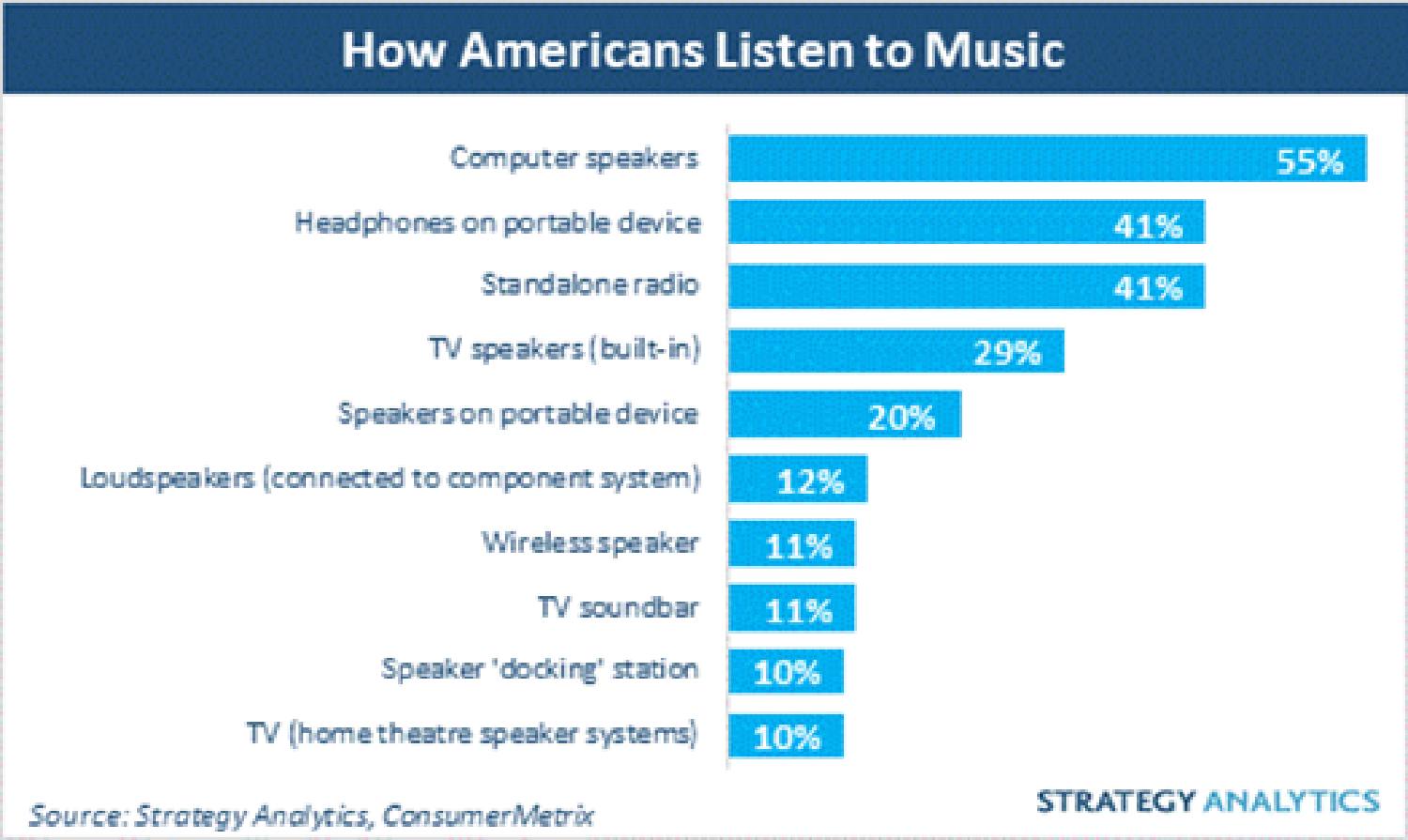
We know this intuitively from walking down the street, and seeing a variety of, at best, mid-range headphones on our fellow travellers. But a survey from 2015 by David Watkins of Strategy Analytics underlines this point. It found that among Americans, computer speakers were the preferred listening device, followed closely by headphones attached to a portable device:
This charts with most recent data, such as IFPI's 2018 Music Consumer Insight Report, which found that 52 per cent of on-demand music listening is via video streaming. A further 86 per cent of consumers still listen to music on the radio. A medium famed, and romanticised, exactly for its lack of audio fidelity.
Then there's where people listen to music. Not in solitary confinement, but out on the streets, on public transport, in the car and in their bedrooms. External sounds, even with whizzy noise-cancelling headphones, has a habit of interfering with music. And that's OK. No one minds.
So, perhaps for the 0.01 per cent of the 0.01 per cent who want to spend $300,000 on speakers there's some point to high resolution audio, but otherwise, there isn't. It's a product no one asked for, with no distinguishing features for the everyday consumer.
Which brings us round to why labels are plunging headfirst into the format. Well, here's a hint, via Billboard again:
Data further shows the distribution of hi-res albums to be rather top-heavy: 77 per cent of the RIAA's highest gold- and platinum-certified records, 79 per cent of one major streaming service's top 100 all-time streamed tracks, 78 per cent of Soundscan's top 100 albums of last year, and 68 per cent of one major streaming service's top weekly tracks.
So it's the biggest tracks which are getting the high resolution treatment. Just as they do when it comes to deluxe editions, or anniversary box sets. Dare we suggest that, as with the Minidisk, the high resolution trend is all about the upsell.
What's strange is that TIDAL, the forgotten streaming service, is already charging $19.99 for access to its high resolution service and has barely made a splash. But with Amazon making noises about launching a high resolution rival, according to Music Business Worldwide, it seems the big tech platforms are also keen to get on board with marketing this futile money spinner.
It wouldn't matter much if there weren't costs involved, but as Izzy pointed outrecently, data leaves an indelible carbon footprint. And uploading millions of high resolution tracks to the cloud will inevitably leave a larger mark on the environment than the current offering of indistinguishable MP3s. It's like bitcoin mining, except for those who want to signal the rarefied nature of their music taste.
But perhaps consumers will bite. After all, we know that price changes the way people experience wine. So why not music?

FT : Bad governance makes banks perilous investments, BBVA and Wells Fargo have

Bad governance makes banks perilous investments
BBVA and Wells Fargo have responded to regulators’ pressure to change how they are governed

As governance changes go, BBVA’s tweak at the end of last year to give its new chief executive a bit more power and its executive chairman a bit less was hardly hold-the-front-page news. All the more so because it coincided with far more interesting rumours — ultimately confirmed in January — that Spanish rival Banco Santander was dramatically ditching plans to hire star banker Andrea Orcel as its new CEO.

That abortive idea continues to haunt Santander. It was conceived — and then killed — by chairman Ana Botín, as the bank took fright at paying the €50m price tag and her senior managers grew nervous about the Italian’s assertive style. Mr Orcel has set in train a legal case against the bank. And Ms Botín has reinstated as chief executive the man who Mr Orcel was due to replace: that hardly looks ideal — or permanent.

By comparison the BBVA changes seem pedestrian. Chairman Carlos Torres — who took over from his longtime predecessor Francisco González last autumn — has had his mandate shrunk from master of everything to chairing the board and overseeing strategy. Chief executive Onur Genç has been upgraded to head the day-to-day running of the business and client relationships. And he now reports to the board rather than to the chairman. Why should anyone care?

Well, for a couple of reasons.

First, good governance really matters. As with many aspects of business, bad practice in governance is easier to prove than good practice — especially when examined with hindsight. Fred Goodwin’s egomaniacal behaviour at the helm of RBS was wrongly tolerated when the bank was riding high. Once it collapsed in the 2008 crisis, the governance shortcomings — a weak chairman, an ineffectual board — were quickly identified as obvious red flags.

Second, regulators really care about this stuff. In the US, banks that have got into trouble — most recently Wells Fargo with its fake accounts scandal — have been forced to bring in robust non-executive chairmen. That has been a big, and welcome, break with the US norm of combining chairman and chief executive in one person. But it may not last. Bank of America recombined the roles under Brian Moynihan. Likewise at Morgan Stanley, under James Gorman. And JPMorgan has long had a chairman-cum-CEO. Late last year, in a rare exception, Citigroup’s chief executive, Mike Corbat, did not apply for the chairman’s role, leaving the jobs split.

In Europe, norms differ drastically — with no obvious fail-safe structure. Certainly the British tradition of having a single board chaired by a non-executive has not been an obviously better guard against disaster than the US combined model. RBS, HBOS and Northern Rock proved as vulnerable as Lehman Brothers, Bear Stearns and Citi.

In France, Société Générale was forced by the terms of the EU’s CRD4 regulations to split its chairman and chief executive position five years ago. But the arrival of Lorenzo Bini Smaghi to chair the board has done little to rattle CEO Frédéric Oudéa, despite growing shareholder criticism and a stock price that is nudging record lows.

The German two-tier model — comprising a non-executive supervisory board and a separate executive team — is no less open to criticism. Just look at the mess Deutsche Bank has found itself in: for at least 15 years the chairman and the broader supervisory board have been guilty of either failing to hold executives to account or becoming so bound up in the strategic direction of the bank that they have stifled the chief executive. Deutsche’s supervisory board chairman, Paul Achleitner, faces a no-confidence vote at next week’s AGM.

Spain offers a different approach again. The tradition of executive chairmen was seen to be so at odds with the spirit, if not the letter, of the EU’s CRD4 regulations that BBVA felt it was sensible to tweak its governance. Spanish banks generally have come under pressure from the European Central Bank to move away from an all-powerful chairman role. If that explains BBVA’s tweaks, it may also be one reason behind Ms Botín’s initial plan to appoint Mr Orcel as a robust chief executive. With that decision upended, she will now have a fine line to tread to keep everyone, including shareholders, happy.

And it is they, of course, who must be the ultimate arbiters of governance. Sensible investors will want banks to be run by driven CEOs kept in check by effective boards to ensure sustainable long-term returns. The unfortunate truth is that sound rules on the subject might guard against disaster. But there is no magic formula for a good honest banker.

FT : Bitcoin jumps above $7,000 to 9-month high

Bitcoin jumps above $7,000 to 9-month high

Bitcoin was hovering above $7,000 on Monday after climbing to a nine-month high over the weekend.

The cryptocurrency jumped to $7,585 on Sunday, its highest level since August, according to Refinitiv data based on the Bitstamp exchange.

Ethereum, the second-largest digital asset by market capitalisation was down 2.6 per cent over the past 24 hours, according to Coinmarketcap

Bitcoin recorded a strong performance last week, rising 22 per cent. That reignited suggestions from the cryptocurrency community that the digital asset acts as a haven in times of uncertainty, as stock markets pulled back on heightened US-China trade tensions.

Bitcoin has surged by more than 90 per cent since the start of 2019, but remains short of its all-time high seen at the end of 2017 when it climbed above $19,000.

>>> What to look at today - 13th of May 2019

Stocks in Asia fell along with U.S. equity futures, the yuan and Treasury yields as investors awaited details on the counter-measures China warned it would impose following last week’s escalation in the trade war between the world’s top two economies.
With no date scheduled for a resumption in bilateral talks, shares dropped in Shanghai and Seoul, while declines were more limited in Tokyo. Hong Kong is closed Monday for a holiday. S&P 500 Index futures fell as much as 1.2%. Ten-year U.S. yields were hovering near the lowest level since early April, just above those on three-month bills. Commodities slipped, led by copper, while the yen edged higher.

Nikkei -0.77% Hang Seng Closed CSI -1.48% Shanghai -1.02% Shenzen -1.04%

Eur$ 1.1231 CNH 6.8893 CNY 6.8579 JPY 109.71 GBP 1.3013 CHF 1.0110 RUB 65.3092 TRY 5.9844 WTI$ 61.76 +0.15%

S&P -1.065% EuroStoxx -0.03% FTSE +0.03% Dax -0.07% SMI +0.32%

Macro :
- China, U.S. Trade Talks Stalled Over Three Areas, Xinhua Says
- Liu Says China, U.S. to Continue Talks in Beijing in Future
- 1MDB’s Jho Low, Rapper Pras Michel Indicted Over Obama Donation
- Yuan May Weaken to 6.95 Per Dollar on Trade Tensions: NatWest

Keep an eye on :
- AC FP : Accor in Talks to Invest Up to $40m in Treebo: Economic Times
- AGS BB : Ageas Joins Bidding Process for Spanish Insurer Caser: Cinco
- AGR AV : Agrana Full Year Net Income EU25.4 Mln
- ALM SM : Almirall First Quarter Ebitda Beats Highest Estimate
- ATRS AV : Atrium Agrees to Sell Polish Malls to ECE for 298 Million Euros
- AVP US : *AVON FALLS 2% AS NATURA DENIES REPORT OF LOAN FOR TAKEOVER
- BAYN GY : Financial Firms Vie to Buy Assets from Bayer: Handelsblatt
- BAYN GY : Bayer Hires Law Firm to Probe Monsanto’s Stakeholder Mapping
- BMW GY : BMW, Daimler to Review Hungary Ramp-Up Plans: Handelsblatt
- CA FP : Carrefour Says Brazil Unit Atacadao Records Tax-Case Provision
- CNE LN : Cairn Energy Is Said to Seek Sale of Norwegian Oil-Field Stake
- CRG IM : Carige May Attract PE Funds After BlackRock Exit, Newspapers Say
- CWC GY : Cewe Stiftung FY Ebit View Midpoint 3.7% Below Est.
- DAI GY : China's BAIC seeks to buy 5 percent Daimler stake - sources - https://reut.rs/2VfTmqb - Reuters
- DAI GY : Mercedes-Benz Mulls Moving C-Class Output Out of U.S.: Auto News
- PBB GY : Deutsche Pfandbriefbank Confirms Guidance as 1Q Profit Unchanged
- EOAN GY : EON 1Q Adj. Ebit Falls 8%, Slightly Beats Estimates
- ENX FP : Euronext to Buy Oslo Bors by End-June After Norway Clearance Norway Doesn’t Set Ownership Level Requirement for Oslo Bors
- FAGR BB : Fagron Buys Mexico-based Cedrosa for EU16.5m in Cash
- FRE GY : Fresenius Seeks Potential Buyers for Transfusion Business: FAZ
- FGP LN : Coast Capital Calls for FirstGroup to Replace Six Directors: FT
- GEO IM : Geox First Quarter Revenue Meets Estimates
- GLEN LN : Zambia Tells Glencore to Surrender Shafts Set to Close
- HYQ GY : Hypoport First Quarter Ebit EU8.0 Mln
- IBE SM : Neoelectra, SDCL May Buy Iberdrola Co-Gen. Plants: Confidencial
- ISP IM : Italy’s Banca IMI Pleads Guilty to Bid-Ridding Scheme for ADRs
- MKS LN : M&S Changes Make It More ‘Relevant,’ Upgrade to Buy: Citi
- MRK GY : Merck KGaA Will Pursue MS Pill Alone After Mixed Trial Results
- MTRO LN : *METRO BANK EXPLORES SALE OF MORE THAN GBP1B WORTH OF LOANS: FT
- NOVN SW : Novartis Eyes Zolgensma Discounts to Get Insurer Coverage: Rtrs
- NOVN SW : Novartis Issues Voluntary U.S. Recall of Promacta, FDA Says
- NSF LN : NSF Plans to Push Ahead With Hostile Bid for Provident: Times
- ORSTED DC : Orsted CEO Says Solar, Onshore Wind Provide Options, JP Reports
- PFG LN : Coltrane Rejects NSF’s Hostile Bid for Provident: Times
- REE SM : Red Electrica to Carry Out Reorganization, Expansion Reports
- RNO FP : Renault Makes Formal Merger Proposal to Nissan, TBS Reports --> Nissan +0.76%
- ROG SW : Chugai (4519) -1.55%
- RDSA LN : Delek: Gulf of Mexico Deal Canceled as First Refusal Executed
- SAL IM : Salini Wins EU530m Contract in Turkey for High-Speed Train
- SGKN SW : St.Galler Kantonalbank Offers New Shares Between CHF415-CHF440
- 9984 JP : SoftBank Group Falls As Much As 4.9% After Uber’s Post-IPO Slump
- SOI FP : Soitec Agrees Acquisition of EpiGaN for EU30m
- STARB SS : Starbreeze Divests Its Indian Subsidiary Dhruva for $7.9m
- STOB LN : *STOBART GROUP TO PICK DAVID SHEARER AS NEW CHAIR: SKY
- TELIA SS : Telia Gets EU Probe Into Takeover of Bonnier TV Operations (1)
- TKA GY : Thyssenkrupp Reaches Pact With IG Metall for Job Cut Program
- TKA GY : Thyssenkrupp Open to Partnerships, Asset Sales: Handelsblatt
- TIS IM : Italian Investors Agree to Buy 22% Stake in Tiscali
- FP FP : Goes Further in Liquefied Natural Gas With $8.8 Billion Deal in Africa - WSJ - https://on.wsj.com/30e8zLN
- UBER FP : Uber's Fall Could Postpone Payday for Kalanick, Early Investors
- UNA NA : Unilever Considers $1 Billion Bid for Skincare Brand: Telegraph
- VIFN SW : Vifor Pharma’s Phase-II Amber Study Meets Primary Endpoint
- VOD LN : Vodafone May Sell Tower Firm Stake to Redeem Pledged Shares: ET

>>> Europe : Brokers Upgrades & Downgrades - 13th of May 2019

>>> Up
* Getinge Upgraded to Reduce at AlphaValue
* Hochtief Upgraded to Outperform at Macquarie
* Marks & Spencer Upgraded to Buy at Citi
* Shell Upgraded to Buy at HSBC; PT 27.40 Pounds

>>> Down
* Air France-KLM Cut to Underperform at Bernstein; PT 7 Euros
* Ambu Downgraded to Hold at ABG; PT 155 Kroner
* Bechtle Downgraded to Hold at Bankhaus Metzler; PT 95 Euros
* Casino Downgraded to Reduce at Kepler Cheuvreux; PT 30.70 Euros
* Evraz Downgraded to Underweight at Morgan Stanley; PT 5 Pounds
* Intu Downgraded to Underweight at JPMorgan; PT 94 Pence
* Man Group Downgraded to Neutral at Goldman; PT 1.50 Pounds
* MTU Aero Downgraded to Sell at Citi
* Tyman Downgraded to Add at Peel Hunt
* Verkkokauppa.com Cut to Accumulate at Inderes; PT 4.40 Euros

>>> Initiation
* Medica Rated New Reduce at Peel Hunt; PT 1.43 Pounds
* Zegona Comms Rated New Overweight at Barclays; PT 1.30 Pounds

>>> Call
* Air France Downgraded at Bernstein Amid Rising Fuel, Staff Costs
* M&S Changes Make It More ‘Relevant,’ Upgrade to Buy: Citi
* MTU Cut to Sell as Citi Sees Better Option in Rolls-Royce