What Caused Last Night's Bitcoin Flash Crash
Shortly before 11pm EDT on Thursday night, we reported that cryptos suddenly jerked lower with Bitcoin flash-crashing over 15%, sliding as low as $6,395 on Bitmex XBTUSD perpetual swap - the most liquid bitcoin contract globally - before bouncing back.
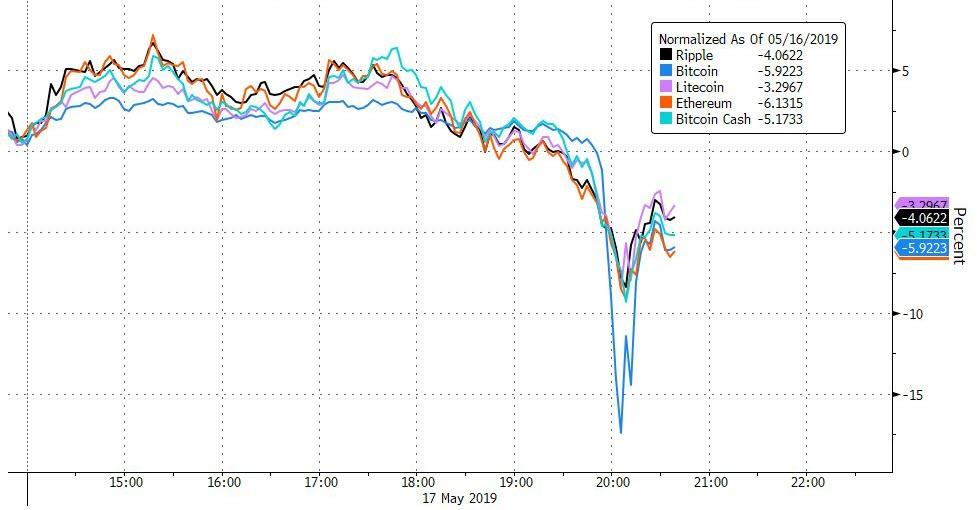
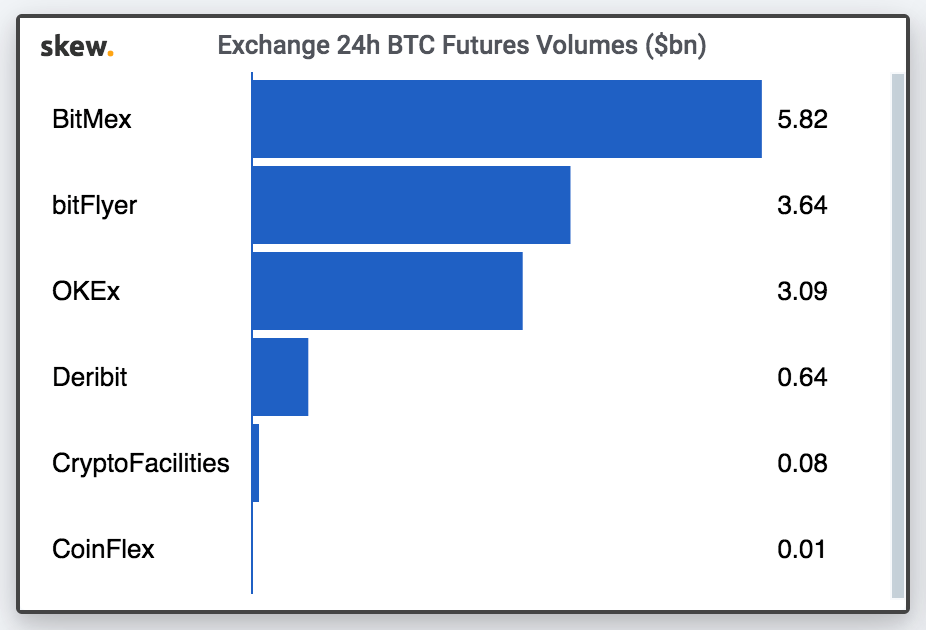
The insta-crash, which took place in a news vacuum and without an immediate catalyst, looked technical and positioning-led on the derivatives side. Courtesy of our cryptocurrency derivative expert friends at Skew, below is a breakdown of what happen in those minutes that send Bitcoin over $1000 lower.
To start with, 5,000 bitcoin went through on European physical exchange Bitstamp between 3.45 a.m and 4.15 a.m (London time, UTC +1) crashing the price down to $6,178 on the exchange.
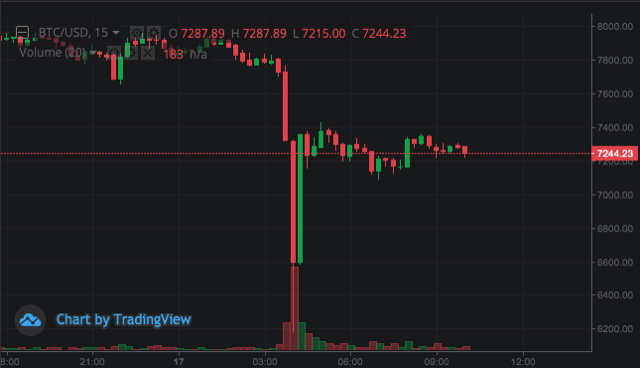
This $35 million volume shouldn’t have been too much of a deal in itself - Kraken had a similar event a few weeks back on the 25th of April - but Bitstamp accounts for 50% of the bitcoin index at Bitmex - the largest bitcoin derivatives exchange. This index is being used to trigger liquidations of the bitcoin XBTUSD perpetual swap contract - the most liquid derivatives instrument where trading occurs on margin and which traded $5bln+ daily over the last week.
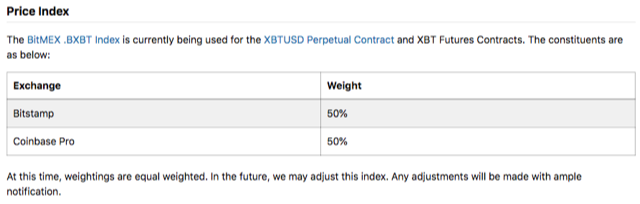
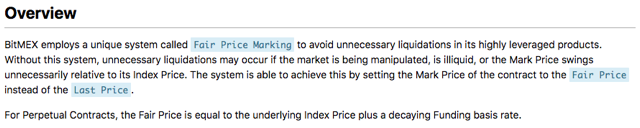
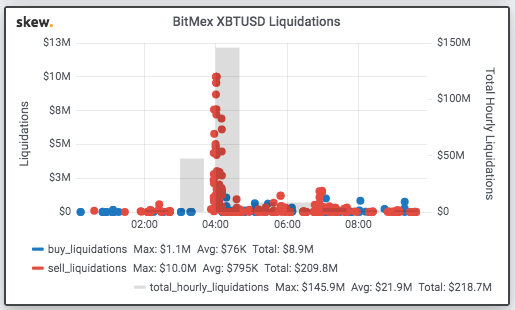
As a result, more than $200mln of sell liquidations occurred which took the market down with it
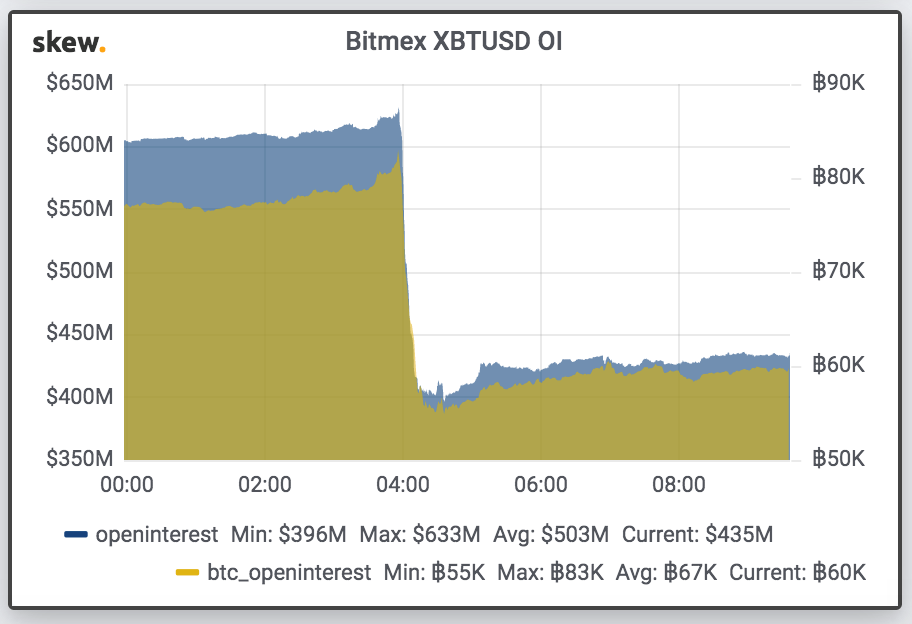
As the crash accelerated, overleveraged positions got cleared, resulting in open interest down by a third from $630mln to $400mln
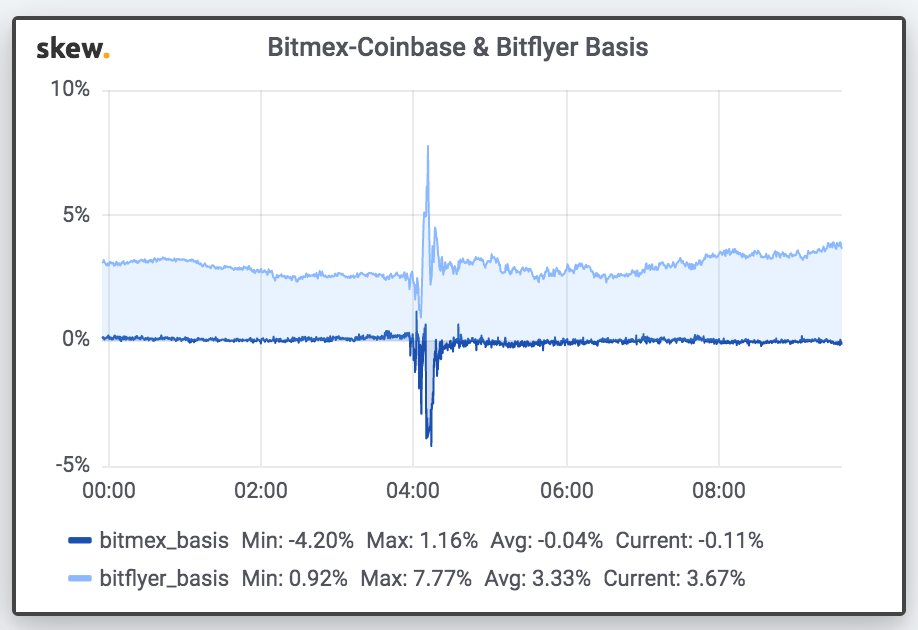
The Basis (Bitmex XBTUSD - Coinbase BTCUSD) instantly plunged to - 5% - very unusual to see the bitmex perp decoupling to such an extent.
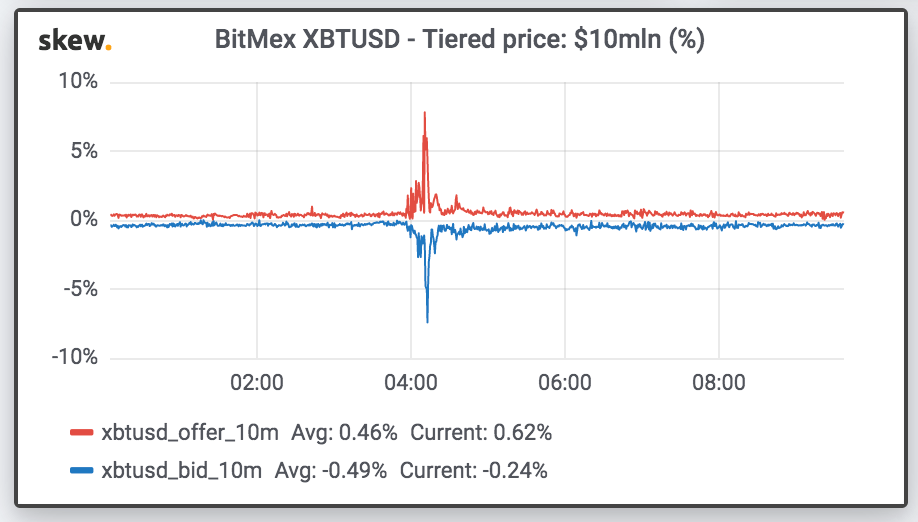
Liquidity - measured by bid offer spread of $10mln in the XBTUSD order book - evaporated for a moment.
Overall, Sk3w concludes that "this was the first serious alert since bull market restarted on the 2nd of April. It's also another serious session for bitcoin with > $12bln going through on the futures side in last 24h."
Auto-Loan Delinquencies Spike To Q3 2009 Level, Despite Strongest Labor Market In Years
But what will happen to banks and automakers when the cycle turns?
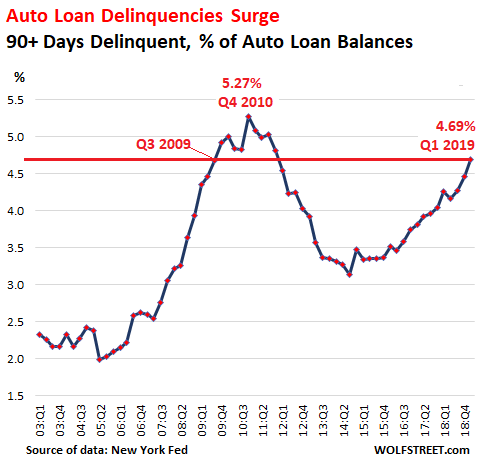
Serious auto-loan delinquencies – 90 days or more past due – jumped to 4.69% of outstanding auto loans and leases in the first quarter of 2019, according to New York Fed data. This put the auto-loan delinquency rate at the highest level since Q4 2010 and merely 58 basis points below the peak during the Great Recession in Q4 2010 (5.27%):
These souring auto loans are going to impact banks and specialized lenders along with the real economy – the automakers and auto dealers and the industries that support them.
This is what the banks are looking at.
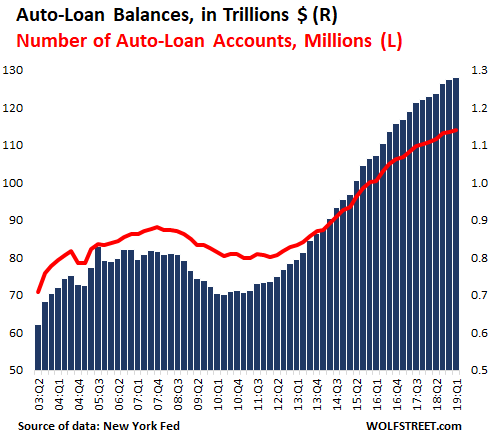
The dollars are big. In Q1, total outstanding balances of auto loans and leases rose by 4% from a year ago to $1.28 trillion (this amount by the New York Fed is slightly higher than the amount reported by the Federal Reserve Board of Governors as part of its consumer credit data). Over the past decades, since in Q1 2009, total auto loans and leases outstanding have risen by 65%.
But the number of auto-loan accounts has risen only 34% over the decade, to 113.9 million accounts in Q1 2019. In other words, what caused much of the increase in the auto-loan balances is the ballooning amount financed with each new loan and longer loan terms that causes those loans to stay on the books longer.
The chart below shows the dollar amounts of auto loan balances (blue columns, right scale) in trillion dollars and the number of auto-loan accounts (red line, left scale) in millions:
Of this ballooning amount of auto loans, 4.67% is seriously delinquent (90+ days). This amounts to $60 billion. This chart shows the trajectory of what the banks and specialized lenders are facing, in billion dollars:
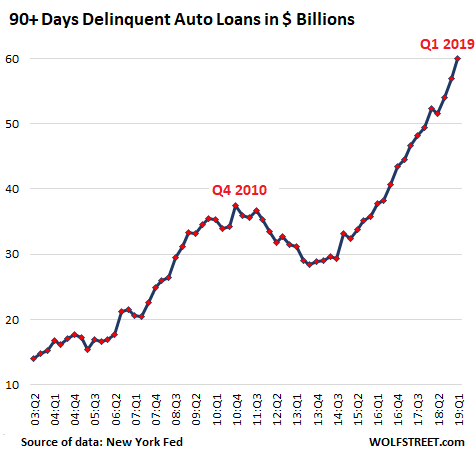
For lenders, these delinquent loans don’t represent total losses. This debt is collateralized by vehicles, which can be repossessed without much of a delay – unlike foreclosing on a house. But generally, the loan amount is far higher than what a repossessed vehicle will bring at the auction. Perhaps the banks can recover 50% on average of the loan amount. So, if all of the current vintage of 90+ day delinquencies turn into repossessions, and the banks lose 50% on them, it would amount to $30 billion in loan losses.
But there are more loans going delinquent even as we speak, and they will become seriously delinquent in Q2, and the next batch in Q3, and so on, and this is working itself forward wave after wave. So the cumulative losses over the next two years will be higher.
These losses are spread over thousands of banks, credit unions, and specialized non-bank lenders, and over asset-backed securities holders, such as pensions funds, other institutional investors, and bonds funds, and most will get through this by just licking their wounds. But some smaller subprime-focused non-bank lenders will collapse, and a few have already collapsed. So these defaulted auto loans are going to hurt, and they’re going to take down some smaller lenders, but they’re not going to take down the US banking system. They’re just not big enough.
This is what automakers are facing.
Lenders have already figured out that subprime auto loans have soured. They’ve been seeing this since 2015 or 2016. And ever so gradually, lenders have tightened their subprime underwriting standards. And subprime customers that don’t get approved for a new-vehicle loans may get approved for a much smaller loan for a cheaper used vehicle. This process has already been shifting potential new-vehicle customers to used vehicles.
For automakers, this has already shown up in their sales. New-vehicle sales, in terms of vehicles delivered to end-users, peaked in 2016 and have been declining ever since. Through Q1 this year, new-vehicles sales, fleet and retail, were down 3.2% from Q1 2018, and so 2019 looks to be another down-year for the industry – the third in a row.
But this isn’t happening in a recession with millions of people losing their jobs and defaulting on their auto loans because they lost their jobs. This is happening during one of the strongest labor markets in many years. It’s happening when the economy is growing at around 3% a year. It’s happening in good times. And people with jobs are defaulting.
This is not a sign of a worsening economy, but a result of years of aggressive and reckless auto lending, aided and abetted by yield-chasing investors piling into subprime auto-loan backed securities because they offer a little more yield in an era of central-bank engineered financial repression. It’s a sign like so many others in this economy, that the whole credit spectrum has gone haywire over the years. Thank you Fed, for having engineered this whole thing with your ingenious policies. So now there’s a price to pay – even during good times.
And we already know what a scenario looks like when the cycle turns, when unemployment surges and millions of people lose their jobs and cannot make their car payments, even people with a prime credit rating – that will then turn into subprime. We know what happens to the auto industry when the economy dives into a recession. We know what this will look like because we’ve seen it before. The auto industry is very cyclical.
What we haven’t seen before is this kind of credit stress among car buyers during good times – with the bad times still ahead. So when credit stress gets this bad during good times, we don’t even want to imagine what it might look like during bad times. Whatever that scenario will be, it won’t be fun for automakers.
The surprise was in the SEC 10-Q filing when no one was supposed to pay attention. Read... Tesla Discloses Record Pollution Credits for Q1: Without Them, it Would Have Lost $918 Million and Bled $1.14 Billion in Cash
Used Class 8 Truck Sales Crash
The outlook for heavy duty Class 8 trucks, an industry used as a leading indicator barometer for the broader economy, continues to deteriorate. Just days after we reported the latest awful order number for new Class 8 trucks – and just hours after we reported industry experts' negative outlook for the rest of 2019, used truck sale data has completed the trifecta of misery for the freight industry.
Preliminary data shows that used truck sales in the Class 8 segment fell 13% in April compared to last year, according to FreightWaves.Used truck sales as a whole fell 5% in April compared to a 25% uptick in March. The average price of a used truck rose 14%, while at the same time average miles contracted and average truck age was relatively flat, according to ACT research.
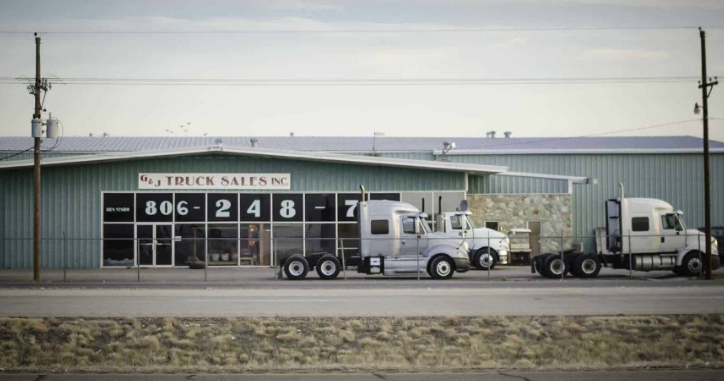
Steve Tam, vice president of ACT said: “Recent conversations with market contacts suggest dealers are very aware that conditions are changing. Auction and wholesale volumes, as well as pricing, are softening.”
He continued: “Some used truck buyers and sellers are paying close attention, but others may be only casually aware of any looming concern. Most truckers have yet to make the leap, as signified by retail markets that are outperforming their dealer counterparts."
Year to date, sales of used trucks have fallen 16%.
Class 8 trucks, which are made by Daimler (Freightliner, Western Star), Paccar (Peterbuilt, Kenworth), Navistar International, and Volvo Group (Mack Trucks, Volvo Trucks), are one of the more common heavy trucks on the road, used for transport, logistics and occasionally (some dump trucks) for industrial purposes. Typical 18 wheelers on the road are generally all Class 8 vehicles, and traditionally are seen as an accurate coincident indicator of trade and logistics trends in the economy.
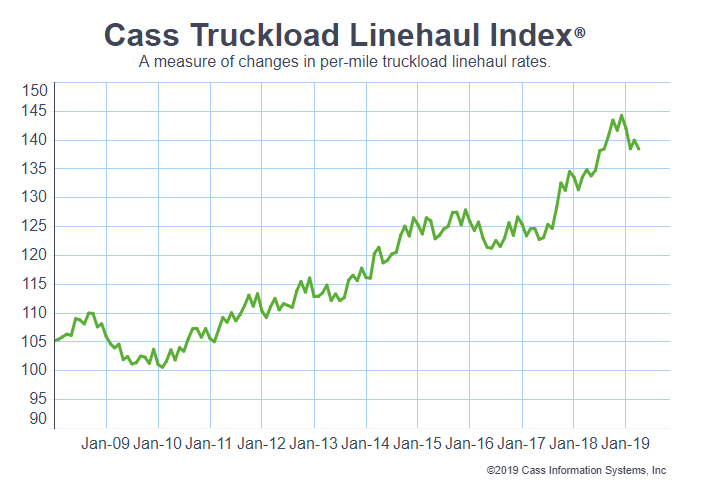
The Cass Freight Index report for the month ended April 2019 also painted a dire picture for freight heading into the end of the second quarter. The report says that "continued decline" in the freight index remains a concern, pointing out that shipments have fallen 3.4% year over year while expenditures have risen 6.2%. Sequentially on a monthly basis, shipments are down 0.3% while expenditures ticked up 0.7%.
North American Class 8 net order data shows the industry booked 14,800 units in April, down 57% from a year-ago. The number also marks a sequential decrease of 6.2% from March. The decline is being blamed on companies filling orders from a bloated backlog of last year’s record purchases and buyers juggling remaining orders. The numbers from last month were the lowest for an April since 2016.
Year to date, the numbers look ugly. There have been 63,000 trucks ordered, a 63% percent decline from the 169,186 orders placed during the same period in 2018. And it doesn't look like the rest of the year is going to get any better.
Tesla CEO Elon Musk launches new ‘hardcore’ cost-cutting effort, will review all expenses - http://bit.ly/2w5vLOI
Tesla CEO Elon Musk told employees today that he and the company’s new CFO will personally review all expenses going forward in a ‘hardcore’ attempt to cut cost following massive losses during the last quarter.
Musk made the announcement in an email sent to all Tesla employees and obtained by Electrek.
In the email, the CEO argued that it is “extremely important” to “examine every expenditure at Tesla, no matter how small.”
Even Tesla still had a $2.2 billion cash position at the end of last quarter, Musk said that it wouldn’t last that long with their burn rate:
“This is a lot of money, but actually only gives us about 10 months at the Q1 burn rate to achieve breakeven!”
In order to stop the bleeding, the CEO is implementing a new cost-cutting initiative that will see all the teams examine every payment, including “parts, salary, travel expenses, and rent.”
The CEO added that Zach Kirkhorn, Tesla’s new CFO, will review and sign every page of outgoing payment while Musk himself will review and sign every tenth page.
Musk described the effort as “hardcore”:
“This is hardcore, but it is the only way for Tesla to become financially sustainable and succeed in our goal of helping make the world environmentally sustainable.”
He said that employees have a few weeks to take ownership of expenses and find ways to make improvements.
It’s not the first time that Musk called for a company-wide effort to cut costs.
After Tesla first achieved a Model 3 production rate of 1,000 units per day last year, Musk turned his focus on cost and encourage everyone to make contributions.
At the time, the CEO said that very small efficiency improvements, like “better packing density or rearranging process flow to a fewer forklift moves”, can have a great impact if everyone works on it.
The new cost-cutting effort comes after Tesla laid off many employees in another attempt to reduce cost.
Earlier this month, Tesla also closed a massive $2.7 billion capital raise in order to support its operations.
--> Adidas Supply chain at risk...stock trading on historical Highs
Kraft Heinz, Adidas and Gap are among the companies whose supply chains run through Xinjiang
AKSU, China—Western companies, including brand name apparel makers and food companies, have become entangled in China’s campaign to forcibly assimilate its Muslim population.
Adidas AG, Hennes & Mauritz AB, Kraft Heinz Co. , Coca-Cola Co. and Gap Inc. are among those at the end of the long, often opaque supply chains that travel through China’s northwest region of Xinjiang. Residents there are routinely forced into training programs that feed workers to area factories, according to locals, official notices and state media.
Political indoctrination is a significant component of the programs, which are aimed at ethnic Uighurs and other Muslim minorities, according to official notices. Along with vocational skills, the curriculum covers Mandarin Chinese, the importance of the Communist Party and national unity, Chinese law and how to counter extremism—such as not dressing too conservatively or praying too frequently. The programs can include militarylike drills.
For workers and factory bosses, resistance to such programs could result in detention as suspected extremist sympathizers.
Some companies said such compulsory training programs would contravene their policies for suppliers, which mandate responsible workplace conditions, free of discrimination.
Much of this has taken place under the radar. Beijing has directed Chinese companies to bring jobs to Xinjiang, often through subcontracting that isn’t known to Western companies, as part of the government’s effort to reduce what it says is violence and religious extremism in the area.
Authorities in Xinjiang have also put in place aggressive surveillance measures, razed traditional Uighur neighborhoods and drawn international protest over detention camps for Muslims, a separate category from the job-training programs.
In interviews, local officials said residents weren’t being forced into training programs, and that they are helping impoverished residents find jobs. Xinjiang’s government said in a written statement there is no forced labor in the region and called any talk of it “rumor and slander.”
A large mill for Huafu Fashion Co. in Aksu runs its workers through a monthlong job-training program in cooperation with the government. The city, near China’s border with Kyrgyzstan, is blanketed in razor wire, police checkpoints and security cameras. Three-quarters of its residents are Uighur.
A photo in an online announcement for Huafu’s training site, opened in December 2017 with 600 trainees, shows female workers dressed in camouflage standing at attention. The factory is billed as the world’s largest mixed-color cotton yarn mill, and the local government said in official notices the Huafu site was part of the “establishment of large-scale vocational training.”
Speaking to residents is difficult; local officials interrupted interviews during The Wall Street Journal’s recent trip to the region. In one interview near the Huafu mill, with officials hovering nearby, 20-year-old Subinur Ghojam and a co-worker said they had come to the factory from a training program. “Before I used to have extremist thoughts, but now they’re all gone,” Ms. Ghojam said.
After she was heard telling a reporter she had been in a training center, officials took her into a room in an adjacent restaurant. She then returned and said, “They say it’s secret. Even speaking of it is not allowed.”
The gray yarn made by Huafu in Xinjiang goes to factories elsewhere in China and in Bangladesh and Cambodia that weave T-shirts for Hennes & Mauritz’s H&M retail chain, two people familiar with the company say. The yarn also turns up in the supply chains of Adidas and Esprit Holdings Ltd. , although the brands don’t buy directly from Huafu, according to the companies.
In response to queries, Adidas said it has advised its suppliers to suspend yarn purchases from Huafu pending its investigation. Adidas had already banned its suppliers from hiring workers through Xinjiang government agencies in 2016, saying it was concerned about forced labor and discrimination. Esprit said it is investigating Huafu. H&M said it has no plans to begin new supplier relationships in the region.
Huafu, based in eastern China, said all its workers are there voluntarily, and its labor management system was “fully compliant with international conventions and regulations.” In a statement, the company said its in-house training program is mandatory for all new workers regardless of ethnicity or religion.
A Gap spokeswoman said two of its suppliers use yarn from mills in Xinjiang, and the brand is currently sorting supplier mills as “preferred” and “non-preferred.” The company has “communicated to our vendors’ entire mill base our expectations of their social and environmental performance, which are conditions of doing business with us,” she said.
A few years ago, Chinese President Xi Jinping ordered a full-scale crackdown in Xinjiang after bombings and other violence authorities blamed on Islamic militants. Boosting employment was central to the government’s strategy. “A person with a job will be stable,” Mr. Xi told local officials in 2014.
Major garment makers have been given a five-year tax exemption and subsidies for electricity, land and worker training to move production to Xinjiang.
Nate Herman, a senior vice president for the American Apparel and Footwear Association, an industry trade group, said his group has discussed the Uighur situation and the opacity of supply chains in Xinjiang. “We know there’s an issue,” he said.
In southern Xinjiang, the governments of Hotan and Kashgar announced in 2017 a three-year push to place 100,000 “surplus rural laborers” in vocational programs.
In Aksu, officials have gathered up more than 4,000 residents over the past two years for deradicalization and textile-making courses under “concentrated, closed-off, military-style management” to meet factories’ labor needs, Aksu’s human resources and social services bureau said in a notice in December. Many were headed for textile factories, the notice said.
During the Journal’s visit, village bulletin boards around Aksu displayed lists of residents below the poverty line, with their full names, national ID numbers and reason for impoverishment (“lack land,” “lack skills,” “lack motivation”). All of the dozens of listed names viewed by the Journal in two villages carried the same case resolution: “transferred to work.”
Documents related to training programs were deleted from government websites after the Journal posed questions to local officials.
A Uighur outside of the city remembers officials sweeping through villages to “organize” locals to work in textile factories last year. If the workers quit, the person said, officials return to organize them again.
“If the government tells you to go work, you go,” this person said.
Li Xinbin, propaganda chief of Aksu, said he and other officials are assigned individual families to lift out of poverty, defined as an annual income below 2,300 yuan ($340), by the end of this year. They use personal time and funds if necessary, and must log their progress in a smartphone app. Mr. Li said the city had no “training centers” of any kind.
Chinese officials have applied the term vocational training broadly, including for detention camps where Uighurs say they were tortured and forced to renounce Islam.
Adrian Zenz, who researches Xinjiang’s camps, said the detention centers and shorter term job-training programs form a continuum of coercion. “In either case, these types of training are not really voluntary but government-mandated.”
Hong Kong-based Esquel Group—the world’s largest contract shirt maker, which says its customers include Calvin Klein, Tommy Hilfiger, Nike Inc. and Patagonia Inc.—set up three spinning mills in Xinjiang to be close to the region’s cotton fields. Esquel CEO John Cheh said that in 2017 officials began offering the company Uighurs from southern Xinjiang as workers.
Esquel took 34 in total the past two years, with all hiring decisions and training made independently of the government, Mr. Cheh said: “We were in no way forced to employ anyone.”
PVH Corp. , the parent company of Calvin Klein and Tommy Hilfiger, said it plans to increase scrutiny of raw materials suppliers. Nike said it was asking its suppliers if they use cotton from Xinjiang. Patagonia declined to comment.
Xinjiang Jinliyuan Garment Co. put villagers supplied by the government through a training program that included “de-extremification” before setting them to work, according to government announcements.
Jinliyuan made some jackets for European-based retail chain C&A, a unit of Cofra Holding AG. A Xinjiang TV report in July also showed workers at the factory sewing pink children’s parkas that featured Walt Disney Co. character Minnie Mouse.
“Before we would recruit workers one by one ourselves, but now the human resources and social security bureau and management committees find labor for us,” said production manager Zhang Yujiang in the broadcast.
A Disney spokeswoman said the company doesn’t have relationships with garment factories in Xinjiang and didn’t authorize the Aksu mill to produce the parkas. She wouldn’t specify whether the garments were counterfeit. A spokesman for C&A said the retailer bought jackets from the Aksu mill last year after audits found no issues. Jinliyuan didn’t respond to requests for comment.
A July article in the state-run Xinjiang Economic Journal said that executives of Cofco Tunhe Co. visited Aksu’s Aketuohai village to recruit villagers to their factory to help the government’s poverty-alleviation push. The state-run company is China’s largest tomato processor, with Xinjiang as its main production base, supplying tomato paste to Kraft Heinz and Campbell Soup and sugar to Coca-Cola.
According to the article, managers noted some villagers weren’t eager to work, saying “the vast majority of them ran back within a few days.”
Cofco Tunhe said in a statement that events described in the article “never happened.” It said all its workers were there voluntarily.
Kraft Heinz said 5% of its tomato supply came from Xinjiang, with none sold in the U.S. Campbell Soup said less than 2% of its tomato paste comes from China, with those products sold in Australia and Malaysia. Coca-Cola said it requires suppliers to follow “our strict policies on responsible workplace and human rights” and uses third-party agencies to monitor compliance.
Xinjiang companies are expected to make regular donations to the local government for policy campaigns and public security. In its 2017 annual report, Cofco Tunhe said it donated 3.5 million yuan ($520,000) to Aksu’s Wushi County government for vocational skills training, low-income housing, tomato industry development and a security patrol car.
Cofco Tunhe said the donated vehicle was a service car to assist residents.
After the initial training, Xinjiang factories are expected to monitor workers and conduct periodic deradicalization programs, according to factory announcements. At the Aksu textile park, a subsidiary of Shanghai-listed shirtmaker Youngor Group Co. held such a session for 240 workers in May 2017 at the request of park management.
At the meeting, workers were told not to pray in public or keep books with ethnic or religious content, according to an online post by Youngor. The post said employees were told not to browse or spread online content harmful to ethnic unity, and that the company would tighten its internet oversight.
Youngor didn’t respond to requests for comment.
Corrections & Amplifications
Xinjiang Jinliyuan Garment Co. made some jackets for retail chain C&A. An earlier version of this article incorrectly said the factory is making jackets for C&A.
Italian deputy PM Salvini lays out EU reform plan
Populist leader of League party calls for budget rewrite and reform of banking and deficit rules
Italian deputy prime minister Matteo Salvini has laid out his three-point plan to change the EU from within, ahead of a rally in Milan on Saturday of far-right and nationalist parties intended as a show of strength among Eurosceptic forces before this months’ European elections.
Mr Salvini, leader of Italy’s League party, said his first aim if he gained sufficient influence in the upcoming EU vote was to rewrite the EU’s seven-year budget, which he said was “unacceptable” in its present form.
He also said he would change EU banking rules, which he accused of putting Europe’s “entire banking system at risk”. He said he also wanted to change the EU’s “fiscal and economic constraints” and return to “pre-Maastricht rules”, referring to requirements that EU nations stick to prescribed limits on public debt and deficits.
Italy has recently been at loggerheads with the European Commission over its budget plans, which are expected to break EU rules by a wide margin next year.
Asked if he saw himself as the leader of the far-right in Europe, Mr Salvini said: “In Italy they use terms sovereigntist and populist in a pejorative way but I am extremely proud to be considered in this way, in the original meaning of the word. Far-right, I do not see myself in that term, but it is a vision of Europe that is different and legitimate.”
Armoured vehicles were already blocking entrances to Milan’s Piazza del Duomo on Friday where a huge stage on one side of the city’s gothic cathedral has been set up for Saturday’s rally.
Mr Salvini said he would be joined by representatives of populist parties from 11 EU countries, including France’s FN and the Alternative for Germany (AfD).