Asian stocks and U.S. equity futures climbed on Monday after President Donald Trump suspended his plans for U.S. tariffs on Mexico. Treasuries fell as demand for havens sank.
The Mexican peso jumped the most in almost a year after the U.S.-Mexico agreement that was unveiled late Friday. Japanese, South Korean and Hong Kong stocks rose, as did crude oil prices. Gold fell. China’s shares also rose as the country’s markets reopened after a long weekend. People’s Bank of China Governor Yi Gang said Friday there’s “tremendous room” to ease monetary policy. The yen touched its low of the session after Governor Haruhiko Kuroda said the Bank of Japan can deliver more stimulus if necessary.
Nikkei +1.13% Hang Seng +2.03% CSI +1.54% Shanghai +1.08% Shenzen +1.69%
Eur$ 1.1304 CNH 6.9519 CNY 6.9339 JPY 108.67 GBP 1.2704 CHF 0.9911 WTI $54.35 +0.60%
S&P +0.31% EuroStoxx +0.48% Dax +0.63% FTSE +0.55% SMI +0.69%
Macro :
- Oil Extends Gains on Saudi-Russia Supply Pledge, U.S. Rigs Data
- United Technologies, Raytheon to Combine as Defense Giant (1)
- China May Rare Earth Exports Fall 15.9% on Month
- Joe Biden’s Easy Ride in 2020 Race Hits Pothole in a Bad Week
- Le Maire Says Trade War May Mean Global ’Economic Crisis’: CNBC
- EU to Warn Business Not to Expect Help Over No-Deal Brexit: FT
Keep an eye on :
- AGL IM : Autogrill to Spend EU1.5b on Growth Abroad: CEO to Corriere
- BYND US : Beyond Meat Short-Sellers Take a $155 Million Beating in Rally
- COPN SW : Cosmo Says FDA Accepts NDA Filing of Remimazolam for Review
- DBK GY : Deutsche Bank to Hire up to 50 Senior Traders, Bankers: FN
- DBK GY : Deutsche Bank Auditors Find Lapses in Cheque Screening: FT
- DBK GY : Deutsche Bank Downgraded to BBB by Fitch on Continued Difficulty
- DIA SM : Regulator Won’t Start Proceedings Over Ana Botin’s Tweet on DIA
- ENEL IM : Germany to Sell Stakes in Foreign Nuclear Companies: Der Spiegel
- ENGI FP : Germany to Sell Stakes in Foreign Nuclear Companies: Der Spiegel
- ENX FP : Euronext Controls 97.7% of Oslo Bors VPS Capital
- ERF FP : Eurofins Says No Evidence of Unauthorized Theft in Cyberattack
- FXPO LN : Ferrexpo Investors Show Discontent With Miner’s Accounts
- FCA IM : Fiat, Renault Chairmen Discussed Reviving Merger, Reuters Says
- FCA IM : Fiat Chrysler Recalls Nearly 300,000 Ram 1500s on Software Flaw
- GLE LN : MJ Gleeson CEO to Step Down in Disagreement Over Pay: Sky News
- HDD GY : Heideldruck Seeks Another Strategic Investor: Euro Am Sonntag
- IBE SM : Germany to Sell Stakes in Foreign Nuclear Companies: Der Spiegel
- KER FP : Clock Ticks on Giorgio Armani’s Vast Empire of Timeless Fashion
- MC FP : Clock Ticks on Giorgio Armani’s Vast Empire of Timeless Fashion
- MS I M : Mediaset, Mediaset Espana to Be Merged Into Dutch Holding
- MS IM : Berlusconi’s Fininvest May Own Over 50% Voting Rights in MFE
- METSO FH : Metso to Acquire McCloskey in EU279m Deal
- MOSB LN : Gatemore Capital Takes 10% Stake in Retailer Moss Bros: Sky News
- NN NA : Dutch Insurer Vivat ‘Seems Like a Good Deal’ for NN: Degroof
- ALOCA FP : Oceasoft: Accord W/ Banking Partners on Redemption Conditions
- OTE1V FH : Outotec Awarded EU250M Copper Plant for Baikal Mining Company
- UG FP : PSA Is Always Open to New Deals, CEO Tavares Tells Expresso
- RAMI FH : Loxam Offers EU9.00 for Each Share of Ramirent
- RNO FP : Renault's 20-Year Marriage With Nissan May Be in Trouble
- RNO FP : Nissan Says Renault Plan to Abstain From AGM Vote `Regrettable'--> Nissan +0.88%
- RNO FP : Renault Could Abstain on Nissan Governance at Nissan AGM: Source
- RNO FP : *ROSTEC PLANS TO SELL RENAULT ~8% OF AVTOVAZ FOR 10B RUBLES: RIA
- RNO FP : After Fiat Flop, Senard Faces Added Pressure to Fix Renault
- RVLV US : *CITRON SAYS IT EXPECTS REVOLVE STOCK TO TRADE TO $50 ( close $34 +88%)
- ROG SW : Roche and Spark Get FTC Request for Extra Info on Spark M&A
- RDSA NA : Shell Says St. Fergus Capacity Restored After Unplanned Outage
- SEV FP : Rosneft and Suez to Consider Creation of Joint Venture
- SIE GY : Siemens Mobility Wins ~EU1.1B Order in Russia
- SIE GY : Gazprom, Siemens Discuss Creation of Russian Joint Venture
- TEG LN : *TEN ENTERTAINMENT: WOODFORD CUTS POSITION TO 5.54% VS 10.08%
- TER FP : Terreis Files Buyback Offer for Ordinary, Preference Shares
- UBI FP : EA and Ubisoft Have ‘Most at Stake’ as E3 Summons Gamers to L.A.
>>> Up
* Aegon Upgraded to Neutral at Citi
* Allianz Upgraded to Buy at Citi
* Generali Upgraded to Neutral at Citi
* Industrivarden Raised to Buy at Kepler Cheuvreux; PT 236 Kronor
* Neste Upgraded to Buy at Citi
* Prudential Upgraded to Buy at Citi
* RSA Upgraded to Buy at Citi
* S4 Capital Upgraded to Buy at HSBC; PT 1.80 Pounds
* Saipem Upgraded to Hold at Jefferies; PT 4.65 Euros
* Taylor Wimpey Upgraded to Hold at Shore Capital; PT 1.60 Pounds
* Vesuvius Upgraded to Top Pick at RBC; Price Target 7 Pounds
>>> Down
* FirstGroup Downgraded to Reduce at HSBC; Price Target 90 Pence
>>> Initiation
>>> Call
* Axa Among Citi’s Top Europe Insurer Picks, Allianz, Aegon Raised
* Addtech Expectations too High, DI Says With Sell Recommendation
* Playtech Gets Buy Rating as Jefferies Sees Positive Change Ahead
* Metall Zug Falls on Warning of Break-Even 1H; Kepler Cuts Stock
Recessionary Panic: Eurodollars Soar To Levels Last Seen During The European Financial Crisis Amid Record Bond Inflows
If one didn't have access to stock prices, one would be left with the impression that the global market is on the verge of an outright catastrophe. Here's why.
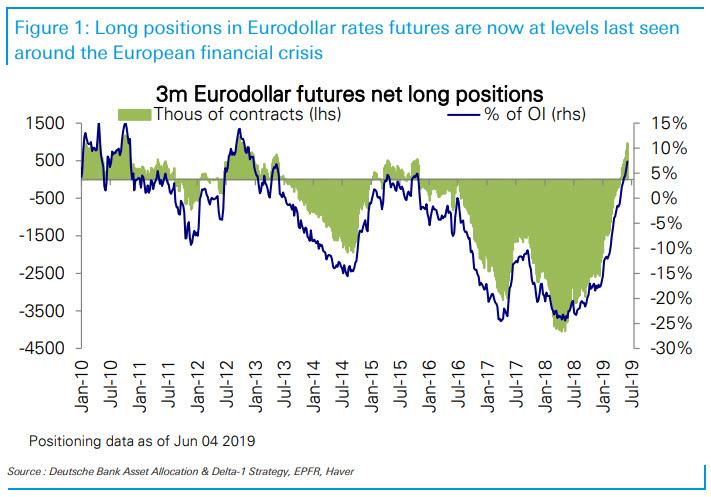
With the rates market now pricing in almost 4 rate cuts by the end of 2020, long positions in Eurodollar rates futures are now at levels last seen around the European financial crisis, suggesting that traders are bracing for a deflationary tsunami to sweep across the world (of course, stocks are once again near all time highs, because, well, the Fed and more QE is just over the horizon).
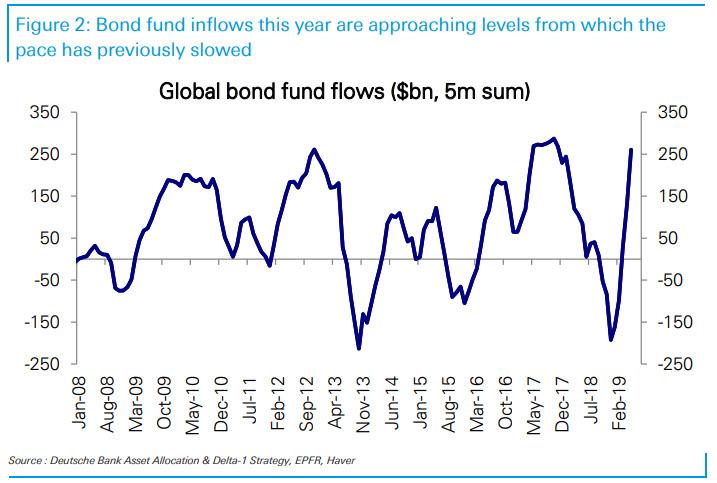
Meanwhile, according to the latest EPFR data, bond funds again raked in enormous inflows ($17.5b), as they have been doing all year (even as stock outflows continued unabated). According to Deutsche Bank calculations, this brings total inflows this year to a massive $261BN, approaching the largest on record seen over comparable periods, to levels from which the pace has slowed historically, and yet there is no sign that the great rotation from stocks to bonds is slowing. Quite the opposite.
Excluding riskier categories like HY (-$2.9bn), bank loans (-$1.4bn) and EM (-$0.7bn), bonds in fact saw even larger inflows ($22.7bn) this week, the largest on record...
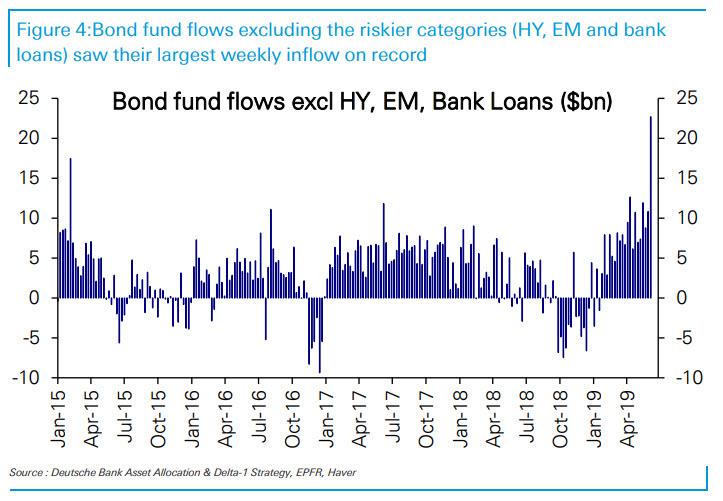
... with government bond funds (+$8.9bn) seeing the bulk according to DB's Parag Thatte.

Money market funds (+$31.3bn) are also seeing tremendous inflows, taking the total over the last six weeks to a whopping $138bn, the largest on record over comparable periods in previous years as investors also flee to the safety of cash.

As Deutsche Bank puts it, "Risk-off trade intensifies with bond getting multi-year high inflows; money market funds benefit notwithstanding seasonality."
So what are investors "fleeing" from? Why stocks, of course even if one wouldn't know it looking at the S&P500: stocks (-$10.3bn) saw outflows overall this week, but were starting to see inflows return late in the week, especially into US equities which saw inflows starting Tuesday, coinciding with the equity market rebound.

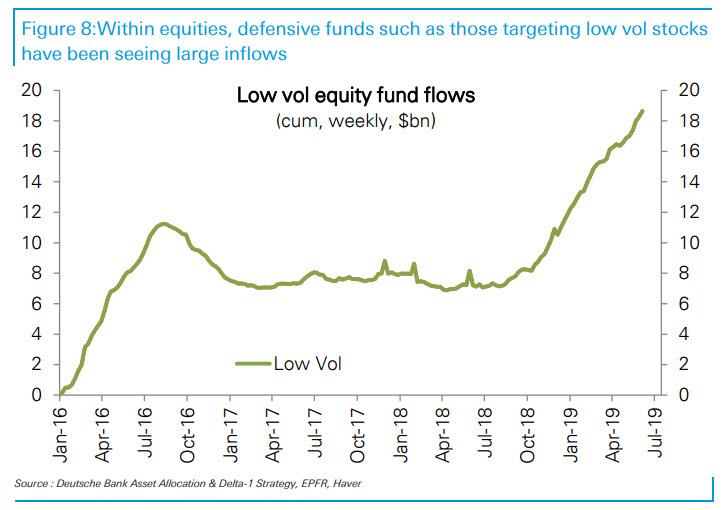
Defensive oriented equity funds (+$1.3bn) like min-vol have continued to see steady inflows with this week seeing the largest in almost 3 months.
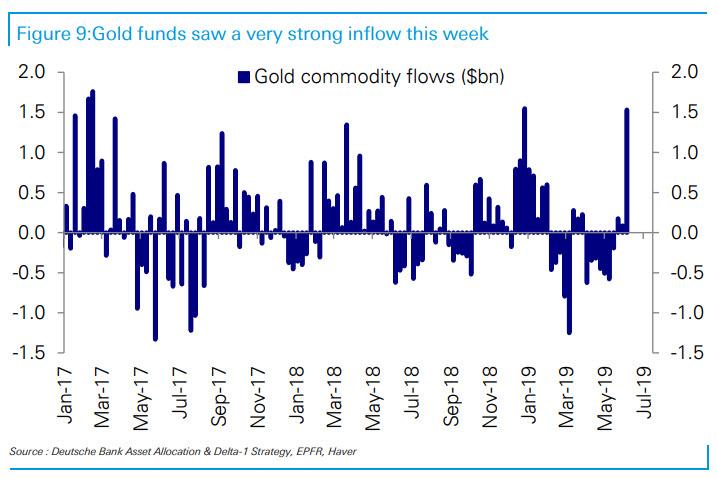
Gold funds (+$1.5bn) last week also saw the largest inflow in over 2 years. Gold long futures positioning also rose sharply to the highest in a year.
Meanwhile, stocks remain in a world of their own with positioning elevated across most investor classes: equity futures positioning rose this week and remains elevated. According to DB, after declining, albeit modestly for 4 straight weeks, positioning in equity futures rose this week and remains near the top of its historical range.

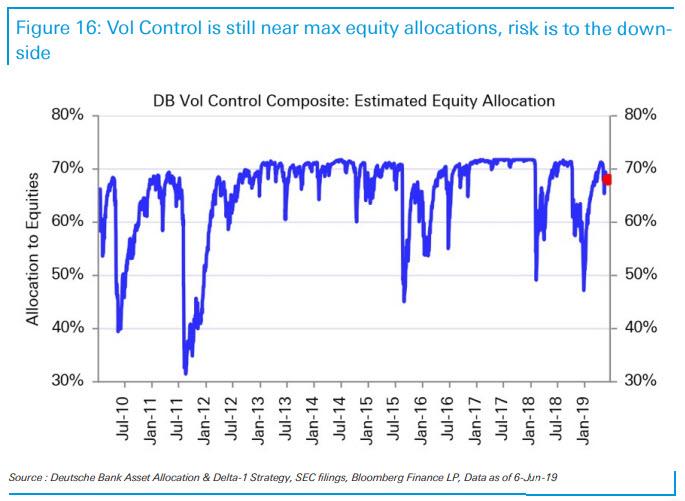
Vol Control is still near maximum equity allocations, after some selling early in the week and buying later in the week. While VIX came in, 1M realized volatility increased. Risk from Vol Control continues to be to the downside if vol spikes further.
Risk Parity will likely trim equity beta. Exposure to equities, bonds, and USD is at the top of its range. And vol of the cross asset portfolio increased above its historical average, with equity vol increasing the most vs other asset classes

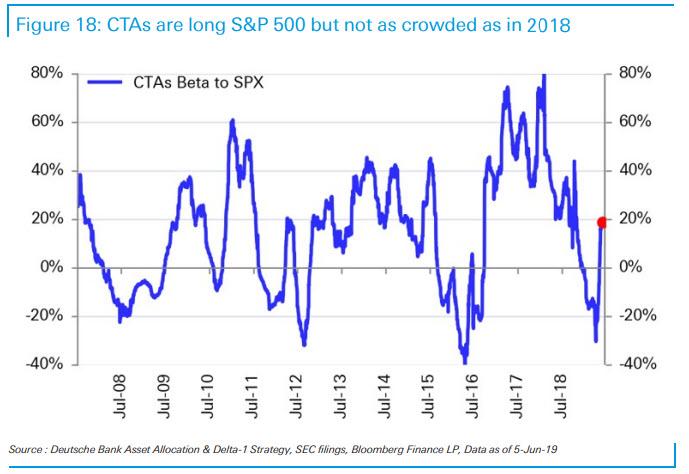
The CTA complex is still net long S&P 500 as spot very briefly slipped below longterm MAs then bounced sharply above short-term MAs. While CTAs would be liquidity seekers in a more significant move down, the complex is not crowded in the long S&P 500 trade.
The one outlier within stocks: Equity L/S continues to have net beta and gross leverage at multi-year lows. Single-stock portfolios are still overweight Communication Services and EPS Growth so have been somewhat volatile. Despite some short covering, PMs continue to control net beta primarily with ETFs, futures, and options.

* * *
The irony: this tremendous disconnect between equities and virtually every asset class is the result of one thing - the market's growing conviction that the US economy is sliding into a recession, and the Fed doing everything in its power - cutting rates, doing more QE, perhaps NIRP - to prevent that. As DB's Thatte notes, the German bank's rates strategists view short rates as currently putting too high a probability of the economy sliding into recession.
In other words, every single asset class - except equities - is now pricing in something a sharp global slowdown. As for the S&P? Trading just shy of 2,900, the US stock market is not only oblivious to the risks that all other asset classes are screaming about, but continues to rise even more with every incremental economic data point, the disastrous jobs report being the best indication, sending the S&P 1% higher on Friday amid, what else, hopes that the Fed will ease even more as "terrible news is once again tremendous news."
The Fed Should Ignore Trump and Contemplate Cuts for the Right Reasons
There is a danger if Fed policy makers err on the side of caution just to show their independence
Central bank independence rests on a shaky platform, and the Federal Reserve’s is especially wobbly. As policy makers prepare to discuss rate cuts, they face double trouble politically. Cutting rates to compensate for the damage done to the U.S. economy by tariffs risks co-opting the Fed into Donald Trump’s trade battles. Worse, easing looks like the Fed is caving in to Mr. Trump’s public demands for rate cuts.
So far Fed chairman Jerome Powell has done a good job of avoiding political controversy, insisting that Mr. Trump holds no sway inside the Fed. But he knows that any perception that the Fed is doing the bidding of the White House would damage its credibility with markets, one of its most powerful tools.
The real danger isn’t that Fed independence is compromised, or at least not yet. Instead, the danger is that the need to show their independence leads policy makers to err on the side of caution, perhaps waiting longer than they otherwise would to show they aren’t being pushed around. At a time when the need for easier money is debatable, it would be natural for policy makers to snub Mr. Trump’s calls for cuts to prove their impartiality. But it would be a mistake.
Start with trade. The tariffs threatened on Mexico have been suspended, but the pending extension of 25% import taxes to all Chinese goods will most likely push up prices in the U.S. and slow the economy. The Fed should look through the immediate price rises and focus on the longer-term damage that would be done to the economy, which would lead to more unemployment and lower inflation than would otherwise have been the case.
China tariffs are unlikely to throw the U.S. into recession on their own (although if they prompted a market crash the combined effects could be much worse). But yet more tariffs should lead the Fed to at least consider lower rates, even if that makes it look as though they are helping out the president.
The broader global slowdown in growth also pushes the Fed toward lower rates. Growth forecasts have been cut, inflation is expected to be moribund almost everywhere in the developed world and other central banks are hinting at easing, or in a couple of cases are already easing. A weak jobs report Friday in the U.S. doesn’t help matters. If the Fed does nothing, the shift in monetary policies overseas will tend to push the dollar up, a de facto tightening in the U.S.
The Fed has three big advantages when it comes to preserving the appearance of independence. It has decades of credibility. It has its record from last year, when it raised rates in the face of the Trump tax cuts, as an independent central bank should. And with the bond markets in a flap about the risks ahead, a rate cut wouldn’t come as a surprise to anyone.
Still, the Fed should be prepared for gleeful tweets from Mr. Trump after any cut, and there would surely be more questions if the Fed does what the White House wants. But the true test of independence isn’t cutting rates when Mr. Trump is right, or at least has a plausible case that they should be cut. The real problem would be to cut rates when Mr. Trump is wrongly demanding a cut.
At the moment it isn’t nearly as obvious as either Mr. Trump or the bond market thinks that rates need to be cut, let alone that they need to be cut a lot. Fed policy makers have made clear recently that cuts are possible, if only as an insurance policy, and Mr. Powell last week acknowledged that Mr. Trump’s trade conflicts are a consideration. Still, the main problem isn’t that the economy is in trouble. The problem is that the economy is doing less well than expected. This matters a lot to markets, which price performance against expectations. But the Fed will be looking at the outlook, which is for so-so growth at a time when the U.S. is managing the rare trick of having plentiful jobs and reasonable (if unspectacular) pay rises without much inflation.
There is a decent case to be made that there is a greater danger of inflation undershooting the Fed’s 2% target than overshooting it, which might justify an “insurance” rate cut. But some in the market are worried that much more might be on the way; for the first time there is a non-negligible chance of five cuts this year, equivalent to one at every meeting, and by December three cuts are priced as more likely than not. That would require things to go badly wrong, and the Fed to be worried that the economy has stalled.
If the trade conflicts worsen and there is a serious fall in stocks, then a dire economic outcome and several rate cuts would be plausible. But so long as the economy keeps up at least the dreary growth of the past decade it is hard to see why the Fed would move to panic stations—whatever Mr. Trump asks for.
United Technologies Strikes Deal to Merge With Raytheon
Combination creates No. 2 aerospace-defense company making everything from F-35 engines to Patriot missile systems
United Technologies Corp. doubled down on the aerospace market with an all-stock deal to merge with defense contractor Raytheon Co. RTN 1.25% , after UTC executives earlier chose to exit the escalator and air-conditioner businesses.
The combined company, valued at more than $100 billion after planned spinoffs, would be the world’s second-largest aerospace-and-defense company by sales behind Boeing Co. BA 0.87% , with annual revenue of about $74 billion this year. It will make everything from engines and seats for jetliners and F-35 jet fighters, to Patriot missile launchers and space suits for astronauts.
The proposed deal intensifies the consolidation in the aerospace and defense industry as plane makers seek better terms from suppliers and the Pentagon puts more pressure on contractors to cut costs and invest more of their own money in new technologies, such as space systems and cybersecurity.
The new company will be named Raytheon Technologies Corp., and executives on Sunday called the deal, which doesn’t include a takeover premium, a merger of equals. UTC shareholders will own 57% of the shares and UTC will appoint eight of the 15 new directors. The Wall Street Journal reported Saturday that the two sides were nearing a deal.
UTC’s current leader, Greg Hayes, will serve as CEO of the merged company, with Raytheon CEO Tom Kennedy as executive chairman for two years. Executives said the merger would allow them to boost research spending and squeeze out some $1 billion in annual costs from the marriage.
Raytheon shareholders will receive 2.3348 shares in the new company for every share they currently own. The combined company will have about $26 billion in debt, with $24 billion coming from UTC. It will be based in the Boston area.
The combined entity would be split about 50/50 between commercial and defense sales, though military is likely to shrink as a proportion as UTC’s Pratt & Whitney division ramps up deliveries of its latest jetliner engines. One-third of the two companies’ aerospace and defense revenue last year—some $25 billion—came from the Pentagon.
“There is some truth to the idea that bigger is better,” Jefferies analyst Sheila Kahyaoglu wrote in a note to clients Sunday. “With common customers there is some leverage to size and the supply chain.”
“What’s even more important is the underlying technology both companies are developing,” Mr. Kennedy said in an interview. Raytheon first approached Mr. Hayes about a deal last year, he said.
Mr. Kennedy pointed to areas such as hypersonics—missiles traveling more than five times the speed of sound—and air-traffic-control systems where the enlarged company can be a dominant player.
Byron Callan, a defense analyst at Capital Alpha LLC., said the proposed deal reflected the likely slowing of military spending increases and the need for companies to boost their investment in new technologies.
The tie-up would complete a radical transformation at UTC, a once sprawling conglomerate that already plans to spin off its Otis elevator and Carrier building-systems businesses into separate companies.
Raytheon would be combining with UTC’s remaining aerospace business, and the companies expect the transaction to close in the first half of next year, after UTC completes the spinoffs.
The deal isn’t expected to attract significant antitrust scrutiny, analysts said, because UTC and Raytheon don’t compete against each other in most of their markets.
“It’s a nonissue,” said Mr. Hayes, with expected divestitures of just $80 million a year in sales. However, the companies have yet to brief the Pentagon or suppliers.
UTC makes engines, landing gear and other parts for commercial and military planes. Raytheon produces missiles such as the Tomahawk together with Patriot missile-defense systems, radars and other electronic-warfare systems.
“There is minimal overlap for the two companies,” said Ms. Kahyaoglu. The companies could mutually benefit from their separate expertise, she said, such as leveraging UTC’s expertise in global positioning systems across Raytheon’s missile programs.
The deal is the largest announced so far in a year that has included some big mergers but otherwise has been lackluster. Before this, the biggest proposed acquisition this year was Bristol-Myers Squibb Co.’s $74 billion purchase of rival drugmaker Celgene Corp.
Farmington, Conn.-based UTC, which acquired Rockwell Collins for $23 billion late last year, is one of the U.S.’s last remaining big industrial conglomerates—though it is set to radically transform with the spinoffs and now the merger.
The Otis elevator division and Carrier building-systems businesses will become separate publicly traded companies, leaving UTC as a pure-play aerospace company.
Investors are pressuring traditional conglomerates to become more focused. Rivals Honeywell International Inc. and General Electric Co. are both shaving off units to streamline their businesses. Several activist investors had pushed UTC to split.
Waltham, Mass.-based Raytheon’s sales rose 6.7% last year to $27.1 billion but it has largely avoided big deals. It has invested heavily in recent years ahead of the recent uptick in Pentagon spending, and has the biggest export business among the five largest U.S. defense contractors.
The two-year uptick in Pentagon spending on new aircraft, missiles and other defense equipment is also running out of steam, with analysts projecting muted growth over the next several years.
Pentagon spending fell sharply between 2013 and 2017 because of broader federal budget pressures and then expanded at a clip of around 10% in the final year of the Obama administration budget and the first two of the Trump era. Spending increases are now slowing to low single-digit increases, and much of the additional money is being directed at refreshing U.S. nuclear forces.
A major defense industry merger has the benefits of providing economy of scale, making its supply chain leaner and creating an export powerhouse. But it can also threaten stagnation of research and development and make prices creep up at home, said Gregory Sanders, a deputy director at the Center for Strategic and International Studies, a Washington-based think tank. The merger partners said they’d expand research spending.
“There are a lot of countries that encourage mergers because they’re primarily focused on export markets,” he said. “But from the U.S. perspective that always has to be weighed against the domestic market. Much of what we’re producing is for the U.S. market.”
A market behemoth may be good at selling hardware, but fewer competitors mean that prices across the board can go up, which can be a problem for the main customer: the U.S. taxpayer. Mr. Kennedy said one-half the $1 billion in annual benefits from the merger would accrue to customers, most of it via lower prices for the Pentagon.
The battle in Israel to create an unhackable phone
Politicians and intelligence agencies are using the IntactPhone
Nearly a decade ago, a young Israeli entrepreneur made a pair of bets — one on a company that claims it can hack any smartphone in the world and the other on a company that went on to develop a smartphone that is nearly unhackable.
Today, those two companies, whose offices are less than hour’s drive apart in Israel’s northern tech corridor, are leading forces in the shadowy battle between surveillance and privacy.
NSO Group, which is still run by the entrepreneur Shalev Hulio, is now valued at $1bn and its flagship product Pegasus is used by governments and intelligence agencies around the world to remotely and secretly hack smartphones.
Often the very same governments and intelligence agencies also turn to Communitake Technologies, the designers of the chunky custom-built IntactPhone, to keep their own secrets out of reach of NSO’s technology.
“If this is an arms race, think of this technology like the Force in Star Wars,” said a cyber technology dealer, who has sold both offensive and defensive cybertechnology to governments. “If companies like NSO are the Dark Side of the Force, then people like Communitake are the Jedis.”
When Mr Hulio first invested in Communitake, it had developed code that could remotely access a phone and root through its inner workings.
With some 50 or so employees, Communitake chose a high-minded path: it licensed the technology to the likes of BlackBerry and Nokia so they could help users fix their phones remotely, and only after the phone’s owners permitted access.
But Mr Hulio foresaw that a second market, for mining smartphone data surreptitiously, was going to become very lucrative, and made a parallel investment in NSO, whose software worked similarly, but without asking for any consent. “Tech savvy terrorists and criminals [were concealing their communications and] going dark,” said Mr Hulio in a statement, adding that NSO was quickly approached by the intelligence community. “Our technology could be key to preventing a terrorist attack.”
By 2012, Communitake and Mr Hulio went their separate ways — his work at NSO was going to be “a shadow on our company,” said Ronen Sasson, Communitake’s chief executive.
“While it was hard to leave behind a very successful company, it was an easy decision knowing we could help create a technology that would go on to save an untold number of lives,” said Mr Hulio.
Communitake also changed course, setting off to build a phone that no one, even NSO, could hack.
Please use the sharing tools found via the share button at the top or side of articles. Copying articles to share with others is a breach of FT.com T&Cs and Copyright Policy. Email licensing@ft.com to buy additional rights. Subscribers may share up to 10 or 20 articles per month using the gift article service. More information can be found at https://www.ft.com/tour.
Communitake does not market itself as the anti-NSO, but least one country which has bought NSO’s software, equipped its senior officials with IntactPhones after testing the two technologies against each other, said one person familiar with the contract.
The Intactphone is used by senior UN officials, heads of states and, in one country the company will not name, by a national prosecutor whose predecessor was hacked.
Its cost ranges anywhere from a few thousand dollars to the millions. The most expensive set-up includes privately hosted servers that generate the ephemeral encryption keys that lock each individual communication into a sealed vault, and dozens of phones distributed among government officials.
The company saw a boost after the Israel Innovation Authority took a stake and helped market the technology abroad, especially in the US and in Mexico. Now it is developing a commercial version, that will run on a custom-built phone designed to mimic the look of a normal smartphone. That would allow people to carry a secure phone without drawing attention.
“In the first few years we have had the product battle-test by some very high-tech customers — intelligence agencies, governments,” said Mr Sasson. “Now we are going wider.”
The battle lines are oddly concentrated in Israel, where NSO and Communitake are part of an industry that includes companies like Cellebrite, recently valued at $600m, which unlocks encrypted smartphones for governments, and Verint Systems, the $3.7bn cyber surveillance company that has hundreds of engineers in Israel working on software used by the FBI and European law enforcement.
They thrive on graduates of the Israeli army’s surveillance units, including Unit 8200, the signals intelligence and decryption division from which Eran Karpen, Communitake’s chief operating officer, hails. And they also benefit from Israel’s reputation for world-beating cyber surveillance, and the mystique of its intelligence agencies, especially in the Middle East.
For smaller companies like Communitake, that is a key asset. Gartner, the consulting firm, pitched the IntactPhone against the established players — the government-grade offerings from IBM and BlackBerry, and other less known companies like Palo Alto-based VMware — and ranked it in the top five for government use.
But Israeli security companies also have to get past the suspicion that they are fronts for Israeli intelligence agencies. Both NSO and Communitake, for instance, are regulated by the ministry of defence, and can only sell to governments or agencies approved by Israeli authorities.
The close ties with the Israeli government and in recruitment raises the question of backdoors — official or not — in the technologies, and why the Israeli government would allow the commercial sales of a phone it itself cannot hack.
Senior UN officials in Israel, for instance, use the IntactPhone to speak to colleagues inside the Gaza Strip and abroad without the Israeli government listening. Benny Gantz, the leader of the Israeli opposition, is reported to use one after his smartphone was said to have been infiltrated by Iranian hackers. Communitake said that to allay those concerns, it allows buyers to examine the phone’s source code and its physical architecture.
The company is careful not to claim that its phone is entirely secure. But building a sophisticated phone from scratch, and running a highly secured operating system on it allows them to “minimise the attack surface,” said Mr Sasson, describing the three ways phones are normally hacked — either by malware inserted remotely, by physical extraction of its encrypted data, or by the interception of communications when in transit.
The phone, for instance, can block attempts to extract its data via a cable, and the bespoke version of WhatsApp that it installs would have repelled NSO’s most recent hack, when it’s clients used a vulnerability in the supposedly secure messaging to infiltrate phones remotely, he said.
But if anybody is out there selling a phone that they guarantee is unhackable, they’re probably lying, said Mr Sasson. “With something like this, you can make yourself 95 per cent safe. Nothing is 100 per cent safe.”
Fate of Olympus financier shines light on Japanese legal system
Nobumasa Yokoo’s 966 days in pre-trial detention echo treatment of ex-Nissan boss Ghosn
Almost three years of detention before trial. Eight-hour interrogations in harsh physical conditions. New charges brought at the last minute. It may sound like dystopian fiction but that is what happened when Japanese financier Nobumasa Yokoo declined to confess.
The prosecution of former Nissan chairman Carlos Ghosn has shone a spotlight on Japan’s criminal justice system, but his initial 108 days in detention pale by comparison with the 966 days Mr Yokoo — a leading figure in the fraud scandal at medical equipment maker Olympus — spent locked up before his trial.
The methods Mr Yokoo described in an interview with the Financial Times highlight concerns about so-called “hostage justice” and the extreme pressure applied to extract confessions in Japan.
“I’ve never met Carlos Ghosn, I don’t know him and frankly I don’t know what he did,” he said at a press conference. “But I do note a striking parallel in our cases, especially in the way the prosecutors chose to arrest him for one charge and then drag things on by arresting him on another charge.”
Mr Yokoo’s case was overseen by the same prosecutor who is now pursuing the ex-Nissan chief.
Mr Ghosn is living in Tokyo under strict bail conditions as he awaits trial on charges of financial misconduct. He has denied all charges.
The long detention of Mr Ghosn has prompted international outrage and put Japan’s justice system, which boasts a 99.97 per cent criminal conviction rate, in the dock. Prosecutors say they lack other investigative tools, such as wiretaps or subpoena powers, so extracting a confession is all important.
At a briefing in January, Shin Kukimoto, deputy chief prosecutor, denied criticism that the long detention period and intensive interrogations lasting up to eight hours a day could create an environment for forced confessions. “We listen properly to claims made by the suspect,” Mr Kukimoto said at a briefing. “We don’t do the kind of interrogation that forces a confession.”
Not everyone agrees that this is the best approach.
“Japan has long relied too heavily on confessions. There was criticism but it stayed inside the country,” said Shuhei Sugimoto, a criminal defence lawyer. “But now, the Japanese system is facing pressure from where it had least expected, and that international criticism could be a catalyst for change.”
Mr Yokoo was a retired Nomura banker when he became embroiled in the Olympus affair, which began in 2011 when Michael Woodford, the company’s chief executive, exposed a long-running scheme to hide losses via dubious acquisitions.
Mr Yokoo, a financial adviser to Olympus, was found guilty of abetting the falsification of financial statements, money laundering and defrauding a separate company called Gunei. He must report to prison imminently after an appeal to Japan’s supreme court failed earlier this year.
Mr Yokoo maintains his innocence but irrespective of guilt, his case shows the pitiless treatment meted out to any defendant in Japan who does not confess.
“I was detained for two to three months at Marunouchi police station. Except for the weekends, the prosecutors would pack us in a tight space in their basement with our hands cuffed from 9am to 5pm every single day,” he told the FT. “On the worst days, they would interrogate me for just three minutes and I would have to wait on a hard wooden bench for the rest of the day.”
One weekend, Mr Yokoo was packed into a bus with a few burly police officers and driven for hours to his “crime scene” at the Gunei headquarters, even though the charges related to abstract financial transactions. This was “nothing beyond harassment”, he alleged.
“I was interrogated without any recording and many times before the actual arrest,” he said. No lawyer was present. When he asked for a heater during interrogation on a cold December day, he said the prosecutor slammed the table with a rolled-up paper and shouted: “We’re not rich like you guys! We’re poor so we can’t afford heating!”
The Tokyo district public prosecutors office declined to comment on Mr Yokoo’s claims.
Perhaps more extreme than the nature of the interrogations was their duration. Mr Yokoo said he saw his family for only three hours during more than two-and-a-half years of pre-trial detention. At one point during his detention, he was prescribed a strong tranquilliser after he began hitting his head on the wall at 3am.
New charges brought 16 months after his initial arrest, and one month before his trial was due to start, meant another half-year in pre-trial detention. Akira Kitani, a judge turned defence lawyer, has also questioned an unusual decision by the court to let prosecutors revise their charges against Mr Yokoo during the final phase of his trial.
“In this case, the request for a revision in charges should not have been permitted . . . considering that there was a long period for both sides to adjust their claims during pre-trial proceedings,” Mr Kitani said.
While pleading guilty usually results in a lighter sentence, the contrast between Mr Yokoo and others in the Olympus case is stark. While Mr Yokoo was sentenced to four years in prison and ordered to pay $12m in penalties, the Olympus executives who actually falsified the accounts pled guilty and received suspended sentences, spending 40 days in detention at most. That gap creates a powerful incentive to confess.
Although Mr Yokoo has exhausted his avenues of appeal, he is now seeking a retrial after two pieces of evidence that were deemed critical in his criminal trial were discarded by the judge in a separate civil lawsuit.
The seven-year process has been tough for Mr Yokoo’s family. “We’re going to lose our house, we’re going to lose all our assets,” said Yuka Yokoo, his daughter. “But something I don’t look forward to is seeing anyone else experience this horrible treatment by this horribly flawed legal system.”