(ZH) Slide In Corporate Profits Suggests Recession May Have Already Started Prof

Slide In Corporate Profits Suggests Recession May Have Already Started

Submitted by Joseph Carson, Former Director of Global Economic Research, Alliance Bernstein
Corporate profits rebounded in Q2, rising 5.3%, reversing the near 5% decline of the prior two quarters based on the updated figures released by the Bureau of Economic Analysis. The up and down pattern in profits has become a persistent trend, as corporate profits have been flat to slightly negative now for the past 5 years, while profit margins have plunged to the lowest level since 2010. The flat trend in profits and the long slide in margins have important economic consequences as both have always preceded recessions in years past.
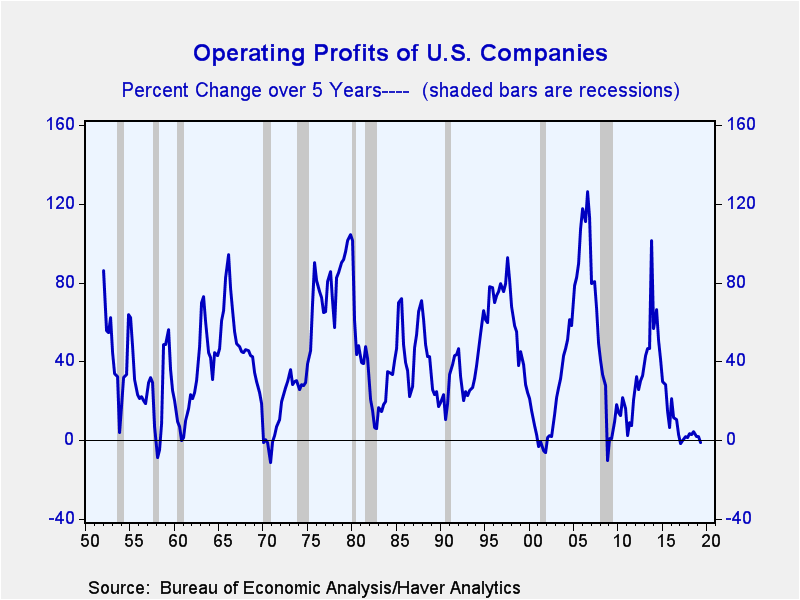
To be fair, the economy has not been, nor is it currently in recession, based on the GDP figures as well as the labor market data. Nonetheless, the profit and margins data shows how vulnerable the economy is at the present time, especially with business leverage at record highs.

In hindsight, the 2017 federal tax law change, which was signed into law on December 20th, probably helped a number of companies postpone making hard decision in their core operations. To be sure, profits on an after tax basis as well as cash flow was boosted by the substantial reduction in federal corporate tax rates. But the translation gain from a lower federal tax rate is a one-time benefit, and going forward operating earnings on the bottom line should track the top line.
The weak trend in operating profits could come as a big surprise to investors since S&P 500 earnings have been temporarily "spiced" (doubly) by the reduction in federal tax rates.
S&P 500 earnings are reported on an after-tax basis and are presented on a per share basis. Not only did the federal tax law provide a large boost to after-tax earnings, but also companies used the tax windfall to buy back stock - nearly $1.2 trillion since the new tax law went into effect.
According to various estimates the outstanding share count for the S&P 500 declined by over 5% in the past 12 months or so. The reduction in the share count made the year-on-year earnings per share gains paint a more optimistic picture than what was actually occurring. With the benefit of the tax reduction in the rear view mirror and corporate buybacks slowing S&P earnings will now be more aligned with the current state of the economy. That creates the potential for an increasing number of corporate earnings reports disappointing relative to market expectations.
A number of companies have already offered "cautious" guidance on 2H 2019 earnings. Yet, the sharp drop in profit margins increases the odds that the actual performance for a long list of firms, across a wide range of industries, will be much worse than companies guidance or analysts’ expectations.
Of all the real economy indicators pointing to the potential of recession the profit data are the most telling because businesses need earnings and cash flow to sustain existing operations (payrolls, rents, inventory etc.) and also to meet hefty debt obligations. Although interest rates are low the new tax law limits the deductibility on corporate debt—increasing the effective cost of interest payments. That is likely to put an additional strain on highly leveraged businesses.
A "true" earnings recession appears to be in train, with the potential to trigger cuts in investment, inventories, employment and then consumer spending. That’s the standard sequence of events following a downturn in corporate profits. The equity market has not re-priced to the dim outlook on corporate profits - as investors appear to betting that the economic slowdown in temporary, largely related to the trade dispute between the US and China and/or Fed will be forced to lower rates to sustain the cycle. The resilience of the equity market is typical as financial market corrections often follow economic slowdowns/recession and nowadays market corrections can occur as fast as "tweet-speed".

FT : Central banks will need new tools to combat the next downturn

Central banks will need new tools to combat the next downturn
Traditional monetary policy has had a number of unpleasant side-effects

Trying to predict a recession is a fool’s game. Expansions don’t die of old age. Various hard-to-predict accidents can put an end to them. A trade war — like the Smoot-Hawley tariff spiral in the 1930s — could be one such accident. The question is not when, but how, a recession plays out. And the policy response is key to the answer.

The most consequential policy mistake in economic history was the lack of a proper response to the financial crash of 1929. Central banks failed to recognise the impact of bank failures and debt-deflation dynamics, and monetary policy was too tight. So what could have been just a recession became a fully fledged depression. The lessons of this episode clearly guided the response to the global financial crisis of 2008.

Time will tell whether unleashing a trade war will turn out to be another historic mistake. But one thing is certain: policymakers no longer have the ammunition that has been required to respond properly to past recessions, let alone to full-blown crises.

Until now, monetary policy has essentially worked by lowering interest rates to stimulate demand and the appetite for risk. But a cursory glance at capital markets tells you that this isn’t an option today. A third of all government bonds globally — and two-thirds in Europe — have negative yields. Even in the US, which still enjoys moderate growth, long-dated Treasury yields are at or near record lows and could easily head towards zero in a recession. Traditional monetary policy has also had a number of unpleasant side effects, from boosting inequality to normalising low-to-negative rates, with adverse consequences for savers and banks’ profitability.

What other tools are available? Fiscal policy will play a major role in any future downturn, but will not be enough on its own. While there are powerful forces at play that will contribute to keeping interest rates low, this could change with large fiscal stimulus when debt is at record levels and rising. Moreover, historically, fiscal policy has not been flexible enough to be deployed quickly when needed.

In the next recession, a different policy framework will be required. This would involve what might be termed “going direct”: policies that put central bank money into the hands of public and private sector spenders, rather than relying on the incentives of lower rates.

Such a framework could be organised in a variety of ways but would certainly require closer co-ordination between fiscal and monetary authorities to ensure that fiscal expansion does not lead to an increase in interest rates. Over time it would help to restore a more normal rate environment, reducing the pressures of lower rates on savers and on the financial system.

To be feasible, a policy of going direct should have the following elements. First, a clear definition of the circumstances that call for such unusual policy co-ordination. Second, an explicit inflation objective that fiscal and monetary authorities are jointly held accountable for achieving. Third, a mechanism that enables the prompt deployment of productive fiscal policy measures, without the negative monetary policy impact on inequality. Could digital money offer something here? Finally, and critically, a clear exit strategy.

Such a mechanism could take the form of a standing emergency fiscal facility that would only be activated when monetary policy has been exhausted and inflation is still expected to undershoot its target. The size of the facility would be determined by the central bank and calibrated to achieve the inflation objective (including making up for past inflation misses), while the use of the funds would be decided by the fiscal authority.

It is, of course, a big jump from proposals such as this to an operational policy framework. A great deal of work remains to be done, and close attention will have to be paid to the respective legal and institutional set-ups of the various monetary jurisdictions. The European Central Bank will face particular challenges in this regard.

But, as I recall Timothy Geithner, then president of the New York Federal Reserve, saying in late-night emergency meetings in 2008, “Plan beats no plan”. Central banks increasingly find themselves in a liquidity trap. Business as usual is no longer an option.

If we plunge into another crisis, “going direct” will be the only policy option. But unless robust plans are drawn up now, such a revolution in macro policymaking risks devouring its own children by undermining the integrity and credibility of central banks, and unleashing uncontrolled fiscal spending further down the road.

FT : Lendlease urges Brexit accord to avert ‘major hard landing’

Lendlease urges Brexit accord to avert ‘major hard landing’
Australian group that is one of UK’s biggest foreign developers seeks end to uncertainty

One of the biggest foreign real estate developers in the UK is urging a speedy resolution to the Brexit impasse, pressing for action to be taken to avoid a “major hard landing” that hurts asset prices. 

Lendlease, the Australian developer with a £15bn project pipeline in Britain, said foreign investors have been patient — in part because buoyant global liquidity has supported asset prices — but the complex political stand-off needs to be resolved.

The company has already slowed work on its flagship International Quarter London in Stratford due to market uncertainty, and said that along with other investors it was waiting to see how Brexit plays out before deploying a lot of fresh capital to projects.

“Clearly from our perspective a resolution sooner rather than later is what we’re hoping for — and something that doesn’t cause a major hard landing in the UK would also be preferable,” Steve McCann, Lendlease chief executive, told the Financial Times said. 

“We just need some certainty; that’s what we’re really looking for.” 

Lendlease has had a presence in the UK for more than two decades but has stepped up its investment there as part of an overseas expansion aimed at diversifying from Australia. Its UK portfolio includes developing Google’s new headquarters in King's Cross; a £2.3bn mixed-use development at Elephant Park, London; and the £1.5bn Smithfield development in Birmingham. 

The company’s push abroad during the past six years has helped it overcome challenges in Australia, where a weak property market and troubles at its construction arm have dented its performance. Lendlease is selling its underperforming engineering division in a move it has warned could cost shareholders A$1bn ($673m). 

Mr McCann, who has led Lendlease for just over a decade, said the company was a long-term player in the UK market but noted that activities there had been “significantly reduced” because of uncertainty. 

“People are waiting, and they’re not investing as proactively as they normally would. But we’re not seeing people, you know, sell assets at stressed prices . . . so that’s not a bad sign,” he said. 

Mr McCann said Lendlease had contingency plans in place for several scenarios, including one in which liquidity dries up and the cost of capital adjusts. But he said strong global demand for real estate infrastructure would probably support real estate values. 

“In a low interest rate, low-growth environment, the spreads that people can earn from those types of investments remain pretty attractive. So even in a really difficult environment, unless capital dries up, you would think asset values [in London] will hold up reasonably well.” 


The company generated 75 per cent of its earnings in Australia as of 2016. Two-thirds of its current A$96bn investment pipeline is overseas projects.

In July Lendlease inked a $15bn deal with Google to redevelop the technology group’s landholdings in three areas near San Francisco into housing and office space including 15,000 new homes — a model it hopes to replicate in other US cities. 

“It really puts us on the map in terms of reputation,” said Mr McCann, who is targeting five US cities for expansion — New York, San Francisco, Boston, Chicago and Los Angeles. 

Lendlease also is developing projects in Singapore and Malaysia. It is eyeing opportunities in India, attracted by the rapid economic growth, and political and regulatory reform under Prime Minister Narendra Modi. 

“We have done work in India before and found it challenging . . . [But] the doors are much more open and it’s an easier place to do business,” said Mr McCann. 

WSJ : New Delays Could Keep Boeing 737 MAX Grounded Into Holiday Travel Season A

New Delays Could Keep Boeing 737 MAX Grounded Into Holiday Travel Season
American and United have pushed the MAX’s expected return to their schedules into December

Friction between Boeing Co. BA 0.37% and international air-safety authorities threatens a new delay in bringing the grounded 737 MAX fleet back into service, according to government and pilot union officials briefed on the matter.

The latest complication in the long-running saga, these officials said, stems from a Boeing briefing in August that was cut short by regulators from the U.S., Europe, Brazil and elsewhere, who complained that the plane maker had failed to provide technical details and answer specific questions about modifications in the operation of MAX flight-control computers.

Boeing as a result now has to resubmit briefing documents describing proposed software changes, these people said. The changes then have to be vetted by the U.S. Federal Aviation Administration before a follow-up meeting with the same participants can be held and crucial simulator and flight tests of the final software revisions scheduled.

The upshot, the people said, is likely to be several more weeks of delay that could significantly reduce the likelihood that many of the planes would be back flying passengers in North America during the Christmas holidays, as Boeing and some U.S. carriers have publicly projected. The meetings and the fallout haven’t been reported before.

In Europe, some industry officials say they are increasingly convinced the bulk of the planes on that side of the Atlantic aren’t likely to resume carrying passengers until January at the earliest. European regulators have signaled they might need the extra time to examine anticipated changes to the MAX’s flight-control computers and the automated stall-prevention system dubbed MCAS. Misfires in MCAS led to the crashes of two MAX aircraft in less than five months that took a total of 346 lives and prompted a global grounding in mid-March.

A Boeing spokesman declined to comment on the troubled session last month, which was held in the Seattle area. “Our best current estimate continues to be a return to service of the MAX that begins early in the fourth quarter,” he said, adding that timing will be driven by the Federal Aviation Administration and global regulators. “Our focus is on safety and ensuring the trust and confidence of customers, regulators and the flying public,” he said.

An FAA spokesman said the agency “continues to follow a thorough process, not a prescribed timeline, for returning the aircraft to passenger service.” Referring to various U.S. and international safety reviews under way, he added, “While the agency’s certification processes are well-established and have consistently produced safe aircraft designs, we welcome the scrutiny from these experts and look forward to their findings.”

Some industry officials still believe the latest problems can be resolved quickly enough to have the planes back in the air just before Christmas.

The August meeting was intended to delve into Boeing’s plans to improve safety by having both MAX flight-control computers operating on every flight. The original MAX design, like earlier versions of the plane, relied on a single computer during each trip, making the jet more vulnerable to safety hazards caused by sensor malfunctions or failures.

The apparent discord comes amid signs of additional hitches in the process of getting the green light and FAA certification for the MAX. In recent weeks, Boeing and the FAA identified another potential flight-control computer risk requiring additional software changes and testing, according to two of the government and pilot officials.

Separately, the FAA confirmed that an international group of experts it had assembled, including representatives of nine foreign regulatory bodies, will need more time to document its work and submit recommendations to U.S. certification efforts.

Discussions about MAX pilot training pose the thorniest issues, which both U.S. and European regulators have put off resolving until the end of the approval process. How much pilot training will be mandated—and whether extra simulator time will be required before or after pilots take the controls of the 737 MAX—will be decided by regulators in individual nations and regions.

The FAA and most U.S. pilot-union leaders don’t favor upfront simulator training. European pilots and government officials have said regardless of the decision on simulator training for MCAS emergency response, many aviators on that side of the Atlantic are likely to require some simulator time to comply with other regulatory requirements before they resume flying the MAX.

Boeing since late last year has either submitted, or been on the verge of submitting, three earlier versions of the software fixes, only to be delayed by various technical challenges and questions requiring more analysis and simulator testing.

Airlines are trying to navigate the continued uncertainty about when the plane will return as they plan the final months of the year and prepare for a crush of holiday travelers.

On Sunday, American Airlines Group Inc. said it is removing the MAX from its schedules for an additional month through Dec. 3, but said it remains confident the plane will be certified to fly this year. United Airlines Holdings Inc. announced a similar extended MAX cancellation Friday, saying it will strike the plane from its schedules until Dec. 19.

Both carriers indicated they were confident the jet will be ready to rejoin their fleets in time for the end-of-year holidays. Both had previously aimed to resume MAX flights in early November.

Other carriers such as Southwest Airlines Co. and Air Canada have opted not to schedule any flights on the MAX until next year, when they feel more confident regulators will have signed off and the necessary training and maintenance will be complete. It could take upward of six weeks to train crews on new software and procedures and perform checks and maintenance on planes that have been parked since March, a Southwest executive said last week.

Airlines don’t want to run the risk of counting on the plane only to be caught off guard by another delay. People flying to visit friends and relatives for holidays and over school breaks often don’t have much flexibility to adjust plans on short notice, or much patience for last-minute changes.

“By proactively removing the MAX from scheduled service, we can reduce last-minute flight cancellations and unexpected disruptions to our customers’ travel plans,” Southwest said in a statement last month.

U.S. carriers had 72 MAX jets in their fleets at the time of the grounding. That number was supposed to roughly double this year, making it increasingly difficult to work around the plane’s absence.

WSJ : Germany’s Small Steps Into Stimulus Are Unlikely to Meet Economists’ Hopes

Germany’s Small Steps Into Stimulus Are Unlikely to Meet Economists’ Hopes
International organizations and others have urged Berlin for months to spend more to fight a looming recession

BERLIN—As Germany’s economy shrinks, the government is about to loosen the purse strings—a little bit, and very discreetly.

Economists and international organizations have urged Berlin for months to let go of its fiscal orthodoxy and spend more to fight a looming recession. Global economic growth is slowing and the world’s central banks are lacking much ammunition to stimulate demand, while Germany’s overflowing coffers are a pile of unused ordnance, the argument goes.

But while German officials say the government is preparing measures to support demand, they are likely to fall well short of the big stimulus the world is hoping for.

There is no doubt Germany could use a boost. Its gross domestic product dropped 0.1% in the second quarter and is likely to have fallen again in the past three months, putting the country in a recession. In the second quarter alone, the manufacturing sector shrunk almost 5% and exports took their steepest drop in six years.

Confidence surveys point to more gloom ahead. And with the U.S.-Chinese trade war unresolved and the U.K. now increasingly likely to leave the European Union without an agreement next month, things could turn uglier.

“If there ever was a time for the government to spend more, this would be now,” said Dirk Schumacher, head of European economics at Natixis . “This would benefit not just Germany but the eurozone as a whole. Everybody is asking for it.”

Faced with this, the finance ministry has been working on proposals worth about €50 billion ($55 billion) and almost entirely financed by debt, according to two senior officials.

The bulk of the stimulus would come from not raising taxes to finance the higher welfare spending and falling corporate tax revenues that will occur automatically as profits fall and workers lose their jobs, which would allow the budget deficit to grow.

Incentives to buy electric cars or insulate homes and special rules allowing companies to write down investment faster are also in the cards, as are special-purpose investment vehicles, which thanks to an accounting quirk aren’t subject to the country’s strict fiscal rules.

Such a package would be projected to boost GDP initially by about 1.5% but faces questions about its potential effectiveness.

There is no consensus on what would be an appropriate amount to spend. Some economists have called for hundreds of billions. Others much less. The issue isn’t so much the amount of spending—but the following caveats.

First, Germany’s fiscal rules allow a government budget deficit of up to 0.35% of GDP—about €12 billion—a year. Using off-budget vehicles could raise this somewhat before Germany hits the eurozone’s hard fiscal limits.

Jens Südekum, a professor at Heinrich-Heine-University in Düsseldorf, reckons Germany could raise its deficit to about €35 billion a year without breaking any rules. This would mean spreading the government’s planned largess over two years: Not exactly a big-bang stimulus.

“The government seems to have decided it will not slam on the brakes in case of a recession,” said Mr. Südekum. “The question is whether that is too little, too late.”

The second concern is timing. Many economists want Germany to act now. But because of how the stimulus is designed, it wouldn’t kick in until well into a recession, when much of the damage has already happened.

One reason the government is taking its time is politicians’ reluctance to appear too alarmed. As one senior official puts it, “we have more than enough money and instruments to apply in case of a recession, but we will not talk ourselves into one.”

Chancellor Angela Merkel played down the likelihood of a pre-emptive strike two weeks ago, saying “I don’t see the need for fiscal stimulus.”

David Marsh, chairman of OMFIF, a London-based economic think tank, sees “a new openness by the government [regarding deficit spending] and that’s progress…But it certainly won’t take the pressure off the European Central Bank” to continue supporting the eurozone’s economy.

Lastly, even as the government slowly warms to the notion of supporting demand, other potential policies point in the opposite direction, at best muddying the message, at worst threatening to neutralize the fiscal boost.

The Social Democrats, the junior member in Ms. Merkel’s coalition, unveiled plans this week for a €10-billion-a-year wealth tax. Several party leaders have also called for an increase in the top rate of income tax, even though Germany has the highest taxes on labor after Belgium according to data from the Organization for Economic Cooperation and Development.

Another example: A package of environmental measures that the government will unveil this month could include some growth-boosting policies. But it could also feature a carbon tax, which would have a chilling effect.

With opinion polls showing that fiscal prudence remains highly popular, there are still misgivings among many politicians about breaking with five years of budget surpluses; especially as Berlin braces for early elections should Ms. Merkel’s fragile government fall.

Michael Hüther, director of the German Economic Institute, a business-affiliated think tank, says the fixation on balanced budgets “is preventing a sober analysis of the situation…I’m not saying we need a huge spending plan tomorrow, but we need confidence that something will be done.”

>>> TradeGate Pre-Market Indications

DAX:
  • Daimler (DAI TH) +0.8%
  • Beiersdorf (BEI TH) +0.7%
  • ThyssenKrupp (TKA TH) +0.7%
  • Wirecard (WDI TH) +0.7%
    • Wirecard, Brightstar Sign MOU to Digitize Financial Processes
  • Munich Re (MUV2 TH) -0.7%
    • ‘Devastating’ Dorian Batters Bahamas With Record-Strength Winds
MDAX:
  • Aroundtown (AT1 TH) +6.7%
    • TLG Immobilien Builds Stake in AroundTown and Opens Merger Talks
  • Alstria Office (AOX TH) +1.1%
    • Alstria Raised, LondonMetric Downgraded at Morgan Stanley
  • Deutsche Wohnen (DWNI TH) +1.1%
    • Watch German Landlords as TLG Starts Aroundtown Merger Talks
  • Deutsche Euroshop (DEQ TH) +0.9%
  • Kion (KGX TH) +0.7%
  • Dialog Semi (DLG TH) -0.9%
  • Lanxess (LXS TH) -1.1%
  • TAG Immobilien (TEG TH) -1.2%
    • Watch German Landlords as TLG Starts Aroundtown Merger Talks
SDAX:
  • TLG Immobilien (TLG TH) +2.7%
    • TLG Immobilien Builds Stake in AroundTown and Opens Merger Talks
  • Leoni (LEO TH) +1.7%
  • HelloFresh (HFG TH) +1.7%
  • Adler Real Estate (ADL TH) +1.4%
    • Watch German Landlords as TLG Starts Aroundtown Merger Talks
  • Schaeffler (SHA TH) +1.1%
  • S&T (GROA TH) -0.7%
  • Aixtron (AIXA TH) -0.8%
  • Heidelberger Druck (HDD TH) -1.3%
  • Encavis (CAP TH) -1.5%
    • PNE, JinkoSolar Holding Climb: NEX Index Movers
  • Borussia Dortmund (BVB TH) -3%
    • BBC: Union Berlin 3-1 Borussia Dortmund: Union stun Dortmund for first Bundesliga win

FT : Lyxor loses $7.3bn of ETF outflows in 2019 amid sale speculation

Lyxor loses $7.3bn of ETF outflows in 2019 amid sale speculation
Selling asset manager would help parent Société Générale strengthen balance sheet

Lyxor has been hit by large outflows from its $67.8bn exchange traded funds business amid speculation that the Paris-based asset manager could be sold by its parent Société Générale.

Lyxor would provide any potential buyer with a strong position in Europe’s fast-growing ETF industry, where it ranks as the third-largest player behind BlackRock and DWS, the asset management subsidiary of Deutsche Bank. 

Investors, however, pulled $7.3bn from Lyxor’s ETF unit in the first seven months of 2019, by far the biggest outflows sustained by any ETF provider globally this year, according to ETFGI, a London-based data provider.

Arnaud Llinas, head of Lyxor’s ETF arm, said the outflows were due to a broader retreat from European stock markets and not related to uncertainty over the future of the business. 

“European equity ETFs have suffered around €15bn of outflows this year. Lyxor's business mix is strongly geared towards European equities,” he said.

The outflows could dent the sale price for Lyxor, which oversees total assets of $208.5bn.

Amundi, JPMorgan, UBS and DWS would all view Lyxor as an attractive acquisition target, according to ETF industry watchers.

BlackRock is a less likely buyer as it already controls 44 per cent of the European ETF market. A deal that further strengthened BlackRock’s dominant position would probably draw attention from regulators on competition grounds. 

Deal activity in Europe’s $910bn ETF industry has risen as the shift among investors from traditional actively managed funds into low-cost trackers has accelerated, forcing rival ETF providers to strengthen their competitive positions.

Atlanta-based Invesco bought Source, a London ETF specialist, in 2017 in an effort to boost its European presence. WisdomTree and Legal & General Investment Management have separately acquired arms of ETF Securities, another London-based ETF boutique. 

SocGen last year bought German rival Commerzbank’s equity, markets and commodities division. The deal included Commerzbank’s $10bn ETF business, which SocGen is in the process of integrating with Lyxor. 

Deals involving other ETF managers have required buyers to pay a hefty premium but City analysts have struggled to place a valuation on Lyxor as there is no publicly available data about its earnings or profit margins.

SocGen’s top management have repeatedly emphasised the need to strengthen its balance sheet even though the bank was able to reach the 2020 target of 12 per cent for its core tier one equity capital ratio in the second quarter of this year.

“The sale of Lyxor could be very beneficial for SocGen’s capital position. The question is why the bank has not done so before instead of raising capital via rights issues that diluted earnings and were unpopular with investors,” said an analyst who did not wish to be named.

Amundi, the fifth-largest player in Europe’s ETF industry, has attracted net inflows of $5.6bn in the first seven months of 2019, already surpassing its new business inflows for the whole of last year.

Combining Amundi and Lyxor’s ETF capabilities would create an ETF platform with assets of about $131bn, which would be better equipped to compete against BlackRock.

A marriage between UBS and Lyxor would result in an ETF business with assets close to $136bn, which would rank as Europe’s second-largest player and a more formidable competitor to BlackRock. 

JPMorgan has aggressively stepped up ETF product development and recruitment, but it remains outside of the top 20 providers in Europe, a position that it could transform via a deal with Lyxor.

Lionel Paquin, chief executive of Lyxor, declined to comment on the potential sale.