Kingfisher brings in former Carrefour executive to lead French unit
Alain Rabec takes over struggling business that includes Castorama and Brio Dépôt
Kingfisher, the UK home improvements group, said on Friday it will bring in Alain Rabec, a former executive at the hypermarkets unit of Carrefour, to head up its struggling French operations as the incoming group chief executive seeks to make his mark.
The appointment of Mr Rabec, who begins on Tuesday as chief executive of Kingfisher France, comes two days after Thierry Garnier took over the role of group chief executive from Véronique Laury.
The do-it-yourself retailer has struggled particularly in France, after the UK its biggest market, where last week it reported a 12.2 per cent fall in retail profit, in the six months to July 31. Like-for-like sales, which Kingfisher termed as “volatile”, fell 4.4 per cent to £2.2bn. Its French unit Castorama, which will be under Mr Rabec’s stewardship, was hit in the six month period by logistics and stock inefficiencies, the group said on September 18.
Mr Rabec will be responsible for 200 stores, 20,000 employees and £4bn of sales. In December he left Carrefour where he had spent many years in senior roles, most recently as executive director of Carrefour Hypermarkets, Kingfisher’s statement said on Friday. There he handled 230 stores and €17bn in sales.
Before that role, he had been in charge of reorganising Carrefour’s supermarket business, including a shake-up of its product offer and he introduced a loyalty scheme.
“He is one of the most experienced and respected retailers in France and will bring a wealth of deep operational experience to Kingfisher,” said Kingfisher chief executive Mr Garnier. “His knowledge of the French retail market is second to none.”
Mr Rabec’s LinkedIn entry states he had led Carrefour’s hypermarket unit since June 2016 and after his departure in December became a retail consultant based in Rennes.
“Castorama and Brico Dépôt are businesses with great potential and many growth opportunities ahead in an attractive market,” said Mr Rabec, who takes over from Christian Mazauric, who has taken time out to recover from an operation.
Fierce competition in France from privately owned Adeo, which owns brands such as Leroy Merlin, particularly hit Brio Dépôt in the first three months of the fiscal year but also hurt Castorama.
Shares in the FTSE 100-listed group rose 2.4 per cent on Friday in London.
Italy sells €7.5bn in new debt at lowest borrowing cost on record
Rome looks to seize on vigorous rally in bond market in recent weeks
Italy sold €7.5bn of new debt at record-low borrowing costs as the country’s new government capitalised on a powerful bond rally in recent weeks.
The sale of new five-year and 10-year bonds comes three weeks after the centre left Democratic party and the populist Five Star movement ended weeks of political uncertainty by agreeing to form a new coalition. Investors responded by piling into Italian debt, pushing yields to all-time lows.
Rome locked in those lower funding costs on Friday, selling five-year debt at a yield of 0.26 per cent and 10-year debt at 0.88 per cent. Both auctions attracted solid demand from investors, who are navigating markets where more than two-thirds of eurozone government bonds trade at negative yields. The majority of those yielding more than zero are Italian.
“In a world where interest rates are going to remain very low for a very long time, we would expect yields to fall further,” said Mark Dowding, chief investment officer at BlueBay Asset Management, which favours Italian debt in its portfolios.
Mr Dowding said the recent decline in yields — which has gained added impetus from the recent resumption of bond-buying stimulus by the European Central Bank — has created a virtuous circle for Italian debt. As yields fall, Rome’s massive debt pile of more than 130 per cent of GDP looks more sustainable, drawing in further buyers.
The new government replaced an unstable coalition between Five Star and the rightwing populist League party, which unnerved investors over the past 18 months with its anti-EU rhetoric. Markets were also uneasy about the prospect of new elections, which would have likely strengthened the position of League leader Matteo Salvini.
“The political changes have forced a lot of the bears to capitulate,” Mr Dowding said. “They were working on the assumption that Salvini would start another massive confrontation between Rome and Brussels and questions about Italy’s place in the single currency would re-emerge. That’s not how things have played out.”
Early premarket gappersGapping up:
- LTM +47.1%, AVXL +6.3%, LVS +4.8%, PSNL +4.4%, MTN +4.2%, NKTR +3.1%, LYFT +1.9%, SGH +1.7%, PFE +0.8%, TXN +0.6%, ZUO +0.6%, ABBV +0.6%
Gapping down:
- PRGS -14.9%, GOL -11.8%, MU -5.9%, EGO -4.6%, CAMP -4.2%, AMAT -2.3%, WDC -2%, TDW -2%, LRCX -1.7%, SMH -1.1%, AMD -1%, SOXX -0.9%, EBAY -0.8%, UEPS -0.8%, INTC -0.7%, AVGO -0.7%, KLAC -0.7%, LSCC -0.6%
Richemont Buys Buccellati to Bolster Jewellery Business
The Swiss luxury-goods maker bought the Italian jewellery maison from Chinese investment company Gangtai Group for an undisclosed price.
GENEVA, Switzerland — Richemont is acquiring Italian jewellery brand Buccellati to bolster its existing portfolio of Cartier and Van Cleef & Arpels.
The Swiss luxury-goods maker bought the Milan-based brand from Gangtai Group Corp, a Chinese investment company, for an undisclosed price. Luca Solca, an analyst at Sanford C Bernstein, said it probably paid less than the €230 million ($250 million) the Shanghai-based investment company paid for Buccellati several years ago.
The new addition strengthens Richemont’s position in the branded-jewellery market. Jewellery has become more important for the company as it’s proven to be more resilient during economic downturns than watches. Richemont has been bolstering the unit, after Cartier introduced new lines such as Clash to attract more millennials to the brand.
“Buccellati is a brand with strong heritage and character, which can benefit from the expertise and scale of Richemont in jewellery,” Bernstein’s Solca said.
Buccellati, which celebrates its 100th anniversary this year, also makes watches and silverware, using techniques dating back to the Renaissance. Various bracelets in its collection are inspired by nobles in European history, such as the Caterina Bracelet, which features a honeycomb surface in gold and diamonds to replicate the yellow-white 16th-century silk gown in a portrait of Catherine de Medici’s wedding to King Henry II of France.
Corriere della Sera reported last year that the brand had sales of €50 million in 2017.
The acquisition will have no material impact on Richemont’s operating results in the current fiscal year, the Geneva-based company said in a statement Friday.
Europe shows the way in online privacy
U.S. antitrust actions and privacy regulation create opportunities for privacy-first innovation
It’s been a busy couple of months for smart speakers — Amazon released a bunch just this week, including updated versions of its existing Echo hardware and a new Echo Studio with premium sound. Sonos also introduced its first portable speaker with Bluetooth support, the Sonos Move, and in August launched its collaboration collection with Ikea. Meanwhile, Apple didn’t say anything about the HomePod at its latest big product event — an omission that makes it all the more obvious the smart move would be for Apple to acquire a company that knows what they’re doing in this category: Sonos.
Highly aligned
From an outsider perspective, it’s hard to find two companies that seem more philosophically aligned than Sonos and Apple when it comes to product design and business model. Both are clearly focused on delivering premium hardware (at a price point that’s generally at the higher end of the mass market) and both use services to augment and complement the appeal of their hardware, even if Apple’s been shifting that mix a bit with a fast-growing services business.
Sonos, like Apple, clearly has a strong focus and deep investment in industrial design, and puts a lot of effort into truly distinctive product look and feel that stands out from the crowd — and is instantly identifiable once you know what to look for. Even the company’s preference for a mostly black and white palette feels distinctly Apple — at least Apple leading up to the prior renaissance of multi-color palettes for some of its more popular devices, including the iPhone.
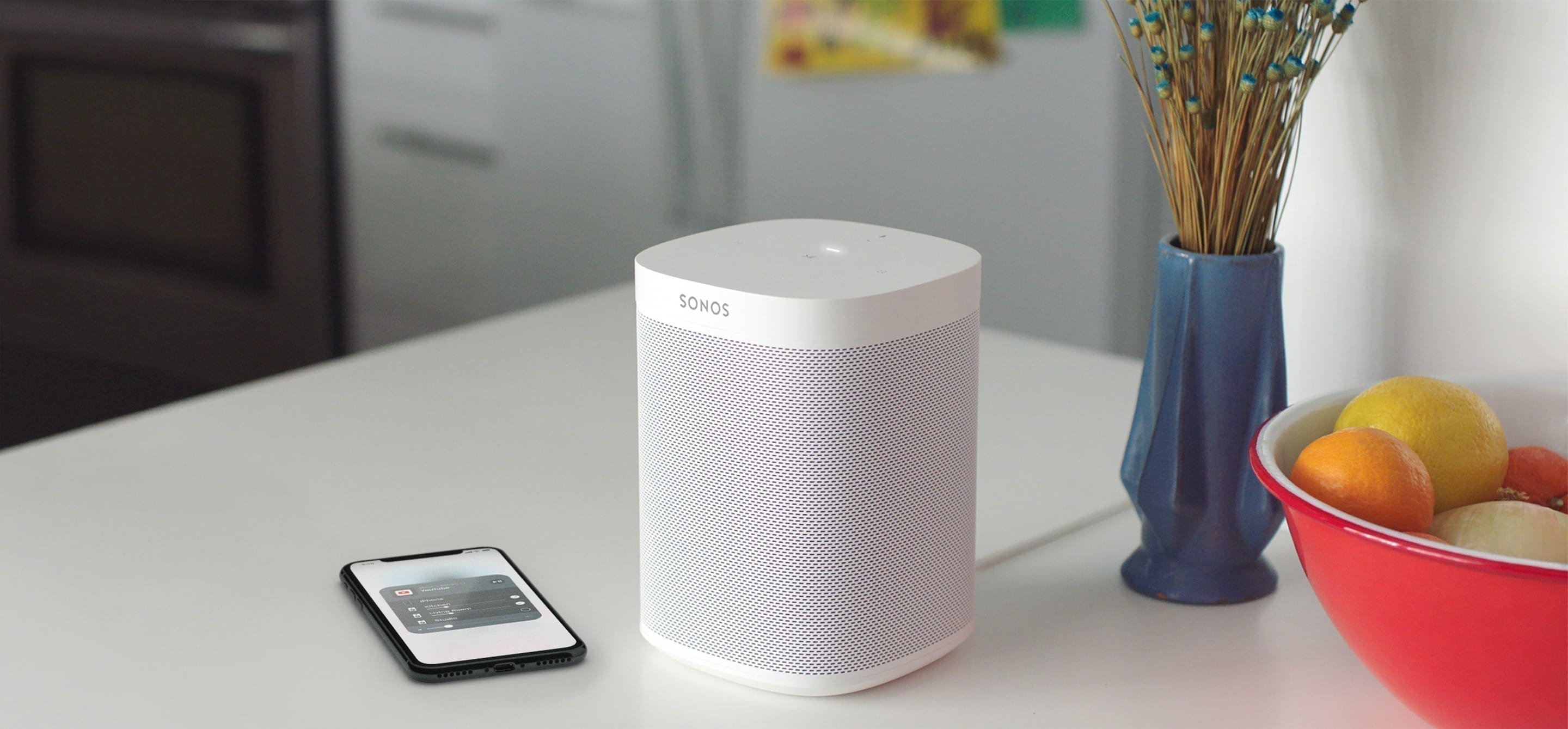 From a technical perspective, Apple and Sonos seem keen to work together — and the results of their collaboration has been great for consumers who use both ecosystems. AirPlay 2 support is effectively standard on all modern Sonos hardware, and really Sonos is essentially the default choice already for anyone looking to do AirPlay 2-based multiform audio, thanks to the wide range of options available in different form factors and at different price points. Sonos and Apple also offer an Apple Music integration for Sonos’ controller app, and now you can use voice control via Alexa to play Apple Music, too.
Competitive moves
The main issue that an Apple-owned Sonos hasn’t made much sense before now, at least from Sonos’ perspective, is that the speaker maker has reaped the benefits of being a platform that plays nice with all the major streaming service providers and virtual assistants. Recent Sonos speakers offer both Amazon Alexa and Google Assistant support, for instance, and Sonos’ software has connections with virtually every major music and audio streaming service available.
What’s changed, especially in light of Amazon’s slew of announcements this week, is that competitors like Amazon are looking more like they want to own more of the business that currently falls within Sonos’ domain. Amazon’s Echo Studio is a new premium speaker that directly competes with Sonos in a way that previous Echos really haven’t, and the company has consistently been releasing better-sounding versions of its other, more affordable Echos. It’s also been rolling out more feature-rich multi-room audio features, including wireless surround support for home theater use — all things squarely in the Sonos wheelhouse.
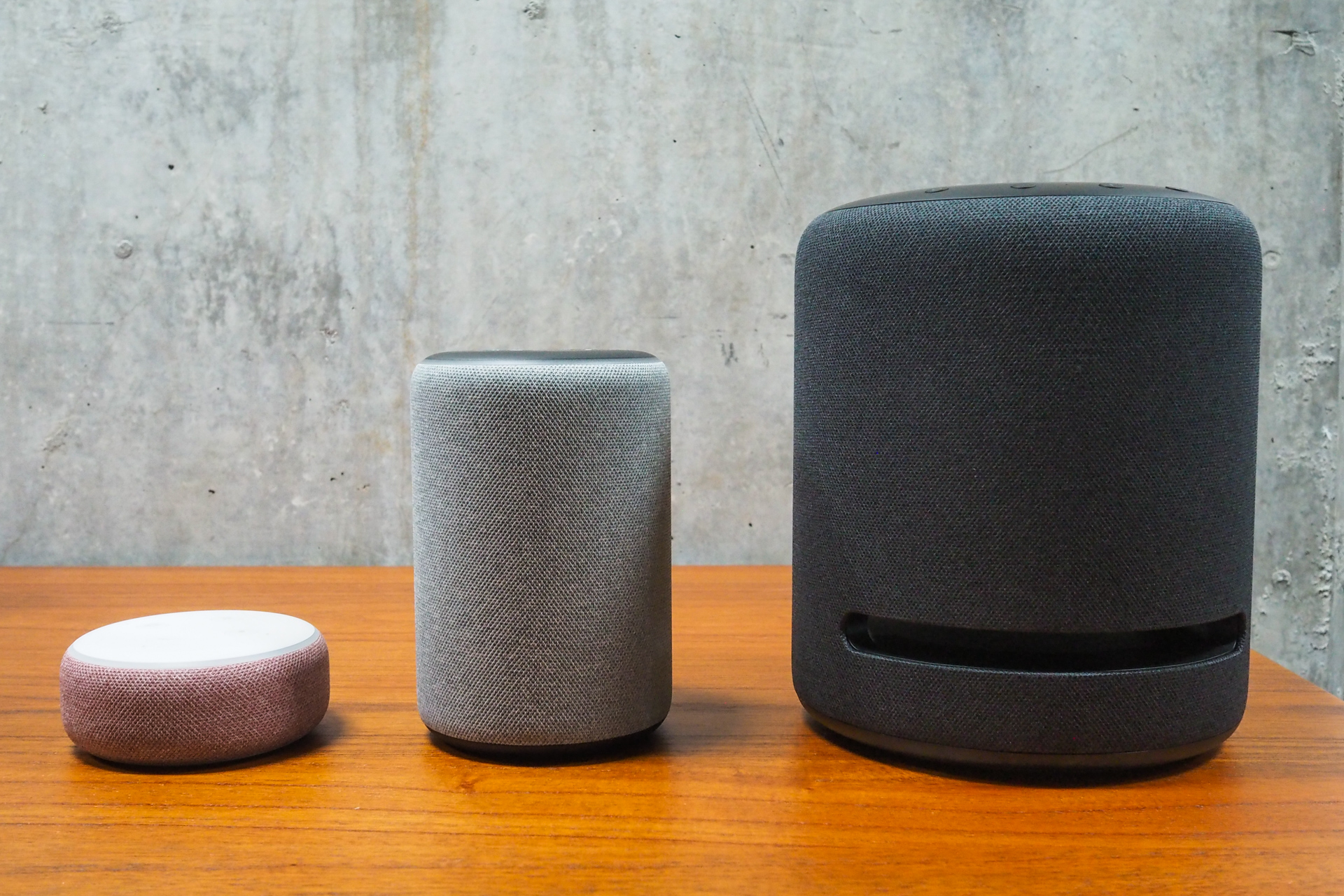
For now, Sonos and Amazon seem to be comfortably in “frenemy” territory, but increasingly, it doesn’t seem like Amazon is content to leave them their higher-end market segment when it comes to the speaker hardware category. Amazon still probably will do whatever it can to maximize use of Alexa, on both its own and third-party devices, but it also seems to be intent on strengthening and expanding its own first-party device lineup, with speakers as low-hanging fruit.
Other competitors, including Google and Apple, don’t seem to have had as much success with their products that line up as direct competitors to Sonos, but the speaker-maker also faces perennial challenges from hi-fi and audio industry stalwarts, and also seems likely to go up against newer device makers with audio ambitions and clear cost advantages, like Anker.
Missing ingredients/work to be done
Of course, there are some big challenges and potential red flags that stand in the way of Apple ever buying Sonos, or of that resulting union working out well for consumers. Sonos works so well because it’s service-agnostic, for instance, and the key to its success with recent products seems to also be integration with the smart home assistants that people seem to actually want to use most — namely Alexa and Google Assistant.
Under Apple ownership, it’s highly possible that Apple Music would at least get preferential treatment, if not become the lone streaming service on offer. It’s probable that Siri would replace Alexa and Assistant as the only virtual voice service available, and almost unthinkable that Apple would continue to support competing services if it did make this buy.
That said, there’s probably significant overlap between Apple and Sonos customers already, and as long as there was some service flexibility (in the same way there is for streaming competitors on iOS devices, including Spotify), then being locked into Siri probably wouldn’t sting as much. And it would serve to give Siri the foothold at home that the HomePod hasn’t managed to provide. Apple would also be better incentivized to work on improving Siri’s performance as a general home-based assistant, which would ultimately be good for Apple ecosystem customers.
Another smart adjacency
Apple’s bigger acquisitions are few and far between, but the ones it does make are typically obviously adjacent to its core business. A Sonos acquisition has a pretty strong precedent in the Beats purchase Apple made in 2014, albeit without the strong motivator of providing the underlying product and relationship basis for launching a streaming service.
What Sonos is, however, is an inversion of the historical Apple model of using great services to sell hardware. The Sonos ecosystem is a great, easy to use, premium-feel means of making the most of Apple’s music and video streaming services (and brand new games subscription offering), all of which are more important than ever to the company as it diversifies from its monolithic iPhone business.
I’m hardly the first to suggest an Apple-Sonos deal makes sense: J.P. Morgan analyst Samik Chatterjee suggested it earlier this year, in fact. From my perspective, however, the timing has never been better for this acquisition to take place, and the motivations never stronger for either party involved.
Disclosure: I worked briefly for Apple in its communications department in 2015-2016, but the above analysis is based entirely on publicly available information, and I hold no stock in either company.
What’s Off-White Without Virgil?
Creative director Virgil Abloh’s hiatus comes at a turning point for his brand, which may need a degree of reinvention when he returns.
PARIS, France — A crowd of excited Virgil Abloh fans lingered outside the Centre Pompidou in Paris on Thursday night, waiting for something that would never materialise. The designer had promised that there would be some sort of crowd participation at the staging of his Off-White Spring/Summer 2020 womenswear collection. But inside, without the high-concept production that the industry has come to expect of Off-White’s shows, the runway only surprised by featuring minimal visible logos, focusing instead on sharp shirt dresses, cut-out leather pants and leggings with a front slit.
Abloh, as expected, was nowhere to be found. He announced at the beginning of September that he would work from home in Chicago for three months in order to recover from an overwhelming travel schedule, which included eight international flights per week as part of his work at Off-White and Louis Vuitton, where he is the men’s designer. (He also participates in myriad collaborations and is an in-demand DJ.)
For Off-White, Abloh’s temporary disappearance comes at a precarious time for the brand, which may be in need of reinvention when its founder does inevitably return.
In many ways, the retrospective on Abloh’s work in fashion and beyond on view at The Museum of Contemporary Art Chicago this summer felt like the end of a chapter for the designer, who has deftly recognised that fashion has become less about the intricacies of design and more about the significance of images and the way products build communities of like-minded people.
Many are wondering about the future of the brand, and what it might look like in the future with or without Abloh’s involvement. It was the topic of discussion last week in a closed Facebook discussion group called High Fashion Talk, as prompted by Iolo Lewis Edwards, a photographer and founder of the 25,000-member group of passionate fashion fans, many of whom are men.
“They can really benefit from that as a way to ‘refresh’ on their clothing which can be kind of redundant sometimes,” said one member. “Imagine a mass-produced Off-White hitting the middle markets instead, I reckon they could wipe the floor with high street brands,” said another.
Edwards said that he has seen a shift in recent months in the way that the group’s members regard Off-White, the sought-after luxury streetwear brand and collaboration machine founded by Abloh in 2014. Known for the sort of visual branding, tribal significance and tightly controlled distribution strategy that can turn a simple T-shirt into a coveted signifier of status and affiliation, Abloh pushed high-fashion to think differently about streetwear, limited-edition “drops” and community building. He has since been embraced by the mainstream, with LVMH naming Abloh men's artistic director of Louis Vuitton in 2018. More recently, Tom Ford appointing Abloh to the board of the CFDA.
But like all that goes up, Abloh’s ascent to the pinnacle of luxury menswear appears to be levelling off — and it’s not just fashion fans on Facebook groups. According to data from retail analytics firm Edited, demand for Off-White products at US retailers is slowing down. The number of sold-out products on Farfetch is down 50 percent year-over-year, and the number of discounted items is up 7 percent. During the sales in July, 40 percent of the brand's products were discounted, up from 30 percent the same period the prior year. For the year through August, the value of earned media about the brand on social media decreased 38 percent versus the same period a year earlier, according to Tribe Dynamics.
“It seems like the audience has moved over to Louis Vuitton rather than Off-White now,” said Edwards.
Off-White is at a turning point as the luxury streetwear cycle that Abloh helped pioneer starts to cool off. Last week, Balenciaga’s Creative Director Demna Gvasalia stepped down from Vetements, the only luxury streetwear brand to rival Off-White for its high-fashion influence, which has seen a more dramatic tumble in its relevance to both the industry and shoppers.
Abloh has already started to lay the groundwork for a new era at Off-White, pushing the collection in new directions on the runway in recent seasons, including more tailoring and evening wear. But the brand is still primarily known for its core offering of $300 T-shirts and $600 hoodie sweatshirts, as well as accessories and Nike collaboration sneakers, branded with his signature crossing arrows and quotation marks. These pieces are his major differentiators, much more so than the understated but elegant runway pieces which don’t have as clear a reason for existing in the market.
However, Off-White is hardily entering a tailspin. It is consistently at the top of Lyst’s quarterly list of hottest brands (based on Lyst and Google search data, conversion rates and sales and social media), alternating in the top spot with Gucci since the second quarter of 2018.
In the most recent quarter, Off-White’s Jitney bag — a ladylike style with “LOGO” and “CASH INSIDE” printed largely on the outside in Ablohs’ handwriting — topped the Lyst Index of most popular women’s items, and chunky Off-White Odsy 1000 sneakers ranked fifth in men’s products.
Currently, 16 percent of its US wholesale products are marked down, according to Edited, compared with an average of 37 percent for luxury brands.
And the community that Abloh has built around Off-White is still out there, waiting for the next Nike release or showing up to his show venues, motivated to belong as much as to buy. Its what inspires his fans to take in his work in a museum or cue up for his latest collaboration.
Luxury streetwear may have peaked among the jet-set youth, but there are still consumers discovering the brands that defined the trend. The larger societal movement of people dressing more casually, even at work and special events, should also keep the streetwear brands from fading fast.
Many luxury brands have also tapped into streetwear, making Off-White’s core market more competitive, said Mario Ortelli, managing partner of luxury advisory firm Ortelli & Co. But Off-White has a track record of giving customers what they don’t know they want yet, rather than reacting to the zeitgeist, he added.
“Off-White so far has shown great ability to adjust to what our market requests,” Ortelli said.
Meanwhile, however, big changes are coming to Off-White’s retail strategy, which will likely make the brand easier to shop and, as a result, cut into some of the hype it earns by being limited in release. This is particularly important for sneakers, which are seen as more desired based on how few pairs are available for sale. Last year, for example, releases of the coveted Yeezy sneaker did not instantly sell out because Adidas increased the quantities on the market.
The force behind the retail strategy change is Farfetch, which acquired the New Guards Group in August. The Milanese platform controls Off-White and other limited-release brands led by creatives with ardent followings, like Heron Preston and Palm Angels. Farfetch plans to launch, test and scale brands with New Guards through its own sales channels, effectively betting it can cash in on the rise of the next Off-White. The marketplace also plans to increase the volume of direct retail and e-commerce sales of existing brands, which only represents about 5 percent of New Guards Group revenue.
New Guards Group does not actually own Off-White, however, so it is unclear how much longer that relationship will last. New Guards is the majority owner of a company that licenses the Off-White trademarks, which are owned by Abloh. Once that agreement expires — neither side has said when — Abloh will be free to do what he wants with the Off-White brand.
What is clear, however, is that Abloh’s status as a leader in fashion isn’t going away anytime soon. He understands better than most that the business of fashion today is predicated on much more than innovative design.
Perhaps this self-enforced travel ban is a way for him to find his next approach.
Where Europe Runs On Coal
The end of the age of fossil fuels is not yet in sight in Europe. As Statista's Martin Armstrong illustrates in the following infographic, there are still a number of countries that generate a very large proportion of their electricity from coal.

You will find more infographics at Statista
At the same time, not all countries have announced a date for phasing out its use. This applies in particular to those countries that have a high proportion of coal-fired electricity. Despite recent efforts to transition to renewable energy, Germany still lies in the upper quarter of the country comparison, behind countries such as Poland, Czechia, Greece and Bulgaria. The government is aiming to phase out coal by 2038.
Scientists are demanding a move away from electricity generation from coal. The prevention of climate change can only be achieved by a complete abandonment of fossil fuels. In addition, electricity from renewable energies can be produced more cheaply than electricity from fossil fuels - taking into account the resulting costs of health and climate damage. In Poland, for example, many people suffer health problems from the consequences of high levels of air pollution. Nevertheless, there is no prospect of a swift turn away from coal. One reason for this is that jobs in the five-digit region depend on coal production.
Global coal production has risen again recently, with around 8 billion tonnes of coal mined in 2018. Countries such as China, Russia and the USA contributed to the increase.