Google’s latest user-hostile design change makes ads and search results look identical
Did you notice a recent change to how Google search results are displayed on the desktop?
I noticed something last week — thinking there must be some kind of weird bug messing up the browser’s page rendering because suddenly everything looked similar: A homogenous sea of blue text links and favicons that, on such a large expanse of screen, come across as one block of background noise.
I found myself clicking on an ad link — rather than the organic search result I was looking for.
Here, for example, are the top two results for a Google search for flight search engine ‘Kayak’ — with just a tiny ‘Ad’ label to distinguish the click that will make Google money from the click that won’t…
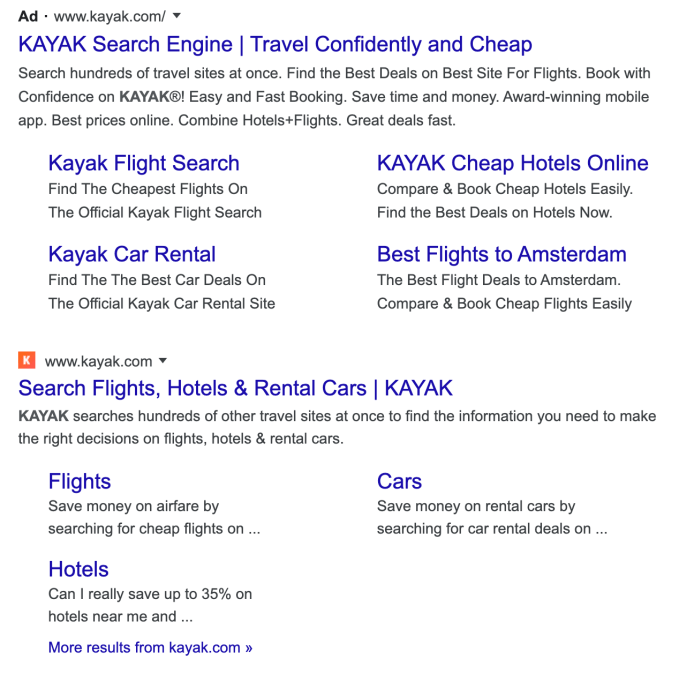
Turns out this is Google’s latest dark pattern: The adtech giant has made organic results even more closely resemble the ads it serves against keyword searches, as writer Craig Mod was quick to highlight in a tweet this week.


Last week, in its own breezy tweet, Google sought to spin the shift as quite the opposite — saying the “new look” presents “site domain names and brand icons prominently, along with a bolded ‘Ad’ label for ads”:


But Google’s explainer is almost a dark pattern in itself.
If you read the text quickly you’d likely come away with the impression that it has made organic search results easier to spot since it’s claiming components of these results now appear more “prominently” in results.
Yet, read it again, and Google is essentially admitting that a parallel emphasis is being placed — one which, when you actually look at the thing, has the effect of flattening the visual distinction between organic search results (which consumers are looking for) and ads (which Google monetizes).
Another eagle-eyed user Twitter, going by the name Luca Masters, chipped into the discussion generated by Mod’s tweet — to point out that the tech giant is “finally coming at this from the other direction”.
They're finally coming at this from the other direction:https://twitter.com/GinnyMarvin/status/757606109322633216 …


44 people are talking about this
‘This’ being deceptive changes to ad labelling; and ‘other direction’ being a reference to how now it’s organic search results being visually tweaked to shrink their difference vs ads.
Google previously laid the groundwork for this latest visual trickery by spending earlier years amending the look of ads to bring them closer in line with the steadfast, cleaner appearance of genuine search results.
Except now it’s fiddling with those too. Hence ‘other direction’.
Masters helpfully quote-tweeted this vintage tweet (from 2016), by journalist Ginny Marvin — which presents a visual history of Google ad labelling in search results that’s aptly titled “color fade”; a reference to the gradual demise of the color-shaded box Google used to apply to clearly distinguish ads in search results.
Those days are long gone now, though.

271 people are talking about this
Now a user of Google’s search engine has — essentially — only a favicon between them and an unintended ad click. Squint or you’ll click it.
This visual trickery may be fractionally less confusing in a small screen mobile environment — where Google debuted the change last year. But on a desktop screen these favicons are truly minuscule. And where to click to get actual information starts to feel like a total lottery.
A lottery that’s being stacked in Google’s favor because confused users are likely to end up clicking more ad links than they otherwise would, meaning it cashes in at the expense of web users’ time and energy.
Back in May, when Google pushed this change on mobile users, it touted the tweaks as a way for sites to showcase their own branding, instead of looking like every other blue link on a search result page. But it did so while simultaneously erasing a box-out that it had previously displayed around the label ‘Ad’ to make it stand out.
That made it “harder to differentiate ads and search results,” as we wrote then — predicting it will “likely lead to outcry”.
There were certainly complaints then. And there will likely be more now — given the visual flattening of the gap between ad clicks and organic links looks even more confusing for users of Google search on desktop.
We reached out to Google to ask for a response to the latest criticism that the new design for search results makes it almost impossible to distinguish between organic results and ads. But the company ignored repeat requests for comment.
Of course it’s true that plenty of UX design changes face backlash, especially early on. Change in the digital realm is rarely instantly popular. It’s usually more ‘slow burn’ acceptance.
But there’s no consumer-friendly logic to this one. (And the slow burn going on here involves the user being cast in the role of the metaphorical frog.)
Instead, Google is just making it harder for web users to click on the page they’re actually looking for — because, from a revenue-generating perspective, it prefers them to click an ad.
It’s the visual equivalent of a supermarket putting a similarly packaged own-brand right next to some fancy branded shampoo on the shelf — in the hopes a rushed shopper will pluck the wrong one. (Real life dark patterns are indeed a thing.)
It’s also a handy illustration of quite how far away from the user Google’s priorities have shifted, and continue to drift.
“When Google introduced ads, they were clearly marked with a label and a brightly tinted box,” says UX specialist Harry Brignull. “This was in stark contrast to all the other search engines at the time, who were trying to blend paid listings in amongst the organic ones, in an effort to drive clicks and revenue. In those days, Google came across as the most honest search engine on the planet.”
Brignull is well qualified to comment on dark patterns — having been calling out deceptive design since 2010 when he founded darkpatterns.org.
“I first learned about Google in the late 1990s. In those days you learned about the web by reading print magazines, which is charmingly quaint to look back on. I picked up a copy of Wired Magazine and there it was – a sidebar talking about a new search engine called ‘Google’,” he recalled. “Google was amazing. In an era of portals, flash banners and link directories, it went in the opposite direction. It didn’t care about the daft games the other search engines were playing. It didn’t even seem to acknowledge they existed. It didn’t even seem to want to be a business. It was a feat of engineering, and it felt like a public utility.
“The original Google homepage was recognised a guiding light of purism in digital design. Search was provided by an unstyled text field and button. There was nothing else on the homepage. Just the logo. Search results were near-instant and they were just a page of links and summaries – perfection with nothing to add or take away. The back-propagation algorithm they introduced had never been used to index the web before, and it instantly left the competition in the dust. It was proof that engineers could disrupt the rules of the web without needing any suit-wearing executives. Strip out all the crap. Do one thing and do it well.”
“As Google’s ambitions changed, the tinted box started to fade. It’s completely gone now,” Brignull added.
The one thing Google very clearly wants to do well now is serve more ads. It’s chosen to do that deceptively, by steadily — and consistently — degrading the user experience. So a far cry from “public utility”.
And that user-friendly Google of old? Yep, also completely gone.
IONITY, a European EV charging network owned by BMW, Daimler, Ford, Hyundai, Kia, and VW Group (with Audi and Porsche) has announced that prices will be going up over 500% starting January 31 as they transition to a pay-per-kWh system.
Previously, IONITY charged a flat, fixed rate of €8 for a DCFC charging session. This was a good deal if you showed up with an empty battery and filled most of the way. If you arrived with, say, 10% battery remaining, and added 60 kWh during your charging session, then you’d get away with paying about €0.13 per kWh. For context, in France, electricity costs about €0.19 per kWh at home, and €0.24 per kWh at Tesla Superchargers. In Germany, you pay €0.30 per kWh at home, and €0.33 at Tesla Superchargers in Germany.
Starting next month, however, IONITY will be charging users a whopping €0.79 per kWh. (PDF press release). The Audi e-Tron battery is 95 kWh, so if you “filled it up” with 80 kWh, that’s €63.20 to travel probably about 160 miles, give or take. Terribly expensive.
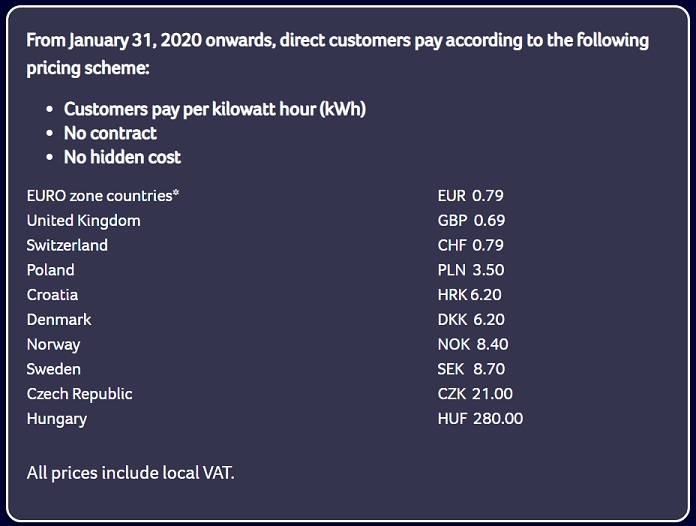
IONITY pricing
The UK’s Alternative Fuels Infrastructure Regulations: 2017 requires IONITY to offer transparent pricing in this manner for non-subscription users. But IONITY also enters supplier agreements with its car makers, referred to as “Connected Mobility Service Partners” (MSPs). This is a subscription service where you pay monthly to get a discounted price per kWh, and generally agree via terms of use or a privacy policy in an app to allow the vendor to harvest data from you to enable other revenue streams for the vendor. IONITY does not offer a complete list of MSPs or prices you’d pay on its website.
Electrek’s Take
If IONITY’s owners want to make driving electric as unappealing as possible, keep it up. One positive thing we can say at least: Thanks to the UK regulations and the subsequent pricing per kWh, it’s abundantly transparent what a terrible deal it is. Conversely in the United States, Electrify America still hides its terrible pricing behind per-minute billing, although we expect that to change as California’s ban on pricing by the minute comes into effect at DCFC stations in 2023.
The notion of “charging as a service” is, frankly, repulsive. Electricity is a commodity, and it would be nice to be able to procure it without entering an ongoing relationship with yet another subscription service.
Our takeaway on this is that legacy OEMs still don’t get the competition they’re facing from Tesla. It’s not enough to compete with Tesla on vehicle specs. They need to concern themselves with the entire ownership experience. This suggests that they either don’t understand or reject that challenge.
>>> Up
* ASML PT Raised to 300 euros from 265 euros at UBS (+)
* BAE PT Raised to 750 pence from 655 pence at Berenberg
* BAT Raised to Equal-Weight at Morgan Stanley
* Daimler Raised to Hold at SocGen; PT 47 euros
* Dassault Aviation Raised to Outperform at Exane; PT 1,410 euros
* Ferrari PT Raised to 180 euros from 120 euros at Citi
* Gjensidige Raised to Hold at ABG; PT 188 kroner
* NN Raised to Buy at HSBC; PT 42 euros
* Renishaw Raised to Overweight at Morgan Stanley; PT 4,500 pence
* Rightmove Raised to Neutral at JPMorgan
* Sandvik Raised to Buy at SocGen; PT 230 kronor
* Schaeffler Raised to Buy at Citi; PT 11 euros
* Unicaja Raised to Buy at UBS
* Zurich Ins. Raised to Buy at HSBC; PT 480 Swiss francs
>>> Down
* BAE Cut to Neutral at Exane; PT 670 pence
* Boskalis Cut to Hold at ABN Amro Bank; PT 22.50 euros (+)
* Compass Cut to Hold at HSBC; PT 1,915 pence
* Continental AG Cut to Neutral at Citi
* ConvaTec Cut as Shore Sees Post-Turnaround Investment Risks
* Entra Cut to Hold at ABG; PT 160 kroner
* Essity Cut to Hold at ABG; PT 335 kronor
* Handelsbanken Cut to Hold at Berenberg; PT 95 kronor
* Harvia Cut to Sell at Handelsbanken; PT 9.50 euros
* HighCo cuts to Neutral from Buy at Oddo Securities (HCO FP) (+)
* KAZ Minerals Cut to Hold at VTB Capital; PT 520 pence
* Lancashire Cut to Reduce at HSBC; PT 551 pence
* Mail.ru Group GDRs Cut to Hold at Renaissance Capital; PT $26
* Nemetschek Cut to Reduce at Baader Helvea; PT 62.50 euros
* Renault Cut to Sell at Citi; PT 30 euros
* SIG Combibloc Cut to Neutral at Goldman; PT 15.50 Swiss francs
* Tokmanni Group Cut to Hold at Handelsbanken; PT 14 euros
* Wm Morrison Supermarkets Cut to Sell at Goldman; PT 175 pence
>>> Initiation
* Agripower France Rated New Buy at MainFirst; PT 13 euros
* Aston Martin Rated New Buy at Citi; PT 600 pence
* Elior Group Reinstated Buy at HSBC; PT 15.60 euros
* Galp Rated New Neutral at Oddo BHF; PT 16.50 euros
* Immobel SA Rated New Buy at Berenberg; PT 87 euros
* Intershop Rated New Buy at MainFirst; PT 670 Swiss francs
* Partners Group Rated New Sell at Berenberg; PT 607 Swiss francs
* PSP Swiss Rated New Buy at MainFirst; PT 155 Swiss francs
* Sodexo Reinstated Buy at HSBC; PT 113 euros
* St James's Place Rated New Outperform at Autonomous Research
* Swiss Prime Rated New Hold at MainFirst; PT 113 Swiss francs
>>> Call
* Car Volume Consensus Too High, Structural Winners Favored: Citi (+)
* Asos Sales Beat Estimates, But Gross Margin Weak: Morgan Stanley
* Autoneum ‘Significantly’ Outperformed Weak Market, Vontobel Says
* STMicro Beats Across Board, 1Q Outlook ‘Stronger:’ MS
* ‘Tread Cautiously’ in EU Tobacco, BAT Upgraded: Morgan Stanley (+)
How China’s slow response aided coronavirus outbreak
Controls on information may have hampered efforts to curb the spread of the disease
In Wuhan, the Chinese city at the centre of the outbreak of a deadly Sars-like virus, dozens of vendors line up for compensation after officials shut down the local market.
“Many people here got infected,” said one vendor, referring to the virus that originated in the market and has now spread across the globe. Stallholders queueing outside the blue-shuttered stalls of the market were each receiving Rmb10,000 ($1,445) for lost business.
“We had live animals but nothing illegal,” insisted another vendor, amid reports that the virus jumped from wild animals such as civet cats that were reportedly sold at the market.
Nearly two months after the first reports of a new virus emerged in Wuhan, authorities have shut down air-and-rail transport links into and out of the central city, China’s seventh largest, which also acts as a transport hub to most of the country’s metropolises.
People swarmed the city’s airport and train station on Wednesday night to try to beat the travel ban. As the death toll mounted to 17 and the number of infected rose to 599 across China and cases were reported throughout Asia as well as the US, worried residents descended on Wuhan’s hospitals.
City authorities claim the air-and-rail travel ban and the closure of the market were evidence of decisive action to combat the spread of the disease. But with more than 100m Chinese about to travel for the lunar new year holiday, analysts question whether the slow release of information worsened the spread of the disease.
China only began a determined national drive after President Xi Jinping on Monday urged an all-out effort to curb the spread of the virus, and the Communist party threatened local officials who tried to cover it up, analysts said.
“The government has been trying to monopolise disease-related information from the very beginning,” said Yanzhong Huang, a fellow for global health at the Council on Foreign Relations in the US.
The Chinese government’s dissemination of information on the Wuhan virus is a dramatic improvement on 2003, when authorities covered up the Sars outbreak. This time, health authorities have released regular updates on the virus after patients began showing symptoms in late December.
Chinese authorities have isolated suspected patients, checked their contacts for infection, and identified and shared the virus’ genetic profile with overseas researchers. “China seems to be following best practices,” said Jeffrey Koplan, a global disease expert at Emory University in the US.
The problem was the slow dissemination of this information, analysts said.
When Chinese state media reported 27 cases of an unknown type of pneumonia in Wuhan on December 31, city authorities closed the market the next day, according to staff. Over the following two weeks, authorities in the city identified dozens of infections and said the cause was a virus similar to Sars.
But the city’s bestselling commercial newspaper, the Wuhan Evening News, did not feature the outbreak on its front page for two weeks, between January 6 and January 19.
Chinese censors also initially instructed media to stick to reprinting official reports on the virus from central government-controlled media, severely restricting independent reporting, according to multiple journalists.
In one example, a Chinese reporter said this month that they were told by a medical professional that hospitals in the city were given a target of “zero infections” among staff, with hospital deans liable to be fired for failing to meet the target. As a result, medical staff were slow to report infections among nurses.
But the journalist’s media outlet did not follow up on the information, the reporter said. This week, the Wuhan government suddenly admitted that 15 medical staff had been infected — a development normally considered an important indicator of the virality of a disease.
“Until recently the government was saying [there were] no such infections. Does that mean the infection happened all at once?” said the Council of Foreign Relations’ Mr Huang of the medical staff cases.
Part of the reason for the tightly controlled release of information was that Wuhan, a provincial capital, was hosting annual meetings of the top municipal and provincial officials from January 7 to 17.
“This is a major factor that the authorities in Wuhan city sought to project an air of calm and most likely delayed taking action to stop the spread of the Wuhan coronavirus,” said Dali Yang, an expert on Chinese bureaucracy at the University of Chicago.
Since Sars, China has built a world class network of disease control centres in all its big cities. Yet several cases were confirmed overseas in Thailand and Japan before infections were reported in Chinese cities other than Wuhan.
“The strength of the Chinese system, that [it] gets right down to the front line, was ultimately what got Sars under control,” said a public health expert who declined to be named. “There is a question of whether the alert [was] in place sufficiently quickly this time”.
Following Mr Xi’s statement, there have been stronger warnings on social media. “Anyone who deliberately delays and hides the reporting of cases out of self-interest will be nailed on a pillar of shame for eternity,” the ruling party’s Central Political and Legal Affairs Commission said on a social media account.
In Wuhan on Thursday, those who were unable to get away before the quarantine flocked to supermarkets and convenience stores to gather supplies while others crowded hospitals, worried they might have caught the disease. The atmosphere was of a city preparing for a siege rather than Spring Festival celebrations.
“I wouldn’t normally visit a hospital with mild symptoms,” said a 25-year-old woman surnamed Liu outside one of the city’s hospitals. “But I am more cautious after hearing about the virus.”
Lagarde’s legacy building begins at the ECB
The ECB president will launch the second strategic review in the 20-year history of the organisation
Every good central banker needs a legacy. Mario Draghi, the former head of the European Central Bank, is widely credited with rescuing the eurozone from a debt crisis. Today his successor, Christine Lagarde, will kick off the search for a defining cause of her own.
Ms Lagarde will launch the second strategic review in the 20-year history of the ECB — a process that she has said will last until December as it turns “every stone” in search of ways to fine tune its monetary policy toolkit.
One of the most controversial ideas Ms Lagarde has proposed for the review is to make tackling climate change a “mission-critical” priority of the ECB.
It is easy to see why this idea appeals to Ms Lagarde, with extreme weather events increasing in frequency and intensity every year — the latest being the wildfires raging across Australia — and pushing green issues to the top of the political agenda.
The Bank for International Settlements warned this week that the next financial crisis could be caused by a “green swan” event driven by global warming and that action by central banks, while important, would not be enough on its own to deal with it this time.
Central bankers, notably Mark Carney at the Bank of England, have long been pushing for more action to deal with the financial risks of climate change. Yet Ms Lagarde is likely to nudge the ECB to go further in several ways.
For a start, the ECB could integrate climate-related risks into all its modelling and take more account of them when valuing collateral it accepts from financial institutions, as proposed by Banque de France governor François Villeroy de Galhau.
Environmental campaigners are calling on the ECB to do even more and repurpose its €2.6tn asset-purchase programme, known as quantitative easing (QE), by divesting “brown” bonds issued by carbon-intensive companies while increasing purchases of green bonds.
This would be unacceptable to some members of the governing council, such as Jens Weidmann, head of Germany’s Bundesbank. Critics say it is up to politicians, not central banks, to decide which companies to favour and which to penalise.
But the “green QE” idea is catching on at the European Commission as it develops its Green Deal to cut carbon emissions. Thierry Breton, the EU’s new single market and industry commissioner, said this week that to unlock the €1tn of financing needed for the Green Deal countries may issue long-term debt that could be bought by the ECB via its QE programme.
“We are going to discuss this with the ECB, which is looking for tools to invest in as part of its quantitative easing policy,” Mr Breton said on a visit to Paris this week.
- Lufthansa (LHA TH) +2.7%
- Lufthansa Weighs Listing of Stake in Jet-Maintenance Unit
-
STMicroelectronics (SGM TH) +2.6%
- STMicro 4Q Net Revenue, Gross Margin Beats Highest Ests
-
Imperial Brands (ITB TH) +1.8%
- ‘Tread Cautiously’ in EU Tobacco, BAT Upgraded: Morgan Stanley
- Salmar (JEP TH) -1.2%
- Prosus (1TY TH) -1.4%
- GEA Group (G1A TH) -1.5%
- HelloFresh (HFG TH) -1.5%
-
K+S (SDF TH) -1.5%
- Shares fell 8.2% yesterday
-
Renault (RNL TH) -1.7%
- Renault Cut to Sell at Citi; PT 30 euros
- Nemetschek (NEM TH) -2.4%
- Nemetschek Shares Fall Post-Market on Baader Double Downgrade
-
ACS (OCI1 TH) -2.6%
- Galp, ACS reach $2.43 billion solar-energy deal
- Wm Morrison Supermarkets (MZP TH) -2.8%
- Wm Morrison Supermarkets Cut to Sell at Goldman; PT 175 pence
-
Hochtief (HOT TH) -5.8%
- Hochtief Sees ~EU800m Impact of CIMIC Reorg; FY Div +16%
IMF chief Georgieva:Uncertainty remains the top risk to the downside for growth - Consensus is that interest rates to be lower for longer
DAX:
- Lufthansa (LHA TH) +2.9%
- Lufthansa Weighs Listing of Stake in Jet-Maintenance Unit (1)
- Continental AG (CON TH) -0.7%
- Continental AG Cut to Neutral at Citi
- Wirecard (WDI TH) -0.7%
- SAP (SAP TH) -0.9%
MDAX:
- RTL (RRTL TH) +0.7%
- Metro AG (B4B TH) +0.5%
- GEA Group (G1A TH) -1.1%
- K+S (SDF TH) -1.3%
- K+S Reader Interest Increases; Option Volume High
- Nemetschek (NEM TH) -2.4%
- Nemetschek Shares Fall Post-Market on Baader Double Downgrade
- Varta (VAR1 TH) -2.6%
- Hochtief (HOT TH) -5.9%
- Hochtief Sees ~EU800m Impact of CIMIC Reorg; FY Div +16% (1)
SDAX:
- Corestate (CCAP TH) +0.8%
- HelloFresh (HFG TH) -1.3%
- RIB Software (RIB TH) -1.9%
- Cewe Stiftung (CWC TH) -2.1%
- Cewe Stiftung Prelim Full Year Ebit High End Of EU58 Mln
- Heidelberger Druck (HDD TH) -2.2%
- S&T (GROA TH) -3.1%
- S&T Rose 11% Wednesday After Targets Surprised Analysts