(ZeroHedge) Europe's Solar Surge Exposes Cracks In Aging Power Grid: Analysts

Europe's Solar Surge Exposes Cracks In Aging Power Grid: Analysts

Europe’s solar power boom is putting huge pressure on electricity grids that were never built to handle this much renewable energy, say analysts.
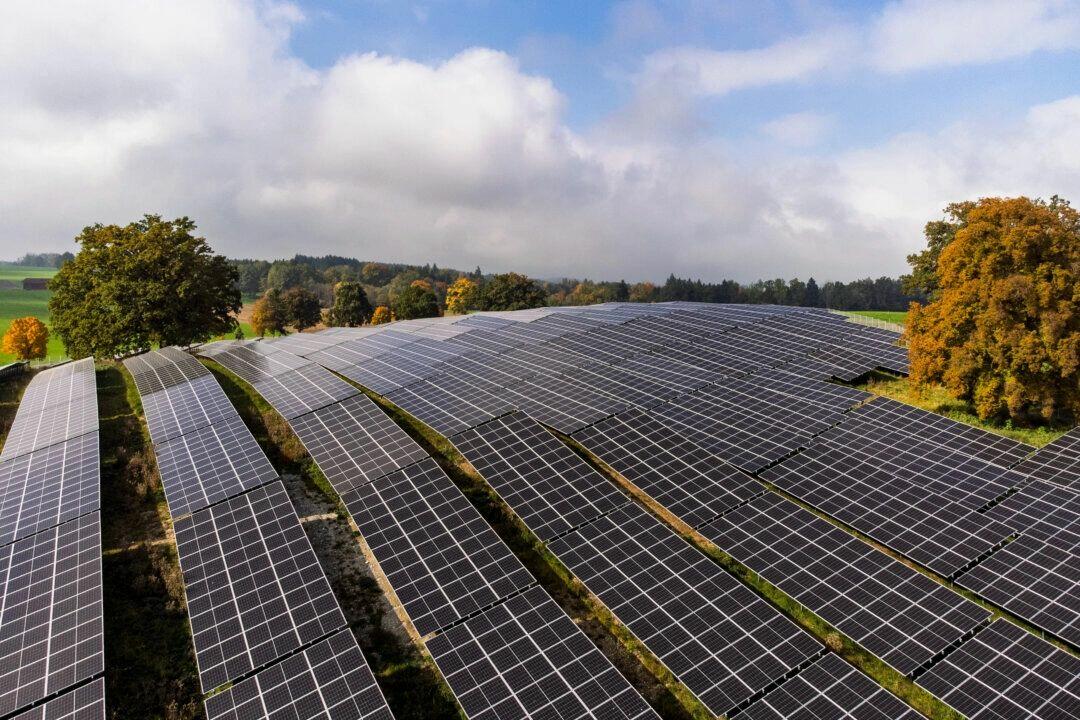
An aerial view taken with a drone shows a solar energy field near Weilheim, Germany, on Oct. 16, 2025. Philipp Guelland/Getty Images
As a record number of new solar panels are being installed every year, the old grid system is struggling to keep up.
Solar generation capacity in the European Union continues to increase and reached an estimated 338 GW by 2024, according to SolarPower Europe.
To curb its dependence on Russian energy and accelerate its green transition, the EU set a goal in 2022 to install at least 700 gigawatts of solar power by 2030, enough to supply electricity to hundreds of millions of homes.
But the rapid expansion has exposed cracks in Europe’s energy system, threatening to slow the transition unless grids catch up.
Europe’s power grids faced a surge in voltage problems last year, with 8,645 over-voltage incidents reported in 2024—nearly 10 times more than in 2023, according to the European Network of Transmission System Operators for Electricity (ENTSO-E).
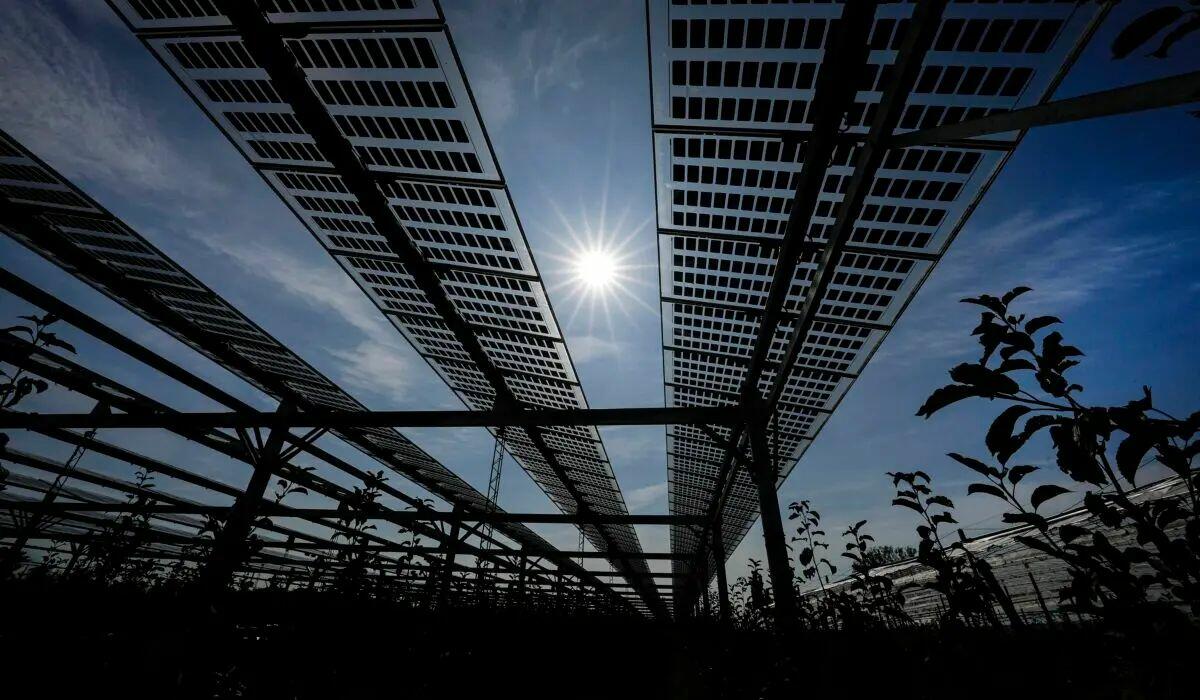
Special mounted solar panels are installed over a biological apple fruit tree plantation in Gelsdorf, western Germany, on Aug. 30, 2022. Martin Meissner/AP Photo
Aging distribution infrastructure complicates the issue. Industry group Eurelectric estimates that nearly half of Europe’s distribution networks will be more than 40 years old by 2030.
Energy analyst and project lead at the Helmholtz Center Berlin, Susanne Nies, told The Epoch Times that Europe’s power system is under heavy strain because it was designed for a time when electricity made up only a small share of total energy use.
“When you go to the countryside and countries like France or even Germany, those grids have been built in the 50s. They are really nearly 70 years old,” she said.
Europe’s electricity system was initially designed for one-way flows—from large power plants to homes and businesses, Nies explained, adding that now it must handle power flowing in both directions, as millions of solar panels feed energy back into the grid.
She said today’s grid needs to combine large regional “super grids” with smaller, local systems that can operate independently during emergencies.
Harry Wilkinson, head of policy at the Global Warming Policy Foundation, said the challenge is not only that Europe’s grid is aging but that it must be vastly expanded to connect power sources that are far more scattered than in the past.
“Just the physical amount of additional cabling that you have to add to the grid, to connect, that is a big challenge, just in itself,” he said.
Voltage Problems and Spain’s Grid Struggles
Most voltage problems in 2024 originated from Sweden’s Svenska kraftnät, which implemented automated reporting, while operators in Slovenia, Moldova, and Romania also experienced increases as renewables expanded, according to Eurelectric.
Others fared better: Hungary’s MAVIR cut incidents for a second year, and grid operators in Spain, the Netherlands, and France reported none at all.
However, in April, huge power outages hit Spain and Portugal, leaving millions of homes and businesses without power. In Spain, where solar energy now provides about 21 percent of the country’s power—up from 8 percent five years ago—emergency measures have been necessary to prevent blackouts.

Customers dine in a restaurant illuminated by a generator during a blackout in Barcelona, Spain, on April 28, 2025. AP Photo/Emilio Morenatti
Nies said that while in Spain’s case, the solar power grid was not the culprit, it has not been updated as fast as needed, and parts of it could be improved.
Wilkinson disagrees that it wasn’t the grid’s fault. He told The Epoch Times that renewables are simply more complicated to manage as a technology.
Nies noted that Spain remains poorly connected to its neighbors, while Germany’s grid is far more integrated, with four transmission operators and nearly 900 distribution system operators that manage local electricity networks.
According to independent energy consultant Kathryn Porter, location plays a far greater role in weaker grids. While frequency stays consistent across a network, voltage is a local factor that must be stabilized by nearby equipment.
“Spain’s conventional generation is concentrated in the north and east, while the south is dominated by renewables, making the southern network weak and increasingly difficult to control,” she said in her blog.
Grid Spending
Solar power supplies 22.1 percent of the EU’s electricity, according to energy thinktank Ember Climate, compared with 12.4 percent in China.
In the United States, the share is projected to reach about 7 percent in 2025, according to the U.S. Energy Information Administration.
Even as solar output soars, Europe’s electricity demand has stagnated, falling last year and recovering only slightly in 2025. Weak demand makes it more challenging to balance an energy system that is increasingly dominated by intermittent renewables.
The International Energy Agency (IEA) says investment in transmission and distribution networks is becoming critical as grid upgrades struggle to keep pace with the rapid buildout of low-emission power.
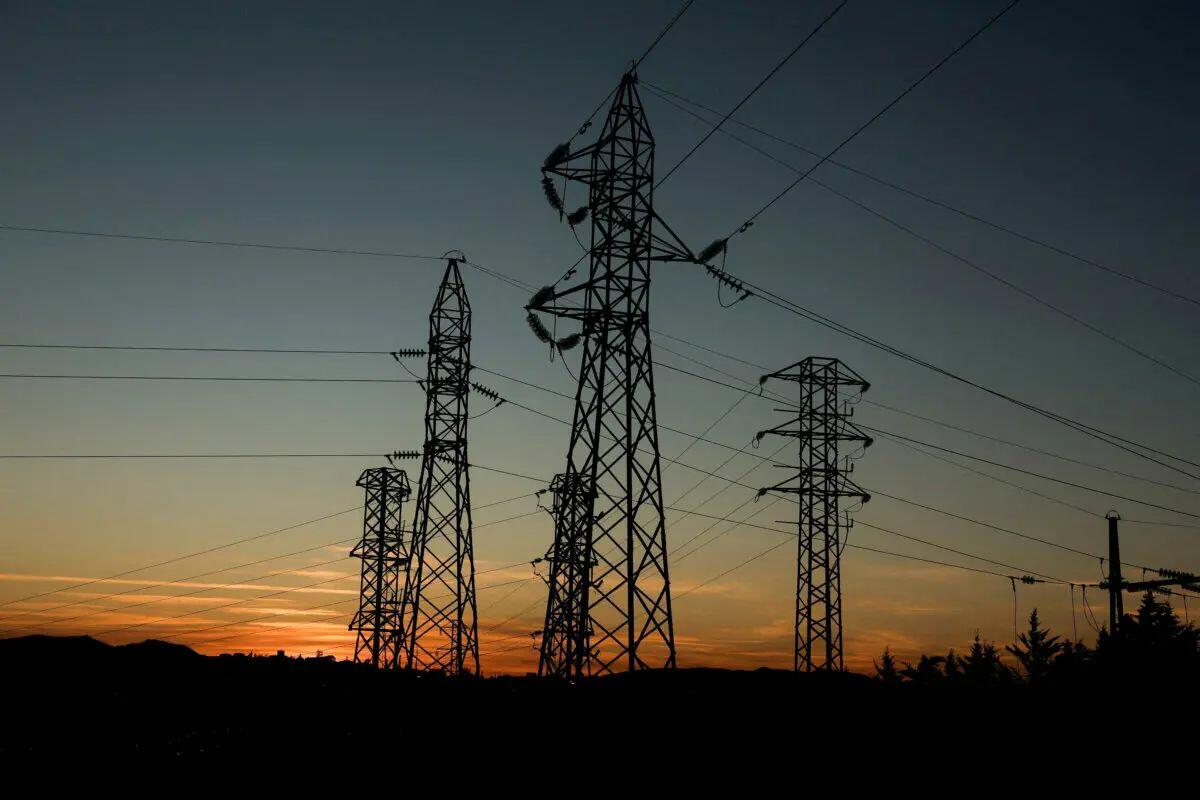
Power lines connecting pylons of high-tension electricity are seen during sunset at an electricity substation on the outskirts of Ronda, during a blackout in the Spanish city, on April 28, 2025. Jon Nazca/Reuters
Annual grid spending in the EU is set to exceed $70 billion in 2025, double the level a decade ago, the IEA said in a June report. Yet investment still trails the growth of clean-energy projects, leading to long connection queues and bottlenecks in moving cheap solar power from southern Europe to industrial centers in the north.
The European Investment Bank, the EU’s lending arm, warned in September that a lack of investment in grid spending causes inefficiencies in Europe and beyond. It stated that investment should remain a top policy priority if Europe wants to stay competitive.
When reviewing the overall economics of solar energy, the costs of grid management and the impact of high penetration levels on the grid are crucial, Wilkinson said. High penetration levels refer to a situation where the system relies heavily on one or more sources of renewable energy, which are intermittent and more challenging to ensure voltage and frequency stability.
“We should be realistic about the enormous cost burden that is likely to be faced because of those decisions,” he said.
New Solar Installations
Industry group SolarPower Europe expects a slight drop in new solar installations in 2025, marking the first decline in a decade. In its July statement, the group attributed the slowdown to grid bottlenecks, falling subsidies, and permitting delays.
The downturn is driven mainly by a slump in rooftop solar, especially among homeowners.
“In traditionally strong residential rooftop solar markets, like Italy, the Netherlands, Austria, Belgium, Czechia, and Hungary, households are now postponing installations as the impact of the 2022 energy crisis wanes,” SolarPower Europe said.
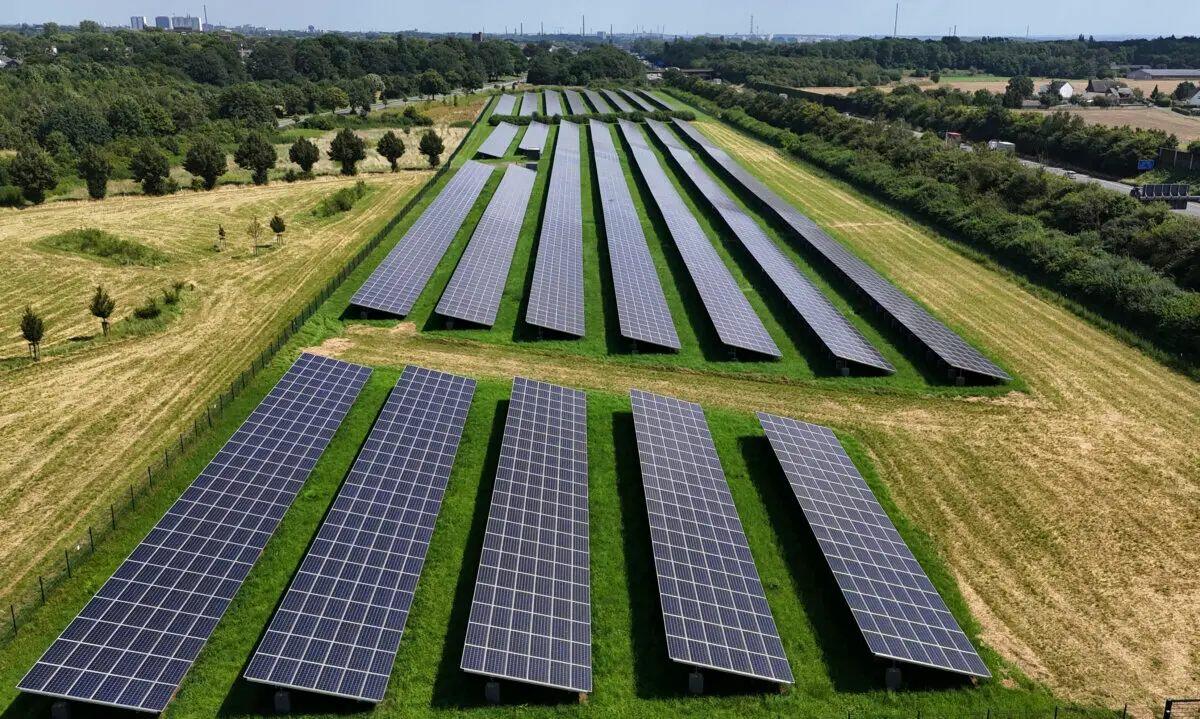
Solar panels on a solar field in Moers, Germany, on Aug. 5, 2024. Ina Fassbender/AFP via Getty Images
It added that the withdrawal of incentive schemes without adequate replacements has led to a collapse of more than 60 percent in some rooftop markets compared with 2023, while Poland, Spain, and Germany have seen drops of over 40 percent.
A policy brief from Ember last year warned that renewable expansion was being “held back by urgent stress signals” in Europe’s electricity networks.
Another report by Strategic Energy Europe found that more than 1,700 GW of potential renewable capacity was being held in connection queues due to limited grid capacity.

(ZeroHedge) Germany's Debt Cannon Fails: Special Fund Fuels Bureaucracy, Not Gro

Germany's Debt Cannon Fails: Special Fund Fuels Bureaucracy, Not Growth

The German federal government is firing its big debt cannon at the ongoing recession. So far, with zero effect. Berlin is about to learn the hard way that you cannot create prosperity with a money printer.

In March, the federal government launched its major investment offensive – starting with the first bond tranche meant to fuel the so-called “special fund” with fresh credit.

Credit Pump Running Hot
Every year, new bonds with maturities of five to thirty years are to be issued in volumes of €50 billion. With broad support from the Bundestag and Bundesrat, the government is going all in. Half a trillion euros are to be pumped into infrastructure projects over the next decade – and naturally, everything that can be booked under “climate neutrality.”

That a significant part of this credit volume will be diverted to cover gaping deficits in social funds is almost beside the point. The verdict remains unchanged: German policymakers have fully committed to a brute-force Keynesianism – maximum artificial state demand, now coupled with the ECB’s again negative real interest rates.

A textbook of the central bank era, repeatedly seen in the 20th century – always leaving the same trail: growing mountains of debt and the systematic crowding out of private investment from the capital markets.

A vacuum effect. Price guarantees, subsidies, and electricity cost allowances keep this artificial economy liquid – even attracting private capital with guaranteed returns – capital that would be far more productive elsewhere. A fatal vicious cycle.

Scarce resources are diverted into unproductive sectors of the economy. A poverty program hailed by state-aligned media, NGOs, and government economic institutes as some magical potion that is supposed to breathe new life into a bloodless economy.

Zero Growth Despite Debt Spree
In Berlin, hope was last pinned on firing the “Big Bertha” to buy some breathing room. With polling numbers for the Union and SPD plummeting, the goal was to spark a temporary boom to carry them over the finish line of the upcoming state elections. That is the real purpose of the special fund – an expensive political trick that will plunge children and grandchildren into even deeper debt.

Even the Chancellor counts among those dazzled by artificially created credit. Once a champion of a lean state, he switched immediately after taking office to full-blown state expansion.

A weather vane in Berlin, blown by Brussels, carrying the unmistakable siren song of socialism.

The creation of the special fund was, according to Merz in spring, a state-politically necessary step, marking a significant new economic policy beginning amid the debt orgy of the Federal Republic.

Classic “road construction” is meant to ignite economic growth. Stone-age economic thinking from a long-gone era, when governments could still afford such short-lived fiscal fires – though that hardly made it better socially.

For this economic acrobatics, taxpayers will bleed for decades. Irresponsible. Unethical. Inadequate economic policy.

The news from the Federal Statistical Office that growth again came to a standstill in Q3 hit even harder.

Never forget: with net new public debt at 4.7% and a state share of GDP over 50%, private business collapses in practice. That is the only way to mathematically explain a zero growth outcome.

This is the real message from Wiesbaden’s disaster report.

Offloading State Bureaucracy
In German politics, fatal economic illiteracy combines with a dangerous drive to expand the political apparatus – with every intervention in the free economy, every new debt package, every climate-policy justification. This excess shrinks Germany’s future economic potential in favor of an ever more powerful bureaucracy.

Employer president Rainer Dulger’s urgent warning should be taken seriously. He called it a “scandal for the business location,” highlighting that in the past three years alone, 325,000 new employees had to be hired just to manage growing bureaucratic demands.

Biggest cost drivers include GDPR, with its endless documentation and reporting obligations, as well as EU IT security regulations. Add the ever-expanding Supply Chain Due Diligence Act and a flood of new hospitality reporting requirements.

Politics is increasingly outsourcing its bureaucratic monsters to the private economy. A reality not reflected in GDP calculations. In truth, Germany’s state share has long exceeded 50%, possibly already 55%. The state balloons – and German productivity continues to suffer.

Like a Chain Letter
Ideological statism persists like a chain letter. Olaf Scholz’s “double whammy” ultimately became the special fund – bureaucratically less infantile in appearance but essentially the same. State bureaucracy continues to grow to centrally manage this massive debt mountain.

The drying financing channels of the green patronage economy are being flooded again with fresh money. The party goes on. A few fill their pockets while future generations pay via higher taxes and inflation. That part of the new credit is now going to the military economy shows one thing: internally, there is no longer belief that the climate economy is the saving haven.

With the military economy, an old Keynesian classic returns: production above all else – regardless of what is being produced. Even if goods and services benefit only a small, select group of economic profiteers.

China Caught in the Intervention Trap
Europeans are not alone. China, which grants the private sector broad free-market space, repeatedly resorts to Keynesian emergency measures in crises. The creation of massive real estate overcapacity is one example.

The crisis that peaked with the Evergrande collapse is far from over. Millions of apartments were built solely to artificially maintain a short-term economic fire and prevent labor market collapse after the 2008 financial shock. Today, China’s export engine, fueled by high subsidies, serves a similar function – feeding a true mercantilist machine.

Wherever one looks, German politics exists in a fatal echo chamber, where every ideological misstep amplifies itself – the rhetoric grotesquely magnified. In its seven-year planning, the EU Commission under Ursula von der Leyen inflates the central Brussels budget to about €2 trillion.

This provides fiscal cover for the EU’s debt kings. One wonders: wasn’t the EU Commission originally meant to enforce the Maastricht debt rules?

Centralizer Headquarters
In Brussels centralism, the illusion of controlling the economy thrives within a self-reinforcing bureaucratic dynamic. Every new law, every additional regulation may harm the economy, but simultaneously expands the influence of Brussels.

It was only a matter of time before the last inhibition fell and the EU Commission’s borrowing ban was circumvented. This step came with the establishment of the “NextGenerationEU” fund.

In Brussels, the motto is clear: never let a good crisis go to waste. The result is always a new agency, whose archives fill with the latest regulatory ideas of bored civil servants – always financed by new Ponzi-style debt.

Debt piles on debt in an inverted pyramid structure. It cannot end well – and it will not.

The ideological contrast Americans are demonstrating – with massive deregulation – finds no reception in German politics, media, or philosophical debate. All focus is on the combative figure of US President Donald Trump, who thus secures America’s competitive advantage in the media spotlight for the long term.

>>> Ralph Lauren Corp (RL US) — The “Dreams Business” Playbook

Ralph Lauren Corp (RL US) — The “Dreams Business” Playbook
CEO: Patrice Louvet | WWD Edward Nardoza Honor for CEO Creative Leadership | Nov 2025

🧭 Executive Takeaway
Since joining in 2017, Patrice Louvet (ex-P&G Beauty) has rebuilt Ralph Lauren into a premium lifestyle powerhouse, restoring its creative credibility while sharply improving financial discipline.
His “Magic × Logic” model — pairing Ralph Lauren’s creative vision with operational rigor — has turned around a brand once reliant on outlet traffic and discounting.

📊 Key Metrics
Metric FY 2025 YoY Change Since 2017
Revenue $7.1 bn +7 % Stable growth
Adj. Operating Income $990 m (14 % margin) +150 bps +>300 bps margin recovery
Average Unit Retail Price +107 % 33 consecutive quarters of gains
Share Price Performance +350 % vs S&P 500 +170 % → $20 bn mkt cap (all-time high)

🎯 Strategic Pillars
  • “Dreams Business” positioning: Elevates brand from apparel → aspirational lifestyle; parallels Disney’s emotional storytelling.
  • Premiumization: Rationalized discount outlets, improved product quality, doubled price points.
  • Servant Leadership: Culture of inclusion & empowerment; fits Gen Z expectations.
  • Operational Discipline: Data-driven planning, focus on outcomes vs. activity.
  • Energy Management: Emphasis on resilience, team performance, and long-term sustainability.

💬 Leadership Style
“We’re not in the fashion business, we’re in the dreams business.” — Patrice Louvet
“Magic + Logic” = Design vision + Execution rigor.
Transformation Architect mindset; blends emotional intelligence with brand discipline.

🧩 Strategic Outlook
  • Premium Expansion: Further lift in ASPs, selective store rationalization, and DTC push.
  • Digital and Data: Continued omni-channel integration; luxury e-commerce partnerships.
  • Lifestyle Adjacencies: Home, fragrance, hospitality collaborations.
  • ESG Narrative: Timeless, sustainable craftsmanship vs. fast-fashion volatility.

📈 Stock & Valuation
  • Market Cap: ≈ $20 bn
  • 2025E P/E: ~18× vs. peers (Tapestry ≈ 13×, Capri ≈ 11×, Hermès ≈ 45×)
  • Catalysts:
    1. Margin expansion from DTC mix (+150 bps YoY)
    2. Continued ASP growth / “Dreams Business” halo
    3. Potential inclusion in luxury peer baskets
    4. Optional future M&A (optional acquirer or target angle)

💼 M&A / Strategic Angles
  • Inbound Takeover: Unlikely near-term given Ralph Lauren’s founder control; however, LVMH / Kering could see value in U.S. luxury heritage platform.
  • Outbound Deals: Possible bolt-on lifestyle or fragrance acquisitions under Louvet’s disciplined capital framework.
  • Positioning: Now trades closer to luxury multiples than traditional U.S. apparel; brand equity supports premium valuation.

⚡ Catalysts Ahead
Short Term (6–12 mo) Medium Term (12–24 mo)
Holiday ’25 sales momentum Further premiumization → 15 %+ margin target
Continued DTC mix shift Strategic expansion in Asia & Middle East
Share buybacks / capital returns Brand extensions (home, hospitality)

🏁 Investment View
Ralph Lauren has successfully crossed the chasm from “discount brand” to “heritage luxury player.”
Under Louvet, execution consistency and creative coherence underpin one of the most effective brand turnarounds of the last decade.
RL = Premium Re-rating Story / Long-Term Compounder.

WWD : Ralph Lauren CEO Patrice Louvet Gives a Leadership Masterclass

Ralph Lauren CEO Patrice Louvet Gives a Leadership Masterclass
The P&G veteran who’s been in the corner office at Ralph Lauren for eight years is taking home the WWD Edward Nardoza Honor for CEO Creative Leadership.

When Patrice Louvet first stepped into Ralph Lauren Corp. as president and chief executive officer in July 2017, the company was in a delicate spot.

The brand had long been at the vanguard of American fashion, but the business underneath was relying on outlet sales and price promotions. Changes were under way, but the company’s first effort at bringing in an outside CEO was cut short after just 18 months.

Louvet, a mild-mannered veteran of Procter & Gamble Co., had a balancing act on his hands. He needed to both be in sync with the founder and designer — an iconic figure who still serves as executive chairman and chief creative officer — and in charge of the transformation the company needed.

How did he do it?

“Very thoughtfully,” said Louvet during an interview in his Madison Avenue office.

“Ralph and I spent a lot of time together before we both signed on the dotted line,” the CEO said. “We wanted to make sure we had the same vision for the company. We valued the same things.


“We learned that we were both Libras. So that was a reassuring data point. Libras play well together,” he joked.

At least, they can play well together.

According to Cosmopolitan: “For a Libra-Libra couple, the relationship can go either way. Either they bring out the best in each other and become a charming, stylish power couple…or they bring out the worst in each other.”

Louvet, who turned 61 in September, and Lauren, who hit 86 this month, turned out to be the ultimate corporate power duo, methodically strengthening both the brand and the business over the past eight years.

In fiscal 2025, revenues increased 7 percent to $7.1 billion while adjusted operating income hit $990 million with a 14 percent margin, an increase of 150 basis points from the prior year.


Ralph Lauren’s stock has risen 350 percent on Louvet’s watch — well ahead of the 170 percent increase seen in the S&P 500 — leaving the company’s market capitalization at an all-time high of $20 billion.

Louvet has pushed the brand to reach higher and average unit retail prices have increased 107 percent after 33 straight quarters of gains as the company leaned in on premium and tailored its offering.

For grabbing the pony’s reins, calming its nerves and building a business profile to match its brand profile, Louvet is taking home this year’s WWD Edward Nardoza Honor for CEO Creative Leadership at the WWD Honors gala.

The honor recognizes leadership skills that Louvet has spent a lifetime honing and has sharpened further at Ralph Lauren.

Part of that is his work with Lauren himself.

“Very early on I spent time with Ralph in Telluride,” Louvet said. “I go there every summer to think, enjoy Colorado and drive his cars. And he drives on the way out and I drive on the way back. A different car every time. Every time. He brings about 10 different cars from his collection. [Lauren has one of the largest vintage car collections in the world.]

“My favorite is the McLaren P1,” said Louvet, adding that Lauren has one in yellow and another in silver, “as people do.”

In between all that high-powered driving — the F1’s top speed is 217 mph — Louvet said he and Lauren “reflected a lot on what business are we in.”

“The Dreams Business”
“We concluded that we were in the dreams business, not in the apparel business, not in the fashion business,” the CEO said. “We’re in the dreams business, more akin to Disney than to traditional fashion or apparel brands. That really gave us a launching pad for this journey.”

In 2015 and 2016, Louvet said the brand was not connecting with younger consumers and that the company had “kind of lost its confidence.”

“If you’re in the dreams business, what are you doing as a brand on heavy promotion in off-price? If you’re in the dreams business, why is your quality of product deteriorating? If you’re in the dreams business, why is the consumer experience in your stores actually not that great?” Louvet said.

But before Louvet spoke, he listened, something the executive really learned to do when P&G sent him to Asia in 2002 to run hair care and health care as a general manager for Japan and South Korea.

“There’s a great quote that I use all the time with the teams around, ‘We have two ears and one mouth,’” he said. “There’s a technical reason for that. So I applied that to myself coming into this company.

“You’ve seen a lot of people come from other companies and say, well, here’s the game plan. I know how to do this. I’ve done this before. We’re just going to run through this series of actions,” he said. “That generally doesn’t work out.”

Louvet instead chose to come in very intentionally.

“On my first meeting, on my first day, I wanted to signal that everybody mattered in this company,” he said. “So my first meeting was not with Ralph, was not with my leadership team, it was actually with the executive assistants in the building.”

Twice — once at P&G and a decade later at Ralph Lauren — independent analyses of Louvet’s leadership style described him as, “A Transformation Architect.”

“It resonated with me because my family includes generations of well-renowned architects,” Louvet said. “Architecture is often regarded as the highest union of art and science — imagination with structure, beauty with discipline. I suppose those values carried through the generations, because that’s exactly how I think about brand leadership.”

The CEO’s great-great-grandfather Louis-Victor Louvet was a Paris-trained Beaux-Arts architect who served as Charles Garnier’s principal deputy on the Palais Garnier opera project. And his son, Louis-Albert Louvet, was one of three lead architects of the Grand Palais in Paris.

If that puts Louvet’s architect roots in the 19th century, his approach to being in charge is significantly more modern.

“I believe in servant leadership,” Louvet said. “So my style is not to take a document, throw it back at you and say, ‘This is really horrible.’ I don’t work that way. That’s 20th-century leadership.”

Even his imitation of 20th-century leadership lacks a certain verve. It’s just not who he is.

“I believe in 21st-century leadership, which is, ‘OK, my job is to set you up for success,’” Louvet said. “I’ve experienced 20th-century leadership, when I worked at Procter & Gamble in the beginning in France. It doesn’t work today. Gen Z, they don’t respond to that kind of management. They’re like, ‘If this is how you’re going to lead this company, then I’ll go work somewhere else.’”

P&G — where many of Louvet’s luxury CEO peers have also gotten their starts — figures prominently in his development as a leader.

“Very early I became a brand manager on Pampers. I think I was 30,” Louvet said. “Pampers at the time in France was close to a billion dollars — it’s a complicated business. So you learn to manage complexity early. You need a plan to manage complexity. You learn to focus on what really matters. Remove the noise, focus on what really matters, focus on outcomes, not activity.”

Louvet recalled one of his first bosses at P&G telling him: “’You’re like a duck. On the surface you’re gliding. It looks very elegant and calm. And then I know below the surface you’re paddling like crazy.’ And it’s true. I mean, it’s not easy. I work pretty hard. I take this very seriously.”

During his nearly 30-year stint at P&G, Louvet rose to become group president of the global beauty business, which drove $11.5 billion in revenues across 12 brands annually.

Louvet is used to running big businesses and managing everything that comes along with that.

“I don’t think it’s helpful for me to come into a meeting super stressed and for the team to feel it,” Louvet said. “If my boss comes in super stressed, I’m like, ‘Well, should I have confidence in him or her?’ It just doesn’t create the right atmosphere to get the best out of people.

“Keeping my stress to myself is probably the most effective way to do it,” he said. “Now, the downside of that is sometimes people go, ‘Well, it’s hard to tell what you’re thinking.’ That’s part of my journey to be more expressive. And then as people get to know me better, they also know that when I flinch, something bad’s about to happen.”

But Louvet is too calm to flinch too often.

“Managing Energy”
“I’m a big believer in managing energy,” he said. “We are corporate athletes and everything that applies to professional sports actually is very relevant for us. Except — take tennis. You don’t play a match every other day. You play every day [as a corporate athlete]. Your match is not three hours, your match is probably 10 hours. Your career is not 15 years, it’s likely 30 years, etc., etc., etc.

“The whole premise for athletes is how do they manage their energy and how do they have the right energy at the right time?” Louvet said. “I actually believe life is about managing your energy, not managing your time. There’s physical energy, emotional energy, psychological energy.”


Louvet, an avid cyclist, is a self-described weekend warrior when it comes to exercise, so has what looks like a mini treadmill that he can walk on while at his standing desk.

“Chip [Bergh, former Levi Strauss & Co. chief and another P&G vet] was always a good inspiration for me,” Louvet said. “I saw what he did at Gillette before I took over from him and he would take a two-hour or an hour-and-a-half break over lunch [to] work out.”

Of course, there have been times when Louvet’s stress management has been tested.

“Probably the toughest thing I’ve had to do in this job is to furlough about 80 percent of the organization” during the pandemic, he said. “There’s a big risk when you do that, that you lose that entire organization and that even when you call them back, they’re like,’ ‘you know what? We don’t want to work here anymore because the values of this company, the way you treated us.’”

Team Ralph turned back up and carried on.

But Louvet came out of the pandemic a different leader.

“You’re operating in a lot of uncertainty with decisions that impact people’s lives, literally and livelihoods. So I think I’ve come out of that as a stronger decision-maker. Better decisions. I think greater confidence in making these types of game-changing decisions where you have a lot of different points of views. We could have waited until the government said, ‘You’ve got to close down your stores.’ We closed our stores before that.”

Louvet also sharpened his focus further during the pandemic.

“There was a lot of noise during COVID and lots of points of view, just like there was a lot of noise when [President Trump’s] tariffs started,” he said. “This industry just has a lot of noise. The ability to just laser-focus on these are the three or four meaningful things — don’t get distracted by the noise. Just run your play. Run what you believe in.”

Staying Constant
At Ralph Lauren, where “timeless style” is a mantra, those beliefs have stayed constant.

“Part of the challenges you’ve seen in the industry for many other firms is they’ve kind of lost sense of who they are,” Louvet said. “You bring back the designer and he or she probably wouldn’t recognize many of these companies. So I think just continue to bring Ralph’s vision to life, continue to be true to the purpose that we have. Are we inspiring the dream of a better life for our employees, for our consumers, for our partners, for our different stakeholders?”

Louvet knows Ralph Lauren — the company and the man. And along the way, he’s learned more about himself and grown.

“I’m much more of a dreamer now than I was when I arrived here,” Louvet said. “Ralph has also been a wonderful partner in defining what really is important and what we need to stick to.

“We found, I think, a good balance of magic and logic together, which as you know in this industry is critical,” he said. “Part of our success and sustained success is because we’re striking this balance. There was a risk with me coming in that we would over-index on logic, and this doesn’t work in this industry. Now if you over-index on magic and you don’t have the operational discipline, the strategic focus, that doesn’t work either or it doesn’t work at scale.”

Ralph Lauren works because it has both that magic and that logic, the Lauren vision of design and the Louvet vision of management.

WSJ : Why Pfizer Can Still Prevail in the Obesity Fight With Novo Nordisk

Why Pfizer Can Still Prevail in the Obesity Fight With Novo Nordisk
Both pharma giants show some desperation in fight for Metsera’s obesity assets

The gloves are off in the obesity-drug fight. But Novo Nordisk NOVO.B -2.09%decrease; red down pointing triangle might be swinging so hard it risks losing its balance.

The maker of Ozempic has been losing ground to Eli Lilly LLY 2.17%increase; green up pointing triangle and a crop of copycat GLP-1 makers such as Hims & Hers Health HIMS 3.18%increase; green up pointing triangle. Novo’s new chief executive, Mike Doustdar, deserves credit for shaking up a once-stodgy Danish pharma with a move fast and break things mindset. He inherited a company rapidly ceding share, and his response has been urgent: layoffs to free up cash for reinvestment, and a dealmaking spree that included the acquisition of Akero Therapeutics AKRO -0.11%decrease; red down pointing triangle, a company with a liver-disease treatment, for up to $5.2 billion.

Now, Novo’s bid to regain its footing has taken a form unthinkable under past leadership: an unsolicited $9 billion offer to pry Metsera MTSR -1.08%decrease; red down pointing triangle, the developer of a monthly injection, away from Pfizer PFE 1.48%increase; green up pointing triangle, which had agreed to buy it in a deal valued at up to $7.3 billion. It is a bold move for a company that mostly shied away from dealmaking under past leadership.

In this case it also looks like a move born of frustration, one that is now making Novo investors uneasy. The stock skidded Thursday and Friday as investors questioned how confident the pharma company is in its own obesity-drug pipeline, said Will Sevush, a healthcare strategist at Jefferies.

On Friday, Pfizer sued Novo and Metsera, alleging that under the terms of the Pfizer-Metsera agreement, the offer from Novo can’t qualify as superior. Pfizer might have a point.


According to Metsera’s proxy statement on its merger with Pfizer, Metsera held talks with seven potential acquirers between 2024 and September 2025. Novo Nordisk, identified as Party 1 in the filing, was the first suitor.

During the negotiation process, Novo offered the same unconventional two-step structure it is offering now, a plan in which it would first pay Metsera upon signing in exchange for nonvoting shares, after which Metsera would distribute that cash to shareholders as a dividend. Full ownership would be transferred only after regulatory approval. Novo’s workaround was meant to sidestep any regulatory concerns, letting Metsera shareholders walk away with immediate cash no matter what. But Metsera’s board ultimately opted to proceed with Pfizer, citing regulatory uncertainty to closing a deal with Novo, likely given its leading position in the GLP-1 market.

If Novo’s bid is truly superior, why didn’t Metsera accept a similar one the first time? Why did the Metsera board, as the proxy statement shows, prod Pfizer to sweeten its deal? Under the merger agreement, the definition of “Superior Company Proposal” refers to a weighing of not just price but also regulatory, financing, timing, and legal risks. While shareholders might get more money under Novo’s proposal, Pfizer’s argument that Metsera can’t pay out the dividend under Delaware law and Pfizer’s request for a temporary restraining order to block the merger’s termination already have made Novo’s offer, in essence, riskier.

A Novo spokesperson said that Metsera assets are highly complementary to Novo’s products and pipeline, and that the Danish company “is uniquely positioned to bring its expertise in product development and manufacturing to accelerate the successful commercialisation of the Metsera assets.”

Pfizer on Thursday cast Novo’s move as a threat to competition and even invoked nationalist undertones. In a statement, the company called Novo’s bid “an attempt by a company with a dominant market position to suppress competition in violation of law by taking over an emerging American challenger.” And Chief Executive Albert Bourla, who was the first to appear at the White House alongside President Trump for a drug-pricing deal, is clearly ready for a political fight as much as a corporate one.

Even so, Pfizer—which had recently been fending off an activist investor as patents on key drugs expire and Covid revenue fades—still has time to decide it is better to negotiate than fight. Metsera seems to be using Novo’s offer as leverage to extract a sweeter deal, and under the merger terms, Pfizer has until Tuesday to counterbid. Given how valuable GLP-1 drugs have become, a small bump in price could be worth it.

Last quarter, Eli Lilly made more than $10 billion in revenue from Zepbound and Mounjaro, its flagship obesity and diabetes treatments. Metsera’s obesity portfolio, which includes a long-acting injection that would require fewer shots than Lilly’s drugs, clearly has potential to compete in that category.

If Pfizer wants a foothold in the obesity race, swallowing a higher price for Metsera might be the cost of admission.

WSJ : Is OpenAI Becoming Too Big to Fail?

Is OpenAI Becoming Too Big to Fail?
Sam Altman’s ability to intertwine the startup throughout major tech players puts it at the nexus of a vital part of the U.S. economy

Slowly then all at once, OpenAI became something of a juggernaut that’s hard to fully fathom.

It hasn’t yet turned a profit. Its annual revenue is 2% of Amazon.com’s sales. Its future is uncertain beyond the hope of ushering in a godlike artificial intelligence that might help cure cancer and transform work and life as we know it. Still, it is brimming with hope and excitement.

But what if OpenAI fails?

There’s real concern that through many complicated and murky tech deals aimed at bolstering OpenAI’s finances, the startup has become too big to fail.

Or, put another way, if the hype and hope around Chief Executive Sam Altman’s vision of the AI future fails to materialize, it could create systemic risk to the part of the U.S. economy likely keeping us out of recession.

That’s rarefied air, especially for a startup. Few worried about what would happen if Pets.com failed in the dot-com boom.

We saw in 2008-09 with the bank rescues and the Chrysler and General Motors bailouts what happens in the U.S. when certain companies become too big to fail.

Altman—by design or happenstance—has engineered OpenAI’s rise to a $500 billion valuation just as the Trump administration has embraced its own policies of picking champions in the name of national defense and economic security.

The White House has been very vocal in efforts to protect AI development in the U.S., which is helping fuel what otherwise would be a much slower economy. More than that, some are betting that AI and robotics will be the salve to our nation’s debt troubles.

“An economy that’s over $30 trillion in debt needs the productivity boost that AI is going to give us,” tech investor David Sacks said on social media years ago before becoming the White House AI czar.

Recent days have brought several reminders of how big and central OpenAI, founded in 2015 as a nonprofit, has become.

Sen. Bernie Sanders (I., Vt.) said he thought OpenAI and its chatbot, ChatGPT, should be broken up—a remarkable statement considering the company is expected to generate just $13 billion this year.

“We need to take a deep breath and understand that it’s like a meteor coming to this planet—we gotta be prepared to deal with it in all of its complexity,” Sanders told Axios about AI.

And, after a lengthy effort to reorganize itself, OpenAI announced moves that will allow it to have a simpler corporate structure. This will help it to raise money from private investors and, presumably, become a publicly traded company one day. Already, some are talking about how OpenAI might be the first trillion-dollar initial public offering.

In a blog post Tuesday, OpenAI Chair Bret Taylor marked the moment, declaring: “Built to benefit everyone.”

It’s the kind of altruistic talk Altman is known for as he predicts that superintelligent AI—or AGI—will help cure cancer and save humanity.

“I think AGI is probably necessary for humanity to survive—our problems seem too big to solve…without better tools,” Altman tweeted a few years ago.

Microsoft, which will hold a 27% stake, saw its shares rise on the latest news, pushing its market value past $4 trillion. (Later in the week, Nvidia, which had previously announced plans to invest $100 billion into OpenAI, became the first $5 trillion company.)

The linkages between these tech behemoths and the stock market’s dependence on them are notable. The lessons of the financial crisis earlier this century weren’t just that the banks were too big to fail, they were too interconnected to fail.

The big financial institutions were intertwined by a web of complex financial instruments and vehicles that threatened to bring down the U.S. system as certain players teetered toward collapse. This led the U.S. government to step in with a bailout package as well as take other unusual measures.

Nobody is saying OpenAI is dabbling in anything like liar loans or subprime mortgages. But the startup is engaging in complex deals with the key tech-industry pillars, the sorts of companies making the guts of the AI computing revolution, such as chips and Ethernet cables.

Those companies, including Nvidia and Oracle, are partnering with OpenAI, which in turn is committing to make big purchases in coming years as part of its growth ambitions.

Supporters would argue it is just savvy dealmaking. A company like Nvidia, for example, is putting money into a market-making startup while OpenAI is using the lofty value of its private equity to acquire physical assets.

They’re rooting for OpenAI as a once-in-a-generational chance to unseat the winners of the last tech cycles. After all, for some, OpenAI is the next Apple, Facebook, Google and Tesla wrapped up in one. It is akin to a company with limitless potential to disrupt the smartphone market, create its own social-media network, replace the search engine, usher in a robot future and reshape nearly every business and industry.

“I think the industry is underrating and underinvesting given the scale,” Microsoft AI CEO Mustafa Suleyman told me the other day during our appearance at a Paley Center for Media event in Menlo Park, Calif.

Suleyman was sidestepping concerns raised about OpenAI becoming too big to fail. Instead, he painted a more optimistic picture, pointing to how investments in AI have already shown “truly exponential improvement in capabilities” and saying that future spending will “drive incredible improvements in capabilities.” The sort of capabilities, he added, that will upend “basically every industry.”

To others, however, OpenAI is something akin to tulip mania, the harbinger of the Great Depression, or the next dot-com bubble. Or worse, they see, a jobs killer and mad scientist intent on making Frankenstein.

But that’s counting on OpenAI’s success.

FT : Police say ‘nothing to suggest’ Cambridgeshire train stabbings were terrori

Police say ‘nothing to suggest’ Cambridgeshire train stabbings were terrorism
Two suspects under arrest are both British nationals born in the UK

British police have said that there is “nothing to suggest” the mass stabbing of passengers on a train in eastern England was a terrorist incident, adding that the two suspects under arrest are both British nationals.

Superintendent John Loveless said that of the nine people believed to have suffered life-threatening injuries in Saturday evening’s attack, four had since been discharged while two were still in a life-threatening condition.

He said the British Transport Police investigation was still seeking “to establish the full circumstances and motivation” for the attack.

“At this early stage it would not be appropriate to speculate on the causes of the incident,” he added.

Loveless said that, while Counter Terrorism Policing had initially supported the Transport Police investigation, “at this stage there is nothing to suggest this is a terrorist incident”.

He added that a 32-year-old Black British male and a 35-year-old British man of Caribbean descent, both of whom had been born in the UK, were in police custody. The transport police said both men were “arrested on suspicion of attempted murder”.

Overall, ten people were taken to hospital by ambulance after the attack, while one further person went on their own.

“We now know this attack is not being treated as terrorism, and that two British-born, British nationals have been arrested,” home secretary Shabana Mahmood posted on X. “The investigation is ongoing, and I am receiving regular updates from the police.”

The two men have not been named, as is common in the UK before being charged with an offence.

Police can normally hold a suspect for up to 24 hours without charge, but this can be extended up to 36 hours for serious offences and up to 96 hours with the permission of a magistrate.

Earlier on Sunday Reform UK leader Nigel Farage — who has campaigned to make it obligatory for police forces to identify the ethnicity of people arrested and charged — had called for information on the suspects to be released “as soon as possible”.

Pressure has increased on police to reveal suspects’ nationalities following the murder of three school-age girls in Southport in July 2024 — an attack that led to riots after online misinformation wrongly suggested it had been carried out by an asylum seeker.

Before Sunday’s police statement, defence secretary John Healey said he “would expect” the police to release information on the suspects.

Speaking on Sky News on Sunday Healey added that the attack “reflects a period of really increasing pressure on our country and uncertainty more widely in the world — a new era of threat if you like”.

The transport police said there had been no fatalities in the attack, which occurred on the 6.25pm train from Doncaster to London King’s Cross. Video posted online showed armed police rushing towards the train after it stopped at Huntingdon, about 60 miles north of London.

The force said it had been called at 7.42pm to reports of a “multiple stabbing”. It added that armed police from the Cambridgeshire force had boarded the train within eight minutes of the first call and arrested the two suspects.

Saturday’s attack was the second mass stabbing in the UK within a week. A 49-year-old man was killed and a 45-year-old man and a 14-year-old boy were injured on Monday in a knife attack in Uxbridge, north-west London. The man arrested for the attack, Safi Dawood, is a refugee from Afghanistan who arrived in the UK in 2020.

It also came just under a month after Jihad al-Shamie, a Syrian-born British citizen, launched a car and knife attack on a synagogue in Manchester during Yom Kippur services. The attack ended in the deaths of two worshippers and the shooting dead of al-Shamie by police.

The transport police said there would be a “high visibility presence of police officers” on trains and at stations on Sunday to “reassure the public and respond to any concerns”.

London North Eastern Railway issued a “do not travel” notice shortly before 6am on Sunday, warning that some services would be delayed or cancelled. The disruption is expected to last until the end of Sunday.

FT : Renewed drive for autonomous cars as tech giants muscle in

Renewed drive for autonomous cars as tech giants muscle in
Legacy manufacturers seek to keep pace with advances in self-driving technology as the next competitive front

Car giants from General Motors and Stellantis to Volkswagen are racing to develop autonomous vehicles as they seek to compete with Tesla and other new rivals on “the next frontier” of growth.

After shelving plans to develop robotaxis last year, General Motors recently said it would introduce an “eyes-off, hands-free” semi-autonomous driving system in its vehicles from 2028. Meanwhile, rivals such as Volkswagen and Stellantis are partnering with Uber to scale up its fleet of autonomous vehicles.

Legacy carmakers have long struggled to keep up with the pace of advances in self-driving technology made by the likes of Waymo and Baidu in the US and China. But to fill the gap, some companies have partnered with ride-hailing group Uber while others have poached talent from Apple and technology rivals as they seek new sources of revenue.

“Will there be the stomach by management to try to balance expectations from Wall Street with actually making generational disruptive moves and changes to culture and speed?” Tu Le, founder of the Sino Auto Insights consultancy, said of GM’s revived initiative. “This is the million dollar question.”

None of the systems being developed envision full automation that will be driverless at all locations. But the ultimate aim is for the vehicle to drive itself on its own without human intervention in certain defined areas.

GM’s work is being led by its new chief product officer and driverless tech pioneer Sterling Anderson, who joined GM in June after co-founding driverless vehicle start-up Aurora. Before that, he led Tesla’s Autopilot efforts.

“Autonomy will make our roads safer. It will be the cornerstone of GM’s modern portfolio going forward,” Anderson said.

Anderson plans to debut the company’s new semi-autonomous system in the Cadillac Escalade IQ, an electric sport utility vehicle, that will allow drivers to take their eyes and hands off the road while driving on some highways.

But analysts say the pivot towards autonomous technology will pose an inherent dilemma for traditional carmakers.

Margins in the ride-hailing market are notoriously thin, and scaling a robotaxi service will require heavy capital investment at a time when the automotive industry is already struggling with the higher costs of developing electric vehicles and the loss of profits in China.

“The carmakers need to produce profit and cash whereas the big tech giants need to produce growth. The market is not holding them to the same agenda, which gives the tech giants a much greater advantage to pursue things like robotaxis,” HSBC analyst Mike Tyndall said.

Individual ownership of vehicles is also a limitation to ride hailing. For the industry’s economics to work, “we’ll have to give up personal ownership”, he added.

To save costs and accelerate the pace of expansion, rivals such as Volkswagen and Stellantis have chosen to partner with Uber to scale up its fleet of autonomous vehicles.

Stellantis said last week it would jointly develop robotaxis with Uber, chipmaker Nvidia and Taiwan’s Foxconn with the aim of producing them from 2028. Starting in the US, Uber plans to deploy about 5,000 of Stellantis’ autonomous vehicles with capabilities that can be driven by themselves in limited, pre-mapped areas.

The group behind Jeep, Peugeot and Fiat brands is also collaborating with Chinese robotaxi company Pony.ai to develop autonomous vehicles in Europe.

“I’m convinced we can deliver substantial value in the emerging robotaxi market and space,” Stellantis chief executive Antonio Filosa told analysts on Thursday.

In April, Volkswagen said it plans to commercially launch its ID. Buzz autonomous vehicles on the Uber platform, starting in Los Angeles next year.

VW’s tie-up came after Argo AI, a self-driving vehicle group jointly backed by the German group and Ford, abruptly shut down in late 2022. Executives acknowledged at the time that establishing fully autonomous technology that is profitable and scalable would cost billions of dollars and take too long.

Having invested more than $10bn over the past decade, GM’s chief executive Mary Barra also ended efforts to build and manage a fleet of robotaxis after a disastrous accident in 2023 brought a halt to operations at Cruise, its former driverless car division. 

While Tesla and Waymo, the Alphabet-owned self-driving car company, have pinned their future in expanding their robotaxi service, GM has pivoted towards developing self-driving vehicles for personal use with its Super Cruise “hands-off” driver assistance software.

“We’re enjoying approximate 70 per cent margins on [the Super Cruise] business,” Barra said at a recent earnings briefing, adding that Super Cruise customers have nearly doubled year-on-year to more than 500,000. 

“When you look at owning a fleet and all the other aspects that go into running a robotaxi fleet, that’s not our core business today. We are focused on personal autonomy.”