TechCrunch : Meta has an AI product problem

Meta has an AI product problem

In the midst of an unprecedented AI buildout, Meta is spending more than most. The company is building two massive data centers, and reporting indicates there will be as much as $600 billion in spending on U.S. infrastructure over the next three years.

Those figures might not raise eyebrows in Silicon Valley, but they’re starting to make Wall Street nervous.

The issue came to a head this week as Meta reported quarterly earnings, which showed the company’s operating expenses jumping $7 billion year-over-year and nearly $20 billion in capital expense. It was the result of intense spending on AI talent and infrastructure, which has yet to bring in meaningful revenue for the company. When analysts pressed for more specifics, Mark Zuckerberg made it clear the spending was just getting started.

“The right thing to do is to try to accelerate this to make sure that we have the compute that we need, both for the AI research and new things that we’re doing, and to try to get to a different state on our compute stance on the core business,” Zuckerberg told analysts on the call. “Our view is that when we get the new models that we’re building in MSL in there and get like truly frontier models with novel capabilities that you don’t have in other places, then I think that this is just a massive latent opportunity.”

If his goal was to reassure investors, it didn’t work. By the end of the call, Meta’s share price had plummeted in value. Two days later, the rout has only deepened. The Meta’s stock dropped 12% by the closing bell on Friday, representing more than $200 billion in lost market cap.

It’s dangerous to read too much into stock prices, and in strict financial terms, Meta’s quarterly earnings weren’t that bad. ($20 billion in quarterly profit is nothing to complain about.) But this was the first quarter in which Meta’s aggressive AI spending on both talent and infrastructure had a visible impact on the company’s bottom line. Even more alarming was that, aside from a lot of enormous data centers and well-compensated AI researchers, it wasn’t clear what the money actually bought.

Analysts pressed Zuckerberg on why he was spending so much on AI, and when they could expect to see revenue from the growing spending. But the call came at an odd spot in Meta’s planning, with no clear budget for projected spending and no available product that could anchor a revenue forecast. As a result, Zuckerberg was left with only general claims about the promise of AI.

“There are going to be all kinds of new products around different content formats, and we’re starting to see that,” he asid during the call. “And then there are the business versions of all these too, like business A … the other part is how more intelligent models are just going to improve the core business and improve the recommendations that we make across the Family of Apps and improve the recommendations in advertising.”

Meta isn’t the only company spending billions of dollars on AI infrastructure, so it’s worth teasing out why this same spending isn’t spooking investors at Google or Nvidia, both of which had a great quarter. OpenAI is the biggest offender, spending the same amount with far less financial cushion than Meta.

There really are concerns that we’re creating a bubble, and if we are, Meta’s core business will let it ride things out better than most.

But if you ask Sam Altman why he’s spending hundreds of billions of dollars on compute, he’ll tell you he’s operating one of the fastest growing consumer services in human history — and one bringing in $20 billion a year in revenue. We can argue about how sustainable the growth rate is (that’s a separate blog post), but there really is a fast-growing product at the bottom of all the OpenAI hype. A fast-growing ARR figure goes a long way to answer questions.

Meta doesn’t have a product like that, and it’s not clear where it’s going to come from.

The company’s most powerful AI product is the Meta AI assistant, which Zuckerberg noted on the call has more than a billion active users. But those numbers are surely juiced by the three billion active users on Facebook and Instagram, and it’s hard to see the current version of Meta AI as a competitor to ChatGPT. There’s also the Vibes video generator, which really did boost daily active users, but has limited business impact beyond that.

The most ambitious project is the Vanguard smart glasses released earlier this month. However, the glasses feel more like an extension of Meta’s Reality Labs work than a real attempt to harness the power of LLMs.

Put simply, these are promising experiments, not fully formed products.

It’s telling then that when he was pressed on infrastructure spending, Zuckerberg’s response wasn’t to point to the recent launches, but to focus on the next generation.

Zuckerberg stressed, while emphasizing the pending impact of the Superintelligence Lab’s new models, that he was very excited about new products.

“It’s not just Meta AI as an assistant,” he said. “We expect to build novel models and novel products, and I’m excited to share more when we have it.”

But this was an earnings call, not a product launch, so all he could say was that there would be more to share “in the coming months.”

As the market response showed that answer is wearing thin.

To be fair, it’s only been four months since Zuckerberg restructured his company’s AI team, and the new Superintelligence team hasn’t had time to launch an earthshaking AI product yet. But as the company spends billions of dollars to stay competitive in AI, there’s still no clear indication of what role Zuckerberg wants to play in the new industry.

Will Meta AI use the company’s detailed store of personal data to grow into a ChatGPT competitor? Is Vibes the first step in a consumer entertainment play, building off Meta’s targeted ad system? Or maybe Zuckerberg’s references to “business AI” are hints at a more detailed enterprise play?

So far, it’s anyone’s guess. Whatever the answer, the pressure is on Meta to find it — and soon.

The Information : Google and Microsoft Face Less AI Spending Risk Than Meta, Ama

Google and Microsoft Face Less AI Spending Risk Than Meta, Amazon


The Takeaway
  • Google and Microsoft lead in AI spending capacity with robust cash flow and cloud backlogs.
  • Meta faces significant AI investment risk due to lower cash and lack of cloud revenue.
  • Amazon’s high capex is mitigated by its large AWS cloud and substantial contract backlog.

Of all the big tech companies investing in AI, Google and Microsoft are the best positioned to handle the growing costs of the technology, judging from data disclosed this past week in September-quarter earnings.

Google and Microsoft generate more cash from their businesses than other big tech companies, including Apple. And they’re devoting a smaller percentage of that cash to capital expenditures for new AI data center construction than other companies. Meta Platforms, on the other hand, is the worst positioned.

Meta generates less cash than other big tech companies and is spending a bigger proportion of it on capital expenditures than either Google or Microsoft. And unlike Google, Microsoft and Amazon, Meta doesn’t have a cloud business that is renting AI-powered servers. Its best hope of paying for its huge investment in AI is to make vast improvements in its advertising business and other possible new products.

Google, Microsoft and Amazon have all reported a growing backlog of contracts at their cloud businesses, flowing from demand for AI services. That backlog will help pay for the new data centers. That reduces the risk for those companies of their heavy AI investments.

The three companies also have the benefit of hefty cash reserves. All three had around $100 billion in cash and short-term investments as of Sept. 30, more than twice Meta’s reserves.

This situation highlights the gamble Meta CEO Mark Zuckerberg is taking. He said this week he planned to significantly increase both capex and operating expenses in 2026 to try to front-load AI computing capacity, ensuring that Meta can develop leading AI models unconstrained by capacity shortages. Meta’s robust ad business has comfortably underwritten these investments so far, but the company’s spending means it can ill afford a slowdown in the digital ad market.

As the accompanying chart demonstrates, each of the big tech companies has reported rapid growth in the cash it generates in the past five years. All big companies use that cash for capex, as well as to buy back shares and pay dividends to shareholders. But for Microsoft, Amazon, Meta and Google, a rapidly growing portion has gone to capex to build new data centers and other equipment in the past two years.

Google has been the most aggressive in ramping up its capex, lifting it 187% from $32 billion in 2023 to the company’s projection this week of between $91 billion and $93 billion this year. But Google can easily afford it: the company’s cash production was up 30% for the first three quarters of the year to $112 billion. Wall Street analysts estimate the full year cash production figure will hit $157.5 billion, according to S&P Global Market Intelligence.

Microsoft is in a similarly strong position. In its fiscal 2025 year, ending in June, it generated $136 billion in cash and spent $64 billion on capex. When we recalculate its quarterly reports on a calendar 2025 basis—to compare it to the other companies—Microsoft is expected to generate about $155 billion in cash from operations this year and to spend about $77 billion in cash on capex, or about 49%. (Microsoft is committing more to capex than that number suggests, however, because it is paying for some equipment through finance leases.)

In contrast, Meta this year will spend 65% of the $109 billion it’s expected to generate from operations on capex. Amazon will spend even more—as much as 88% this year, we calculate, using analyst estimates for Amazon’s full-year cash from operations.

Amazon is in a different position than Meta, however. Firstly, its capex has historically been much higher than that of other tech companies, as the chart shows, because of its need to invest in warehouses and other facilities for its e-commerce business.

And Amazon is better able than Meta to afford its capex because of its giant cloud business, Amazon Web Services. Thanks to AWS, Amazon has a committed backlog of business that it knows will turn into revenue in the next few years. That backlog has risen 28% since the middle of last year to $200 billion as of Sept. 30. CEO Andy Jassy told analysts that figure didn’t include several new deals struck in October that haven’t yet been announced.

Google and Microsoft have also reported significant growth in their backlog. The accompanying chart compares the backlog between Google, Amazon and Oracle. The smaller cloud firm disclosed in early September that its backlog had skyrocketed to $455 billion as of Aug. 31, about three times what it was three months earlier.

That increase reflected a number of AI-related cloud deals it has struck in recent months, most prominently with OpenAI. These deals, which stretch over the next few years, are forcing Oracle to also invest heavily in new data centers. (Microsoft’s backlog number includes deals unrelated to Azure, which is why we left the company off our chart.)

WSJ : FDA Official Steps Down, Sued by Drugmaker

FDA Official Steps Down, Sued by Drugmaker
George Tidmarsh, who resigned Sunday, is accused in a lawsuit of seeking a bribe and defaming a drug

A Food and Drug Administration official who resigned on Sunday was sued by a Canadian pharmaceutical company, which accused him of soliciting a bribe and tanking its stock with false statements as part of a revenge campaign against a former colleague.

Dr. George Tidmarsh was hired in July by FDA Commissioner Dr. Marty Makary to lead the agency’s drug division, a top role regulating much of the country’s pharmaceutical industry that gave Tidmarsh a prominent perch in the Department of Health and Human Services headed by Robert F. Kennedy Jr.

Drugmaker Aurinia Pharmaceuticals filed a lawsuit in federal court in Maryland on Sunday evening detailing its accusations against an official at an agency that this year has faced upheaval and uncertainty in the form of DOGE cuts, leadership departures and a slew of new policies.

A lawyer for Tidmarsh, Joseph Galda, said that he didn’t solicit a bribe.

A spokeswoman for HHS, which wasn’t named as a party to the lawsuit, said Tidmarsh resigned Sunday morning after being placed on administrative leave Friday. The HHS Office of the General Counsel and the Office of the Inspector General were notified of “serious concerns about his personal conduct,” the spokeswoman said.

“Secretary Kennedy expects the highest ethical standards from all individuals serving under his leadership and remains committed to full transparency,” the spokeswoman said.

Tidmarsh in September posted on LinkedIn that an FDA-approved kidney drug, voclosporin, had “not been shown to provide a direct clinical benefit for patients,” a highly unusual move for a government official in his position. The FDA said when it approved the drug in 2021 that the medicine had shown a “clinically meaningful benefit” in trials. Tidmarsh later took down the post and said he had been speaking in a personal capacity.

But the stock of Aurinia, the only maker of voclosporin, dropped 20% in a few hours, wiping out more than $350 million of market value, according to the lawsuit.

Aurinia and its U.S. subsidiary brought the suit against Tidmarsh, alleging defamation and injurious falsehood, and seeking damages for its losses, plus punitive damages.

Tidmarsh told the New York Times that he had been placed on administrative leave after he raised concerns about a new-fast track program for drugs. He said he was told he had been placed on leave because of an investigation into a LinkedIn post he wrote, the Times reported.

An HHS official said the personal conduct brought to the attention of HHS lawyers and the inspector general’s office related to the LinkedIn post.

Galda, Tidmarsh’s lawyer, said he didn’t have knowledge of the LinkedIn post and declined to comment on it.

Tidmarsh didn’t respond to requests for comment other than through his lawyer.

The unusual LinkedIn post followed years of antagonism from Tidmarsh directed at Aurinia board chair Kevin Tang, who once pushed Tidmarsh out of a chief executive role at a different company, the lawsuit alleged.

Tang, a pharmaceutical investor, and Tidmarsh first clashed in 2019 when, according to the lawsuit, Tang asked Tidmarsh to resign as CEO from La Jolla Pharmaceutical, where Tang was board chair. Tidmarsh stepped down, and a company press release from the time said Tidmarsh was leaving to “pursue other interests.”

Tang declined to comment.

Over the next several years, Tidmarsh sent a series of spiteful messages to Tang and his business associates, the lawsuit said. “You will be exposed,” he wrote in one text message to Tang quoted in the complaint. “Are you enjoying failure? Get used to it,” he wrote in another message included in the complaint.

Tidmarsh met Makary at a conference last October and helped prepare Dr. Jay Bhattacharya for his confirmation as National Institutes of Health director, he said in an FDA video this year. He was “working with the new FDA,” he said in a LinkedIn post in November, to remove from the market desiccated thyroid extracts, a product critical to another company led by Tang, American Laboratories Holdings. “I’m not powerless,” he told Tang in another message in December, according to the complaint.

Tidmarsh had previously worked as a director at American Laboratories from 2015 to around 2019. Between 2018 and 2025 the company paid him more than $22.5 million, according to the lawsuit.

In August, after Tidmarsh started work at the FDA, the agency warned patients away from the thyroid extracts and said it would take action against the products.

That same month, according to the complaint, Tidmarsh’s personal lawyer, Galda, emailed Tang: “It is my understanding,” he wrote, that American Laboratories “may have issues that require” extending for another 10 years an agreement between the company and Tidmarsh. Under the agreement, Tidmarsh had been receiving payments from the company for past services, and when he joined the FDA rerouted those payments to a limited liability corporation benefiting his sons to comply with ethics rules, according to an email included in the complaint.

The email from Galda “transparently reflects an attempt to extort and solicit a bribe,” the complaint alleged.

Galda said the email was taken out of context and is contradicted by other messages. He said he wasn’t referencing the thyroid extracts and that the email was meant to keep options open for Tidmarsh to help the company after he left the FDA.

After he received the email, Tang contacted law-enforcement officials through a lawyer, the complaint said.

A month later, Tidmarsh posted on LinkedIn his negative comments about voclosporin, used to treat lupus nephritis, a condition that can lead to kidney failure. The comments continued his campaign of retaliation against Tang and confused doctors and patients, the lawsuit alleged.

WSJ : Singapore’s Top Real-Estate Asset Managers Mull Merger That Could Create $

Singapore’s Top Real-Estate Asset Managers Mull Merger That Could Create $150 Billion Entity
The plans are in the very initial stages, and a deal may or may not materialize

Two major Singaporean real-estate asset managers are exploring a merger that could create a US$150 billion property company.
Temasek-owned Mapletree Investments and CapitaLand Investment are considering a business combination, with plans potentially starting next year.
CapitaLand Investment had US$90 billion in assets under management as of August 13, 2025, while Mapletree had US$61.7 billion as of March.

Two of Singapore’s biggest real-estate asset managers are exploring a merger that could create one of Asia-Pacific’s top property companies with more than US$150 billion in assets under management, people familiar with the process said.

Temasek-owned Mapletree Investments and Singapore-listed CapitaLand Investment 9CI 0.38%increase; green up pointing triangle are considering a potential business combination, people familiar with the matter said. The two property developers are likely to start laying the groundwork for the process as early as next year, the people said.

The plans are in the very initial stages, and a deal may or may not materialize, the people said.

“CapitaLand Investment remains committed to delivering long-term shareholder value and routinely evaluates investment opportunities aligned with its strategy,” a spokesperson said, adding that the company doesn’t comment on rumors or speculation.

Temasek and Mapletree Investments both declined to comment.

One person said the process is part of the recent moves by Temasek-owned entities to evaluate options for growing their businesses into larger, stronger global entities. Temasek owns 100% of Mapletree Investments and 54% of CapitaLand Investment.

In 2023, Temasek portfolio companies Keppel Offshore & Marine and Sembcorp Marine merged to form Seatrium, creating a unified entity that ranks among the world’s leading rig builders. In 2021, CapitaLand announced a comprehensive restructuring plan that brought together its multibillion-dollar fund-management and hospitality businesses.

As of Aug. 13, 2025, CapitaLand Investment had 117 billion Singapore dollars in assets under management, equivalent to around US$90 billion, held via stakes in seven listed real-estate investment trusts and business trusts. These include Singapore-listed CapitaLand Integrated Commercial Trust, CapitaLand China Trust, and CapitaLand India Trust. Its portfolio also includes asset classes such as retail, office, lodging, industrial, logistics, business parks, wellness, self-storage, data centers and private credit.

As of end-March, Mapletree Investments had 80.3 billion Singapore dollars in assets under management, or about US$61.7 billion. The group also manages three Singapore-listed REITs that include Mapletree Logistics Trust and Mapletree Industrial Trust. It also has nine private-equity real-estate funds with a portfolio across Asia-Pacific, Europe, the U.K., and the U.S.

Its parent, Temasek, is ranked among the top 15 sovereign wealth funds by the Sovereign Wealth Fund Institute. Temasek’s net portfolio value at the end of its fiscal year ended March 31 was US$324 billion.

The state-run firm owns stakes in some of the world’s biggest companies, including BlackRock, Standard Chartered Bank, Singapore Airlines, and Singapore’s PSA International—one of the world’s largest port operators.

WSJ : Vietnam Is Building Islands to Challenge China’s Hold on a Vital Waterway

Vietnam Is Building Islands to Challenge China’s Hold on a Vital Waterway
Contested South China Sea boasts rich oil and gas reserves and could play key role in a conflict over Taiwan

In the turquoise waters of the South China Sea, one country is challenging Beijing’s grip on one of the world’s most important maritime thoroughfares.

Over four years, Vietnam has built out a series of remote rocks, reefs and atolls to create heavily fortified artificial islands that expand its military footprint in the Spratly Islands, an archipelago where Hanoi’s claims clash not only with China’s but also with those of Taiwan, the Philippines, Malaysia and Brunei.

Built from sand, coral and rock carved from the bottom of the sea, the new islands now sport multiple ports, a 2-mile-long airstrip to accommodate large military aircraft, ample munitions storage and defensive trenches that could host heavy weaponry, according to satellite images reviewed by The Wall Street Journal and analysts who study the South China Sea.

Island race
Vietnam’s outposts allow it to project power in the Spratlys and are a response to China’s own campaign to expand and fortify a series of rocks and atolls in the same island chain. The Vietnamese militarization of the islands far surpasses what any country other than China has undertaken in the South China Sea, a key thoroughfare for global trade that would be a vital resupply route for the U.S. military should a conflict break out over Taiwan.


Satellite images show that Vietnam has created new land on all 21 rocks and so-called low-tide elevations—reefs that were previously submerged at high tide—that it occupies in the Spratlys. That compares with China’s seven such artificial islands in the archipelago.

As of March, Vietnam had built more than 2,200 acres of artificial land in the South China Sea, compared with just under 4,000 acres constructed by China, according to the Washington-based Center for Strategic and International Studies, or CSIS.

In the 1970s and ’80s, China forcibly seized from Vietnam several features in the Spratlys and the Paracel Islands, another disputed archipelago further north, in battles that claimed the lives of dozens of Vietnamese troops.

More recently, China took control of Scarborough Shoal from the Philippines in 2012, raising fears among other countries in the region, including Vietnam, that China could do the same to them. Beijing also has pressured Hanoi to cease oil-and-gas exploration in waters it considers its own and challenged Vietnamese fishermen’s access to the Paracels.

How to build an island
Vietnam began reclaiming land on a large scale in 2021, when huge dredging barges appeared near several reefs and rocks in the Spratlys.

Vietnam also employs land-based excavators that lift material from closer to the shore to expand the island surface. The new landmass is then fortified with rock and concrete walls to protect it from erosion.

The scale of transformation can be seen on Sand Cay, which in a matter of years grew from a fleck of an island with a handful of buildings into an expansive outpost with a large, fortified port and other military infrastructure.

China has used its fortified islands in the South China Sea to deploy vessels and aircraft for longer periods without having to refuel and restock on the mainland. It has also installed extensive radar and other surveillance infrastructure that give it visibility of other countries’ movements across the waterway.

Vietnam is expected to make similar use of its new outposts, albeit without directing aggressions against other countries, says Harrison Prétat, deputy director of CSIS’s Asia Maritime Transparency Initiative.

A base for critical infrastructure
Barque Canada Reef, Vietnam’s largest and most sophisticated artificial island in the South China Sea, illustrates major new facilities and their purpose.

Other islands built out by Vietnam feature many of the same installations, including ports, ammunition storage and the larger administrative buildings or barracks.

The Vietnamese government hasn’t publicly addressed its artificial island building, although officials have said that the country is focused on protecting its sovereignty in the South China Sea. Spokespeople for the Vietnamese and Chinese foreign ministries didn’t respond to requests for comment.

When asked in February about Vietnam’s land reclamation, a spokesman for the Chinese government said that it opposes “construction activities on illegally occupied islands and reefs.”

However, Chinese forces never sought to prevent Vietnamese dredgers from accessing the outposts. That contrasts with China’s aggressive rhetoric and actions against the Philippines, whose vessels it has repeatedly blocked from taking supplies to its more modest outposts in the South China Sea.

Milder response
The strikingly different treatment can be explained by Vietnam’s more complex relationship with China, says Khang Vu, a visiting scholar at Boston College. Chinese companies own thousands of factories in Vietnam, from where they export to the U.S. and other countries that have placed higher tariffs on China. The two nations’ ruling Communist parties have also established ways to tackle issues, such as Chinese aggressions against Vietnamese fishermen in the Paracels, out of the public eye.

“Vietnam wants to manage the dispute with China, but at the same time we want to prevent another Chinese surprise attack against those islands,” says Vu.

By contrast, Beijing views the Philippines, a U.S. treaty ally, as a proxy for Washington, whose presence in the South China Sea Beijing opposes. The U.S., which has condemned China’s island-building, hasn’t publicly spoken out against Vietnam’s efforts, likely because they are seen as a potential bulwark against Beijing, says Le Hong Hiep, a senior fellow at the ISEAS–Yusof Ishak Institute in Singapore.

A State Department official said the U.S. calls “on South China Sea claimants to resolve their disputed claims to territory peacefully in accordance with international law.”

Few analysts believe that Hanoi, with its much smaller navy and air force, could actually defend the outposts during an all-out war. That relative weakness also helps explain why other countries in the region have mostly looked the other way on Vietnam’s large-scale creation of artificial land that can be seen here:

“China’s island building represented a direct threat to a lot of Southeast Asian economic interests, the access to the waters, and…also was a threat to navigation and international maritime rights,” says Boston College’s Vu. “I don’t think that anyone thinks that Vietnam is going to do any of that.”

FT : Coffee commotion puts German view of venture capital under scrutiny

Coffee commotion puts German view of venture capital under scrutiny
LAP Coffee’s €2.50 cappuccino is ‘apparently too disruptive for Berlin’, says one founder

A series of attacks on a nascent Berlin coffee chain backed by venture capital has sparked a lively debate about German attitudes to entrepreneurship.

The shopfronts of 15 LAP Coffee outlets were splattered with red paint last weekend in what appeared to be a co-ordinated assault by perpetrators whose identity and motives remain unknown. The chain, which pitches itself as a disrupter offering cheap but high quality coffee, had previously been targeted by an online campaign called “LAP Coffee? Shit!”

The group describes the company, backed by investors including New York-based Insight Partners, as the “tech industry’s aggressive attempt to take over another part of our lives, to push out local independent cafés, and to make big profits for founders and investors”.

The attacks triggered an outpouring of anger from the German start-up scene. Paula Hübner Wehmeyer, a New York-based venture capital investor, said in a video on LinkedIn that the controversy “tells me so much about the German attitude to entrepreneurship”.

Dozens of others piled in, with one founder in the German capital claiming that “a €2.50 cappuccino is apparently too disruptive for Berlin”.

The row partly represents a clash between two sides of Berlin. It is a techno city that prides itself on its gritty countercultural vibe, but has also become a hub for start-up founders over the past two decades. It has faced soaring rents and widespread gentrification.

The debate has shone a light on Germany’s efforts to shake off a long period of economic stagnation and promises by new chancellor Friedrich Merz to boost innovation.

While Europe’s largest economy lags significantly behind the US and the UK in terms of venture capital deal volume, Dirk Schumacher, chief economist at the development bank KfW, pointed out that the German VC market had developed significantly over the past 10 to 15 years.

He said that Germany now had a record 32 unicorns — start-ups with valuations above $1bn. However, that figure pales in comparison with the 729 in the US and 313 in China at the end of 2024, according to PitchBook data.

While Germany still has fewer venture capital deals than many of its international peers, Schumacher said this had more to do with the lack of large private pension pools and university endowments than social or political attitudes. He described the LAP coffee row as a “tempest in a teapot”.

Yet some start-up founders and their backers say there are grains of truth in the cries of anti-entrepreneurship that must be addressed if Germany — and Europe more broadly — is to have any hope of keeping pace with its rivals.

Kai Eberhardt, chief executive and co-founder of the medical app developer Oviva, recently spent close to €7mn to obtain a new data protection certificate from German authorities. “Of course patients must be protected, but the process was opaque and frustrating,” he said. “Entrepreneurship is celebrated and supported in the US. In Europe, failure is punished far more harshly.”

Jeannette zu Fürstenberg, one of the godmothers of the German VC scene, said that the country “still lacks the density of companies capable of scaling into truly massive valuations or revenues”.

Although successive governments had made promises and launched schemes to support start-ups, she said: “Public equity financing is too bureaucratic, too sluggish, and not ambitious enough in scale.”

Herbert Mangesius, general partner and co-founder of Vsquared Ventures, said that Germany’s real challenge “isn’t a lack of entrepreneurial spirit, but the system itself.” He added: “Anyone trying to start a business here — whether it’s a coffee shop or a deep tech start-up — faces high costs, bureaucracy, and complex regulation.”

LAP’s critics say that it is absurd and dishonest to turn the debate into one about Germany and its pro- or anti-business credentials. They say that they are not opposed to innovation, but object to the chain’s business model, which they say is an exploitative attempt to push into residential areas and force out local independent rivals.

“They’re just collecting data and numbers so that they can get so big that at some point that they can sell,” said Philipp Reichel, who founded a Berlin roastery and also owns an independent coffee shop.

Reichel said that the LAP model was not even innovative. He points to the venture capital-backed Blank Street coffee, which has more than 80 branches in the US and the UK, and Luckin Coffee, the Chinese chain that now has more than 24,000 outlets globally.

LAP’s opponents and the company itself can agree on one thing: that this particular row may say more about Berlin and the city’s unique character than about Germany as a whole.

“We don’t see these issues happening in other cities,” said LAP co-founder Ralph Hage, who has also opened stores in Hamburg and Munich. “Berlin is its own bubble.”

FT : Tech groups step up efforts to solve AI’s big security flaw

Tech groups step up efforts to solve AI’s big security flaw
Google DeepMind, Anthropic and Microsoft are trying to prevent ‘indirect prompt injection attacks’ by hackers

The world’s top artificial intelligence groups are stepping up efforts to solve a critical security flaw in their large language models that can be exploited by cyber criminals.

Google DeepMind, Anthropic, OpenAI and Microsoft are among those trying to prevent so-called indirect prompt injection attacks, where a third party hides commands in websites or emails designed to trick the AI model into revealing unauthorised information, such as confidential data.

“AI is being used by cyber actors at every chain of the attack right now,” said Jacob Klein, who leads the threat intelligence team at AI start-up Anthropic. 

AI groups are using a variety of techniques, including hiring external testers and using AI-powered tools, to detect and reduce malicious uses of their powerful technologies. But experts warned the industry had not yet solved how to stop indirect prompt injection attacks.

Part of the problem is LLMs are designed to follow instructions, and currently do not distinguish between legitimate commands from users and input that should not be trusted. This is also the reason why AI models are prone to jailbreaking, where users can prompt LLMs to disregard their safeguards.

Klein said Anthropic works with external testers to make its Claude model more resistant to indirect prompt injection attacks. They also have AI tools to detect when they might be happening. 

“When we find a malicious use, depending on confidence levels, we may automatically trigger some intervention or it may send it to human review,” he added. 

Google DeepMind uses a technique called automated red teaming, where the company’s internal researchers constantly attack its Gemini model in a realistic way to uncover potential security weaknesses. 

In May, the UK’s National Cyber Security Centre warned that this flaw posed an increased threat, as it risks exposing millions of companies and individuals that use LLMs and chatbots to sophisticated phishing attacks and scams. 

LLMs also have another major vulnerability, where outsiders can create back doors and cause the models to misbehave by inserting malicious material into data that is then used in AI training.

These so-called “data poisoning attacks” are easier to conduct than scientists previously believed, according to new research published last month by AI start-up Anthropic, the UK’s AI Security Institute and the Alan Turing Institute.

While these vulnerabilities pose big risks, experts argue that AI is also helping to boost company’s defences against cyber attacks.

For years, attackers have had a slight advantage, in that they only needed to find one weakness, while defenders had to protect everything, said Microsoft’s corporate vice-president and deputy chief information security officer Ann Johnson.

“Defensive systems are learning faster, adapting faster, and moving from reactive to proactive,” she added.

The race to solve flaws in AI models comes as cyber security is emerging as one of the top concerns for companies seeking to adopt AI tools into their business.

A recent Financial Times analysis of hundreds of corporate filings and executive transcripts at S&P 500 companies last year found the most commonly cited worry was cyber security, which was mentioned as a risk by more than half of the S&P 500 in 2024.

Hacking experts said the advancement of AI in recent years has already boosted the multibillion-dollar cyber crime industry. It has provided amateur hackers with cheap tools to write harmful software, as well as systems for professional criminals to better automate and scale up their operations. 

LLMs allow hackers to quickly generate new malicious code that has not been detected yet, which makes it harder to defend against, said Jake Moore, global cyber security adviser at cyber security group ESET.

A recent study by researchers at MIT found that 80 per cent of ransomware attacks they examined used AI, and in 2024, phishing scams and deepfake-related fraud linked to the technology saw a 60 per cent increase.

AI tools are also being used by hackers to collect information on victims online. LLMs can scour the web efficiently for personal data on someone’s public accounts, images or even find audio clips of someone speaking.

These could be used to conduct sophisticated social engineering attacks for financial crimes, said Paul Fabara, Visa’s chief risk and client services officer. 

Vijay Balasubramaniyan, chief executive and co-founder of Pindrop, a cyber security firm specialising in voice fraud, said generative AI has made creating realistic sounding deepfakes much easier and quicker than before. 

“Back in 2023, we’d see one deepfake attack per month across the entire customer base. Now we’re seeing seven per day per customer,” he added. 

Companies are particularly vulnerable to these kinds of attacks, said ESET’s Moore. AI systems can collate information from the public internet, such as employees’ LinkedIn posts, to find out what kind of programs and software companies use day to day, and then use that to find vulnerabilities. 

Anthropic recently intercepted a sophisticated actor using the company’s language models for “vibe hacking”, where the person had automated many of the processes of a large-scale attack.

The bad actor used Claude Code to automate reconnaissance, harvest victims’ credentials and infiltrate systems. The person had targeted 17 organisations to extort up to $500,000 from them. 

Cyber experts said companies need to stay vigilant in monitoring for new threats and consider restricting how many people have access to sensitive datasets and AI tools that are prone to attacks.  

“It doesn’t take much to be a crook nowadays,” said Visa’s Fabara. “You get a laptop, $15 to download the cheap bootleg version of gen AI in the dark web and off you go.”

FT : Opec+ to pause oil output rises next year after warnings of glut

Opec+ to pause oil output rises next year after warnings of glut
Eight countries agree to lift production slightly in December but pause further increases at start of 2026

Opec+ has responded to fears of an oil glut by pausing its plans to increase production next year.

Eight members of the oil producers’ group said they would add another 137,000 barrels a day of crude in December, but then halt any further rises in January, February and March.

The group said the pause was due to “seasonality”. Oil demand in the first quarter is generally weaker after the end of the holiday season when oil refineries often go into maintenance.

The eight Opec+ countries, led by Saudi Arabia and Russia, have steadily increased their production quotas this year, by 2.91mn b/d including next month’s rise, equivalent to about 2.7 per cent of global oil demand. But they have slowed the pace in recent months. 

December’s planned increase follows a small rise in October and November as producers respond to forecasts of an oil glut next year.

Last week, Wael Sawan, Shell’s chief executive, became the latest industry boss to cite the risk, saying “there is a credible scenario of oversupply in the market next year”.

The small increase in December also suggests Opec+ is not anticipating that large volumes of Russian oil will be removed from the market in the near term by the latest round of US sanctions.

At the end of October, the US imposed sanctions on Russia’s two largest oil companies, Rosneft and Lukoil, and secondary sanctions on any financial institutions that do business with them. 

Oil prices, which had fallen to a five-month low of around $60 a barrel ahead of the sanctions, rose above $65 in response.

Energy Aspects, a research company, estimated that between 1.4mn and 2.6mn b/d of Russian crude could be affected by the sanctions, with India’s imports being the worst hit. 

But the market remains sceptical that the sanctions will seriously impede the flow of Russian oil, given the extensive structures that Moscow has built since 2022 to work around attempts to control its exports. 

Jorge León, head of geopolitical analysis at Rystad Energy, a research company, said it remained too early to tell how serious the effect of the sanctions would be.

“Crude export numbers look steady, but that is because that crude was produced a month ago or so. In reality, exports will start showing some signals in three to four weeks,” he said.

“Yes, OPEC+ is blinking, but it’s a calculated move . . . Sanctions on Russian producers have injected a new layer of uncertainty into supply forecasts, and the group knows that overproducing now could backfire later.”

>>> Europe’s Solar Surge Exposes Cracks in the Grid

⚡ Europe’s Solar Surge Exposes Cracks in the Grid
Source: The Epoch Times – Evgenia Filimianova | Date: Nov 2025
Summary:
EU’s record solar buildout (338 GW in 2024, target 700 GW by 2030) is straining a grid built for one-way power flows. Over-voltage incidents jumped 10x y/y (8,645 in 2024). Nearly half of Europe’s distribution assets will be >40 yrs old by 2030. Grid investment, now >$70 bn p.a., still trails the pace of renewables.

🧭 Key Takeaways
  • Grid bottlenecks = new chokepoint. 1,700 GW of renewable capacity stuck in connection queues.
  • Shift in capital cycle: focus moving from panel installs to transmission & distribution (T&D).
  • Spain blackouts highlight fragility; Germany better integrated regionally.
  • Residential solar slowdown: rooftop installs -40–60% YoY across core EU markets.
  • Policy tailwinds ahead: EIB + REPowerEU likely to boost funding for grid modernization.

📈 Potential Beneficiaries
Segment Company / Ticker Catalyst
Grid cabling Prysmian (PRY IM) / Nexans (NEX FP) / NKT (NKT DC) “Super-grid” build-out, HV cable demand
Power equipment Schneider (SU FP) / ABB (ABBN SW) / Siemens Energy (ENR GY) Transformer & substation upgrades, voltage control
Integrated utilities RWE (RWE GY) / E.ON (EOAN GY) / Iberdrola (IBE SM) / Enel (ENEL IM) Regulated returns on grid CAPEX
Infrastructure funds EDPR (EDPR PL) / Ørsted (ORSTED DC) Hybrid solar-storage, grid JV potential

📉 Names at Risk
Segment Company / Ticker Risk
Rooftop solar / inverters Enphase (ENPH US) / SolarEdge (SEDG US) / SMA (S92 GY) Rooftop demand collapse, interconnection delays
Devs overexposed to Spain/Italy Solaria (SLR SM) / Acciona Energía (ANE SM) / ERG (ERG IM) Grid fragility, subsidy roll-offs
Energy-intensive industry BASF (BAS GY) / ArcelorMittal (MT NA) Power volatility risk

⚙️ Trade Framing
  • Theme rotation: From Panels → Cables.
  • RV Pair: Long Prysmian / Nexans vs Short SolarEdge / Enphase.
  • Macro Hedge: Long T&D CapEx exposure offsets renewables execution risk.
  • Catalysts: EU grid-funding packages (Q1–Q2 2026), new EIB green bonds, capex guidance from utilities (Feb results season).

View:
Grid modernization is emerging as the bottleneck of Europe’s energy transition. 2025–2027 likely marks the “Grid Supercycle.” Expect outperformance of grid-equipment and T&D-focused names versus solar developers and rooftop-exposed firms.

(ZeroHedge) Europe's Solar Surge Exposes Cracks In Aging Power Grid: Analysts

Europe's Solar Surge Exposes Cracks In Aging Power Grid: Analysts

Europe’s solar power boom is putting huge pressure on electricity grids that were never built to handle this much renewable energy, say analysts.
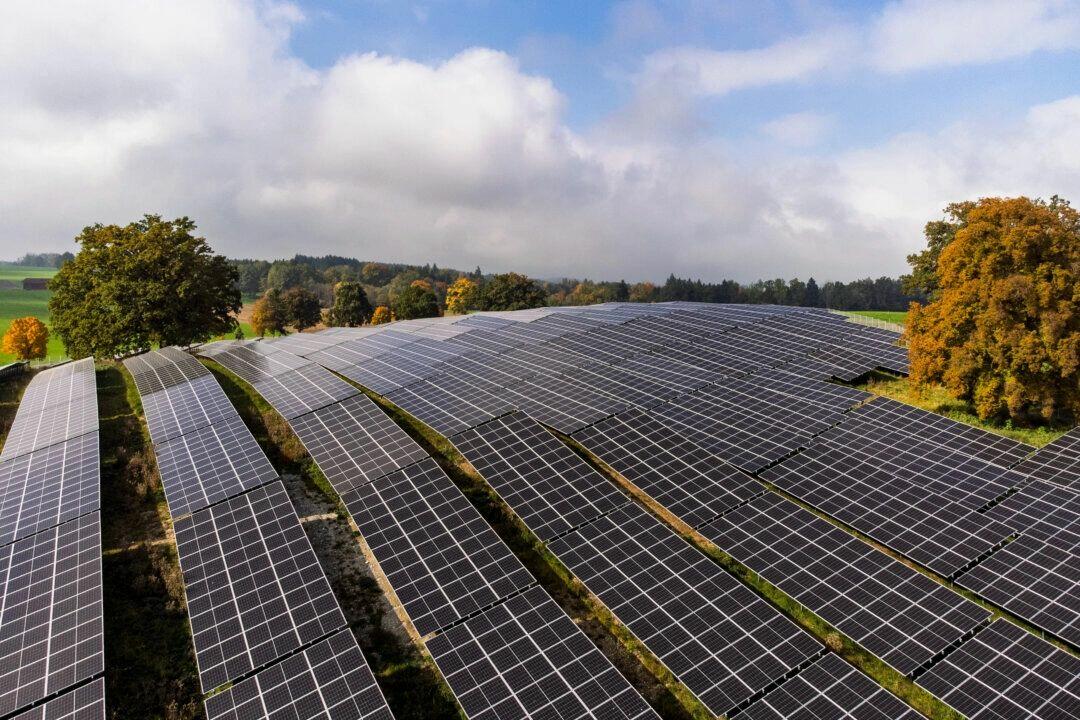
An aerial view taken with a drone shows a solar energy field near Weilheim, Germany, on Oct. 16, 2025. Philipp Guelland/Getty Images
As a record number of new solar panels are being installed every year, the old grid system is struggling to keep up.
Solar generation capacity in the European Union continues to increase and reached an estimated 338 GW by 2024, according to SolarPower Europe.
To curb its dependence on Russian energy and accelerate its green transition, the EU set a goal in 2022 to install at least 700 gigawatts of solar power by 2030, enough to supply electricity to hundreds of millions of homes.
But the rapid expansion has exposed cracks in Europe’s energy system, threatening to slow the transition unless grids catch up.
Europe’s power grids faced a surge in voltage problems last year, with 8,645 over-voltage incidents reported in 2024—nearly 10 times more than in 2023, according to the European Network of Transmission System Operators for Electricity (ENTSO-E).
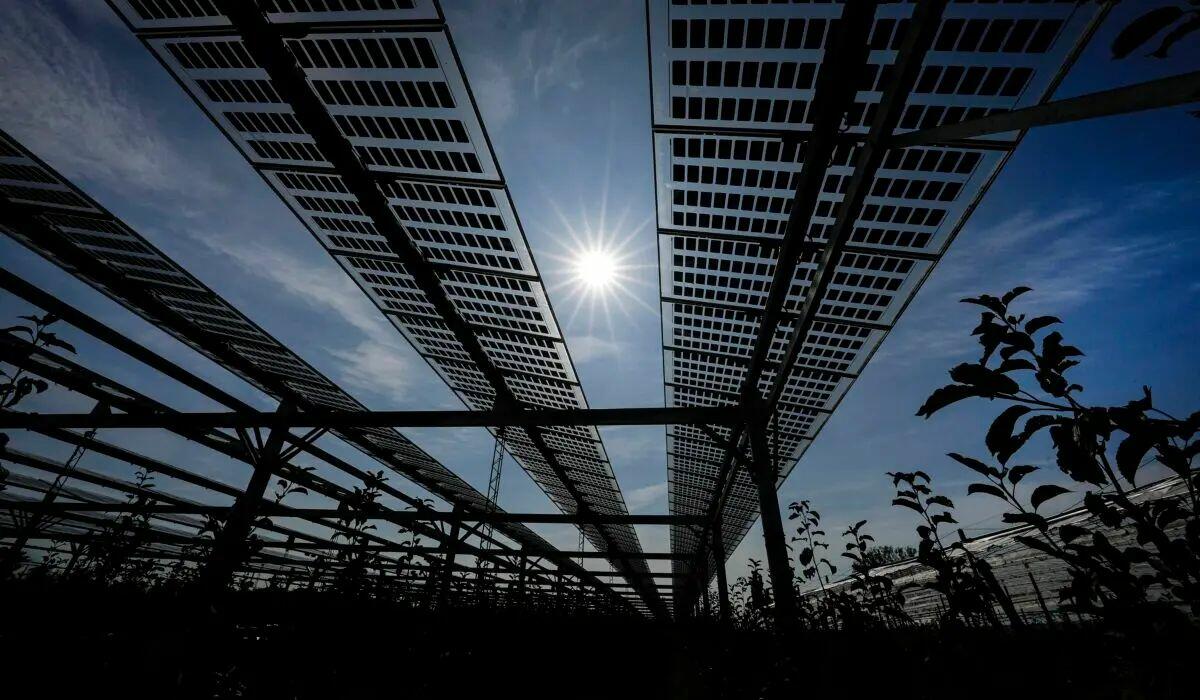
Special mounted solar panels are installed over a biological apple fruit tree plantation in Gelsdorf, western Germany, on Aug. 30, 2022. Martin Meissner/AP Photo
Aging distribution infrastructure complicates the issue. Industry group Eurelectric estimates that nearly half of Europe’s distribution networks will be more than 40 years old by 2030.
Energy analyst and project lead at the Helmholtz Center Berlin, Susanne Nies, told The Epoch Times that Europe’s power system is under heavy strain because it was designed for a time when electricity made up only a small share of total energy use.
“When you go to the countryside and countries like France or even Germany, those grids have been built in the 50s. They are really nearly 70 years old,” she said.
Europe’s electricity system was initially designed for one-way flows—from large power plants to homes and businesses, Nies explained, adding that now it must handle power flowing in both directions, as millions of solar panels feed energy back into the grid.
She said today’s grid needs to combine large regional “super grids” with smaller, local systems that can operate independently during emergencies.
Harry Wilkinson, head of policy at the Global Warming Policy Foundation, said the challenge is not only that Europe’s grid is aging but that it must be vastly expanded to connect power sources that are far more scattered than in the past.
“Just the physical amount of additional cabling that you have to add to the grid, to connect, that is a big challenge, just in itself,” he said.
Voltage Problems and Spain’s Grid Struggles
Most voltage problems in 2024 originated from Sweden’s Svenska kraftnät, which implemented automated reporting, while operators in Slovenia, Moldova, and Romania also experienced increases as renewables expanded, according to Eurelectric.
Others fared better: Hungary’s MAVIR cut incidents for a second year, and grid operators in Spain, the Netherlands, and France reported none at all.
However, in April, huge power outages hit Spain and Portugal, leaving millions of homes and businesses without power. In Spain, where solar energy now provides about 21 percent of the country’s power—up from 8 percent five years ago—emergency measures have been necessary to prevent blackouts.
Customers dine in a restaurant illuminated by a generator during a blackout in Barcelona, Spain, on April 28, 2025. AP Photo/Emilio Morenatti
Nies said that while in Spain’s case, the solar power grid was not the culprit, it has not been updated as fast as needed, and parts of it could be improved.
Wilkinson disagrees that it wasn’t the grid’s fault. He told The Epoch Times that renewables are simply more complicated to manage as a technology.
Nies noted that Spain remains poorly connected to its neighbors, while Germany’s grid is far more integrated, with four transmission operators and nearly 900 distribution system operators that manage local electricity networks.
According to independent energy consultant Kathryn Porter, location plays a far greater role in weaker grids. While frequency stays consistent across a network, voltage is a local factor that must be stabilized by nearby equipment.
“Spain’s conventional generation is concentrated in the north and east, while the south is dominated by renewables, making the southern network weak and increasingly difficult to control,” she said in her blog.
Grid Spending
Solar power supplies 22.1 percent of the EU’s electricity, according to energy thinktank Ember Climate, compared with 12.4 percent in China.
In the United States, the share is projected to reach about 7 percent in 2025, according to the U.S. Energy Information Administration.
Even as solar output soars, Europe’s electricity demand has stagnated, falling last year and recovering only slightly in 2025. Weak demand makes it more challenging to balance an energy system that is increasingly dominated by intermittent renewables.
The International Energy Agency (IEA) says investment in transmission and distribution networks is becoming critical as grid upgrades struggle to keep pace with the rapid buildout of low-emission power.
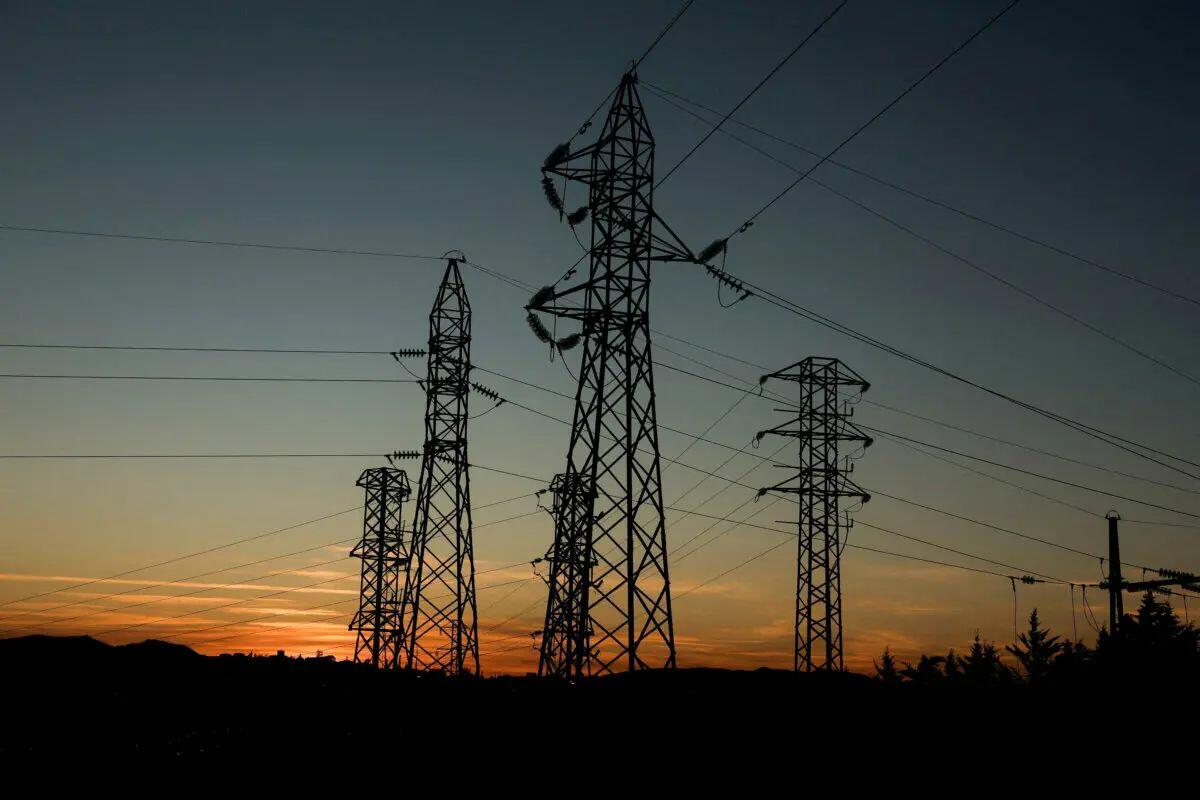
Power lines connecting pylons of high-tension electricity are seen during sunset at an electricity substation on the outskirts of Ronda, during a blackout in the Spanish city, on April 28, 2025. Jon Nazca/Reuters
Annual grid spending in the EU is set to exceed $70 billion in 2025, double the level a decade ago, the IEA said in a June report. Yet investment still trails the growth of clean-energy projects, leading to long connection queues and bottlenecks in moving cheap solar power from southern Europe to industrial centers in the north.
The European Investment Bank, the EU’s lending arm, warned in September that a lack of investment in grid spending causes inefficiencies in Europe and beyond. It stated that investment should remain a top policy priority if Europe wants to stay competitive.
When reviewing the overall economics of solar energy, the costs of grid management and the impact of high penetration levels on the grid are crucial, Wilkinson said. High penetration levels refer to a situation where the system relies heavily on one or more sources of renewable energy, which are intermittent and more challenging to ensure voltage and frequency stability.
“We should be realistic about the enormous cost burden that is likely to be faced because of those decisions,” he said.
New Solar Installations
Industry group SolarPower Europe expects a slight drop in new solar installations in 2025, marking the first decline in a decade. In its July statement, the group attributed the slowdown to grid bottlenecks, falling subsidies, and permitting delays.
The downturn is driven mainly by a slump in rooftop solar, especially among homeowners.
“In traditionally strong residential rooftop solar markets, like Italy, the Netherlands, Austria, Belgium, Czechia, and Hungary, households are now postponing installations as the impact of the 2022 energy crisis wanes,” SolarPower Europe said.
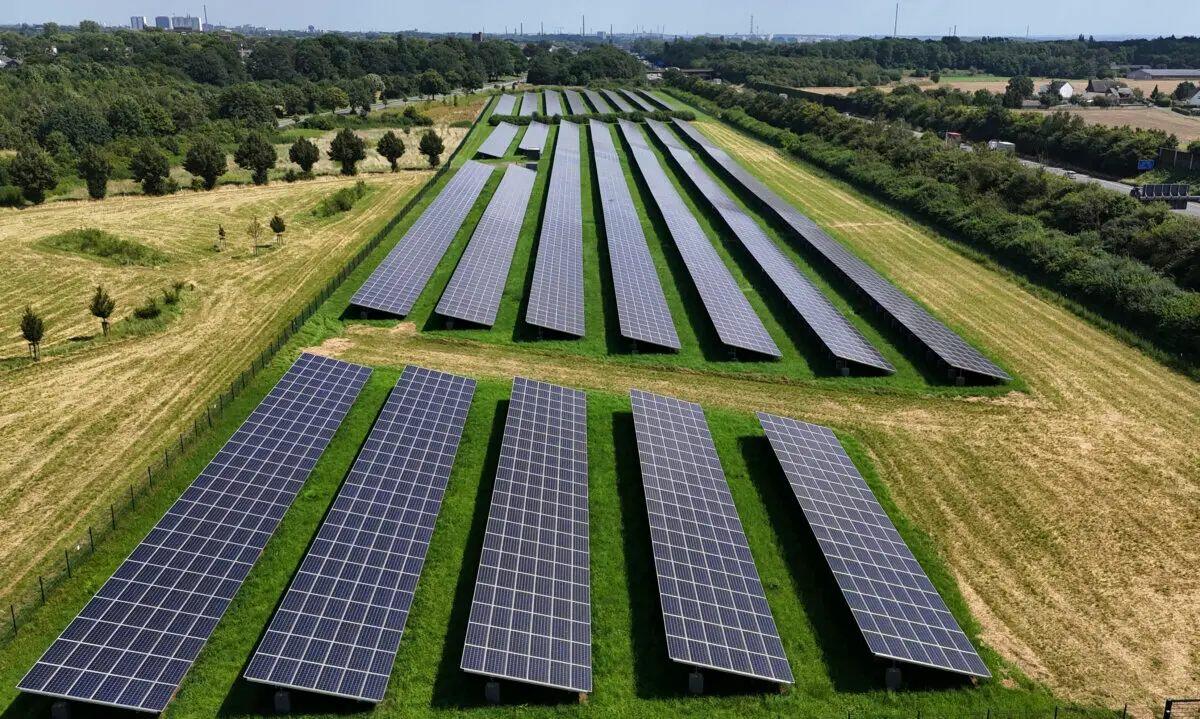
Solar panels on a solar field in Moers, Germany, on Aug. 5, 2024. Ina Fassbender/AFP via Getty Images
It added that the withdrawal of incentive schemes without adequate replacements has led to a collapse of more than 60 percent in some rooftop markets compared with 2023, while Poland, Spain, and Germany have seen drops of over 40 percent.
A policy brief from Ember last year warned that renewable expansion was being “held back by urgent stress signals” in Europe’s electricity networks.
Another report by Strategic Energy Europe found that more than 1,700 GW of potential renewable capacity was being held in connection queues due to limited grid capacity.