(ZH) Forget Covid-19, San Diego Faces Critical Quake Danger From Long-Inactive F

Forget Covid-19, San Diego Faces Critical Quake Danger From Long-Inactive Faultline

A 5.5 magnitude earthquake rocked Baja California, Mexico, on Friday night, and was felt as far as San Diego County. San Diegans have had a lot on their mind this past week, from the Covid-19 outbreak to now worrying about when the big earthquake will strike.
For decades, conventional thinking has always been San Diego County has a lower probability of devastating earthquakes than Los Angeles or San Francisco areas.
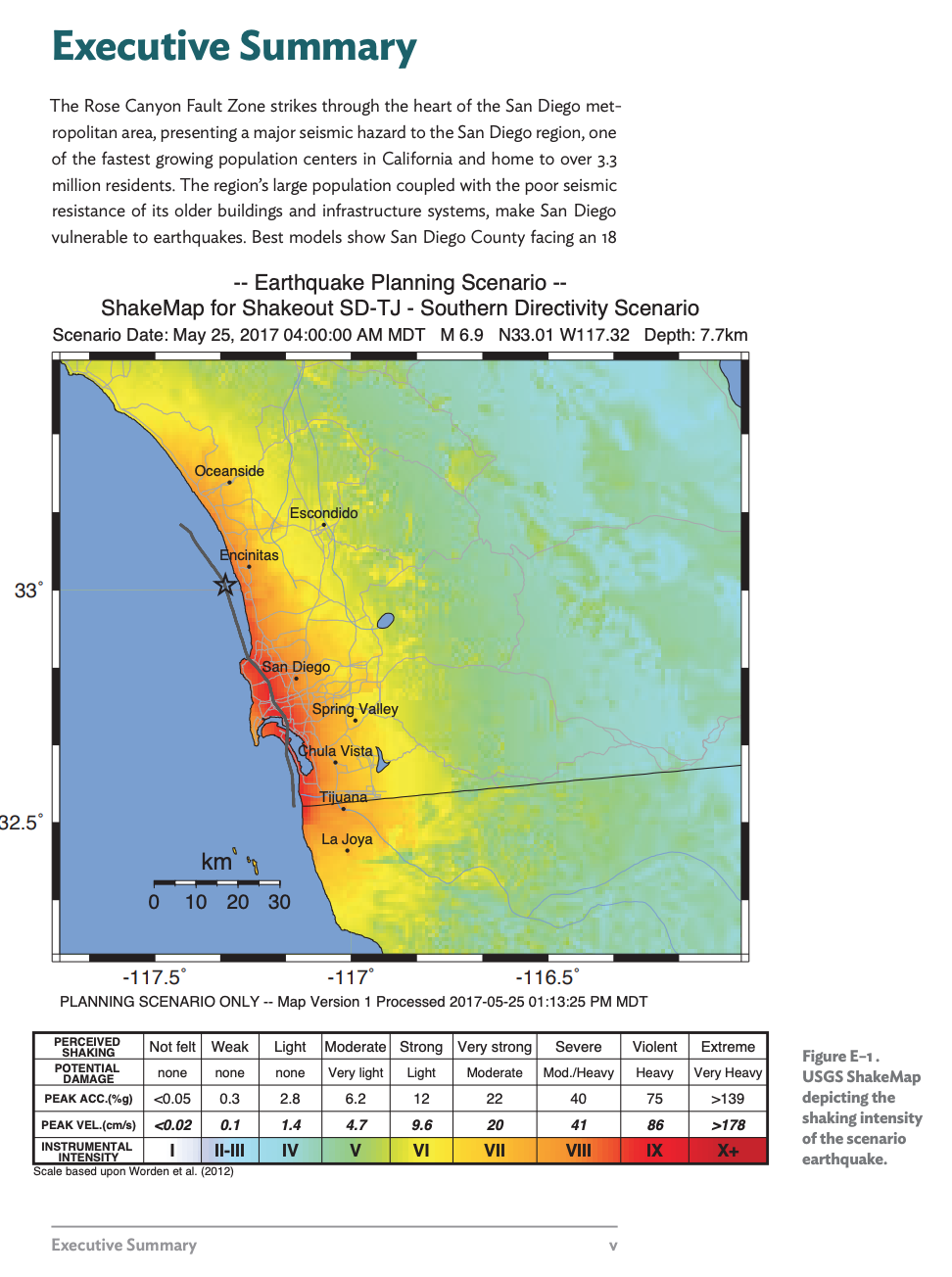
But a new report by the San Diego chapter of the Earthquake Engineering Research Institute (EERI), found a fault that runs through the heart of San Diego could be a much more serious problem than previously thought, reported Log Angeles Times.


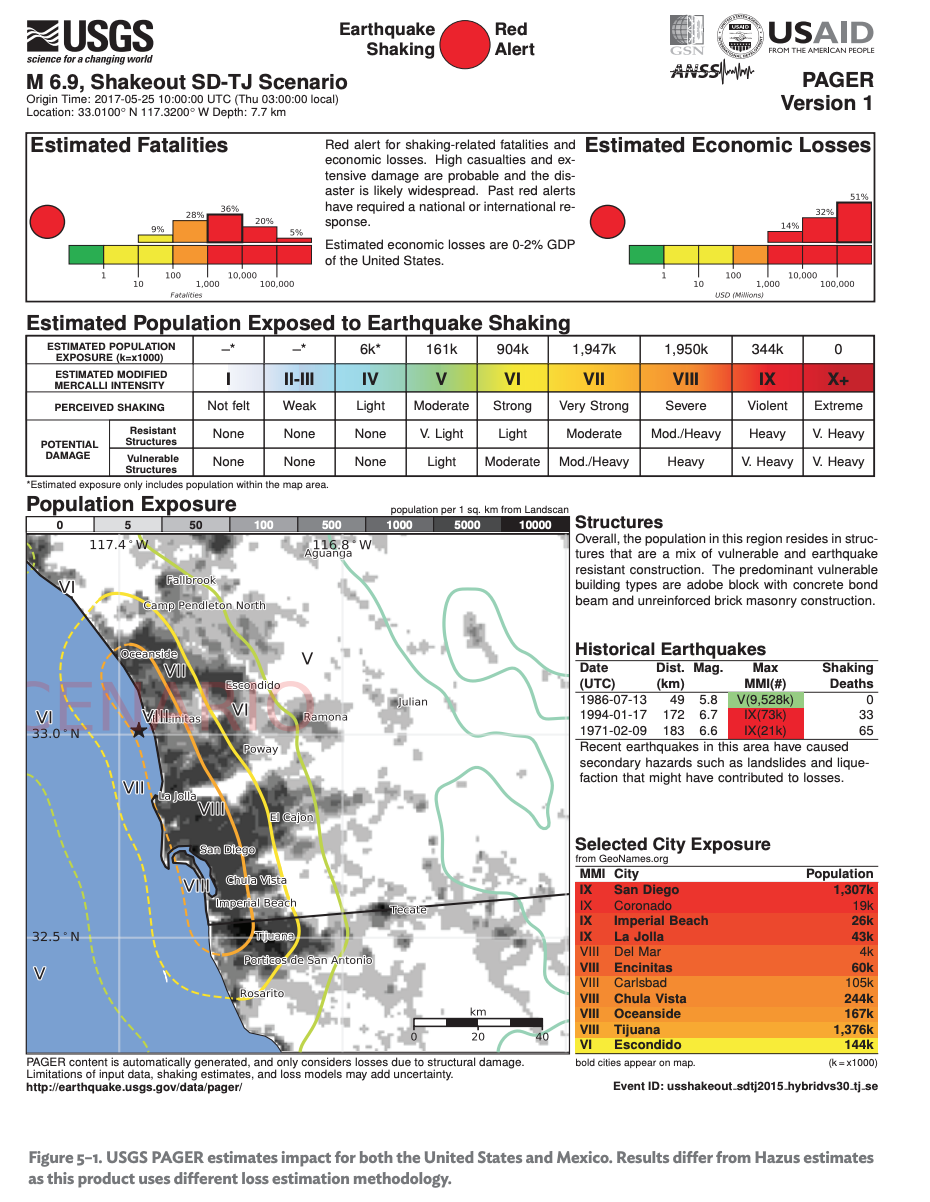
EERI modeled for a 6.9 magnitude earthquake along the Rose Canyon Fault that runs directly through San Diego. What they noticed is that it would have devastating effects on local infrastructures, such as ruptured gas, water, electric, and fiber services between La Jolla and the Silver Strand, cause severe structural damage to tall buildings and lead to the destruction of major bridges across the county.
"We're expecting a large fault rupture, almost six feet, a lot of liquefaction impacts, which basically is softening of the soil that causes a lot of impact to underground infrastructure like water distribution pipes," said Heidi Tremayne, executive director of the EERI. "We're worried that coastal communities could really be lacking some basic services for many months after an earthquake of this magnitude."
With an 18% chance that Rose Canyon Fault could trigger a big quake in the next three decades, EERI said damage from it would cost upwards of $38 billion and account for $5.2 billion in lost income for local businesses.

"In the short term, I would consider getting a group of regional experts together and take a look at these recommendations and determine maybe a way ahead and mitigate some of these things so we're better prepared if in fact we have an earthquake along this fault," said Gary Johnston, the chief resilience officer for the San Diego County Office of Emergency Services.
There's without any doubt that California as a whole is long overdue for a destructive earthquake. We noted back in December that "very unusual seismic activity" was taking place off the West Coast.
Seismologists warned about a year ago that California's seismic activity is in an "earthquake drought." With fears of large quakes could be nearing.

WSJ : Bull Market Faces Tough Test as It Turns 11

Bull Market Faces Tough Test as It Turns 11
Coronavirus is threatening longest-ever bull market for stocks

Eleven years ago, the stock market bottomed out.

Few saw it coming. Warren Buffett told CNBC in March 2009 that the U.S. economy had “fallen off a cliff.” State offices were flooded by people filing for unemployment benefits, and analysts warned the selling could last longer.

Against all odds, stocks turned higher the next day. And they have kept climbing to records with relatively few prolonged interruptions—that is, up until just a few weeks ago.

If investors started the year fairly confident that the run would continue for at least another 12 months, many are rethinking their calls now. The emergence of coronavirus has disrupted everyday life from China to Italy, sent Treasury yields tumbling to record lows and thrown a wrench in Wall Street’s attempts to forecast how the rest of the year will unfold.

“2020 will be the year of the virus,” said David Kelly, chief global strategist at J.P. Morgan Asset Management, adding that he had observed “mayhem” while shopping at warehouse retail chain Costco Wholesale Corp. “We’re not seeing [the epidemic’s] effects on the economy yet, but we could. And in fact, we probably will.”

Making matters worse: Much of the selling in the past couple of weeks appears to have been driven by high-frequency traders and algorithmic strategies, which have exacerbated stock swings especially just after the stock market’s open and before the market’s close, said Michael Drummey, head of trading at Mizuho Americas LLC.

“The real buyers are standing down just to wait and see what happens,” Mr. Drummey said.

So far, the ensuing rout hasn’t been as bad as prior downturns. At its lowest point this year, the S&P 500 was down 13% from its mid-February high—still several percentage points away from tipping into what would qualify as a bear market.

In 2011 and 2018, for example, stocks came within a whisker of entering bear-market territory, which is defined as a 20% drop from the market’s recent high.

The 2011 downdraft occurred amid a downgrade of the U.S. sovereign-credit rating and a fight between the administration and Congress over the country’s debt limit. In late 2018, stocks cratered as fears grew about the impact of the U.S.-China trade war and interest-rate increases by the Federal Reserve.

Today, investors are grappling with entirely different problems. They are worried about the likelihood that global economic growth cools as a result of the coronavirus epidemic.

And markets are pricing in an increasingly grim picture. Shares of companies that rely on consumers going about their everyday activities have tumbled: JPMorgan Chase & Co. is down 22% for the year; United Airlines Holdings Inc. fell 41% and Kohl’s Corp. shed 32%.

Much of investors’ trepidation stems from one indisputable fact: No one knows how bad the epidemic will get.

Forecasts are as varied as one could imagine. Under one scenario, Goldman Sachs Group Inc. sees economic growth slowing sharply in the first half of the year, then rebounding in the following quarters. But in another—in which the epidemic evolves into a more disruptive pandemic—Goldman believes the U.S. economy could fall into recession and the bull run in stocks could end.

Index provider MSCI Inc. built a model to predict how much more stocks could fall if reduced spending due to coronavirus shaves 2 percentage points off global growth in the short term. Under such a scenario, the company believes U.S. stocks could fall as much as 22% from their Feb. 19 high.

However it all unfolds, it appears that Wall Street agrees on one thing. The epidemic has displaced prior threats like stretched valuations, a run-up in growth stocks and a bitter trade feud between the U.S. and China as the No. 1 threat to the bull market.

“This is something different. It affects the way people go about their lives and I think that’s what’s causing angst in the broader economy and feeding into markets,” said Bill Callahan, investment strategist at Schroders PLC.

If there is an upside to the selling, it is that parts of the markets that had looked expensive are now trading at more modest valuations.

Technology stocks, long the leaders of the bull market, had run up so quickly the past few years that some investors worried they were vulnerable to a violent reversal that could take down the broader market. But now many dominant companies are only up modestly for the year, with Microsoft Corp. up 2.5% and Amazon.com Inc. up 2.8%. In some ways, the pullback appears to have brought valuations back to levels that seem more realistic given the current economic environment.

Not all investors have viewed recent declines as necessarily the start of a more painful downturn.

“If you look at this bull market over the past decade plus, there’ve been so many market spasms, and the typical pattern is that the market goes through a mini-correction and then comes out on the other side,” said Dave Donabedian, chief investment officer at CIBC Private Wealth Management.

Still, that hasn’t stopped nervousness from rippling across the investing world, affecting everyone from seasoned traders to individual investors rushing to log into their brokerage accounts.

“I’m a little tired,” joked R.J. Grant, director of equity trading at KBW Inc. He noted the irony of working a job in which punishing bouts of selling are actually a boon for business. “I haven’t opened my personal account,” Mr. Grant said.

Financial-planning company Edelman Financial Engines LLC, which counts more than a million 401(k) investors among its clients, said its call center staffed by financial advisers got four times the number of usual phone calls on Feb. 28.

Even those who believe that the market will ultimately rebound are reluctant to predict when the worst of the selling will be over.

“One negative headline can send the market into a tailspin, but there’s no one positive headline that can give us the all clear,” said Mizuho’s Mr. Drummey.

FT : Saudi Arabia launches oil price war after Russia deal collapse

Saudi Arabia launches oil price war after Russia deal collapse
Kingdom to raise crude production and offer deep discounts just as coronavirus hits demand

Saudi Arabia has launched an aggressive oil price war targeting its biggest rivals after Russia refused to join production cuts with Opec, in a move that threatens to swamp the crude market with supplies just as the coronavirus outbreak hits demand.

Saudi Arabia will raise production and offer its crude at deep discounts to win new customers next month, according to two people familiar with the country’s oil policy, which risks sending prices tumbling further. Oil prices had already dropped by a third since January to near $45 a barrel.

The kingdom plans to pump more than 10m barrels a day next month while announcing unprecedented discounts of almost 20 per cent in key markets, in an apparent attempt to punish Russia, while squeezing the US shale industry and other higher cost producers.

Production could eventually surpass 11m b/d, one of the people said, well above the roughly 9m the Riyadh had previously proposed lowering its output to.

Crown prince Mohammed bin Salman, the country’s de facto ruler, moved at the weekend to consolidate his position, arresting at least three members of the royal family that may have posed a threat to his accession to the throne.

The fall in oil prices risks new turmoil in the kingdom, as MBS’s plan to modernise the economy relies at least in part on higher energy revenues to fund the transformation.

Shares in Saudi Aramco, the state oil company, dropped almost 9 per cent on Sunday, falling below its December stock market listing price. The broader Saudi stock market sank more than 8 per cent.

Saudi Arabia had last week sought the support of Opec and allies outside the cartel, such as Russia, for a substantial cut in production to stabilise the oil market, which has been reeling as the spread of coronavirus hits the global economy and saps demand for crude.

But Russia torpedoed the plan, eyeing an opportunity to hit US shale producers, infuriating the kingdom and resulting in the countries removing all restrictions on their output from April.

“Opec and other countries including Russia couldn’t get an agreement. If others will push their production, why is Saudi Arabia not doing the same,” said a second person familiar with the kingdom’s output policy. “Now we have the right to sell more to compensate for any loss in prices.”

Russia has built up a $170bn national wealth fund from excess oil revenues in recent years and believes it can tap that to offset any short-term price war, despite crude plunging close to its budget break even price of around $42 a barrel.

Mikhail Leontiev, press secretary for Rosneft, Russia’s largest oil producer, said that the relationship with Saudi Arabia had become “meaningless”.

“The true result of the arrangement is that the total volume of oil that was reduced as a result of the repeated extension of the Opec+ agreement was completely and quickly replaced in the world market with American shale oil,” he said in a statement to state-owned news agency TASS.

Rosneft is majority owned by the Russian state and run by one of president Vladimir Putin’s closest and longest-serving associates.

“The proposal that was made was not a partnership. A partnership agreement always implies a compromise,” Mr Leontiev said, adding that the collapse of the agreement allows Russia to concentrate on monetising its crude resources.

The last price war in 2014 upended the global oil industry, inflicting pain on producers from the North Sea to North Dakota, and forcing them to adapt to the decisive end of the $100-oil era.

Higher output from Saudi Arabia would again hit the US shale sector, the rapid growth of which over the past decade has made the US the world’s top producer and forced rivals to restrict output in a bid to prop up the price.

The US shale industry has struggled to generate consistent profits, however, and is struggling with tighter access to financing, leaving it vulnerable.

But the kingdom appears to be targeting Russia in particular.

Saudi Arabia is set to announce that it will sell its crude into north west Europe, a key market for Russian barrels, at discounts to its reference price of more than $8 a barrel compared to March, according to an official price list seen by the Financial Times.

In the US it is also set to discount its crude by around $7 a barrel in April compared with March. It also made prices cuts to Asia of between $4-6 a barrel.

Monthly price adjustments are normally only a few cents or at most a dollar or two, leaving little doubt over what the kingdom is hoping to achieve.

Saudi Arabia’s 12m b/d production capacity has largely been restored after the drone and missile strikes on its key facilities in September.

The kingdom maintains the most spare production capacity globally, allowing it to raise its output faster than rivals.

The move will put pressure on Saudi Arabia’s allies in the Gulf like the UAE and Kuwait to cut their prices and potentially increase output to remain competitive.

A price war is likely to prove painful for all sides, but will hit the economies of weaker oil-dependent producers like Nigeria and Angola particularly hard, as they have little scope to increase output and less ability to borrow to plug budget shortfalls.

The price cuts threaten to further weigh on international oil prices, with Brent already down from $70 a barrel in early January to near $45 a barrel. It fell 9 per cent on Friday alone after the so-called Opec+ deal unravelled.

Traders and analysts have warned an all-out price war could see oil prices fall to $30 a barrel or lower, bringing back memories of the last time Saudi Arabia opened the taps in 2014.
>>> Barron’s Weekend Summary: The sharp drop in bond yields has heightened the a

Barron’s Weekend Summary: The sharp drop in bond yields has heightened the appeal of stocks with high dividends; Coronavirus-related guidance reductions from tech companies have been relatively subdued so far
* Cover story: The sharp drop in bond yields has heightened the appeal of stocks with high dividends, and the recent selloff in the stock market has raised their visibility, though high dividend yields can bring risk, and many investors see these stocks as value traps rather than as opportunities; The dividends on a dozen companies with strong balance sheets and durable businesses look secure: MO, DOW, XOM, VLO, PRU, CMA, T, CVX, WFC, ABBV, STX, KMI.
* Tech Trader: Despite the volatility and negative headlines this past week, coronavirus-related guidance reductions from tech companies has so far been relatively subdued and based mostly on other factors; business trends and outlooks could still deteriorate if infections accelerate around the world, but investors should begin to think about buying opportunities.
* Trader: The coronavirus probably isn’t done yet with the market—as more tests are conducted, there is likely to be a spike in the number of coronavirus cases in the US, which could cause another selloff, but which also creates a buying opportunity, says Christopher Harvey of Wells Fargo Securities.
* Interview: Paul Hickey and Justin Walter of Bespoke Investment Group, which helps clients remain mindful of historical market facts and current opportunities, discuss the threat of the coronavirus to the aged bull market and other issues (picks: XLF, KBE, BAC, GS, XLE, ALB, LIT, EA, ATVI, MSFT, SNE, WORK).
* Profile: Bill Nolin and Tom Rozycki, co-managers of the Principal Blue Chip fund, invest in businesses still run by their founders, or where executives behave like founders by thinking long-term and holding significant ownership (top 10 holdings: AMZN, GOOG, Berkshire Hathaway, MSFT, V, AMT, BAM, CHTR, MA, FB).
* Features: 1) Some bond bulls think investors should continue to hold on to their bonds even after yields have dropped, while others see more risk in these low returns if yields were to reverse their recent, stunning decline—but economist A. Gary Shilling remains positive on long-term Treasuries; 2) Barron’s inaugural list of the 100 Most Influential Women in Finance is an unranked list of top players selected because of their accomplishments and leadership, influence in the sector, and the capacity to shape business or industry in the future; related story says that “Though women make up more of the industry’s senior leaders, a closer look shows that many are filling corporate functions—human resources, general counsel, investor relations—rather than the revenue-generating businesses that tend to be the proving ground for roles like chief executive or money manager”; 3) Positive on NEM, GOLD, INIVX: Gold is living up to its reputation as a haven during turbulent times—the precious metal is up 10.7% this year, to a seven-year high, and could be on its way to testing its record high of $1,900, set in 2011; 4) A recent Vanguard Group survey of 44,000 do-it-yourself investors found that many had become more exposed to risks in the stock market during the bull run than they might have intended or that were appropriate for their proximity to retirement; 5) Pamela Rosenau, chief equity market strategist at HighTower, says the market could go down between 15% and 20% from its high, and is telling investors that it’s time to head for master limited partnerships, select opportunistic noncyclical stocks—and gold.
* European Trader: + Carrefour: Europe’s largest retailer has been hit by competition from AMZN and other online rivals, sending shares down, but a turnaround plan launched in 2018, cost-cutting, and online investments are beginning to create the potential to boost earnings and shares.
* Emerging Markets: Investors could be paid handsomely for entering the “risky morass” of Turkey’s market, where ten-year sovereign local-currency bond yields have jumped nearly two percentage points over the past month while stocks have fallen, which looks like a good trade to some managers—for now.
* Commodities: “Demand for transportation fuels has declined significantly along with prices, and both are set to worsen as the coronavirus continues to spread around the world, feeding fears over travel.”
* Streetwise: “What if the economy takes a hit, but our worst fears don’t play out?,” asks columnist Jack Hough. “For its base forecast, GS assumes the Covid-19 outbreak will be widespread but short-lived, with GDP bottoming at zero growth in the second quarter before rebounding, and earnings stalling, while falling interest rates push the S&P 500 to just over 19 times earnings by year’s end.”

WSJ : How Germany’s 1930s Bauhaus Design Transformed Tel Aviv’s

How Germany’s 1930s Bauhaus Design Transformed Tel Aviv’s Cityscape
A tenant of a Chicago glass tower by Mies van der Rohe visits Tel Aviv, a city packed with thousands of examples of the minimalist Bauhaus style

IT WAS a curious confluence of events that transformed me into a fangirl of the Bauhaus, the German design school that architect Walter Gropius founded in 1919.

The first was a 2001 trip to Walden Pond with my now husband. At his beseeching, it included a tour of the Gropius House in Lincoln, Mass., which required visitors to wear surgical booties. Shortly thereafter, I had delivered to my Manhattan office six slavishly rendered miniature ceramics of buildings designed by members of the Bauhaus. I displayed them lovingly on my desk. Then, in 2003, Unesco designated about half of Tel Aviv’s so-called White City—a planned section where some 4,000 Bauhaus buildings stand—a World Heritage site. It was as if the gods of architecture were coaxing me to Israel.

But life got in the way. By the time I stood in Tel Aviv, a high-tech, vibrant city of 435,000, it was December, 2019, the very end of the 100th anniversary of the Bauhaus’s founding and it all had come to mean even more to me. In the intervening years, I’d moved with my family into a Chicago apartment building designed in 1961 by Ludwig Mies van der Rohe, the last director of the Bauhaus school.

That first morning, sunglasses in hand, I fully expected to be blinded by the light reflected off the white minimalist buildings that make up much of Tel Aviv. Experts estimate 120,000 to 150,000 Jews fleeing Europe settled in this desert city along the Mediterranean between 1931 and 1948, when the state of Israel was established. According to Nitza Szmuk, architect, restoration expert, and professor emeritus at the Technion-Israel Institute of Technology, “They needed quick and cheap construction for the new immigrants, and the pure architecture and lines of the Bauhaus fit the place and the idea of a new, modern life in a new, modern country.”

About a half dozen architects who had studied with Gropius cooked up thousands of concrete buildings that were functional and free of adornment. The balconies, small in German iterations, were expanded here to take advantage of breezes, while windows were minimized to combat heat. Despite introducing the occasional curve, architects strove for linear uniformity and egalitarianism. The structures were painted a practical, inexpensive white.

Walking from our little hotel off Dizengoff Square, I didn’t need those sunglasses. Telephone wires blocked dingy balconies; concrete corners crumbled; cracks had been hastily filled with putty that would make Walter Gropius shudder.

I perked up once I was in the square that’s become the city’s social heart. Yaacov Agam’s circa-1986 kinetic fountain played elegantly against the Bauhaus buildings that ring the square. They include a pristinely restored 1938 movie house, now the Cinema Hotel and the restrained apartment complex 94-96 Dizengoff, both designed by Ukranian-born Yehuda Megidovitz. At the nearby Bauhaus Center, its founder, Micha Gross, told us that with the centennial of the school, he’s seen interest in the White City increase astronomically, at least among visitors. “Tel Avivians start to recognize the beauty of the Bauhaus buildings only once they are renovated,” the Swiss immigrant said. “Fortunately, at this moment, all over the town, buildings are getting fixed and the general consciousness is improving.”

Our peregrinations continued: You can actually sleep in the Poli House Hotel, though Egyptian-Canadian designer Karim Rashid’s new bright, look-at-me furnishings conflict with the Bauhaus spirit. The horseshoe-shaped Jacobson’s Building, with its ribbons of balconies, looks like a gorgeously marooned cruise ship.

Once back home, I eyed a re-creation of Mies’s cantilever chair, S 533 F, one of many rereleases thmsg 4at celebrate the 100th anniversary of the Bauhaus. Commissioned by the German firm Thonet, its gravity-defying tubular steel would add some much-needed curves to the right angles of my Lincoln Park apartment. And the geometric fabrics by Bauhaus member Gunta Stölzl and her student, Anni Albers, recently released by New York textiles company Designtex, would complement my circa-1955 glass-and-steel coffee table. My husband usually resists color in our austere apartment (we don’t even have plants), but soon he will come home to see our ash gray sofa newly re-upholostered with Stölzl’s sunny, graphic fabric. And he’ll have only Gropius to blame.