Use Of Fed Liquidity Swap Line Surges
Heavy drinking at ECB USD liquidity source
The ECB has announced the results of its USD liquidity tender. $114bn was taken up by financial institutions. The ECB and other major central banks announced that they will be conducting daily USD tenders next week. The intention is to convince market participants that USD funding will be there in any size required.
The ECB’s hope is that if it demonstrates that the liquidity is there in size, the private sector may start re-intermediating. The tenders were at low rates considering market conditions, and offered at unlimited size, but the strategy is similar to the Fed’s – ask no questions, write the check.
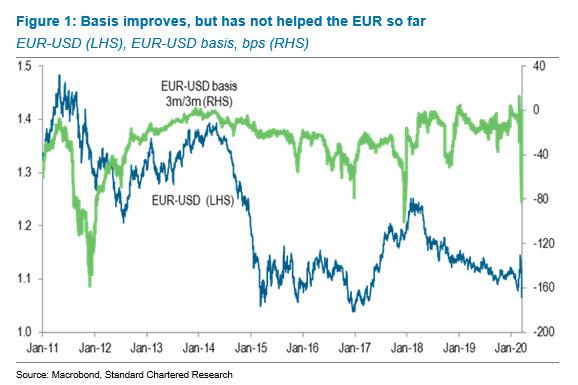
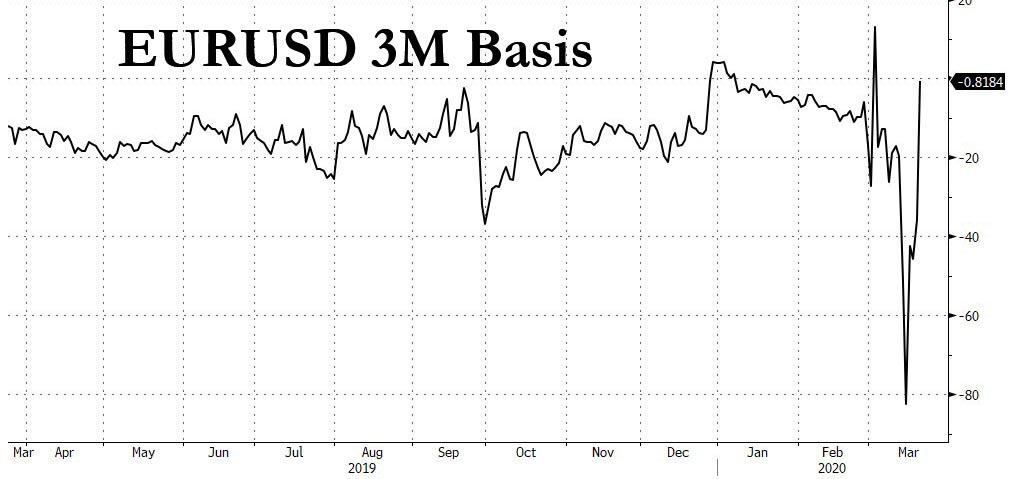
The effect on the EUR-USD basis was immediately visible in a sharp narrowing in recent days.
By late afternoon trading on 20 March, the basis had tightened to essentially 0bps.
However, the EUR did not respond positively to the basis narrowing, trading near recent lows. This is not unusual; the relationship between the EUR and the basis has not been very reliable over the past decade.
A sharp widening of the basis is sometimes associated with EUR weakness, but the narrowing does not seem to reverse EUR weakness, at least not quickly.
More broadly, the message may be that dealing with issues in individual money markets is a necessary condition for preventing further deterioration, but insufficient for repair.
U.S. Coronavirus Cases Jump; FDA Approves Rapid Test
President Trump approves a major disaster declaration for New York as deaths in the country rise to 260
The number of confirmed coronavirus cases in the U.S. had surged to nearly 20,000 as of Saturday, almost 10 times their level a week ago, as President Trump said he was considering a major disaster declaration for California and other states.
President Trump already approved such a declaration for New York, unlocking federal funding and assistance for the strained state. New York accounts for half the infections in the country.
Trump administration officials and congressional leaders were still working on a financial response of more than $2 trillion to address the outbreak and the economic fallout. The funding would include a nearly $1.5 trillion spending bill under consideration by U.S. Senators, as well as aid from the Federal Reserve.
“I think the Democrats and the Republicans are going to come up with a package that’s going to be really something very special,” Mr. Trump said of the proposed package at a press conference. “It’s going to help people.”
Globally, the number of infected hit 289,948 and deaths reached nearly 12,000, according to data compiled by Johns Hopkins University, as more governments resorted to drastic measures to contain the spread. Italy again recorded the highest one-day death toll for any country.
Total cases are at 19,624 in the U.S., while deaths quadrupled to 260 from a week ago, according to Johns Hopkins University. New York state has 11,675, including 7,530 in New York City, state and city officials said Saturday.
More than 195,000 people in the U.S. have been tested for the virus, Vice President Michael Pence said Saturday. The vice president also said the government has ordered “hundreds of millions of masks” for health-care providers.
Mr. Pence said that he and his wife would be tested on Sunday after it was discovered that one of his staffers had tested positive for the virus, the first such case in the White House.
The pace of results of tests could quicken. The Food and Drug Administration on Saturday approved a rapid-testing kit for the disease. Cepheid, a California company, was awarded the approval for the test, which provides results within 45 minutes.
The escalation has strained hospitals and medical resources in New York City and elsewhere. General Motors said it is lending logistics, purchasing and manufacturing support to Ventec Life Systems to help the medical-devices company ramp up production of ventilators.
New York Gov. Andrew Cuomo on Friday ordered all nonessential businesses to close and urged residents to stay indoors to the greatest extent possible.
Mr. Cuomo said at a press conference Saturday that existing facilities would be converted to house ill patients by the U.S. Army Corps of Engineers.
“We’re requesting four field hospitals at 250 capacity each. That would give us 1,000 field hospital beds,” he said, adding that the Javits Center, a massive convention center in New York City, would be a possible location.
A million N95 masks will be sent to New York City as a shortage of protective equipment for medical professionals dwindles, he said. “It won’t get us through the crisis, but it will make a significant contribution to New York City’s mask issue,” Cuomo said.
He added that the state has identified 6,000 new ventilators available for purchase.
The governor also said the Federal Emergency Management Agency will assist in state emergency funding to aid in recovery efforts.
In an effort to conserve protective medical equipment and tests, due to shortages of both, New York City health officials issued a directive on Friday to stop testing outpatients for coronavirus if their symptoms were mild or did not require hospitalization.
“Outpatient testing must not be encouraged, promoted or advertised,” the advisory, sent by the commissioner of the New York City Department of Health and Mental Hygiene, reads. The City of Los Angeles issued a similar directive to its doctors on Thursday.
As more states announced lockdowns, Starbucks said it would shut U.S. stores and use drive-through only for at least two weeks, except for cafes in or around hospitals and health-care centers. Starbucks said it would continue to pay employees for 30 days. The move followed shutdowns last week by companies including Apple Inc., which closed all its stores outside of Greater China.
Meanwhile, around the world, the number of deaths from the disease have mounted.
On Saturday, another 793 people were reported to have died in Italy in the past day with the virus, bringing the total to 4,825. Saturday’s figure was a new highest one-day death toll recorded in any country. The total confirmed coronavirus infections rose to 53,578, an increase of 14% from the previous day.
In Spain, the number of people who have died from the virus rose by almost a third in the past day to 1,326, according to data released by the Spanish Health Ministry on Saturday. The total number of people infected jumped by 4,946 to bring the total to almost 25,000, making Spain the country with the third-most infections, behind only China and Italy.
New cases and deaths continued to arise in Asia, where many countries had appeared to have contained the outbreak in recent weeks. Singapore reported its first fatalities Saturday morning, a 75-year-old woman and a 64-year-old man. Both had a history of heart disease, local health officials said.
Several countries and territories in Asia are now seeing a second wave of infections from citizens and travelers who were recently in the U.S., Europe and parts of Asia where infection rates are climbing.
Hong Kong stepped up efforts to enforce quarantine and social-distancing measures on Saturday, after a jump in imported cases over the past two weeks took the total number of infections to 294. Those who flout self-isolation rules will be prosecuted immediately, and could face fines or imprisonment. “The imported cases have made the situation in Hong Kong more severe than ever,” Chief Executive Carrie Lam said at a press conference.
Civil servants in the semiautonomous Chinese city will work from home again starting Monday, after public services returned to normal in early March upon initial success in containing the spread. The city will postpone university entrance exams originally scheduled for next week.
The number of confirmed cases in Australia topped 1,000 on Saturday after a jump in New South Wales state, where authorities identified more cruises where passengers contracted Covid-19 aboard.
The jump in infections prompted authorities to close Sydney’s Bondi Beach, after beachgoers ignored rules limiting outdoor gatherings to 500 people. Separately, Crown Resorts Ltd.’s Melbourne casino lost its exemption from Australia’s rules limiting indoor gatherings to 100 people.
China reported no new local infections for the third straight day, though it said there were 41 new imported cases. The number of people still fighting the disease fell by 590 to about 6,000, according to the National Health Commission. Nearly 72,000 patients have recovered, representing 89% of the total infected people in the country, the commission said.
In Japan, where authorities are scrambling to proceed with the Olympic Games, infections topped 1,000 after the country registered the biggest daily increase in a week.
The number of deaths in Iran rose by 123 over the past 24 hours to 1,556 on Saturday, health ministry spokesman Kianoush Jahanpour said. Iran logged 966 new infections, bringing the total number of cases to 20,610.
In an attempt to avoid crowds in the streets as Iran celebrates the Persian New Year, President Hassan Rouhani said shopping malls would be closed from Saturday, and the government was looking into ways to provide discounts on online shopping.
What China’s Economic Data Says About a U.S. Recovery: Nothing Good
In the new world of coronavirus, life moves quickly.
A month ago, with U.S. equity indexes at record highs, there were but few references in the U.S. media to the virus in China, in some other countries, and on cruise ships. By this week, with equity markets pausing momentarily, having slumped by 30%, there is 24/7 coverage of a pandemic that has put nation after nation into lockdown and quarantine. The economic consequences are going to be surprisingly ugly, with U.S. gross domestic product likely to record a double-digit annualized decline in the April-June quarter and a recessionary year pretty much baked in the cake.
The U.S. and Europe are about a month or so behind China, epidemiologically but also economically. To see what might be coming down the track, think about China for a moment.
In the past two weeks, Chinese economic data for February—the first month of lockdown—have shown an unprecedented collapse in readings for business confidence, industrial production, investment, and retail sales. Industrial production and services output, for example, were down about 13% in the year to January/February. The nominal value of retail sales was down 20%, in spite of a surge in online shopping and deliveries. Investment spending and property transactions fell off a cliff.
March data will hardly be much better, and there will be a unique and large contraction in China’s GDP in the first quarter. Year-on-year growth could be negative, too.
Even though China is now slowly getting back to work, the unemployment rate rose one percentage point, to 6.2% (certainly an underestimation). The global coronavirus recession now emerging will sting China’s economy just as its leaders believe the worst to be over. Officially, the government is still targeting about 6% GDP growth in 2020, but China will be lucky to eke out a positive outcome at all.
The U.S. and Europe are in pursuit, even if Western lockdowns and quarantines are less draconian. That said, Italy, Spain, and France have recently mandated tough containment measures. So have a raft of U.S. cities and states. Open borders and public health crises do not make comfortable bedfellows, and in the past month the U.S., Canada, and the European Union have been among many to restrict access by foreign citizens. With airlines reeling, and shops and factories on the cusp of large losses, we have arrived at what economists call a “sudden stop” in the travel, tourism, hospitality, entertainment, retail, and housing sectors.
In response, the Federal Reserve and the Trump administration have joined other G-7 central banks and governments in conveying their angst about an unfolding recession, if not looming depression. The Fed announced emergency measures to cut the federal-funds rate to zero and pump several hundred billion dollars into the financial system to prevent a potentially damaging seizure of liquidity. Renewed purchases of Treasury bonds, or quantitative easing, and the establishment of a new lending facility to support the commercial paper market—a vital credit source for larger companies—were among initiatives designed to temper the “dash for cash” and instill order into credit markets.
The federal government has a potentially more powerful role to cushion the fall in GDP brought on by the inability or unwillingness of the private sector to spend and borrow. Treasury Secretary Steven Mnuchin is trying to get the Senate to agree to an $850 billion package of stimulus, which ultimately might include a payroll-tax cut, help for the beleaguered airline and other sectors, loan assistance and tax-payment relief, health care and other investment, and direct income support payments.
At just over 4% of GDP, this figure would be significant. To be effective, though, a lot of fiscal stimulus might have to wait for the peak of the infection, the restart of businesses and factories, and normalization of work. It might not be enough.
The consumption share of GDP in the U.S. is 68%. Spending on transportation services, leisure activity, hospitality, and eating out amounts to just over $2 trillion, or about 14% of total consumption. A 20% drop in this sort of consumption alone translates into a direct 2% decline in GDP (8% annualized in a quarter). But the secondary effects of shutdowns, such as rising unemployment, bankruptcies, and loss of confidence, would compound the impact considerably.
China’s experience may well foreshadow what’s coming for the West. But neither in China nor anywhere else do we know if there might be a second wave of seasonal infections or when an effective vaccine will emerge.
On top of the U.S.-China trade war, relations have continued to sour during and because of this health crisis. Moreover, we have yet to think through the transformational impact of the crisis on supply chains, globalization, and Sino-Western relations—and at home, on public health systems, the nature of work, and fiscal legacies.
The 2020 economic effects of the coronavirus crisis are just an hors d’oeuvre.
George Magnus is the author of Red Flags: Why Xi’s China Is in Jeopardy; an associate of the China Centre in Oxford, Britain; and a former chief economist of UBS.
All European Bank Stocks Got Hit Hard in the Coronavirus Market Rout
Industries haven’t all been equal in the month since the stock market rout began, and the European banking sector has been hit particularly hard. European stock markets are down by about 35% on average since Feb. 19. European bank shares have declined by about 45%.
Investors don’t seem to distinguish between banks within the euro zone—the largest of which are supervised by the European Central Bank—and banks outside. Both France’s Société Générale (ticker: GLE.France) and the United Kingdom’s Barclays (BCS) are down by about 50%.
Markets have also equally treated the banks that were struggling before the coronavirus crisis and the ones whose business had picked up during the previous years of economic recovery. The shares of Germany’s long-struggling banking behemoth Deutsche Bank (DB) have sunk by almost 50%, just like those of France’s BNP Paribas (BNP.France).
The market pounding on the European sector came even as central banks, namely the Bank of England and the ECB, in their policy response to the crisis, put special emphasis on helping the banking sector.
Special liquidity facilities at ultralow interest rates were announced. Regulators and supervisors cut some levels of capital requirements, or allowed banks to use capital buffers to live through the crisis. The idea was that it was important to allow banks to continue supporting the economy on the eve of an economic shock that may prove to be temporary but will certainly be volatile.
On the supply end of credit, banks were provided with cheap money to encourage them to keep lending. On the demand end—the borrowers, notably the thousands of small and medium companies that will be hardest hit—European governments multiplied state-sponsored schemes of credit guarantees designed to reassure banks that they would be paid back in full—no more new “bad loans” to saddle their portfolios with.
Investors remained indifferent. Banks are trading at the bottom of their valuations, measured by the ratio of their market capitalization to the value of their assets. Here, at least, the hierarchy of performances before the crisis has been roughly maintained. Deutsche Bank trades at about 17% of its book value, and SocGen trades at about 19%. At the top of the ranking are the euro zone’s perceived strongest lenders, such as BNP Paribas and Banco Santander (SAN), trading at about a third of their book value.
Policy makers point out that banks are not today in the sorry state they were caught in at the onset of the financial crisis, after years of ultralight regulation. According to the ECB, the euro zone banking sector’s common equity Tier 1 ratio is now above 14%. It stood at barely 8% in 2008.
The bad loans on their balance sheets have shrunk after a decisive push by supervisors. And their liquidity ratios have improved, as well. Finally, the euro zone has since then created a so-called resolution regime, which allows for the orderly shutdown of a big bank in case of a major crisis, and doesn’t force taxpayers to foot the bill.
The problem is now whether these more solid foundations can withstand the challenge of an economic tsunami. Banks are exposed to industries such as airlines, the hotel industry, and the oil sector.
In spite of the hundreds of billions pledged by governments in the form of credit guarantees for struggling companies, bad loans could still come back to haunt balance sheets. Meanwhile, ever-lower interest rates are putting pressure on profits. At some point, governments that are helping the banks to help the economy may have to focus on helping the banks themselves.