FT : How long will the coronavirus slump last?

How long will the coronavirus slump last?
An analysis of 27 bear markets since the 1800s suggests the effects could be shortlived


The bull run in US stocks ended in pretty gory fashion this month. But how long this bear market lasts will depend largely on what kind of economic shock the coronavirus proves to be — and what other financial vulnerabilities it uncovers or exacerbates.

The S&P 500 is now almost 30 per cent below its peak, leaving analysts and investors wondering whether this is now an opportunity to dive back into the equity market, or whether there is more pain to come.

Goldman Sachs’s chief global equity strategist Peter Oppenheimer has tallied 27 bear markets since the 1800s. He found that the average decline is 38 per cent, and that it has on average taken 60 months for US equities to return to their previous peak. However, the dispersion between different types of bear markets is significant.

“Structural” bear markets, which are triggered by deep-seated economic imbalances and financial bubbles unwinding, have on average meant a 57 per cent slump, and taken 111 months to return to their previous peak.

The more garden-variety “cyclical” bear markets, where rising interest rates damp economic activity and depress corporate profits, have typically led to a 31 per cent peak-to-trough drop for the US stock market, and it has on average taken 50 months to recover.

Meanwhile, “event-driven” bear markets are those triggered by some kind of one-off shock, such as a war, spiking oil prices, an emerging-markets crisis or a brief financial calamity like the Black Monday crash. This seems to fit the coronavirus scenario best, Mr Oppenheimer argues. Such bear markets on average lead to a more modest 29 per cent decline, and last just 15 months.

Nonetheless, Mr Oppenheimer stresses that there are reasons to think that the current market may be more painful than the typical event-driven bears of the past.

A global pandemic is a novel danger with no modern precedents, and interest rates are already extremely low across most of the global economy, which means that central banks have less firepower available to mitigate the impact, he said. This bear market could therefore morph into something far more pernicious and persistent.

FT : Apollo bets against SoftBank debt pile

Apollo bets against SoftBank debt pile
Leon Black’s short position adds to pressure on Japanese group after soured investments

Leon Black’s Apollo Global Management hedge funds have placed a sizeable short bet against bonds issued by SoftBank, citing concerns about the Japanese conglomerate’s debt load and its exposure to cash burning tech start-ups.

Apollo discussed the trade with investors during a presentation in December, which also pointed to SoftBank chief executive Masayoshi Son’s investment process and pay package, said two people who attended the talk.

The firm entered the position that month, believing the bonds were mispriced and should not be trading at investment grade levels, one person briefed on the matter said.

SoftBank and Apollo declined to comment. The exact size of the position could not be learned.

Apollo, which manages about $3bn in the hedge funds and more than $330bn in total, is known as one of the savviest investors in credit and so-called distressed companies.

Its wager adds to the pressure on SoftBank as the Japanese group faces calls to improve its share price and provide transparency around the $100bn Vision Fund, which has suffered from a string of soured investments.

Paul Singer’s Elliott Management has called for SoftBank to enact share buybacks and governance reforms, in a bid to reduce the discount between its stock price and the value of its holdings in companies such as Alibaba.

SoftBank announced it would buy back close to $5bn worth of shares to help shore up the technology group’s stock price, which has declined more than 40 per cent since the start of the year. 

The rating agency S&P Global last week raised concerns about the buybacks, cutting SoftBank’s outlook to negative and questioning its commitment to “financial soundness”. 

Investors have homed in on SoftBank’s Vision Fund and its bets on cash burning start-ups such as the food delivery company DoorDash and Indian hospitality group Oyo Hotels. 

The fund unit weighed on SoftBank’s fourth-quarter earnings, posting $2bn in unrealised losses as one of its largest investments, the property group WeWork, was forced into a bailout after failing to go public. Last week SoftBank told WeWork investors it could back out of $3bn in planned share purchases, citing regulatory investigations into the company.

Elliott has called for greater transparency in the Vision Fund’s investments and questioned SoftBank’s plans to commit as much as $38bn toward a second version, one person familiar with the hedge fund’s thinking said.

Apollo is targeting SoftBank’s more than $170bn total debt load, which has raised concerns in some corners of the credit markets. 

The cost of insuring against the risk of SoftBank not being able to pay its debt back has soared. Spreads on five-year credit-default swaps passed 500 basis points last week, with these derivatives tied to the Japanese conglomerate’s bonds having been quoted at little over 200 basis points earlier in March.

The company has said it has enough funds to repay its debt for at least two years, and the pending closure of SoftBank-controlled Sprint’s merger with T-Mobile would further reduce its liabilities.

(ZH) Equity Hedge Funds Suffer Their Worst Month Ever

Equity Hedge Funds Suffer Their Worst Month Ever

While Robert Reich may be very badly confused what the word "hedge" means...
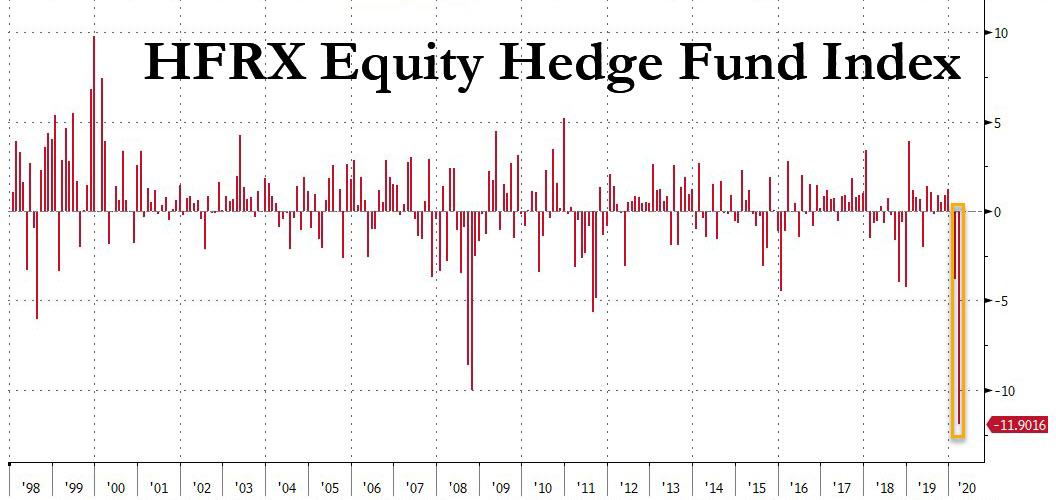
... his comment does touch on a valid point, even if it is diametrically the opposite of the one he had hoped to make: according to Hedge Fund Research, the HFRX Equity Hedge Fund index just suffered its worst one-month drop in history.


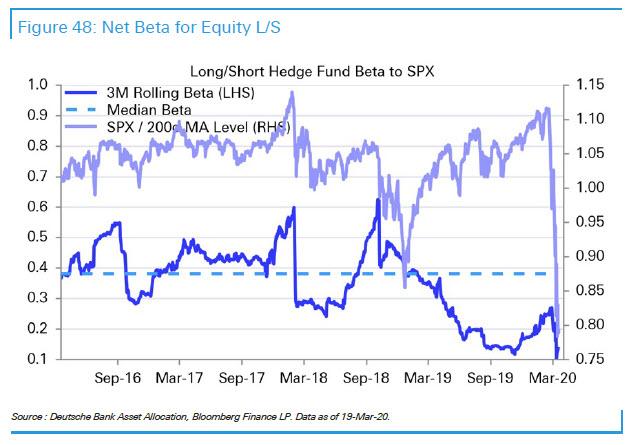
This is mostly the result of the continued chaos in the hedge fund worlds, where hedge funds had taken down their beta to the S&P over the past two years to the lowest level on record, as PMs have no idea what to do in this "market":
Others, such as Goldman, blame illiquidity for the epic collapse, with Goldman's David Kostin writing on Friday that "illiquidity likely contributed to the sharp underperformance of popular hedge fund and mutual fund stocks this week as investors reduced risk" noting that whereas "investor positioning remained unusually elevated relative to levels at the bottom of other major S&P 500 corrections", this week those positions declined sharply.
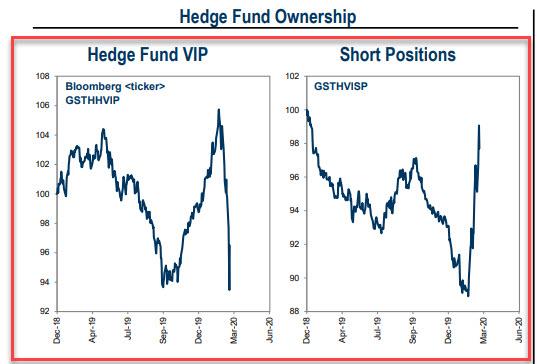
As a result, from Monday to Wednesday, Goldman's Hedge Fund VIP basket (GSTHHVIP) which Goldman has repeatedly praised in the past for its outperformance of the broader market, "lagged our basket of large shorts (GSTHVISP) by 850 bp (-17% vs. -8%), more than any 3-day period in the nearly 20 years of the baskets’ history."

In other words, anyone who listened to our reco from exactly one month ago to go long the most shorted names and short the VIP stocks...
... while the GS VIP list is certainly notable, if only because everyone owns the same 50 or so top stocks, what we find far more fascinating, and a far better source of alpha, is the hedge fund top 50 most shorted - or hated - stocks, which as we have shown year after year tend to significantly outperform the market due to periodic and vicious short squeezes especially in this day and age when the link between fundamentals and asset prices has been terminally severed by central banks, something we described most recently in "Going Against The Wall Street Crowd Has Been The Most Profitable In 5 Years"
... made an absolute killing in the past month. Which is more than we can say for most hedge funds.
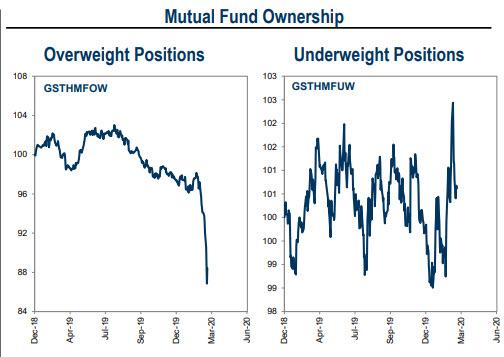
Actually, it's more than we can say for virtually all funds, period. because as Goldman also notes, "Mutual Fund Overweights (GSTHMFOW) also lagged Underweights (GSTHMFUW)."
More pain is yet to come, because as Kostin concludes "Goldman's Sentiment Indicator shows that equity positioning has plunged in recent weeks, "additional selling is likely until positioning matches lows reached at the bottom of prior corrections."
Which brings us back to what Robert Reich said in his tweet - yes hedge funds are down less than the market, but that's to be expected. The problem is that they are not up! After all, for the past decade, hedge funds underperformed the S&P year after year, sparking an unprecedented wave of redemptions which led to record inflows into cheaper, passive investing alternative such as ETFs. One would think that they would finally compensate investors for all this long-term pain by at least delivering a positive return when the market crashed.
But no, while hedge funds underperformed the market on the way up, they not only failed to be a real hedge on the way down, but fell the most on record. So why pay them 2 and 20 to suck all the time, failing to keep up with the S&P when stocks are rising, and then also tumble (if a little bit less) when the market crashes?
What exactly are hedge funds "hedging"?
One person who may know the answer, is the chief investment officer of Veritas Pension Insurance, who told Bloomberg he will review the firm’s hedge fund allocation amid "concerns the asset class is adding little to overall returns."
Kari Vatanen, who started as CIO at the Finnish fund this month, said he can’t guarantee that he’ll continue to allocate 7% to hedge funds, once his review is completed later this year: “I want to see data and evidence,” he said by phone. “I fear they don’t work, but I hope to be proven wrong.”
“Of course there are good funds out there as well,” he said. But the overall takeaway is that “relative to indexes, hedge fund returns haven’t been great since the financial crisis, it’s somewhat of a disappointment,” he said.
Let's paraphrase that: hedge funds returns have been absolutely catastrophic since the financial crisis, failing to keep up with stocks on the upside, and failing to offset drops when the market tumbles.
Vatanen is hardly the last one to re-evaluate investments in hedge funds in light of their recent catastrophic performance, amid signs that "few strategies really protect portfolios against the kind of panic-driven trading that’s gripped markets in recent weeks", as Bloomberg wrote.
"Many investors will have to critically evaluate the role of alternative strategies in their portfolio," Vatanen said, in what was the clearest death knell to all those $10MM+ Tribeca duplexes.
SCMP : A third of coronavirus cases may be ‘silent carriers’, classified Chinese

A third of coronavirus cases may be ‘silent carriers’, classified Chinese data suggests
  • * More than 43,000 people in China had tested positive without immediate symptoms by the end of February and were quarantined
  • * It is still unclear what role asymptomatic transmission is playing in the global pandemicThe number of
“silent carriers” – people who are infected by the new coronavirus but show delayed or no symptoms – could be as high as one-third of those who test positive, according to classified Chinese government data seen by the South China Morning Post.
That could further complicate the strategies being used by countries to contain the virus, which has infected more than 280,000 people and killed nearly 13,000 globally.
More than 43,000 people in China had tested positive for Covid-19 by the end of February but had no immediate symptoms, a condition typically known as asymptomatic, according to the data. They were placed in quarantine and monitored but were not included in the official tally of confirmed cases, which stood at about 80,000 at the time.
Scientists have been unable to agree on what role asymptomatic transmission plays in spreading the disease. A patient usually develops symptoms in five days, though the incubation period can be as long as three weeks in some rare cases.

One obstacle is that countries tally their confirmed cases differently.
The World Health Organisation classifies all people who test positive as confirmed cases regardless of whether they experience any symptoms. South Korea also does this. But the Chinese government changed its classification guidelines on February 7, counting only those patients with symptoms as confirmed cases. The United States, Britain and Italy simply do not test people without symptoms, apart from medical workers who have prolonged exposure to the virus.

The approach taken by China and South Korea of testing anyone who has had close contact with a patient – regardless of whether the person has symptoms – may explain why the two Asian countries seem to have checked the spread of the virus. Hong Kong is extending testing to airport arrivals in the city, even if travellers have no symptoms. Meanwhile in most European countries and the US, where only those with symptoms are tested, the number of infections continues to rapidly rise.
A growing number of studies are now questioning the WHO’s earlier statement that asymptomatic transmission was “extremely rare”. A report by the WHO’s international mission after a trip to China estimated that asymptomatic infections accounted for 1 to 3 per cent of cases, according to a European Union paper.

“The number of novel coronavirus (Covid-19) cases worldwide continues to grow, and the gap between reports from China and statistical estimates of incidence based on cases diagnosed outside China indicates that a substantial number of cases are underdiagnosed,” a group of Japanese experts led by Hiroshi Nishiura, an epidemiologist at Hokkaido University, wrote in a letter to the International Journal of Infectious Diseases in February.
LUNAR NEWSLETTER
Get updates direct to your inbox
your email