French public feel lied to as lockdown fatigue grows
Controversy over face masks erodes trust in Emmanuel Macron’s government
I watched France enter quarantine with some apprehension. Public trust in the government had run low, as had President Emmanuel Macron’s approval ratings, after months of gilets jaunes discontent and protests over pension reforms. Would my fellow citizens comply? If anything, the swine flu precedent of 2009 pointed to a negative.
The government of Nicolas Sarkozy, president at that time, had done what the Covid-19 crisis has made us realise is the appropriate thing to do when a pandemic looms: plan for the worst.
Following the World Health Organization’s advice, then health minister Roselyne Bachelot ordered 94m vaccines and replenished the stocks of face masks. One morning I waited for several hours in line in an overheated gym, with my infant son and our individual vouchers, to get our shots against H1N1 influenza. But it turned out we were among a small minority who showed up. Many around me ignored the vaccination campaign, including my neighbour with whom I was sharing a nanny and we nearly fell out.
France was singled out for its low vaccination rate — 8 per cent, compared with 45 per cent in Norway, 59 per cent in Sweden and more than 25 per cent in the US. Fewer than 30 per cent of pregnant women, deemed the most at risk, showed up. The fact that swine flu did not develop into a global pandemic emboldened the anti-vaccination movement. Ms Bachelot was chastised for wasting €400m in taxpayers’ money. Before Covid-19, only two-thirds of people in the country of Louis Pasteur agreed vaccines were safe, one of the lowest trust rates in the world.
Has coronavirus cured the French of their distrust? Witnessing the horror in neighbouring Italy, the French entered lockdown with discipline — we all have someone elderly to worry about and death has afflicted many, including my former neighbour who has lost her father in the pandemic. Last month, Mr Macron’s approval ratings rose to 43 per cent, a level unseen since his election. Ms Bachelot, now a TV commentator, has enjoyed full rehabilitation.
But controversy over the use of face masks is threatening to wipe away the goodwill. With depleted stocks in the country, the government sought to deter the public from buying them. “It is useless to wear masks in the streets,” Mr Macron was heard saying on February 27 during a visit to a Parisian hospital.
After admitting the earlier recommendation was guided by fears of panic buying, the government is now considering distributing reusable masks as it makes plans to exit the lockdown in May. Three out of four French people believe the government lied to them, according to a poll released last week.
Transparency in pandemics is “a necessary if not sufficient condition for accountable decision-making and the promotion of public trust,” the WHO advises, noting that “most measures for managing public health emergencies rely on public compliance for effectiveness”. In France, trust is being eroded at a time when fatigue is running high over the restrictions, the economy is reeling from the lockdown and society is about to undergo a complex deconfinement process.
The lack of domestic testing capacity is also emerging as a potential problem. Setting the tentative date of May 11 for relaxing restrictions, Mr Macron said that he would widen testing to “people with symptoms” — currently, only seriously ill patients and care workers are being tested — “because testing everybody would not make any sense”. This assertion does not address the question of asymptomatic cases or take account of more ambitious, and seemingly more successful, testing strategies in Germany or South Korea.
Among other issues in need of clarifying is the decision to start the reopening process with the schools, since they were among the first institutions to close. French teachers are worried and a proper explanation is in order. More broadly, is the French government now aiming for “herd immunity” — the infection of a large chunk of the population — in order to mitigate the economic devastation?
Whatever the hard truth, it would be better to lay it out early and clearly, or risk losing the French’s new-found trust.
It’s Ugly Out There
The data is catching up to reality and it is … unpleasant.
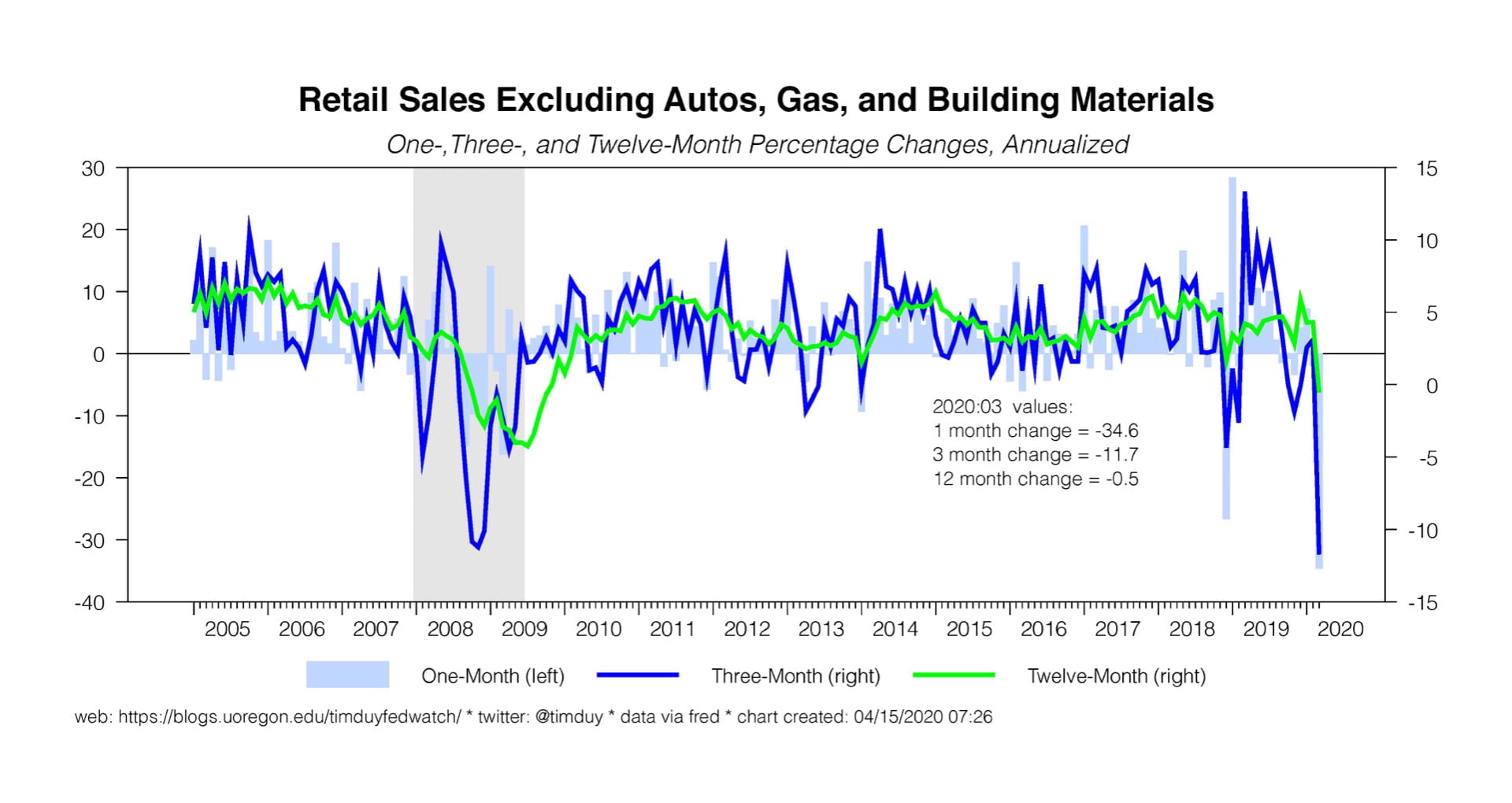
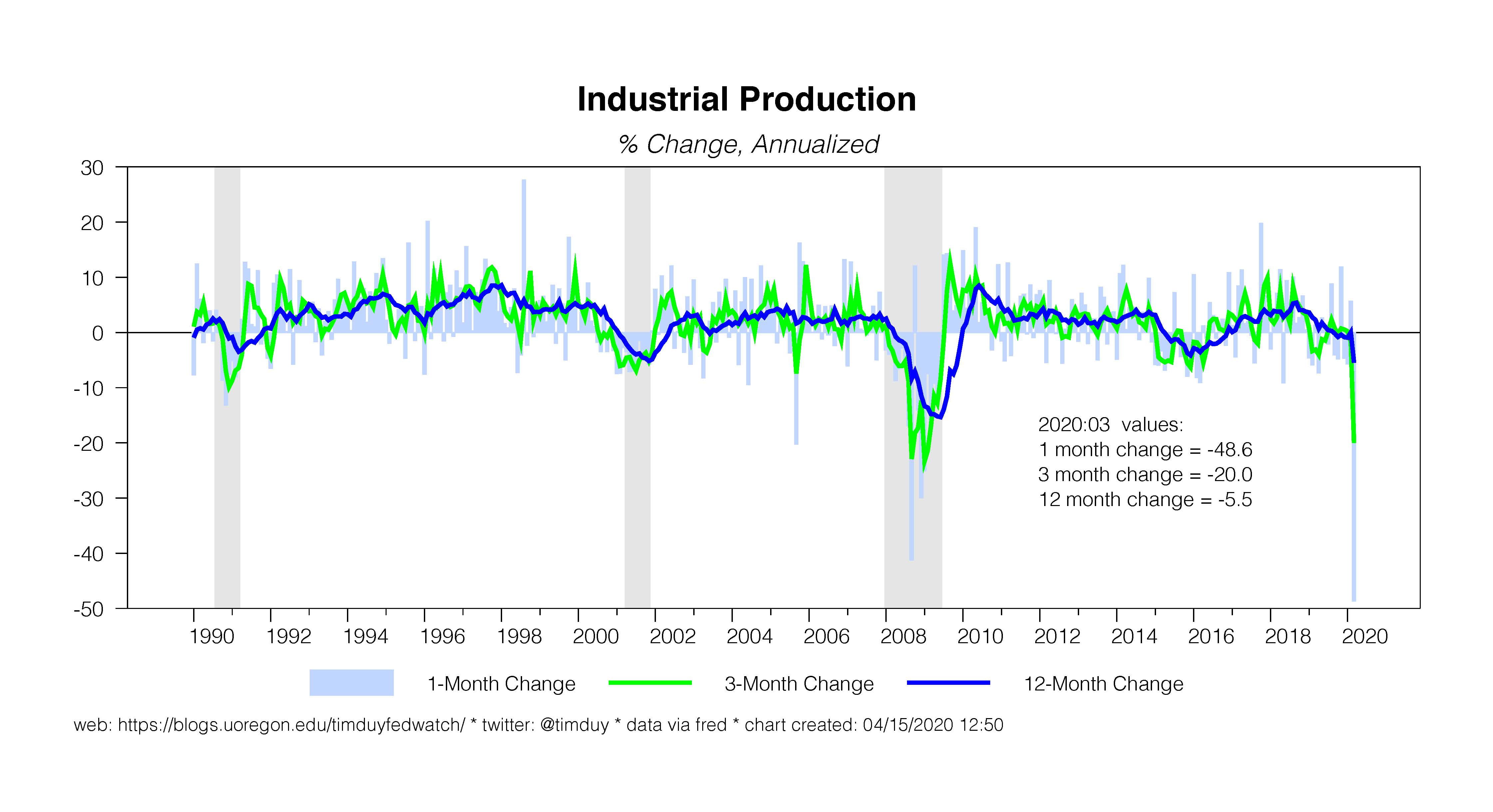
If you stop the economy, some activity is going to drop to zero, which will yield some pretty substantial monthly declines. And that means you are going to get some pretty crazy annualized changes. Like this for retail sales:
And this for industrial production:
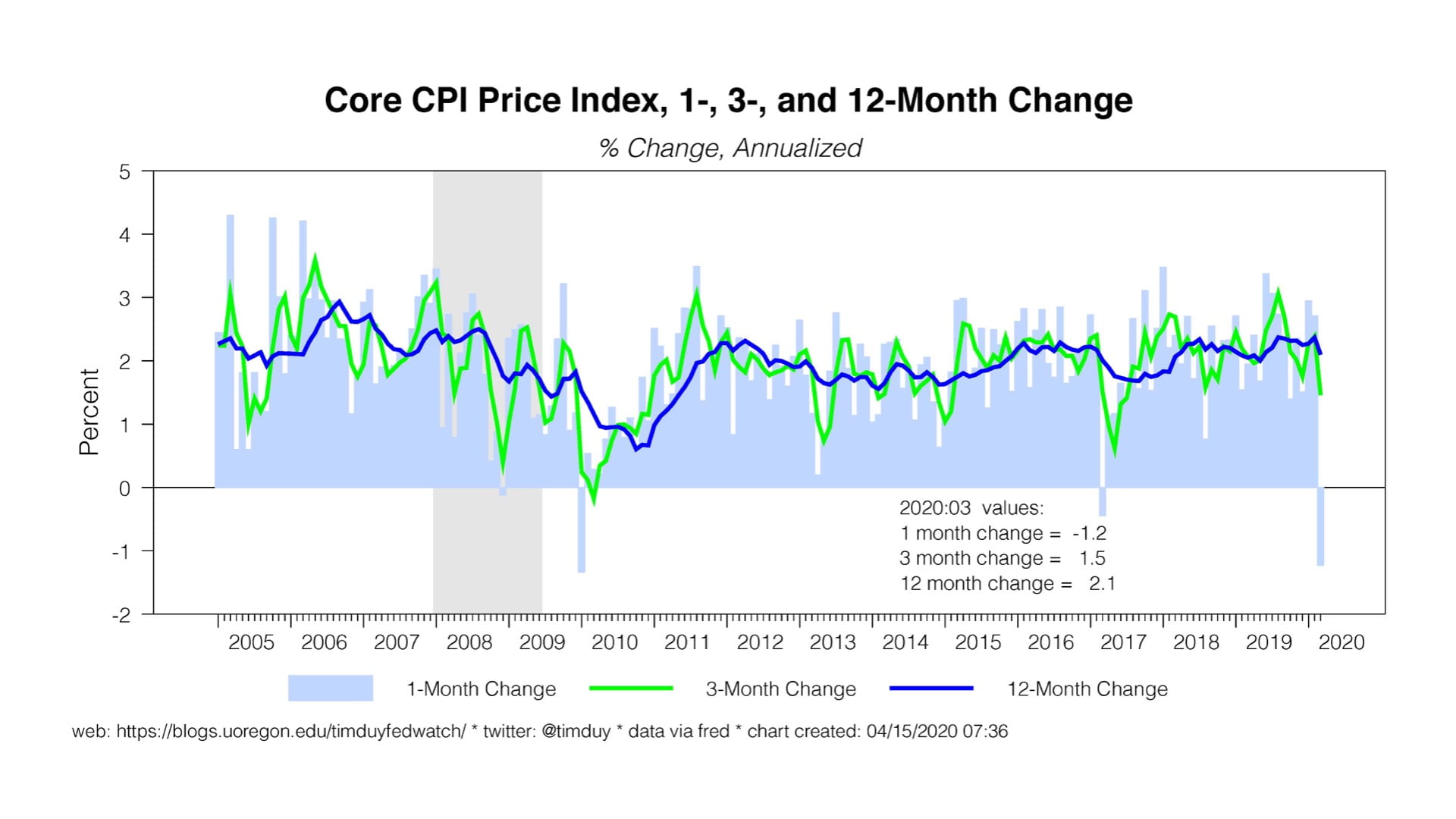
See also the Beige Book for some distressing anecdotal discussions of the economy. Also, as should have been expected, this wasn’t a classic supply shock that produced a jump of inflation. Instead, the demand side weakness dominated and dragged inflation down:
Of course, we really shouldn’t have expected anything else. Once we made the decision to shut down large parts of the economy, the data and anecdotes are going to follow in a fairly predictable way. In fact, a failure of the data to collapse would indicate that the shutdown was not successful. The collapse in data is almost not a bug, but instead it’s a feature of the broader policy.
Yes, even if expected, it is still a bitter pill to swallow.Making it more bitter is that the policy response is looking shaky. Certainly, some of the shakiness of the policy response is more about the execution rather than the intention. The objective was correct; attempt to keep as many people as possible attached to their employers and provide a generous safety net to those who lost their paycheck. Getting the money out the door, however, has proved a bit more complicated.
The enhanced unemployment benefits scheme looked good on paper but fell victim to woefully unprepared state governments. Partly the lack of preparedness is understandable. Even well-prepared states might fall short of the mark if they built systems for the “worst case” scenario of the Great Recession. But the technological limitations speaks to a broad-based failure to modernize the programs. I suggest that states adopt a “presumption of benefits” standard and push out the money while the paperwork is still in the pipeline.
The Payroll Protection Program (or PPP, an acronym I hate because I can’t read it without thinking “purchasing power parity”) also found itself under the constraints of an underpowered system that has delayed the release of money. Moreover, the money has now all been spoken for and Congress needs to boost the size of the program.
That said, the money is beginning to flow and will flow harder in the coming weeks. That’s good; it will help keep a floor under the economy. More though will still need to happen to support the economy through the shutdown. Congress will advance another support bill to extend the PPP. Congress should also deliver more aid to state and local governments. And there is still that thorny problem of completing the chain between renters and investors in the commercial real estate space.
If Congress wants to keep the economy afloat, it needs to keep shoveling the money. The Fed has implicitly given the green light to spend away, and Congress should take it up on that offer.
I think the short story is that, from a macro policy perspective, we are moving in the right direction but more needs to be done to hold the economy together. Still, the ultimate constraint on the economy is that it can’t begin recovery until we can start to loosen the extreme social distancing and stay-at-home orders that are dragging dragging down activity.
Eventually that time will come (but don’t rush it or all the work we just did will be in vain; I am hoping by the end of June if not the beginning), and we should anticipate the economic numbers to pop on the upside. Think of the same story in reverse. Even assuming that reopening the economy is like turning up a dimmer switch, there will still be pent up demand activated and some activity will be starting from a base of almost zero. There is little place to go but up.
Keep a pragmatic outlook. Don’t confuse that pop for a V-shaped recovery. It isn’t. There will be some lasting damage to the economy. Arguably, PPP should have come first and more forcefully and then perhaps fewer layoffs and furloughs would be working through the system. Moreover, more now PPP might be cold comfort to firms that have already folded. I think it is hard to fix that damage, which will in turn slow the eventual recovery.
Moreover, we will open the economy gradually. Social distancing restraints will ease but not disappear. No large gatherings, fewer seatings at restaurants, etc. And I anticipate people will approach many activities only cautiously. Ultimately, we the public will decide when the economy reopens, not the government. Travel, leisure, hospitality will face a tough road in the year (or longer) ahead.
Still, on the theme of pragmatism, don’t dismiss the importance of that first pop of activity. It marks a turning point, a place to begin rebuilding the economy. The level won’t be where we want it to be and we will need to maintain pressure for ongoing policy support to foster the economy, but the economy will be moving in the right direction. Don’t become too enamored with either the pessimists or the optimists; the reality will fall somewhere in-between.
Bottom Line: Controlling Covid-19 requires drastically constricting economic activity; the proof that the plan is working is that the data collapses and we bend the infection curve. The former has definitely happened and it looks like the latter will as well – social distancing works. We still have a long way to go until we return to some semblance of normality, but expect people to begin working in that direction when the restrictions on activity ease. Most important now is to keep the pressure up on Congress to provide sustained support for the economy; that support should be open-ended, based on economic conditions not time or dollars.
Most Asian stocks declined along with U.S. equity futures as a slew of weak economic data from the world’s largest economy offered a fresh reminder about the impact of the coronavirus. The dollar extended gains.
Shares fell in Australia, Japan and Hong Kong, and swung in China. European stock futures fluctuated and contracts on the S&P 500 slipped 1% at one point in Asia trading, after the benchmark sank about 2% on Wednesday. Earnings reports showed the virus is taking its toll -- Goldman Sachs Group Inc.’s investment portfolio took a hit, while Bank of America Corp. and Citigroup Inc. followed rivals in setting aside billions for loan losses. Treasuries held their gains and oil steadied near its lowest in two decades.
US After Hours BBBY +12.2% up nicely on earnings beat; RCUS +47.6% jumps on M&A chatter
Nikkei -1.26% Hang Seng -0.73% CSI -0.01% Shanghai +0.16% Shenzen +0.31%
Eur$ 1.0885 CNH 7.0850 CNY 7.0812 JPY 107.87 GBP 1.2470 RUB 74.94 CHF 0.9668 TRY 6.9059 ZTI$ 19.91 +0.20%
S&P +0.08% EuroStoxx +0.54% FTSE +0.51% Dax +0.48% SMI +0.56%
Macro :
- Spanish Regulator Extends Ban on Short Positions for a Month
- GERMANY TO FORBID LARGE PUBLIC EVENTS UNTIL AT LEAST AUGUST 31
- U.S. Investor Bull-Bear Spread -7.89: AAII
Keep an eye on :
- ATRLJB SS : Atrium Ljungberg Withdraws FY Forecast Due to Virus, Acquisition
- BARN SW : Barry Callebaut First Half Ebit CHF303.5 Mln, +0.7% Y/y
- BIM FP : BioMerieux Withdraws 2020 Objectives, Delays Div. Decision
- COFB BB : Cofinimmo Expands CP Program to EU950m for Long-Term Maturities
- DRW3 GY : Draegerwerk Prelim 1Q Ebit Loss About EU0.6 Mln
- ELE SM : Spain’s Endesa Close to Signing EU550M Loan: Expansion
- EDP PL : EDP Renovaveis 1Q Electricity Generation Falls 8%
- ELIOR FP : Elior Proposes to Not Pay Out Div for 2019-2020 Finl Year
- EQT SS : Flying Tiger Gets DKK150 Million Liquidity Injection, JP Says
- GAM SW : *BANTLEON VOTING RIGHTS IN GAM RISE TO 5.23% FROM 3.17%: SIX
- GSF NO : Grieg Seafood Offering Prices 1.79m Shares at NOK140.05/Share
- JMT PL : J. Martins Still Discussing Whether to Pay Dividends, CEO Says
- KESKOB FH : Kesko Oyj March Comparable Sales +2.2%
- LOOMB SS ; Loomis Signs SEK1.2b Two-Year Loan
- MS IM : German Cartel Office Approved Mediaset Prosieben Deal on Apr. 14
- NEXI IM : Nexi Sees 1Q Revenue Over EU220m, Suspends Guidance
- UG FP : Peugeot Maker PSA Tests Pandemic Measures at Factory Near Paris
- PRY IM : Prysmian Says Brazil Antitrust Court Ruled Against Company
- REP SM : Iberdrola, Repsol, Naturgy Seek Loans, Credit Lines: Expansion
- SPM IM : Saipem Withdraws 2020 Guidance, Says Balance Sheet Solid
- SHOT SS : Scandic Demand Seen Starting to Recover Soon, Handelsbanken Says
- STM FP : Apple Chipmaker TSMC’s Profit Soars on Internet, IPhone Demand
- UBI IM : ISS, Glass Lewis Invite Intesa Holders to Back Cap. Hike for UBI
- VACN SW : VAT First Quarter Net Sales CHF145.5 Mln, +14% Y/y
- DG FP : Vinci Airports 1Q Passenger Traffic Falls 21% on Virus Impact
- ZAL GY : Zalando Reports Prelim Adj Ebit Loss
- ROSE SW : Zur Rose First Quarter Sales CHF426.6 Mln
>>> Up
* ASML Raised to Buy at BofA; PT 325 euros
* Boozt Raised to Buy at Carnegie; PT 55 kronor
* C&C Raised to Hold at Berenberg; PT 182 pence
* Compass Raised to Outperform at Bernstein; PT 1,500 pence
* Dometic Raised to Hold at ABG; PT 55 kronor
* Enel Raised to Add at AlphaValue
* EUROB GA Raised to Overweight at JPMorgan; PT 70 euro cents
* Forterra Raised to Buy at Peel Hunt; PT 320 pence
* Getlink SE Raised to Buy at HSBC; PT 14.30 euros
* Ibstock Raised to Buy at Peel Hunt; PT 255 pence
* John Mattson Fastighetsforetagen Raised to Hold at Carnegie
* K2a Knaust & Andersson Fastigheter Raised to Hold at Carnegie
* Kungsleden Raised to Buy at Carnegie; PT 85 kronor
* Matas Raised to Buy at Carnegie; PT 55 kroner
* RBS Raised to Equal-Weight at Barclays; PT 130 pence
* Sandvik Raised to Buy at Pareto Securities; PT 175 kronor
* Simcorp Raised to Buy at Carnegie; PT 660 kroner
* SKF Raised to Buy at Pareto Securities; PT 175 kronor
* Sydbank Raised to Buy at SEB Equities; PT 107 kroner
* Swisscom Raised to Neutral at JPMorgan; PT 521 Swiss francs
* Uponor Oyj Raised to Hold at Handelsbanken; PT 9.60 euros
* Washtec Raised to Buy at HSBC; PT 45 euros
>>> Down
* ABB Cut to Hold at HSBC; PT 18 Swiss francs
* Air France-KLM Cut to Sell at Deutsche Bank; PT 3.50 euros
* Bouygues Cut to Neutral at Goldman; PT 34 euros
* Bpost Cut to Sell at SocGen
* Carlsberg Cut to Hold at Handelsbanken; PT 850 kroner
* Hikma Cut to Hold at Jefferies; PT 2,325 pence
* Intesa Sanpaolo Cut to Reduce at Oddo BHF; PT 1.80 euros
* Italgas Cut to Sell at Citi
* JD Sports Cut to Sector Perform at RBC; PT 570 pence
* J. Martins Cut to Neutral at CaixaBank BPI; PT 16.95 euros
* Klovern Cut to Hold at Carnegie; PT 16 kronor
* Kojamo Cut to Hold at Carnegie; PT 17 euros
* Lufthansa Cut to Sell at Deutsche Bank; PT 5.70 euros
* Petra Diamonds Cut to Equal-Weight at Barclays; PT 3 pence
* Piraeus Bank Cut to Neutral at JPMorgan; PT 1.80 euros
* Sartorius Cut to Hold at LBBW; PT 245 euros
* Scandic Raised to Buy at Handelsbanken; PT 60 kronor
* SMCP Cut to Neutral at Goldman; PT 4.60 euros
* Snam Cut to Sell at Citi
* Stora Enso Oyj Cut to Hold at SEB Equities; PT 10 euros
* Terna Cut to Neutral at Citi
* Wallenstam Cut to Sell at Carnegie; PT 90 kronor
>>> Initiation
* Codemasters Rated New Buy at Panmure Gordon; PT 350 pence
* HelloFresh Rated New Hold at MainFirst; PT 29 euros
* Idorsia Rated New Buy at Citi; PT 33 Swiss francs
* Nacon Rated New Buy at Berenberg; PT 6.85 euros
>>> Call
* Citi Cuts Three Italian Utilities on Lower Inflation Scenario
* Heineken Is Most Exposed to Extended Alcohol Restrictions: Citi
* Hiscox Virus Losses Manageable, Brand Could Suffer: MS
* JD Sports Now Less Compelling, RBC Downgrades to Sector Perform
* Temp Staffing Firms Should Recover Quicker Than Permanent: RBC
After Hours Summary: BBBY +12.2% up nicely on earnings beat; RCUS +47.6% jumps on M&A chatter
After Hours Gainers:
Companies trading higher in after hours in reaction to earnings/guidance: BBBY +12.2% (reports Q4 upside), NDLS +1.8% (reports Q1 system-wide comps declined 7.2%)
Companies trading higher in after hours in reaction to news: RCUS +47.6% (news reports that GILD is allegedly in discussions to purchase a stake in RCUS), CGEN +11.8% (getting picked up as RCUS sympathy play as it also has an early-stage Tigit inhibitor), AXDX +10.8% (announces collaboration agreement to distribute the BioCheck MS-FAST and SARS-CoV-2 tests), VNDA +7% (enrolls first patient in ODYSSEY trial for severe COVID-19 pneumonia; also initiates study of role of genetic variation in COVID-19 infections), XP +7% (reports Q1 key retail performance indicators), WKHS +4.9% (expands HorseFly last mile delivery patent portfolio; comments on COVID-19 conditions), KBR +2.5% (wins US Air Force contract), RAD +1.9% (not seeing news, still looking for catalyst), QGEN +1.4% (announces launch of therascreen BRAF test), COST +0.9% (increases dividend)
After Hours Losers:
Companies trading lower in after hours in reaction to earnings/guidance: LAKE -8.2% (reports Q4 results - notes "significant" interest globally in its products in the wake of the coronavirus outbreak), AFG -4.5% (sees Q1 core earnings below consensus; lowers 2020 expectations), HEI -0.2% (withdraws 2020 guidance, provides update on outlook), GLOB -0.1% (reaffirms EPS outlook for Q1, raises Q1 revenue outlook)
Companies trading lower in after hours in reaction to news: ATHX -15.2% (stock offering), CALA -10.8% (stock offering), ARCT -2.9% (stock offering), PFGC -2.8% (stock offering), RDFN -1.2% (reports home-buying demand was down 25% yr/yr for the week ending April 13), UAL -1.1% (confirms will get $5 from US Treasury), ACGL -0.9% (provides COVID-19 update; announces loss estimates), CLDR -0.5% (Carl Icahn affirms lowered active stake of ~17.7%), VIR -0.1% (reports VIR-2218 update)
Closing Stock Market SummaryThe S&P 500 declined 2.2% on Wednesday, as the release of historically weak economic data undercut risk sentiment. The Dow Jones Industrial Average lost 1.9%, the Nasdaq Composite lost 1.4% to snap a four-session winning streak, and the Russell 2000 underperformed with a 4.3% decline.
Highlighting the data: retail sales declined 8.7% m/m in March (Briefing.com consensus -10.0%), industrial production declined 5.4% m/m in March (Briefing.com consensus -3.3%), the Empire State Manufacturing Survey for April plunged 57 points to -78.2 (Briefing.com consensus -32.0), and the NAHB Housing Market Index for April plunged 42 points to 30 (Briefing.com consensus 57).
In addition, more banks bolstered their loan-loss reserves to prepare for tougher times ahead, the Fed's Beige Book for April noted a sharp contraction in economic activity with business contacts expecting conditions to worsen, and The Wall Street Journal reported that the Paycheck Protection Program for small businesses was on pace to run out of money today.
The plethora of reminders that economic conditions are woeful contributed to losses in all 11 S&P 500 sectors, but the S&P 500 remarkably still finished above Monday's closing level. The financials sector (-4.3%) was an influential laggard following earnings reports from Bank of America (BAC 22.19, -1.54, -6.5%), Citigroup (C 42.86, -2.56, -5.6%), and Goldman Sachs (GS 178.52, +0.29, +0.2%).
The energy sector (-4.7%) declined the most, though, as the group remained pressured by lower oil prices after the EIA projected a 9.2 mb/d decline in oil demand in 2020. WTI crude futures settled just below $20.00/bbl, losing 1.3%, or $0.27, to $19.95/bbl.
UnitedHealth (UNH 281.68, +11.18, +4.1%) was a notable standout after the Dow component reported better-than-expected earnings results. Its outperformance limited the decline in the health care sector (-0.5%).
Separately, airline stocks finished mixed after the companies reached individual agreements with the government for payroll relief. Shares of American Airlines (AAL 12.29, +0.35, +2.9%) closed higher, while Delta Air Lines (DAL 24.35, -0.19, -0.8%) closed lower.
Longer-dated U.S. Treasuries exhibited strength in a textbook trade given the negative economic data and decline in stocks. The 2-yr yield declined two basis points to 0.20%, and the 10-yr yield declined 11 basis points to 0.64%. The U.S. Dollar Index increased 0.7% to 99.57.
Reviewing Wednesday's big batch of data:
- Retail sales declined 8.7% m/m in March (consensus -10.0%) following an upwardly revised 0.4% decline (from -0.5%) in February. Excluding autos, sales declined 4.5% (Briefing.com consensus -7.6%) following an unrevised 0.4% decline in February.
- The key takeaway from the report is that it captured the impact of the COVID-19 shutdown situation, as spending in discretionary categories cratered while spending for essential items accelerated in a big way.
- Industrial production declined 5.4% m/m in March (consensus -3.3%) following a downwardly revised 0.5% increase (from 0.6%) in February. Total capacity utilization was 72.7% (consensus 74.1%) following an unrevised 77.0% in February.
- The key takeaway from the report is that it captures the severity of the shutdown situation, best reflected in the pronouncement that the downturn in industrial production was the worst since 1946.
- The New York Fed's Empire State Manufacturing Survey plummeted 57 points to -78.2 (consensus -32.0).
- The NAHB Housing Market Index for April plunged to 30 (consensus 57) from 72 in March.
- Business inventories decreased 0.4% in February, as expected, while the January reading was revised down to -0.3% from -0.1%.
- The Mortgage Bankers Applications Index increased 7.3% week-over-week.
Looking ahead, investors will receive the weekly Initial and Continuing Claims, Housing Starts and Building Permits for March, and the Philadelphia Fed Index for April on Thursday.
- Nasdaq Composite -6.5% YTD
- S&P 500 -13..9% YTD
- Dow Jones Industrial Average -17.6% YTD
- Russell 2000 -29.1% YTD
Cash demand surges in Europe despite coronavirus lockdown
Eurozone citizens responded to pandemic by hoarding banknotes, data suggest
The value of euro banknotes in circulation has increased by the largest amount since the 2008 financial crisis, according to new data which indicates many people in Europe have responded to the coronavirus pandemic by hoarding cash.
In the four weeks to April 10 the value of euro banknotes distributed to individuals and businesses rose by €41.2bn to €1.33tn, the weekly financial statement published by the European Central Bank on Wednesday showed.
That is the biggest jump in the amount of cash in circulation in the eurozone since it rose by €41.4bn in the four weeks to October 24 2008 — shortly after Lehman Brothers went bankrupt, causing the global financial system to freeze.
In some European countries, where cash is still the only way to pay in many shops and cafés, consumers responded to concern about the spread of coronavirus by withdrawing extra cash from ATMs at the start of the pandemic.
A sharp increase in cash withdrawals was reported by both the German and Austrian central banks last month, as the virus spread rapidly across Europe and governments responded by imposing increasingly strict lockdowns on activity.
Demand for cash continued to rise last week despite much of the eurozone being subject to strict social distancing rules and many people being told to stay at home except for essential travel, while shops and restaurants had closed their doors. The value of euros in circulation rose €7.7bn in the week to April 10 from the previous week.
About a third of all cash in circulation is kept by households as a safe asset for “rainy day” purposes, according to a previous ECB study.
The increase in demand for banknotes was comparable to the uptick usually seen in the weeks before Christmas, suggesting it was linked to the recent increase in spending on household items, such as toilet paper, pasta and soap, as many consumers stocked up.
In Germany, the use of contactless payments has jumped after supermarkets and chemists started asking people to pay by card if possible to avoid the risk of the virus being transmitted via handling of cash — a major shift in a country where three-quarters of transactions in shops are usually carried out using cash.
However, in other countries cash demand has reduced recently. In research published on Wednesday, Ireland’s central bank reported a sharp fall in ATM withdrawals and bank card transactions after the government directed people to stay indoors last month.
ATM withdrawals in Ireland were down 57 per cent month-on-month in the first week of April, after the first coronavirus restrictions were introduced. Card spending was down one-third in the same period.
Average ATM withdrawal amounts “increased markedly” since the government announced it was closing schools on March 12, the central bank said.
“This was combined with a lower number of transactions at ATMs, suggesting that people were concentrating their cash withdrawals into a small number of ATM visits,” it said.
“If the current level of spending and ATM withdrawals were to continue for the remainder of April 2020, it is estimated that overall card spending and cash withdrawals would be €2.6bn — or 40 per cent — lower than in comparison with April 2019,” the bank said