Barron’s Weekend Summary: Telemedicine is getting a big boost from the coronavirus pandemic, which could be the catalyst that pushes it to the mainstream; Tech Trader looks at seven stocks to play the work-at-home trend.
* Cover story: Positive on TDOC, LCGO, MASI, IRTC, American Well: The coronavirus epidemic is catapulting telemedicine from the outskirts of healthcare to its core, with the crisis giving millions of Americans their first taste of virtual medicine, which may be the catalyst that pushes online care into the mainstream; For that to happen, emergency measures that have relaxed federal regulations allowing more virtual visits would need to be made permanent, but the biggest hurdle is financial incentives that favor healthcare providers seeing patients in person.
* Tech Trader: Positive on AKAM, NET, RNG, EGHT, BOX, DBX, NFLX: ZM has become “an absurdly expensive stock” and “makes sense only for the most speculative portfolios,” but there are other ways to play the new stay-at-home recovery at a far lower multiple of sales, including content delivery networks, document storage companies, other internet-based communication platforms—and Netflix, which should continue to see high subscriber growth.
* Trader: “You don’t have to dig into index performance to see that the big and the strong are just getting bigger and stronger as the small and weak get crushed”—giants such as AMZN and NFLX, benefiting from the coronavirus crisis in different ways, are hitting all-time highs; Positive on CODI: The small-cap company—which essentially operates like a middle-market private equity firm, acquiring, operating, and divesting businesses in several niche consumer and industrial end markets—is poised to emerge from the coronavirus recession stronger than when it entered it.
* Profile: Claire Hart, manager of the $28B JPMorgan Equity Income fund, faces a major challenge because of the coronavirus pandemic, but she has used market volatility to stick with bets she believes in and to abandon less certain ones, and says she doesn’t expect a quick return to normalcy (top 10 holdings: BAC, CVX, CME, BMY, JNJ, BLK, MSFT, PNC, CMCSA, MCD).
* Interview: Tiffany Hsiao, who runs the Matthews China Small Companies fund, talks about how Chinese consumers and businesses are recovering after the country eased restrictions, the risk of a second wave of outbreaks, and why the portfolio has been so resistant to a black swan development that has rattled markets.
* Features: 1) Cautious on Compass: Despite a $370M investment from SoftBank’s Vision Fund and other venture capital investors, the company has failed to live up to its promise that its technology would make its agents more productive and profitable than traditional brokers, and it continues to play catch-up with leaders such as RLGY and RMAX; 2) A rush to get back life back to normal raises the risks of a coronavirus relapse and setting the recovery back even further, and if confidence isn’t restored, consumers may refrain from spending even after the all-clear is finally given; 3) Many investors expect a Covid-19 vaccine within 18 months, but that timeline may be wildly optimistic, according to SVB Leerink analyst Dr. Geoffrey Porges, who says there is little chance of a vaccine for widespread administration in 2021, and that a vaccine for the majority of the population, necessary to end social distancing, won’t come until 2022 or 2023; 4) “The pharmaceutical industry may be one of the best places to take shelter as Covid-19 ravages the economy, given its focus on new products, a promising sales outlook, and low price/earnings ratios”—cancer treatments remain as crucial as ever, as does development of a coronavirus vaccine; 5) Positive: RTX, OTIS, CARR: The three companies, launched after the merger between Raytheon and United Technologies, hit the market at possibly the worst time for any business, but they nonetheless look appealing, despite the fact this year’s downturn will ding their results; 6) Active ETFs have existed on the fringes for years, mostly in fixed income and quantitative strategies, but new regulatory changes and ETF structures have led to a wave of “nontransparent” or “semitransparent” active ETFs with stock pickers at the helm, who hope the trend further proves their viability; 7) In an interview, F chief Jim Hackett talks about the company’s ability to weather the pandemic and the future of pickup trucks, ride-sharing services, electric vehicles, and more.
* Financial Planning: 1) Barron’s annual list of the Top 100 Financial Advisors in the US features some of the largest practices at the big brokerage firms, as well as some of the best independent advisory teams; The top five are Lyon Polk, Gregory Vaughan, and Andy Chase of Morgan Stanley PWM, Mark Curtis of Morgan Stanley Graystone, and Brian Pfeifler of Morgan Stanley PWM; 2) A list of the Top 50 private wealth management teams is topped by the Jones Zafari Group, the Erdmann Group, and the Westmoreland Group at Merrill Private Wealth Management.
* European Trader: Because the coronavirus pandemic has radically changed perceptions and rules, “companies paying dividends are being frowned upon in Europe after years of being celebrated as the avant-garde of the long, post-financial-crisis recovery,” leaving investors to determine how long dividends will be gone, and what they should do about it.
* Commodities: “Milk prices this year have more than erased the gains they scored for all of 2019, as the closure of restaurants and schools to prevent the spread of Covid-19 forced changes in the dairy market and in consumer buying behavior.”
* Streetwise: Morgan Stanley’s Adam Jonas envisions a long list of changes that will affect automobile industry after the pandemic: less commuting, less car renting, younger cars, fewer dealers, more digital, and touchless dealer services—as well as greater transparency on prices.
Flagship Renaissance fund dabbles with bitcoin
Medallion has entered the world of cryptocurrency trading
Renaissance Technologies’ flagship hedge fund Medallion has dipped its toes into the wild world of cryptocurrency trading, in a sign that the computer-driven investment group is willing to play in more esoteric markets to generate its industry-leading returns.
The $75bn hedge fund group disclosed in a regulatory filing that Medallion — a highly successful fund only open to Renaissance’s own employees — was dabbling in bitcoin, the original cryptocurrency.
While Renaissance said that it would limit its trading activities to cash-settled bitcoin futures traded on the CME, the Long Island-based investment group founded by former Cold War codebreaker Jim Simons stressed the risks of the nascent asset class.
“The underlying commodity for these futures transactions, bitcoin, is a relatively new and highly speculative asset,” Renaissance said in the filing. “Bitcoin and futures based on bitcoin are extremely volatile, and investment results may vary substantially over time.”
From the filing it is not clear how active Renaissance is in bitcoin, or whether it has bought any of the cryptocurrency futures, only that it is now “permitted to enter into bitcoin futures transactions”, according to a separate section on the risks and trading styles of its various funds. Its other funds, which manage money for external investors, make no mention of bitcoin. A spokesman for the hedge fund declined to comment.
Cryptocurrencies like bitcoin remain at the fringes of the mainstream finance industry, but hungry for new potentially profitable assets to trade, Wall Street has been gradually bringing them into the fold.
Big trading firms like DRW are now making markets in cryptocurrencies, and even traditional investment groups like Fidelity have launched “digital asset” businesses. The CME’s bitcoin futures contract launch in 2017 was a major moment, by allowing more mainstream investors — such as Renaissance — to bet on or against bitcoin for the first time.
But it is a controversial development. The Securities and Exchange Commission has refused to approve exchange traded funds for the cryptocurrency, and many in the finance industry consider it a scam and prone to manipulation.
Chicago-based Cboe Global Markets, CME’s crosstown rival and the first US derivative exchange to offer bitcoin futures, unexpectedly pulled the plug on the fledgling market last year as demand for the product wavered.
It is also phenomenally volatile. The price of bitcoin soared from under $1,000 at the start of 2017 to a peak of nearly $20,000 in December that year, before suddenly collapsing. Since 2018 it has seesawed between $3,000 and $12,000.
Renaissance listed a range of risks involved in trading the cryptocurrency, such as its limited history, volatility, the lack of any official recognition as a currency, limited regulation, the possibility of increased government scrutiny and its “susceptibility to manipulation by malicious actors”.
“Any of these factors could materially and adversely affect the value of the fund’s investments,” the filing stated.
The Medallion fund is on track for its best year, the Wall Street Journal reported on Friday, despite a volatile market that has affected Renaissance’s other funds, which have posted some of their worst quarters ever.
The Renaissance Institutional Equities Fund has managed to claw back some of its earlier losses, gaining 4.8 per cent in the first two weeks of April to reduce its loss this year to 10.3 per cent, while Renaissance Institutional Diversified Alpha is close to flat for the month and down 10.4 per cent for the year, according to people familiar with the matter. Renaissance Institutional Diversified Global Equities Fund was up 1 per cent in the first two weeks of April, paring its 2020 loss to 9 per cent.
Renaissance also revealed in the filing that it was last year fined €150,000 by the Spanish securities regulator for breaching a short-selling ban on Liberbank in 2017, a decision that the hedge fund group is now appealing in the Spanish high court.
“Although Renaissance had not engaged in a short sale, the (regulator) determined that Renaissance’s reduction of long positions violated the short sale ban because it resulted in an increase in the net short position in Liberbank held by the funds Renaissance manages,” the filing said.
However the investment group believes that the regulator and the Spanish Ministry of Economy and Enterprise have “improperly broadened the scope of the Spanish regulation beyond its intent and plain language”, given that Renaissance did not enter any short-selling transactions after the ban was put in place, the filing stated.
"The Fed Is All The Buyers Have": The Banks Agree Stocks Have Never Been More Expensive
Late last week, we showed a chart from Credit Suisse which we described simply as "insanity" because it demonstrated that as the US careened into a depression, with GDP crashing and the unemployment rate soaring, between the latest Fed-driven surge in stocks and the collapse in earnings estimates, the PE multiple on the broader market had eclipsed the previous record of 19.0x set during the market's February all time high, and had now hit a new all-time high of 19.4x. In other words, the market has never been more overvalued than it is right now.
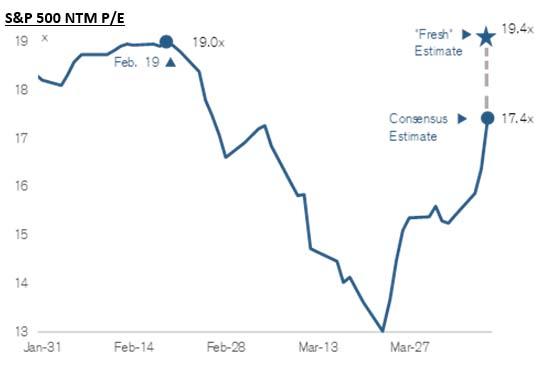
The chart eventually made its way to Jeff Gundlach who yesterday tweeted that "U.S. GDP looks to be down 15%ish, unannualized, from its peak. SPX is presently down a similar amount from its peak. Ergo (and I over simplify to make a valid point) stocks now are back to the Feb 19th highs from a valuation perspective. “In Fed We Trust” is all the buyers have."
U.S. GDP looks to be down 15%ish, unannualized, from its peak. SPX is presently down a similar amount from its peak. Ergo (and I over simplify to make a valid point) stocks now are back to the Feb 19th highs from a valuation perspective. “In Fed We Trust” is all the buyers have.

570 people are talking about this
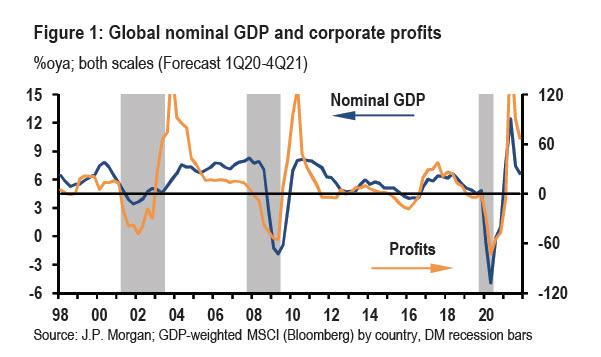
Gundlach's math is not quite correct because as JPMorgan showed last week, the beta of corporate profits to moves in GDP is about 7x during financial crises. As a result, according to the bank's chief economist Joseph Lipton, in the current recession in which JPM expects global GDP growth to collapse by the same 9.8%-points in Q2, the bank is applying the same profit drop beta of seven—on par with the global financial crisis-- which implies a plunge in corporate profits of roughly 70% in the year through 2Q20.
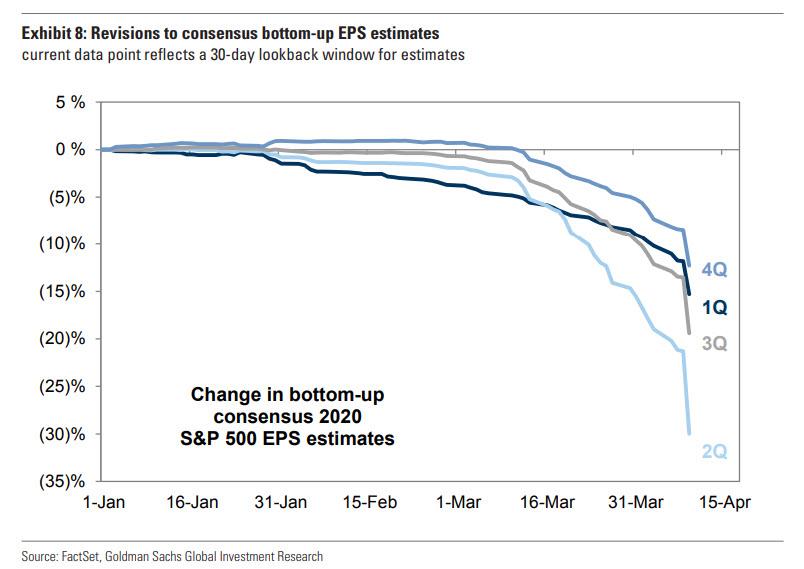
Meanwhile, with every passing day the fundamental disconnect is getting worse, because as stock prices soar (mostly due to momentum-chasing machine buying while humans sell) earnings estimates are cashing...
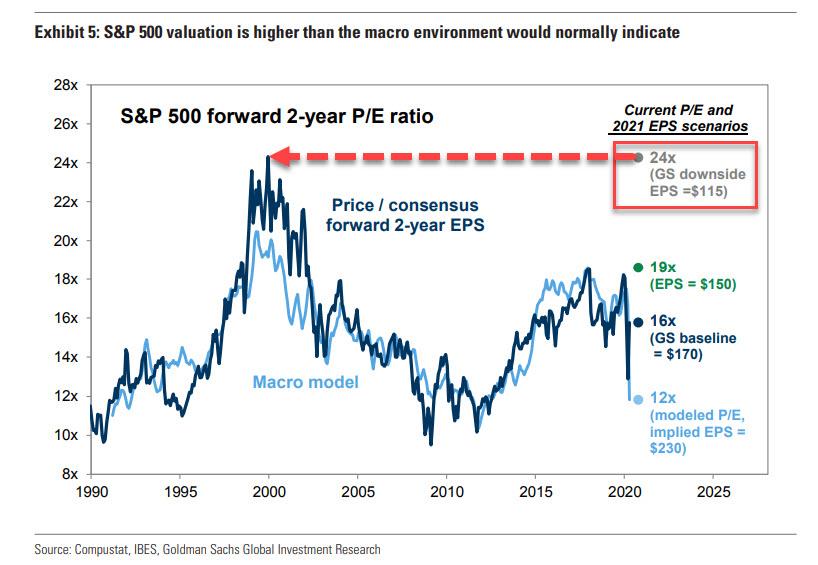
... with Goldman calculating that its latest bear case PE multiple (on 2021 earnings no less as nobody is looking at 2020 anymore) is now a dot com bubble-eseque 24x.
Meanwhile, crashing the bulls' party, or rather their expectations for a V-shaped recovery, JPMorgan also cautioned that corporate profits won't recover their pre-pandemic baseline until some time in 2022 if not 2023, which is terrible news for Wall Street strategists as it means they will now have to apply even more ridiculous forward multiples from 2023 for their optimistic recos to make any sense.
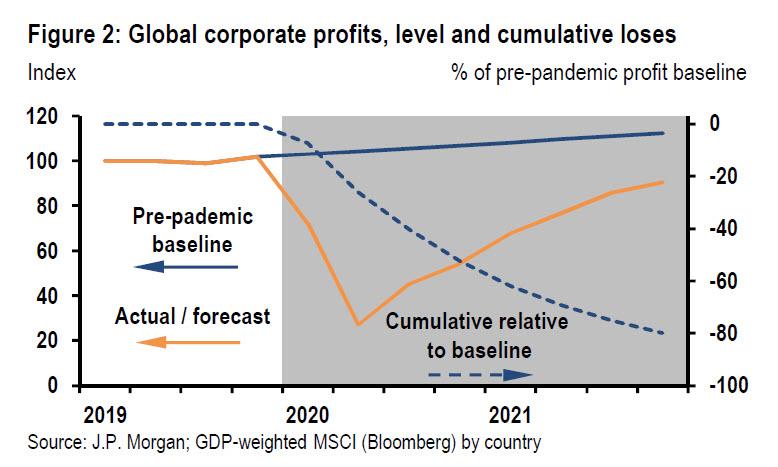
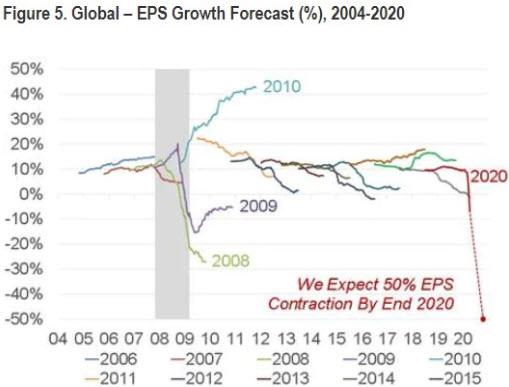
And so as Credit Suisse, JPMorgan and Goldman all point out the schizophrenia in being bullish in a time when corporate profits are set for the biggest - and longest - drop since the Great Depression, late last week two more banks joined the bandwagon with Citi warning that "equities fall the same as EPS in a recession... and reflect that equity markets are currently not reflecting the expected decline of 50% in global EPS in 2020." Make that 70% according to JPMorgan.
Finally, exactly two weeks after our post on the "shocking" topic of how expensive the market is right now, Bank of America's Savita Subramanian has also done the math and concludes that as "stocks have rallied, bottom-up consensus estimates for 2020 have fallen", which in turn has pushed the S&P 500's forward P/E ratio from March's low of 13.0x to 19.5x, higher than mid-Feb's peak P/E of 18.9x.
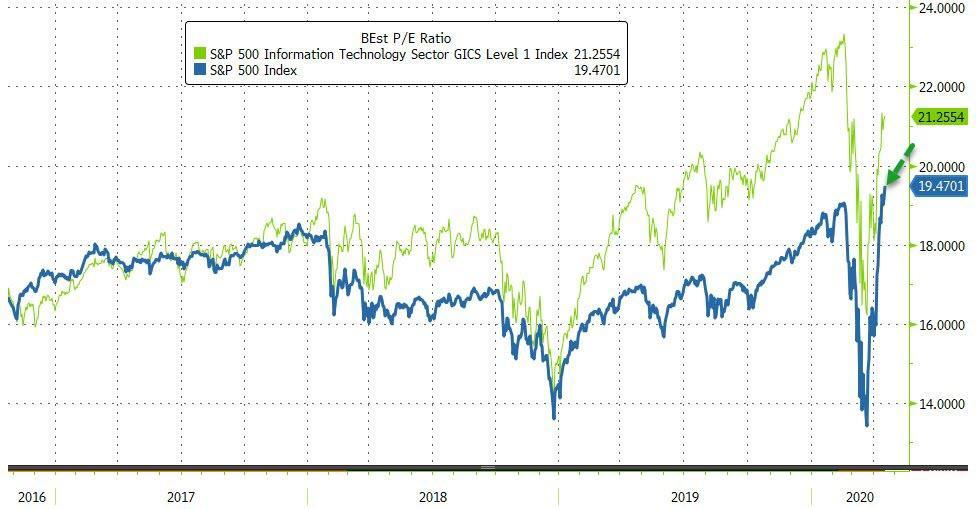
In other words, using the bank's reference table of 20 different valuation metrics, "we're back to elevated multiples on most of the 20 metrics we track" with just three exceptions: lower than average Price to Free Cash Flow, cheaper relative to bonds (equity risk premia frameworks) and - drumroll - relative to gold.

The last one is especially amusing because it means that slowly but surely investors are finally realizing that the biggest winner after the current reflationary surge will not be equities but what the WSJ once dubbed "a pet rock."
Of course, even in this unprecedented dislocation of a "market", equity investors still have hope, which is literally is all they have: or as Gundlach puts it, "In Fed We Trust” is all the buyers have" and Citi agrees: "Central bank intervention could cap the downside."
Better pray to those central banking gods, bulls.
Bidet Makers See Their Moment and Scramble to Make a Splash
A global toilet-paper shortage has broken American cultural taboos, but with sudden growth comes new hazards
Jason Ojalvo, CEO of direct-to-consumer bidet company Tushy, knew that America’s backsides couldn’t wait. Watching demand skyrocket on his online sales dashboard as America’s great toilet-paper crisis of 2020 left store shelves bare and shoppers panicking, he decided to take drastic measures to guarantee ongoing supply.
He would ship bidets directly from China by air.
It wasn’t exactly the Berlin airlift, but if Americans ever adopt bidets en masse, scholars may some day view it as a pivotal moment in the history of U.S. bathroom habits.
In the midst of a global pandemic, relatively inexpensive add-on bidets—widespread in many parts of the world but never popular in the U.S.—are experiencing a hyperaccelerated transition through the life cycle of a new direct-to-consumer fad. Suddenly these bidet companies are approaching their “Casper Moment,” when a fad becomes a new consumer-goods category, epitomized by a handful of companies. This draws the attention of competitors as well as consumers—and requires tough choices about how best to take advantage of demand that may prove fleeting.
“We’re having the cultural moment that we spent the past five years preparing for and we’re not going to blow it,” says Mr. Ojalvo, who previously spent nearly a decade at Amazon’s Audible unit.
Launched in relative obscurity, bidet specialists including Tushy and Omigo spent investor cash on customer acquisition through targeted advertising on Instagram, Facebook, Google and Amazon. It’s the classic direct-to-consumer playbook, popularized by Casper, Allbirds and Dollar Shave Club: simple product, sophisticated marketing.
Jason Ojalvo, CEO of direct-to-consumer bidet company Tushy, knew that America’s backsides couldn’t wait. Watching demand skyrocket on his online sales dashboard as America’s great toilet-paper crisis of 2020 left store shelves bare and shoppers panicking, he decided to take drastic measures to guarantee ongoing supply.
He would ship bidets directly from China by air.
It wasn’t exactly the Berlin airlift, but if Americans ever adopt bidets en masse, scholars may some day view it as a pivotal moment in the history of U.S. bathroom habits.
In the midst of a global pandemic, relatively inexpensive add-on bidets—widespread in many parts of the world but never popular in the U.S.—are experiencing a hyperaccelerated transition through the life cycle of a new direct-to-consumer fad. Suddenly these bidet companies are approaching their “Casper Moment,” when a fad becomes a new consumer-goods category, epitomized by a handful of companies. This draws the attention of competitors as well as consumers—and requires tough choices about how best to take advantage of demand that may prove fleeting.
“We’re having the cultural moment that we spent the past five years preparing for and we’re not going to blow it,” says Mr. Ojalvo, who previously spent nearly a decade at Amazon’s Audible unit.
Launched in relative obscurity, bidet specialists including Tushy and Omigo spent investor cash on customer acquisition through targeted advertising on Instagram, Facebook, Google and Amazon. It’s the classic direct-to-consumer playbook, popularized by Casper, Allbirds and Dollar Shave Club: simple product, sophisticated marketing.
Spikes in sales of bidets could have long-term implications for the entire toilet-paper industry, says Svetlana Uduslivaia, head of home and tech research at Euromonitor. Research suggests that households that adopt them reduce their toilet-paper consumption by up to 75%, she adds. In Japan, 80% of households with two or more people have bidets, but it took decades for the country to reach that level of adoption.
Market penetration of bidets in the U.S. is in the single digits. Historically, that may be because Americans associated them with bordellos, sexuality and other matters that seemed vaguely scandalous and French. But demand began spiking in early March. On March 8, Chicago-based BioBidet, which was incorporated in 2008, got an unprecedented 4,000 orders for its entry-level SlimEdge bidet attachment on Amazon alone. Almost immediately, BioBidet ordered more than 50,000 more bidets from its suppliers in East Asia, says senior marketing director James Amburgey.
In San Francisco, Brondell, founded in 2003, saw sales growth throughout March that put it a year ahead of where it had projected it would be before the crisis, says Steve Scheer, president of Brondell. The company’s online offerings are almost completely sold out.
Kohler, the Wisconsin-based plumbing, bathroom and kitchen giant, saw bidet orders increase eight times compared with a year ago in March, says a spokeswoman.
Two-year-old Omigo, newest of the online-only bidet startups, experienced a 12-fold increase in daily sales on March 12, says Tom Lotrecchiano, its co-founder. The company is now sold out entirely of its two models of bidet attachments and is quickly running through its stock of much pricier bidet toilet seats. Reorders are on the way, but “we’re scrambling,” says Mr. Lotrecchiano.
Tushy realized in the second week in March that if sales through Amazon and its own website maintained their pace, the company would be completely out of bidets by the weekend. By that Thursday, sales were 10 times normal. Mr. Ojalvo, along with company founder Miki Agrawal, formerly of reusable period underwear company Thinx, examined their supply chain to figure out how they could keep up with demand.
That was when they chose to start shipping their bidets on planes.
That meant shipping costs would be three times what they had been spending before. The Tushy team immediately put designers on the task of shrinking the packaging for their bidets to limit the damage. Airfreight is usually reserved for the smallest, highest-value items, like iPhones. But trans-Pacific passage in a shipping container can take 30 days, and Tushy couldn’t wait.
Companies like Brondell, BioBidet and Kohler, built in an age dominated by traditional retail, have simply run out online. But Omigo and Tushy, having always been direct-to-consumer, are able to manipulate their online advertising spend in order to address shortages.
For Omigo,that’s meant giving up on what could easily be three to four times the volume of orders the company is currently shipping, says Mr. Lotrecchiano. The company’s leaders decided to keep Omigo’s ad spend steady rather than increase it to capture surging interest because it would lead to too many disappointed customers as wait times stretch out, adds Mr. Lotrecchiano.
Tushy, by contrast, first zeroed out its online advertising budget for a few days, and then began bringing it up again slowly, deciding that the crisis has created so much interest that it no longer needs as many targeted ads on giant platforms like Amazon, Google and Facebook as before the crisis. Where before Tushy might spend a big chunk of the $79 price for its entry-level bidet on advertising—direct-to-consumer companies often spend a third of revenue on marketing—it has been able to redirect that money to its higher shipping costs, says Mr. Ojalvo.
Airfreight costs are still squeezing Tushy’s margins, but the company’s leaders have decided that, because people who buy their products tend to become bidet evangelists, every one they can get into customer’s hands now will lead to more sales in the future.
Booming demand for bidets hasn’t gone unnoticed by the direct-to-consumer sellers on Amazon’s marketplace. As of this writing, the add-on bidet Amazon has designated as “Best Seller” is from an outfit called Tibbers Home, which has no easily findable web presence outside of its Amazon seller page. One model of Tibbers Bidet costs $124 and ships free to Prime members. A bidet listed as the same make and model costs $33, including shipping, on the bargain shopping marketplace Wish, where goods often come directly from manufacturers in China and can take weeks to arrive.
U.S. makers of bidets I talked to decry the quality of inexpensive models direct from China, of which there are an endless variety. But the kind of bare-bones add-on bidets sold by all of these companies vary little in their design. All are slim enough to be installed underneath an existing toilet seat in about 10 minutes, and consist of a hose that attaches to a toilet’s water supply, a valve to control water pressure and a nozzle that sprays water. That’s about it.
The simplicity of these add-on bidets is one way they are similar to mattresses, another category that was “disrupted” by upstarts that capitalized on a straightforward and inexpensive technology. For mattresses, it was the replacement of bulky springs with high-density foam. Mattress startups made what is one of the cheapest and most abundant forms of plastic on earth more appealing mainly through clever marketing.
The low barriers to entry for companies offering basic bidets, plus the spike in demand, are reasons Omigo’s Mr. Lotrecchiano is convinced we’ll see major retailers release their own house-brand bidets in the next six months—just as happened in direct-to-consumer mattresses, where Walmart created a subbrand as its answer to Casper mattresses.
Paradoxically, the functional equivalence of all these bidets is one reason Tushy could come out ahead in the end, fulfilling its leaders’ aspirations to make it the Casper of its category. By focusing on aesthetics, the company hopes to position itself as the hip alternative to stodgy, traditional bidets. “People care about design, especially if you live in a small place in New York City and you want to look at things that feel good,” says Ms. Agrawal.
For now, the biggest barrier for all of these companies remains Americans’ historical reluctance to use a bidet at all. “Our competitor is toilet paper,” says Mr. Ojalvo.
It took some getting used to, but eventually everyone in my own household, including the kids, figured out how to use our new bidet. We’re now using a fraction of the toilet paper we once did, and the thought of ever going back to plain old toilet paper is about as appealing as cleaning my hands with a dry paper towel instead of soap and water.
Crops at risk as coronavirus lockdown grounds bees
Movement restrictions limit pollination, threatening food production
Lockdowns, quarantine requirements and border closures introduced in recent weeks around the world to slow the coronavirus pandemic are threatening to hit food production by limiting the movement of bees, agriculturalists have warned.
Farmers around the world growing fruits, vegetables and nuts rely on bees to pollinate their crops. In many cases bees are trucked through agricultural areas, rather than staying local to one area — but now they cannot travel.
“A third of our food depends on the pollination by bees. The production of those crops could be affected,” said Norberto Garcia of Apimondia, the international federation of beekeepers.
In the US, honey bees gather pollen and nectar from plants including berries, melons, broccoli and almonds, pollinating $15bn worth of crops every year, according to the US Department of Agriculture.
Kelvin Adee, a leading US beekeeper with 75,000 hives, said visa and travel restrictions meant the sector was having a hard time securing workers, most of whom come from Latin America. While he managed to hire labour ahead of the Californian almond pollination season, they have to self-quarantine every time they move to a different location around the country, leading to a delay in pollination.
“We’re behind [schedule] and it’s going to be a real challenge,” said Mr Adee, who is also the president of the American Honey Producers Association, adding that many beekeepers were also facing problems with haulage as there was a sharp decline in available truck drivers to move hives around the country.
Both the US and Canada, which need a large number of bees, import queen bees and other bees from Australia, New Zealand, Mexico and Chile. However, since many flights have been cancelled and airports closed, bee purchases have become impossible for some beekeepers, said Apimondia.
In Europe, many beekeepers have been able to move around within state borders, but in some countries like Greece, beekeepers have been banned from travelling long distances to allow the bees to pollinate.
“In some cases bees will starve,” said Fani Hatjina at the Hellenic Institute of Apiculture.
Farmers in the UK rely on replenishing their colonies with bees from southern Europe, but imports have become difficult, said Luke Dixon at Urban Beekeeping, which looks after hives in and around London including at the Bank of England.
Logistical issues and the inability to obtain paperwork are causing a bottleneck. He said: “The next couple of weeks are crucial [for farmers needing bee pollination].”
In India, a national lockdown has hit Narpinder Singh, a beekeeper with bee colonies in Punjab and a number of surrounding states. His business mostly produces honey from mustard plants for export to the US, and also pollinates apples, lychees and walnuts. He and his workers cannot travel across state lines to move the hives around and feed them.
“As the temperature increases, we have to shift the bee boxes to the shade” otherwise they will die from the heat, he said.
Farooq Ahmad Lone and his workers migrate across large swaths of India from Kashmir to Gujarat pollinating mustard crops and apple orchards. Travel restrictions have meant that they have had to abandon their normal routine of travelling at night to avoid the daytime heat.
“If we [travel] in the day the bees will die because of the heat . . . This is the first time we have witnessed such hardships,” he said.
A Covid-19 Vaccine Could Take Longer Than Investors Expect. Here’s Why.
Among investors, the conventional wisdom is to expect a Covid-19 vaccine in no more than 18 months. But that may be a wildly optimistic timeline. “I think there is a negligible chance that we will have a vaccine that is suitable for widespread administration in 2021,” says Dr. Geoffrey Porges, an analyst at SVB Leerink.
A vaccine for the majority of the population—necessary to end the social distancing restrictions that will remain after the lockdowns are lifted—will not come until 2022 or 2023, Porges says, although an unproven vaccine approved for health-care workers could come next year.
To stop the virus that causes Covid-19, a vaccine would need to be administered to billions of people worldwide. Under normal conditions, vaccines generally go through a decade or more of testing, and up to 96% of experimental vaccines fail to reach the market. Of course, the timeline for a Covid-19 vaccine will be more compressed. But regulators need to be confident that the vaccine won’t put healthy people at risk. “We have to be really careful here,” Porges says.
Others are more bullish on timing. The biotech company Moderna (ticker: MRNA) says that its vaccine could be ready to administer to health-care workers by this fall under an emergency use authorization. The company dosed its first patient with its vaccine on March 16, and hopes to begin a Phase 3 trial, involving thousands of subjects, by early in the fall.
Moderna CEO Stéphane Bancel says that the odds that one of the Covid-19 vaccines under development will be widely available within 18 months are “pretty high.” The company said late on Thursday that the federal government had committed up to $483 million toward development of its vaccine.
Hopes for a quick vaccine surged when Johnson & Johnson (JNJ) said its Covid-19 vaccine could be ready for emergency use by early 2021. But regulators would need to decide who could access the vaccine, which would have only a few months of testing by then.
Two of the biggest vaccine makers, GlaxoSmithKline (GSK) and Sanofi (SNY), announced on Tuesday what could be a vitally important collaboration. It combines a Sanofi effort to identify a Covid-19 antigen with Glaxo’s vaccine adjuvant technology, which makes a vaccine more potent. They say their vaccine could be ready by the second half of 2021, and they would be able to make hundreds of millions of doses a year.
More than 80 other vaccine programs are in various stages, according to the Milken Institute. That diversity of efforts notionally gives the scientific community a greater chance of finding one or more vaccines that work. Experts say that more than one Covid-19 vaccine will probably be needed.
There is some good news. Moderna’s Bancel says that the virus that causes Covid-19 is relatively simple, improving the odds of finding an effective vaccine. “This is a virus that the scientific community believes is not that complicated from a virology standpoint,” he says.
I have news that feels exciting only because I’ve been housebound for a month. My car keys turned up on the floor near the patio door. They had gone missing two weeks before, and my usual response to that involves retracing my steps, blaming others, then raising metaphysical questions about things being, yet not being, where I know that they are. But this time, I had the luxury of not needing to go anywhere. So I swung into inaction, and now my decisive apathy has paid off. It feels good to be a winner.
What doesn’t feel so good is thinking about what all this staying at home means for the car business. Auto sales fell 27% in March, the Commerce Department reported this past week. Remember, business shutdowns became widespread only in mid-March, so April’s decline is likely to be much worse. Most car dealers are closed.
That’s obviously terrible news for General Motors (ticker: GM), Ford Motor (F), Fiat Chrysler (FCAU), and other car makers, and there will be the usual cascade of pain. Falling vehicle sales will hurt component manufacturers, such as BorgWarner (BWA) and Aptiv (APTV). As cars continue to roll off leases, used inventory will swell; prices are already falling. Megadealers, including AutoNation (AN) and CarMax (KMX), will be stuck with inventory that is losing value, but they will have it better than mom and pop dealers, which lack the same online sales savvy and access to capital.
Rental companies, such as Hertz Global Holdings (HTZ) and Avis Budget Group (CAR), could have to sell vehicles into weakness. Even AutoZone (AZO), O’Reilly Automotive (ORLY), and other parts chains, which benefit when cash-strapped consumers fix up their old cars for longer, face crippling store closures as few miles are put on the nation’s fleet. The broader problem is that the U.S. car- and parts-making businesses employ nearly a million workers, and the car- and parts-selling businesses, another two million. These workers are also buyers, not just of cars, but of smartphones, sneakers, and, under happier circumstances, meals out and vacations away. Layoffs and furloughs already have begun.
“We do have a few people that are calling and canceling,” says Mark Boles of Boles Automotive, a repair shop outside Charlotte, N.C. “If, when they call and cancel, it’s because they’ve lost their job, that’s terrible to hear. When I start getting those phone calls more frequently, I’ll start to really worry.”
Read more: Ford’s CEO Says Its Cars Will Be Built to Kill Viruses
Ford this past week warned that it would take a big loss for the first quarter, but also said it has enough cash to make it through the end of the third quarter without the car business reopening—and few expect a shutdown of that length. I reached out to Ford CEO Jim Hackett, who talked about lessons learned during the 2008 global financial crisis. “Remember, Ford didn’t take any bailout money,” he says. “We got a lot of commendation from our customers because of that.” That left the company determined to be ready for the next downturn, and it is, says Hackett.
arrett Nelson, who covers a broad range of car businesses for CFRA, calls this downturn worse than the 2008 crisis and fears that discretionary spending could take longer to come back. He isn’t ruling out bailouts. “It would probably be some form of taxpayer money, similar to what the government is doing with the airlines,” says Nelson. “You’re taking an equity stake in exchange for taxpayer funds to keep them afloat.” Nelson has a Hold on Ford and a Sell on GM. He sees a dividend cut looming for GM, whereas Ford already has suspended its payout. He rates Fiat Chrysler a Buy for its “much better situation from a balance-sheet perspective,” and the momentum its new Ram 1500 pickup had generated before the shutdown.
Analyst Adam Jonas at Morgan Stanley expects government help for the car producers, but not bailouts. “We don’t think that the manufacturers are going to fail the way they did back in 2008 and 2009,” he says. “But the industry is going to need support, and this time around we think the support is going to come from the bottom up to the top, in the form of a consumer stimulus.” The original cash-for-clunkers program, in which Uncle Sam essentially paid people to trade in old cars for new ones, was a $3 billion package that spurred $14 billion in purchases. This time, he expects a $10 billion package, leading to $50 billion in purchases.
If you more than triple the size of cash for clunkers, I feel it deserves a new name. Hear me out: clunkers gone humongers. Let’s see if it catches on.
Jonas recently raised his rating on Tesla (TSLA) to Equal Weight from Underweight. “We think that Tesla’s relative lead on electric vehicles might actually be improved coming out of the downturn, as other companies pare back on what they see as nonessential spending,” he says.
Seth Basham at Wedbush, who covers car dealers and parts chains, says AutoZone is a favorite, for its strong balance sheet and focus on do-it-yourselfers. Parts chains in general should see healthy sales by the end of this year into next year, he adds. He’s also warming to CarMax: “We think they’re going to emerge from this crisis a stronger company, relative to a lot of competitors who are going to be weakened or potentially end up going out of business.”
Ford’s Hackett says ride-sharing services like Uber and Lyft weren’t cutting into his business, although pundits cited them as long-term threats to car ownership. The pandemic could make drivers think carefully about shared spaces, including cars, he says, noting that Ford is working on vehicle interiors featuring nanosurfaces that can kill viruses on contact.
Morgan Stanley’s Jonas envisions a long list of changes after the pandemic: less commuting, less car renting, younger cars, fewer dealers, more digital and touchless dealer services. “When you think about the car dealer business, there are so many unpleasantries,” he says. “The lack of transparency, and the different pricings. It’s got to change. I’m kind of hopeful that one of the silver linings here is that this could accelerate a better experience.”
I’m preparing a micro-stimulus at the end of this year, when I’m due for a new minivan. That assumes the kids can’t talk me into a sport-utility vehicle by then, and that I’m not locked into another standoff with my keys.