Medium : Omnipork Races Impossible Foods to the Future of Plant-Based Pork

Omnipork Races Impossible Foods to the Future of Plant-Based Pork
Impossible might be the first name you think of when it comes to plant-based meat, but Hong Kong’s Omnipork has been quietly taking over the Asian market

At the 2020 Consumer Electronics Show, plant-based titan Impossible Foods unveiled a much-anticipated new product: Impossible Pork. In January, another new creation, Impossible Sausage, was slated to sell at select Burger Kings across the US in the form of a breakfast croissant, but both of these Impossible additions have since been delayed. At CES, many were excited about a new type of plant-based meat; thanks to the runaway success of mostly “beef”-centric brands like the Impossible Burger and Beyond Meat, pork seemed like a fresh new idea.
But plant-based pork isn’t exactly a novelty — it’s long been a part of vegetarian food cultures in Asia, and with the advent of better technology, today it can even taste (almost) like the real thing.
In 2012, Hong Kong-based food startup Green Monday launched with the goal of promoting a vegetarian lifestyle in a decidedly omnivorous culture. But while meat plays a prominent part in East Asian cuisines — something that Green Monday is hoping to influence — mock meat has actually been a part of Chinese Buddhist fare for centuries, dating all the way back to the Tang Dynasty.

Its Chinese name — 新猪肉 — literally means ‘new pork.’

Noted food expert Fuchsia Dunlop has described in detail how medieval Chinese used tofu, seitan, and vegetables to create elaborate fake meat dishes, an illusive tradition that uses ingredients to resemble other ingredients. It seems fitting, then, that Green Monday’s subsidiary right{treat} was the first to launch a modern version of plant-based pork in 2018, which they named Omnipork.

“Pork is by far the most consumed meat in Asia,” says Green Monday co-founder David Yeung, who believes that the region’s strong economy and growing wealth affluence and strong growth trends will soon make its preferred choice of meat untenable. “It is only a matter of time before the hog industry becomes unsustainable,” he explained via email, “which is now evidenced by the African swine fever.” First reported in late 2018, the viral outbreak took a little over a year to kill off 40% of China’s sow herds, prompting the government to release emergency reserves of frozen pork for the 2020 Lunar New Year.

Even without swine fever as a pressing threat to a huge food supply, it’s clear that more people are turning to plant-based meat as a new option in the face of worsening climate change and environmental destruction. In the age of being so-called extremely online, with information being pumped out of the health and wellness industries, people are more concerned about their food; Yeung thinks that general concern for healthier eating has “skyrocketed.” And while western markets have eagerly embraced plant-based proteins as a new norm, Omnipork takes a different approach to its better-known counterparts, based on how pork is typically used in Asian cuisine. Its Chinese name — 新猪肉 — literally means “new pork.”
“In the East, meat may not stand alone as the full dish, like a steak, bacon, sausage, or burger. It is often blended or incorporated into a dish with other ingredients,” said Yeung, comparing staple foods in North America. Indeed, pork can be found mixed into a plethora of dishes across the East Asian food pantheon, including dumplings, dimsum, meatballs, and various types of noodles. That isn’t even counting staple broths that are made with pork bones, like Japanese tonkotsu ramen, or savory Chinese zong (glutinous rice dumplings) that almost always have a little pork hiding inside them.
Omnipork is also made to be steamed, one of the most common Asian cooking methods. Yeung believes that pork is a “foundation ingredient” in Asian cooking, which is the key to Omnipork’s versatility.
If nobody had told me this wasn’t real pork, I wouldn’t have known.
On paper, Omnipork checks many, if not all, of the same boxes as its western brethren: It’s promoted as a more sustainable, healthier alternative to real meat that still tastes like actual pork. It’s made from peas, soy, shiitake mushrooms, and rice. Green Monday claims that its flagship product is 66% lower in calories and 86% lower in saturated fat, while also having 260% more calcium and 127% more iron than the real thing.

On a plate, Omnipork looks and tastes pretty good. On a trip to Shanghai last December, I ordered it in “flexitarian” bolognese pasta at Wagas, a chain of healthy eating cafes. The tomato sauce admittedly camouflaged the Omnipork, but the texture and flavor were spot-on what you’d expect from a meat sauce. If nobody had told me this wasn’t real pork, I wouldn’t have known. Green Monday has also extended Omnipork to fast food — even China’s Taco Bell outlets are serving it as a meatless alternative in hard-shell crunchy tacos.
Of course, while China’s formidable consumer base is a much-coveted market for any brand, there’s also much more potential for meatless pork substitutes beyond its borders. Besides East Asia and Chinese-majority countries, the rest of the continent is filled with vastly different cultures, religions and social practices from community to community. For starters, Asia also includes Muslim-majority countries like Malaysia and Indonesia, the latter being the most populous Muslim country in the world; Singapore has a large Muslim community, and the Middle East comprises a huge swathe of Western Asia. But even with Omnipork’s plant-based ingredients, getting a halal (or kosher) certification for Muslim (or Jewish) consumers requires some rebranding.
Impossible Foods claims there are 2.5 billion people around the world who can’t eat pork for religious reasons (including some Christian sects, like Seventh-Day Adventists), which would be a lucrative win for the first company to be able to widely cater to their dietary restrictions. The Majlis Ugama Islam Singapura (Muis) — the Islamic Council of Singapore — oversees halal certification and consumption guidelines for the country’s Muslim community. When it comes to plant-based pork, Muis considers whether the ingredients are halal, and whether eating a product (such as mock pork) can create “undesirable social consequences… in this case, it may cause confusion for the Muslim public from the use of the name of a clearly prohibited food item under Muslim law.”
Pork is, after all, serious business in Islamic culture, and considered strictly haram (forbidden) — the word “pork” alone is a red flag to Muslims who might otherwise be interested in trying a halal mock pork product. “It’s a problem of association. The product itself may be plant-based and halal, but it becomes an issue when you call it ‘pork,’” said Abdullah Tarmugi, a retired Singaporean politician who served as Minister-in-Charge of Muslim Affairs from 1993 to 2002. “When a Muslim consumes a plant-based product to resemble pork, then one might ask, is there a need for Muslims to want to get a taste of pork?” he explained. “So, it’s the association of the product with a forbidden animal that becomes an issue; not the product itself.”
Tarmugi, who is 75, concedes there might be a generational component to warming attitudes towards plant-based meat, but is open to giving it a shot. “Personally, I won’t have any problem eating it. To me, it’s the product that really counts, not what you call it.”
I’m Vegan and Muslim, and It’s Time to Open Our Eyes
“There is a delicate comfort in ignorance, especially when it comes to how the food we eat is produced.”
medium.com

According to a Green Monday rep, Omnipork has gotten around this religious taboo by rebranding to Omnimeat — arguably a more palatable name for the exact same product — which has received halal certification. “The [certification] process took time, but it wasn’t particularly challenging, as at the end the product is purely plant-based,” said Yeung, who also added that Green Monday will be launching Omnimeat in the Middle East in Q2 2020.
Back home in Singapore, I went online and ordered a kilogram of Omnipork from a vegetarian food delivery service. It arrived in a thick sheet emblazoned with the name “Omnipaste” — something I hadn’t yet seen in any of Green Monday’s branding — which suggests that the company’s golden goose might be having a bit of an identity crisis as it finds its footing in a multicultural global market.
The raw “meat” resembled thick fish paste or fish meat used in Chinese and Southeast Asian cuisines — structurally less dense than real pork, but still malleable. There was no discernible halal certification on the package I received, despite confirming its certification with the company.
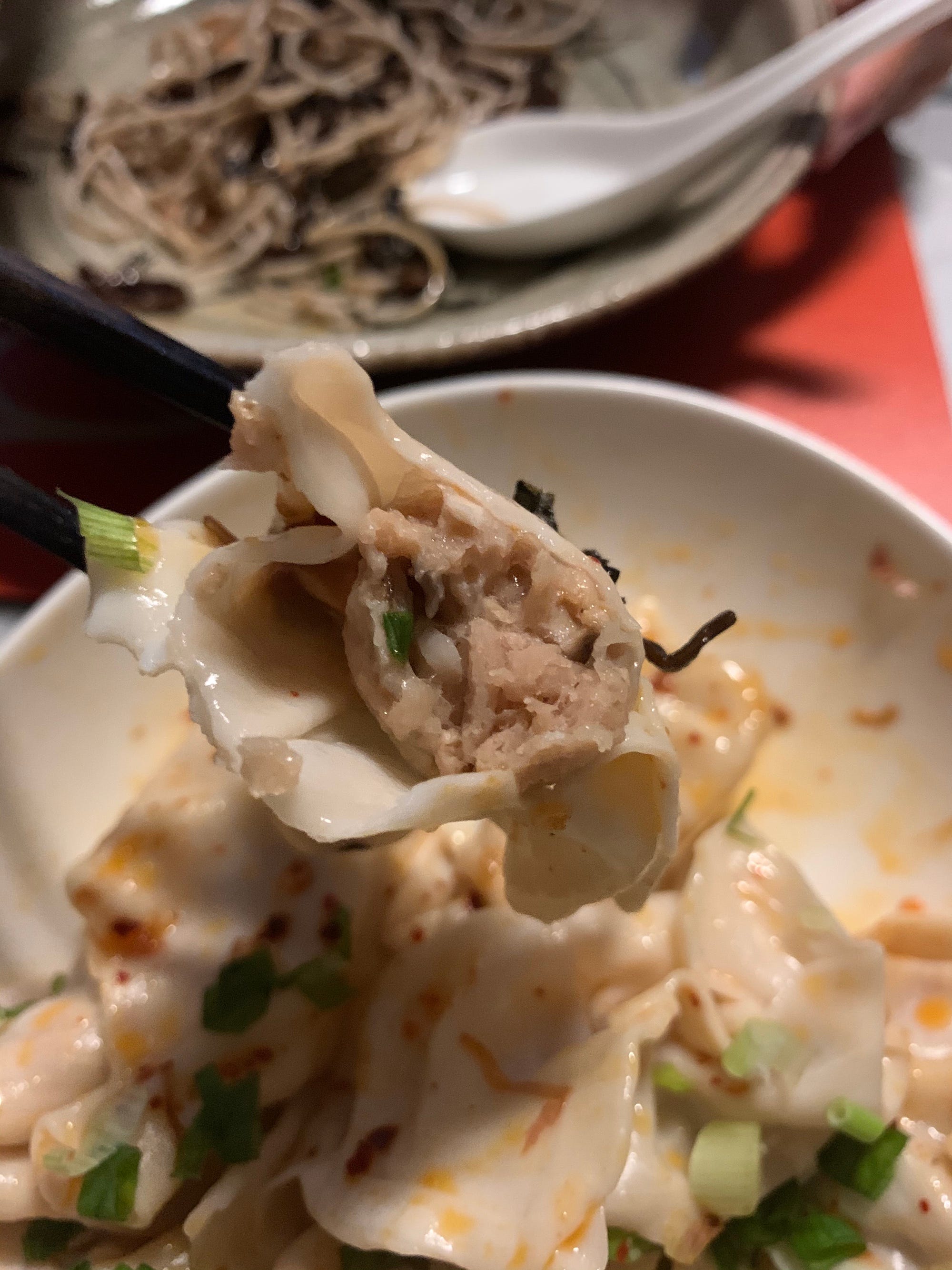
Photo: Alexis Ong
In the pan, it popped and sizzled just like real pork, and once safely ensconced in dumpling skins, the paste looked like real pork wonton fillings. But the fact remains that it’s still prohibitively expensive as a regular daily protein source — my single kilo of Omnipaste cost around $23 USD. When Impossible Pork finally launches, it’s hard to imagine it’ll be any cheaper.
It shouldn’t be a question of Impossible Pork or Omnipork, but rather, how to introduce more plant-based meat options and make them as accessible and affordable as possible.
As to whether Yeung views Impossible Pork as a threat to Omnimeat’s quiet growth across the region, he remains diplomatic about the future of plant-based foods. “Collectively, meat alternative brands and companies are striving to reduce people’s meat intake,” he explained. “People need lots of choices when it comes to food, more options only means more opportunities.” This makes sense considering that Yeung was an early investor in Beyond Meat, which he describes as a “pioneer” in the plant protein business. “I vividly remember the first time I tasted the beta version of Beyond Burger in their lab, and I knew right away that it would be a…game-changer,” he recalled. Green Monday does have designs on the US market, but won’t disclose details yet.
Whether Omnipork can conquer the United States, where mainstream palates are so decidedly different, remains to be seen. While American food culture has certainly diversified over the years, especially in major cities with strong Asian communities and enclaves, going meat-free seems like a daunting additional hurdle in the American cultural landscape. But it’s variety that will help to win over this extremely lucrative consumer market — a market historically defined by a wealth of different brands. It shouldn’t be a question of Impossible Pork or Omnipork, but rather, how to introduce more plant-based meat options and make them as accessible and affordable as possible.
Omnipork, while originally tailor-made to suit Asian recipes and Asian palates, could ultimately be used as a substitute for ground pork in any cuisine; as Omnimeat, it stands poised to take over a completely untapped base of halal and kosher customers. Plant-based pork, it seems, can be just as unifying as its animal-derived counterpart.
Medium : It’s Not that I’m Negative, America Really is Screwed

It’s Not that I’m Negative, America Really is Screwed
Why Economics Says America’s Collapse is Probably Irreversible Now

A few years ago, I wrote a post called “Why We’re Underestimating American Collapse.” Sadly, I think my predictions have proven to be true — though I suppose you can judge that for yourself. 90,000 dead and counting. A president who calls the death toll a “badge of honor.” A paralysed Congress. 40 million unemployed. Today, I often get the question, “Why are you negative, Umair?” or, “What can be done to fix all this?” These are really the same question, and my answer, which you probably won’t like, goes like this: we’re still underestimating American collapse.
The economics of American collapse say that it’s probably too late to fix America. It’s probable that this is the new normal. Chaos, decline, incompetence, malice, poverty, hopelessness, despair.
Let me explain, as clearly as I can.
You can see, right about now, that America is what political scientists call a failed state. A President who tells people to drink bleach during a pandemic. 90,000 dead, of which 90% are needless. A society that’s not able to provide basics for it’s citizens anymore. A nation in which income, savings, life expectancy, happiness, trust are all in free-fall. This is the stuff of epic social collapse.
Now, the reason that America collapsed is straightforward. Americans never invested in building expansive social systems, unlike Europe. Systems to provide healthcare, retirement, childcare, finance, and so forth.
The result has been twofold. One, the average American now goes without these things. That’s because they’re largely unavailable. For example, the fresh food that I can get on any block in Europe is simply absent in huge chunks of the States. You buy processed food, or you don’t get food. The same is true of many, many things, like, say, education, or income. You don’t have a job with guarantees and protections like in Canada or Europe. You have a lower quality — not just quantity — of income.
Two, the the average American pays prices that the rest of the world considers absolutely absurd — because they are — for the very same things. Having a child? That’ll be $50K, thank you. An operation? That’ll be more than a house. Want to educate a kid? There go your life savings. Want a few fresh apples? That’ll be ten times the price Canadians or Europeans pay. These things — the basics of life — are eminently affordable in the rest of the rich world. In America, though, they cost more than the average person can afford.
How do I know that? Because the average American now dies in debt. Their whole life is one long sequence of unpayable debts now. First, there’s “lunch debt” which becomes “student debt” which becomes a mortgage and credit card debt which becomes “medical debt.” The forms of debt in quotes don’t even exist in most other rich countries. In America, though, they define life — precisely because the average American is now a poor person, in the sense that they can’t make ends meet when it comes to paying for the basics of life.
Sure, they might have a big car and big house and a big gun. But the economic truth is this: all those things are had on debt, and the average American now lives like an impoverished person. No savings, no assets, no liquidity. 80% — eighty percent — of Americans live paycheck to paycheck, struggle to pay basic bills, and can’t raise say $500 for an emergency. Those are the statistics of a nation having descended into poverty.
Now. I don’t write all that to make some theoretical point, so let’s come back to the question. Can America save itself from collapse? If you really understand the numbers, then the answer above — sadly — is: probably not. The economics say that America has more or less almost certainly reached a point of no return now, and collapse is nearly inevitable.
To stop collapse, America would have to start investing — massively, suddenly, historically — in functioning systems. To stop longevity and health cratering, it needs a healthcare system. To stop happiness and trust cratering, it needs affordable education and retirement. To stop incomes and savings plummeting, it needs retirement systems and protections for workers. And so forth. Every single facet of American collapse requires massive, large-scale, sustained public investment to be turned around, that goes on for a decade or more.
Many Americans even support that much. They get, by now, that without a new social contract, America is finished. Sure, the American Idiot — Trump and his army of bleach-drinking morons — don’t. But maybe the average American does — sure, let’s allow that much. The tragic wrinkle is that it makes no difference. Even if the majority of Americans want a better America — is it too late to actually build one? Probably.
Why? Well, who’s going to pay for it? Remember those dismal statistics above? The average American lives like a poor person now? So who exactly is going to pay for all these expansive new systems? The average person simply can’t afford the very improvements to society that they need anymore. Bang! What happens then? The answer is: nothing does. More of this does: a slow, shocking collapse and descent. Because there’s no other option, choice, alternative. Nobody much has the money for one. You see, if I say to the average American — “let’s fix America. All you have to do is pay ten percent more in taxes, and you’ll have world-class healthcare, retirement, childcare, and so on” — they might even support it, whole-heartedly. They might genuinely want it.
But the economic truth is that they cannot afford it. That ten percent is now crucial income. That’s what “the average American dies in debt” tells us. The average person can’t give up that ten percent. He or she needs it — usually desperately — to pay off simple everyday bills. They have no real savings to speak of. So where is the money to fund this wonderful new social contract going to come from? The bitter truth is this: Americans are now too poor to afford a better social contract. Even if Americans support a Canadian or European style social contract, the hard economic truth is that are probably now too poor to ever have one. Americans are now so poor they can barely afford to support themselves and their own —80% live at the edge — so how can they afford to support anyone else, let alone everyone else?
That’s not just some idle opinion. You can see stark evidence of these fatal economics already doing their work. Americans just rejected their best chance at reform in generations, Bernie and Liz Warren. That was on the left — the 70% or who say they want decent healthcare, retirement, education, and so on. Only they never, ever vote for it, when it comes down to it. Why? Raising the spectre of higher taxes to fund a functioning society is something that simply can’t be borne by even those who want. Nobody can afford it now. Even Americans who say they want a better society don’t seem able — predictably, consistently — to follow through now. There’s a reason for that, and it’s that America is too poor as a country to afford to be a functioning society anymore.
Even if, as Bernie promised, taxes wouldn’t rise — Americans don’t seem to believe it. Why not? It’s not just they don’t — with good reason — distrust their government. It’s also that they can’t bear any more uncertainty. When your whole life and future seems to be going up in smoke, when you bear all the risk in society — the last thing you can take is even more. So while Bernie and Liz might have championed a functioning society at the same tax rate, the risk of taking having to pay for a functioning society is simply now too much for Americans who already live at the edge. What if taxes do end up rising by five percent? When you’re already perpetually struggling? Bang! Then it’s game over. Americans can’t afford to bear the risks or costs of fundamental reforms to a broken society, and that seals in collapse as the only trajectory left to follow.
On the right, by the way, people are so confused and bewildered that, like the protesters above, they’re willing to give up their lives to keep their livelihoods. That’s how desperate things have gotten. See the point: on the left, people might want a functioning society, but never, ever vote for it, because nobody can afford it, while the right has given up on it altogether, hoping only for the chance to be exploited, just so long as food can still be put on the table. That leaves…nobody much…in society…who both wants a functioning nation, and can afford to pay for it.
Sure, it’s true that corporations and the super rich can be taxed. And they should be, heavily. But that’s not enough. There’s a reason that Europe and Canada ask people to pay higher taxes to support a better social contract, and that reason is that is the only way such a contract is sustainable. You can’t get there from a one-off tax on corporations and the rich alone.
It’s also true that if America were to build a better social contract — with say good healthcare and retirement and so forth — everyone’s bills would decline over time. But that doesn’t solve the problem, which is that Americans can’t afford the costs in the first place. Sure, if American had public healthcare, people wouldn’t have to pay $10K per person per year for it. But they do — and it’s not as if someone’s magically going to raise their incomes by that much if they don’t. Do you think corporate America’s going to give anyone a raise just because it’s paying less in healthcare costs? That’s why all the plans for overhauling America’s broken public healthcare system involve, still, employers paying into some kind of fund — nobody wants to give people more money. But without giving people more money, Americans stay too poor to live in anything but…the collapsing society America’s become.
If that doesn’t make sense, just think about it in your own life. Could you really afford to lose 10% of your income right about now? Ever? More likely, like most Americans, your life is balanced right on the razor’s edge. A few percent either way, and — kaput!! — you lose most or everything you have. There goes the mortgage, school, the credit ratin, and so forth. The plainer economic translation of that is: you’re too poor to afford a functioning society. You can barely support your own — how can you support anyone, everyone, else?
So how was America left too poor to afford anything but collapse? In Europe and Canada, there’s a certain kind of fairness that came to prevail. People pay about half their incomes in taxes. Half for me, half for everyone else. But that also means that society’s surplus is distributed far more equitably in the first place. That half you pay in taxes goes on to employ doctors, nurses, professors, public servants of all kinds that simply don’t exist in America. It’s used to invest in hospitals, schools, universities, parks, libraries — every single year. That’s been happening for something like 50 years by now: a cycle of equitable redistribution that became sustained investment and reinvestment. What happens if you invest in a thing like a park, hospital, library for fifty years? It gets better and better. It’s returns grow and grow. There’s more of everything to go around for everyone. The battle for self-preservation doesn’t lock people into poverty, as it has in America. That is what it means to be a truly rich society.
America’s been doing exactly the opposite, for the same fifty years, and longer. See any reinvestment in…anything? Everything’s decrepit, from airports to schools to libraries, precisely because there hasn’t been any. There hasn’t been any — or enough, anyways — because Americans didn’t want to pay those higher taxes Europeans and Canadians did. They believed the strange, foolish, and evidence-free ideologies of trickle-down economics and neoliberalism and all the rest of it — we’ll all be richest if we invest in…precisely nothing together. Nobody should care about anyone else. Nobody should ever support anyone else in the pursuit of anything. Life was to be purely individualistic, adversarial, and acquisitive.
That led Americans straight into a poverty trap. They were paying lower taxes, sure. But their public goods were decaying. Their common wealth was eroding. Their systems and institutions were corroding. What happens to metal that isn’t polished, a street that’s never cleaned, a house that’s never repaired? Well, in the end, you have to pay a bigger bill. But you might not be able to afford it by then. Bang! Then you’re done. You live in that crumbling house until it finally turns to dust, if you can’t pay the roofer, plumber, electrician. That’s where America is now.
Do you know what a poverty trap is? When a poor person spend more than rich people just to have the basics — think of a poor person spending most of their income on low-quality food, transportation, medicine, and so on, because it’s all they can get. That’s where America is now, from a global perspective. In a classic poverty trap. Too poor to ever afford to be rich again, because it doesn’t have the money to invest in it’s own self-improvement or betterment now. Decades of underinvestment mean that there was less and less to go around — until American life became a brutal daily battle for self-preservation. But when all you can do is barely even struggle to preserve yourself, put food on the table, keep your family afloat — what do you have left to give back to a better society? Nothing, is the grim answer, and it’s borne out by America’s spectacularly low — negative — savings rate, aka, everyone but the mega-rich dies in debt.
To achieve European or Canadian living standards, how much would America have to invest now? Think of it: gleaming hospitals for everyone, thriving public squares, expansive childcare, good retirement, jobs that pay the bills, oversight of it all. It would take trillions. Probably dozens of trillions. Much, much more than average Americans all put together can afford to spend now. Those are the brutal economics of collapse. Societies who let themselves become poor can hardly then wave a magic want and become rich.
What it means to be a poor society, which is what America’s become, is also the experience of life in it by now: political chaos, economic ruin, emotional paralysis, cultural degeneration. Europe and Canada, again, have been investing in life for decades, while America’s been ignoring it. The result is that they are ahead now — and America probably can’t ever catch up. America let itself become a poor society, and this — the chaos and dislocation of now — is what it means to be one.
I know this is grim reading. It’s terrible and horrific. Is it “negative,” though? Well, I know that it comes across that way. I want to do a job that the typical pundit won’t, though, which is try to tell you simple truths. The one that economics tells me is this. It’s too late for America to recover. It left it too long. It was arrogant and conceited, paying for things it didn’t need, like wars and mega-mansions, but not those it did. So it didn’t invest when it should have, but now the bill is due, but nobody can pay it. What do you call a society like that? Bankrupt. Just like most Americans are, only they don’t know it. What do you call a whole society of people, after all, who die in debt?America’s broke, my friends. And when you’re broke, what do you have left to invest in yourself?
There’s one way out, by the way, if you’ve followed me closely. Give people money. No strings attached, no questions asked, now, on a large-scale, more or less permanently, forget how much needs to be borrowed to make it happen. So people can fund a working society again. Or else. That’s the big question for America. The rest is noise. Until something along those lines begins to take shape — my answer is simple: Americans made themselves too poor to now afford to have the luxury of a functioning, civilized, modern society. Or is all that a necessity?

(Business Insider) Roughly half the Twitter accounts pushing to 'reopen America'

Roughly half the Twitter accounts pushing to 'reopen America' are bots, researchers found
Roughly half the Twitter accounts pushing to 'reopen America' are bots, researchers found - Business Insider
It's unclear who's behind the surge in bot activity or whether they're originating from the US or abroad.
  • There's been a surge in bot activity in the past month in online discussions about reopening America from COVID-19 shutdowns, researchers at Carnegie Mellon University said this week.
  • The researchers analyzed over 200 million tweets discussing COVID-19 and found that roughly half the accounts were likely bots.
  • They identified the bots by looking for accounts that tweeted more frequently than humanly possible or whose location appeared to rapidly switch among different countries.
  • It's unclear who's behind the surge in bot activity or whether they're originating from the US or abroad.
  • Visit Business Insider's homepage for more stories.
As parts of the US have lifted shutdown orders during the COVID-19 pandemic, there's been a fierce argument online about the risks and benefits of reopening. New research suggests that bots have been dominating that debate.
Carnegie Mellon University researchers analyzed over 200 million tweets discussing COVID-19 and related issues since January and found that roughly half the accounts — including 62% of the 1,000 most influential retweeters — appeared to be bots, they said in a report published this week.
That's a far higher level of bot activity than usual, even when it comes to contentious events — the level of bot involvement in discussions about things like US elections or natural disasters is typically 10% to 20%.
The researchers identified bots using artificial-intelligence systems that analyze accounts' frequency of tweets, number of followers, and apparent location.
"Tweeting more frequently than is humanly possible or appearing to be in one country and then another a few hours later is indicative of a bot," Kathleen Carley, a computer-science professor who led the research, said in a release.
"When we see a whole bunch of tweets at the same time or back to back, it's like they're timed," Carley added. "We also look for use of the same exact hashtag, or messaging that appears to be copied and pasted from one bot to the next."
The researchers said they found that among tweets about "reopening America," 66% came from accounts that were possibly humans using bot assistants to spread their tweets more widely, while 34% came from bots.
There are a few possible explanations for the surge in bot activity. People may have more time to set up elaborate bot networks during stay-at-home orders, and the availability of botnets for hire has exploded recently. Carley also said that the global nature of the pandemic meant that countries and interest groups were using it to advance political agendas.
However, the researchers did not determine the origins of the bot activity or narrow down whether it was coming from foreign nation-state actors or from within the US.
"Even if someone appears to be from your community, if you don't know them personally, take a closer look, and always go to authoritative or trusted sources for information," Carley said. "Just be very vigilant."

NYT : Crumbs for the Hungry but Windfalls for the Rich

Crumbs for the Hungry but Windfalls for the Rich
Billions are going to zillionaires under the guise of pandemic relief.

While President Trump and his allies in Congress seek to tighten access to food stamps, they are showing compassion for one group: zillionaires. Their economic rescue package quietly allocated $135 billion — yes, that’s “billion” with a “b” — for the likes of wealthy real estate developers.

My Times colleague Jesse Drucker notes that Trump himself, along with his son-in-law, Jared Kushner, may benefit financially from this provision. The fine print was mysteriously slipped into the March economic relief package, even though it has nothing to do with the coronavirus and offers retroactive tax breaks for periods long before Covid-19 arrived.

Senator Sheldon Whitehouse of Rhode Island and Representative Lloyd Doggett of Texas, both Democrats, have asked the Trump administration for any communications that illuminate how this provision sneaked into the 880-page bill. (Officially, the provision is called “Modification of Limitation on Losses for Taxpayers Other Than Corporations,” but that’s camouflage; I prefer to call it the “Zillionaire Giveaway.”)

About 82 percent of the Zillionaire Giveaway goes to those earning more than $1 million a year, according to Congress’s Joint Committee on Taxation. Of those beneficiaries earning more than $1 million annually, the average benefit is $1.6 million.

In other words, a single mom juggling two jobs gets a maximum $1,200 stimulus check — and then pays taxes so that a real estate mogul can receive $1.6 million. This is dog-eat-dog capitalism for struggling workers, and socialism for the rich.

Many Americans understand that Trump bungled the public health response to the coronavirus, but polls suggest that they don’t appreciate the degree to which Trump and Congress also bungled the economic response — or manipulated it to benefit those who least need help.

The United States simply accepted that the pandemic would cause vast numbers of workers to be laid off — and then it provided unemployment benefits. But Germany, France, Britain, Denmark and other countries took the smarter path of paying companies to keep workers on their payrolls, thus preventing layoffs in the first place. The United States did a little bit of this, but far less than Europe — yet the United States in some cases spent a larger share of G.D.P. on the bailout than Europe did.

So the unemployment rate in Germany and Denmark is forecast to reach about 5 percent while in the United States it may already be about 20 percent, depending on how you count it.

It’s not fair to viruses to blame our unemployment crisis simply on the pandemic. It’s also our national choice.

At the same time, it has become increasingly clear that money intended to rescue small businesses has often gone not to those with the greatest need but rather to those with the most shameless lawyers. They are part of our national equation: Power creates money creates more power creates more money.

One provision in the rescue package provides a tax break that benefits only companies with more than $25 million in gross receipts. AutoNation, a Fortune 500 company, received $77 million in small business funds, although it returned the sum after The Washington Post reported its haul. For-profit colleges, which are better known for exploiting students than educating them, have raked in $1.1 billion.

A Brookings Institution study found that young children in one in six American households are not getting enough to eat because of the worst economic crisis since the Great Depression, and we’re rushing to help … tycoons!

A Kaiser Family Foundation study found that because of layoffs, 27 million Americans as of May 2 were at risk of losing employer-sponsored health insurance. You might think that this would lead to a push for universal health coverage. But, no, the opposite: Trump is continuing to support a lawsuit to overturn the entire Affordable Care Act — and allow millions more to lose coverage.

During the Great Depression, President Franklin Roosevelt responded boldly to economic desperation by creating jobs, passing Social Security and starting rural electrification. In this crisis, Trump is trying to restrict food stamps and health insurance while giving free money to real estate tycoons — probably including himself.

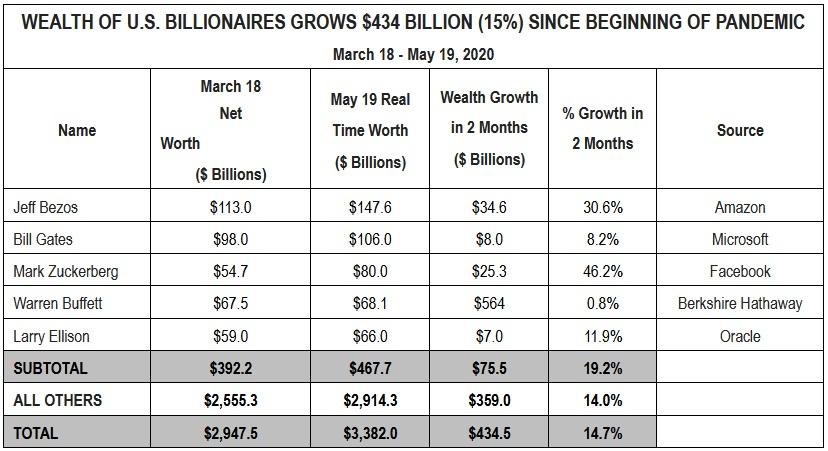
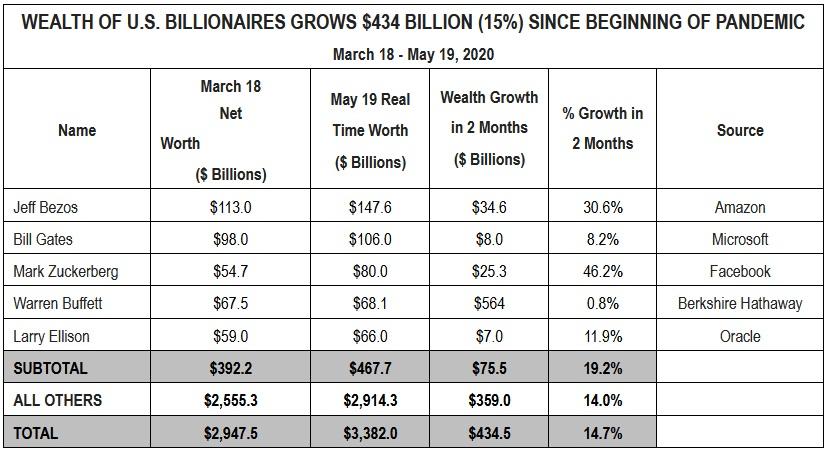
Of course, America does remain a land of opportunity, if you have the wealth. A new study determined that in the two months since March 18, roughly the start of the economic crisis, America’s billionaires saw their wealth collectively grow by 15 percent. And another 16 Americans became billionaires in that period. It’s great to see people pulling themselves up by their bootstraps!

The House of Representatives is trying to repeal the Zillionaire Giveaway, but Trump and his congressional allies are resisting. Trump meanwhile sees little need to help states and localities, which in April alone laid off more employees than in the entire Great Recession.

Trump was elected in part by voters angry at the way the system was rigged. But under Trump, the economy has become rigged ever more decisively, even as children go hungry and ordinary workers lose their jobs and their lives.

(ZH) Billionaires In US Have Grown $434 Billion Richer During Pandemic

Billionaires In US Have Grown $434 Billion Richer During Pandemic

While just under 40 million Americans have filed for unemployment since mid March, America's billionaires are doing just fine - watching their fortunes soar a combined $434 billion during the same period, reports CNBC.

Leading the pack are Jeff Bezos and Mark Zuckerberg, whose fortunes grew by $34.6 and $25 billion respectively, according to the Americans for Tax Fairness and the Institute for Policy Studies' Program for Inequality - based on Forbes data for America's over 600 billionaires collected between March 18 and May 19.
Percentage-wise, Elon Musk's wealth grew 48% to $36 billion, while Zuckerberg clocked in at 46%. Bezos' wealth grew 31% to $147 billion. His ex-wife, MacKenzie Bezos, saw her wealth increase by roughly 33% to $48 billion. On average, American billionaires saw their net worth grow 15% during the two-month period from $2.948 trillion to $3.382 trillion.

Via inequality.org
Bezos, Bill Gates, Zuckerberg, Buffett and Larry Ellison saw combined gains of $76 billion.
That said, looking at YTD paints a slightly different picture:
Because the study timeline captures the stock market bottom and quick rebound, it creates a slightly sunnier picture for billionaires than the full year. For the year, Buffett’s wealth has declined by $20 billion, according to the Bloomberg Billionaire’s Index, while Gates is down by $4.3 billion. For the year, Jeff Bezos has gained $35.5 billion while Zuckerberg is up by $9 billion. -CNBC
"The surge in billionaire wealth during a global pandemic underscores the grotesque nature of unequal sacrifice," said Chuck Collins, director of the IPS Program on Inequality and co-author of the Billionaire Bonanza 2020 report. "While millions risk their lives and livelihoods as first responders and front line workers, these billionaires benefit from an economy and tax system that is wired to funnel wealth to the top."

Still, the pandemic hasn't been kind to other billionaires - whose yacht upgrades may need to wait. Those in travel and retail have taken a beating. Ralph Lauren saw his wealth drop by $100 million to $5.6 billion, while hotelier John Pritzker has seen a $34 million drop to $2.56 billion. We know, time to get a collection going.

(ZH) Earth's Magnetic Field Mysteriously Weakening In Specific Locations, Throw

Earth's Magnetic Field Mysteriously Weakening In Specific Locations, Throwing Off Satellites And Spacecraft

The Earth's magnetic field, which protects life on our planet by blocking the majority of harmful solar radiation, is mysteriously weakening in specific locations.
Over the last two centuries, it has lost nearly 10% of its strength, leading some to speculate that a multi-century pole reversal has begun. What's more, scientists have identified a large, localized region of weakness extending from Africa to South America, along with a second 'center of minimum intensity' southwest of Africa - both of which are allowing charged particles from the cosmos to penetrate lower altitudes of the atmosphere - throwing off satellites flying in low-Earth orbit, according to Sky.
Known as the South Atlantic Anomaly, the field strength in this area has rapidly shrunk over the past 50 years just as the area itself has grown and moved westward.
Over the past five years a second centre of minimum intensity has developed southwest of Africa, which researchers believe indicates the anomaly could split into two separate cells. -Sky

According to scientists from the Swarm Data Innovation and Science Cluster (DISC) at the European Space Agency (ESA), measurements from their 'swarm satellite constellation' have shed tremendous light on the second anomaly.
In fact, the anomaly had puzzled ESA researchers as their Swarm satellites would sometimes 'black out' when flying through the affected region. Three years ago, they observed a link between the blackouts and Ionospheric thunderstorms.
"The new, eastern minimum of the South Atlantic Anomaly has appeared over the last decade and in recent years is developing vigorously," said Dr. Jurgen Matzka of the German Research Center for Geosciences. "We are very lucky to have the Swarm satellites in orbit to investigate the development of the South Atlantic Anomaly. The challenge now is to understand the processes in Earth's core driving these changes."
If this is the beginning of a pole reversal - which happens roughly every quarter-million years, it would result in multiple north and south magnetic poles all around the globe during the multi-century phenomenon.
"Such events have occurred many times throughout the planet's history," said ESA, adding "we are long overdue by the average rate at which these reversals take place (roughly every 250,000 years)"

Not to worry, in theory, as the space agency says that the South Atlantic dip which they're still learning about was "well within what is considered normal levels of fluctuations."
For people on the surface the anomaly is unlikely to cause any alarm, but satellites and other spacecraft flying through the area are experiencing technical malfunctions.
Because the magnetic field is weaker in the region, charged particles from the cosmos can penetrate through to the altitudes that low-Earth orbiting satellites fly at.
"The mystery of the origin of the South Atlantic Anomaly has yet to be solved," added ESA. -Sky
"However, one thing is certain: magnetic field observations from Swarm are providing exciting new insights into the scarcely understood processes of Earth's interior."

WSJ : Protests Reignite in Hong Kong Over Beijing’s Security Measure

Protests Reignite in Hong Kong Over Beijing’s Security Measure
Tear gas returns to city streets as people vent anger at Beijing’s move to swiftly impose national-security laws on the city

HONG KONG—Riot police fired tear gas and water cannons as protesters defied social-distancing rules to return to the streets and vent anger at Beijing’s plan to swiftly impose national-security laws in the city.

A crowd of mostly young people began gathering Sunday at lunchtime in the shopping district of Causeway Bay, heeding calls online to ramp up demonstrations against China’s ruling Communist Party after a monthslong lull during the coronavirus pandemic.

Police fired tear gas for the first time in weeks, and later deployed water cannons and pepper spray to disperse thousands of protesters who had fanned out across the district, echoing familiar scenes from last year. More than 100 arrests, mostly for unlawful assembly, were made by 5 p.m., police said.

Tensions have risen in the city since China signaled Thursday that it would unilaterally implement laws against subversion, sedition and terrorism, as well as collusion with foreign forces, which Beijing blames for stoking mass protests last year. The unrest lasted more than seven months, growing violent at times and plunging the city into recession.

Pro-democracy groups in Hong Kong said Beijing’s decision to bypass the local government and legislature violated its promise for “one country, two systems,” agreed to with Britain when the territory was handed back in 1997. Under that agreement, China pledged to uphold until 2047 the finance hub’s autonomy on matters such as law, as well as people’s freedom of speech and assembly.

Chinese Foreign Minister Wang Yi said Sunday that the move by China’s legislature targets the “tiny minority” whose activities severely damage national security. It “doesn’t affect Hong Kong’s high degree of autonomy, doesn’t affect the rights and freedoms of Hong Kong residents and doesn’t affect the legitimate interests of foreign investors in Hong Kong,” he said.

Hong Kong leader Carrie Lam has said she supports the new legislation and that it would ensure stability and prosperity in the city.

The measures were viewed differently overseas, with international condemnation intensifying over the weekend. More than 200 parliamentarians and policy makers from 23 countries, including the U.S., U.K. and Canada expressed grave concern.

“It is the genuine grievances of ordinary Hong Kongers that are driving protests,” read a statement published Sunday. “Draconian laws will only escalate the situation further, jeopardizing Hong Kong’s future as an open Chinese international city.”

Secretary of State Mike Pompeo said Friday that Beijing’s decision to bypass Hong Kong’s legislature and “ignore the will of the people of Hong Kong would be a death knell for the high degree of autonomy Beijing promised.” The State Department said it is delaying submitting the annual review of Hong Kong’s autonomy until it can assess any action taken by China’s legislature, which wraps up Thursday.

Beijing’s move also spooked investors, who on Friday drove Hong Kong’s benchmark stock index down by nearly 6%, its worst one-day fall since July 2015.

“I think this is the termination of one country, two systems,” one protester said Sunday, describing how police descended quickly on the early marchers, squeezing them from two sides and prompting many to flee. “Hong Kong is lost. The most important thing is to fight back against the Communist Party,” added the 25-year-old insurance-company employee.

Heavily armed police in full riot gear stayed out in force throughout the day as protesters chanted Hong Kong’s protest anthem. Police said they were forced to use tear gas because demonstrators had assaulted police officers, thrown objects at them and obstructed traffic.

Calls for Hong Kong to be free from Chinese rule rang out, while some protesters waved independence flags. Chinese leader Xi Jinping said in 2017 that Beijing wouldn’t tolerate demands for independence, calling it China’s red line.

“One country, two systems has gone now,” said Chris Hon, a 25-year-old engineer among the crowd Sunday. “The only option left to restore our own system is independence.”

Anti-China sentiment has become more evident in protests. U.S. flags, as well as those proclaiming independence for Hong Kong were common at some protests last year.

Mr. Hon said that rather than worry about the new national-security laws, it is more urgent for him to be standing up against them.

The measures are meant to scare protesters, he said, but they won’t yield. “We Hong Kong people have nothing to lose now,” he said.

China is seeking to avoid a repeat of last year’s chaos, when more than a million people poured into the streets in June to oppose a bill, later withdrawn, that would have legalized extradition to China. The opposition movement has broader demands, including universal suffrage and an independent judge-led investigation into police. Some groups have called for mass rallies starting next weekend to mark the first anniversary of 2019’s biggest rallies.

More flashpoints loom as Hong Kong’s legislature on Wednesday discusses a bill to criminalize disrespect of China’s national anthem. There is also rising concern that with social-distancing rules in place, the annual mass vigil to commemorate victims of the 1989 massacre of students around Tiananmen Square won’t be allowed to go ahead on June 4 as in previous years.

In Causeway Bay on Sunday afternoon, a 70-year-old gray-haired woman led call-and-response chants at the front line of confrontation between protesters and police. The woman, dressed in black, said she felt a duty to stand with protesters.

“These are the sons and daughters of Hong Kong, and they are wonderful. They didn’t do anything wrong,” she said. “I am here for justice for the next generation.”

WWD : Nike’s New Campaign Centers Around Overcoming Adversity

Nike’s New Campaign Centers Around Overcoming Adversity
Titled "Never Too Far Down," the campaign centers around a film narrated by LeBron James and featuring Serena Williams and Tiger Woods.


Nike Inc. is pulling out all the stops with its latest advertising campaign to motivate a public that needs a lot of motivation these days.
Called “Never Too Far Down,” the campaign centers around a short film narrated by LeBron James and features the NBA superstar along with Serena Williams and Tiger Woods and the adversity they’ve encountered — and overcome — during their careers. For James, it recalls when his team, the Cleveland Cavaliers, was facing elimination after a 3-to-1 deficit in the 2016 NBA Finals (they eventually took the title from the Golden State Warriors). For Woods, it shows when he fell to his knees after taking a shot at the Barclays tournament in 2013 because of chronic back pain that nearly ended his career. And for Williams, the video shows her determination when falling far behind an opponent in a match.


The “Never Too Far Down” film will air on Nike’s social media channels, and on television and during the livestream of Tiger Woods’ “The Match. Champions for Charity.” It will also air during the May 26 Dortmund versus Bayern Bundesliga Match and during other programming.
“We’ve all be underestimated and counted out,” James says in the video. “In those moments, we felt like it was over. But it’s when we’re given no chance that we somehow found that last bit of strength to keep fighting. We came back from the impossible, from being broken, we found a way when it seemed hopeless.”


The video goes on to say that right now, we’re all fighting for something bigger than a win or a championship, and shows signs about shutdowns during the coronavirus. It ends by saying: “If we’ve learned anything from sports, no matter how down we might be, we are never too far down to come back.”

The campaign, which also shows snippets of Nike athletes Cristiano Ronaldo and Naomi Osaka, among others, launched on the Saturday of Memorial Day weekend and was tied to Woods’ return to the golf course in a charity match on Sunday, where he and Peyton Manning were set to square off against Phil Mickelson and Tom Brady. The match is worth $10 million that will be donated to coronavirus relief efforts.
“The whole world, we’re fighting for something bigger than a championship right now,” James said. “People are struggling and this continues to be an incredibly difficult time. For me, thinking forward to a time when we’ll be able to play again, it keeps me going. Even if basketball looks different for a while, I’m excited about the possibility of getting back in the game because I know how inspiring and powerful sports can be. I think the lessons we learn from sports can inspire us all.”
Williams agrees: “This time has been like nothing else,” she said. “I mean, I’m no longer playing tennis! No one is. I’ve been playing tennis for over 20 years and never has a tournament been canceled in my career for any reason until now. It’s such a unique time in history right now, with all these global challenges around the COVID-19 virus and how it’s impacting all of us in ways that are the same and also so different. Some athletes are returning to sport, for others — like me — I’m really just getting back into the swing of training.”
Woods also weighed in: “This pandemic has caused so much tragedy, but sport can still be a positive force for so many people. I’m hopeful that we can all return to our sports when the time is right, and I am looking forward to this weekend and creating a platform to raise money for COVID-19 relief and hopefully remind folks of the levity and joy that golf and other sports can bring to the world.”

Since organized sports were brought to a standstill during the pandemic, Nike has worked to bring together its community through its Play Inside and Play for the World initiative. It has offered free weekly livestreamed YouTube workouts and unlocked its Nike Training Club app content. It has also been producing personal protective equipment for first responders.

Challenge : Autodidacte, réseaux... Comment StéphaneCourbit s'est bâtiun emp

Autodidacte, réseaux... Comment Stéphane Courbit s'est bâti un empire audiovisuel


PORTRAIT La tempête sanitaire a mis à l’arrêt son empire audiovisuel, alors même qu’il boucle le rachat du géant Endemol ? Pas de quoi faire trembler cet autodidacte ambitieux, virtuose du poker.


L'endroit est magique. Dans les bâtiments xviiie de l'hôtel du Grand Contrôle, à Versailles, les premiers locataires des douze chambres aménagées par Airelles Collection, la filiale d'hôtellerie de prestige de LOV Group, devaient profiter fin mai d'une vue imprenable sur la pièce d'eau des Suisses et l'" escalier des Cent Marches " qui mène à l'esplanade du château. Royal. Mais voilà, fin avril, l'hôtel de luxe a encore des allures de vaisseau fantôme. Des plastiques opaques battent les fenêtres, palissades et échafaudages encombrent le trottoir, et de vulgaires tôles ferment les porches majestueux. Le coronavirus a stoppé net le projet de Stéphane Courbit. Les sociétés de paris en ligne de son groupe sont aussi à l'arrêt. Mais la pandémie a surtout pétrifié Banijay, l'empire de production audiovisuelle qu'il bâtit à pas de géant depuis 2008. Même si les emblèmes français de l'écurie Courbit s'adaptent (Cyril Hanouna sur C 8 a modifié son émission pour rester en direct, et Nagui s'est interrompu, France 2 optant pour des rediffusions), Banijay (1 milliard d'euros de chiffre d'affaires) n'échappe pas au coup de frein dans les 23 pays où il est présent.


Le coup d’une vie

Pour Stéphane Courbit, la crise sanitaire tombe au pire moment. Le 26 octobre dernier, le self-made-man drômois a annoncé la plus vaste opération d’une carrière qui n’en fut pas avare : l’acquisition, auprès de Disney et du fonds Apollo, d’Endemol Shine, un concurrent deux fois plus gros que Banijay. Dans la corbeille, 200 sociétés de production supplémentaires, les séries Black Mirror, Versailles ou Peaky Blinders et des milliers de concepts d’émissions saute-frontières, de Survivor à Masterchef, L’Ile de la tentation ou The Island. Pas de quoi élever le niveau intellectuel des populations, mais indispensable aux chaînes partout dans le monde pour tenir leurs audiences. Stéphane Courbit ne s’exprime pas, il attend le feu vert des autorités de concurrence pour boucler l’affaire. Un ancien concurrent fait le calcul : « Sa dette atteint 2 milliards, or ses revenus vont beaucoup baisser. Courbit a manqué de chance : la pandémie peut diviser ses bénéfices par deux et il ne se rattrapera pas hors des frontières puisque la crise est mondiale. Il peut s’en sortir, mais il va devoir renégocier sa dette. Il peut encore gagner, mais c’est très courageux ».


Pour emporter cette énorme proie, l’ex-petit prince de la production audiovisuelle a négocié dix-huit mois, abandonné l’affaire, repris les conversations, mis sur pied des structures capitalistiques complexes et convaincu ses banques. Un échafaudage qui, pour l’instant, résiste à la tempête : « L’opération n’est aucunement remise en cause, elle suit son cours, assure Arnaud de Puyfontaine, le président du directoire de Vivendi, actionnaire à 31,4 % de Banijay. J’ai eu Stéphane Courbit au téléphone : il continue à porter ce projet avec beaucoup de conviction. » Personne ne semble douter : « Ce sera une affaire difficile pour lui, estime le président du directoire de M 6, Nicolas de Tavernost, cela va l’occuper deux ans. Mais il a les compétences pour le faire. » Le milieu de l’audiovisuel le connaît bien. Il y a chez Stéphane Courbit un as du Monopoly – qu’il a pratiqué des heures, enfant, avec sa sœur, dans la maison de Puy-Saint-Martin dans la Drôme – doublé d’un virtuose du poker.


L’atout Arthur

La première audace a été maintes fois racontée, elle est révélatrice. Entré comme stagiaire dans la société de production de Christophe Dechavanne, époque Ciel mon mardi, Stéphane Courbit n’a pas 30 ans et moins de quatre ans de maison lorsqu’il propose à son patron une association à 50/50. Dechavanne offre 49/51. Stéphane Courbit refuse, part et pointe au chômage. Mais il a compris l’essence du métier. Pas de programme réussi sans talents, sans animateurs, ces saltimbanques capricieux et égocentriques capables de générer de l’audience. « Il faut comprendre comment fonctionne un Hanouna ou un Nagui, donner un intérêt financier important, mais surtout gérer cette relation construite sur une grande liberté créative », explique Thomas Valentin, vice-président du directoire en charge des antennes de M 6.


Deuxième coup de poker, Stéphane Courbit déniche sur une radio périphérique un animateur amusant et doué, mais qui patine dans une avalanche de blagues de potaches : Jacques Essebag, dit Arthur, est prêt à le suivre. Les deux hommes s’associent à parité dans Case Productions, qui deviendra ASP Productions (pour Arthur et Stéphane). Pour se donner de l’importance aux yeux des patrons de chaîne, le jeune entrepreneur bluffe : « Il tournait bruyamment les pages vides de son agenda en disant “pas cette semaine, ni la prochaine…”, raconte l’éditeur et créateur de sites Gérard Ponson, qui le connaît depuis trente ans. Ils ont ramé durant des mois, mais ils étaient doués. »


Invité autour d’une pizza par le journaliste Charles Villeneuve, pilier du TF 1 de la grande époque, qui cher­che un producteur délégué pour une émission de divertissement, Stépha­ne Courbit sort un marqueur de sa veste, griffonne la mécanique d’un programme sur la table et conseille, compte tenu de l’heure de diffusion, de réaliser deux émissions. Impressionné, Villeneuve le présente au vice-président et patron de l’antenne de TF 1, Etienne Mougeotte : « J’ai immédiatement compris qu’il allait devenir un grand producteur, assure aujourd’hui Mougeotte. C’est une tête bien faite, rationnelle, organisée et inventive. »


Une usine à programmes

L’émission, Télé-Vision, présentée par Béatrice Schönberg, démarre à la rentré 1994 sur TF 1, qui achète un, puis deux, puis trois programmes. L’ancien stagiaire de Dechavanne finira par fournir l’essentiel des émissions de l’avant-soirée de TF 1 et une quarantaine de prime time par an. Rien n’est trop ambitieux pour cet autodidacte né de parents divorcés, un cadre de banque et une employée de poste. « Il aime la réussite, dit Etienne Mougeotte. Il veut devenir numéro un, quitte à prendre des risques. »


Fin 2000, Stéphane Courbit et Arthur vendent leur structure florissante au géant néerlandais de la production Endemol, qui offre aussitôt à Courbit la présidence d’Endemol France. Le 26 avril 2001, M 6 diffuse un concept inédit en France, Loft Story, une version française de l’émission d’enfermement Big Brother réinventée par Courbit. Cette bombe audiovisuelle provoque un vif débat national, mais fédère 6 millions de téléspectateurs chaque soir. Un record pour M 6. Placé au cœur du typhon à 36 ans, Courbit révèle un sang-froid à toute épreuve.


Mais avec lui, chaque succès a son prix. Dans la foulée, le Drômois propose à M 6 l’exclusivité durant deux ans de tous les concepts sortis de son usine à programmes. A la tête de la chaîne, Nicolas Tavernost et Thomas Valentin ont 24 heures pour se décider. « Je ne voulais pas dépendre d’une seule société », raconte Tavernost, qui refuse. Stéphane Courbit signe aussitôt avec TF 1 un incroyable contrat annuel de 35 millions d’euros. Star Academy, Miss France, La Ferme célébrités, les sociétés de Fogiel, Karl Zero ou Lagaf : il est partout. Avec l’éditeur Gérard Ponson, le producteur échafaude un projet de magazines déclinés de ses émissions : « On avait l’idée de revendre nos titres à terme au groupe Lagardère, raconte Ponson. Il me disait : “Gérard, on va racheter Lagardère !” » Rien n’est trop beau pour lui.


Des qualités de négociateur

« Il est charmant dans la vie, prévenant, il a beaucoup de charme et c’est un type bien, réglo : j’ai développé avec lui une vraie amitié, assure Etienne Mougeotte. Mais c’est un lion en affaires, un dur. Il ne lâche rien, jamais, et surtout pas le prix. Il n’aurait pas fait cette carrière sans ses qualités de négociateur. » Thomas Valentin a eu aussi face à lui dans les séances de négociation et d’achat de programmes ce joueur de poker : « Un calme phénoménal, une maîtrise parfaite de ses émotions. »


En 2005, Endemol France affiche 180 millions d’euros de chiffre d’affaires et le record de rentabilité du groupe. Stéphane Courbit tente en vain de racheter l’entreprise, et part avec 240 millions d’euros. Des fonds aussitôt réinjectés dans son propre holding, baptisé Financière LOV, les initiales des prénoms de ses trois enfants. Encore un coup de poker. Dans la principale filiale, Banijay, il attire Nagui, Alexia Laroche-Joubert, Benjamin Castaldi, investit dans les jeux en ligne comme Betclic ou Everest Poker avant même qu’ils soient autorisés en France. Invite au capital Vivendi et l’éditeur italien De Agostini. Et fusionne avec un gros concurrent, Zodiak Media, en 2015. Il rêvait depuis longtemps d’une revanche sur Endemol, il y est presque.


Ce parcours fulgurant laisse tout de même quelques tâches. En 2004, Stéphane Courbit est à la tête d’Endemol France lorsqu’il vire son numéro deux, Axel Duroux… quelques semaines avant le paiement de ses stock-options. Duroux obtiendra 12 millions d’euros devant la justice. Sa boulimie l’a aussi mené dans les méandres de l’affaire Bettencourt, l’héritière de L’Oréal ayant investi 143 millions d’euros dans sa société. Au terme du procès, en 2015, Stéphane Courbit écope d’une amende de 250 000 euros. Le jugement, très sévère, relève « un abus frauduleux de l’ignorance ou de la faiblesse d’une personne vulnérable ». La presse ne le rate pas. Blessé, il rentre dans sa coquille. Il recevait rarement les journalistes, il ne les verra plus.


Un réseau de pontes

Décrit comme accessible, « pas bling-bling du tout », le producteur acquiert tout de même très tôt, avec son complice Arthur, une maison à Saint-Tropez et un appartement à Courchevel. Pour se rapprocher des pontes de l’audiovisuel. Depuis, il passe ses vacances dans sa vaste maison, toujours à Saint-Tropez, où l’attendent ses ânes. « Il adore ses ânes », assure un proche. Il n’en oublie pas les puissants… Son regard bleu et son allure d’éternel adoles­cent frappent. Nicolas de Tavernost le présente volontiers par une boutade : « Stéphane Courbit n’a pas pu venir, il a envoyé son fils ! »


Ceux qui l’approchent louent sa politesse, sa discrétion et la qualité de ses conseils. « On sent immédiatement une intelligence hors du commun, témoigne Denis Olivennes, président de CMI Média (Elle, Marianne…), propriété de Daniel Kretinsky. Il a cette capacité de calcul très rapide d’un Drahi ou un Kretinsky. » Villeneuve le propulse chez Bolloré, qui lui présente Alain Minc, lequel l’introduit chez Arnault (présent au capital de Banijay) et Pinault. Olivennes le fait entrer au Siècle. Lorsqu’il vient voir le maire de Neuilly, où il habite, pour un imbroglio de terrain, Stéphane Courbit se lie d’amitié avec le jeune Sarkozy – dès les années 1990 –, pour qui il a voté en 2007. Par tradition familiale, il se veut pourtant « de gauche » et vomit volontiers les bourgeois.


A 55 ans, Stéphane Courbit en a pourtant les atours. Il conserve son regard bleu perçant et sa silhouette svelte, mais l’éternel jeune homme a désormais des cheveux gris, un fils à Polytechnique, une fortune évaluée par Challenges à 820 millions d’euros en 2019, et, demain, une entreprise de 3 milliards de chiffre d’affaires à sortir du coma. Son appétit est pourtant intact. Pas question de grasse matinée à l’hôtel du Grand Contrôle.

Bus. Of Fashion : Gucci Just Left the Fashion Calendar Behind. Who Will Follow?

Gucci Just Left the Fashion Calendar Behind. Who Will Follow?

Gucci to Go Seasonless, Show Twice Per Year

This week, everyone will be talking about Gucci's move to a seasonless schedule, Memorial Day sales — or lack thereof — how beauty retailers will reopen stores and luxury's bet on resort dressing. Get your BoF Professional Cheat Sheet.

  • “I will abandon the worn-out ritual of seasonalities and shows to regain a new cadence,” wrote designer Alessandro Michele in a diary entry posted to Gucci’s Instagram
  • The Italian megabrand is planning a virtual press conference for Monday
  • The move follows Saint Laurent’s decision to break with the conventional fashion calendar and calls from independent designers to overhaul the fashion system

The Covid-19 pandemic is shaking the fashion sector to its core, prompting brands big and small to reevaluate the traditional system — conceived for a pre-internet, pre-global era — that has long governed the industry’s approach to developing, showing, delivering and discounting collections. Gucci’s move to go seasonless and scale back shows to twice per year throws the weight of a megabrand behind the drive for change. Saint Laurent, which is also owned by French conglomerate Kering, has announced its intention to skip Paris Fashion Week this September and reshape its schedule for showing collections for the rest of the year. In recent weeks, a forum fronted by Belgian designer Dries Van Noten and a group facilitated by BoF have both published proposals for overhauling the fashion system.

The Bottom Line: Who else will join the call for change? LVMH, the world’s largest luxury group, which owns Louis Vuitton, Dior, Fendi and Celine, has been conspicuously silent.