WWD : Groupe Arnault Takes Stake in Lagardère

Groupe Arnault Takes Stake in Lagardère
The media company, focused on books and travel retail, had been fending off an activist investor.

PARIS — Helping out a family friend — and widening his media holdings — Bernard Arnault has taken a minority stake in embattled publishing and retail conglomerate Lagardère SCA via his Groupe Arnault holding.

Following a capital increase and share purchase, Groupe Arnault will hold a stake equivalent to around one-quarter of the share capital of Lagardère Capital & Management (LCM), Arnaud Lagardère’s holding company.

The development offered an additional safety net to Lagardère, who in recent months had to fend off an activist investor, Amber Capital, that had attempted to take control of the ailing company.

At Lagardère’s annual general meeting earlier this month, shareholders rejected all 18 resolutions submitted by Amber to assemble a new supervisory board.

A joint statement Monday said the Arnault and Lagardère families would share the long-term strategic interest for the company, active in book publishing under the Hachette umbrella, plus travel retail under the Relay, Aelia Duty Free and Vino Volo banners.

“This linkup will strengthen the corporate structure and financial capacities of LCM. The family groups led by Bernard Arnault and Arnaud Lagardère will act in concert with regard to Lagardère SCA,” it added.

It is understood the investment was made out of loyalty to the Lagardère family — Arnault was very close to founder Jean-Luc Lagardère, Arnaud Lagardère’s father — more than a belief in the media group’s current business prospects.

“I have welcomed Arnaud Lagardère’s proposal to join forces with him,” Bernard Arnault, also the chairman and chief executive of luxury giant LVMH Moët Hennessy Louis Vuitton, said in a statement. “My friendship with Jean-Luc Lagardère brought our families together, and I have the utmost respect for the group that he built. I am delighted that we are now, alongside Arnaud Lagardère, a long-term shareholder of the company that bears his name.”

Lagardère said he and Arnault “have long shared the values of family entrepreneurship. Groupe Arnault’s exceptional achievements in France and worldwide, its success in the field of distribution and its investment in the creative and cultural industries, are aligned with the fundamentals of my group and are the mark of an enduring and productive working relationship.”

Bernard Arnault was on the supervisory board of Lagardère SCA from 2004 to 2012, and his son Antoine, chief executive of Berluti and head of communication and image at LVMH, took a seat from 2012 to 2013. In turn, Arnaud Lagardère sat on the board of directors of LVMH from 2003 to 2009.

Via LVMH, Arnault also has investments in French newspapers Le Parisien and Les Echos, the Radio Classique station, plus the financial weekly Investir and magazine Connaissance des Arts.

Groupe Arnault’s investments, meanwhile, include a 16 percent stake in retail giant Carrefour SA via Blue Capital, an investment fund owned by Groupe Arnault and Colony Capital.

Founded in 1992, Lagardère generated 7.21 billion euros in revenues in 2019. It operates in 40 countries and employs 30,000 people.

Revenues in the first quarter of this year dipped 12.5 percent to 1.36 billion euros, reflecting the impact of the COVID-19 crisis, particularly on travel retail.

Over the past decade, the group has whittled down its activities, particularly in magazine publishing, though it still holds the Elle brand license and owns the iconic celebrity title Paris Match and weekly newspaper Le Journal du Dimanche.

In 2011, Lagardère sold 102 international titles to Hearst Magazines, most notably Elle in 15 countries, including the U.S., Canada, Germany, Italy, Russia, China and Japan. It sold off its stake in Marie Claire in 2018.

Monday’s statement noted that the partnership between Groupe Arnault and LCM is subject to the approval of the employee representative bodies of the entities concerned.

The parties have yet to make the requisite declarations to the French financial markets authority.
FT : Bernard Arnault to buy stake in Arnaud Lagardère’s holding company

Bernard Arnault to buy stake in Arnaud Lagardère’s holding company
Billionaire LVMH owner’s investment comes after Vivendi raised stake in media group

LVMH’s billionaire owner Bernard Arnault has agreed to buy 25 per cent of Arnaud Lagardère’s holding company, coming to the aid of his fellow French businessman weeks after he saw off a challenge from an activist investor.

Through the holding company, Mr Lagardère owns a 7.3 per cent stake in the publicly traded Lagardère, the media group founded by his father and whose biggest businesses are book publisher Hachette and a unit that operates retail outlets in airports and transport stations.

Mr Lagardère has been battling to keep control over the company as the activist hedge fund Amber Capital attacked his record of underperformance and his creditors pressured him to pay back heavy personal debts. The unexpected arrival of Mr Arnault assists Mr Lagardère on both fronts.

In a joint statement on Monday, Mr Arnault and Mr Lagardère said shares would be issued in Lagardère Capital & Management so as to “strengthen its structure and financial capacity”. The investment was worth about €100m, according to two people close to the matter.

Mr Arnault’s help may be worth much more than that to Mr Lagardère as it neutralises a line of attack that Amber used against the CEO, namely that his personal debts threatened his ability to lead the company.

Mr Lagardère has borrowed against the value of his stake, and LCM owes as much as €200m to Crédit Agricole.

Amber, which is Lagardère’s biggest shareholder with an 18 per cent stake, has argued that Mr Lagardère’s financial situation is important because of the way in which the media group is structured as a partnership.

Known as a société en commandité par actions, this means that despite owning just 7.3 per cent of Lagardère, Mr Lagardère has a tight grip on the group. He cannot be removed by shareholders but he also has unlimited responsibility for the company’s liabilities.

The joint statement did not mention LCM’s debts. But before the recent shareholder meeting in which Amber tried and failed to replace the board, people familiar with the situation said Mr Lagardère might be willing to negotiate ending the commandité structure and use the proceeds to pay down his debts.

That scenario is now less likely given that LCM will receive cash that will be used to pay down the Crédit Agricole loan, the second person close to the matter said.

Mr Arnault’s investment will also help Mr Lagardère protect his company from the other French billionaire whom he recently convinced to invest to rally votes against Amber.

Vivendi, which is controlled by renowned corporate raider Vincent Bolloré, bought an 11 per cent stake in April and backed Mr Lagardère at the shareholder vote.

Vivendi has since raised its stake to 16.5 per cent. Analysts have speculated that Mr Bolloré might have his eyes on Hachette, since Vivendi is in the publishing business.

The ties between the Lagardère and Arnault families go back decades. Mr Arnault used to play tennis with Lagardère’s father, Jean-Luc, and sat on Lagardere’s board from 2004 to 2012. Arnaud Lagardère was on the LVMH board from 2003 to 2009.

“I have welcomed Arnaud Lagardère’s proposal to join forces with him,” said Mr Arnault in a statement. “My friendship with Jean-Luc Lagardère brought our families together, and I have the utmost respect for the group that he built.”

Shares in Lagardère jumped 13 per cent by mid-day in Paris.

FT : Van owner wins landmark Dieselgate case against VW

Van owner wins landmark Dieselgate case against VW
German court ruling will force carmaker to compensate tens of thousands more customers

Germany’s highest civil court has ordered Volkswagen to pay more than €28,000 to an owner of a diesel minivan, in a landmark judgment that will force the carmaker to compensate tens of thousands of customers.

In the first Dieselgate claim to be heard at the Bundesgerichtshof (Federal Court of Justice) in Karlsruhe since the company was found to be cheating on emissions results more than four years ago, the court found in favour of Herbert Gilbert, who bought a VW Sharan in 2014 for about €31,500.

It ruled that the 65-year-old was entitled to return his vehicle and receive a partial refund, plus interest.

The precedent will de facto force VW to compensate claimants in at least 50,000 outstanding cases.

However, the world’s largest carmaker has largely mitigated the risk of a worst-case scenario.

Last month, it reached a settlement with 240,000 drivers in Germany, who had sued VW in the country’s largest collective lawsuit. They will receive between €1,350 and €6,250 each, as part of a €750m payout.

In 2015, the German group was forced to recall more than 11m cars worldwide after it was revealed that its EA189 diesel engines contained software that manipulated the results of pollution tests.

While VW swiftly reached a €10bn settlement with US owners, and has been forced to set aside more than €31bn in Dieselgate costs, it has taken years for drivers in Germany to receive any compensation en masse.

Instead, tens of thousands of individual cases have wound their way through the country’s legal system, often overwhelming local courts, before the law was changed to allow for a collective lawsuit.

“Today we have made history,” said Claus Goldenstein, whose law firm brought Mr Gilbert’s case.

“The ruling means legal certainty for millions of consumers in Germany and shows once again that even a large corporation is not above the law.”

Volkswagen said it did not expect a wave of new claims, as the statute of limitations may have run out for many of the 2.4m owners of affected VW vehicles Germany.

It added that it would now approach remaining plaintiffs with “appropriate proposals” in order to “relieve the burden on the judiciary as quickly as possible”.

Further cases being heard at the Bundesgerichtshof in July are expected to clarify whether claimants who bought their VW diesel vehicles after the scandal was uncovered are also entitled to compensation.

The Wolfsburg-based carmaker is also awaiting the result of one of the largest consumer lawsuits in the UK, in which more than 90,000 British VW customers are claiming damages.

The bigger risk for the carmaker, and the wider auto industry, is the upcoming ruling from the European Court of Justice, which is examining whether newer diesel engines, used by VW and several other large brands, were also illegally manipulated.

In April, EU advocate general Eleanor Sharpston advised the ECJ that the technology did contain a “defeat device”.

If the court accepted her opinion, owners of diesel vehicles in Germany “could then refer to our Bundesgerichtshof ruling and enforce compensation in the billions”, said Mr Goldenstein, whose company also represents a further 21,000 claimants against VW.

WSJ : Cyclical Stocks Are Staging Comeback

Cyclical Stocks Are Staging Comeback
Industrials and energy sectors logged biggest gains in S&P 500 last week; financials group also rallied

Much of the recent optimism in the stock market has been driven by signs of progress toward a coronavirus vaccine, hopes that have propelled the S&P 500 to its highest level since early March. Some traders are betting on effective virus protection by the end of 2020, enabling economic activity to return to pre-pandemic levels.

Bargain hunters last week scooped up shares that have been badly beaten down during the pandemic. Boeing Co. surged 15%, Halliburton Co. rose 18% and Bank of America Corp. added 5.7%. All are down at least 35% this year.

Meanwhile, the rally in big technology stocks that has fueled the market’s gains over the past two months slowed. Netflix Inc., a key beneficiary of the lockdown, lost 5.5%.

“It makes sense that people are buying cyclicals on the [vaccine] optimism,” said JJ Kinahan, chief market strategist at TD Ameritrade. “But the part that makes me nervous is midmonth in June when most states [are open]…I don’t know if the reality will be able to keep up with the great expectations that we’re seeing right now.”
Next week, investors will parse fresh data on April consumer spending and the Conference Board’s index of consumer confidence for May. Both economic indicators are expected to fall. They will also review earnings reports from home builder Toll Brothers Inc. and apparel maker Ralph Lauren Corp.

The S&P 500 is now off just 8.5% for the year after rallying 3.2% last week and 32% from its late March low. The industrials, energy and financial sectors of the index all remain down 22% or more for the year.

The coronavirus pandemic has brought the economy to a near halt, forcing more than 38 million Americans to seek unemployment benefits as stay-at-home orders have closed businesses and prompted companies to shave their workforces. As a result, consumer spending has plummeted and manufacturing output has slumped. Analysts are projecting record declines in gross domestic product in the current quarter.

Most analysts agree any meaningful recovery in the stock market will be driven by cyclical shares. But when so much remains unknown about the outlook for the economy, many are questioning the viability of the recent rally. A second wave of coronavirus infections, long-lasting economic fallout from stay-at-home orders and escalating tensions with China could send the economically sensitive shares tumbling, they warn.

Any stumbles could propel defensive sectors forward again—in particular, the health-care, consumer staples and utilities groups that tend to shine in times of turmoil. Since the stock market peaked Feb. 19, the health-care sector has fallen just 4.3%, making it the best performer of the S&P 500’s 11 groups.

Analysts say the sector’s resilience this year has been twofold. Traders initially flocked to the shares in part because spending on health care, like consumer staples or utilities, tends to be more stable, even when Americans tighten their budgets.

At the same time, the sector has benefited as investors bet on which biotechnology company will be first to find an effective coronavirus vaccine or treatment. Moderna Inc. and Inovio Pharmaceuticals Inc. both said last week that their vaccine candidates showed promise in early trials. The stocks have more than tripled this year.

Gilead Sciences Inc. is also working on a drug to fight Covid-19 and has seen some success, pushing its shares up 13% in 2020.

The stocks are also popular among institutional investors. Global health care remains the most overweight sector among fund managers, according to a May survey conducted by Bank of America Global Research, with managers’ net allocation to the sector at an all-time high.

Meanwhile, some of the cyclical sectors that tumbled the most during the selloff have subsequently seen the largest gains off this year’s low. Energy shares have recovered the most since stocks bottomed March 23, jumping 60%.

Some analysts and traders, however, caution that some of those gains could be driven by short sellers rushing to cover their bets. Energy stocks have been particularly battered this year as fuel demand plunged from stay-at-home orders and an oil-price war between Saudi Arabia and Russia sent supply surging. A recent curtailment in output and signs of an increase in demand for gasoline have pushed oil prices higher and lifted the shares as well. U.S. crude is up by a third over the past two weeks.

Despite some signs of a brightening economic picture, Liz Ann Sonders, chief investment strategist at Charles Schwab & Co., said she would like to see a stronger rally among financial stocks to bet the tide has turned.

She and others said it will be difficult to achieve meaningful economic recovery without the group, given how intertwined the sector is with the economy. During the nearly 11-year bull market that followed the financial crisis, financials were the third-best performing group, according to Dow Jones Market Data.

Despite last week’s gains, the group’s rebound from the March low is still among the smallest. Bank stocks, in particular, have been hit hard by the possibility of a surge in loan losses, as well as declining interest rates. The yield on the 10-year U.S. Treasury note settled Friday at 0.659%.

“For me, it’s hard to envision a scenario where we are truly getting back on our feet economically with financials being [among] the worst performing sectors,” Ms. Sonders said. “It would be very odd that we see the economy recover and not see some participation by financials.”

WSJ : Chinese Companies Fleeing New York Will Find Warm Welcome at Home

Chinese Companies Fleeing New York Will Find Warm Welcome at Home
With Hong Kong in turmoil, Shenzhen and Shanghai could also be beneficiaries

Tensions between the U.S. and China have spilled into the capital markets. Many U.S.-listed Chinese companies will start to plan their trips back home.

On Wednesday the Senate unanimously passed a bill that could force Chinese companies to delist from U.S. stock exchanges. The key issue—China’s refusal to let American regulators inspect the audits of its companies—has festered for years, but escalating tensions have lifted it to the top of the political agenda. The recent accounting debacle at Luckin Coffee has added impetus.

The legislation would prohibit trading in a company’s shares if its auditor hasn’t been inspected by the Public Company Accounting Oversight Board, a U.S. audit watchdog, for three straight years. It would also require listed companies to reveal whether they are owned or controlled by a foreign government.

Chinese companies with a primary listing in the U.S. have an aggregate market capitalization of around $1 trillion, or 3.3% of U.S. markets, according to Goldman Sachs. More than half of that comes from just one company—Alibaba.

The Senate bill still needs to be passed by the House and signed by the president to become law, and along the way the terms could be watered down. But it still makes sense for U.S-listed Chinese companies to look for a fallback option.

Hong Kong is an obvious candidate. New York Stock Exchange-listed Alibaba raised $13 billion there last November in a secondary listing. Its Nasdaq-listed rival JD.com has filed a confidential application to do the same. Perhaps tellingly, shares of Hong Kong Exchanges & Clearing, the city’s stock-exchange operator, have outperformed the Hang Seng Index since President Trump said two weeks ago he’s looking at Chinese companies that trade on U.S. exchanges but don’t follow U.S. accounting rules.

But the national-security law Beijing is about to impose on Hong Kong casts a cloud over the bourse’s future. Hong Kong’s rule of law and strong protections for free speech and the press, along with its open capital account, have long been its advantages over mainland Chinese exchanges. The day after plans for the new law were announced, the Hang Seng Index fell nearly 6%.

A potentially higher valuation in Shanghai and Shenzhen may be an even bigger draw for newly footloose U.S.-listed Chinese companies. After Hong Kong-listed Semiconductor Manufacturing International Corp., China’s leading chip maker, said it may seek to raise billions of dollars on the Shanghai Stock Exchange’s new technology stock board, its shares jumped 11% in one day. The chip maker delisted from New York last year—over low volume and administrative costs, it said, rather than U.S.-China tensions.

Expect to see a flock of Chinese companies migrating homeward from the U.S.

WSJ : Nissan, Renault Prepare Billions of Dollars in Cuts

Nissan, Renault Prepare Billions of Dollars in Cuts
Japanese car maker looks to shave capacity by an additional million vehicles; some French factories on chopping block

The alliance of Renault SA RNO +0.45% and Nissan NSANY -0.43% Motor Co. is set to disclose billions of dollars in cost cuts this week and Nissan is looking to slash capacity by an additional million vehicles, according to people familiar with the plans.

The moves will complete the undoing of the growth strategy pushed by Carlos Ghosn, former leader of both companies.

The companies had planned to sell around 14 million cars by 2022, a target set by Mr. Ghosn, who envisioned a world-leading behemoth with a major presence in every market.

Now, the target is closer to 10 million, according to the people familiar with the plans. Even before the coronavirus pandemic, the boom in demand the companies anticipated wasn’t materializing, leaving plants underused.

“The situation has become untenable,” said a person close to Renault.

Mr. Ghosn has objected to efforts by Renault and Nissan to blame him for the current predicament. A spokeswoman for Mr. Ghosn said executives at Renault and Nissan had supported his growth plans. “He cannot be held responsible for the state of companies that he has not been running for 18 months,” she said.

The entire car industry has been challenged by the coronavirus, but some are better-equipped to ride out the downturn in demand. Cash-rich Toyota Motor Corp., which unlike Nissan has avoided worker furloughs, said this month it expected a return to normal by the end of the year.

In a series of announcements on Wednesday, Thursday and Friday, Renault and Nissan are set to lay out their planned cuts and describe plans for closer cooperation. Renault owns 43.4% of Nissan.

Nissan is planning to add around $3 billion in cost savings to $3 billion in cuts announced in July 2019 that have been largely carried out, said people familiar with the plans. Since the July 2019 announcement, Nissan has eliminated nearly 15,000 jobs, and further job reductions are planned along with budget cuts in every department from engineering to event planning, they said.

The new plan also calls for cutting capacity by an additional million units beyond the cuts announced last year, bringing Nissan’s annual production capacity to around 5.5 million vehicles, they said. That is still well above current demand in a pandemic-hit global market.

“Under Carlos Ghosn, the company was talking about selling seven, eight, nine million cars. So, all the budgeting at the company was sized around hitting those numbers,” said a person close to Nissan.

In the U.S., where 10,000 workers have been furloughed during the coronavirus shutdowns, no large-scale permanent production cuts are set to be disclosed, but Nissan plans to shut a production line at its plant in Canton, Miss., said a person close to the company.

For its part, Renault has said it aims to cut structural costs by at least €2 billion ($2.2 billion), or 20%, over the next three years.

The French auto maker is looking at factory closures, which is particularly sensitive now because the company is completing a €5 billion state-backed loan to ride out the pandemic. France’s economy ministry is asking Renault to keep technologically advanced activities in France and develop electric batteries in Europe.

Small sites in Brittany and Choisy-le-Roi near Paris are likely to be closed, while a factory in the northern French town of Dieppe that produces Renault’s luxury Alpine brand could also be closed, according to the people familiar with Renault’s plans. The next generation of the Alpine will likely be electric and be built somewhere else, one of the people said.

Meanwhile, Renault’s flagship factory of Flins near Paris could stop producing vehicles within the next few years, the people said. The site produces the electric Zoe, but that production will likely be moved to another Renault factory when the next generation of the vehicle arrives. A planned expansion in Morocco is likely to be reversed.

“Renault is in serious financial difficulty,” said France’s economy minister, Bruno Le Maire, on Friday. “There is an urgent need for action at Renault.”

Renault has already announced plans to close its main China business. That country remains one of Nissan’s core markets, alongside the U.S. and Japan, and a potential bright spot as the coronavirus recovery proceeds. Nissan’s China sales in April matched their year-earlier level.

Some steps the companies are weighing won’t be ready for the announcements this week. Nissan is still reviewing a plant in southern India that has fallen far short of expectations.

Separately, it is looking to trim costs at its struggling Infiniti luxury brand by having Infiniti and Nissan use more common parts and platforms, similar to the way Toyota operates its Lexus brand, said people familiar with the plans.

Even in markets where downsizing is planned, Renault, Nissan and Mitsubishi hope they can keep a foothold by making more use of each other’s factories, research outfits and back-office personnel.

Nissan is closing its factory in Indonesia but will still produce vehicles at Mitsubishi plants in the region—a market where the smaller Japanese company has a stronger presence. Renault will produce vehicles for Nissan in Europe and South America.

Still, sharing factories and research relies on the alliance working smoothly, something Renault and Nissan have struggled to do in the wake of Mr. Ghosn’s sudden departure after his arrest in Tokyo in November 2018. The executive fled to Lebanon in December to escape financial-misconduct charges in Japan, which he denies.

People on both sides said that although Renault and Nissan would announce plans for closer cooperation this week, negotiations on specifics would continue after that.

(ZH) The Fed Is Now The Proud Owner Of Bankrupt Hertz Bonds

The Fed Is Now The Proud Owner Of Bankrupt Hertz Bonds - https://bit.ly/2ZyoBCt

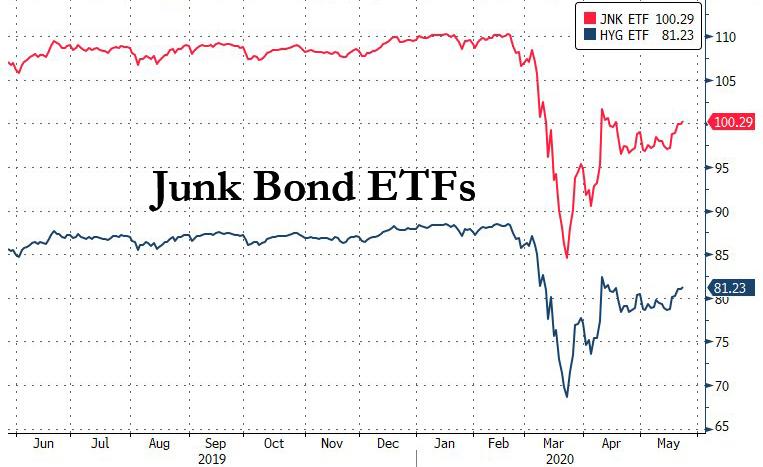
On March 23 - the day the S&P dropped to its cycle low of 2,237 - the Fed stunned capital markets when it announced it would purchase investment grade corporate bonds, traversing a Rubicon into secondary market intervention that not even Ben Bernanke had dared to cross. A few weeks later, on April 9, the Fed doubled down by announcing it would purchase not only junk bonds from "fallen angel" issuers (an announcement which came just days after a quarter in which a record $150BN in investment grade bonds were downgraded to junk, starting the long awaited tsunami of "fallen angels"), but would also buy junk bond ETFs such as HYG and JNK.
This is what the Fed's Secondary Market Corporate Credit Facilities term sheet said on this topic:
The Facility also may purchase U.S.-listed ETFs whose investment objective is to provide broad exposure to the market for U.S. corporate bonds. The preponderance of ETF holdings will be of ETFs whose primary investment objective is exposure to U.S. investment-grade corporate bonds, and the remainder will be in ETFs whose primary investment objective is exposure to U.S. high-yield corporate bonds
Naturally, the news cheered beaten down markets, and was enough to send junk bond ETFs such as JNK and HYG soaring.

One month later, following a surge in inquiry including from the bond king Jeff Gundlach as to when the Fed would actually start buying corporate bond ETFs, the Fed realized it would not be able to jawbone markets any more and would have to put its money where its term sheet was, and on May 11 the NY Fed said it would "begin purchases of exchange-traded funds (ETFs) on May 12."
And while the central bank said the focus of its ETF purchases would be on IG-focused ETFs, the New York Fed also disclosed it would start buying junk bonds ETFs as well:
As specified in the term sheet, the SMCCF may purchase U.S.-listed ETFs whose investment objective is to provide broad exposure to the market for U.S. corporate bonds. The preponderance of ETF holdings will be of ETFs whose primary investment objective is exposure to U.S. investment-grade corporate bonds, and the remainder will be in ETFs whose primary investment objective is exposure to U.S. high-yield corporate bonds.
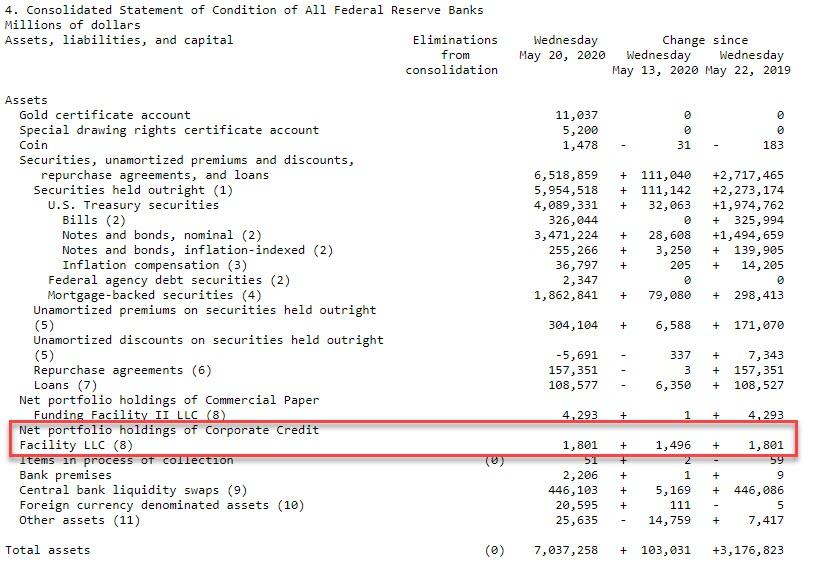
Then, last Thursday, we reported that as part of the Fed's record balance sheet, which for the first time ever surpassed $7 trillion, the Fed disclosed that it also held $1.8 billion under Corporate Credit Facility holdings, the line item that include purchases of both investment grade (LQD) and junk bonds ETFs (HYG, JNK, etc).

This came two days after Powell defended the Fed's program to buy junk bonds during his testimony before the Senate Banking Committee, which asked how purchases of junk bonds is "helping folks on Main Street." Powell flagged that the Fed allowed for buying bonds from so-called "fallen angels" to ensure there is "no cliff" between the two lending markets (even though as we pointed out previously, a clear cliff has formed), saying "we don't want to have a cliff there to where investment grade markets are working well, but the leveraged markets are not, non-investment grade markets are not."
He then added that "we made a very limited, narrow set of actions to support market function in these markets, including buying ETFs, and that's had an effect to improve market function there."
Powell concluded by saying "we're not buying junk bonds generally across the board at all," which of course is correct: he is merely buying ETFs that have junk bond constituents.
And this is where the Fed's first major test of directly manipulating and intervening in market functioning is about to take place.
While the Fed's H.4.1 statement does not breakdown how much of the $1.8 billion in ETF holdings is allocated to investment grade and how much is junk, it is safe to say that at least $1 dollar of that amount has been allocated to purchases of Junk ETFs.
That will be a problem for Powell, because a quick scan of the holdings of both HYG and JNK reveals that these junk bonds ETFs own, among the hudnreds of other securities, several bonds from the just defaulted rental giant, Hertz.
Here are HYG's holdings of HTZ bonds: they amount to just over $50MM in face value across 4 bonds (out of a total of $23.3BN in holdings across just over 1,000 bonds).
And here is JNK: just under $$30MM in notional across 3 CUSIPs out of a total of $11.55BN in total assets in the ETF.
And yes, for those asking, both ETFs hold that infamous Hertz bond that was issued last November and that will default before paying a single coupon.
To be sure, we can only extrapolate but it is safe to say that the Fed's holdings of both these ETFs are modest for the time being, and we assume that the bulk of ETF purchases have targeted the investment grade, LQD ETF; still the fact is that as of this moment, the Fed is a holder, via BlackRock and via HYG and JNK, of bonds which are in default, and which make the Fed a part of the Hertz post-petition equity once it emerges from bankruptcy!
This means that unless the Fed somehow manages to divest of Hertz bonds that comprise its HYG and JNK holdings, the US central bank is as of this moment a stakeholder in the Hertz bankruptcy process, and assuming there is no liquidation, will end up owning a pro-rata stake of the post-petition equity once the company emerges from bankruptcy in the not too distant future.
What happens then nobody knows: will the Fed take a vocal position in the company's future? Can the Fed even own equities via a debt-to-equity swap? What happens when hundreds of other junk bonds default and the Fed ends up owning billions in post-petition equity pro forma for equitization?
We don't know; we doubt anyone on Wall Street or in Congress knows. And we are certain that the Fed itself doesn't know, because in its scramble to stabilize the bond market, it forgot that once companies file for bankruptcy (certainly there is no discussion in the Fed's term sheets of what happens once its corporate bond holdings default) the Fed will - sooner or later - end up being an equityholder.
As a reminder, the ECB was faced with a similar scandal in Dec 2017 when it ended up holding bonds of insolvent Steinhoff, but back then Mario Draghi quickly liquidated the bonds and the market pretended nothing ever happened. The problem for Powell is that one look at the HYG and JNK holdings reveal dozens if not hundreds of companies which will file for bankruptcy within months if not weeks, suggesting the Hertz debacle is just the start of a bankruptcy flood in which the Fed will emerge as a key actor in bankruptcy court and Powell will have to explain away why it is now an equity stakeholder of bankrupt companies.
We eagerly look forward to Powell answering all these questions, hopefully as soon as this Friday when the Fed chair holds yet another video conference.