*NIBC: OFFER PRICE PAYABLE WOULD BE REDUCED TO EUR7.00/SHARE
Asian stocks started the week with gains after Friday’s U.S. jobs report smashed expectations and bolstered hope of a quick economic rebound. The dollar extended its recent slump.
Equities climbed modestly in Japan, China and Hong Kong, while Korean shares lost much of an early advance. Australia’s markets were closed for a holiday. S&P 500 contracts were largely flat after the index posted a third weekly advance last week. The dollar headed for an eighth straight day of declines, while 10-year Treasuries retained last week’s losses.
Nikkei +1.06% Hang Seng -0.19% CSI +0.49% Shanghai +0.23% Shenzen +0.08%
Eur$ 1.1295 CNH 7.0829 CNY 7.0861 JPY 109.51 GBP 1.2709 CHF 0.9631 RUB 68.2518 WTI$ 40.05 +1.26%
S&P +0.28% Nasdaq +0.35% EuroStoxx -0.44% FTSE -0.52% Dax -0.36% SMI -0.09%
Macro ;
- Dumb Money Is Looking a Lot Smarter in Never-Ending Stock Rally
- A Booming Stock Market Could Come Back to Bite the Recovery
- Oil’s OPEC+ Boost Eases With Compliance Concerns Lingering
- U.K. to Go Ahead with Quarantine That Will Further Slam Airlines
- Norway Oil Exploration Drops 30% as Virus Risk Crimps Operations
Keep an eye on :
- AIR FP : Airbus Logs No Cancellations, No New Orders in May
- AIR FP ; Airbus’s Global Footprint Becomes a Burden in a Shrinking Market
- AIR FP : France to Present Aerospace Aid Plan on Tuesday, Le Maire Says
- MT NA : ArcelorMittal Plans to Shed 5,000 Jobs in Italy, La Stampa Says
- AZN LN : AstraZeneca Cancer Drug Shows Early Signs of Promise in Covid-19
- AZN LN : AstraZeneca Is Said to Approach Gilead About Potential Merger
- BO DC : Bang & Olufsen Employees Agree to 10% Cut in Pay, Borsen Says
- BARC LN : High-Profile Names to Testify at Barclays $1.9 Billion Trial: FT
- BEN FP : Beneteau Accelerates Reorganization, Names Bruno Thivoyon as CFO
- BNP FP : BNP has Goldman in its sights after beefing up hedge fund business, French bank aims to join prime broking’s top 3 following acquisition of Deutsche unit last year - FT
- BKW SW : BKW to Enter Gas Market After Swiss Liberalization Move
- BWO NO : BW Offshore Gets Cidade de Sao Vicente Extension From Petrobras
- DHER GY : GrubHub Received Interest From Just Eat, Delivery Hero: CNBC
- EDF FP : China Poised to Pull Plans for U.K. Nuclear Plants: Sunday Times
- EDP PL : EDP Says Portuguese Prosecutor’s Proposal on CEO Has No Effect
- EFA PL : Sonae Capital Is Studying the Purchase of Efacec, Expresso Says
- ENX FP : Euronext May Total Cash Market Transaction Value M/M -5.4%
- FCT IM : Hackers Target Fincantieri’s Norwegian Unit With Ransomware
- GLPG NA : Gilead, Galapagos: Durable Efficacy in Phase 2 Eq. on Filgotinib
- HUSQB SS : Husqvarna Sales Decreased Some 12% in First Two Months of 2Q
- ISP IM : Intesa Gets Preliminary ECB Approval to Take Over Rival UBI
- INTU LN : U.K. Mall Landlord Intu Lines Up KPMG in Case of Administration
- MC FP : LVMH Still Focused on Price Cut in Tiffany Deal: CNBC
- MAP SM : Mapfre Intends to Approve 2020 Dividend, Chairman Tells El Pais
- MCOVB SS : Medicover Says Activity Recovered Faster Than Expected in May
- MCHN SW : Art Basel Show in Switzerland Canceled Over Coronavirus Worries
- MRNA US : Moderna Investigation Initiated by Former Louisiana AG
- MKS LN : U.K. Mulls Keeping Shops Open All Day on Sundays, Times Reports
- PST IM : Poste CEO Says Savings, Financial Sector Most Hit by Virus: Sole
- RNO FP : Nissan, Renault Collaboration Must Be Competitive: Uchida
- ROG Sw: Roche Sees Business Growing in 2020, CEO Tells FuW
- RYA LN : Ryanair Plans Lawsuit on Alleged Alitalia Aid, Repubblica Says
- UPGS LN : Up Global Sourcing Sees Earnings Above Expectations
- DG FP : Vinci’s Notebaert Says Co. Airports Ready to Reopen In France
- VOW3 GY : VW CEO Praised Musk’s SpaceX Success to Motivate Top Executives
- MF FP : Wendel Proposes EU2.80/Shr Div; Unchanged from Previous Year
- WDI GY : Wirecard Offices Searched in Probe Targeting Board Members
- WDI GY : FT Article on EY Dubai Practices
>>> Up
* Campari Raised to Outperform at Bernstein; PT 8.90 euros
* Carlsberg Raised to Overweight at JPMorgan; PT 1,050 kroner
* Covivio Raised to Buy at HSBC; PT 82 euros
* Hays Raised to Overweight at Morgan Stanley; PT 145 pence
* Kingfisher Raised to Outperform at RBC; PT 230 pence
* Siemens Healthineers Raised to Buy at Citi
* Swiss Re Raised to Outperform at RBC; PT 100 Swiss francs
>>> Down
* Andritz Cut to Hold at Commerzbank; PT 38 euros
* Deutsche Euroshop Cut to Sell at Bankhaus Metzler
* Evraz Cut to Sell at Citi
* Hochschild Mining Cut to Add at Peel Hunt
* JD Sports Cut to Underperform at RBC; PT 625 pence
* Kion Cut to Hold at Commerzbank; PT 60 euros
* Klepierre Cut to Sell at Goldman; PT 15.20 euros
* Lufthansa Cut to Underperform at Davy
* Merlin Cut to Sell at Goldman; PT 6.10 euros
* Orsted Cut to Hold at Grupo Santander; PT 820 kroner
* Polypipe Cut to Hold at Berenberg; PT 480 pence
* RBI Cut to Hold at Deutsche Bank; PT 19 euros
* Unibail Cut to Sell at Goldman; PT 44 euros
>>> Initiation
* Royal Unibrew Rated New Underweight at JPMorgan; PT 465 kroner
>>> Call
* Breedon Among U.K. Construction Picks; Polypipe Cut: Berenberg
* Hays Now Top Staffer Pick, Worst Case Priced In: Morgan Stanley
* H&M Faces ‘Challenging’ 2Q, Sales Outlook Improves: Berenberg
* JD Sports Gets Only Sell With RBC Cautious on Growth Prospects
* Kingfisher Double-Upgraded on Strong Positioning, Self-Help: RBC
* Siemens Healthineers Up to Buy at Citi on Covid-19 Test Upside
"A Sudden, Sharp Spike In Yields Will Cause A Stock Market Correction"
Last week, as traders were transfixed by the latest surge higher in stocks, the real move was elsewhere as 10Y yields finally broke out of the narrow range in which they had been trading for the past two months.
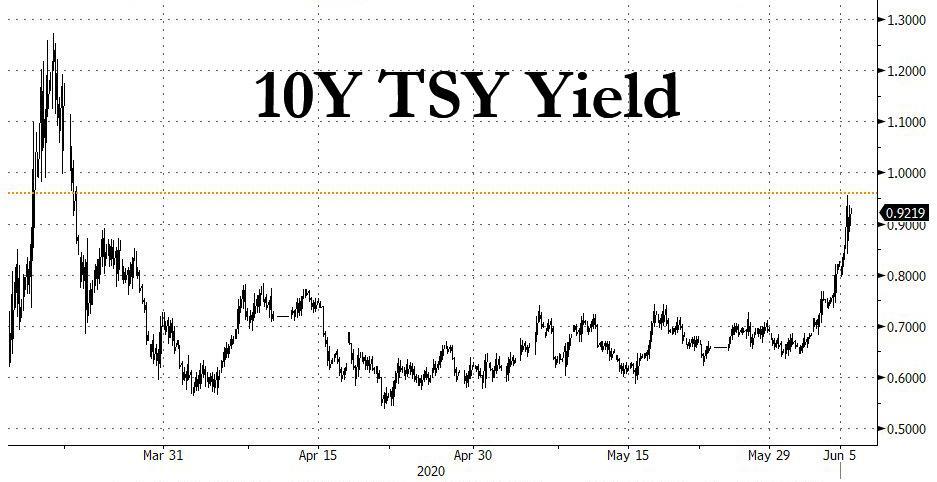
The breakout prompted BofA CIO Michael Hartnett to warn on Friday that the next "extreme move" will be in Treasuries, noting that the "biggest summer pain trade is disorderly rise in government bond yields", with the 30Y rising toward 2%, and the 10Y passing through 1%.
The problem is that such sharp, "VaR-shocking" moves higher in yields, which lead to substantially tighter financial conditions, don't happen in a vacuum and traditionally hit risk assets as Morgan Stanley's Michael Wilson warns in his weekly "Sunday Start" piece titled aptly, "Rates Play Catch-Up, Again."
In his latest note, Wilson starts off by first laying out the five reasons he has been bullish since March:
- Bear markets end, rather than begin, with recessions
- The health crisis that triggered this recession has brought unprecedented monetary and fiscal stimulus that would otherwise have been impossible
- The political pressures behind the reopening of the US economy are likely to make it faster and more durable, even if a second wave of the virus emerges
- Sentiment and positioning have remained remarkably bearish considering the size and persistence of the equity rally; and
- Index prices, the equity risk premium, market breadth and early-cycle leadership are all following the pattern seen after the 2009 bottom.
Wilson also noted that several signals which would support a continued bullish outlook for equities, have been missing, namely: i) the US dollar has remained strong as ii) 10-year Treasury yields continue to be depressed.
While one could argue that a strong US dollar benefits US equity markets through flows and lower rates support valuations, our contention is that both are bad signs for inflation and the overall economic recovery. Therefore, we were glad to see both a weaker dollar and higher back-end rates last week even before the stronger jobs data were released on Friday. In fact, both have moved above some key resistance levels left over from April. This combination provides the missing signal from two critical macro markets that a V-shaped recovery is looking more likely.
The Morgan Stanley analyst then uses the sharp spike in yields to validate his thesis that the bond market - which has been far more pessimistic on global growth - may be capitulating soon (in reality it is just the CTAs who are now dumping as yields crossed their red-line of 0.84%) and starting to price in more inflation, a bullish sign for risk assets. He also drills down into market internals, namely the unprecedented cyclical/defensive chasm, or value/momentum as some describe it, and picking up on what we said in "Is The Momentum-To-Value Rotation Real? The Answer Is In The 5s/30s", looks at the correlation between the cyclical/defensive ratio and 10Y yields:
...we continue to hear investor concerns that equity markets appear disconnected from reality. One argument in support of this view is that longer-term Treasury yields haven’t budged, and the bond market is smarter than the equity market when it comes to forecasting the economy. A good part of my investment framework is based on analyzing the internals of the equity market – i.e., how certain sectors, styles and factors are behaving – rather than the headline index. These signals contain a tremendous amount of information, and I have found them helpful in forecasting real economic activity. One of my favorites is the cyclical/defensives equity ratio, which has been a good leading indicator for economic growth, often better than Treasury yields.
Pointing to the chart below, Wilson shows that in 2018 this ratio proved to be timely in calling the peak rate of change in the US economy as it foreshadowed the top in long-term interest rates when the consensus was very bearish on Treasury bonds. In other words, at least according to Wislon, "equity market internals did a better job than the bond market in calling the top of the economic cycle", although we are confident that the purists will beg to differ.
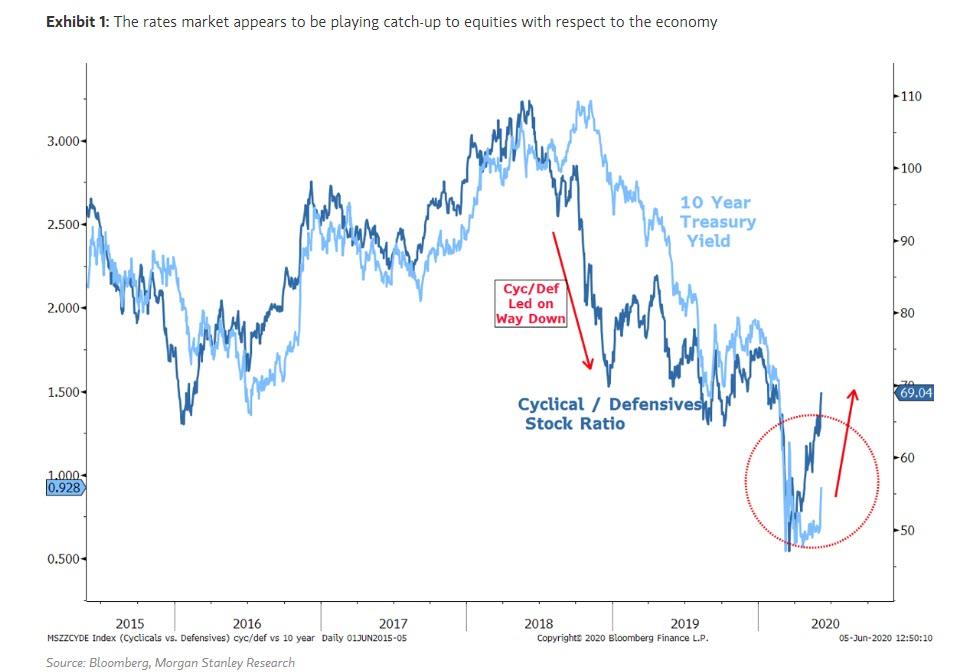
In any case, Wilson argues next that we now find ourselves in the exact opposite situation: "the stock market is ripping, led by cyclicals just as our recession playbook suggests. However, bond yields have lagged and failed to confirm the move in equities until this past week. The divergence between our cyclical/defensive equity ratio and the 10-year yield hasn’t been this wide since 2018, right before yields collapsed unexpectedly. Could this be a turning point for 10-year yields, when the consensus least expects it? Based on our interpretation of the equity market internals, there’s a good chance it is. "
In other words, Wilson desperately needs rates to be higher for his bullish thesis in which stocks rise driven by cyclicals, to be validated (and a jump in yields would also support the Morgan Stanley rates strategy team’s view for a steeper curve).
Which brings us to the downside risks: as Wilson puts it plainly, "sharply rising yields could have knock-on implications for equity portfolios." After all, one just needs to recall the dramatic surge in September 2018 following Powell's hawkish comments, that sent stocks tumbling and 10Y yields surging.
But is the current move comparable? To Wilson, the answer is yes, as "the kind of rise in yields suggested by our cyclical/defensive ratio would qualify as sharp. If rates quickly catch up to cyclicals, I believe it could be temporarily negative for equity indices as valuations come under pressure." The Morgan Stanley strategist then suggests that such a re-rating would likely not crush cyclical stocks, but would be most damaging to the bond proxies and longest-duration parts of the equity market – i.e., high-multiple stocks – which make up a large percentage of the index.
Considering that the vast bulk of equity positioning is precisely in this long-duration segment of the market, how anyone can claim that a selloff in the most concentrated names wouldn't translate into a broader crash, is confusing. At least Wilson concludes by again stating the what by now is all too clear: "A sudden, sharp move would likely cause a correction in the equity market" yet even so, he can't help but conclude bullishly: "I’d view it as just a bump in the road of this new bull market and an opportunity to add to risk, especially in the more economically sensitive areas that have been leading."
* * *
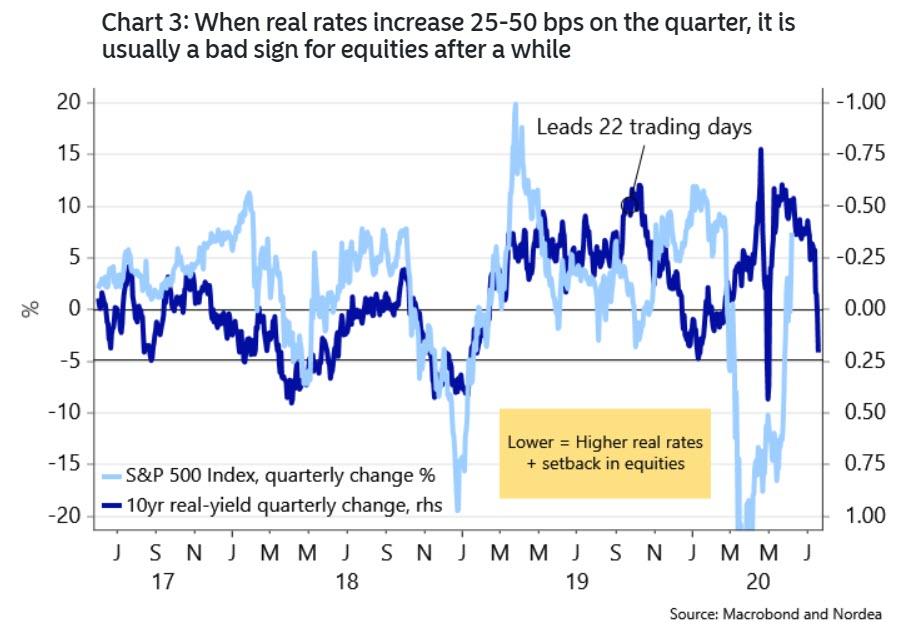
A far less sanguine take on the topic of surging yields comes from Nordea's Andreas Steno Larsen, who in his latest weekly note "EURphoria and panic YCC", agrees with Wilson that "rising real rates usually precede equity sell-offs or it has at least been the case since 2017. When real rates increase 25-50 bps on the quarter, it should raise a bit of concern for the equity momentum within a month."
Well, we are now approaching such territory again, with the Nordea strategist pointing out that 10yr USD real rates are up almost 25 bps on the quarter.
Next, picking up on what BofA's Hartnett said on Friday when he warned that the next "extreme move" will be in Treasuries, Larsen shows just why the BofA strategist is concerned about this: looking at the next chart, the Nordea analyst writes that "if rates are starting to play catch up with the V’s seen in FX and Nasdaq, the scope for higher long bonds yields may be remarkable." And indeed, if the correlations shown below stick, the 10Y could be set to surge almost 1 full percent to catch up with risk assets (if not inflation expectations).
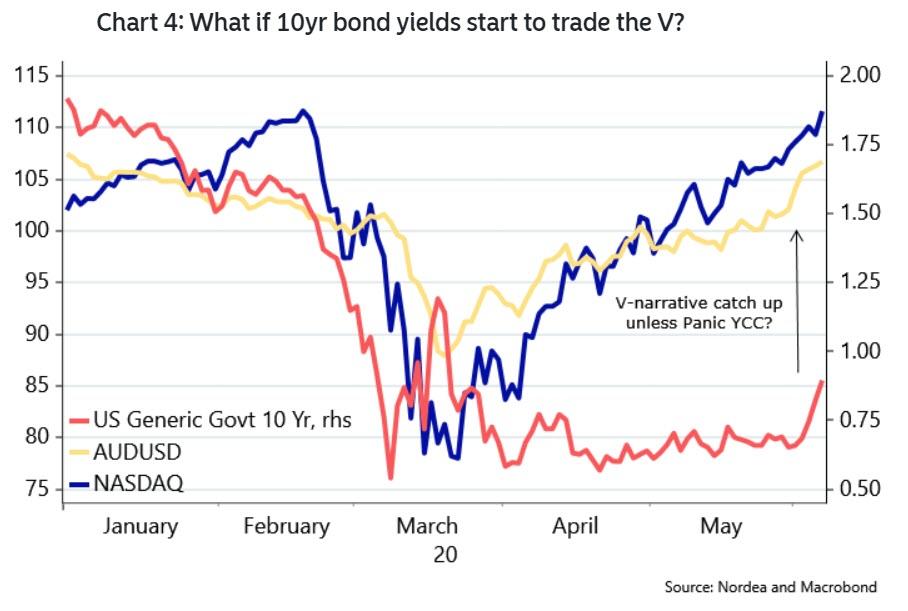
Will we see such a historic move in 10Y yields? While BofA's Hartnett remains on the fence, Larsen is even more skeptical writing that "the Fed could be faced with a firm "market force” if they don’t lock down the yield-curve on Wednesday" when the Fed's next policy meeting takes place. And since the Fed knows it can't afford to lose control of the long end, Nordea remains "very skeptical of a big move higher in long bond yields as YCC is actively being pondered within the Fed ahead of Wednesday."
In any case, "it is so important for the Fed to keep nominal bond yields down in the coming weeks, at least if they would like to keep the V-narrative alive in equity markets", which is why so many strategists have been calling for Powell to announce Yield Curve Control as soon as this Wednesday.
So while there is disagreement over the nuances and fringes, one thing all three strategists noted above agree on is that a violent move higher in yields will result in anything from a sharp market correction to another violent crash a la q4 2018.
One final point: if yields do in fact surge, there is one likely natural shock absorber that could send them sliding back down again, as Japanese-based investors should will start buying USTs including a USD/JPY hedge "with an arm and a leg now" according to Nordea as the "10yr FX hedged spread versus JGBs is now approaching 50 bps, which should automatically put a lid on the momentum of long USD bond yields.
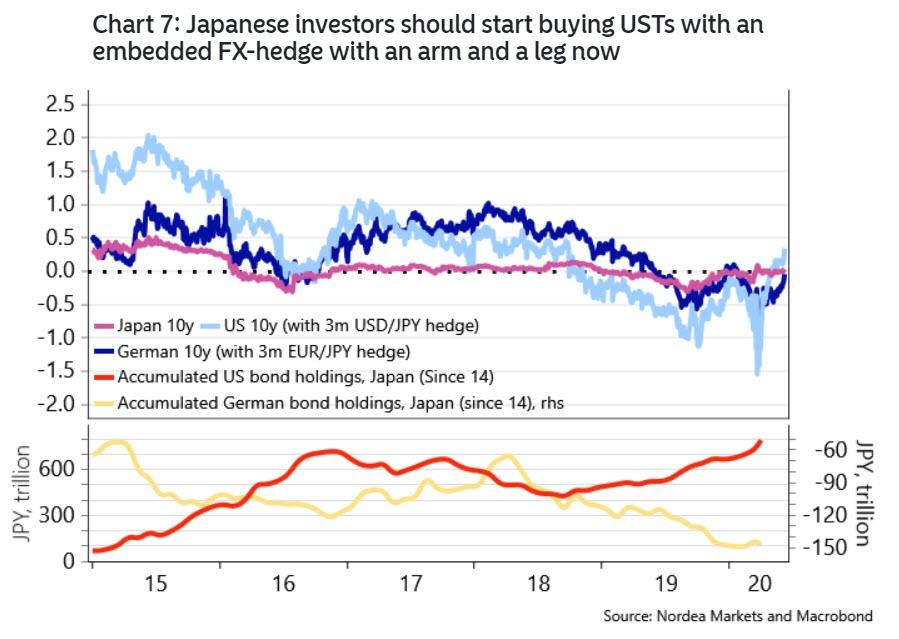
As Larsen concludes, "it is very rare to see +100 bps in such spreads without a subsequent Japanese purchase spree, which was for example the case in 2015."
The Cracks In The Financial System Are Getting Bigger... Here's What It Could Mean For Gold
In the over 30 years I’ve known him, my respect—and liking—for Frank Giustra has only grown. Not just because he’s a world-class businessman, having built Yorkton Securities into a powerhouse, and then founding Lionsgate Entertainment. More relevant to this interview, he’s a first-rate judge of the markets—one of the best I’ve ever met at seeing turning points and understanding trends.
He’s one of the few financiers in the “Master of the Universe” class that understands gold and economics. Frank knows what he’s talking about. I suggest you read this closely.

International Man:
Last time around, the Fed was able to paper over the crisis and create a ten-year bull market in stocks. Is the Fed out of ammo this time?
Frank Giustra:
They are, but that won’t stop them, and they’ll call it something else—helicopter money or Modern Monetary Theory (MMT).In the last cycle, it was QE. It wasn’t printing money; it was QE because it sounded better. It was much more calming and elegant to call it that. It almost rolled off your tongue.They will never call it money printing.The new and popular handle is Modern Monetary Theory. But it’s the same old Ponzi scheme. It’s still plain old money printing.MMT is designed to create demand through money printing, with the idea that you can tax that later as you reach full capacity. But it makes some very naive assumptions about the way politicians operate. It would never work, and the money printing will leave you on the same path as previous disaster stories. Math is math. It’s impervious to bullshit.If you’re printing too much money, it’s going to influence inflation. We’ve already seen it with asset inflation over the last ten years. Inflation didn’t go into the CPI but went into various asset classes instead.As you know, Doug Casey has been writing about this topic for 40 years. I started writing about it 20 years ago. It’s become a fascination for me.Let’s look at how things evolved.It all started with Alan Greenspan. He was the one who ushered in the era of pleasing markets with free money or easy money.He was the first to bail out markets at every crisis and the markets cheered him on.Greenspan was the one that set the stage for the 2008 crisis. Ben Bernanke set the stage for what we’re facing now.All they’ve done is encourage debt and speculation. And to a great extent, the markets still believe the Fed can continue to fix the mess they created.I am absolutely stunned gold is still trading at these levels. Don’t people realize where we are heading?
International Man:
Do you think negative nominal interest rates are coming to the U.S.? If so, what do you think the effects will be?
Frank Giustra:
So far, the Fed has been very reluctant to talk about introducing negative rates.As hopeless as they are, I think they understand what that would mean if the U.S. went into negative rate territory.But Trump is a bully. If he sees the economy still floundering between now and November, he’s going to push and bully.He will likely get his way because the Fed is not truly independent. That idea went out the window long ago. It all started with Greenspan. It was gradual in the beginning, but eventually, it became clear that the separation between church and state was gone. Fiscal and monetary policy work in tandem. It’s one big happy gravy train for the markets.I believe if the economy does what I think it will do, Trump might get his way.
International Man:
Negative interest rates incentivize bad behavior. Savers will be decimated, and borrowers will be rewarded.What do you think the effects of that would be?
Frank Giustra:
It’s true what you say about the savers. Unfortunately for them, they are not the ones that influence policy. Wall Street alone has that power.Savers will certainly get screwed in the end and eventually the speculators will also. They think this party will never end, but they are delusional. It will end.Delusion is firmly engrained in the investor psyche.Wall Street pushes for this continued bad behavior. They throw a hissy fit when they don’t see enough easy credit, and they always seem to get what they want.
International Man:
What do you think the role of gold will be as the international monetary system evolves?
Frank Giustra:
It is tough to say.I don’t think we’ll ever go back to a a strict gold standard. That’s just not going to happen.I believe one of two things may happen. The replacement of the U.S. dollar might end up being some kind of trading unit, a combination of a number of currencies, perhaps with some commodity basket as backing.Or, we may end up with regional currency units that represent trading blocks. Perhaps, Asia as one and the West as another. It’s hard to say.However this plays out, it will be messy. We live in a fractured world. There is no leadership or common ground. In this environment, it’s hard to see how there will be any consensus to replace the dollar. But, it will happen somehow, however messy. I just hope it’s peaceful.
International Man:
The point you made about trading blocks in interesting.Countries like China and Russia are buying substantial amounts of gold.In a world where fiat currencies aren’t trusted by anybody, do you think that gold will play a role in building trust between countries?
Frank Giustra:
It’s already playing a role.They are worried about the weaponization of the U.S. dollar. This concerns not only adversaries like China and Russia, but traditional allies like Europe as well.Their central banks have been buyers of gold for a very long time. I think they’re buying it because they have to de-dollarize. They’re worried about having too many dollars, especially China.Gold is the only currency that’s not paper. It’s trusted globally by central banks. The mere fact that central banks hold it as part of their reserves and that many continue to buy it on a regular basis has to tell you something about its value.Wall Street has mostly ignored gold in the past as an important component of investment portfolios. I say, watch what they do not what they say. Look at central bank behaviour.Follow the money.
International Man:
Recently, we’ve seen gold break through to multi-year highs. What do you think comes next in this gold bull market, and where do you think it’s ultimately going?
Frank Giustra:
I’ve never made a prediction on the gold price. I will always say it’s going higher if I believe it’s going higher.I think that this time, it is going a lot higher, and I will say that much. Where it goes is anybody’s guess.But I’ll tell you one thing—and I’ve been saying this for the last 12 months.This phase of the gold bull market—which started last year—is the third and final wave of the bull market that started in 2001, and this one’s going to be a tsunami.This time, gold will really break out and go to a number that most investors can’t begin to imagine.The eventual gold price is also a function of how long it will take for high or hyperinflation to kick in and what happens in the period before it does.Will we see currency wars? A depression? We are entering scary times.And I mean the real stuff when it comes to gold. Personally, I don’t trust gold ETFsWhen the proverbial poop hits the fan, I believe governments will go to any length to protect their currency. They won’t let you find a place to hide. They will freeze bank accounts and prevent you from exchanging your dollars into other currencies or gold.We have seen this many times before in other countries and even in the U.S.; in 1933, it became illegal for American citizens to own gold, and that law remained in place for almost 40 years. And and these type of protective measures will happen again, in some shape or form.In essence, they will prevent you from trying to protect your savings. Sounds horrible, but it happens over and over again. That’s why you need to own some physical gold.Again, I can’t tell you exactly how this plays out and how high gold will run. I don’t have a crystal ball. But I do have history books.
International Man:
How do average people manage their risk in an environment like this?
Frank Giustra:
It’s tough. I think about this question a lot.Until the dust settles, I’d say stick with cash and gold.Unless it’s gold stocks, I’m not in the market. I think the market is still ridiculously overpriced, given what’s happening in the real economy.The only reason the stock market is still overpriced is because the Fed continues to print free money, which allows speculation to continue at a feverish pace.I just don’t see where the earnings are going to come from. I think that reality is going to set in—probably in the fall or next year.Cash is always useful to buy things; invest because there is no way to know when exactly hyperinflation will set in and you need cash to buy things if they get really cheap. Timing is everything.I try to keep things simple.You will never outsmart the market in the short term, but the probability that things will get very bad is pretty high up on the bell curve. Buy gold, and keep your powder dry and pray.
* * *
(You can find Frank’s writing and insights at http://frankgiustra.com/.)
The ripple effects of the government lockdown are only stating to take shape. That’s not to mention the unprecedented amount of money the that is being pumped into every corner of the economy by the Federal Reserve. That’s exactly why New York Times best-selling author Doug Casey just released an urgent new PDF titled Guide to Surviving and Thriving During an Economic Collapse. It explains what’s to come and exactly what you should do to protect yourself. Click here to get it now.
Not Just Retail: Hedge Funds Flood Into Stocks; Net Leverage Highest In Over Two Years
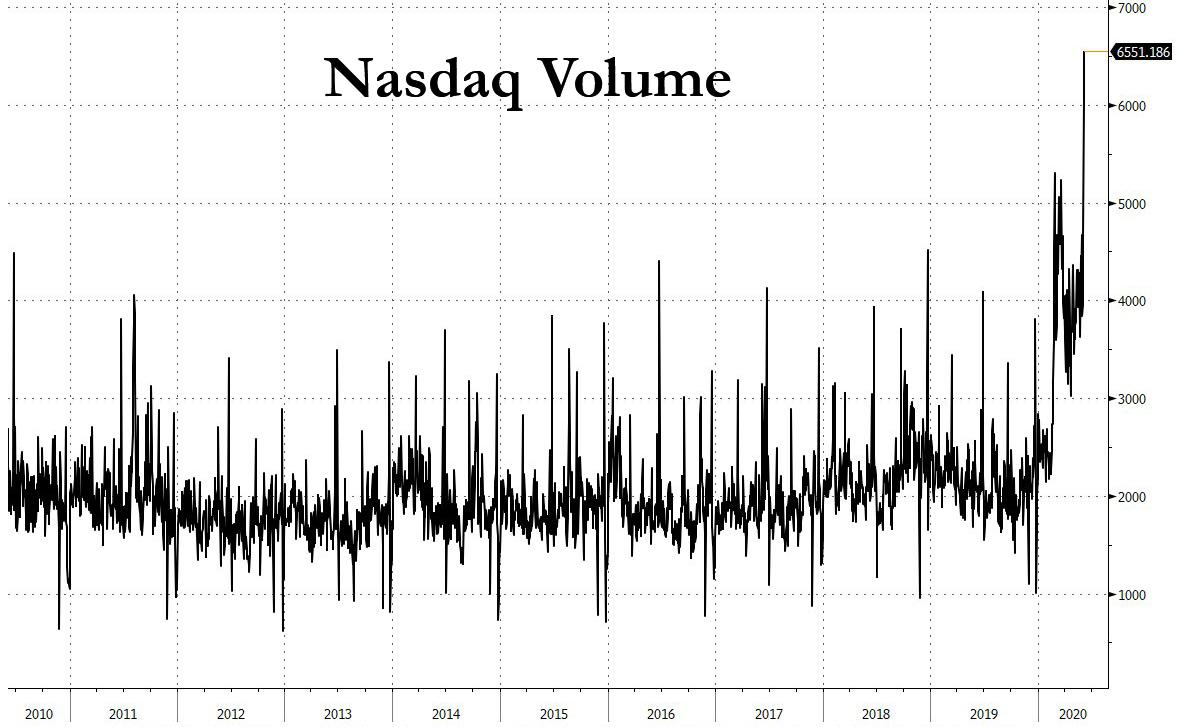
On Friday we officially entered the blow-off top phase of the current meltup: between a record surge in Nasdaq volume...
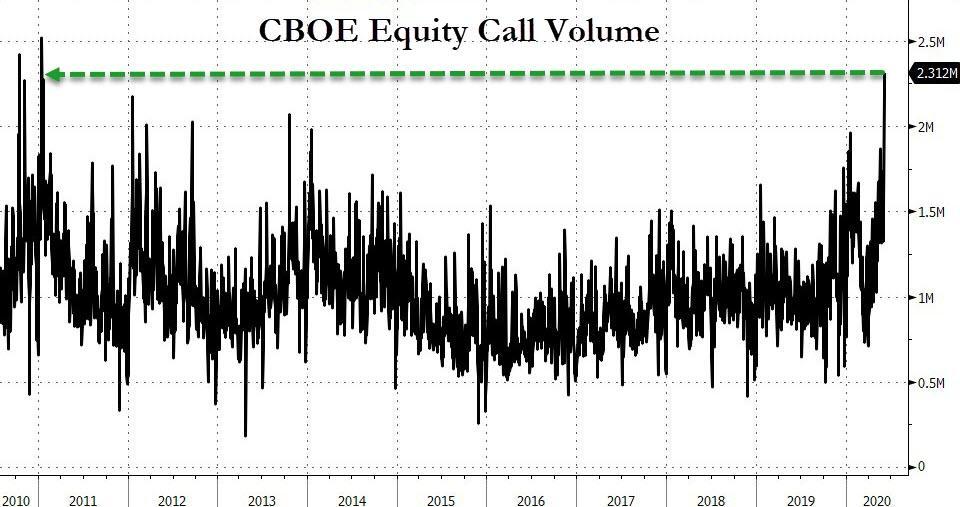
... between a spike in equity call volumes to a decade high...
... and a put-to-call ratio that plunged just shy of all time lows...

... the message was clear: the moment of trader euphoria and buying from retail investors (who as we noted previously managed to lift bankrupt Hertz by 100% on record volumes earlier in the day) so many bulls have been saying is not here so just keep buying as retail froth is missing from the market. Well, it certainly isn't missing any more, as "small traders are now full-bore bullish, on steroids" (thanks Fed).


Well, it's not just retail investors anymore: according to Goldman's PB desk, after holding out for months hedge funds finally capitulated and are now also flooding into stocks.
In its latest weekly exposure report, Goldman's prime desk notes that while overall hedge fund gross leverage fell -2.5 pts to 247.1% (96th percentile one-year), net leverage rose +1.0% to 75.0%, the highest level in over two years.
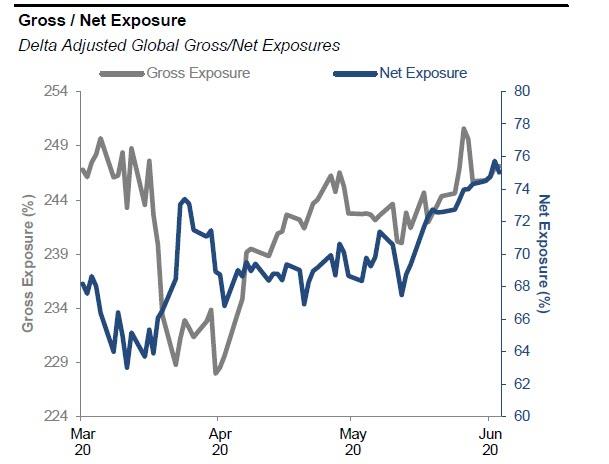
This happened with hedge funds scrambling to cover even more shorts as the MSCI World Index increased +3.3%; as a result the GS Prime Brokerage Book was net bought driven by short covering outweighing long selling in a 2.4:1 ratio, confirming what Citi said recently that much if not all of the recent rally has been driven by short covering.
Digging into the flow data reveals that all regions were net bought led by Europe and North America.
- North America was net bought driven by “risk off” flows – short covering and long selling. Europe’s net buying however was characterized by “bullish” flows – long buying and short covering.
- North America’s weight vs. the MSCI decreased -0.6 pts to +2.6% O/W (91st percentile vs. past year), while Europe’s weight rose +0.4 pts to -4.0% U/W (40th percentile vs. past year).
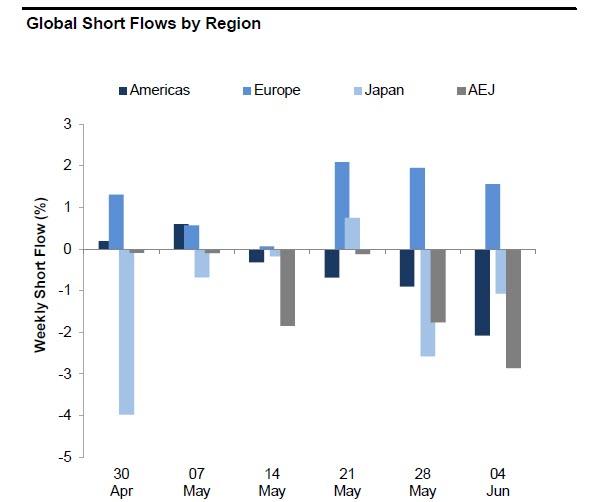
At the sector level, funds again faded the rally in US Industrials even as cyclical stocks soared. The sector was the second most net sold in the US driven by "risk off" flows of long selling outweighing short covering in a 1.2:1 ratio. The sector’s weight vs. the S&P 500 fell -0.7 pts to -1.5% U/W, the lowest level since Sept 2017 according to Goldman's prime desk.
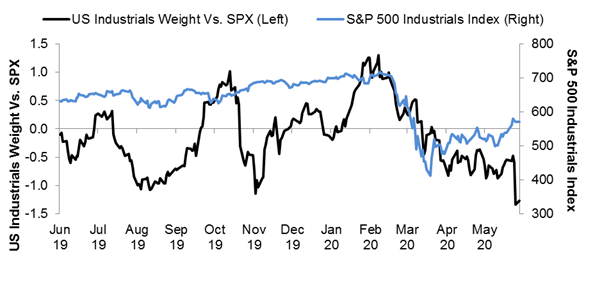
While seven out of the eleven Industries were net sold driven by Aerospace & Defense and Construction & Engineering, Airlines and Commercial Svcs & Supplies were the most net bought industries (so it wasn't just retail flooding in JETS).

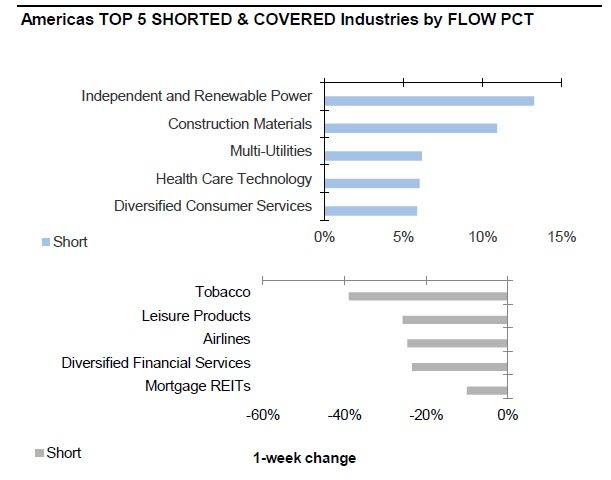
Focusing on the short squeeze, single stock shorts decreased by -2.1% as nine out of eleven sectors were covered led by Consumer Discretionary and Industrials. Utilities and Real Estate were the only shorted sectors. Consumer Discretionary flows diverged – inflows were led by Diversified Consumer Svcs, while outflows were led by Leisure Profucts.
US ETF shorts decreased -2.6% and currently make up 16.5% of the US Short Book (vs. 16.9% last week).
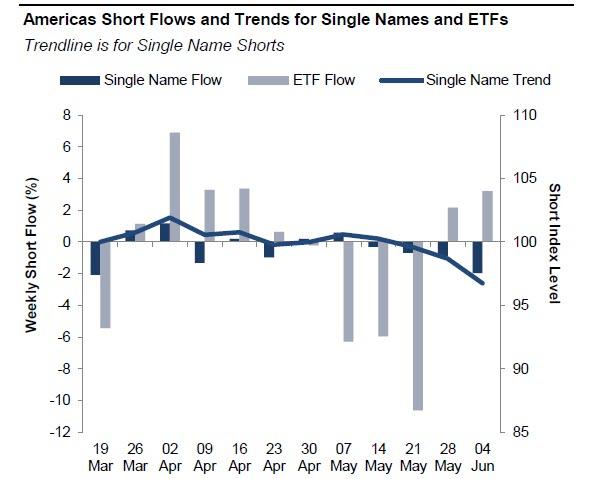
ETF short outflows were driven by Fixed Income, US Listed, and Small and Large Cap ETFs.
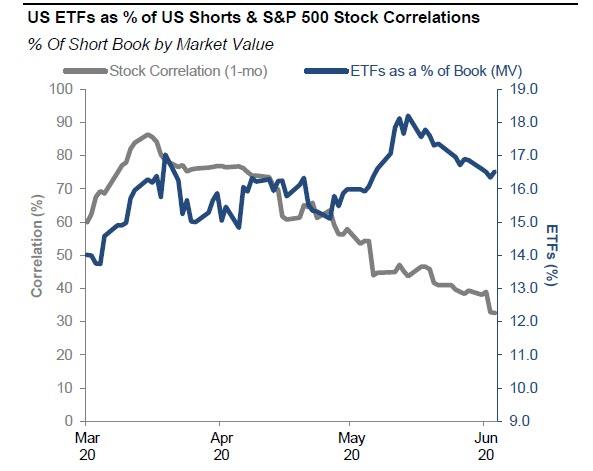
Finally, at the single stock level, some of the most prominent hedge fund rotations were the following:
- Royal Caribbean (RCL) shorts increased +17% as shares rose 12% amid the pricing of a debt offering
- Slack Technologies Inc (WORK) shorts increased +36% as shares rose 17% amid Q1 earnings
- Inovio Pharmaceutical (INO) shorts increased +16% as shares fell 11% amid continued Covid19 Vaccine trials
The Secrets to Mytheresa’s Success
How has the retailer made luxury e-commerce profitable when competitors have struggled? CEO and President Michael Kliger reveals Mytheresa's secret sauce.
LONDON, United Kingdom — Fashion e-commerce is a tricky business. Online luxury sales grew by double digits in 2019. By 2025, e-commerce will account for 30 percent of the luxury goods market, according to Bain. But despite the momentum, both digital heavyweights like Yoox Net-a-Porter and Farfetch, and luxury goliaths like LVMH, have struggled to make multi-brand e-commerce profitable.
“We haven’t found a way to make it profitable,” admitted LVMH Chairman Bernard Arnault at the group’s 2019 results presentation in January, referring to its e-tailer 24S. “All of them are losing money,” he said of competitors. “The bigger they are, the more money they lose.”
And yet German luxury e-tailer Mytheresa has been profitable since its inception, when Susanne and Christoph Botschen took their Munich-based fashion boutique Theresa online in 2006. Now part of the troubled Neiman Marcus Group, Mytheresa generated €377 million in revenue in the year ending in June 2019, up 24.7 percent year-on-year, while growing EBITDA — or earnings before interest, taxes, depreciation, and amortisation, a measure of operating profit — by 50 percent.
Along with the inventory risk inherent in the traditional wholesale model, online players like Mytheresa must contend with several challenges. There’s the logistical friction and cost of managing shipping and returns. And because most luxury e-tailers sell similar products, offer similar experiences and operate in a saturated market where competitors are just a click away and price comparison is common, they are often forced to engage in competitive discounting to drive sales. But the greatest challenge is poor return on high customer acquisition cost.
“Customer acquisition cost is the biggest element in your P&L and you can spend a lot of money without getting results,” said Mytheresa Chief Executive and President Michael Kliger, a former McKinsey & Company consultant turned eBay executive who joined the business in 2015.
A big part of Mytheresa’s success comes down to discipline and scale. The company hasn’t pursued the rapid, marketing-fuelled growth that has derailed competitors. But as the e-tailer eyes expansion in Asia and the US, it will need to spend more money to acquire new customers. Can Mytheresa take things to the next level and stay profitable?
Customer focus and a golden metric
Mytheresa’s 'secret sauce' starts with solving the customer acquisition conundrum by better understanding how and where to invest marketing spend. The company has a singular focus on acquiring the right customers and has built sophisticated attribution models to understand as early as possible exactly which customers are worth engaging and which aren’t.
Competitors have similar techniques for evaluating the value of the traffic they acquire. But while many fashion e-commerce players optimise their marketing to deliver immediate sales revenue, Mytheresa is sharply focused on a different metric: customer lifetime value, or the net profit a company believes it will generate from its entire future relationship with a customer.
Mytheresa is not targeting aspirational shoppers who purchase a trendy piece and never come back. It’s after wealthy fashion lovers who have a high propensity to become valuable long-term clients. Typically, they are cash-rich but time-poor, and value curation and convenience.
To identify these people, Mytheresa has spent significant time analysing clues to predict future behaviour, like how a customer came to its website, as well as early interactions with certain product categories and brands, initial purchases, payment method and home address.
“We have tried to understand which traffic brings what type of customer, because there is a customer that buys a pair of sneakers who then continues spending a lot over the next couple of years and there's another type of customer who buys that same pair of sneakers and nothing happens — that's probably the only luxury piece they will buy for some time,” explained Kliger.
“What ad did that person click to get to our website? What are the first three products? Already the probability machine starts saying: what’s the fourth product and is that good or bad?”
Machines that can find patterns, establish correlations and infer probabilities from large data sets are extremely powerful. But trend-driven markets like fashion are dynamic and complex, and Mytheresa’s models need constant fine-tuning to keep working.
“It’s really not finding the one algorithm; it's the ability to constantly work on this,” said Kliger. “Ten years ago, a person who looked at sneakers would have perhaps not been a luxury customer. Five years ago, someone that looked at a certain brand would have said, ‘That's too classic.’ And now the same brand is extremely fashion-forward. So, the clues are not constant.”
Less is more, small is beautiful
Like competitors, Mytheresa relies on expert buyers such as Tiffany Hsu, the company’s fashion buying director, to know what’s likely to ignite desire next season. “They're not following suggestions on spreadsheets,” said Kliger. “They’re going into the showroom and trying to understand: Is this an exciting product? Will that product sell?”
But the company’s laser focus on serving a specific, high-value customer has resulted in a clearly defined, high-end positioning and tightly curated, highly productive buys. “Sixty-five percent of the business is based on 30 top brands,” said retail consultant Robert Burke.
“In e-commerce, the other big trap is the endless aisle,” explained Kliger. “You have no physical walls to otherwise force you to think hard about what you buy. This may work for Amazon, but in luxury fashion, the belief that ten more products mean more revenue is a fallacy.” Fewer SKUs also drive operational efficiencies like lower photography requirements.
“We don't want another group of customers; we want this customer,” said Kliger. “What can we offer to this customer that she will also like? What are the key brands? What are the right features on our website? With this kind of ruthless thinking, you decomplicate the whole thing.”
For the wealthy shoppers Mytheresa is targeting, time is perhaps the most valuable currency of all and its customer experience is primarily focused on convenience. The company has forgone the more editorialised approach adopted by competitors like Net-a-Porter and was early to go mobile-first. “Everything we do caters to the fact that she has no time,” said Isabel May, Mytheresa’s chief customer experience officer and managing director.
By virtue of its high-end clientele, Mytheresa has developed close relationships with top luxury brands and regularly secures exclusive capsule collections from sought-after labels. “Brands have a very positive view of them, so they get a lot of exclusive product,” said Burke.
But perhaps most critically, Mytheresa has been disciplined about growth. The company has not chased the rapid, marketing-fuelled expansion that has hurt profitability at larger competitors.
“They have a very clear point of view; a very strong positioning compared to the larger players,” explained Burke. “And because of their size, they are able to stay focused. They haven’t tried to grow beyond their ability. They have been very nimble, specific and thorough.”
The pandemic and a post-Neiman future
Like competitors, Mytheresa has been hit hard by the Covid-19 pandemic, which has crushed consumer demand and disrupted operations across the luxury industry. But the e-tailer was lucky to be a digital business based in Germany, where its warehouses kept running even as competitors like Net-a-Porter were forced to shut facilities.
Kliger reports “a big, big negative” in the US, but sees “clear green shoots” in China and South Korea, as well as positive momentum in parts of Europe — including Austria, Switzerland, Germany and the Netherlands — where the company generates more than half its revenue.
At the same time, luxury brands are doubling down on their own direct-to-consumer sales channels and pulling back from wholesale. But Kliger is unperturbed. “Our customer is not the customer that goes to 50 boutiques on one street, nor will she go to 50 dot coms,” he said. “In a €50 billion online luxury market, I do not believe there's one model. Consumers want choice.”
Consumer spending is likely to lag a rebound in wider economic activity as the pandemic takes a psychological toll on shoppers, with serious implications for fashion, which depends on optimism to drive discretionary purchases. And yet, the pandemic may also deepen economic inequality and tip the fashion market towards e-commerce, playing to Mytheresa’s strengths.
The company is significantly underpenetrated in China and the US, the world’s largest consumer markets, and only launched childrenswear in early 2019 and menswear this January, giving it significant scope for future growth.
And yet there are hurdles ahead. “They have very little brand awareness in the US and will need to really spend on customer acquisition to compete against larger players,” noted Burke.
Then, there’s the issue of Mytheresa’s owner. The debt-laden Neiman Marcus Group, which also owns Bergdorf Goodman, filed for bankruptcy in early May. Mytheresa is controlled by a corporate shell and is not part of the Chapter 11 proceedings, though the e-tailer’s ownership has been contested by two lenders which filed separate lawsuits, in 2018 and 2019, claiming Neiman Marcus, at the direction of private-equity owner Ares Management, inappropriately transferred Mytheresa to its corporate parent, beyond the reach of debtholders.
The first lawsuit was dismissed in early 2019; the second has been stayed for the duration of the bankruptcy process. But issues surrounding the transfer were recently the topic of a six-hour hearing in bankruptcy court and seem unlikely to disappear.
According to a filing with the US Securities and Exchange Commission, Neiman Marcus began exploring strategic options for Mytheresa in April 2019, soon after an estimate by Goldman Sachs valued the business at $1 billion, a figure that analysts said was justified by the company’s high-luxury positioning and growth potential.
LVMH has signalled its disinterest in multi-brand e-commerce, while Richemont has its hands full with Yoox Net-a-Porter. But Mytheresa could be a compelling target for a tech giant lacking a presence in the luxury market, a physical retailer that has struggled to develop its own online operations or a private equity firm, said luxury adviser Mario Ortelli.
A deal has yet to materialise, however.
“Our owners were looking for strategic alternatives from IPO to selling the company,” confirmed Kliger. However, the economic and financial gloom brought about by the pandemic has put things on pause, he said. “We won't do anything at the moment.”
Neiman Marcus Group Inc, which owns Mytheresa, remains untouched by the Chapter 11 proceedings. But theoretically that could change, triggering a change in shareholding. “What happens at the moment in the US may be a catalyst for change or may not be,” said Kliger.
For now, the company remains focused on assembling “the largest list of active luxury customers and relationships around the world,” he said. “If you think about revenue, you are already in the danger zone. But if you think about customer relationships, revenue will follow.”
Paul Myners calls for scrutiny into H2O’s illiquid asset sales
Intervention of former City minister follows asset manager’s sale of assets back to Lars Windhorst
Paul Myners has called on the UK regulator to investigate the value of transactions between H2O Asset Management and entities with links to it, just weeks after the group agreed to sell assets to German financier Lars Windhorst in a deal shrouded in secrecy.
The former City minister, who made his name as chief executive of investment manager Gartmore, said the Financial Conduct Authority should probe H2O’s trades to ensure that assets were sold at a fair price.
His intervention, which was sent as a written question to the UK parliament last week, came after the Natixis subsidiary signed an agreement at the end of April to sell back stocks and bonds to Mr Windhorst, the flamboyant financier with links to H2O’s top management.
H2O has been under pressure to reduce its funds’ holdings of illiquid assets linked to Mr Windhorst since a Financial Times investigation last year revealed the scale of the manager’s exposure, prompting more than €8bn of investor outflows.
Few details were disclosed about H2O’s agreement to sell assets linked to Mr Windhorst to the financier’s new investment vehicle, although people with knowledge of the situation told the FT that the assets would be sold at a discount. H2O took heavy writedowns on bonds linked to Mr Windhorst last year.
Lord Myners did not make explicit reference to the deal, but told FTfm that he was concerned about whether H2O’s transactions with parties related to it had delivered fair value for investors.
H2O chief executive Bruno Crastes previously sat on the board of Mr Windhorst’s investment company, a role that was highlighted by fund rating company Morningstar as posing a potential conflict of interest.
Mr Crastes stepped down from the position following the FT investigation and was replaced by H2O chief investment officer and co-founder Vincent Chailley. Both Natixis and H2O insisted there was nothing wrong with the initial arrangement.
Lord Myners also voiced concerns about whether H2O had engaged in so-called cross trades, shifting investments from one client portfolio to another. Last year, the manager said it was considering moving illiquid bonds into a separate fund.
“Cross trades need to be carefully monitored to ensure they don’t favour one client over another,” said Lord Myners. “The same goes for trades with related parties.”
H2O declined to comment on its transactions. The London-based company managed to staunch the surge in outflows from its funds last year but has come under renewed pressure recently after its flagship bond and foreign exchange funds lost more than 50 per cent of their value, as the coronavirus outbreak knocked financial markets in March.
It is not the first time Lord Myners has brought events at H2O to regulators’ attention. In March, he submitted a written question asking what plans the UK government had to investigate H2O’s “risk control strategies and executive leadership” in light of the manager’s disclosure of “surprisingly large” losses in some of its funds.
The FCA said it would respond to Lord Myners.
Toulouse’s troubles mirror those of France as a whole
Economy dependent on a few big companies in small number of sectors could struggle to recover
Philippe Robardey was born and raised in Toulouse and spent the past 30 years building up his family’s aerospace business. But now he fears the sector could be facing a “cataclysm” and the city its “Detroit moment” — a reference to the hollowing out of what was once the heart of the US car industry.
His company, Sogeclair, sells design and manufacturing services and is just one link in a lengthy supply chain which has been hammered by the pandemic.
Toulouse is home to Airbus and sits at the heart of the European aerospace industry — some 200,000 people in the wider region work in the sector, according to local officials. Although it was not hit hard by the virus directly, France’s fourth-largest city is now exposed to its cascading economic effects. What is more, the risk for Toulouse is also a risk for France.
“The French economy has become granular,” said Philippe Martin, chairman of the French Council of Economic Analysis. “In France we are now more dependent on a few very big firms in a few sectors. Airbus in aerospace is an obvious one. LVMH in luxury too. The vulnerability of these big firms translates to the whole economy.”
France’s gross domestic product is likely to shrink 11 per cent this year while Germany’s is set to decline by 6 per cent, helped by a lockdown which was less strict, a stimulus which was more powerful and an economy less reliant on internal consumption and tourism than its neighbour.
“The German lockdown was not as strict and . . . if you add it up, Germany has put 24.5 per cent of its GDP on the table in fiscal support for the economy; in France it’s closer to 12 per cent,” said Céline Antonin, an economist at the OFCE in Paris.
Mr Martin agreed that the intensity of the lockdown remained the most important factor, but added: “We also have to look at the generosity of government short term work schemes and the question of trust in institutions and the quality of social relations. If people don’t trust the public institutions to handle the crisis and employee wages were being paid up to 84 per cent, then the choice to just close up may be easier.”
The particular problem for Toulouse is that the aerospace sector faces a long period of lower demand. Airbus has already slashed production by a third. Philippe Petitcolin, chief executive of French engine maker and equipment supplier Safran, says the supply chain will have to reduce its capacity by 30 to 40 per cent “for the years ahead”.
That supply chain is also fragmented — Safran Electrical & Power’s Villemur-sur-Tarn plant outside Toulouse uses 4,000 parts from 160 suppliers to put in place more 2600km of cabling every year. And according to a 2018 study, 61 per cent of French companies in the sector made less than €50m a year.
Balance sheets are thus less fortified as the crisis bites and credit between companies in the supply chain dries up. “Businesses are going to disappear. There are going to be large lay-offs and there are going to be consolidations that have to take place,” says Mr Robardey, 60, who also heads the Toulouse chamber of commerce and is calling on the state and EU to step in.
Companies have made widespread use of government furlough schemes, but permanent job losses are looming. Employees at Derichebourg aeronautics services in Toulouse are already protesting against proposed cuts.
“I think there will be about 30 per cent of employees in the sector that will find themselves looking for work,” said Dominique Faure, deputy mayor of Toulouse, who looks after economic development. “But it could be 50 per cent, it could be 15 per cent, it’s all about how the economy rebounds.”
Consolidation would provide stability, but will not be easy to achieve. In 2008, industry insiders said they expected a 30 per cent consolidation in the French supply chain that never happened — in part because the market rebounded but also because small, family-owned businesses did not want to give up control.
The French state is planning to unveil a plan to help the aerospace sector this week, including a consolidation fund of less than €1bn being raised from private investors and the industry with the government expected to weigh in.
Big companies will also be pushed to help smaller ones — by extending credit and maintaining contracts — but those like Safran have warned they cannot be expected to support the supply chain indefinitely.
Meanwhile, Ms Faure is trying to spin opportunity out of crisis, arguing that Toulouse and the surrounding region can use the job losses to retrain in areas like artificial intelligence, health and mobility, while businesses can use this hiatus to modernise.
Most importantly, she says “we have to make sure to keep those skills and people in the region . . . to be ready for the rebound”.
The government seems to agree, acting to protect an industry it views as strategic.
“Just yesterday I took a call from a small business making less than €10m a year that had been approached by a potential Chinese buyer, an investment fund,” said Michaël Nogal, a member of parliament in Toulouse for Emmanuel Macron’s governing party. “They’re doing their shopping.”
“Lots of these businesses have specialist knowhow and we can’t allow that to be stolen away. It’s that simple,” added Mr Nogal, who is acting as a go-between for the aerospace supply chain and the government.
The issue for Toulouse, as Nicolas Bouzou, head of Asterès, an economic research centre, says, is that it “was probably over-specialised going into the crisis”. Changing that will take time.
That means its near-term fortunes might be out of its hands. “Until people start flying again, we are going to have a problem,” said Mr Robardey.