WSJ : House Passes $1.5 Trillion Infrastructure Bill

House Passes $1.5 Trillion Infrastructure Bill
Democratic plan to rebuild roads and rails doesn’t have Republican support, and bipartisan efforts have faltered for years

WASHINGTON—The House passed a broad, $1.5 trillion effort to rebuild the nation’s roads, railways and schools, as Democrats pursued their own infrastructure legislation without the bipartisan deal discussed for years during the Trump administration.

Almost 40 House Democrats joined with House Republicans to approve a last-minute amendment to the legislation on the floor. The change aims to bar the government from using funds in the bill to enter into contracts with Chinese state-owned companies or Chinese companies that construct facilities for interning Uighurs in western China.

The bill pours more than $300 billion into repairing bridges and roads, $130 billion into schools that educate low-income children, more than $100 billion into building or preserving affordable housing and $100 billion into expanding broadband internet access. Republicans oppose the legislation, which also includes a host of measures aimed at fighting climate change, and the White House has said President Trump would veto it if it came to his desk.

Mr. Trump has called for Congress to pass a major infrastructure package since he won the White House in 2016, but the extensive bipartisan negotiations necessary to pass such a bill have repeatedly faltered.

The president has recently sought $2 trillion in infrastructure spending to help the economy recover from the recession induced by the coronavirus pandemic. Senate Republicans, averse to such a major spending effort, haven’t embraced the administration’s push, and Democrats said they had lost patience hoping for a bipartisan deal that could become law to materialize.

“We have been on the cusp of producing a trillion-dollar bill, now it’s a $2 trillion bill, where is it? Where is it, where’s their alternative?” said Rep. Peter DeFazio (D., Ore.), the chairman of the House Infrastructure and Transportation Committee.

In a statement advising the president to veto the bill, the Trump administration criticized the bill for not finding money to pay for the new investments and not including measures accelerating the permitting process for new infrastructure projects.

The House Democratic bill puts roughly $100 billion into new transit funding, investing in putting more buses that don’t release carbon emissions on the road. It would also provide roughly $65 billion in funding for water infrastructure and $29 billion to Amtrak over five years.

While the House Democratic bill is unlikely to become law in the near future, lawmakers face a Sept. 30 deadline to act before the current five-year highway bill expires. Both the House bill and a separate highway bill in the Senate would provide for five more years of spending on highways and safety programs.

The House bill would spend $411 billion from the Highway Trust Fund, which is fed by taxes on fuel purchases and has faced shortfalls in recent years, while the Senate bill authorizes $287 billion over five years. The Senate bill passed unanimously out of committee last year, but, like the House bill, it lacks a plan for providing new revenue.

The federal government hasn’t raised the tax on gasoline and diesel since 1993, and revenue to the Highway Trust Fund has dropped as vehicles have become more fuel-efficient. Republicans have opposed raising the gas tax.

Sen. John Barrasso (R., Wyo.), the chairman of the Senate Environment and Public Works Committee, said funding transportation projects with money from the gas tax has become more challenging as the pandemic has cut back on travel and fuel purchases. He said reauthorizing highway funding could occur in the next economic relief bill.

“If there is another recovery bill, it would be important to include in that bill the things that we were able to do in a bipartisan way in the Senate rather than what they did in a partisan way in the House,” he said.

Congress has approved roughly $3 trillion in relief funding over the course of four bills this spring, and House Democrats passed a $3.5 trillion relief bill in May. Senate Republicans haven’t yet committed to approving another relief bill, which they say will consider in earnest beginning in mid-July.

(ZH) JPMorgan Spots A Big Problem For Stocks

JPMorgan Spots A Big Problem For Stocks


In the latest FOMC Minutes released earlier today, the Fed made it clear that contrary to near-consensus expectations that Powell would usher in some form of Yield Curve Control around the September meeting (if not sooner), such a move is unlikely to take place in the near future as Fed officials had "many questions" about the benefits of yield-curve control when they discussed its pros and cons at the latest Fed meeting, even as the Fed reiterated that it would keep rates at zero and continue to buy bonds "for many years."
And while stocks barely reacted to the Fed's surprising talk back of YCC, perhaps because algo subroutines weren't sufficiently clear in what 23-year-old math PhDs expected from the Fed today, the fact that the Fed may be content with leaving things as is indefinitely, is a very worrisome development to none other than the most important bank in the world, JPMorgan.
As the bank's quant Nick Panigirtzoglou writes in his latest Flows and Liquidity report, looking ahead at the second half, it is neither the second virus wave, nor the outcome of the president election that is keeping him at night, but rather a policy mistake that "worries us the most", to wit:
One of the main topics of discussion with clients in recent weeks has been about the downside risks to the equity and risky market outlook into the second half of the year. Of the three main risks mentioned by clients, a second virus wave, a Democratic sweep in the US presidential election; and a policy mistake, it is the third one that worries us the most.

As Panigirtzoglou explains, "the risk of policy mistake is related to the idea that there is a need for additional stimulus going forward and if policy makers fail to deliver it, they would effectively slip behind the curve rather than staying ahead of the curve, risking a negative market response."
In other words, having injected over $3 trillion in liquidity in the past three months, JPM argues that this is nowhere near enough, and incidentally, the House of Morgan is not alone: after all this is precisely the same argument that Goldman made in mid-May when the bank "spotted a huge problem for the Fed", namely that the Fed will need to monetize much more debt - about $1.6 trillion more - than it currently envisions in order to avoid a disorderly surge in Treasury yields.
In not so many words, JPMorgan agrees, and implicitly argues that soon the Fed will have to find a way to appease the market once again or risk a major market hit in the coming months.
Which brings us to the next question: "How should we monitor this risk of policy mistake?"
In his answer, Panigirtzoglou writes that "the lesson from the past and in particular from the Fed's policy mistake of 2018, is that rate markets are likely to be more sensitive and more prompt in signalling any risk of policy mistake. The slope of the yield curve is an important metric to watch in this respect to gauge whether the risk of a policy mistake is re-emerging."

Here we take a slight detour to the first time the JPM quant made a similar warning, which was back in early April 2018 (as extensively discussed here), and around the time the Fed was overtightening and would continue to hike rates into December of that year, sparking the first bear market of the post-crisis era as markets turmoiled in response to the Fed, which had repeated the error of 1937 and nearly tightened right into a recession. While few warned this would happen at the time, Panigirtzoglou was one of them, highlighting that the curve between the 2-year and 3-year forward points of the 1-month OIS had inverted...
... with "such inversion generally perceived as a bad omen for risky markets."
So if we fast forward to today, what is the yield curve signaling at the moment?
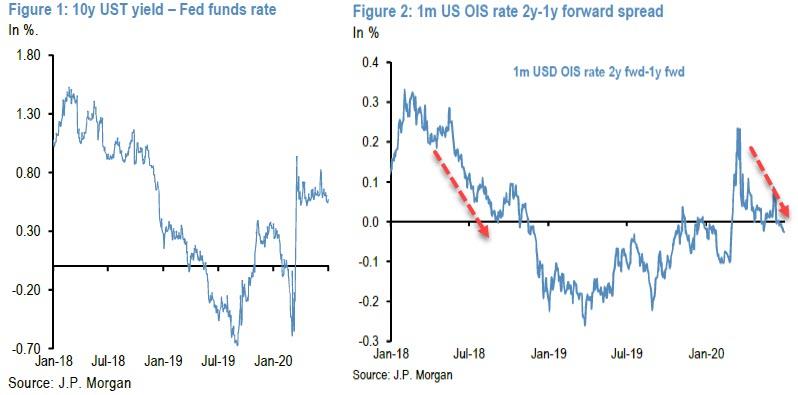
There's some good and some bad news: while the 10y UST-Fed funds yield curve slope remains firmly into positive territory (Figure 1), this is not true with the slope at the front end of the US curve (Figure 2), which to the JPM quant "is a better signal of policy expectations" and is precisely the curve that JPM was focused on back in 2018 when the inversion accurately predicted the upcoming Fed policy error.
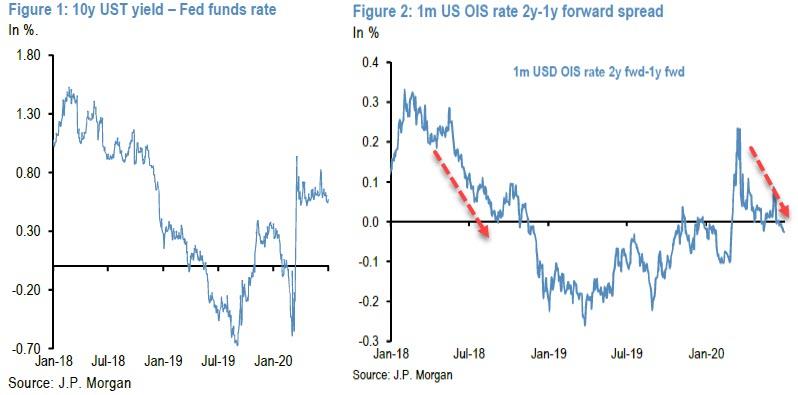
This, according to JPM, "is because the information content of the 10y UST-Fed funds yield curve slope might be blunted by investor flows and imbalances between bond supply and demand rather than expectations about policy", which is a polite way of saying the yield curve is losing its signaling powers and is turning into pure noise as everyone scrambles to frontrun the Fed. Meanwhile, such frontrunning flows "should affect the front end of the curve by much less. For example, pension funds, insurance companies and banks, which together comprise the majority of foreign flows into USTs, tend to focus at either the long or the intermediate 2y-10y part of the UST curve."
As a result, the right curve to keep an eye on is that of the very front end of the US curve as shown in Figure 2, and which as JPM lament "is unfortunately more negative than the message from Figure 1", and here is the same punchline to what was observed back in 2018:
While the spread between the 1- and 2-year forward points of the US OIS curve in Figure 2 had improved rapidly and turned significantly positive after the dramatic policy response to the virus crisis last March, it has been slipping over the past couple of months and turned negative last week. It printed -3bp negative on Monday, June 29th.
For those who missed the prior two explanations (here and here) why this is significant and why this is important for risky markets, JPM had argued before - correctly - that the inversion at the front end of the yield curve had been one of the most important market indicators over the previous two years.
During 2018, JPM cautioned that the inversion at the front end of the US yield curve, since it first emerged in April 2018 between the 2- and 3- year forward points of the 1m OIS rate, had been an important market signal, suggesting markets were concerned over the risk of a policy mistake (Fed overtightening at the time) and thus downside risk for equity and risky markets.
JPM proved to be absolutely accurate as the events in Q4 2018 would demonstrate: indeed, this indicator had been worsening during 2018 not only by turning progressively more negative, but also by shifting forward to between the 1- and 2-year forward points since November 2018. And this negativity persisted during the course of 2019 up until last October, keeping the bank with a cautious stance until then, when none other than JPM conveniently sparked "NOT QE", by inciting a crisis in the repo market and forcing the Fed to launch massive repo operations coupled with Bill monetizations, dramatically easing conditions.
The re-steepening seen after October 2019 was a positive development but it lasted only three months; that's when a far more aggressive catalyst was needed. In January this year, the indicator of Figure 2 had turned significantly negative again, pointing to downside risk for risky markets at the time. Enter Coronavirus, the economic shutdown and the biggest liquidity injection of all time.
Questions about JPM's - or the coronavirus' - role in triggering massive QE episodes in the recent past aside, the lesson we learned from the past two years as well as from the previous cycles is that as long as the inversion at the front-end of the US yield curve persists, it may act to limit the upside to equity and risky markets and signals vulnerability to further negative shocks.
So, as Panigirtzoglouo warns, the re-emergence of that inversion last week is a warning sign. That said, the spread between the 1- and 2-year forward points of the US OIS curve in Figure 2 is not yet negative enough to be worried about a coming correction, but what it does is suggest that many market participants believe the combination of fiscal and monetary accommodation already in train is not yet sufficient given the size of the shock! If it was, the 1-to 2-year or 2- to 3-year forward spreads should be into positive territory.
You read that right: trillions and trillions in QE, corporate bond purchases, repos, FX swaps, debt backstops and so on, is no longer enough, which makes sense for a market that habituates to whatever the Fed's latest liquidity injection is quickly... and then even quicker demand more.
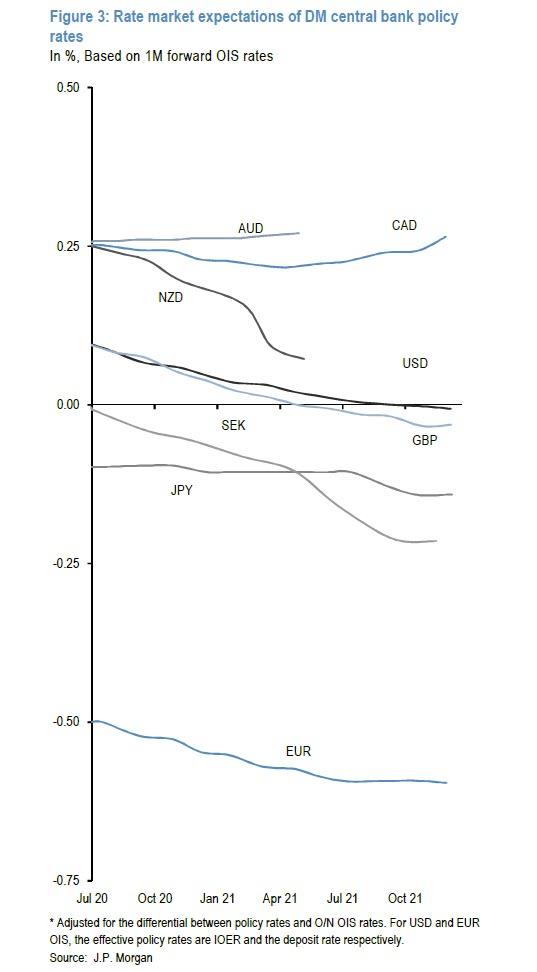
Meanwhile, JPM notes that markets signaling that further policy accommodation may be required is not only confined to the US. As shown by Figure 3 the inversion at the front end is prevalent across most DM yield curves. In some cases, e.g. with the BoE and RBNZ, the central banks have already signaled an openness to consider negative rates, while in others, e.g. with the Fed, markets price in a possibility of negative rates even where they have been more dismissive of the prospect.
To JPM, this suggests that rate markets are signaling the need for further monetary and/or fiscal policy stimulus across DM economies. And, logically, if the Fed turns a deaf ear to this latest extortion attempt by market, and additional stimulus is not delivered, then the inversion at the front end could worsen, "eventually becoming a more problematic signal for equity and risky markets going forward."
In short: unless the Fed wants another market meltdown on its hands, it better pre-emptively stimulate and do so to the tune of trillions.
That said, the Fed still has time: JPM's best guess is that this downside risk signaled by the re-emergence of money market curve inversion would not manifest itself into a substantial correction, as policy makers are likely to eventually respond to signs of deterioration, unless of course they do nothing like in 2018, and perhaps in 2020, with YCC now apparently on the back burner. Still, JPM is confident that "further monetary support, particularly in the form of QE, would likely provide support for risky assets either directly, in the case of corporate bond purchases by central banks, or indirectly by liquidity injections that boost holdings of cash by non-bank investors."
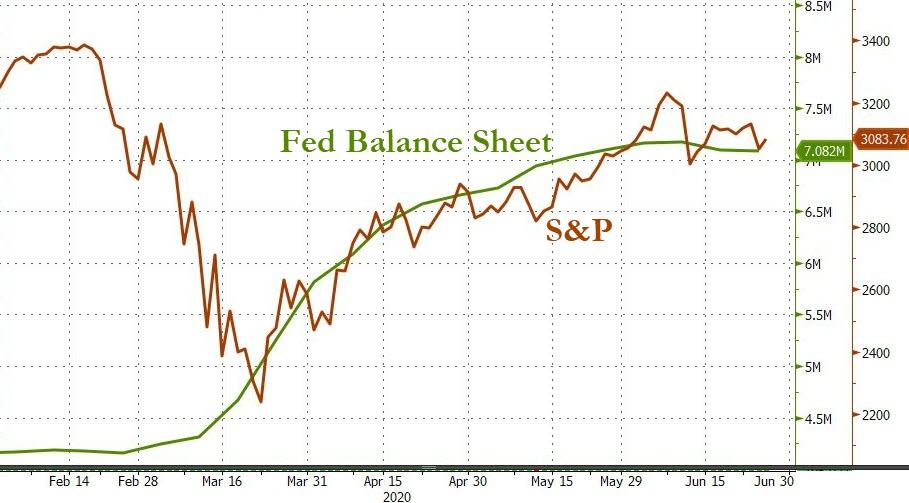
Bottom line: we live in a world where everything is disconnected from reality, from fundamentals and certainly from cash flows, and in order to keep suspending the disbelief the Fed has to inject a fresh trillion (or more) every quarter, if not every month. And with the Fed's balance sheet now shrinking for 2 consecutive weeks, having resulted in a plateau of sorts in the S&P500...
... the only thing that can push stocks higher according to JPMorgan, is another dramatic liquidity injection.
And since we have no doubt that JPM's observation is accurate, it means that Powell faces a two-fold problem: since the Fed chair has taken negative rates off the table (for the time being) and since the Fed today announced that Yield Curve Control isn't coming any time soon, Powell has no choice but to boost unleash another firehose of debt monetizing liquidity in the financial system via even more QE. However, any such reversal to the Fed's current posture of flat/shrinking QE (the Fed is now buying "only $80BN in TSYs per month, down sharply from the $1 trillion or so in March) will be met with howls of rage, especially among what's left of the conservative political establishment. Which means that, just like in March when the Fed used the first pandemic-induced market crash to unleash unlimited QE, the Fed will soon have to go for round 2 and spark either a new market crash or await for another covid-linked market selloff, one which it then uses as a convenient pretext for the next massive liquidity injection.
Failing to do that, watch as the dollar takes off as markets sniff out that another major dollar squeeze is imminent as the front-end inverts. And since this will accelerate the liquidity crunch, one way or another, the coming $1.6 trillion in Treasury issuance - which has already been generously greenlighted by Congress - will serve as a trigger for the next market shock, one which the Fed will quickly reverse by expanding the already unlimited QE by trillions on very short notice.
The one question we have is whether this will be the market crash that the Fed uses to unveil it will also buy equity ETFs (and individual stocks) or if Powell will save this final bullet in its ammo for whatever comes next.
Yet while the Fed's QE expansion is just a matter of time, whether catalyzed by another market crash or not, the bigger question is what happens after that?
"Can governments continue to borrow at such record levels? No," George Boubouras, head of research at hedge fund K2 Asset Management asked in May. "Central-bank support is key in the massive bond buying we’ve seen for now. But if they blink then at some point, in the medium term, it will all likely unravel - with unforgiving consequences for some countries."
Ironically, this also means that an end to the coronavirus crisis is the worst possible thing that could happen to a world that is now habituated to helicopter money and virtually unlimited handouts, which however need a state of perpetual crisis.
"Once there is an end to the crisis in sight, they will be less and less willing to provide support and it will fall more on the street to absorb paper," said Mediolanum money manager Charles Diebel, who’s adding bond steepeners in anticipation of a coming inflationary supernova.
Translation: expect a major crisis in the coming months, one which gives the Fed a green light to do whatever it needs to avoid another market crash.
That, incidentally, would also be the beginning of the end for the current monetary regime, which is why anyone hoping that officials, policymakers and the establishment in general will allow the coronavirus crisis to simply fade away, is in for the shock of a lifetime.

WSJ : A Recovery That Started Out Like a V Is Changing Shape

A Recovery That Started Out Like a V Is Changing Shape
A resurgence of coronavirus cases is making the rebound look more like the reverse image of the square root symbol

After recovering rapidly from mid-April through mid-June the economy has shown signs of sputtering in the past two weeks.

The flattening may reflect a pullback by consumers in states where cases of Covid-19 have shot up, the exhaustion of pent-up demand driven by stimulus checks, or simply a pause after the first wave of low-risk workplaces were allowed to reopen.

Regardless of the reason, multiple data sources show that after an initial V-shaped plunge and partial rebound, activity has since flat-lined, resembling the reverse image of the square-root symbol (√).

“It was a straight line up for the better part of two months,” said Aneta Markowska, chief economist at Jefferies, a financial-services company that compiles a daily index of high-frequency data on mobility, jobs and other activity. “So this is definitely a notable slowdown that began around June 17th.”

Recoveries seldom proceed in a straight line and it’s too soon to write this one off. Its path this time has been especially unpredictable because it depends on the pandemic and the social-distancing measures undertaken to halt its spread.

From March until mid-April, the economy contracted at unprecedented speed as states ordered nonessential businesses to close and people to stay home. Then, daily cases and hospitalizations began to drop in the hardest-hit states and stimulus checks for up to $1,200 per adult arrived in bank accounts. In late April, some states began to lift restrictions and stores reopened. Spending, in particular by lower-income families, rose sharply, returning to prepandemic levels for some categories.

In early June, cases began to rise in some states that had reopened early, notably Arizona, Texas and Florida. California, the first state to shut down, recently saw caseloads surge as it slowly reopened.

Initially, consumers didn’t respond. In fact, the connection ran the other way: Spending in restaurants tended to predict new virus cases roughly three weeks later, according to Jesse Edgerton, an economist at J.P. Morgan Chase, citing anonymized data from the bank’s credit-card customers. That suggests restaurants and bars, with their prolonged close contact and loud talking, are potent channels for spreading the disease.

Then last week spending dropped, the Chase card data show. The decline is a bit more pronounced in states with faster-growing cases, like Arizona and Florida, but not uniformly so, Mr. Edgerton said. Spending was strong in Mississippi, where cases have grown a lot, but weak in Kentucky, where they haven’t.

Ms. Markowska was more emphatic: “There’s a clear decoupling in activity between these hot-spot states in the Sunbelt and the Northeast where activity continues to improve. Texas, Arizona and Florida have not just leveled off but are outright contracting. [For them,] what began like a V is morphing into a W.”

The economy officially entered recession in February and a recovery may have begun in April. But whether it continues depends, first, on the virus and social distancing, and second, on income growth, which in turn depends on jobs and government stimulus.

After collapsing by 22 million in March and April, employment rose, surprisingly, by 2.5 million in May. Economists think it rose by 2.9 million in June, according to a survey by The Wall Street Journal. The Labor Department reports the June data on Thursday. Economists’ estimates are unusually wide, ranging from 2 million to 7 million, and the unemployment rate has been harder to predict because of misclassification errors by survey takers.

In any case, the jobs data are a snapshot of the second week of June, and since then, hiring appears to have slowed. Data from Homebase, which supplies scheduling software to small businesses, suggests small-business employment rose rapidly from mid-April to mid-June, as businesses reopened, said André Kurmann, an economist at Drexel University who with two co-authors has analyzed the Homebase data.

But the recovery, he added, is “now all but stalled: Employment and the proportion of businesses open last week is flat.”

In the past week, Florida and Texas have ordered bars to close or stop serving alcohol; Houston issued a stay-at-home order, and California Gov. Gavin Newsom ordered bars and restaurants in 19 counties to close. Those moves alone are probably not enough to derail the recovery.

But if case counts keep climbing, states might impose more restrictions, or people will simply stay home. If hiring grinds to a halt in July, that will deprive households of income just when enhanced unemployment-insurance benefits are due to expire.

IHS Markit, an economic-analysis firm, sees a 20% chance that a second wave of infections could result in a W-shaped recovery. “Official backtracking on the relaxation of restrictions as well as voluntary pullback on the part of consumers could cause spending to weaken again sharply, throwing the economy back into a brief two-quarter recession,” it said.

If the recovery does resemble a reverse square-root symbol, that would likely be in line with most economists’ forecasts. Indeed, it was the most popular prediction of academic economists surveyed by the University of Chicago’s Initiative on Global Markets.

Being economists, however, they took pains to use the most abstruse expression available, referring to it as a “reverse radical.”

WSJ : SoftBank Seeks to End Partnership With Wirecard

SoftBank Seeks to End Partnership With Wirecard
Japanese tech conglomerate looks to distance itself after it helped arrange a $1 billion investment

SoftBank Group Corp. is looking to distance itself from Wirecard AG, after the Japanese tech conglomerate helped arrange a $1 billion investment months before the German payments company went bust.

One of the world’s largest technology investors, SoftBank is seeking to terminate a five-year partnership its investment arm formed with Wirecard in April 2019, according to people familiar with the matter.

Wirecard declined to comment.

The partnership agreement called for SoftBank to introduce Wirecard as a digital payments provider to other companies in SoftBank’s sprawling portfolio of tech firms. SoftBank also agreed to help Wirecard expand in Japan and South Korea.

The partnership was struck in April 2019 at the same time that a SoftBank-run investment vehicle agreed to plow €900 million ($1 billion) into Wirecard through a convertible bond. It was an unusual deal in which SoftBank ended up not putting in any of its own money when it closed later that year.

Wirecard’s auditors revealed last month that $2 billion of cash on the company’s balance sheet probably didn’t exist. German prosecutors have accused its former chief executive, Markus Braun, of falsely inflating the company’s sales with fake income.

The company filed for the German equivalent of bankruptcy protection last week.

Wirecard continues to operate its payment-processing businesses. Bankruptcy administrators said Wednesday it is looking to sell some of its businesses.

The convertible bond and the partnership with SoftBank were seen as a stimulus injection for Wirecard. In early 2019, its stock price was under pressure after a Financial Times article aired a whistleblower’s allegations of questionable accounting, which the company denied at the time. Wirecard announced the SoftBank partnership just as a government-imposed ban on short selling Wirecard’s stock expired.

The first fruit of the partnership came in July 2019, when Wirecard said it struck a deal with AUTO1 Group, a European car-buying and -selling platform in which SoftBank had an investment.

On an earnings call in August, Mr. Braun said Wirecard was in concrete discussions with half a dozen more SoftBank portfolio companies, and that the partnership would be “a strong positive catalyst” for the second half of 2019.

“This partnership is really accelerating from zero to 100 in four seconds,” Mr. Braun said.

That month, August 2019, Wirecard said it was exploring a collaboration with Oyo Hotels & Homes, and in March said it formed a partnership with Southeast Asian ride-hailing company Grab Holdings. Both are backed by SoftBank.

A spokesperson for AUTO1 Group said: “There is no cooperation with Wirecard. We had a phase of brainstorming, but it never went forward.” Oyo and Grab didn’t respond to requests for comment.

The convertible-bond deal closed in September 2019. But SoftBank itself never contributed cash. The Wirecard deal was instead backed by a fund with commitments from Mubadala Investment Co., an Abu Dhabi sovereign-wealth fund, and SoftBank employees, who included Vision Fund executives Rajeev Misra and Akshay Naheta.

But they then immediately sold most of the Wirecard exposure for an instant profit onto a new set of investors, via an exchangeable bond arranged by SoftBank’s financial adviser on the Wirecard deal, Credit Suisse Group AG. The bonds now trade for around 10% of their face value.

Credit Suisse declined to comment.

SoftBank said last week that it pushed for Wirecard to invite in outside auditors to do an independent investigation into allegations against the company.

Appointing a special auditor “may help put the allegations behind the company once and for all and draw a line under the unwanted distraction that continues to plague the company,” SoftBank officials wrote in an email to Mr. Braun on Oct. 18, 2019, and reviewed by The Wall Street Journal.

SoftBank executives had grown wary of providing introductions between its portfolio companies and Wirecard, a person familiar with the matter said.

On Oct. 21, Wirecard’s board appointed an outside auditor, KPMG, to probe the alleged accounting problems. In April, KPMG said there were obstacles in its investigation and it couldn’t confirm purported revenue, sending Wirecard shares sliding.

FT : Coty accused of trade secrets theft in Kardashian-Jenner deals

Coty accused of trade secrets theft in Kardashian-Jenner deals
US manufacturer Seed Beauty alleges that recent investments by beauty group threaten its competitive position

A Californian manufacturer of beauty products has filed two lawsuits against Coty and celebrity sisters Kim Kardashian-West and Kylie Jenner, alleging that their recent tie-ups amount to a theft of its trade secrets.

The lawsuits come after Coty, and its controlling shareholder JAB Holdings, staked $800m on twin deals with the sisters, betting their influence in the beauty industry will help turn around the lossmaking company that is home to CoverGirl and Max Factor brands.

On Monday Coty agreed to buy a 20 per cent stake in Kim Kardashian West’s make-up brand KKW for $200m, building on a $600m investment in November that secured a 51 per cent in Kylie Jenner’s eponymous cosmetics brand. Together the sisters have 359m followers on Instagram. 

Now Seed Beauty, founded by brother and sister Laura and John Nelson in 2014, is calling those deals into question and asking the courts to intervene to protect its intellectual property and correct what it alleges is a breach of contract by KKW and Kylie Jenner’s company. 

The first lawsuit was filed in the Superior Court of California in Los Angeles on June 19 against KKW and the second on June 30 was against Kylie Jenner’s company and Coty.

Seed Beauty said it was the “sole developer, manufacturer and supplier” for both KKW and Kylie Cosmetics and that its “competitive position would be gravely harmed” were Coty to gain access to its trade secrets. 

Seed maintains in the lawsuits that its expertise covers everything from tracking make-up trends on social media that can quickly be met by new products to then selling those items online.

The Nelsons are prominent players in the beauty industry in their own right, having founded ColourPop Cosmetics, a successful direct-to-consumer brand that churns out bright eyeshadows and glittery lipgloss for legions of young consumers. Kylie Jenner, and later her sister Kim, sought Seed’s help when they wanted to launch their own beauty brands.

While the sisters provide the star power and ideas, Seed then translated their ideas into products and helped sell them online, the lawsuits claim.

“Coty made a $600m investment in [Kylie Cosmetics], but it really was a subterfuge to learn Seed’s confidential business methodologies,” Seed alleges in the lawsuit. 

To protect its interests, Seed Beauty has asked the court to prevent the sisters’ companies from sharing its secrets with Coty, and has also demanded a “reasonable royalty” from the defendants. It is also seeking unspecified damages.

On June 26, it obtained a temporary restraining order against Coty and KKW in the first lawsuit, and has also requested one in the second case. 

Coty is the third-biggest cosmetics maker in the world after L’Oréal and Estee Lauder, but has been embroiled in a painful turnround since 2015 and carries heavy debt. Its struggles have been deepened by the Covid-19 pandemic, leaving its shares down 60 per cent this year. L’Oréal’s have climbed 8 per cent.

Coty and its law firm Cooley declined to comment, as did JAB. KKW and Kylie Cosmetics could not immediately be reached for comment. Seed and its lawyers at Goodwin Procter declined to comment. 

Lawyers for KKW wrote in a legal filing dated June 19 that Seed had not supplied enough evidence that its trade secrets had been stolen.

“The actual ‘trade secret’ that has made KKW successful — which Seed attempts to exploit — is the unique influence, renown, dedication and hard work of KKW’s President and Founder, Kim Kardashian West,” lawyers for the group said. 

For its part, Seed said in this week’s filing that it had tried to resolve the matter amicably. “Out of deep respect for Kylie Jenner, Kim Kardashian, and the highly successful businesses Seed created with them, Seed attempted to resolve this dispute privately and repeatedly asked for assurances related to leakage of Seed proprietary information from King, Kylie to Coty.”

The lawsuits come as JAB is already fighting a case against food giant Mars, which alleges that the investment company stole its trade secrets.

FT : Paulson closes hedge fund to external investors

Paulson closes hedge fund to external investors
Investor who won big on subprime crisis goes private after years of lacklustre performance

John Paulson, the billionaire investor who rose to fame during the financial crisis with a lucrative bet against US subprime mortgages, is closing his hedge fund to external investors after years of lacklustre performance. 

“After considerable reflection and careful thought, Paulson & Co. will convert into a private investment office and return all external investor capital,” Mr Paulson wrote in a letter to investors seen by the Financial Times. “Recent volatility notwithstanding, I am proud of our long-term returns”.

He is the latest high-profile industry figure to take his fund private.

Veteran hedge fund manager Louis Bacon told investors in his 30-year-old Moore Capital Management late last year that he would return outside capital, citing fee pressure and a difficult trading environment.

Mr Paulson said in January last year he would consider turning his firm into a family office managing his personal wealth “in the next year or two”. Paulson & Co closed its London operations shortly after, the FT reported.

In his letter to clients Mr Paulson highlighted some of the firm’s trading milestones, including the subprime crisis and profits made during the recovery. “I look forward to continuing as an active participant in financial markets,” he wrote.

Mr Paulson launched his firm in 1994 but he rose to prominence more than a decade later when he made an estimated $20bn on the collapse of the subprime mortgage market, dubbed the greatest trade ever. 

In the years after the crisis, he struggled to match this success. Failed bets on healthcare stocks, pharmaceuticals and gold prompted investors to flee, cutting Paulson & Co’s assets under management from a high of $36bn in 2011 to $10bn as of January. Less than a quarter of the money currently managed by the firm is from outside investors. 

Mr Paulson is part of the old guard of hedge fund managers who made their fortunes before the massive post-financial crisis quantitative easing and government intervention that many claim has depressed their returns and inflated asset values. 

Several of his peers have also decided to close their firms to outside investors, including Leon Cooperman of Omega Advisors and Jonathan Jacobson of Highfields Capital Management. 

A spokesperson for Paulson & Co declined to comment.

FT : Head of German financial watchdog defends agency’s Wirecard role

Head of German financial watchdog defends agency’s Wirecard role
Felix Hufeld tells Berlin MPs that payments firm was classified as tech company and not fully under BaFin’s oversight

The head of Germany’s financial watchdog denied that the regulator had protected Wirecard instead of investigating it properly, as MPs in Berlin grilled him on the agency’s role in one of the country’s worst-ever corporate scandals.

Felix Hufeld, head of BaFin, told members of the Bundestag on Wednesday that the agency’s ability to act was limited because Wirecard was classified as a technology company rather than a financial services provider, and so was not fully under BaFin’s purview. The agency only oversaw Wirecard Bank.

Mr Hufeld told lawmakers in a closed-door session of the Bundestag’s finance committee that BaFin, the ECB and the Bundesbank had all been in agreement that Wirecard should not be categorised as a financial holding, according to his spokeswoman.

“Though he expressed regret at what happened with Wirecard, he denied that BaFin could have done more than it did,” said Florian Toncar, an opposition MP from the liberal Free Democrats, who attended the meeting.

Lisa Paus, finance policy spokeswoman for the Greens, who was also present, said BaFin “needs to fully analyse its mistakes and then have a fresh start”. “It’s still an open question as to whether that can succeed with Mr Hufeld at [its] helm,” she added.

The collapse of Wirecard, until recently the flagship of Germany’s burgeoning fintech sector, has stunned the country’s political elite and raised far-reaching questions about the state of financial regulation in the eurozone’s largest economy.

The company filed for insolvency last week — the first such filing by a member of Germany’s blue-chip Dax index since it was founded 32 years ago.

The move came days after it admitted that €1.9bn of cash was missing, and Markus Braun, its former chief executive, was arrested on suspicion of false accounting and market manipulation. Mr Braun, who denies wrongdoing, was later released on bail.

BaFin’s actions in 2019 as the Wirecard scandal began to gather steam have attracted mounting scrutiny — especially its decision to impose a two-month ban on short selling the company’s shares and to file a criminal complaint against two FT reporters who wrote about whistleblower allegations of accounting fraud in Wirecard’s subsidiary in Singapore.

Mr Hufeld denied that BaFin had sought to protect the payments company, saying its duty was to “safeguard the integrity of the market”, according to one participant at the meeting. He said there had been indications of criminal behaviour on the part of some investors who were short selling Wirecard’s shares before the FT’s reports came out, and said BaFin would not shrink from imposing such a short selling ban in the future.

People at the meeting said Mr Hufeld complained in forthright terms about the criticism he has faced since Wirecard collapsed, and the lack of political cover BaFin has received from the authorities in Berlin.

“He showed very little humility, and basically denied there had been a failure of oversight,” said Fabio De Masi, an MP for the hard-left Die Linke party, who was present. “My feeling is that he isn’t the right person to reorganise the system of financial regulation in Germany.”

Others said Mr Hufeld still had a chance to salvage his reputation. “He has to put forward proposals as to how the regulator can be improved,” said Mr Toncar. “Whatever happens, a return to business as usual is not an option.”

Last week, the European Commission said it would ask the EU’s top markets supervisor, the European Securities and Markets Authority (Esma) to assess BaFin’s handling of the Wirecard affair.

Valdis Dombrovskis, commission vice-president, told the Financial Times the EU should pursue a formal investigation into BaFin for “breach of union law” if the preliminary probe by Esma discovered shortcomings in the German regulator’s actions.

But Mr Hufeld said Esma had “no right” to carry out such a probe, according to one participant at the meeting, and described a potential investigation as “politically motivated”.

Scrambling to contain the fallout from the Wirecard affair, the German government this week terminated its contract with the country’s accounting watchdog, the Financial Reporting Enforcement Panel (FREP), as it moved to overhaul its accounting enforcement system.

Germany currently splits enforcement between FREP, a private-sector body, and BaFin. Mr Hufeld acknowledged that this two-tiered system had “structural deficits”, according to a participant in the meeting: it functioned well in normal circumstances but had failed in a crisis.

FREP on Wednesday evening defended itself against mounting criticism of its probe into Wirecard. “At no point in time were there any flaws in the auditing procedure, and the communication with BaFin was always strictly in line with the [official] guidelines,” the body said in a press release. FREP pointed out that it neither had the remit nor the resources to uncover fraud.

The BaFin chief declined to comment on the work of EY, the Big Four accountancy firm, which audited Wirecard’s accounts for a decade and has come under sustained criticism for failing to identify problems at the company. Mr Hufeld said it was not his role to assess the performance of EY, or APAS, the German body that oversees auditors.

>>> US Close Dow -0.30% S&P +0.50% Nasdaq +0.95% Russell -0.97%

Closing Stock Market Summary

The S&P 500 (+0.5%) and Nasdaq Composite (+1.0%) finished with decent gains on Wednesday amid positive economic data and upbeat vaccine news. It was also record close for the Nasdaq, but it was a negative day for the Dow Jones Industrial Average (-0.3%) and Russell 2000 (-1.0%).

The S&P 500 real estate (+2.6%), utilities (+2.3%), and communication services (+2.2%) sectors rose more than 2.0%, while the energy (-2.5%), financials (-1.0%), and materials (-0.5%) sectors closed in negative territory.

Each sector had started the day higher after Stat News reported that Pfizer (PFE 33.74, +1.04, +3.2%) and BioNTech (BNTX 64.14, -2.60, -3.9%) made progress on their COVID-19 vaccine candidate, the ISM Manufacturing Index for June returned into expansionary mode with a 52.6% reading (Briefing.com consensus 49.2%), and the ADP Employment Change Report for June showed consecutive gains for private-sector payrolls.

Negative headwinds, however, included an observation that the S&P 500 was already up 3.0% over the prior two days, a report from Bloomberg that the U.S. is preparing global sanctions against China for its abuse of Muslim minorities, and news that Apple (AAPL 364.11, -0.69, -0.2%) will re-close an additional 30 stores tomorrow due to the coronavirus. 

Regarding the latter, the market has adopted the idea that preemptive measures will induce short-term pain but will help curb the outbreak, and that any pain will be alleviated by policy support. The FOMC Minutes from the June 9-10 meeting highlighted concerns about a significant rise in coronavirus infections due to early reopening, and that highly accommodative monetary policy will likely be needed to facilitate a recovery. 

Considering these developments, it was a mixed session with cyclical sectors underperforming and money continuing to flow into the mega-cap and momentum stocks like Amazon (AMZN 2878.70, +119.88, +4.4%). FedEx (FDX 156.66, +16.44, +11.7%) was another standout with a 12% gain following its earnings report.  

U.S. Treasuries finished with modest losses, pushing yields higher across the curve. The 2-yr yield increased two basis points to 0.17%, and the 10-yr yield increased three basis points to 0.68%. The U.S. Dollar Index declined 0.3% to 97.15. WTI crude declined 1.2%, or $0.48, to $39.76/bbl.

Reviewing Wednesday's economic data:

  • The ISM Manufacturing Index for June rose to 52.6% (consensus 49.2%) from 43.1% in May. This was the first reading above 50.0% in four months and the largest month-over-month increase since August 1980. The dividing line between expansion and contraction is 50.0%.
    • The key takeaway from the report is that it reflects a clear bounce back from the super depressed conditions seen in April and May. It's a natural rebound so to speak as the economy reopens, but the key is its sustainability, which is still an open question.
  • Construction spending declined 2.1% m/m in May (consensus +1.1%) on the heels of a downwardly revised 3.5% decline (from -2.9%) in April.
    • The key takeaway from the report is that total construction spending has decelerated and is now up just 0.3% yr/yr, with a 4.7% yr/yr increase in total public construction spending helping to offset a 1.2% yr/yr decline in total private construction spending.
  • The ADP Employment Change report for June showed an estimated 2.369 million positions were added to private-sector payrolls. This was less than the consensus of 3.75 million. The data from May was revised higher to 3.065 million from -2.76 million.

Looking ahead to Thursday, investors will receive the Employment Situation Report for June, the weekly Initial and Continuing Claims report, the Trade Balance report for May, and the Factory Orders report for May.

  • Nasdaq Composite +13.2% YTD
  • S&P 500 -3.6% YTD
  • Dow Jones Industrial Average -9.8% YTD
  • Russell 2000 -14.5% YTD