(9to5) Fi Smart Collar uses GPS and LTE to track your dog’s location on your iPh


My inside dog became a part-time outside dog earlier this year when we completed our backyard fence. Apollo was over-the-moon happy to expand his playground, but as a dog owner I had mixed feelings. What if my dog dug a hole under the fence or one of the kids left the gate open and he escaped?
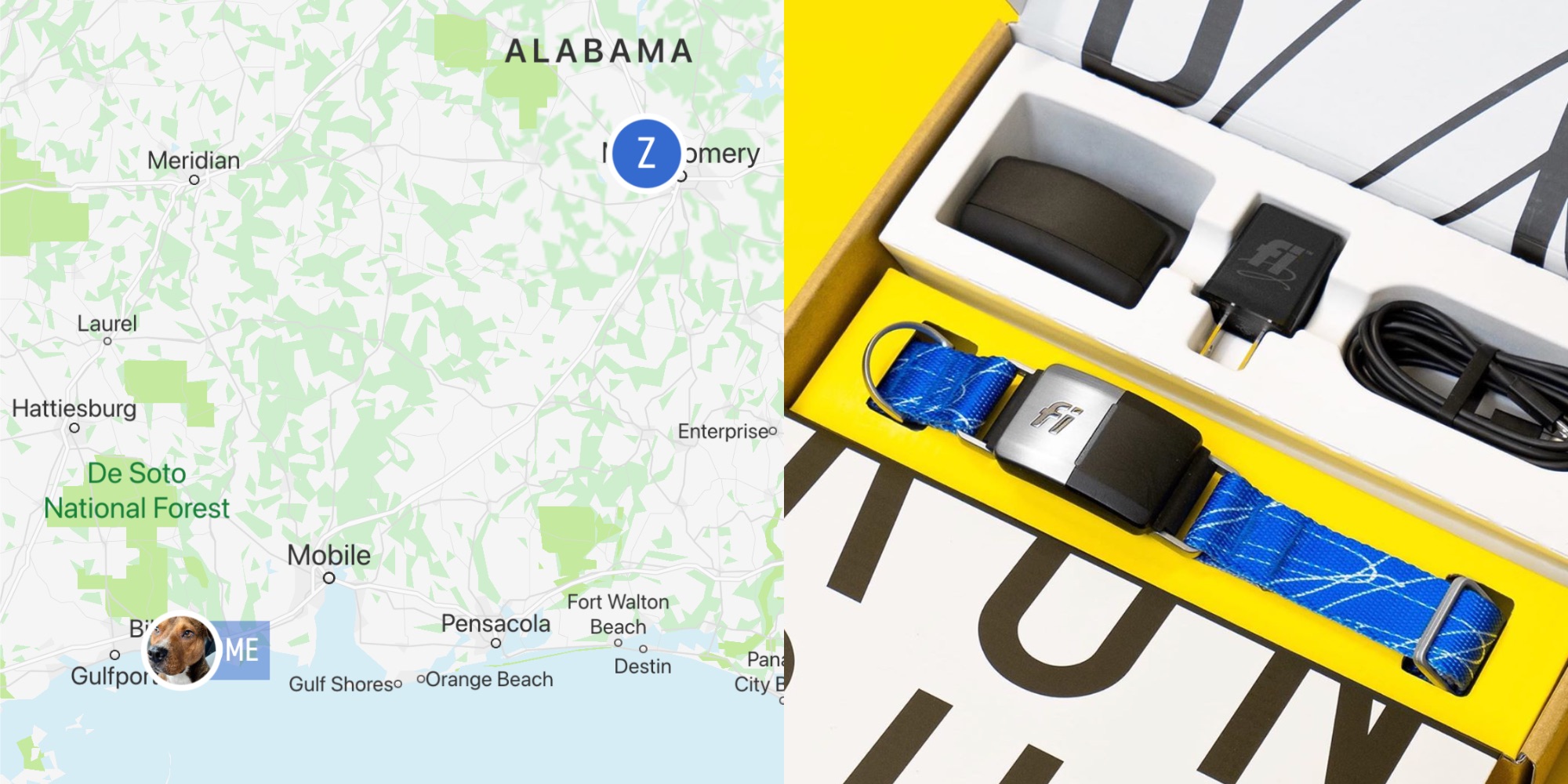
I’ve been testing the Fi smart dog collar for the last few months to help ease that anxiety. Fi is like an Apple Watch for dogs with features like location sharing, alerts for unexpected location changes, and even step tracking.
Fi relies on GPS and LTE-M to make sure your dog is safe, and the experience is managed from iPhone or Android. Here’s how Fi works.

What’s Fi?
Fi is very similar to Apple’s Find My feature for sharing location with family and friends — only you don’t need to buy your dog an iPhone. The smart dog collar includes a rechargeable tracker that’s sleek and unobtrusive. Seriously, Apollo couldn’t stand that red bandanna after his grooming appointment, but he’s been wearing a Fi collar for months without complaining.
Just like with Find My, you can remotely check your dog’s location on your smartphone. This is terrific for making sure your pet is where they should be while you’re at work or out of town.
You can receive alerts if your dog escapes from home or makes a break for it during a walk. Fi considers that dogs do leave home for walks too. You won’t be notified that your dog escaped home if they’re walking with someone designated as an owner. They just need the Fi app.
Fortunately, Apollo hasn’t actually escaped since becoming a part-time outside dog. We did manually test what happens when a pet leaves a designated area or goes on a walk with someone who isn’t authorized to take your dog, however.
Fi can notify an owner about an event using an SMS text message, a push notification from the app, or both. Response times for alerts and accuracy of location data are reliable enough that I feel confident Fi would be a lifesaver if Apollo actually did escape.
If your dog is missing, you can put Fi into lost mode. This updates the collar location every two minutes and turns the built-in LED light red for improved visibility. (You can optionally run the LED in any color during night walks.)
What to know
  • Fi is also a step tracker for dogs — daily step goal streaks, rankings within breeds, and more
  • The smart collar uses the low power LTE-M cellular network for long distant communication to transfer GPS data
  • Battery life will vary from a few days (if your dog is lost) to a few months (if your dog is always around Wi-Fi) which outperforms competing tracking collars
  • Tracking your dog at home works for free on Wi-Fi; tracking your dog if they leave your home wifi with GPS + LTE service needs a service plan:
    • $99 for one year of service
    • $186 for two years of service
    • $248 for three years of service

Fi is also incredibly durable. Apollo’s collar has endured the elements after months of daily use.
Availability
Fi Collar is available from tryfi.com in four sizes (11.5-inch to 34.5-inch necks) and four colors (yellow/gray/blue/pink) for $149. You can swap out color styles or choose a new martingale band ($29) for dogs prone to escaping standard collars. Fi also sells additional Fi Bases ($39) that are used for charging and expanding wireless connectivity to Fi around the house.
Highly recommended if you’re like me and want to know that your dog hasn’t escaped — and more importantly — where they went if they did get lost.

(ZH) Goldman Sees Ghost Of Dot Com Bubble As Baby Boomers Sell Stocks To Their O

Goldman Sees Ghost Of Dot Com Bubble As Baby Boomers Sell Stocks To Their Own Kids

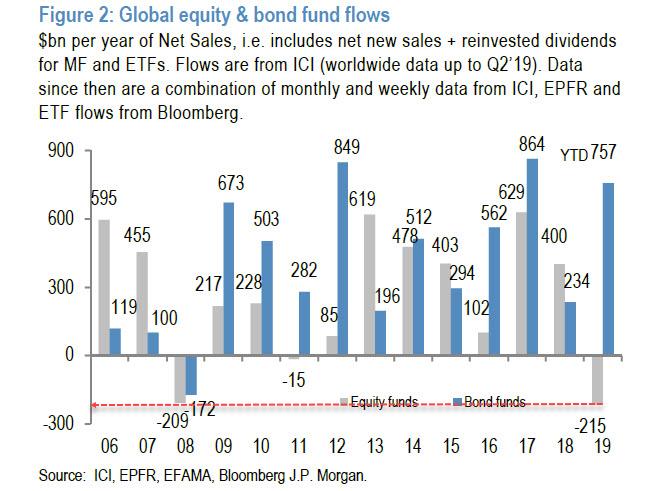
Back in 2019 we posted on several occasions that a "conundrum" had emerged in the stock market: with equities hitting new all time highs, especially in the last quarter after the Fed relaunched QE to bailout a bunch of basis trading hedge funds under the pretext of saving the repo market, equity outflows soared to all time highs...
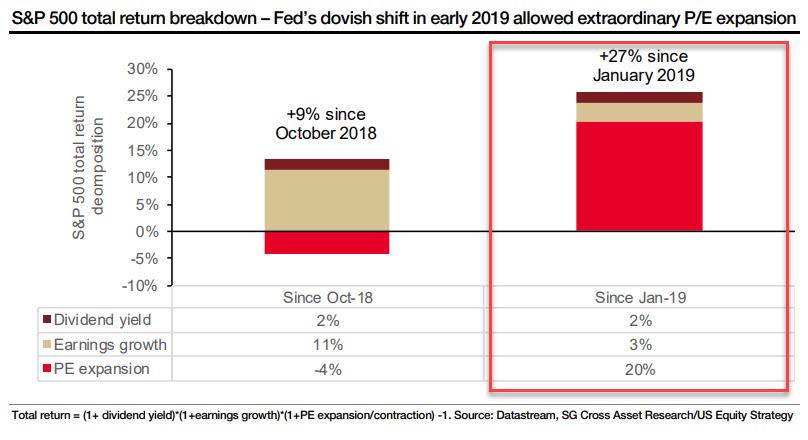
... as investors fled risk assets realizing that the market was unsustainable high and artificially propped up by the Fed (as a reminder 2019 saw zero earnings growth and all the equity upside was thanks to multiple expansion).

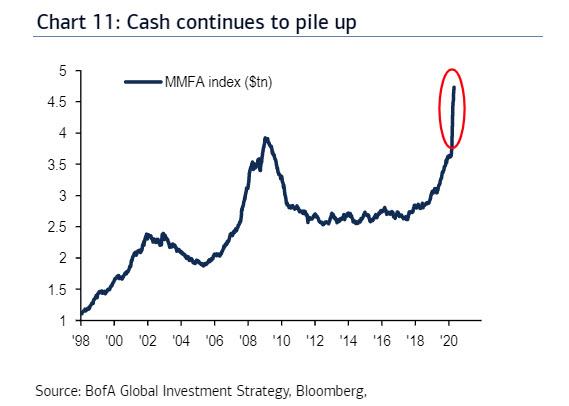
Fast forward to early May when the "conundrum" made a triumphal return, because as BofA reported even as stocks were soaring, investors once again fled into cash, allocating tens of billions to money markets...
... and while investors also rushed to allocate fund to "risk free" bonds, now that the Fed is buying corporate bond ETFs and also debt from such "middle class" stalwarts as Apple and Berkshire, they were once again aggressively selling stock fund ETFs.
In the ensuing two months, the conundrum has persisted even if there was one small change: the funds flowing into money markets have reversed, and according to the latest EPFR fund flows data, the last week of June saw $28.8bn pulled out out of cash, which according to BofA's Michael Hartnett was the largest MMF redemption since Dec 19. That said, even with the latest outflow from money market funds, more than $1.1 trillion in cash has gone into money markets.
Yet what continues to confound professional investors who continue to recommend stocks based on "fundamentals" when the only thing that matters any more is how many trillions the Fed will injects into stocks, is that funds continue to flow into bonds ($15.3bn last week), new money continues to be allocated to gold (42BN in the last week), yet equity funds continue to see relentless outflows, with another $7.1bn pulled out of stocks last week even as stocks appears to be on a relentless upswing.
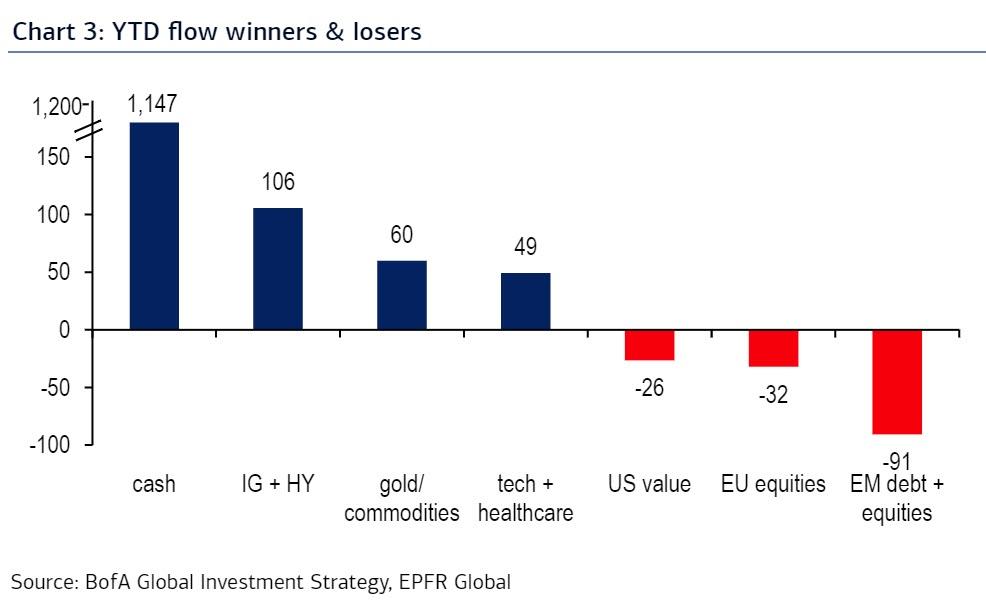
In fact, a look at fund flows among various asset classes, shows that stocks are the only class that has suffered pretty much constant outflows, while new capital has been allocated to gold, bonds (both IG and HY), and most of all cash.

But wait, it's not just the 2019 conundrum that is at play here. Yes, it is true that last year investors were just as aggressively selling equity funds (while the strong buyback bid helped levitate most assets), a situation that has re-emerged in recent weeks, but in 2019 we didn't have the Robin Hood effects, where millions of Gen-Zers and millennials were willingly "investing" their stimulus checks in ultra-high beta stocks and anything that had plunged, even if it was bankrupt companies.
So how is the current situation different? The answer comes courtesy of Goldman's head of hedge fund sales, Tony Pasquariello, who writes that while in total retail investors are dumping stocks, that is not true for all retail investors, where a very clear generational divide has emerged.
Here are his latest observations:
The bifurcation continues within the retail community: an older generation continues to make sales via mutual funds and ETFs (link); a younger generation continue to trade stocks like it’s 1999 (“free trades, jackpot dreams lure small investors to options”).
At some point, the $64,000 question is... Where are we in the retail cycle? Having lived through the late 90’s, I tend to think the recent euphoria can persist a bit longer.
In other words, even Goldman now sees the ghost of the dot com bubble re-emerge, as older Americans scramble to liquidate stock by selling to their very own children.
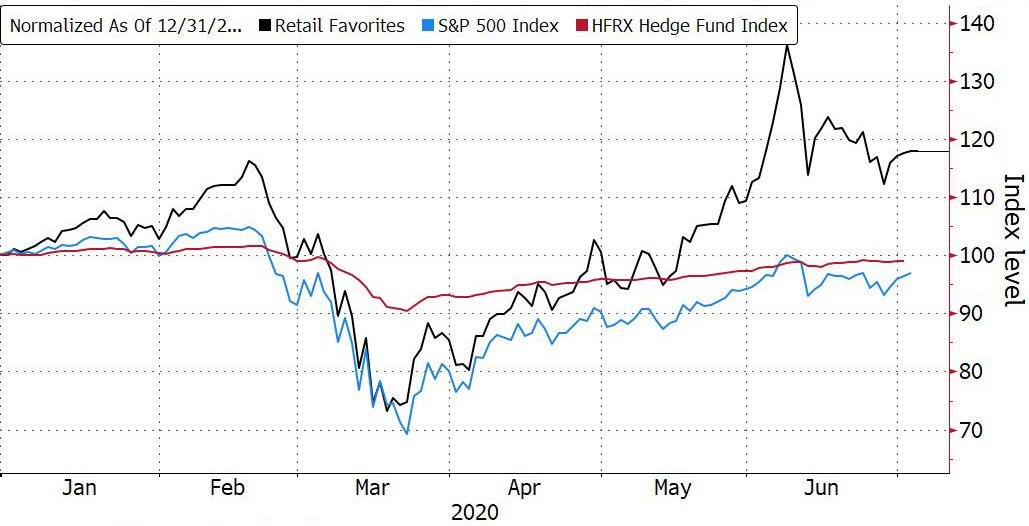
As for Goldman's assessment that the euphoria can persist a "bit" longer, we take the over - with Powell now having gone all in, staking not only the Fed's reputation and the entire capitalist way of life, including the dollar as a global reserve currency on pushing stocks even higher, this may be the one time when retail investors not only outperform hedge funds - and the S&P500 - as they have been for much of 2020...
... but also the baby boomers who can't sell stock fast enough to their own children.
Or then again, maybe this time won't be different.

WWD : Five Million People Signed Up to Buy Air Jordan 1 OG Dior Sneakers

Five Million People Signed Up to Buy Air Jordan 1 OG Dior Sneakers
Dior chief executive Pietro Beccari told WWD only 8,000 pairs were up for grabs.


Five million people – roughly the population of Ireland or New Zealand – registered for a chance to buy the limited-edition Air Jordan 1 OG Dior sneakers, Pietro Beccari, president and chief executive officer of Christian Dior Couture, told WWD.

The executive said 13,000 pairs of the coveted shoes were produced, with 5,000 pairs offered to Dior’s top clients, each of whom received a personal invitation.

That left 8,000 pairs for the rest of the world, and Beccari said Dior collected the names of willing buyers in the span of about nine hours.

On June 25, Dior launched a dedicated microsite at capsule.dior.com for the Air Jordan 1 by Dior drop. There, customers had an opportunity to buy the limited-edition shoes on a first-come, first-served basis. The shoes are priced at $2,000 for the low-top version and $2,200 for the high-top model.

Interested parties were asked to record their preferred model, size and pickup location. Each participant could register only once for the desired style and size.

For the Chinese market, a separate online experience was held via a dedicated WeChat program.

One of the most hotly anticipated sneaker launches of 2020, Dior’s collaboration with Air Jordan was unveiled at the Dior pre-fall 2020 show in Miami in December, and was scheduled to go on sale in March. The coronavirus pandemic forced the brands to postpone the rollout.

Kim Jones, creative director of men’s wear at Dior, is a keen collector of Air Jordan Ones, owning more than 40 pairs. The collaboration marks the Nike-owned label’s first step into the “luxury streetwear” segment.

StockX Air Jordan Dior Market

WWD : Dior Goes Big on Rue Saint-Honoré in Paris

Dior Goes Big on Rue Saint-Honoré in Paris
The sumptuous, five-story boutique has the grandeur and intimacy Paris apartment, decorated to perfection.


With its small, interior garden, framed photos dotting the walls, vintage furniture and views of the Notre-Dame-de-l’Assomption church, Dior’s new five-story flagship at 261 Rue Saint-Honoré has the grandeur – and intimacy – of a Parisian apartment.

The boutique, which opened to the public on July 4 after a dedicated day for VIP clients, is five times bigger than the store it replaces just down the street – a major statement about the brand’s momentum, ambitions, and long-term view.

During a walk-through of the store on Thursday, Pietro Beccari, president and chief executive officer of Christian Dior Couture, drew a parallel to the founder.

“Mr. Dior had the courage to launch his brand right after the war, an act of rebellion against the dark times,” he related. “And I think I can say we are sufficiently resistant in this crisis to be optimistic about the future.”

The executive acknowledged that he had to reduce his initial projections for the mega-store, given the absence of tourists in the French capital amid the coronavirus pandemic. He declined to pinpoint how much of Dior’s Paris sales depend on tourists.

“But we didn’t build this store for the next one year; we built it for the next 20 years,” Beccari said, seated in one of the living-room like settings that dot the vast store. “We are not very hopeful that we will have lots of tourists until next year. So with less tourism, we have the chance and the duty to better take care of locals.”

Thanks to its corner location, the store is flooded with natural light, and affords views of what is known locally as the Polish church, capped by a magnificent cupola and fronted by a charming square.

There is also much to please the eye inside the boutique, done up in creamy shades echoing the pale stone of the facade. Architect Peter Marino employed a range of subtle textures and effects: some walls shimmering with faded floral motifs; others dressed in mottled plaster, or muted toile de Jouy wallpaper. Area rugs – in shaggy, tonal checks on the women’s floors; in denim shades and watery patterns for the men’s areas – heighten the residential feel.

Groovy mid-century armchairs, stools and daybeds mingle with custom tables, some in leaf shapes, and many in bronze, a fetish material for Marino.

Yet nothing is overly showy. There are artworks throughout the store, mainly photographs, but no gobsmacking sculptures or video installations.

Instead, the boutique exalts the merchandising muscle of its women’s and men’s creative directors – Maria Grazia Chiuri and Kim Jones. During the tour, Beccari accentuated areas on the women’s floor dedicated to fashion jewelry and hats, two burgeoning categories that are capturing new clients, and two new handbags debuting at the store: the Saint-Honoré and the Bobby. (They will reach other stores in Dior’s global network on July 11; the Bobby already pre-launched in China.) Dior Around the World and Dioriviera capsule collections are also being sold at the Saint-Honoré boutique first.

Visitors to the first men’s floor alight on vivid logo EarPod cases and sweaters with a Miami vibe, the fruit of a mind meld between Jones and Shawn Stussy, while the second floor has more elegant, formal airs for the tailoring on offer, including a demi-mesure service.

“I believe the product is king, and when we discussed this store with Peter and Maria Grazia, we wanted to make our product stand out as the real hero,” Beccari said. “A more neutral background allows us to do that.”

Not that the store is plain. “I think it’s warm, inviting and there’s a certain joyfulness,” Beccari said. “I think we’re at the summit of chic.”

Marino said his goal was to “simplify the backdrop” for Dior’s multiple creative voices, and to bring in lots of natural light. He began experimenting with a bright, mostly white palette at Dior boutiques in Monaco and Munich, and this one represent the latest iteration.

The boutique also dedicates a room to home wares by Dior Maison designer Cordelia de Castellane, elaborate floral arrangements by Thalie adding a fetching touch to a table laden with colorful glasses and dishes.

Fine jewelry by Victoire de Castellane is showcased in two rooms, with the most spectacular pieces displayed in a glass case lined with miniature couture toiles, all in white.

“It’s like a townhouse,” said Marino, who demolished the grand staircase erected by the previous retail tenant, Roberto Cavalli, preferring the tightly coiled charm of the original stone one residents would have used in the 18th century.

He’s particularly proud of the garden, partly vertical, that punctuates the top three floors, noting he’s as “obsessed” with gardens as Monsieur Dior was, and happy to clear off “roofs full of air conditioners.”

On offer throughout the 10,000-square-foot store are fall-winter 2020 collections, with spacious salons for ready-to-wear and other rooms, nooks or walls for handbags, shoes, eyewear, fragrances and small leather goods.

Clients can also choose from an array of handbags, totes, shoes, sneakers, scarves and small leather goods that can be personalized with initials on site in about 30 minutes. Leather tote bags and suitcases require special techniques and are personalized by special order.

The flagship adds further heat to the Rue Saint-Honoré, and ratchets up the rivalry with Chanel, whose Rue Cambon flagship was vastly expanded and reopened in 2018 with frontage on the happening street, putting it cater-corner with Dior’s new edifice.

Earlier this year, a Cushman & Wakefield report anointed the Rue Saint-Honoré as the hottest strip in the French capital for luxury shoppers in terms of store openings last year, accounting for nearly half of the city’s transactions.

Beccari cited the arrival of Louis Vuitton on the street – that boutique extends to the prestigious Place Vendôme – and it is also home to Buccellati and Graff, as well as fashion brands including Balenciaga, Miu Miu and Saint Laurent.

“Dior as a French brand deserves to have a good presence and I believe it’s one of the best corners on the street,” he noted.

The smaller Dior store at 384-386 Rue Saint-Honoré, a stone’s throw away from the new behemoth, is to be taken over by Loewe which, like Dior, is part of LVMH Moët Hennessy Louis Vuitton. The Spanish brand is targeting a November opening.

Beccari brushed off concerns that the parallel Rue de Rivoli, a main artery now reserved only for buses and cyclists, might reduce footfall, noting that the particular appeal of the Rue Saint-Honoré is its neighbourhood feel, with many eateries nearby and apartments above the luxury storefronts.

The store opening kicks off an exceptionally active moment for Dior, which will unveil new couture and men’s collections over the next eight days, plus Chiuri’s cruise collection in Lecce, Italy, on July 22 – not forgetting the deafening noise around the Air Jordan 1 OG Dior limited-edition sneaker drop this month, alongside a capsule collection of rtw and accessories.

Marino’s next big project for Dior is the Avenue Montaigne flagship, slated to open in late 2021. It’ll be the third time the American architect has overhauled the French brand’s historic boutique.

He noted gleefully that there was one room at the Rue Saint-Honoré store he couldn’t touch: a panelled salon at the front of the store that is listed. The off-white coloration also had to stay like that during the days when Cavalli had dark brown walls and animal-print sofas.

“I do like that a room like that has to stay,” he mused.
Barrons : That Spike in the Job Market Looks a Bit Flimsy. Here’s Why.

That Spike in the Job Market Looks a Bit Flimsy. Here’s Why.

At first glance, America’s job market seems to be rocketing back from the shock of the coronavirus. The U.S. economy has added about eight million jobs since the bottom in April, which means full employment would be restored around October if the recovery continues at its recent clip.

Many of the recent gains, however, are the result of a temporary boost that is already dissipating and could even reverse in the coming months, leaving millions of Americans jobless.

When the coronavirus first hit, the surge in unemployment was concentrated in sectors where workers had to be in close physical proximity to customers: restaurants, bars, hotels, casinos, live sports, dentists’ offices, movie studios, passenger transportation, retail, and personal services such as nail salons and barbershops.

Government restrictions and individuals’ health concerns crushed demand and caused employment in those sectors to drop by 32% between February and April. Despite accounting for only 27% of total employment before the virus struck, losses in these categories were responsible for roughly 60% of all the jobs lost between February and April.

By the end of April, the rate of new infections seemed to have peaked, trillions of dollars of federal income support had started to be disbursed, and states and cities were getting ready to reopen their economies. Factories and construction sites that had temporarily shut down resumed operation, diners started coming back to restaurants, and consumers made it back to retailers. The economy had hit bottom and the expansion of the business cycle had begun.

But those gains are unlikely to last. The surveys used to construct the jobs data were conducted between June 7 and 13, which happens to have been the week just before the latest wave of coronavirus outbreaks erupted across much of the South and Southwest. The new outbreaks have already affected consumer behavior in some of the hardest-hit regions, while state and local governments across the country are now in the midst of “re-closing” parts of their economies.
This accelerating spread of the virus threatens to derail the jobs recovery. After all, more than 75% of all the jobs added since April were in leisure and hospitality, retail, personal services, and dentistry, presumably because people had felt safer about engaging in risky activities. Those industries won’t be growing in July and August if the virus is hospitalizing and killing more people than it was in June.

Even without the virus, there are plenty of reasons to worry about the durability of the recovery. The government’s failure to replace lost incomes transformed a crisis that should have been limited in scope into a downturn that’s spread to every corner of the job market.

At the same time, state and local governments, deprived of tax revenue and faced with mounting costs, have been forced to slash employment, resulting in 1.5 million job losses since February. Excluding high-risk sectors, as well as construction and manufacturing, employment has been essentially flat since April.

This is particularly striking for white-collar workers in industries that should have been unaffected by the virus. Initially, they experienced shallower job losses, but the absence of any growth means that their fortunes are increasingly converging with those in the rest of the economy.
The changing nature of the jobs crisis is also borne out in the changing demographics of the jobless. Between February and April, fully 100% of the 17.3 million increase in the number of unemployed came from people who said they were on “temporary layoff,” while an additional eight million workers lost their jobs and stopped looking for work. Since April, the number of Americans saying they are on temporary layoff has dropped by 7.5 million, while 4.6 million have re-entered the labor force.

Unfortunately, this progress has been partly offset by the rising number of Americans who are unemployed but not expecting to return to their jobs quickly, a category that has grown by 2.2 million people since April. Even if everyone who self-identifies as being on layoff were somehow rehired immediately, there would still be 6.8 million fewer Americans with jobs than in February, and the unemployment rate would be over 7%.

The nature of the jobs being added is also disconcerting. Since April, half of all new jobs have been part time, even though part-time job losses accounted for only a third of the total decline from February to April. The disproportionate increase occurred despite the fact that there were 1.8 million fewer people working part time who would prefer to work full time in June than in April.

Finally, it’s worth remembering that the job gains occurred during a period when the government was sending an unprecedented amount of money to households and businesses. That support is set to end soon, which will put even more pressure on the job market. Unless the government does more to bolster incomes and suppress the virus, the best part of this recovery is already over.

Barrons : The Dow Gained 812 Points This Week. Why Investors Should Fear the Wro

The Dow Gained 812 Points This Week. Why Investors Should Fear the Wrong Kind of Rally.

Everything’s gone sideways—and that might be good news for the stock market.

The Dow Jones Industrial Average rose 811.81 points, or 3.2%, to 25,827.36, while the S&P 500 gained 4%, to 3130.01, and the Nasdaq Composite climbed 4.6%, to 10,207.63, to close the week at an all-time high.

That sure doesn’t look like sideways. But nothing happens in a vacuum, and the market’s good week followed a pretty bad one, which was preceded by a good one, which was preceded by a bad one. In fact, the S&P 500 has advanced just 1.6% since June 2, a reflection of the competing forces buffeting markets right now.

On the negative side of the ledger, Covid-19 is still rising—a record 52,000 new cases were reported in one 24-hour period this past week, and not just because of more testing. And states continue to roll back or delay their reopenings, which will push back the recovery’s timeline.

On the positive side: The Federal Reserve is pumping money into the economy, the data have been better than expected—Friday’s June payrolls report, which showed 4.8 million jobs being added, is just the latest example—a Covid vaccine is being developed, and there’s still a good chance that Congress passes some sort of stimulus bill. Depending on the day, news on any one of these fronts could send the market higher or lower.

“The uncertainty regarding this pandemic just fired up again, as infection rates continue to climb in key U.S. regions,” writes Satya Paradhuma, director of research at Cirrus Research. “In many ways, we will continue to witness a market that is ‘Covid-on, Covid-off.’”

Having a plan go sideways is not usually a good thing, but it can be for a market that had come too far, too fast. That’s because it can take some of the extremes out of the market just as easily as a big decline. For instance, the S&P 500’s 14-day relative strength index—a measure of whether an asset is overbought or oversold—has fallen from overbought on June 8 to something approaching neutral at the end of this past week.

“The market is giving us a correction through time, not price,” says John Kolovos, chief technical market strategist at Macro Risk Advisors.

And history suggests that the stock market could continue to rally over the next few weeks. That’s because it tends to rally strongly from June 26 through July 11, Kolovos says, noting that the S&P 500 has averaged a 6.3% rise during that period. If it follows suit this year, the index could hit a new all-time high.

After that, the market tends to weaken, particularly in an election year. To avoid that, the market’s rally will need to broaden out from big tech stocks to everything else. “We need to see fewer stocks going sideways for it to be sustainable,” Kolovos says.

Could earnings season, which starts in two weeks, be the catalyst that helps stocks escape their seasonal pattern? Hans Mikkelsen, credit strategist at BofA Securities, observes that the Citigroup Economic Surprise Index, which hit a record low in April, has surged to its highest level ever as number after number comes in better than expected. The same thing could happen when earnings season begins in earnest in two weeks.

“Clearly investors expect to see horrific numbers overall…but why would the better than expected economic outcome not also flow through to at least better than feared corporate earnings?” Mikkelsen asks. “At the very least companies should be eager to guide the positive trends they are seeing for [the second half].”

We might already have gotten a peek at what things could look like when FedEx (ticker: FDX) reported earnings this past week. The express shipper reported an adjusted profit of $2.53 a share on revenue of $17.4 billion, easily topping the Street consensus of $1.57 a share on sales of $16.5 billion. At that, FedEx stock, which had been down 7% on the year, jumped 12%. And the company didn’t even provide guidance.

Don’t be surprised if you hear more of the same once earnings season gets under way, writes Chris Harvey, head of equity strategy at Wells Fargo Securities. It also has him worried that investors will take some potentially big earnings beats as a sign that business is improving faster than it really is. That could set up stocks for a big rally that could end in tears. “Today, we fear a summertime melt-up (a rally of 10% or more) is an increasing possibility,” he writes.

Maybe sideways isn’t so bad after all.

WSJ : U.S. Sends Two Aircraft Carriers to South China Sea for Exercises as China

U.S. Sends Two Aircraft Carriers to South China Sea for Exercises as China Holds Drills Nearby
USS Reagan, USS Nimitz to visit South China Sea’s disputed waters while Chinese navy holds drills there

The U.S. is sending two aircraft carriers into one of Asia’s hottest spots to deliver a pointed message to China that it doesn’t appreciate Beijing’s military ramp-up in the region.

The USS Ronald Reagan and USS Nimitz are set to hold some of the U.S. Navy’s largest exercises in recent years in the South China Sea from Saturday—at the same time that China is holding drills in the area.

With tensions rising between the two over trade, the coronavirus pandemic and China’s crackdown on dissent in Hong Kong, U.S. officials said they wanted to challenge what they called Beijing’s unlawful territorial claims.

“The purpose is to show an unambiguous signal to our partners and allies that we are committed to regional security and stability,” said Rear Adm. George M. Wikoff, commander of the strike group led by the USS Ronald Reagan, in an interview.

The exercises by the two carriers and four other warships will include round-the-clock flights testing the striking ability of carrier-based aircraft.

In recent years, the South China Sea has been the center of Beijing’s effort to project its power farther from its traditional boundaries. China claims sovereignty over almost all of the sea, rejecting claims by neighboring Southeast Asian nations, and it has deployed missiles and jamming equipment on newly built artificial islands to make it harder for the U.S. and its allies to operate in the region.

Its latest military move in the sea started on July 1, when Chinese exercises began around the Paracel Islands, which Beijing seized from Vietnam in 1974. State media said they would run through Sunday.

It is rare for major U.S. and Chinese military drills to take place in the same region at the same time.

Adm. Wikoff declined to specify where in the South China Sea the carriers would operate. He said that the U.S. exercises weren’t a response to the Chinese drills, but that Beijing’s rising military assertiveness justified the U.S. naval presence.

“I think it really helps and serves to validate our operations out here in this region,” he said.

The U.S. has sought to project military strength as China has emerged from the coronavirus pandemic pressuring countries and territories around its periphery. Beijing has increased jet-fighter flights near Taiwan, fought a border skirmish with India and passed a national-security law to limit Hong Kong’s autonomy.

U.S. officials say China may be trying to take advantage of the U.S.’s struggles with the pandemic by stepping up its activity in the South China Sea, a major global trade route.

An international tribunal ruled in 2016 that China’s claims in the sea—which overlap with those of Vietnam, Malaysia, Brunei, Taiwan and the Philippines—have no legal basis. Beijing rejected the ruling and continued with its military buildup.

In May, the U.S. Navy sent three ships to the South China Sea to support a Malaysian oil-and-gas exploration vessel that had been closely monitored by Chinese ships.

In recent years, the U.S. has increased what it calls freedom of navigation operations in the South China Sea, in which its warships sail near Chinese-held islands and other disputed territory.

In late April, China said it had “expelled” a U.S. destroyer that sailed close to the Paracel Islands, which are controlled by China but also claimed by Vietnam and Taiwan. The Pentagon said the operation was completed as planned and was followed by a further similar exercise near the islands in late May.

“The provocative actions of the U.S. seriously violated relevant international law norms, seriously violated China’s sovereignty and security interests, artificially increased regional security risks, and were prone to cause unexpected incidents,” Chinese military spokesman Li Huamin said in a statement following the April operation.

Allies of the U.S. have joined some of its recent naval exercises in the South China Sea, including live-fire drills with the Australian navy in April and maneuvering training with Japan’s navy in June.

The Navy’s preparedness in the Asia-Pacific region was called into question when a coronavirus outbreak crippled an aircraft carrier, the USS Theodore Roosevelt, forcing it into port in Guam for two months through early June. The carrier has returned to service and recently held joint drills with the USS Nimitz in the western Pacific.

The joint operations between the USS Ronald Reagan and USS Nimitz in the South China Sea would be the first time the U.S. has held training with two carriers in the area since 2014.

Oriana Skylar Mastro, a resident scholar at the American Enterprise Institute think tank in Washington who studies maritime disputes with China, said she favored stepping up U.S. military operations with allies in the South China Sea to resist China’s expansionism.

However, Chinese President Xi Jinping could be motivated to take bolder military action in the region that would increase the risk of a confrontation, “particularly if the political situation in Hong Kong worsens, peaceful reunification with Taiwan becomes less likely, or domestic criticism of his management of the novel coronavirus outbreak increases,” Ms. Mastro said.

The USS Ronald Reagan and USS Nimitz will arrive from the Philippine Sea, where they have already spent several days of continuous training, with one carrier flying planes during the day and the other during the night.

“We’re really operating at a higher tempo and simulating a higher end of combat power than we would typically do in a shorter length exercise,” said Adm. Wikoff, the USS Ronald Reagan strike-force commander. “We’re flying around the clock, hundreds of sorties a day in a 24-hour period.”

Chinese warships and military aircraft have tried to interfere with U.S. naval exercises in the South China Sea by sailing close by, directing weapon-targeting radars on U.S. vessels or making threats over inter-ship radio, according to former U.S. naval officers.

The U.S. and China signed a 2014 international agreement designed to prevent accidental clashes between navies by improving communications. But deteriorating diplomatic relations between the two countries have added to the danger, said Lynn Kuok, an expert on Asia-Pacific security at the International Institute for Strategic Studies, a London-based think tank.

“The risk of accidental conflict is still below half but it’s increasing,” she said.

Asked if he had any concerns about holding drills in the same region as the Chinese military at the same time, Adm, Wikoff said: “As professionals, we expect all countries to act professionally and interact professionally while at sea, and we don’t see why this would be any different.”