(ZH) One Of The First Ships To Resume Cruising Is Having A COVID Outbreak

One Of The First Ships To Resume Cruising Is Having A COVID Outbreak

On second thought, maybe it was too soon. One of the first cruise ships in the world to resume sailing since the coronavirus-caused worldwide halt to cruising in March is experiencing a significant outbreak of the illness that already has sent several people to the hospital.
Norwegian expedition cruise company Hurtigruten late Friday said four sick crew members from the 535-passenger Roald Amundsen were admitted to the University Hospital of North Norway in Tromsø, Norway, earlier in the day after the vessel docked in the city. All four had tested positive for COVID-19. On Saturday, the line said another 32 crew members had tested positive for the illness.
The Roald Amundsen on Friday had just finished a seven-night sailing out of Tromsø to the Arctic’s wildlife-filled Svalbard archipelago.

The Roald Amundsen
All four of the hospitalized crew members had been sick for several days while on board the vessel, and all four had been placed in isolation. But the line said their symptoms weren’t consistent with COVID-19. They only tested positive for the illness after the ship docked in Tromsø early Friday.
It’s unclear if the crew members are seriously ill, or if they only are being hospitalized as a way to keep them isolated.
The entire ship has now been placed in isolation, and the 154 remaining crew members on board have all been tested for COVID-19. Hurtigruten on Saturday said 122 of the crew members had tested negative for the illness.
Hurtigruten on Saturday said it had contacted all 178 passengers who left the ship early Friday, and they had been ordered to self-quarantine in line with Norwegian health regulations.
The company also has contacted another 209 passengers who were aboard the previous sailing of the Roald Amundsen, and they have been told to self-quarantine, too.

The next voyage of the vessel, which had been scheduled to begin Friday, has been canceled.
Hurtigruten has been at the forefront of efforts to restart cruising in Europe in the wake of falling coronavirus case counts across the continent. The line started cruises to Norway out of Hamburg, Germany, in June with a single ship, the 530-passenger Fridtjof Nansen. It added cruises to Svalbard on the Roald Amundsen and the 335-passenger Spitsbergen in July.
The trips only have been open to local travelers from select European countries. No Americans have been on board the vessels.
“We are now focusing all available efforts in taking care of our guests and colleagues,” Hurtigruten spokesperson Rune Thomas Ege said in a statement posted Saturday at the line’s website. “We work closely with the Norwegian national and local health authorities for follow-up, information, further testing, and infection tracking.”
Hurtigruten had implemented a wide range of new health and safety measures on Roald Amundsen and the other ships it brought back into operation, including enhanced cleaning, added medical screenings for passengers and crew, and an end to buffets. All the vessels were operating at a sharply reduced capacity, below 50% of normal, to ensure social distancing.
The measures were similar to what many lines have been touting as the solution to keeping coronavirus off ships as cruising resumes.
The Roald Amundsen trips included Zodiac landings for wildlife sightseeing in the Svalbard archipelago as well as kayaking and other expedition-related activities.
Huirgruten pioneered cruises to Svalbard in 1896.
Cruises to Svalbard and other parts of the Arctic were thought to be somewhat simpler to run during a pandemic as they don’t involve much passenger interaction with other humans. The typical Arctic voyage is an expedition-style sailing that involves landings and Zodiac excursions to see wildlife, glaciers and floating ice formations.
The Roald Amundsen currently is scheduled to begin sailings around the British Isles for U.K. residents in early September. Hurtigruten didn’t say whether those trips would go ahead.
Hurtigruten is just one of several cruise companies in Europe that have been starting to bring back sailings since June. Until now, no cruise operators in North America have resumed sailings. But one small-ship cruise company, UnCruise Adventures, plans to resume trips out of Juneau, Alaska, on Saturday.

(ZH) More Than 60% Of Global Debt Now Yields Less Than 1%

More Than 60% Of Global Debt Now Yields Less Than 1%

For all its monetary generosity, despite injecting $3 trillion reserves into the banking system (if not the economy), the Fed remains stuck with two big problems. The first one, as we touched on earlier, is that the newly printed money is unable to make its way into the broader monetary plumbing and spark the much needed inflation that will do away with the trillions in debt, although as we also noted, the Fed now has a plan to deposit digital funds directly into individual US accounts (using a "household app" in the words of former Fed economist Julia Coronado).
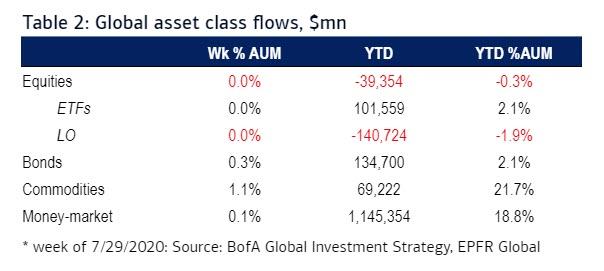
The other problem is that despite all its attempts to stimulate equity animal spirits, the bulk of new fund has flowed into bonds, not stocks. In fact, YTD equity outflows amount to $39BN while inflows to bonds and commodities are over $200BN, with a whopping $1.145 trillion going to cash via money-markets.
And so with so many investors stubbornly buying the one asset class the Fed does not want to be in wide demand (even as it monetized some $3 trillion of it), and even with trillions more in new debt to be paradropped by the US Treasury - something which has failed to taper demand for 10Y Treasurys whose yields just hit an all time low - the hunt for yield is getting harder than ever for fixed-income investors.

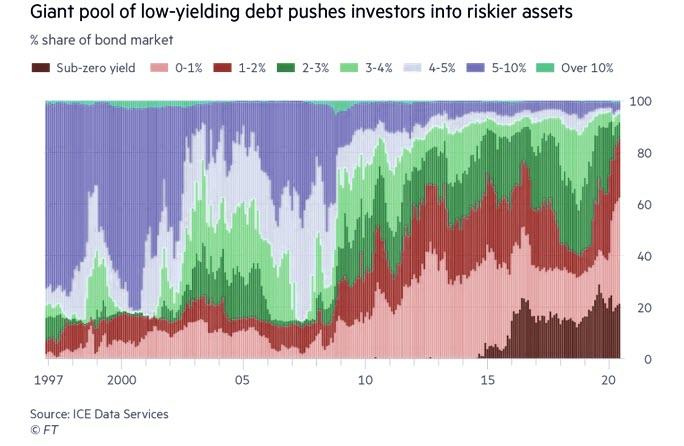
According to the FT, a record 86% of the $60 trillion global bond market tracked by ICE Data Services traded with yields no higher than 2%, with more than 60% of the market yielding less than 1 per cent as of June 30.
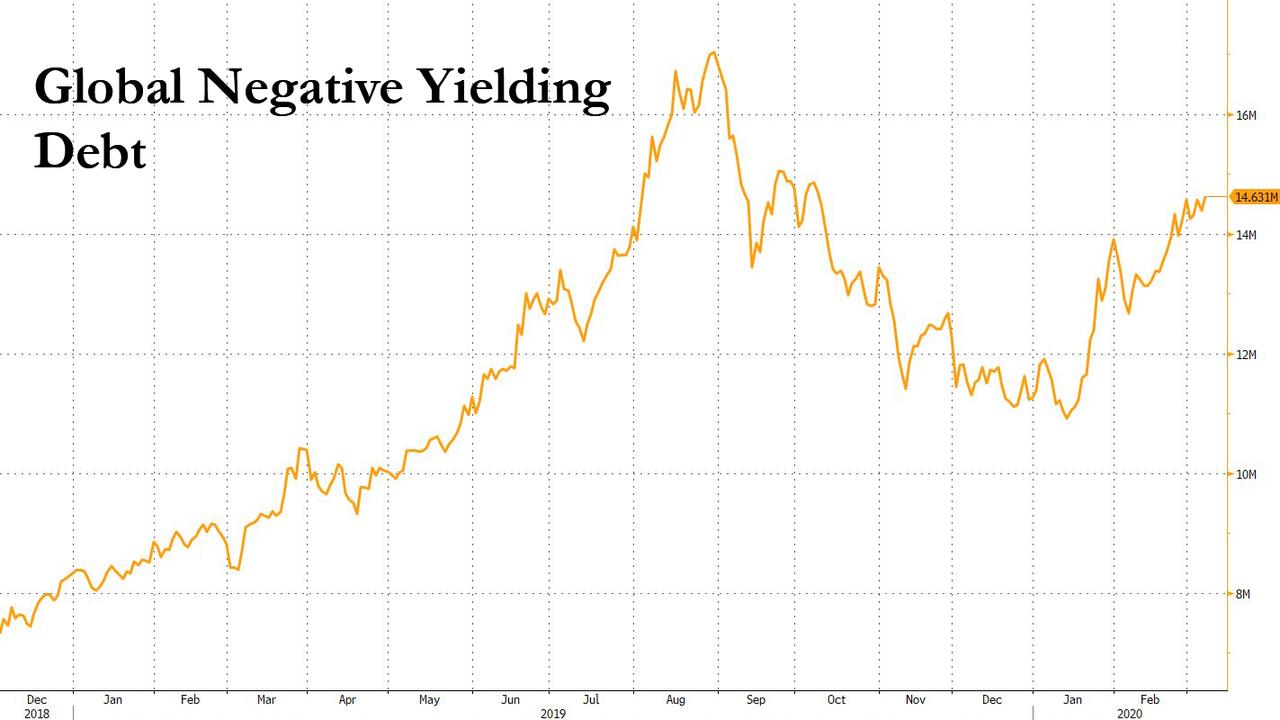
At the same time, global negative yielding debt has soared to $14.6 trillion, from $11 trillion in January, and rapidly approaching the all time high of $17 trillion hit one year ago.
Meanwhile, just 3% of the investable bond universe today yields more than 5%, a share that is close to an all-time low, and represents a precipitous drop from levels seen roughly two decades ago. Consider that in the late 1990s, nearly 75% of bonds traded with yields above 5 per cent, while sub-2% yields comprised under 10% of the market. That was before central banks took over capital markets, and responded to the a series of financial crises by slashing interest rates to ever lower, and eventually negative rates, and launching trillions in bond-buying programs that fundamentally altered the investing landscape.
This has pushed investors into riskier segments in search of income, compelling them to lend to lower-quality companies and countries.

"Yield-chasing behavior has become much more pronounced,” said Matt King, Citi's legendary credit strategist. "If you are a pension fund or an insurance company, you are forced to go down in quality and take extreme risk."
It all came to a head in this year’s Covid-19 crisis, when the Fed again cut interest rates to near zero, and pledged to buy an unlimited quantity of government debt (and has been doing so, monetizing all gross Treasury issuance in 2020). The central bank also launched a number of emergency programs to shore up an unprecedented range of securities — including IG, junk bonds and municipal debt - which sent investment grade prices to all time highs and disconnected them from fundamentals. Investors expect additional stimulus measures to be announced at either this week’s Fed meeting or the next one in September.
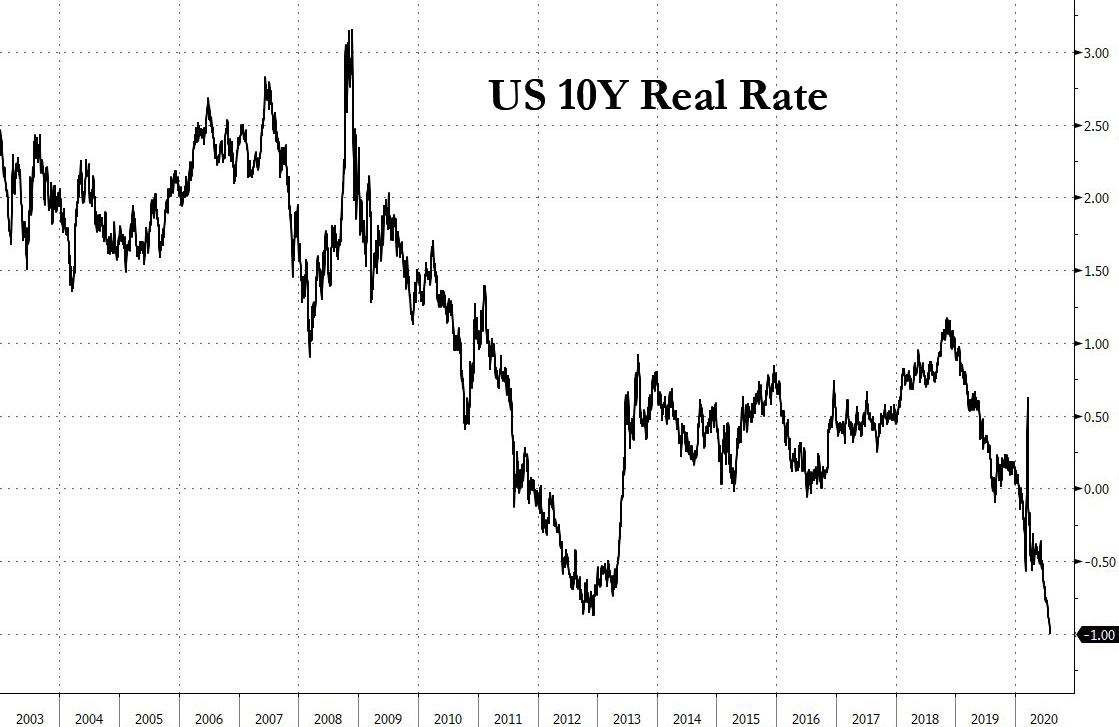
After the latest round of interventions, real yields on US Treasuries — which strip out expectations for inflation — have dropped to all time lows of -1%.
This move “is the direct consequence of all of the central bank support”, said King. "It is the main force driving investors to pile into risky assets" such as gold and cryptos, both of which are at or near all time highs.

WSJ : Homicide Spike Hits Most Large U.S. Cities

Homicide Spike Hits Most Large U.S. Cities
Journal analysis shows double-digit increases in 36 of 50 biggest cities amid pandemic, though other types of violent crime fell

A sharp rise in homicides this year is hitting large U.S. cities across the country, signaling a new public-safety risk unleashed during the coronavirus pandemic, and amid recession and a national backlash against police tactics.

The murder rate is still low compared with previous decades, and other types of serious crime have dropped in the past few months. But researchers, police and some residents fear the homicide spike, if not tamed, could threaten an urban renaissance spurred in part by more than two decades of declining crime.

A Wall Street Journal analysis of crime statistics among the nation’s 50 largest cities found that reported homicides were up 24% so far this year, to 3,612. Shootings and gun violence also rose, even though many other violent crimes such as robbery fell.

Police, researchers, mayors and community leaders see a confluence of forces at work in the homicide spike. Institutions that keep city communities safe have been destabilized by lockdown and protests against police. Lockdowns and recession also mean tensions are running high and streets have been emptied of eyes and ears on their communities. Some attribute the rise to an increase in gang violence.

Some cities with long-running crime problems saw their numbers rise, including Philadelphia, Detroit and Memphis, Tenn. Chicago, the worst-hit, has tallied more than one of every eight homicides.

Less-violent places have been struck as well, such as Omaha, Neb., and Phoenix. In all, 36 of the 50 cities studied saw homicide rise at double-digit rates, representing all regions of the country.

“I was surprised at the consistency of the increase across all of the different cities,” said Jens Ludwig, a University of Chicago professor and director of its Crime Lab, which researches crime, after examining the Journal data.

Police and academics who study crime have long debated why homicide rates rise or fall, citing variables including demographics, incarceration rates, drug epidemics, the economy and policing. That debate has been thrown a new curve: fallout from the pandemic. Moreover it is complicated by the fact that other kinds of crime are falling. Reported robberies were down 11% among the 41 largest cities that made robbery data available.

One explanation for the divergence between homicide and other crime might reside in what is known as “routine activity theory,” which holds that crime is a function of three factors: The supply of offenders, the supply of victims and the intervention between the two by society’s guardians—including police, schools and churches.

Police in many departments said robberies, burglaries and rapes are down so far this year because more people stayed home during Covid-19 lockdowns, leaving fewer prospective victims on the streets, in bars or other public places. Burglars weren’t likely to break into homes filled with people under lockdown, they say.

Homicides, on the other hand, are up because violent criminals have been emboldened by the sidelining of police, courts, schools, churches and an array of other social institutions by the reckoning with police and the pandemic, say analysts and law-enforcement officials in several cities.

Anecdotally, many police departments point to a rising tide of gang violence, in which rival groups of mainly young offenders battle over control of neighborhoods, catching rivals and innocents in the process.

Schools let out young adults in March because of the pandemic and after-school activities largely stopped. Churches and other social institutions were restrained for the sake of social distancing. Police first were hit by coronavirus and then blowback in the neighborhoods they patrol after the killing in Minneapolis of George Floyd, a Black man, while in police custody.

“Gangs are built around structure and lack thereof,” said Jeff La Blue, a spokesman for the Fresno police department. “With schools being closed and a lot of different businesses being closed, the people that normally would have been involved in positive structures in their lives aren’t there.” He noted shootings and stabbings have soared in his community. “Nerves are high. People are short on money.”

Some researchers say the upward trend in murder might be evidence of a fraying of the social order. “Everything that society does that might shape public safety was turned upside-down during the pandemic,” Mr. Ludwig said.

Police say homicide increases are hitting low-income, mostly Black and Latino communities especially hard. The crime maps published by many cities show homicides aren’t up in city centers where antipolice protests are happening, but instead in low-income neighborhoods outside of those city centers.

In Portland, for instance, the police department didn’t see any homicides around protests in July, a department spokeswoman said. Through June, its latest crime maps show, all of its homicides happened east and south of the city center.

Mr. Ludwig studied maps of homicides in Chicago and found killings were concentrated in the south and west, “the most disadvantaged neighborhoods that were already suffering the most from longstanding economic challenges and the coronavirus,” he said. The pace is accelerating: Of 433 homicides in Chicago as of July 26, 106 were in the previous 28 days.

Mr. Trump has blamed increased violence in U.S. cities on Democratic Party leadership in hard-hit municipalities. His decision to send federal agents into U.S. cities, he said, was to help fight violent crime.


In addition to sending federal agents to Portland to protect government property from protesters, the White House said it is sending agents to other cities including Detroit, Albuquerque, Chicago, Milwaukee, Kansas City and Cleveland as part of a program aimed at curbing violent crime. The program, known as Operation LeGend, is named after LeGend Taliferro, a boy who was killed in Kansas City this year.

Though many of America’s biggest cities are run by Democrats, the rise in killings is a bipartisan problem. Homicides are rising at a double-digit rate in most of the big cities run by Republicans, including Miami, San Diego, Omaha, Tulsa, Okla., and Jacksonville, Fla., as well as in cities run by Democrats and in the two major cities run by Independents: San Antonio and Las Vegas.

The Journal’s statistical analysis was based on individual police department reports about crime in their cities. Some public-information departments made data available. The University of Chicago’s Crime Lab helped fill in some blanks and reviewed the Journal data.

Chicago police say conflict springs from tit-for-tat gang violence, including drive-by shootings. In one recent attack on the city’s South Side, shooters in a Chevrolet Malibu fired 60 times from a car, injuring 15 people attending the funeral of a man who himself had been killed in a drive-by shooting days before, apparently in retaliation for an earlier shooting, according to local reports. People at the latest funeral returned gunfire.

SHARE YOUR THOUGHTS
What should be done to address the homicide spike in U.S. cities? Join the conversation below.

The recession and coronavirus lockdowns are hurting programs aimed at curbing the violence in Chicago, said Eduardo Bocanegra, senior director of READI Chicago, a mostly privately funded program that provides employment and counseling services to men at risk of becoming, at turns, victims of violence or attackers.

“Men in my program are being killed right now,” he said, noting that five people in the program, which currently has about 220 people enrolled, were killed in the five weeks from Memorial Day to July 4, including one who was walking away from a confrontation.

State and city grants that he expected to come through were put on hold. Mr. Bocanegra has cut staff from 120 to 100 and trimmed enrollment in the program from 18 months to 12. It has gotten harder to place men in the program into jobs, he said, and he worries it is only going to get tougher to tap funds as organizations fight for scarce public and philanthropic dollars.

Michael LiPetri, chief of crime control strategies at the New York Police Department, said the city’s rise in homicide is worst in Brooklyn, where shootings have broken out at large gatherings such as barbecues in public parks and outdoor dice games.

The department is moving officers to Brooklyn from larceny units, where the work has slowed. City policy has made it harder to keep the peace, Mr. LiPetri said. He cited a city council decision in June that exposes New York officers to criminal charges if they kneel on the chest or back of suspects. Public anger at police is also an impediment, he said: “It is impossible for a New York City police officer to break up those large gatherings.”

New York, Detroit and Fresno officers all said the easing of bail requirements in their states likely returned some dangerous criminals to the streets.

Mayor Bill de Blasio has acknowledged police concerns about the new restrictions on police tactics but in July said, “I believe we can make it work.” In a statement to the Journal, the New York mayor’s office added, “It’s a perfect storm out there. Not only are the courts not fully open, but don’t fail to notice that there is a historic pandemic and economic crisis right now.”
Homicide this year is still far lower than it was in the past. In 1990, for example, New York City alone had 2,262 murders, about equal to the total number of killings in the nation’s largest 25 cities so far this year.

Between 1993 and 2018, violent crime in U.S. cities dropped 54%. After 2000, the pace of that decline in cities was faster than in suburbs and rural communities, according to Bureau of Justice Statistics crime victimization surveys.

It is hard to tell if the long-run trends that transformed many U.S. cities for the better are now reversing, or if instead this will be a spike. A great deal hangs on that question, experts say.

“If the city descends into the level of danger that we saw in the 1970s, that will be a challenge for all of America,” said Edward Glaeser, an urban economist at Harvard University.

WSJ :Luxury Department Store Lord & Taylor Files for Bankruptcy

Luxury Department Store Lord & Taylor Files for Bankruptcy
Chain’s owner, the fashion rental service start-up Le Tote, also files

Luxury department store chain Lord & Taylor, an industry pioneer dating back nearly 200 years, filed for bankruptcy along with its owner, the venture-backed fashion-rental subscription service Le Tote Inc.

Sunday’s chapter 11 filings in the U.S. Bankruptcy Court in Richmond, Va. are the latest indications of the Covid-19 pandemic’s ruinous effect on storied American retailers, coming less than a year after Le Tote agreed to buy Lord & Taylor from Hudson’s Bay Co., the parent of Saks Fifth Avenue.

Lord & Taylor temporarily closed its 38 bricks-and-mortar locations in March but has continued to operate through online channels as restrictions on nonessential shopping went into effect during the coronavirus pandemic.

In court papers, the company said it would conduct going-out-of-business sales at the Lord & Taylor stores, anticipating a liquidation of the bricks-and-mortar footprint.

The most-profitable locations will continue to be marketed in the hopes of generating interest, Chief Restructuring Officer Ed Kremer said in a declaration filed in court.

The company is considered the oldest U.S. department store and was the first to install an elevator, open a branch location and hire a woman CEO—Dorothy Shaver, who was instrumental in making it a beacon for American designers in the ’40s and ’50s. The chain traces its origins back to 1826 when Samuel Lord and George Washington Taylor founded a dry-goods store on New York City’s Lower East Side.

Founded in 2012, Le Tote rents women’s clothing and accessories for a flat monthly fee. Backers of the San Francisco company include venture-capital firms Andreessen Horowitz, Y Combinator and Google Ventures.

As Americans’ spending on apparel has plunged, thousands of retailers have been forced to shut their doors, some for good. Since March, a number of major clothing retailers have been pushed into bankruptcy, including Brooks Brothers Group Inc., J.C. Penney Co., Neiman Marcus Group Ltd. and J.Crew Group Inc.

But department store chains like Lord & Taylor, J.C. Penney and Neiman Marcus were already retrenching before the pandemic, struggling with falling sales as shoppers buy more online and shift their preferences to small specialty stores. More than two dozen public and large private retailers in the U.S. have filed for bankruptcy so far in 2020, more than in all of last year.

Lord & Taylor’s troubles started in 1986 when its parent company was acquired by May Co. The new owner added lower-priced merchandise, ran frequent sales and kept a tight lid on investments, undercutting Lord & Taylor’s upscale image.

Hudson’s Bay sold the retailer’s flagship New York City store on Fifth Avenue for $850 million to WeWork Cos. A few years later Le Tote bought the whole company for roughly $100 million.

The business generated $253.5 million in revenue last year and entered the bankruptcy with 651 employees and $137.9 million in debt.

Lord & Taylor’s bankruptcy advisers include law firm Kirkland & Ellis LLP, financial adviser Berkeley Research Group LLC and investment bank Nfluence Partners.

The case number is 20-33332.

FT : Deutsche probes Trump banker’s apartment deal

Deutsche probes Trump banker’s apartment deal
Private banker Rosemary Vrablic purchased a property from company linked to Jared Kushner

Donald Trump’s longtime private banker at Deutsche Bank, Rosemary Vrablic, is facing an internal investigation into the terms of a previously-unknown apartment deal between her and a company co-owned by the US president’s son-in-law, Jared Kushner.

Ms Vrablic’s 2013 purchase of an apartment linked to Mr Kushner came to light after his latest annual financial disclosures, which are required because he is a senior adviser in the White House.

The disclosures revealed a previously unknown connection between Mr Kushner and a company that sold apartments in a luxury building on New York’s Park Avenue.

The New York Times subsequently unearthed property records showing that Ms Vrablic and two of her colleagues at Deutsche at the time bought an apartment from the company — Bergel 715 — in 2013 when Mr Kushner was part-owner of the firm and his family was a client of Ms Vrablic’s.

A person familiar with the situation said that Deutsche was not previously aware of the deal and was investigating the terms of the $1.5m transaction. Bankers are prohibited from taking preferential deals from their clients.

Deutsche also currently has a rule requiring bankers to disclose any transactions they do with clients. The bank could not immediately confirm whether this rule was in place in 2013.

In a statement, Deutsche said it will “closely examine the information that came to light on Friday and the fact pattern from 2013”.

Deutsche hired Ms Vrablic from Bank of America as a senior private banker and managing director 14 years ago, calling her “one of the top private bankers to the US ultra high-net-worth community”.

Mr Trump and Mr Kushner have both showered praise on Ms Vrablic, with the former telling the New York Times in 2016 that she was “the boss” of Deutsche, and the latter describing her as an “amazing banker, amazing woman” in closed-door testimony to the House intelligence committee in 2017.

Ms Vrablic will continue with her normal duties during the investigation, as will Dominic Scalzi, a private banker who was hired alongside Ms Vrablic in 2006 and also invested in the property, said the person familiar with the situation.

The third banker listed on the apartment’s property deeds, Matthew Pontoriero, has since moved to Citigroup.

The property in question — a 908-square-foot one-bedroom apartment in a doorman building, 715 Park Avenue — was transferred to a company registered to Ms Vrablic’s home address in 2014 and sold for $1.85m the following year, according to public property records cited by the New York Times.

Ms Vrablic’s lawyer, Mr Scalzi and Mr Pontoriero did not immediately respond to requests for comment, while a spokesperson for Citigroup declined to comment.

The White House referred questions to the Kushner family’s property company. Christopher Smith, general counsel for Kushner Companies, said it was “not the managing partner of that entity [Bergel 715] and has no involvement with the sales of the apartments”.

The US president has a complex relationship with Deutsche Bank. Both parties have sued each other, but Mr Trump has remained an active client of the German lender, turning to them for some of his biggest loans.

Last month, the US Supreme Court temporarily blocked subpoenas from Congress demanding Deutsche hand over Mr Trump’s financial records, sending the issue back to lower courts. At the time Deutsche said it “remained neutral” throughout the proceedings and would abide by the courts’ final decision.

Mr Trump has long argued that his finances should remain private, breaking with the long-held tradition for presidential candidates to publish their tax returns.

FT : UK chemical industry warns of £1bn cost to duplicate EU regime

UK chemical industry warns of £1bn cost to duplicate EU regime
Smaller companies may fail to survive move to a British safety registrations agency

The conical flasks in the Cornelius Group chemical factory in Suffolk are the size of space hoppers, each filled with a bubbling concoction that the company’s chief executive, Neville Prior, says is too secret to divulge.

The chemicals, which are used to make contact lenses, are highly volatile but for Mr Prior it is the bureaucratic blowback for his industry from the impact of Brexit next January that keeps him awake at night.

From January 1 the safety registrations of the chemicals Mr Prior uses to make his products — currently held in the Reach registration database run by the European Chemicals Agency (Echa) in Helsinki — will need to be re-registered with a new UK equivalent.

For Cornelius Group, with 200 employees and turnover of about £50m a year, Mr Prior said registering some 2,000 chemicals within the two-year government deadline represents a costly bureaucratic marathon for no gain.

Registering a single chemical in the new UK Reach database could cost up to £300,000 if companies are required to buy “letters of access” to use the vast banks of test data held by Echa — information that is expensive to produce and often owned by third parties. Even then, additional testing may be required.

Steve Elliott, chief executive of the Chemical Industries Association, said that unless a data-sharing deal was done with Brussels the new system would add more than £1bn in costs to companies, just to duplicate existing registrations.

To make matters more complex, Mr Prior, like other medium-sized business owners, has still not seen the computer software that the Health and Safety Executive will use to collect the new UK registrations.

“The real question is how do you get hold of the registration data, which is held in commercial agreements,” he said. “It’s unclear and we’re getting closer and closer to the time when Brexit is going to happen.” 


The decision to create a costly copy of the EU Reach database flows from prime minister Boris Johnson ruling out seeking associate membership of Echa as part of his “clean break” Brexit.

The chemicals industry is not alone in facing costs of duplicating existing EU standards regimes after the end of the Brexit transition period. Manufacturers have warned of the costs of a new UK Conformity Assessed quality standard that ministers say will replace the existing CE mark from next year.

In a letter to MPs in May, Rebecca Pow, the minister at the Department for Environment, Food and Rural Affairs overseeing the policy, admitted there would be “significant cost and burden to industry” in complying with UK Reach, but argued that the “benefits of having control of our own laws outweigh the costs”.

That is not a view shared by Dani Loughran, managing director of Aston Chemicals in Aylesbury, another medium-sized business that imports and distributes chemicals used by some of the world’s leading cosmetics brands.

Aston sells about a thousand different products, many of which will require a new UK registration and the company and its suppliers may have to commission fresh testing to duplicate the Echa data.

Even without new testing, the basic cost of registering each chemical will be about £5,000, with the additional cost of “letters of access” varying from £33,000 for an emollient used in a face cream, for example, to £150,000 for a shea butter used as a base for sunscreen. In one case a letter of access cost nearly £300,000.

“Our EU competitors are licking their lips, and that is deeply frustrating,” Ms Loughran said of the mounting costs. “We’ve spent 30 years growing from nothing, now all these barriers are being forced upon us.

“It is enormously wasteful and uncompetitive for UK companies like us to have to spend time, money and resources to repeat all of these registrations for no additional benefit to anyone.”

Both Ms Loughran and Mr Prior also had doubts that UK Reach would have the bureaucratic bandwidth to manage the new processes. Echa employs 600 people with an annual budget of €110m, compared with the £13m a year budgeted for the UK version, including up to 50 staff.

Crucial to shrinking the new registration costs for UK companies — by up to 80 per cent according to Chemical Business Association chief Peter Newport — will be whether British negotiators can broker a data-sharing agreement between Echa and the UK authorities to remove the need for the letters of access.

“Basically the EU has a pantry in Helsinki stuffed full of goodies, and we now want to populate the UK’s new pantry with that data,” Mr Newport said.

He added that there were widespread concerns in the industry that the cost of UK registration risked making some chemicals commercially non-viable in the UK market, with knock-on effects for supply chains and UK jobs.

The request for a data-sharing agreement is supported by both the European Chemical Industry Council and the Chemical Industries Association. But EU officials are cautious about the prospects for such a deal.

The UK’s draft agreement seeks to conclude a data-sharing deal by the end of 2021, but in her letter to MPs Ms Pow conceded that “businesses may find it difficult to obtain the necessary data”.

Defra added: “We have already legislated to ensure existing EU Reach registrations held by UK businesses will be carried over, and continue to look at ways in which we can further support them during this period.”

But the need to register with UK Reach remains, creating a burden even for big players such as the German chemical maker BASF, which has 10 small plants in the UK, each employing about 100 people.

Geoff Mackey, corporate affairs director at BASF, said the company had about 1,200 substances to register and had calculated the combined cost would be around £60m-£70m, all with “no added value to the company’s business and not enhancing human safety or environmental protection in any way”.

Businesses like BASF, and even Cornelius Group, should be able to absorb costs and adapt but Mr Newport said some might not survive the regulatory storm.

“We’re very, very concerned,” he said. “Bigger global and pan-EU companies will survive this, but a lot of smaller and micro companies that are already exhausted by Covid-19 may very well not.”

FT : Wirecard processed payments for mafia-linked casino

Wirecard processed payments for mafia-linked casino
Malta-based gaming company CenturionBet was used by the ’Ndrangheta crime organisation to launder money

Wirecard processed payments for a Maltese online casino that was later revealed to have laundered money for a powerful arm of the ’Ndrangheta, one of Europe’s most dangerous mafia organisations.

Italian legal sources and documents seen by the Financial Times confirmed that, up to 2017, Wirecard processed payments for CenturionBet, a Malta-based gaming company that was later judged by Italian courts to have been used by organised criminals to move cash out of the country in a sophisticated money laundering operation.

CenturionBet was used to launder millions of euros of criminal profits by an ’Ndrangheta group from the southern Italian region of Calabria whose activities included taking control of one of Europe’s largest refugee reception centres and siphoning off EU funds intended to provide care for migrants arriving from north Africa.

The Calabrian ’Ndrangheta is one of Europe’s most powerful organised criminal groups, engaging in industrial-scale cocaine trafficking in collaboration with Latin American drug cartels as well as extortion, arms smuggling, money laundering and murder.

Wirecard continued to do business with CenturionBet, which was incorporated in Malta but owned by a Panamanian shell company, until 2017 when its gambling licence was suspended by Maltese authorities and it ceased trading after an anti-mafia raid that saw 68 people arrested. Since then more than 30 people have been sentenced for mafia-related crimes linked to the case.

Revenues from CenturionBet comprised only a tiny fraction of Wirecard’s global operations but the discovery raises further questions about the business model of the German company once lauded as a pioneer of European fintech. 

As a regulated payments institution Wirecard is required to adhere to strict anti-money laundering rules and to submit suspicious transaction reports to relevant authorities.

According to internal documents seen by the Financial Times, Wirecard also processed payments for another larger Maltese gambling company that has been named by the Italian authorities as having laundered money for organised criminal groups in cases that are still being investigated.

It is possible that Wirecard was unaware of the companies’ alleged links to organised crime. One former Wirecard staff member recalled that after press reports of mafia links at the larger Maltese gambling company, a compliance review was carried out but the company passed on the basis of assurances provided. Wirecard declined to comment.

Wirecard went from being one of Germany’s largest publicly listed companies worth more than €24bn to admitting in June this year that large parts of its operations were likely to be fictional. Since then its former chief executive has been arrested in Germany on charges of fraud, while its former chief operating officer is missing, after fleeing the country.

Investigators, short sellers and journalists had for many years raised questions about possible illegality by some of the tens of thousands of smaller customers for which Wirecard processed payments.

Last year an Italian man, Francesco Martiradonna, a 47 year-old from Bari, was sentenced in Italy to 11 years in prison for placing CenturionBet, which Italian prosecutors judged him to control, at the disposal of various organised criminal groups, who used the company for money laundering purposes and tax evasion.

As the numerous autonomous families that make up the ’Ndrangheta have grown in wealth and power, they have increasingly adopted more sophisticated ways of laundering their criminal profits, including through online casinos, some of which have been based in Malta. 

Italian investigators said that the money laundering skills of certain Italian organised criminal operations has meant that crime groups from other countries, including Russia and Albania, have been known to use them to clean the proceeds of crime in exchange for a fee.

FT : Facebook accused of failing to deliver on advertisers’ boycott demands

Facebook accused of failing to deliver on advertisers’ boycott demands
Activists on hate speech promise further disruption as some companies continue their veto

Facebook has “failed to deliver” on most of its advertisers’ demands on content moderation despite July’s boycott, one of its organisers has said, as civil rights groups weigh their next move and some big brands refuse to resume spending on the platform. 

Jonathan Greenblatt, chief executive of the Anti-Defamation League, said the action against the world’s largest social media platform by US marketers “wasn’t a really full campaign. It was a warning shot.”

The groups were “right now looking at new potential actions, with new . . . stakeholders”, he added. 

“Things are in the works,” he said, because Facebook had “failed to deliver on the vast majority” of their demands. A sister “Stophateforprofit” campaign, for example, was launched in Europe over the weekend. 

More than 1,100 companies committed to pulling their digital advertising dollars from Facebook for the month of July in protest at its perceived failure to tackle racism and hate speech on its platform after the killing of George Floyd.

The top 100 advertisers on Facebook spent at least $308m in July, compared with nearly $390m for the same month last year, according to data from Pathmatics, as several big spenders cut back.

Many marketers are returning for August — around 95 per cent of the total, according to an estimate by a top advertising agency executive. These include many smaller players that are more reliant on the platform, as well as groups such as Heineken, The North Face and Puma. 

It comes after Facebook made some concessions, including agreeing to create a team to study if its algorithms lead to racial bias and a new role of vice-president for civil rights.

The social media group also agreed to join an effort to create an industry-wide definition of hate speech and undergo two audits related to the toxic content on its platform. 

“We saw high double-digit per cent declines early in the month with some spend returning to the platform as the month of July progressed,” one large media buying agency said. “Ultimately, though, it’s hard to isolate for the boycott versus market effects of Covid.”

The top 100 advertisers on Facebook spent at least $308m in July, compared with nearly $390m for the same month last year, according to data from Pathmatics, as several big spenders cut back.

Many marketers are returning for August — around 95 per cent of the total, according to an estimate by a top advertising agency executive. These include many smaller players that are more reliant on the platform, as well as groups such as Heineken, The North Face and Puma. 

It comes after Facebook made some concessions, including agreeing to create a team to study if its algorithms lead to racial bias and a new role of vice-president for civil rights.

The social media group also agreed to join an effort to create an industry-wide definition of hate speech and undergo two audits related to the toxic content on its platform. 

“We saw high double-digit per cent declines early in the month with some spend returning to the platform as the month of July progressed,” one large media buying agency said. “Ultimately, though, it’s hard to isolate for the boycott versus market effects of Covid.”

Sheryl Sandberg, Facebook's chief operating officer, said on the call that the company had “a lot more to do” to tackle hate speech, adding: “We are working every day to meet this challenge, not because of pressure from advertisers, but because it is the right thing to do.”

Mr Greenblatt said the civil rights groups “never expected to put a dent in Facebook’s P&L . . . We said we wanted to shine a spotlight on their practices.” 

He said that the campaign’s “success is undeniable” in this respect, as it was raised repeatedly in last week’s bruising congressional hearings with the big tech chiefs.

But he added: “Another ad pause is absolutely possible if Facebook doesn’t make [more] progress in a meaningful timeframe.”