>>> Europe : Brokers Upgrades & Downgrades - 8th of September 2020

>>> Up
* BT Raised to Overweight at Barclays; PT 160 pence
* BW LPG Raised to Hold at Cleaves Securities; PT 37 kroner
* Euronav Raised to Hold at Cleaves Securities; PT $8
* Flutter Raised to Overweight at Barclays; PT 13,000 pence
* Hargreaves Lansdown Raised to Buy at Berenberg; PT 1,915 pence
* Jupiter Raised to Hold at Berenberg; PT 196 pence
* Saint-Gobain Raised to Buy at SocGen; PT 41 euros
* Schindler Raised to Buy at HSBC; PT 280 Swiss francs
* St James's Place Raised to Buy at Berenberg; PT 1,195 pence
* Standard Life Aberdeen Raised to Buy at Berenberg; PT 285 pence

>>> Down
* *EUROPEAN TELECOMS SECTOR CUT TO UNDERWEIGHT AT MORGAN STANLEY
* GVC Cut to Equal-Weight at Barclays; PT 900 pence
* HeidelbergCement Cut to Hold at SocGen; PT 58 euros
* Pirelli Raised to Buy at Citi; PT 4.60 euros
* Sika Cut to Hold at SocGen; PT 230 Swiss francs (Yest. PM)
* Valeo Cut to Sell at AlphaValue

>>> Initiation
* Grenke Rated New Hold at Nord/LB; PT 60 euros
* Schumag Rated New Buy at GSC Research; PT 1.50 euros

>>> Call
* ABI Potential CEO Succession a Headwind for the Short Term: Citi
* Ashstead Gains Based on ‘Good Peer Performance,’ Liberum Says
* Berenberg Sees Encouraging Signs in European Asset Managers
* Saint-Gobain Rises on SocGen Upgrade; HeidelbergCement, Sika Cut (Yest. PM)

WSJ : Production Problems Spur Broad FAA Review of Boeing Dreamliner Lapses

Production Problems Spur Broad FAA Review of Boeing Dreamliner Lapses
Plane maker says no immediate safety threat exists, but parts of the fuselage didn’t meet design standards; eight planes are grounded

Production problems at a Boeing Co. BA 1.35% 787 Dreamliner factory have prompted air-safety regulators to review quality-control lapses potentially stretching back almost a decade, according to an internal government memo and people familiar with the matter.

The plane maker has told U.S. aviation regulators that it produced certain parts at its South Carolina facilities that failed to meet its own design and manufacturing standards, according to an Aug. 31 internal Federal Aviation Administration memo reviewed by The Wall Street Journal.

As a result of “nonconforming” sections of the rear fuselage, or body of the plane, that fell short of engineering standards, according to the memo and these people, a high-level FAA review is considering mandating enhanced or accelerated inspections that could cover hundreds of jets.

The memo, a routine update or summary of safety issues pending in the FAA’s Seattle office that oversees Boeing design and manufacturing issues, says such a safety directive could cover as many as about 900 of the roughly 1,000 Dreamliners delivered since 2011.

The final language depends on the outcome of continuing reviews by Boeing and the agency, as well as decisions by more-senior FAA officials. The extent of the review reflects that the agency’s concerns are significant.

Boeing has told regulators a defect resulting from the quality lapse doesn’t pose an immediate safety threat to Boeing’s flagship fleet of Dreamliners, people familiar with the matter said. The wide-body jets have an excellent safety record and are frequently used on international routes. Regulators aren’t preparing immediate action and haven’t publicly signaled what steps they might take.

But that slip-up combined with another recently discovered assembly-line defect prompted Boeing to take the unusual step in late August to voluntarily tell airlines to ground eight of their 787s for immediate repairs. Since then, Boeing has publicly confirmed the eight planes weren’t safe to remain in service.

Both defects together led Boeing to determine the eight jets didn’t meet structural-soundness “requirements for safe flight and landing,” according to the FAA memo, which summarized the status of the agency’s examination of the issue. Boeing also determined the second defect by itself doesn’t pose an imminent safety hazard.

The extent of FAA scrutiny of Dreamliner production lapses and the period it covers haven’t been reported previously. The Air Current, a trade publication, earlier reported the factory lapses and August groundings of the eight planes, which are slated to end when Boeing-led teams complete fixes expected to take about two weeks.

A Boeing spokesman said the plane maker is conducting a thorough review to understand the root cause of the two defects and is inspecting newly produced airplanes before delivery. The company has fully briefed the FAA and is working closely with regulators, he added. “We are taking the appropriate steps to resolve these issues and prevent them from happening again,” he said.

The FAA, in responses to questions about the groundings and broader production review, has said it “is aware of the matter and continues to engage with Boeing.” The agency’s high-level review includes analyses of data and production parts.

The manufacturing slip-ups mark the latest production problems for the troubled plane maker and present a test for Chief Executive David Calhoun and a revamped safety-review process after two fatal accidents of its narrow-body 737 MAX. The crashes took 346 lives.

The Boeing spokesman said a new internal safety-review process put in place after the MAX crashes worked as intended. He added that the company took proactive steps to address the problems.

Boeing quickly notified airlines with Dreamliners needing immediate repairs, the spokesman said. The carriers include United Airlines Holdings Inc., Air Canada, All Nippon Airways Co., Singapore Airlines Ltd., Air Europa Líneas Aéreas S.A.U., Norwegian Air Shuttle AS A and Etihad Airways, according to people familiar with the matter and aviation-tracking service Flightradar24.

A United spokesman said the airline removed a 787 from service immediately after Boeing’s notification. ANA said it grounded its plane after Boeing flagged the problem and didn’t need the aircraft back immediately because of weak market demand. Representatives of the other carriers didn’t immediately respond to requests for comment.

Stepped-up safety inspections and repairs could disrupt airline maintenance schedules and passenger flight schedules.

Deliberations about mandated inspections and how many Dreamliners might be covered have been under way inside the FAA for months, according to people familiar with the matter. Such a directive would target excessive stresses that could cause premature material fatigue affecting the carbon composite parts that fit behind the passenger cabin. A person familiar with Boeing’s internal review said Sunday that there is no indication at this point suggesting the defects stretch back to the jet’s early years, but said the analysis was continuing.

The FAA, according to a person briefed on the agency’s deliberations, is focused on identifying how the manufacturing breakdowns occurred, why Boeing’s computerized safeguards failed to flag mismatches between the parts that failed to meet design standards and what changes are required to ensure the 787 fleet’s continued safety.

As Boeing engineers comb through records to identity planes with possible flaws, the FAA already has learned what prompted one of the defects: The plane maker didn’t test how it produces shims, or material that fills gaps between barrel-shaped sections of the jets’ fuselages, to ensure they meet requirements, according to the FAA memo. The shims are produced at Boeing’s Dreamliner factory in North Charleston, S.C.

Boeing’s process to generate shims was “not validated prior to implementation into the production process” and lacked a quality check to verify the final product “meets the engineering requirements,” according to the FAA memo. “Boeing has acknowledged a process that produces nonconforming products” and is working to change that, the memo adds.

According the memo, Boeing’s request for more time to resolve some issues “adds to the risk of the fleet.”

Boeing identified the suspect shims in August 2019 and immediately reactivated a computerized quality check that identifies improper shims that had been turned off, the person familiar with Boeing’s internal review said. The second defect, which this person said Boeing detected last month as part of an internal review, stems from variations in the smoothness of the interior fuselage skin near the rear of the planes.

When both defects occur in the same location, Boeing engineers determined, the composite sections don’t fit properly when fastened together and tiny imperfections could result in a potential hazard under extreme flying conditions, albeit circumstances pilots would rarely encounter, people familiar with matter said. Typically, such structural faults prompt mandatory FAA safety action.

Boeing engineers have been reviewing manufacturing records, including high-resolution photographs taken during production, to determine how many Dreamliners delivered since the plane’s 2011 debut might contain fuselage defects, the people familiar with the matter said.

The episode is the latest example of Boeing manufacturing snafus. In recent years Boeing has had to revamp quality checks to prevent workers leaving debris inside the Dreamliner, its KC-46A military air-refueling tankers and narrow-body 737 MAX jets.

Boeing’s move to ground the Dreamliner on its own volition contrasts with how the aerospace giant responded to the 737 MAX crashes. After the second accident in Ethiopia in March 2019, Boeing didn’t immediately call for the aircraft’s grounding as global regulators began issuing flight bans.

FT : AB InBev launches process to replace longtime chief Carlos Brito

AB InBev launches process to replace longtime chief Carlos Brito
Brewing giant considers external candidates to replace Brazilian who has been at helm for 16 years

Anheuser-Busch InBev, the maker of Budweiser and Stella Artois, has launched a process to replace chief executive Carlos Brito, the Brazilian who led its transformation into the world’s largest brewer through a series of takeovers during his 16-year tenure.

The brewer is seriously considering outside candidates for the role, according to three people with knowledge of the matter, in what would be a significant move for a company that prides itself on its homegrown culture. 

Two of these people said that AB InBev was working with recruitment firm Spencer Stuart on the search. One of the people said that Mr Brito was involved with the AB InBev board in the process and planned to step down at some point next year. 

Part of the reason for the external search is that AB InBev is currently considering only one internal candidate, Michel Doukeris, who heads its North America-based Anheuser-Busch business, these people added. Other candidates previously tipped as possible candidates such as chief strategy officer David Almeida and chief marketing officer Pedro Earp are not being considered. 

It is also possible that Mr Brito remains in charge for longer if the company does not settle on a candidate from the search, one of the people said. This person added that Mr Brito was expected to join the company’s board after stepping down. 

AB InBev declined to comment.

The company has already replaced its chief financial officer and chairman in the past 18 months. The changes in leadership come as AB InBev continues to grapple with a heavy debt load stemming from its £79bn takeover of SABMiller, which capped nearly two decades of dealmaking that gave it a dominant position in the brewing industry. 

Finance chief Felipe Dutra stepped down in February to be replaced by Fernando Tennenbaum, finance chief at the company’s Brazilian unit, less than a year after Olivier Goudet ceded the chairman’s role to Marty Barrington, former chief executive of the tobacco group Altria.

Having reached record highs in 2015 ahead of the SABMiller deal, AB InBev’s shares now sit more than 60 per cent below that level as investors worry about its debt burden, which at the end of June stood at $87.4bn, or 4.9 times earnings.

It halved its final dividend in April, after another cut in 2018; it has also been making disposals to help pay down debt, including the sale of its Australian division for $11bn to Asahi this year.

Mr Brito’s departure would mark the end of an era for the brewing industry after Jean-François van Boxmeer of Heineken also stepped down this year. Like Mr Brito, Mr van Boxmeer had pushed to create a global brewer during the sector’s period of hectic consolidation.

Mr Brito led what had been a Latin American regional brewer’s expansion into the world’s largest beer maker, fuelled by aggressive dealmaking, a bonus-led staff culture and fierce cost-cutting at the businesses it had acquired.

Any successor will need to win the approval of two key blocks of shareholders — the Belgian families who formerly controlled Interbrew and the three Brazilian founders of 3G Capital. Other major shareholders include tobacco group Altria and Colombia’s Santo Domingo family.

Mr Brito’s brewing career began in 1989 when he joined the Brazilian brewer Brahma, working for his mentor Jorge Paulo Lemann, the founder of private equity firm 3G, who paid for his Stanford education.

Brahma began a deal-led expansion, transforming into regional brewer Ambev, of which Mr Brito became chief executive in 2004. That same year the company merged with Belgium’s Interbrew, maker of Stella Artois, to create InBev; four years later it staged a hostile takeover of the US powerhouse Anheuser-Busch to become a global brewer.

FT : Slowdown in German industry’s recovery casts doubt over outlook

Slowdown in German industry’s recovery casts doubt over outlook
Industrial output undershot economists’ expectations in July, latest figures suggest

German industrial production rose by less than economists had expected in July, fuelling concerns about whether the nascent recovery in the eurozone’s pandemic-stricken economy is running out of steam. 

The 1.2 per cent month-on-month rise in German industrial output in July reported by the Federal Statistical Office on Monday was the third consecutive month of growth. But it undershot economists’ consensus expectations for a 4.8 per cent increase, according to a poll by Reuters. 

The figure adds to the concerns of policymakers at the European Central Bank, who will meet on Thursday to discuss monetary policy and are likely to consider how the recent appreciation of the euro risks undermining the competitiveness of eurozone exports and driving down import prices. 

The Federal Statistical Office slightly upgraded its initial estimate of Germany’s monthly industrial production expansion in June to 9.3 per cent. But it said the manufacturing sector’s output in July remained 10 per cent below the level of a year ago. 

Production in the strategically important German carmaking sector rose 6.9 per cent in July from the previous month, but it was still 15 per cent below the pre-pandemic levels of February. 

New car registrations in Germany were down 20 per cent year on year in August, a drop from their 5.4 per cent annual contraction in July.

Excluding production declines in construction and energy goods, all other areas of German industry increased production by 2.8 per cent. 

“Production is likely to have increased again in August, but we now seem to be past the period of rapid catch-up growth,” said Jack Allen-Reynolds, economist at Capital Economics. 

Separate data published on Friday showed that German factory orders expanded less than forecasts had expected in July, rising only 2.8 per cent month on month, compared with economists’ consensus expectations for a 5 per cent increase.

A sharp drop in domestic orders for German manufacturers was offset by a strong rise in foreign orders — reversing the pattern in June.

The revival of the Chinese market has become a particular bright spot for German exporters; exports to China from Europe’s largest economy rose 16 per cent between May and June.

“Orders for German goods from outside the eurozone have gained some traction in July, with the ongoing recovery in China possibly becoming a stabilising factor for growth, while major eurozone countries are facing rising new infection rates and growing concerns that regional lockdowns may need to be implemented,” said Thomas Strobel, economist at UniCredit.

The German government recently boosted its package of economic support measures, including extending by a year its Kurzarbeit furlough scheme, under which workers are sent home and receive about two-thirds of their pay from the government. 

Peter Altmaier, economy minister, also sent an upbeat message about the German economy last week, forecasting that the resilience of the country’s labour market would help it achieve a sharp, V-shaped recovery. 

Mr Altmaier forecast that the German economy would shrink 5.8 per cent over the course of this year, compared with an earlier forecast of a 6.3 per cent contraction. He expected the economy would return to pre-pandemic levels in 2022.

(ZH) Connecting The Dots: How SoftBank Made Billions Using The Biggest "Gamma Sq

Connecting The Dots: How SoftBank Made Billions Using The Biggest "Gamma Squeeze" In History

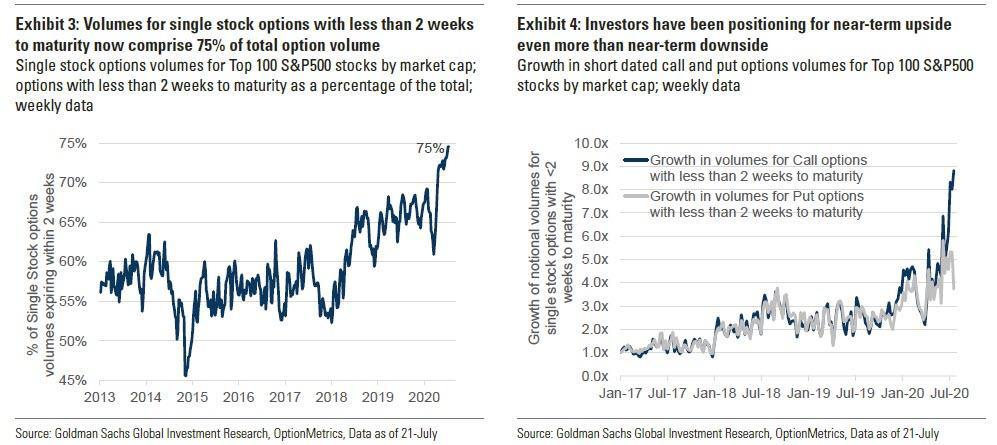
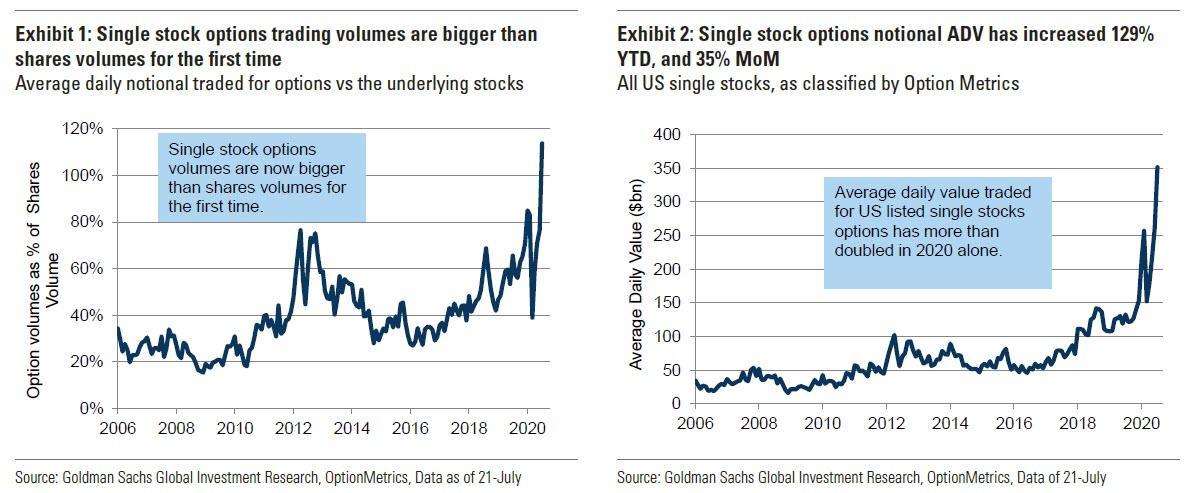
It was back in July when we first reported that Goldman had observed a "historic inversion" in the stock market: for the first time ever, the average daily value of options traded has exceeded shares, with July single stock options volumes hitting 114% of shares volumes.
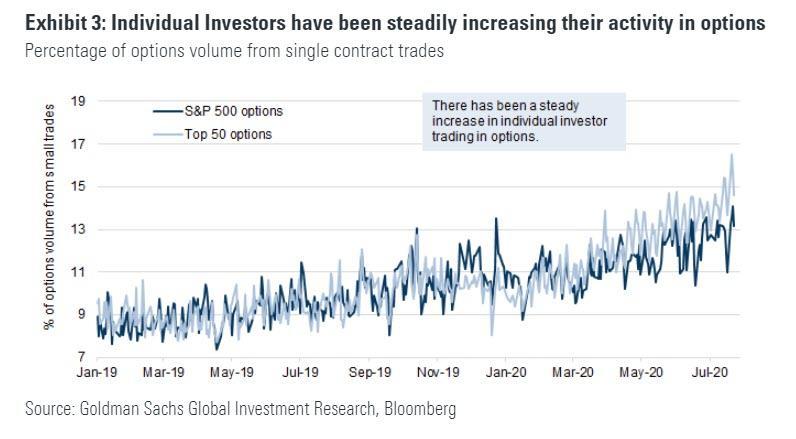
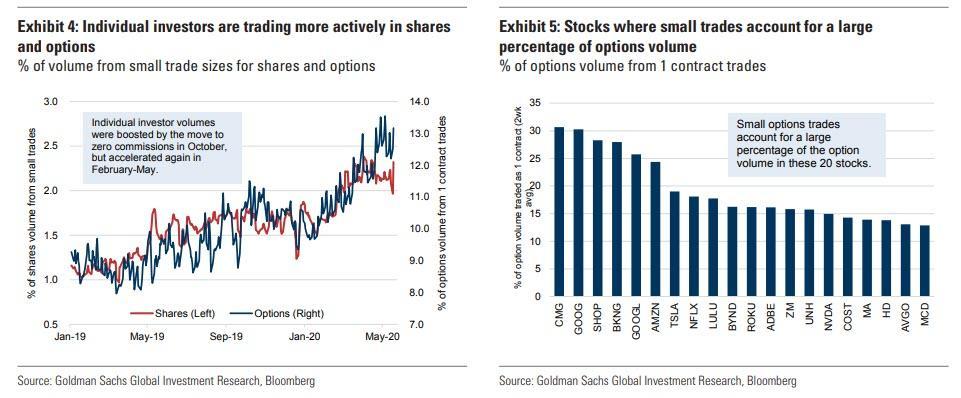
This followed a May report in which we discussed "how retail investors took over the stock market", pointing out the "recent surge in options trading - which has far more impact on market flows due to embedded leverage" and cited Goldman data which showed that "individual investor active trading is playing an increased role in market volatility, particularly in select stocks. In the shares market, 2.3% of all volume is made up of trades for $2,000 or less. The increase in small trades has been even more notable in the options market, where 13% of all trades are for 1 contract."

We also pointed out that "a significant portion of this increase has been driven by higher volumes in short dated contracts, as investors are literally using massive leverage to wager on near-term momentum moves such as those often highlighted OTM calls traded in Tesla stock."
The last clue that an entire generation of investors were flooding into options (read calls) was the surge in individual investor option activity in both the top 50 and the top 500 US names, which has continued a steady climb since the start of the year.
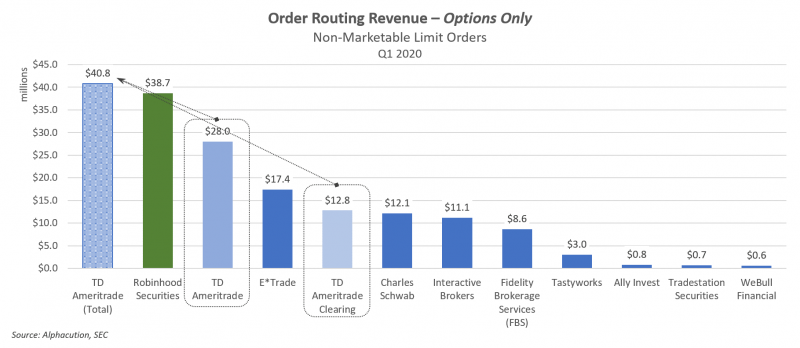
To be sure, this option frenzy was a goldmine for retail brokerages such as Robinhood, Schwab and Etrade, which reported options trading activity surging 129% YTD (up 35% from June levels), which helped explain why various HFT outfits are paying so much to frontrun Robinhood option trades.

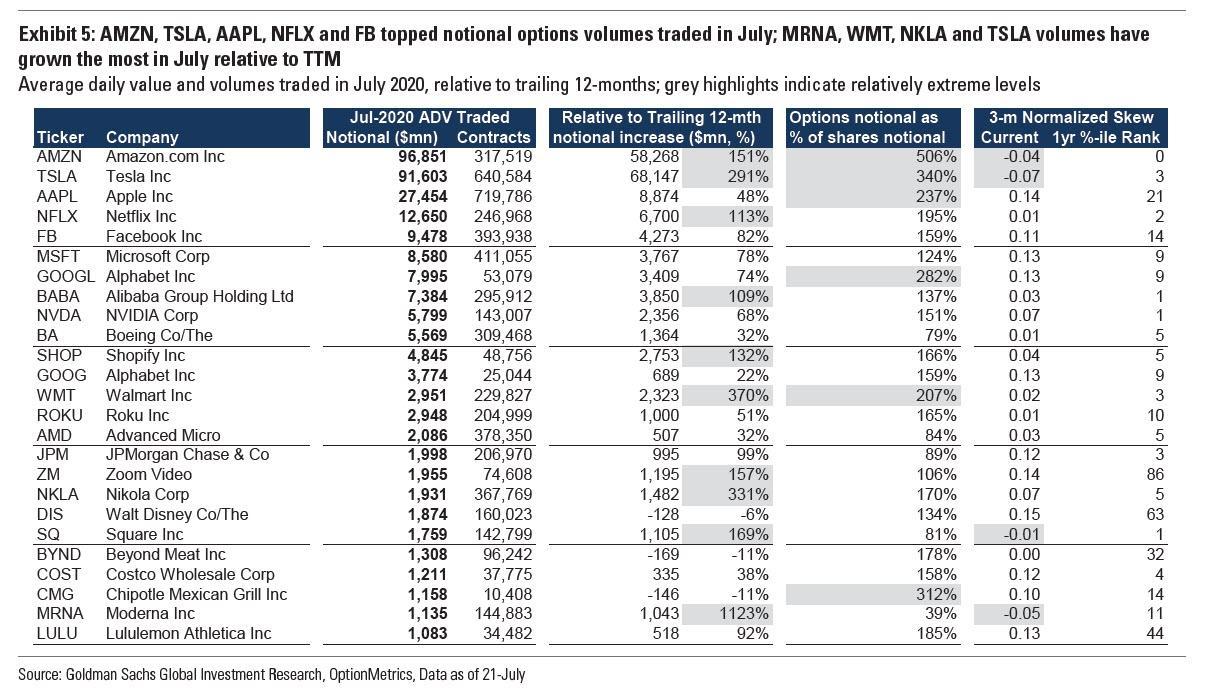
Finally, we also pointed out where the option trading footprint was largest, and not surprisingly we showed that options volumes had been driven higher by an increase in trading in many of the large market cap names. AMZN, TSLA, AAPL, NFLX and FB had the highest volumes in July. Among the top 25 underliers with high notional volumes, MRNA, WMT, NKLA and TSLA saw the biggest jump relative to the prior 12-months.
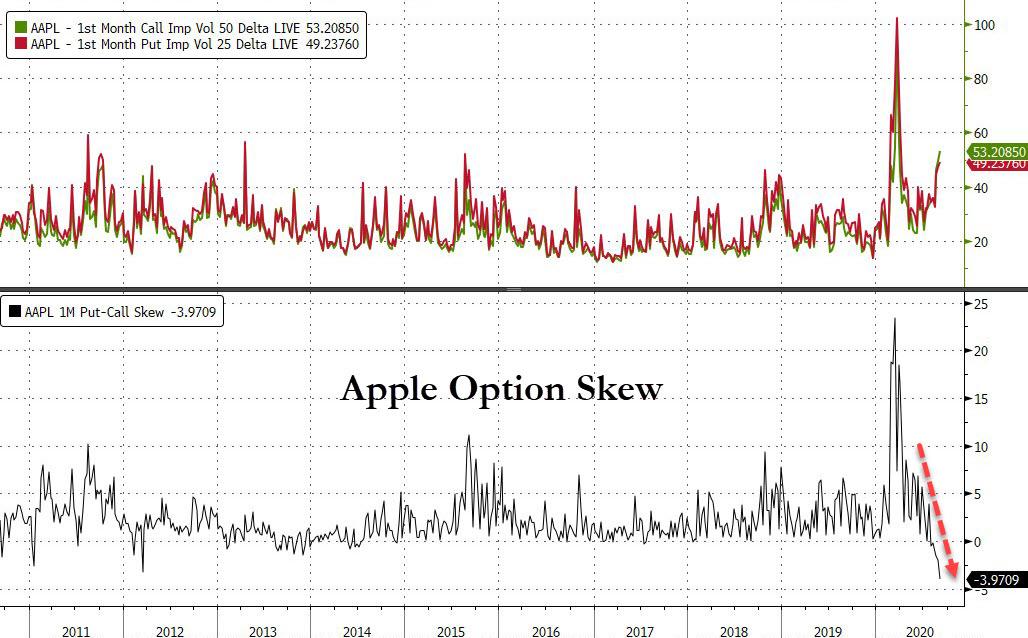
Also of note, bullish sentiment in a number of names as indicated by options market skew, was at extremely high levels. Three-month normalized put-call skew in AMZN, TSLA, SQ and MRNA had declined to below 0 as of two months ago, a striking development because as Goldman notes, "negative skew is a relatively rare statistic for large cap names such as AMZN (where three month skew is currently at all-time lows), implying crowding in long AMZN calls."
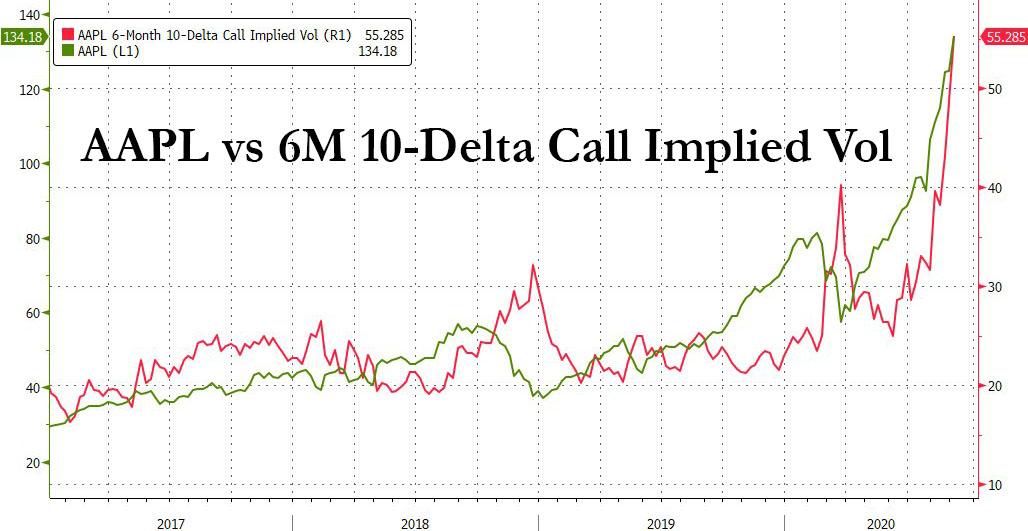
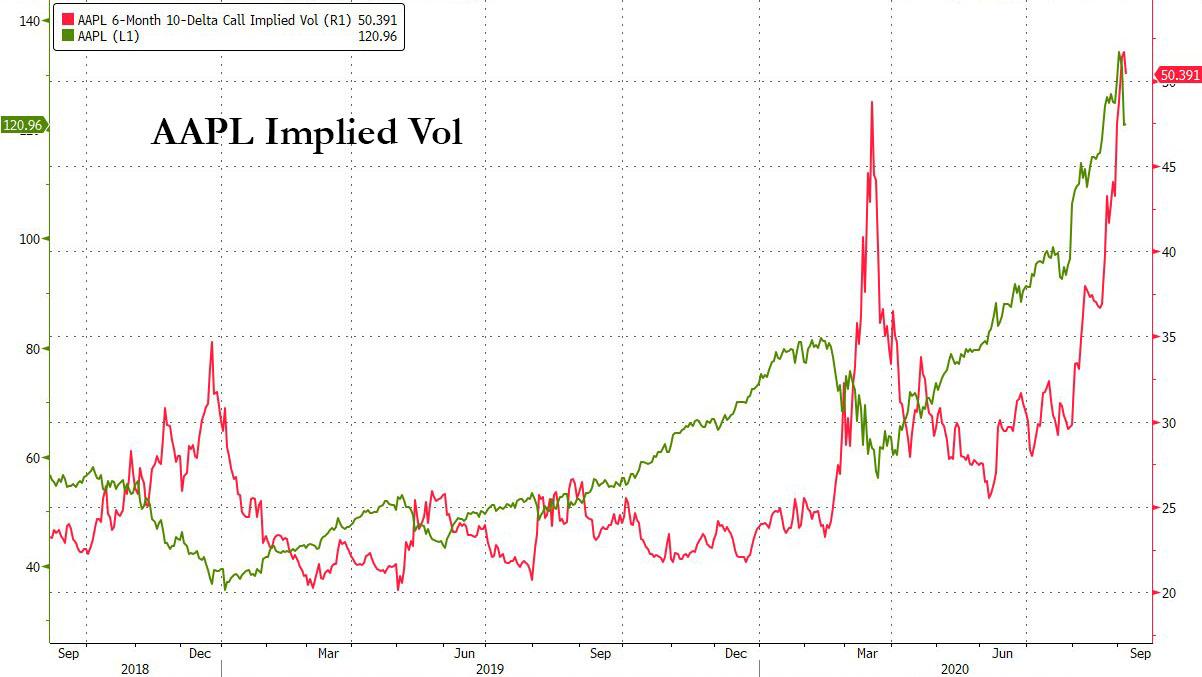
Fast forward to last week when we first showed that these trends had accelerated to an unprecedented degree, and the implied vol among some of the giga-cap names such as Apple had exploded to record levels even as the stock was trading at all time highs and sporting a market cap of $2.2 trillion...
... while the plunge in option skew, first highlighted in July, had also hit unprecedented levels.
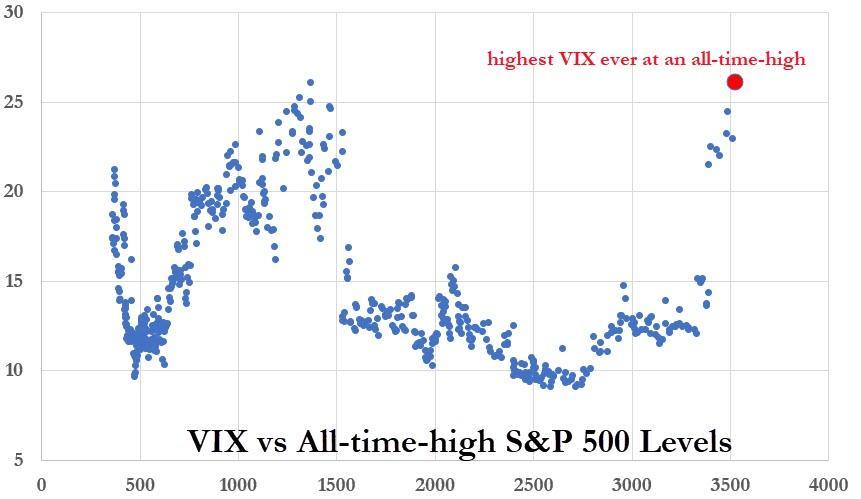
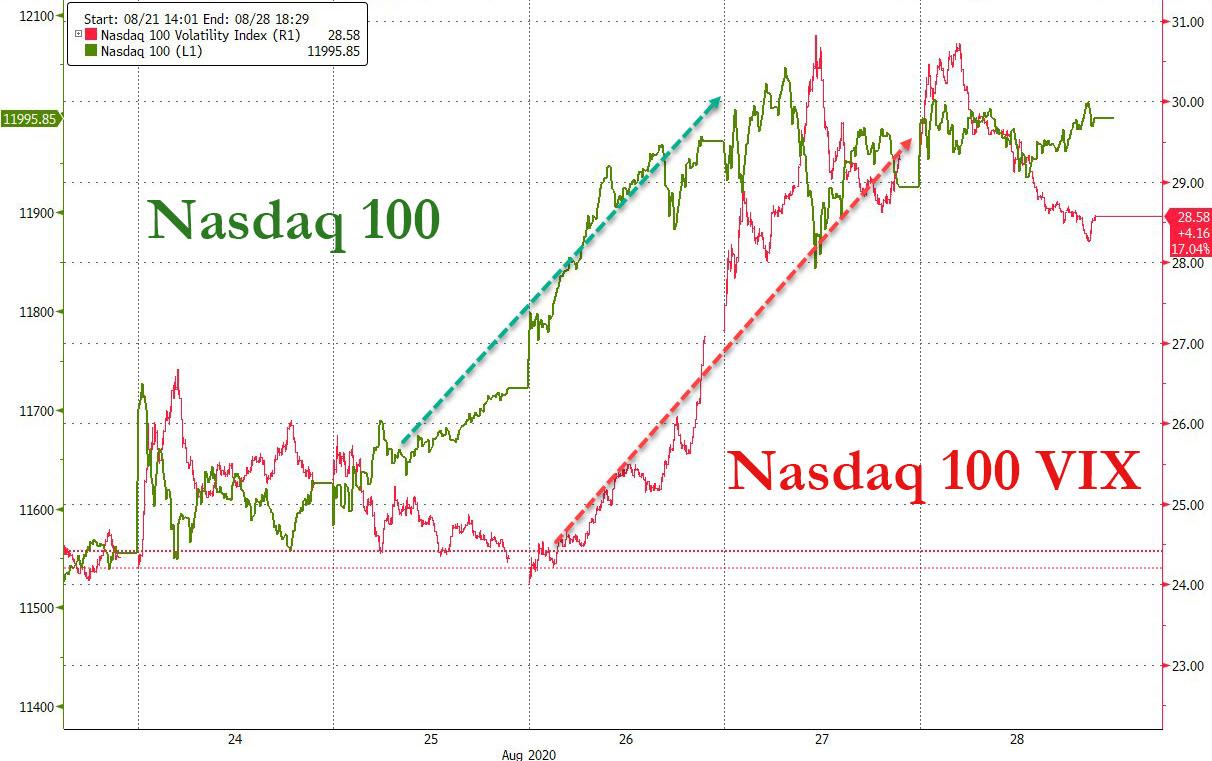
These bizarre trends, where one or more players where furiously buying calls and pushing both the implied vol and gamma (in both single stocks and the broader market) ever higher while dealers were caught short gamma and were forced to chase stock prices to obscene levels, creating a feedback loop where the more calls were bought the higher the underlying stock price surged, leading to even more call buying and the paradox of a record high vix at an all time high in the S&P500 (in fact the last time we had observed such a confluence was the day the dot com bubble burst)...
... led us to explain last Wednesday that "an epic battle was raging beneath the market surface" where as Nomura's Charlie McElligott said that "street-wide, Dealers are short Gamma / short Calls off the back of the MASSIVE upside premium buyer (as in BILLIONS spent) who has been in the market over the past month or so in a number of mega-cap single-name Tech cos."
Putting it all together, we said that "a combination of market euphoria, free options trading, and most importantly, few market-makers have sparked the fire" indicating that a key player in all this was indeed retail investors. We then added that it also meant that "a few large funds understood this and have added fuel to the fire by pushing implied higher and higher and putting further pressure on the likes of Citadel and Goldman. With this process helping drive names like Apple and Tesla, this also makes sense why Breadth has been so terrible."
The punchline, for all those who had been looking at the market action in recent weeks in stunned silence, was that "while most of the market is fading lower we are seeing a battle between a few big hedge funds and banks who are getting shorter and shorter gamma."
* * *
Then all the pieces fell into place last Thursday when we first reported that contrary to expectations that the furious melt up of July and August was solely due to a buying frenzy among retail speculators, the identity of the "mystery marketwide call buyer" - or "nasdaq whale" as he was later dubbed - was none other than SoftBank and its founder, Masa Son. This is what we said:
It is hardly unreasonable to imagine SoftBank, the "brains" behind such catastrophic investments as WeWork, WireFraud WireCard, and countless other failed "unicorns" would desperately try to Volkswagen not just a handful of tech names, but the entire market in the process. After all, Masa Son is desperate to deflect attention from the fact that as we put it last October, " SoftBank is the Bubble Era's "Short Of The Century." And if there is one thing that can salvage the Japanese VC titan's reputation it is a second tech bubble which blows out the valuation of his countless (otherwise worthless) investments...
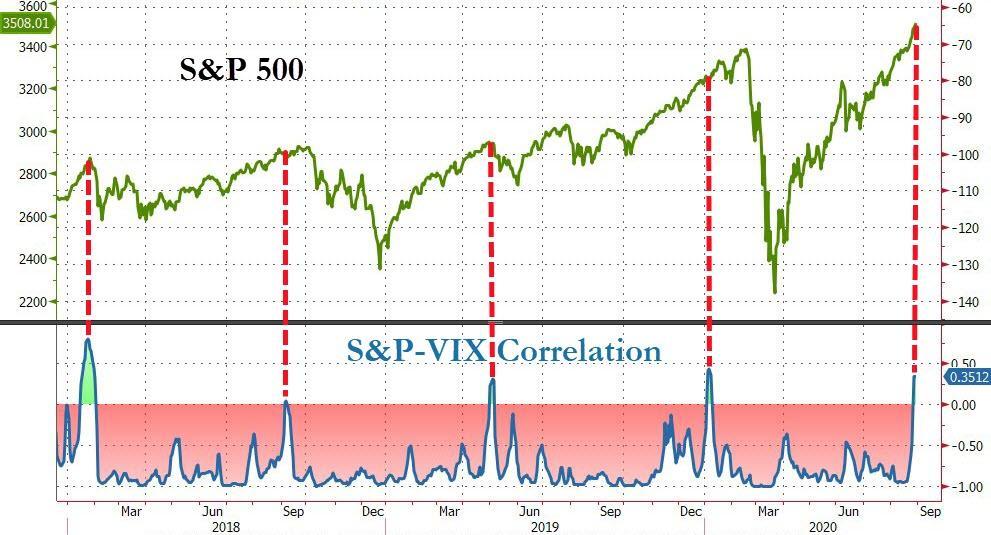
One day later both the FT and the WSJ confirmed that it was indeed SoftBank which was using a "positive gamma" strategy of buying up single name stocks, which it then propelled higher by buying calls in the same stock, if not sparking then certainly accelerating the gamma feedback loop which we first described last Tuesday before the SoftBank presence was reported in "A Classic Feedback Loop": Why Everyone Is Chasing The "Gamma Crash Up" as both single name implied vol and the overall VIX surged alongside stocks (resulting in a historic inversion in the S&P-VIX correlation)...
... sending both the FAAMGs, the Nasdaq and the S&P500 to all time highs.
In retrospect it should have been obvious not just to us but everyone what was going on.
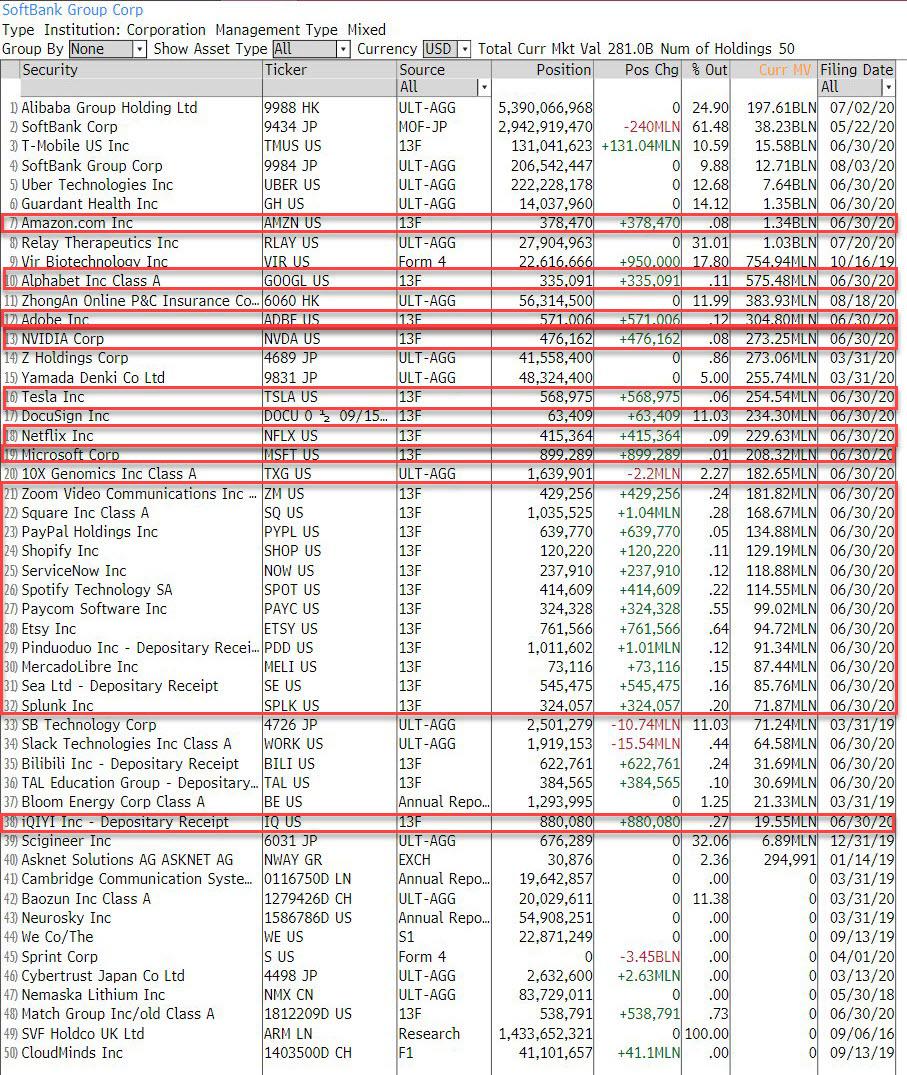
After all, it was in early August that we first learned that for the first time SoftBank was targeting investments of more than $10 billion in public stocks as part of a new asset management arm, far exceeding the initial holdings that founder Masayoshi Son outlined to shareholders in the company's latest earnings call, and a break from the company's strategy of investing in private names.
None of this was a secret, because on Aug 11, Son said SoftBank had acquired major holdings in not only the FAAMG stocks but some of the highest beta, "story" tech names.
Of course, the biggest hint was Bloomberg's report in mid-August that SoftBank's "investments were made using financing structures that can prevent SoftBank from showing up in public records as a direct shareholder." Because why hide its footprints if it wasn't engaging in a trade that would spark a historic surge in the very same public names it had just purchased, and which would gradually seep over to the broader market, sending the S&P to a record high of 3,580 just a few days ago.
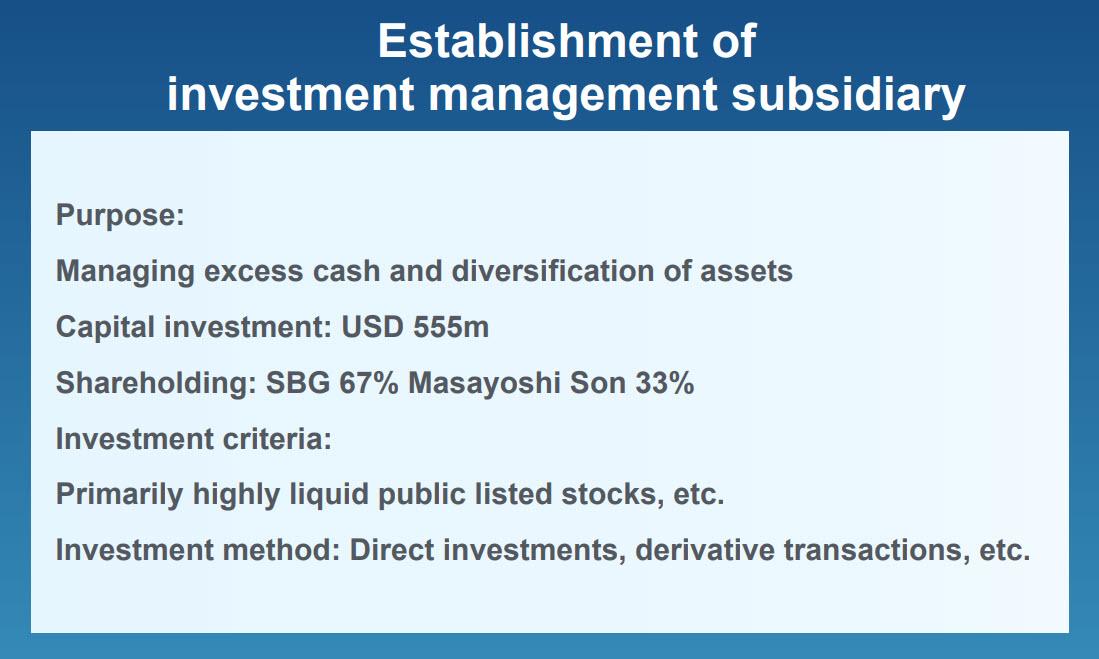
Incidentally, deep inside the company's latest quarterly report on page 68, SoftBank revealed that it has established an "investment management subsidiary" whose purpose was to manage excess cash (i.e., Treasury operations) and diversification of assets and which would consist "primarily of highly liquid public listed stocks" where investments would either be direct of via "derivative transactions."
There was also another reason why Masa Son desperately felt the need to spark a massive ramp in public stocks (conveniently taking place at a time in the year when markets were especially sleepy, during the vacation breaks of August): having seen his reputation and credibility crushed after the WeWork and WireFraud fiascos, the new unit reflected Son's revived ambitions to secure tens of billions in fresh outside capital after the bombing of the second Vision Fund. And what better way to do it than to show a remarkable return on his brand, spanking new investments in public FAAMG stocks:
The founder had said in May that SoftBank was unlikely to secure outside investors for a second Vision Fund after problems with the first. But in the upbeat financial results Tuesday, Son expressed readiness to accelerate a companywide shift from telecom to investing. “Our strategy hasn’t changed,” Son said. “We still plan on unicorn hunting with Vision Fund two, three and so on.”
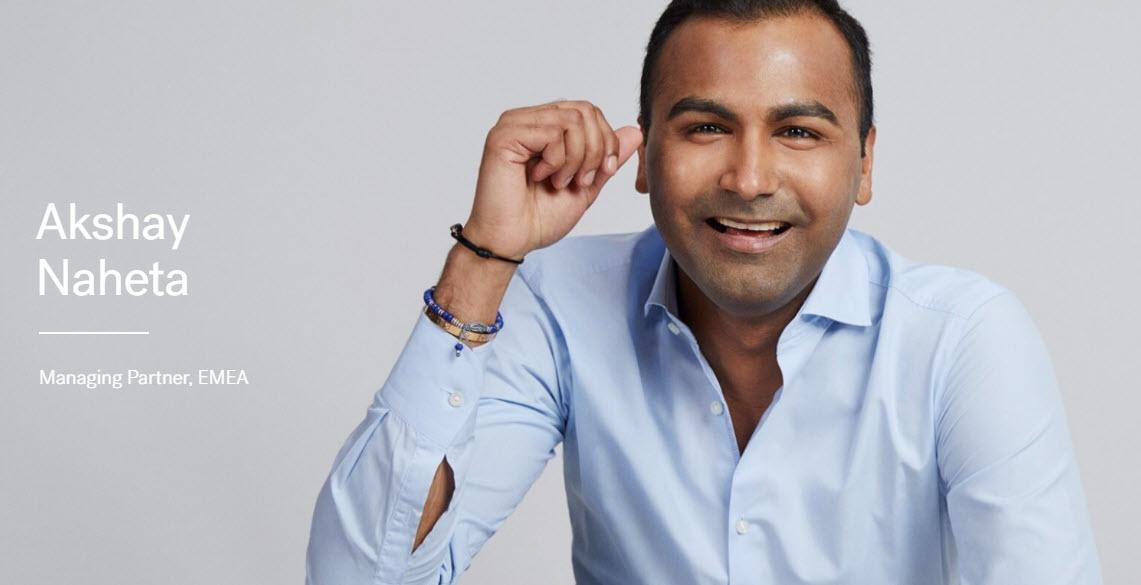
Which brings us to the "brains" behind the strategy, which we now know is Akshay Naheta, a SoftBank senior vice president in Abu Dhabi, who is the head of SoftBank's new asset management team (i.e., the brand new team investing in public companies) and who was hired in Jan 2017 from the London-based Knight Assets which he founded, and where he focused on "arbitrage and value investing."
Remarkably, Knight's investments had generated a staggering IRRs of 112.5% annually since its 2011 launch (and didn't charge a management fee at that), and one wonders just how much of the fund's impressive performance was the result of similar gamma loops. One also wonders why Akshay would leave what was arguably one of the best performing buyside platforms last decade?
And where did Akshay learn the tools of the trade? Why at that "pristine" bank which has "never" had any legal issues or record criminal and civil settlements: Deutsche Bank, where Naheta was Head of Principal Strategies, "responsible for proprietary trading and structured deals, managing risk across various asset classes globally."
Surely this financial wizard is a Wharton grad - after all for him to have such phenomenal "deep value" investing acumen, he must have learned from the best. Wrong: the SoftBank gamma guru graduated from MIT with an M.Sc in Electrical Engineering and Computer Science in 2004, following an undergrad from the University of Illinois at Urbana-Champaign where he graduated with a B.S., highest honors, in, drumroll, Electrical Engineering.
If JPM's Bruno Iskil was the London whale, perhaps we should now call Askhay the "Gamma whale."
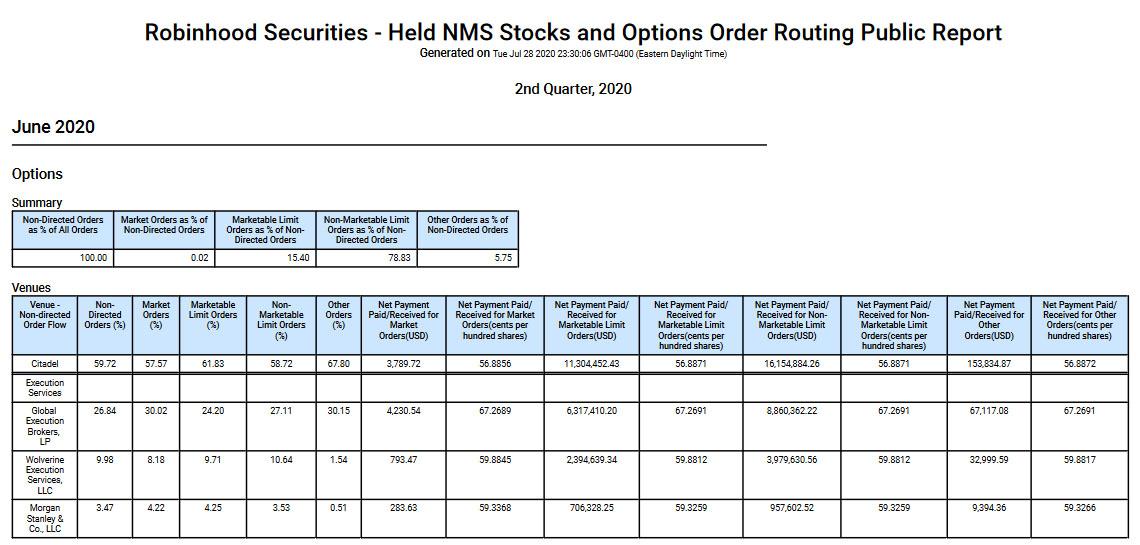
One almost wonders how much of a role in the marketwide gamma that flooded across markets in the past month did this computer science expert relegate to HFTs, whose momentum buying he knew would be sparked the moment SoftBank indicated it was splurging on calls across the most popular tech names, especially with HFTs frontrunning similar call buying over at retail frenzy ground zero, Robinhood, which made a killing in option trading payment for orderflow in June according to its 606 Report. We can only imagine what July and August will look like.
Conveniently, Askhay had Robinhood to help him, because having observed the furious retail call buying which we described from May across July (see above), Askhay realized that all he needs to do is pour a little extra gasoline on the fire, show a few outsized trades to the HFTs which would then unleash a cascade of call buying on their own, resulting in massive - and free - leverage of SoftBank's own call buying trade.
Incidentally, Askhay was also the brains behind another infamous SoftBank trade: the $1 billion "structured equity" trade in WireCard. In a nutshell the trade consisted of a €900MM investment from SoftBank Investment Advisors in April 2019, at which time SoftBank said it would pursue a “strategic co-operation agreement” with Wirecard giving the impression that one of the world’s most powerful technology investors was forging a deep business relationship with the German company and inspiring confidence in its shares. But the day after SoftBank formally signed the strategic tie-up with Wirecard in September, SBIA cut its exposure to the German payments group through a sale of new bonds exchangeable for the payments company’s stock. As the FT reported, "Bankers at Credit Suisse sold the €900m debt instrument to a broad group of investors, which essentially allowed SBIA to fund its entire investment without putting in a cent of its own money, while also gaining tens of millions of upfront cash profits."
And speaking of German companies (and frauds), we find it rather remarkable that some of the most prominent Deutsche Bank traders are now at SoftBank. Yes, there's Akshay triggering the biggest gamma squeeze in history, but we learned in 2018 that Colin Fan, former co-head of Deutsche's investment bank who made MD at 28, and one-time head of Deutsche's trading business had also joined SoftBank, where he was reunited with Rajeev Misra, Deutsche's former head of global credit trading (he oversaw a team of credit traders whose bet against the U.S. subprime mortgage market was chronicled in The Big Short), and the current head of Softbank's $100BN Vision Fund.
Other Deutsche Bank alumni, Nizar Al-Bassam, Michele Faissola (who was implicated in the death of DB's senior risk manager, William S. Broeksmit, who was found dead in 2014 after committing a still unexplained suicide) and Wayne Grigull, work for or advise (Faissola is an advisor) Centricus Advisors (formerly known as F.A.B. Partners) and helped the Vision Fund raise its Saudi money. Many worked together at Merrill Lynch before joining Deutsche Bank. As EFC noted some time ago, "they have history."
Keeping a close eye on these former Deutsche Bankers, now at SoftBank, is imperative.
* * *
Which brings us to what is perhaps the last loose end: how much money did Akshay - and SoftBank - make using this strategy? According to the FT, SoftBank is currently sitting on unbooked profits of about $4 billion. This is roughly the same amount as SoftBank has risked by spending on call premiums over the past few months - as it built up a massive position equivalent to roughly $30 billion in notional exposure - resulting in a 100% gain in just a few months.
Of course, as we noted yesterday, despite being exposed as the fund behind the market's bizarre August moves, implied vol has yet to drop which means that SoftBank is likely still in the trade and has yet to take a profit...
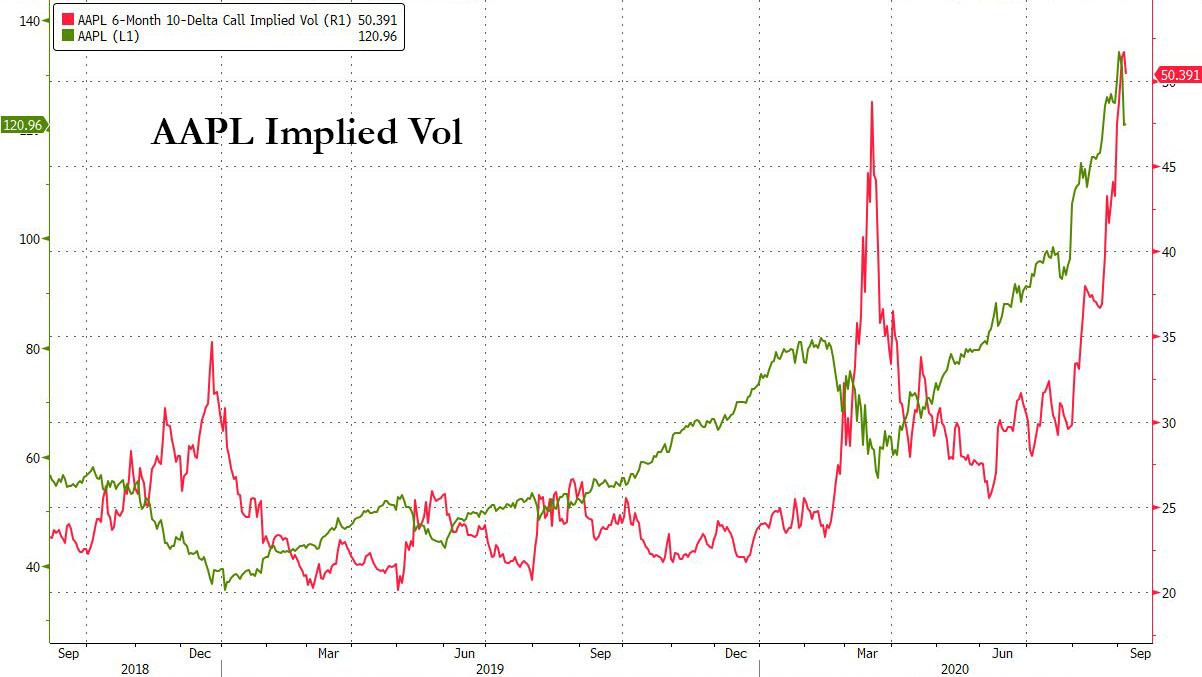
... or that dealers have not yet figured out a proper strategy to hammer implied vol. One thing that is certain is that it is only a matter of time before dealers, who were counterparties to the SoftBank trade and are likely nursing billions in losses (assuming they didn't delta-hedge all of their exposure) will do everything in their power to punish the Japanese conglomerate. And even if they did fully delta-hedge their outlier gamma exposure, now that the FAAMG rally has broken, the precipitous ramp observed on the way up is about to reverse as dealers start dumping the stocks they had to buy as gamma spiked, leading to a mirror image of the melt up trade. In short, while SoftBank may have made a 100% profit, unless it somehow unwinds this trade asap, it risks losing not only all of its gains but also suffer material losses that would eat into the option premium and would then also hammer the value of its underlying stock investments.
The bottom line is that as one unnamed trader quoted by the FT said, "it’s just a levered punt on the market. The whole strategy is just momentum buying."
Well of course it is, but it had not only the benefit of massive leverage, but also timing, striking just as there was virtually nobody in the market to take the opposite side of the trade while piggybacking on a call-buying frenzy among the retail community, something any trader with a background in HFT/market structure inefficiencies such as a Akhsay would be well aware of.
The only question we have now is what happens to SoftBank - whose reputation for foolhardy leeroy jenkins-tyle investments with little to no diligence but merely seeking to manipulate the market with its size and scope precedes it, once the momentum reverses, and after hunting dealers with a max painful gamma squeeze, dealers now return the favor.
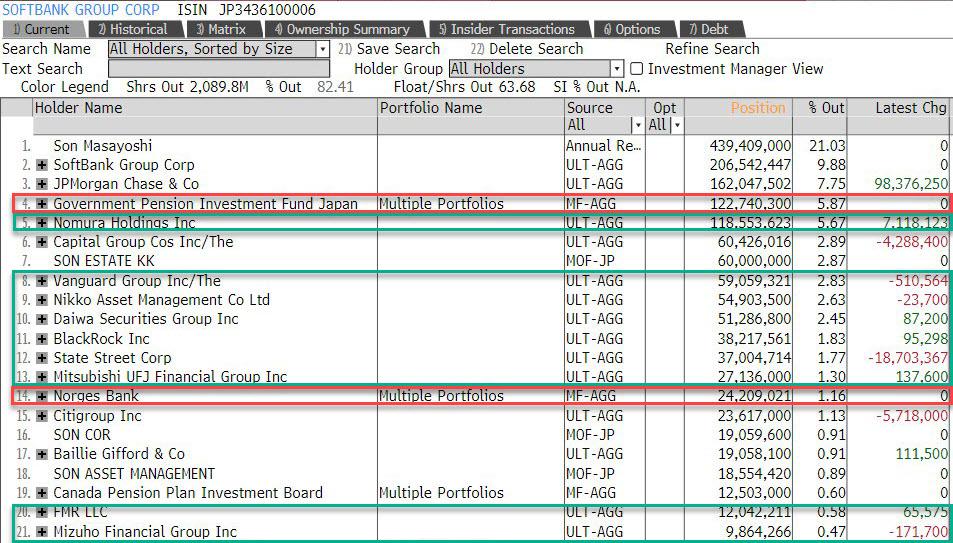
The answer: probably not much - recall that the BOJ is now the biggest investor in Japan's ETFs, and with SoftBank widely held not only by Japan-focused ETFs but also by Trust banks through which the BOJ operates, it is safe to say that the Japanese central bank is one of the top investors in SoftBank, if not bigger even than Masa Son himself with his 21% holding.
Add the fact that Japan's pensioners via the GPIF are among the top investors in SoftBank (which among other thing, means that the fate of Japan's pension funds is now directly tied to the performance of AAPL and TSLA calls), not to mention that the world's largest sovereign wealth fund, the Norges Bank is also a top 15 investors...
... and it is clear that nothing bad can ever happen to SoftBank - even if this particular momentum trade were to crash and burn - simply because a failure of this particular "Nasdaq whale" would be far too systemic, causing massive losses among both sovereign wealth fund and central banks, and it would promptly receive a bailout from the BOJ, something we first suggested last year.
In fact, the fact that SoftBank is now too big to fail is - in our view - the true reason behind Masa Son's unprecedented gamma gamble: after all if the trade succeeds Masa wins, if the trade loses it is the merely taxpayers that lose (as they always do in the end)... something which apparently was not lost on Akshay himself:
FT : SoftBank sheds $8.9bn as ‘whale’ options bets unnerve traders

SoftBank sheds $8.9bn as ‘whale’ options bets unnerve traders
Retail investors concerned group is increasingly behaving more like a risk-hungry hedge fund

Shareholders in SoftBank wiped nearly $9bn off its market value on Monday after weekend revelations that the Japanese conglomerate was the mystery “whale” that had driven US technology stocks to record highs.

The Financial Times reported on Sunday that the group’s trading strategy meant it was now sitting on gains of about $4bn after founder Masayoshi Son drove aggressive bets on equity derivatives.

Traders in Tokyo said the report had helped crystallise the perception among some investors that SoftBank’s behaviour as a company increasingly resembled that of a hedge fund, populated with former investment bankers with a massive appetite for risk. 

SoftBank shares lost 7.2 per cent on Monday — a fall that erased ¥946bn ($8.9bn) from the company’s market capitalisation. The benchmark Nikkei 225, in which SoftBank is the second biggest component, according to Bloomberg data, dropped 0.5 per cent.

Before the fall on Monday, SoftBank’s stock had climbed 33 per cent this year. The slide followed two days of declines on the Nasdaq at the end of last week.

It also came on the heels of warnings from Yunosuke Ikeda, Nomura’s Japan equity strategist, that the early part of September could usher in a broader sell-off of tech stocks in Tokyo as institutional investors return from vacation and unload stocks left overvalued by summer options purchases by individuals.

Fund managers said retail investors, which make up 30 per cent of SoftBank’s shareholder registry, reacted particularly negatively to the company’s latest shift in investment strategy. 

“For institutional investors who understand how options trades work, many don’t anticipate a major impact on SoftBank’s earnings,” said Naoki Fujiwara, a fund manager at Tokyo-based Shinkin Asset Management. But he said retail investors “are worried the derivatives trades will lead to major losses again”. 

SoftBank’s high-risk strategy has been built up over the past few months, according to people with direct knowledge of the matter, during which time the group spent about $4bn on options premiums focused on individual US tech stocks. 

In total, it has taken on notional exposure of about $30bn using call options — bets on rising stock prices that provide the right to buy stocks at a preset price on future dates. Some of this position has been offset by other contracts bought as hedges.

SoftBank has declined to comment.

While SoftBank’s huge derivatives bet on selected US stocks has worked for now, leaving the Japanese group with large, albeit as yet unrealised, profits, a continued pullback in equity markets could erode returns. 

Meanwhile, analysts in SoftBank’s home market warned of the heightened sensitivity in certain parts of the Tokyo Stock Exchange to a broader rout of US technology stocks.

Over the summer, Japanese retail investors have piled into tech and game stocks, pushing the smaller-cap Mothers market to a two-year high. Analysts say many of those names could now be vulnerable.

FT : Hopes of US stimulus deal fade after strong jobs report

Hopes of US stimulus deal fade after strong jobs report
White House feels confident economy can rebound without new spending

Hopes of Congress and the White House reaching a deal on further economic stimulus have faded, as an unexpectedly steep drop in the jobless rate has stifled appetite among Republicans and the White House for a compromise on new coronavirus relief.

Haggling over fresh federal support for the US economy will resume when lawmakers return to Washington after their summer break this week, as the impact of $3tn in relief funds approved at the start of the pandemic fades.

Economists and analysts expected an agreement to be struck by the end of the month to plough about $1.5tn in new government money into the economy, which could be pivotal to sustaining the US rebound. But prospects for a deal have diminished.

The strength of equity markets throughout August, as well as Friday’s data showing joblessness dropping to 8.4 per cent, below the unemployment peak during the Great Recession, has removed some of the pressure on Republicans on Capitol Hill, and Trump administration officials, to strike a deal. 

“In the Cares Act [the March stimulus bill] we got to a deal because there was a crisis mentality on both sides, when the market was crashing and the economy was shutting down. The crisis mentality is just not there right now on the Republican side,” said Ben Koltun, senior research analyst at Beacon Policy Advisors in Washington. 

After the release of the unemployment data on Friday, Larry Kudlow, President Donald Trump’s top economic adviser, told Bloomberg TV that the US could “absolutely live with” no deal on new stimulus. “Right now the economy is on a self-sustaining recovery path in my judgment and will continue along those lines, and will continue to surprise on the upside,” he said. 

Democrats say the US economy needs an extra $3tn in fiscal stimulus to shield households and businesses from the impact of mass unemployment and income loss, and warn failure to strike a deal could be devastating. They have also pointed out that the US is experiencing a “K-shaped” recovery, with wealthier Americans bouncing back quickly to pre-pandemic levels of activity, while low-income families face hunger, joblessness and housing uncertainty. 

Even Federal Reserve officials have called for a deal to be reached on new stimulus, saying it would provide vital support as the impact of the Covid-19 recession lingers.

“It really does behove us as a country, as a very wealthy country, to use our great powers to support people who did nothing wrong,” Jay Powell, the Fed chair, said in an interview with NPR that will be aired on Monday. 

But Democrats may have missed the window when Republicans were feeling maximum pressure to reach an agreement, in July, due to new increases in infection in many sunbelt states that raised fears of a “double dip” in economic activity. At the time, Republicans proposed $1tn in new spending, but Democrats dismissed the offer as insufficient and held out for a price tag of more than $2tn.

When Congress returns this week, Senate Republicans are expected to propose new stimulus legislation worth $500bn, which is even farther away from the Democratic position, and will probably be rapidly dismissed.

Republicans and Democrats are separately discussing an agreement to extend funding for the federal government until after the end of September, which would avert a federal shutdown but remove another catalyst for action. 

“The co-operative spirit we had in March and April has dissipated as we move closer and closer to the election,” Mitch McConnell, Senate majority leader, told reporters last week.

Ted Cruz, the Republican senator, told a virtual Texas business panel: “I am sceptical about anything being passed between now and November.”

In an interview with Fox News Sunday, Treasury Secretary Steven Mnuchin characterised the two sides as being “stuck”.

“In my discussions with [Democratic House Speaker Nancy Pelosi] where we're really stuck is both on certain policy issues but more importantly on the top line. The Speaker has refused to sit down and negotiate unless we agree to something like a two and a half trillion dollar deal.”

He urged Democrats to embrace the $500bn legislation that Senate Republicans are set to propose this week, asserting there would always be room to pass additional stimulus measures down the line.

“Let's do a more targeted bill now. If we need to do more in 30 days, we'll continue to do more.”

Amid the stalemate, some Democrats are calling for compromise. “I think there is a recognition that we need to get something done and if we don't, it's going to hurt both sides,” Josh Gottheimer, a Democratic congressman from New Jersey and a member of the bipartisan Problem Solvers Caucus told the Financial Times. “I think a lot of people are really frustrated that both sides aren’t talking. You have to get back to the table.”

But while Mark Meadows, White House chief of staff, and Mr Mnuchin have expressed some optimism that a deal can still be passed, Mr Trump has shown less interest in an agreement.

Instead of encouraging negotiations, Mr Trump has moved ahead with a series of executive actions to try to make up for the lack of fiscal support. But his unilateral moves so far have had a very limited impact on the economy.

On Friday the president remained combative, saying Democrats were “holding additional China virus relief hostage to reasons that nobody can understand”. He floated a proposal to direct $300bn in unused funds for lending to troubled business under the Cares act into the economy by executive order, which he probably could not do without congressional approval. 

“His focus on the campaign trail is on other things right now. It doesn’t seem like [a stimulus deal] is seen among Republicans and Trump as an important political calculus to their electoral success,” said Mr Koltun. 

Mr Meadows has indicated that the biggest sticking point for the two sides is how much money to allocate for state and local governments. Democrats have asked for nearly $915bn, while Republicans say they are willing to give up to $300bn.

The stalemate has left scores of cities and municipalities in the lurch, as many face budget shortfalls. 

Dean Trantalis, the Democratic mayor of Fort Lauderdale, Florida, said cities were getting increasingly frustrated about the lack of consensus, adding it might be time for the two sides to address some of the key components in separate bills, just to ensure that something gets passed.

“They basically gave us a lifeline and then cut us off before things were able to stabilise,” he said. “The bill is very complex and I think we’re going to have to address it in a piecemeal fashion — try to get portions of it agreed.”

He added: “We can’t hold everything back just because we can’t get everything we want.”