SoftBank Has Closed Most Of Its "Nasdaq Whale" Positions
Following our Thursday report identifying SoftBank as the primary - but not only - catalyst behind the bizarre moves in high beta tech names and the broader market over the past several weeks (confirmed later by the FT and WSJ), an odyssey which we summarized in "Connecting The Dots: How SoftBank Made Billions Using The Biggest "Gamma Squeeze" In History" with subsequent reports that SoftBank, or the "Nasdaq whale" as some now call it was sitting on "unbooked" profits of about $4 billion, the market was quick to punish SoftBank (9984.JT) which dropped on Friday then tumbled another 7% on Monday despite what the company has been proud to frequently remind its investors was the second biggest buyback authorization after Apple.
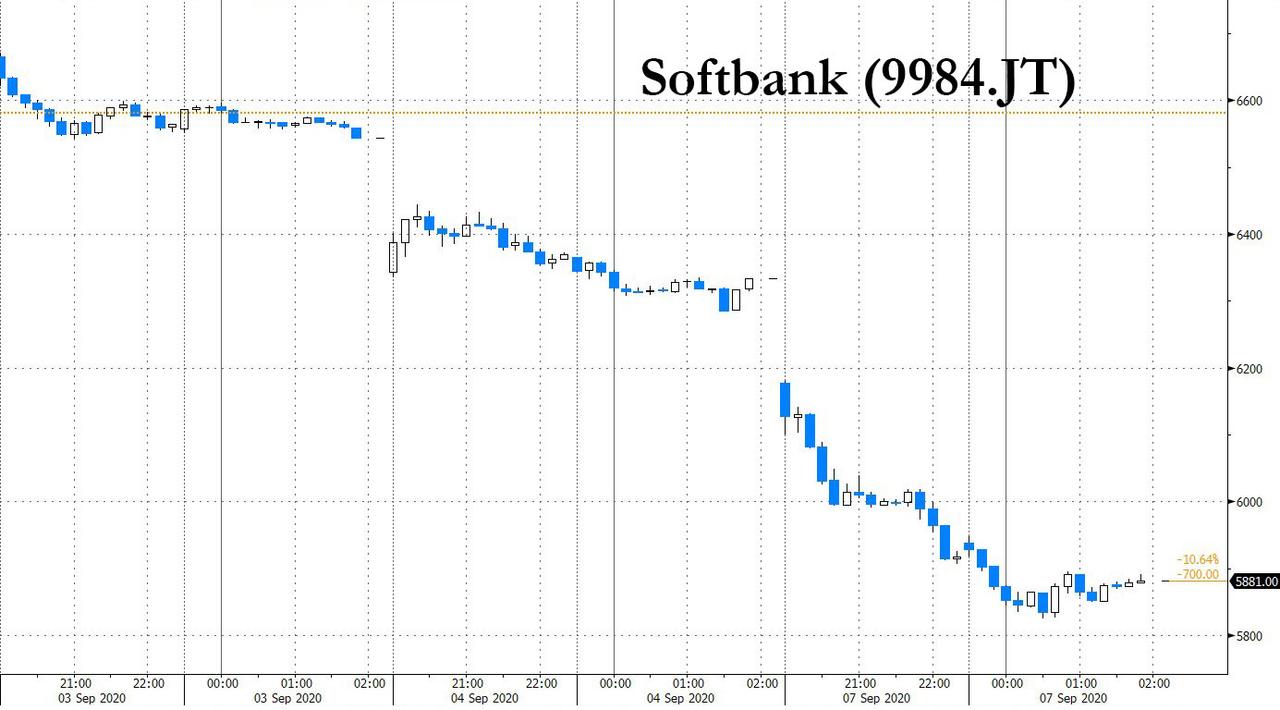
There were two reasons cited for the drop: the first was the realization that "SoftBank’s behaviour as a company increasingly resembled that of a hedge fund, populated with former investment bankers with a massive appetite for risk." This realization was assisted by our weekend report which revealed the main players behind the Softbank trade, which was the brainchild of Abu Dhabi-based Akshay Naheta, a former Deutsche Bank prop trader who now heads SoftBank's new asset management team which invests in public equities, including all those tech companies that have soared in August on the massive gamma melt-up facilitated by concurrent call buying as described previously.
The second reason cited by the FT for today's tumble is that "retail investors, which make up 30 per cent of SoftBank’s shareholder registry, reacted particularly negatively to the company’s latest shift in investment strategy."
"For institutional investors who understand how options trades work, many don’t anticipate a major impact on SoftBank’s earnings,” said Naoki Fujiwara, a fund manager at Tokyo-based Shinkin Asset Management. But he said retail investors “are worried the derivatives trades will lead to major losses again."
Which is understandable: while it is known that SoftBank has made a roughly 100% profit generating $4 billion in profits from the purchase of $4 billion in option premium, it was generally unknown if the bank can hold on to this profit, or in other words if it can book it before dealers move the market aggressively against SoftBank, potentially leading to all gains being wiped out and/or losses. Indeed, this is what the FT reported just this morning:
While SoftBank’s huge derivatives bet on selected US stocks has worked for now, leaving the Japanese group with large, albeit as yet unrealised, profits, a continued pullback in equity markets could erode returns.
Well, it appears that in keeping with its newly-found reputation of a hedge fund, and contrary to widespread speculation that the Japanese conglomerate is still on the hook, SoftBank has already unwound a majority of its public holdings.
We know this thanks to a little-noticed conference call that took place in late August, days before we revealed SoftBank's role in the marketwide gamma grab. The call, which took place on August 26 and was held by Morgan Stanley's media sector specialist covering SoftBank and was first noticed by Thunderdome Capital, emphasized several things:
- The company's massive buyback: "We always said our stock was cheap, but our stock is the best thing out there right now. Biggest buyback in Japan history. Only Apple's buyback is bigger globally."
- The continued "successful" listing of SoftBank's private portfolio companies: "Already had 9 companies that have listed out of the Vision Fund this year. We're starting to take smaller stakes in companies so we can sell them more quickly and increase our IRR."
- Visiong Fund's liquidity position: "Still have $14 billion in cash in the Vision Fund, which is partially being used to pay the 7% preferred return, but also to invest more in other assets."
But most importantly, the call touched on the biggest topic in capital market in the past week: the fate of SoftBank's public investments, with the following striking disclosure:
"We spent $10 billion on public equities and have already sold $7 billion of them. We consider this "treasury operations" where we are buying very liquid operations to earn higher returns on our cash."
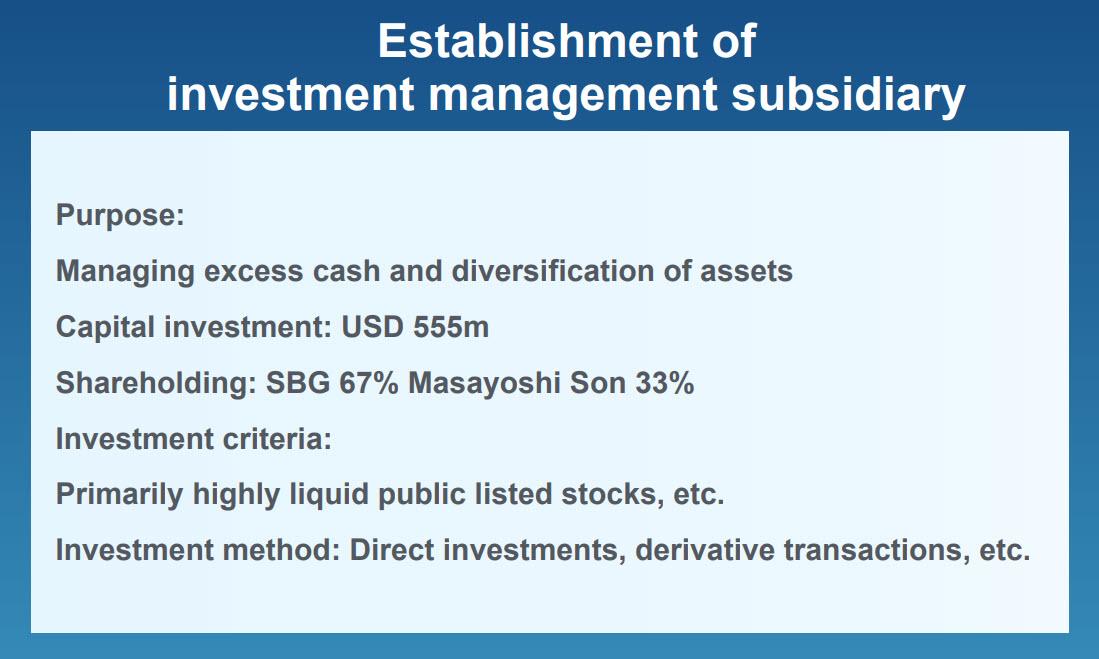
The statement refers to SoftBank's brand new investment management subsidiary which was first revealed in the company's Aug 11 earnings call...
... and specifically to the portfolio of public investments which SoftBank unveiled recently (highlighted below) and then used various option strategies to turbocharge returns during the now infamous gamma meltup.
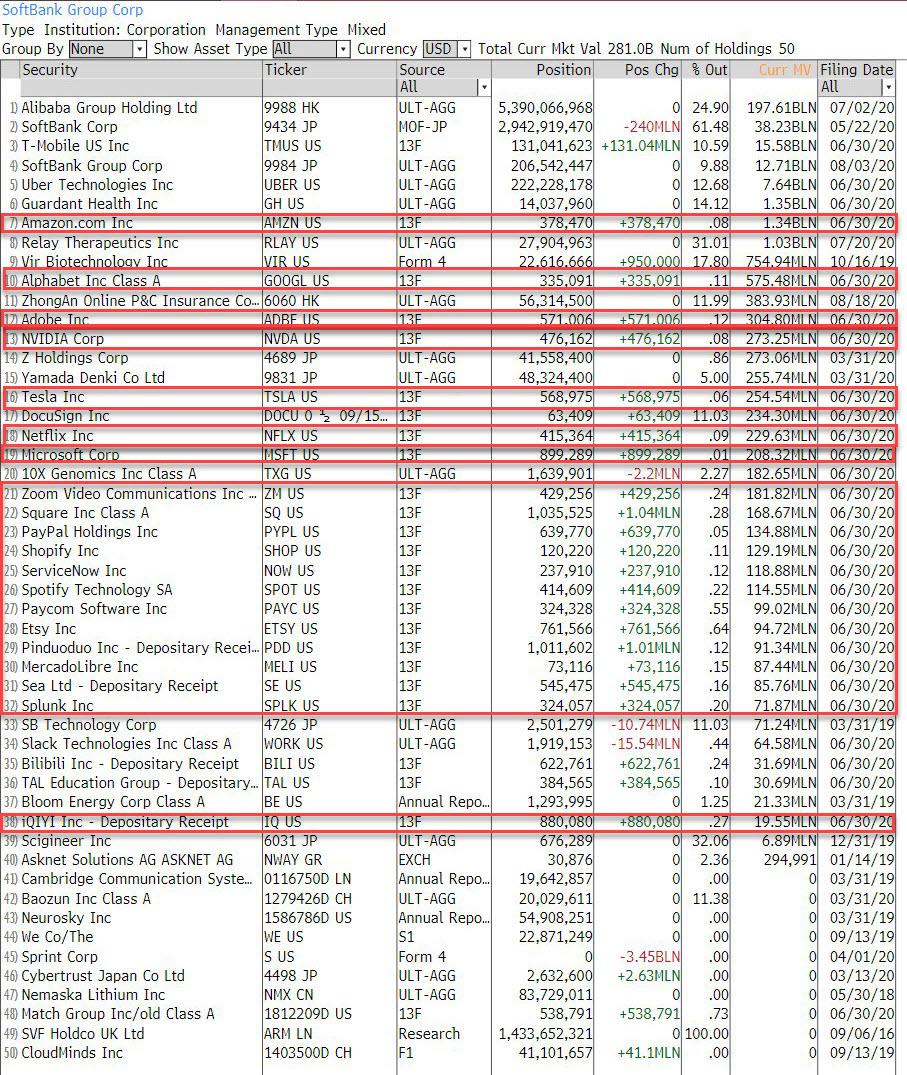
It also means that for all intents and purposes, SoftBank is now out of most - if not all - of its public equity positions and "Nasdaq Whale" bets which were, as we reported last week, the primary catalyst for the market's tremendous rally.
Then again, even without the benefit of this conf call, one could see that SoftBank was mostly out of its controversial public stock positions through the market's action into Thursday and Friday, when all the beneficiaries from the gamma grab were hammered.
As we first discussed late last week, and as the BearTraps report wrote over the weekend, "the sell-off on Thursday and Friday was clearly a 'gamma-squeeze-unwind', in our view. Dealers had to buy tech stocks and Nasdaq futures throughout March to hedge the rising prices of call options (which they were short). Ahead of the Fed meeting, Maso Son likely took off a chunk of his long call position early Thursday we are told."
So once the calls option prices stopped rising, market makers furiously reversed their gamma chase and had to take down their hedges, dumping significant amounts of stock they had delta-hedged as gamma was surging back into the market, and so on: "as the delta on the calls they sold came down Thursday, dealers were forced to sell stock, and reset hedges lower"
And speaking of market whales, besides SoftBank there is also the Fed to consider, and as Larry McDonalds writes, "if the Fed had the chance to let some air out of the Nasdaq bubble without disrupting financial conditions (overall cost of capital), they would do it in a second." He then points out the chart below which shows a "highly unusual divergence" between Nasdaq vol and the broader Goldman overall financial conditions index, and which "speaks to the Nasdaq Whale's volatility juicing influence on the Nasdaq, without leaking over to credit markets" and as a result Powell is smiling.
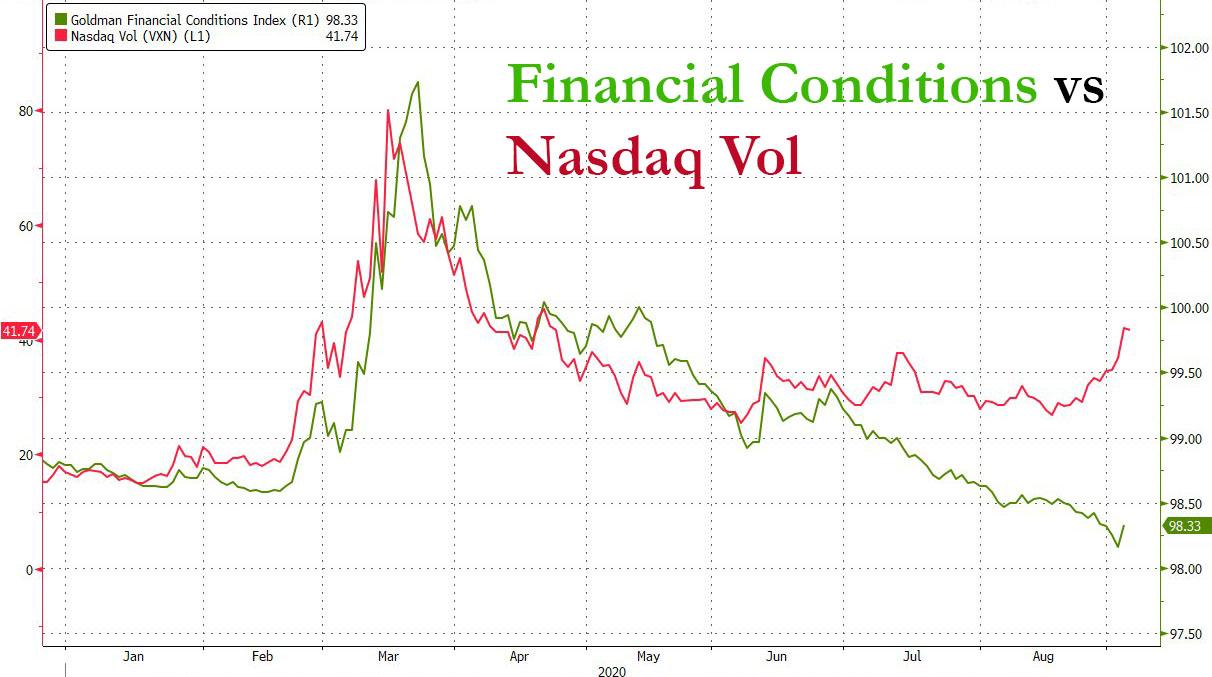
And yet, McDonald believes that "the Fed is getting a bit nervous about the Whale's splash though, Nasdaq froth. The FOMC's reticence to hint at more QE candy combined with the mentions of macroprudential financial stability and leverage - indicates they are worried" but not enough to overcome their fear of tightening financial conditions. In other words, in the Bear Traps Report's view the Fed "would like to send a message to Masa Son. A little high heat is in order, "chin music" as they say in the big leagues, as long as they do not push FCIs tighter (financial conditions)."
Whether the Fed will teach Masa Son a lesson is unclear, but what is certain is that SoftBank is now clearly out of the picture when it comes to fmenting a gamma melt up. In fact, one can virtually assure that any further attempts to prompt a marketide gamma squeeze will be summarily punished by dealers who are now left with excess high beta stocks which they loaded up on amid the delta-hedging frenzy and now have to dump. In short, the path of least resistance in the coming day is down, not up.
While institutional investors will take this in stride, this will be a major problem for retail daytraders who since March have enjoyed a tremendous ascent in stocks and may be about to see their major test of their convictions (something bitcoin weak hands clearly failed over the weekend as the cryptocurrency space simply imploded).
Meanwhile, with elections looming, further risk-on will demand more QE, and will threaten the Fed's credibility unless it gets it. Unless, of course, as McDonald concludes the Fed wants banks to retain capital and fudging some level of credibility gives banks a steepener (yield curve) to play with.
Finally, recall that it was last August when former NY president Bill Dudley wrote an Op-Ed urging the Fed to crash the market to prevent another Trump re-election. Well, if his message resonated with the FOMC, what better time to unveil a hawkish shock than at the Sept FOMC meeting in 9 days - the last one before the presidential election. Because if there is one thing that - in Dudley's and Trump's view - could cripple his re-election chances, it is a market crash just weeks before Nov 3.
- Hexagon (HXGB TH) +3.7%
- TOMRA (TMR TH) +2.7%
-
BT (BTQ TH) +2.6%
- BT Raised to Overweight at Barclays; PT 160 pence
- AstraZeneca (ZEG TH) +1.7%
- Vestas (VWS TH) +1.7%
- Nokia (NOA3 TH) +1.5%
- HelloFresh (HFG TH) +1.5%
- Bechtle (BC8 TH) +1.4%
-
Vodafone (VODI TH) +1.2%
- Vodafone’s Payout Boost Hostage to Spectrum, Debt Reduction
- Glaxo (GS7 TH) +1.2%
- Aroundtown (AT1 TH) -1%
- Rational (RAA TH) -1.4%
DAX:
- No major moves
MDAX:
- Fraport (FRA TH) +1.7%
- HelloFresh (HFG TH) +1.4%
- Aixtron (AIXA TH) +1.3%
- Commerzbank (CBK TH) +1.3%
- Siemens Healthineers (SHL TH) +1.2%
SDAX:
- Shop Apotheke (SAE TH) +3.1%
- Encavis (CAP TH) +1.5%
- Steinhoff (SNH TH) -2.3%
China Launches Initiative to Set Global Data-Security Rules
Move, unveiled Tuesday is meant to counter U.S. Clean Network effort
HONG KONG—China is launching its own initiative to set global standards on data security, countering U.S. efforts to persuade like-minded countries to ringfence their networks from Chinese technology.
Announcing the initiative on Tuesday at a Beijing seminar on global digital governance, Chinese Foreign Minister Wang Yi cited growing risks to data security and what he characterized as efforts to politicize security issues and smear rival countries on technology matters—in an apparent swipe at Washington.
To counter such challenges, “it is important to develop a set of international rules on data security that reflect the will and respect the interests of all countries,” Mr. Wang said, according to a transcript of his speech published by China’s Foreign Ministry. The Wall Street Journal reported on Monday that Beijing planned to unveil the initiative.
Beijing’s initiative comes amid heightened tensions with Washington over issues including trade and technological competition, which has raised the specter of an increasingly bifurcated internet.
In recent months, the Trump administration has taken steps to curtail what it describes as national-security threats from Chinese tech firms like Huawei Technologies Co. and popular Chinese apps including ByteDance Ltd.’s TikTok and Tencent Holdings Ltd. ’s WeChat. Chinese officials, meanwhile, have accused the U.S. of imposing a double standard and of trying to sabotage the efforts of Chinese businesses to expand.
The Chinese initiative comes about a month after U.S. Secretary of State Mike Pompeo announced the Clean Network program, which would exclude Chinese telecommunications firms, apps, cloud providers and undersea cables from internet infrastructure used by the U.S. and other countries.
Under its new “Global Initiative on Data Security,” China would call on all countries to handle data security in a “comprehensive, objective and evidence-based manner” and maintain an open, secure and stable supply chain for information and communications technology and services, according to a text released by the Chinese Foreign Ministry.
It also would urge governments to respect other countries’ sovereignty in how they handle data—in line with Beijing’s vision of “cyber sovereignty,” whereby countries exercise full control over their own corners of the internet.
The initiative doesn’t mention the U.S. or its Clean Network program. Mr. Wang nonetheless made it clear in his announcement that the move comes in response to the White House effort.
“Bent on unilateral acts, a certain country keeps making groundless accusations against others in the name of ‘clean’ network and used security as a pretext to prey on enterprises of other countries who have a competitive edge,” Mr. Wang said, according to the transcript. “Such blatant acts of bullying must be opposed and rejected.”
The Beijing initiative offers commitments that echo China’s responses to American allegations of Beijing’s unfair trade practices and security threats from Chinese technology.
For instance, the Chinese initiative would urge countries to oppose “mass surveillance against other states,” and call on tech companies not to install “backdoors in their products and services to illegally obtain users’ data, control or manipulate users’ systems and devices.” U.S. officials have accused Huawei of engaging in such activities and urged friendly governments to block the Chinese company from their domestic 5G networks. Huawei has denied these allegations.
Chinese diplomats have approached a number of foreign governments to seek their support for Beijing’s initiative, people briefed on the matter said. It wasn’t clear how much interest it has garnered so far.
Given rising risks to data security that require a global solution, “what is pressing now is to formulate global rules and norms that reflect the aspiration and interests of the majority of countries,” said a briefing note on the new initiative that Chinese diplomats provided to foreign counterparts ahead of the announcement, a copy of which was reviewed by the Journal.
More than 30 countries and territories were part of the U.S. Clean Network program as of early August, according to the State Department. Mr. Pompeo described it as an effort to protect the privacy and data of American citizens and businesses from hostile groups like China’s Communist Party. He also encouraged foreign governments and companies to participate in securing their data from the Chinese Communist Party’s “surveillance state and other malign entities.”
Mr. Wang signaled Beijing’s plans for its own data-security initiative on a videoconference last week with foreign ministers from the Group of 20 nations.
“Data security is an issue of shared interest for countries around the world,” Mr. Wang said on the video conference, according to China’s Foreign Ministry. “We call on all parties to communicate and coordinate in a constructive way as we work to ensure the secure and orderly cross-border flow of data.”
Chinese Bottled-Water Giant Surges in Hong Kong Debut
Nongfu Spring’s market value eclipses Danone’s as investors bet on China’s increasingly affluent consumers
Stock in China’s top bottled-water company surged in its Hong Kong debut Tuesday, after investors thirsty for new stock sales placed nearly $150 billion of orders for a $1.1 billion deal.
Nongfu Spring Co. stock rose as much as 89% from its IPO price and by noon Hong Kong time stood 55% higher, giving it a market value of about $48 billion—or more than Danone SA, the French food company behind Evian and Volvic water and Danone yogurt.
The warm reception for Nongfu Spring shows Hong Kong investors remain eager for ways to bet on China’s increasingly affluent consumers. That is a good omen for Yum China Holdings Inc., YUMC -3.76% the operator of KFC and Pizza Hut in China, whose new Hong Kong stock starts trading on Thursday.
Hong Kong’s IPO market lures many mom-and-pop investors, who often rush to subscribe to offerings before flipping shares for short-term gains, but in this case big institutions also laid out huge orders for Nongfu Spring.
Individuals placed nearly $87 billion of orders, or nearly 1,050 times the small portion of the deal reserved for them, according to a filing. That triggered an adjustment boosting their slice of the deal to 27% from 7%. Institutional buyers made 60 times more orders than shares on offer, implying they placed about $61 billion of orders.
Andrew Sullivan, an independent analyst in Hong Kong, said low interest rates were pushing small investors to seek returns by buying into IPOs, and they could fund subscriptions with cheap margin loans from brokers.
He said the business model was attractive, too. “The key here is that there are good profits in water. Once you have your source and bottling sorted, it is then a matter of where you pitch your brand, the distribution and price point.”
Nongfu Spring had a net profit margin of about 21% of sales last year, more than double China’s industry average, according to Frost & Sullivan research cited in the prospectus.
Vincent Wen, investment Manager at KCG Securities Asia Ltd., said many investors liked Nongfu Spring because they saw it as a defensive investment. “Its businesses are immune to any global economic shock and U.S.-China tensions,” said Mr. Wen.
The IPO valued Nongfu Spring at nearly 29 times next year’s forecast earnings, according to Arun George, an analyst who publishes on the independent research platform Smartkarma. That is nearly twice Danone’s equivalent price-to-earnings multiple of 15 times and above Coca-Cola Co. KO 1.11% ’s roughly 23 times.
Five cornerstone investors, including Singapore sovereign-wealth fund GIC Pte. Ltd., Fidelity International and U.S.-based hedge-fund manager Coatue Management LLC, had endorsed the deal by committing to buy a total $320 million of stock wherever the deal priced.
Based in the eastern province of Zhejiang, Nongfu Spring was founded in 1996 by businessman Zhong Shanshan, and uses the slogan “Nongfu Spring tastes a bit sweet.”
The company ranked top in China’s packaged drinking-water market last year, with nearly 21% market share, according to Frost & Sullivan. It also sells tea-based drinks, juices and energy drinks.
Net profit rose 37% to 4.9 billion yuan ($717 million) last year, although sales and profit suffered in early 2020 as the pandemic disrupted supply chains and everyday life.
The IPO was led by China International Capital Corp. 3908 -0.33% and Morgan Stanley. MS -0.08% The deal’s size could increase by 15% if underwriters exercise what is called a green-shoe option.
This is the year’s second-largest food and drinks IPO, after coffee maker JDE Peet’s NV raised nearly $2.9 billion in Amsterdam in May, according to Dealogic.
Bank battle stirs tensions between European capitals
Polish finance minister complains race to lead the EBRD is dominated by big western EU powers
Since the start of the year, France, Italy and Poland have been battling to provide the next head of the European Bank for Reconstruction and Development, the multilateral lender set up to help former Soviet economies with their transition to the free market.
For the EBRD, the outcome of the contest will be significant, as the lender prepares for the latest expansion in its original mission in eastern Europe — this time to sub-Saharan Africa.
After months of wrangling, the contest appears to have narrowed to a two-horse race between France’s Odile Renaud-Basso and Italy’s Pier Carlo Padoan — and Poland is crying foul.
Tadeusz Koscinski, Poland’s finance minister, and his country’s candidate for the post, complained to the Financial Times that the bloc’s biggest players were riding roughshod over other states in the process of finding the next EBRD president.
On Monday, he wrote to finance ministers urging them to use a meeting in Berlin this week to make another attempt at coalescing around a single EU candidate — on a one-country, one-vote basis which would give an equal voice to all member states.
“It’s a dark cloud on how the democratic process in the EU works, and it seems to be the French and the Germans dictating to everyone else more and more openly,” Mr Koscinski said in an interview.
Member states had previously sought to agree on a common EU candidate, but the matter is not on the agenda for formal debate this week in Berlin. It will instead go directly to a meeting of the EBRD’s board of governors in October, where the president will be determined.
The meeting will bring together all the bank’s shareholders, including countries such as the US, Canada, Japan and China. The winner will have to clinch a majority of the 71 public sector shareholders by number and also by shareholding — a system which gives bigger countries more weight.
Mr Koscinski said that if the EU could not find a common position on the EBRD presidency, it would not bode well for even more complicated negotiations on the detail of the bloc’s multiyear budget. “It shows how far away we are from working together,” he added.
Poland’s candidate, who became finance minister late last year, has always seemed unlikely to go the distance, however, given Warsaw’s strained relations with western EU capitals.
The country has been in an argument with Brussels since 2017 when the European Commission started Article 7 proceedings because of concerns about judicial independence. Rule of law worries have damped other capitals’ willingness to offer Poland such a big international position, said one European official.
France has meanwhile been putting considerable diplomatic heft behind Ms Renaud-Basso, director-general of the French Treasury, and is hoping the US, with its 10 per cent shareholding, will offer her its backing. This would leave her well-placed to clinch the post.
But given that it will be a secret ballot, no candidate will be able to feel 100 per cent confident until the votes are counted and announced, said the official, who joked that the EBRD shareholders are “the most duplicitous electorate in the world”.
Valdis Dombrovskis, the commission’s executive vice-president for economic policy, has emerged as the frontrunner to take over as EU trade policy chief following the shock departure of Ireland’s Phil Hogan, writes Jim Brunsden.
Ursula von der Leyen is poised to announce her choice for the EU’s new trade policy chief, with a decision expected on Wednesday if not sooner, and Mr Dombrovskis, a former Latvian prime minister, widely expected to take over the role.
EU diplomats pointed to Mr Dombrovskis’ credentials as a leading commissioner from the centre-right European People’s party, the same political family as Mr Hogan, and his strong governmental experience. The appointment would be the centrepiece of a mini-reshuffle induced by Mr Hogan’s departure last month.
It would also further boost the position of Mr Dombrovskis, who Ms von der Leyen chose last year as one of triumvirate of top-level commissioners in her team. His elevation to the rank of executive vice-president was a surprise move at the time — the product of Ms von der Leyen wrestling with how to find political balance in her team.
The commission president held video hearings with the two candidates to replace Mr Hogan as Ireland’s commissioner on Monday, and must now choose between MEP Mairead McGuinness and former EIB vice-president Andrew McDowell. But whoever is chosen will probably be passed over for Mr Hogan’s trade job.
There is widespread expectation that, after the Hogan debacle, Ireland will have to content itself with a less high-profile portfolio. Speculation is rife about a rejiggering of Ms von der Leyen’s team that would see the financial services part of Mr Dombrovskis's current job handed to Finland’s EU commissioner Jutta Urpilainen.
Ms Urpilainen’s current job, as commissioner for development and international partnerships, would then be inherited by the successful Irish candidate.
Gains in Asian stocks petered out Tuesday amid fresh Sino-American tensions and recent selloff in U.S. technology shares. The pound extended losses on concern the U.K. is inching closer to a no-deal Brexit.
Shares posted modest gains in Japan, Australia and South Korea. Hong Kong and Chinese stocks headed lower as President Donald Trump said he intends to curb the U.S. economic relationship with the country. Futures on the S&P 500 Index pointed higher, though pared gains, with those on the Nasdaq 100 down from Friday’s close. Europe’s Stoxx 600 rose Monday. Oil extended its retreat below $40 a barrel as a price cut by Saudi Arabia signaled fuel demand is wavering in key markets. The dollar was steady.
Nikkei +0.72% Hang Seng +0.28% CSI +0.77% Shanghai +0.92% Shenzen +0.56%
Eur$ 1.1825 CNH +.68289 CNY 6.8288 JPY 106.23 GBP 1.3155 CHF 0.9169 RUB 75.8148 WTI$39.08 -1.73%
S&P +0.80% Nasdaq +0.13% EuroStoxx +0.42% FTES +0.43 Dax +0.48% SMI +0.08%
Macro :
- Trump: Cos. Outsourcing to China Wouldn’t Get Federal Contracts
- Boris Johnson’s Taste for Brexit Danger Could Doom EU Trade Deal
Keep an eye on :
- ABI BB : AB InBev Begins Process to Replace CEO Carlos Brito, FT Says
- AMAST SS : Amasten Fastighets Offering Prices 68m Shares at SEK7.30/Share
- AMZN US : Amazon Withheld Jeff Bezos Email Chain From U.K. Regulator
- ASRLN NA : ASR Nederland to Nominate Joop Wijn as Chairman
- AV/ LN : Aviva France Receives Number of Expressions of Interest: Echos
- BARC LN : Barclays Pulls Risky Mortgages After Nearing Lending Limit: FT
- BMPS IM : Italy’s Treasury Signs Off on Monte Dei Paschi Sale Decree: Rtrs
- IAG LN : Moody’s Cuts IAG to Ba2 From Ba1; Outlook Remains Negative
- EN FP : Bouygues Construction JV Wins EU150M Housing Contract in Monaco
- CABK SM : *CAIXABANK, BANKIA MAY CUT 8,000 JOBS AFTER MERGER: EXPANSION
- COLR BB : Colruyt Stops Selling Non-Food Items on Collishop Website
- DANSKE DC : Danske Revamp Likely to Outweigh Latest Scandal: Handelsbanken
- DBK GY : Deutsche Bank Invited 20% of London Staff Back to Office: FN
- DIA IM : DiaSorin, MeMed Start Partnership on Novel Immune Response Test
- ENX FP : Borsa Italiana Is Valued at EU3.3B-EU3.7B in Sale by LSE: MF
- FASTAT SS : Fastator Offering Prices 1m Shares at SEK120/Share
- ITP FP : Interparfums Sees FY Rev. Close to EU300m, Est. EU292m
- LSE LN : Borsa Italiana Is Valued at EU3.3B-EU3.7B in Sale by LSE: MF
- MS IM : Italy Court Sets Hearing on Vivendi’s Stake in Mediaset Dec. 16
- KN FP : Groupe BPCE Appoints Jean-Francois Lequoy Deputy CEO, CFO
- NEOEN FP : Neoen Gets 14-Year Contract for 100 MW in Australian Auction
- ROG SW : Roche Gets FDA Clearance for BK Virus Test on Cobas Systems
- SAP GY : SAP Appoints Singaporean as President of Southeast Asia
- SREN SW : Swiss Re Is Upbeat on Renewals Outlook, Sees Price Increases
- TYRES FH : Nokian Renkaat CEO: Short-Term Focus on Cash Flow, Cost Control
- VLA FP : Valneva Starts Phase 3 Clinical Study for Chikungunya Vaccine
- VIV FP : Italy Court Sets Hearing on Vivendi’s Stake in Mediaset Dec. 16
- VOW3 GY : VW CEO Says No Deal Cooking After Meeting Elon Musk in Germany
- WLN FP : Worldline May Have to Offer Concessions in Ingenico Deal: Rtrs
- ZWIPE NO : Zwipe Offering Prices 6.38m Shares at NOK15/Share