>>> US Gapping down

Gapping down
In reaction to earnings/guidance
:

  • KALU -12.6%, CHU -9.4%, CLAR -6.8% (also announces convertible notes offering), ARGX -4.9%, CMG -4.5%, TSCO -4.5%, EW -3.6%, KMB -3.6%, TAL -3.2%, AAL -2.6%, ALK -1.6%, EFX -1.4%, SUI -1.4%, STC -1.3%, RELX -1.2%, LRCX -1.1%, TRN -1.1%, GL -1%

Other news:

  • APTX -13.6% (prices offering of 14 mln shares of common stock at $3.00 per share)
  • PLL -11.8% (prices offering at $25 per ADS)
  • AMSC -6.4% (stock offering)
  • ARGO -1.4% (announces estimated Q3 catastrophe losses)
  • GMAB -0.9% (announces topline results from Phase 3 CASSIOPEIA study)

Analyst comments:

  • PTON -3.1% (downgraded to Neutral from Buy at Goldman)
  • QLYS -3% (downgraded to Sell from Neutral at Goldman)
  • RGS -1.8% (downgraded to Hold from Buy at Loop Capital)
  • W -0.8% (downgraded to Accumulate from Buy at Gordon Haskett)

>>> US Gapping up

Gapping up
In reaction to earnings/guidance
:

  • ALGN +26.9% (also introduces Invisalign G8 with new SmartForce Aligner Activation), OPTN +14%, BCOV +12.4%, SNA +9.5%, PTEN +9.2%, AXTA +7%, RUSHA +6.4%, WSO +5.5%, DFS +5.3%, TSLA +5%, LVS +5%, SLM +4.9%, UFPI +4.8%, CSX +4.7% (also authorizes $5 bln share buyback), PAG +4.4%, TPH +4.3%, WHR +4.2%, ENTG +4.1%, SLG +3.1%, VMI +3%, CHKP +2.8%, KO +2.7%, SIRI +2.6%, FTI +2.5%, UMPQ +2.5%, SEIC +2.4%, STM +2.3%, T +2.3%, DOW +2.2%, ALLE +2%, HRI +1.9%, CTXS +1.9%, DGX +1.8%, FITB +1.7%, VIAV +1.6% (also new CFO), DHR +1.5%, NOC +1.5%, PDS +1.4%, NTGR +1.3%, PHM +1.2%, WSBC +1%

Other news:

  • ALLK +5.6% (publishes results from Phase 2 study of lirentelimab)
  • MLCO +4.1% (in sympathy with LVS)
  • NK +3.9% (doses the first patient in the Phase 1 clinical trial of hAd5-COVID-19)
  • UXIN +3.7% (announces launch of prorietary used car rating system)
  • YCBD +3% (announces expansion of cbdMD product sales into Life Time Cafes nationwide)
  • WYNN +2.5% (in sympathy with LVS)
  • BCRX +2.2% (publication of data from the APeX-2 trial of berotralstat in patients with hereditary angioedema)
  • GILT +2.2% (awarded $20 mln cellular backhaul managed service contract renewal and expansion)
  • OBSV +1.8% (presents two late-breaking posters at the ASRM 2020 Virtual Scientific Congress)
  • CZR +1% (in sympathy with LVS)

Analyst comments:

  • XRAY +3.1% (upgraded to Buy from Neutral at Guggenheim)
  • IRBT +1.8% (upgraded to Outperform from Mkt Perform at Raymond James)
  • H +0.8% (upgraded to Hold from Underperform at Gordon Haskett)
  • ERIC +0.5% (upgraded to Buy from Hold at Danske Bank)

>>> US Early premarket gappers

Early premarket gappers

  • Gapping up:
    • ALGN +24.5%, BCOV +9.8%, DFS +7.1%, PTEN +6.9%, RUSHA +6.4%, AXTA +6.1%, ALLK +5.6%, UFPI +4.9%, SLM +4.9%, TSLA +4.8%, CSX +4.5%, WHR +4.2%, LVS +4.1%, RXT +4%, NK +3.9%, ENTG +3.3%, SLG +3.1%, VMI +3%, FTI +2.9%, WYNN +2.8%, NTGR +2.6%, UMPQ +2.5%, SEIC +2.4%, MLCO +2.2%, STM +1.7%, VIAV +1.6%, PDS +1.4%, OBSV +1.3%, FR +1.3%, CHKP +1.2%, DOW +1.1%, TSCO +1.1%, BABA +1%, WSBC +1%
  • Gapping down:
    • APTX -12.8%, KALU -12.6%, PLL -11.3%, CHU -7.3%, CLAR -6.8%, AMSC -6.4%, ARGX -5.5%, TAL -3.9%, CMG -3.6%, EW -3.6%, LRCX -2.3%, ACCD -2.1%, EFX -1.7%, ALK -1.5%, ARGO -1.4%, REPL -1.4%, STC -1.3%, RELX -1.2%, TRN -1.1%, GMAB -1%, GL -1%, CTSH -0.8%, CCI -0.7%, DHR -0.7%

>>> Danaher beats by $0.36, beats on revs (226.55)

Danaher beats by $0.36, beats on revs (226.55)
  • Reports Q3 (Sep) earnings of $1.72 per share, $0.36 better than the S&P Capital IQ Consensus of $1.36; revenues rose 17.1% year/year to $5.9 bln vs the $5.51 bln S&P Capital IQ Consensus.
  • Operating cash flow for the third quarter 2020 was $1.7 billion, representing a 93.0% increase year-over-year, and non-GAAP free cash flow was $1.5 billion, representing a 110.0% increase year-over-year.

>>> Dow beats by $0.21, beats on revs (48.55)

Dow beats by $0.21, beats on revs (48.55)
  • Reports Q3 (Sep) earnings of $0.50 per share, excluding non-recurring items, $0.21 better than the S&P Capital IQ Consensus of $0.29; revenues fell 9.8% year/year to $9.71 bln vs the $9.51 bln S&P Capital IQ Consensus.
    • Volume declined 1% versus the year-ago period. Sequentially, volume increased 9% with all operating segments and regions delivering gains on improved industry demand trends across furniture & bedding, appliances, packaging, construction and automotive end markets.
  • OUTLOOK (commentary)
    • "We enter the fourth quarter with sequential momentum, improved financial flexibility, and a consistent focus on cash which will continue to benefit us as the gradual recovery strengthens and broadens. I am tremendously proud of the Dow team's discipline in the face of the pandemic and multiple natural disasters. Although the third quarter rebound was significant, the recovery has been uneven across markets, and we expect this will continue in the near term. We are determined to continue delivering against our strategic and operational objectives. Our proactive and agile approach to evolving market conditions -- combined with our fundamental competitive advantages of industry-leading feedstock flexibility, geographic breadth, and participation in diverse end markets and technologies -- will enable us to continue to build on our performance and advance our ambition."

>>> Dow beats by $0.21, beats on revs (48.55)

Dow beats by $0.21, beats on revs (48.55)
  • Reports Q3 (Sep) earnings of $0.50 per share, excluding non-recurring items, $0.21 better than the S&P Capital IQ Consensus of $0.29; revenues fell 9.8% year/year to $9.71 bln vs the $9.51 bln S&P Capital IQ Consensus.
    • Volume declined 1% versus the year-ago period. Sequentially, volume increased 9% with all operating segments and regions delivering gains on improved industry demand trends across furniture & bedding, appliances, packaging, construction and automotive end markets.
  • OUTLOOK (commentary)
    • "We enter the fourth quarter with sequential momentum, improved financial flexibility, and a consistent focus on cash which will continue to benefit us as the gradual recovery strengthens and broadens. I am tremendously proud of the Dow team's discipline in the face of the pandemic and multiple natural disasters. Although the third quarter rebound was significant, the recovery has been uneven across markets, and we expect this will continue in the near term. We are determined to continue delivering against our strategic and operational objectives. Our proactive and agile approach to evolving market conditions -- combined with our fundamental competitive advantages of industry-leading feedstock flexibility, geographic breadth, and participation in diverse end markets and technologies -- will enable us to continue to build on our performance and advance our ambition."

WWD : Moncler Unveils Born to Protect Sustainability Plan

Moncler Unveils Born to Protect Sustainability Plan
Among the numerous initiatives, Moncler has pledged to establish a Diversity and Inclusion Council to boost cultural change, internally and externally, by January 2021

MILAN — Moncler is further committing to sustainability, mapping out its course under its Born to Protect Sustainability Plan until 2025.
The plan focuses on five strategic drivers: climate action; circular economy; fair sourcing; enhancing diversity, and giving back to local communities.
Among the latter initiatives, Moncler, generally identified with the down jacket, is pledging to help 100,000 people most in need and protect them from the cold by 2023. In the past three years, the company has aided around 45,000 children in difficult situations in some of the world’s coldest areas as part of the Warmly Moncler project for UNICEF.
As per the Nurture Genius project part of the plan, Moncler will establish a Diversity and Inclusion Council to boost cultural change, internally and externally, by January 2021. By the following year, 100 percent of employees will be engaged in a three-year cultural awareness plan. By 2023, a new organizational model based on cross-functional and cross-cultural working groups will be implemented.


“The world is facing ever more urgent social and environmental challenges,” said Remo Ruffini, chairman and chief executive officer of the company. “The pandemic is a reminder that we can, we must, always go beyond what we have already achieved if we are to make our future better. To rise to these great challenges, as individuals, as organizations and as companies, we must mobilize extraordinary energies. The kind that can only be generated by engaging people around common goals.”

Because of the current challenges, Ruffini urged “welcom[ing] new ways of thinking and working,” in order to “find innovative solutions in new places.”
With the new sustainability plan, Moncler is setting a number of goals, which include becoming carbon neutral worldwide by 2021 and employing 100 percent renewable energy globally by 2023.
“At Moncler, we will embrace these challenges with humility and with ambition, searching and improving, in the knowledge that even small steps can lead to great results. Moncler Born to Protect is the renewal of our continued commitment to protect today and tomorrow for all,” said Ruffini.
Circularity is key for the company, implying designs that are set to last, using low-impact materials and cutting waste. This means recycling fabric scraps and using sustainable nylon as well as the elimination of single-use plastics. More than 80 percent of nylon fabric scraps will be recycled by 2023 and 50 percent of the nylon used by the company will be sustainable by 2025. Moncler is expecting zero single-use conventional plastic by 2023.
Starting from January 2021, Moncler will start recycling down that is DIST-certified. DIST stands for Down Integrity System and Traceability and the protocol is developed together with external experts. The down, through an innovative mechanical process, requires 70 percent less water compared with traditional down recycling processes. Since 2015, 100 percent of Moncler’s purchased down is traced and certified according to the DIST Protocol.
Being fair and ensuring trust means tracing and sourcing responsibly, according to the plan. For this reason, Moncler is aiming for 100 percent of key raw materials to be traced by 2023 and to have more than 80 percent of its strategic suppliers achieve the highest grades of the company’s social compliance standard by 2025. Moncler is targeting continuous improvement of social and environmental standards throughout the supply chain through close collaboration with its business partners.


Realizing the need to give back, one high social value project will be implemented every two years and all employees will be involved in volunteering initiatives by 2022.
Moncler, which is a signatory of the Fashion Pact, in July signed a financing credit line granted by Intesa Sanpaolo SpA for a maximum amount of 400 million euros and based on a rewarding mechanism linked to the achievement of environmental impact reduction targets, similarly to other brands in the industry such as Prada and Salvatore Ferragamo.
Among the steps taken over the years to achieve sustainable practices, 90 percent of product packaging is made with sustainable materials; the company has cut its direct CO2 emissions by 30 percent in the 2017-2019 period and energy used in Italy and at directly owned production site in Romania is entirely renewable.
Last year, the company entered the Dow Jones Sustainability World and Europe indices and was recognized as Industry Leader in the “Textiles, Apparel & Luxury Goods” sector.
(ZH) JPMorgan's Kolanovic Has Another Warning For Those Expecting A Crushing Bid

JPMorgan's Kolanovic Has Another Warning For Those Expecting A Crushing Biden Victory

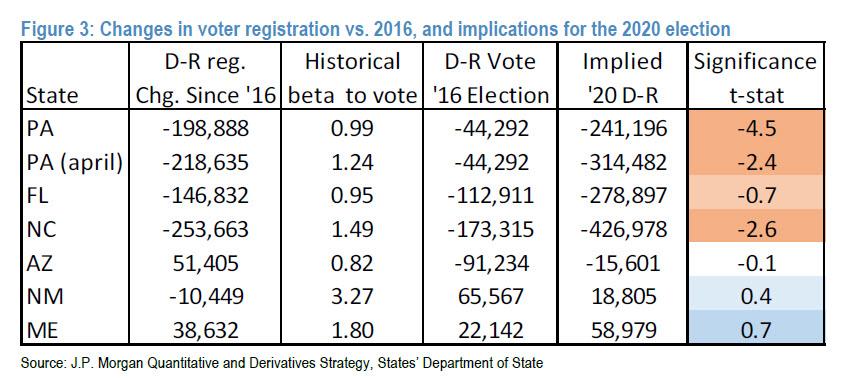
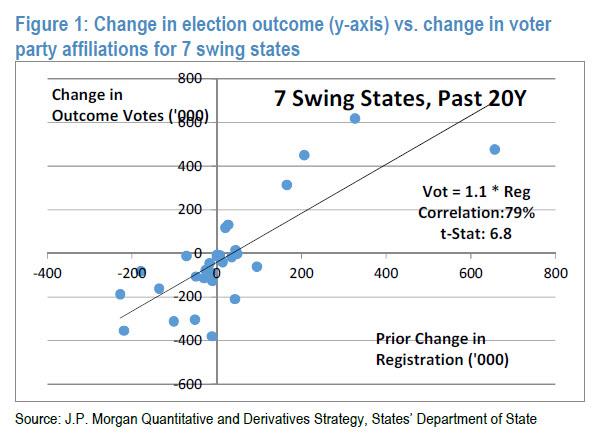
Last week, we published an article detailing a warning from JPMorgan's top quant Marko Kolanvoci to all those expecting a landslide Biden win (and by extension Blue Sweep) in which he showed the recent changes in voter registration data and their possible implication for state outcomes. In a nutshell, the JPM strategist found that there had been a sizable increase in Republican voter registrations in key battleground states compared to only modest increases in Democrat registrations...
... and also observed that the change in D-R (Democrats less Republicans) registrations "highly correlates with the subsequent change in D-R voting outcomes."

We summarized that if Kolanovic's hypothesis is accurate, the change in voter registration data shown above would immediately invalidate all polls such as that most popular one from Real Clear Politics showing Biden sweeping across the Battleground states. In fact, we concluded that while he does not say it, "the implication from the Kolanovic analysis is that Trump may well end up winning the critical trio of Pennsylvania (20 Electoral votes), Florida (29 votes) and North Carolina (15 votes)." That said, Kolanovic hedged by saying that changes in voter registration was only one variable in determining the election outcome, and "these results should not be taken as a prediction of state election outcomes."
Fast forward to today when the JPM quant lays out another variable which also suggests that Trump's odds of victory are far higher than conventional (and flawed as the 2016 election showed) polling would imply.
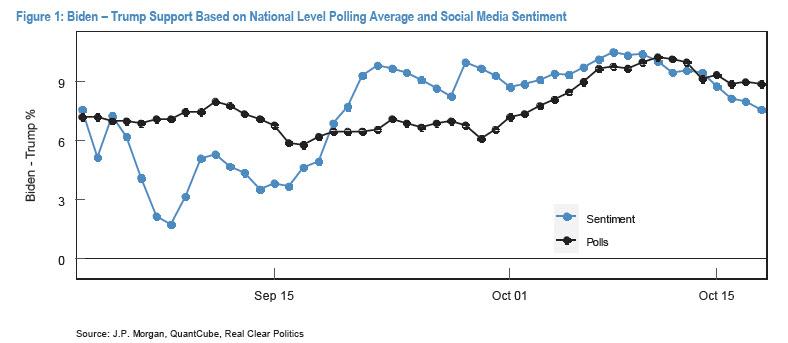
In a report published this morning, Kolanovic presents a Twitter sentiment analysis on the US election and compares it with the traditional polling data. The top level data is presented in the chart below: it shows the Biden – Trump support at the national level based on QuantCube Social Media (Twitter) Analytics, and compares it to polling averages from RealClearPolitics.
Commenting on the data, Kolanovic says that when looking at the evolution of social media sentiment, one sees that "Biden’s lead over Trump widened in September (possibly as a result of the first debate, market weakness, and COVID developments). The sentiment bottomed with the president’s COVID diagnosis but started meaningfully recovering since then." The quant also notes that "social media sentiment appears to be a leading indicator of the polling average. Therefore, all else equal, one could expect the polls to tighten in the near future."
Here, another key consideration is that even the sentiment data is likely biased in Biden's favor as the recent scandal involving Twitter and Facebook's suppression of Hunter Biden news demonstrated. As even JPMorgan admits, "one should also be mindful that social media signals may not be unbiased – suppressing or boosting certain types of accounts and messages would skew the signals. For instance, on a number of occasions, messages from the president himself and stories possibly favorable for him (e.g. NY Post, etc.) were suppressed." For these reasons, he writes "while we believe directionally social media sentiment is a good signal, we would advise against taking at face value the absolute reading (i.e. there could be a persistent bias) as well as the magnitude of the sentiment shifts (i.e. there could be systematic de-boosting and throttling of accounts and messages)."

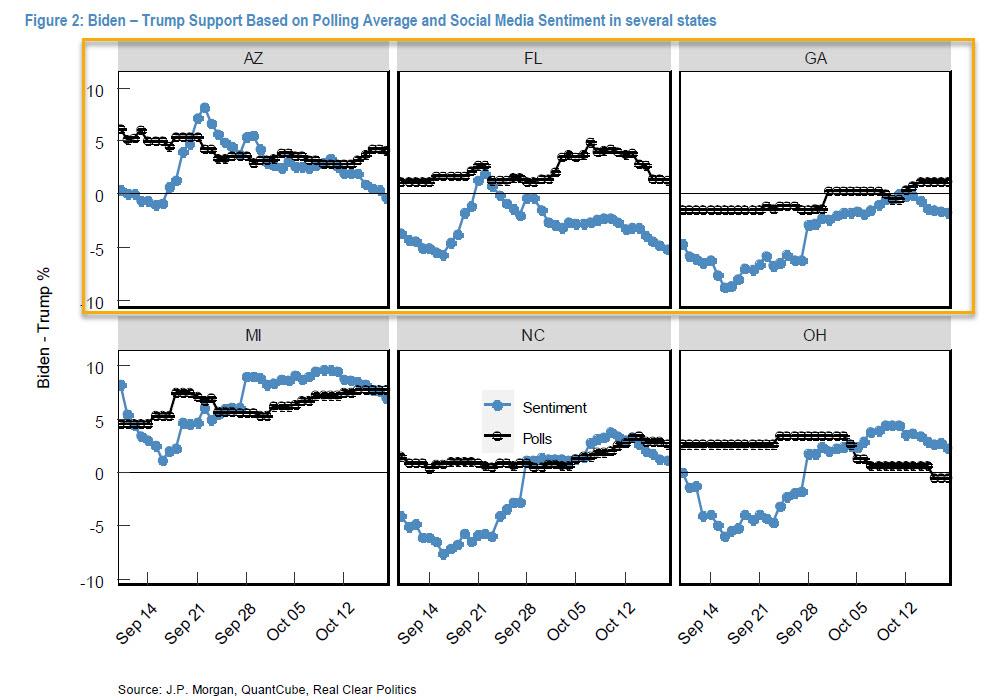
Last, but certainly not least and perhaps the most important observation from Kolanovic, comes from his discussion of the polls vs sentiment divergence not at the aggregate level but within battleground states.
As indicated in the next chart, which shows the Biden – Trump support delta in several states based on QuantCube Social Media Analytics and RealClearPolitics Polling Averages, the JPM quant observes that, "in several states, there is a divergence between social media sentiment analysis and polls. For instance in Arizona, Florida, and Georgia, sentiment diverges from the polls."
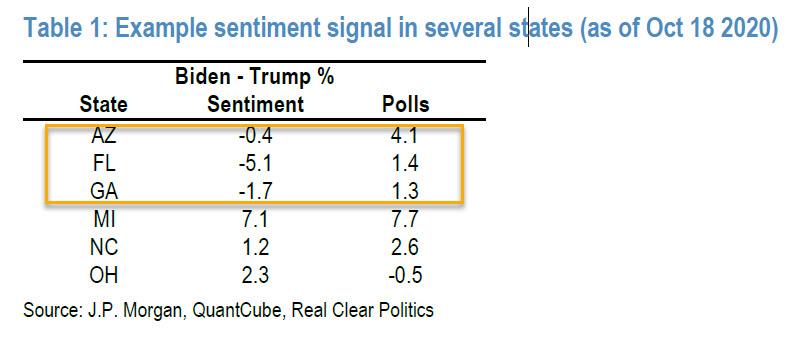
The table below summarizes the above data, underscoring the dramatic shift in pro-Trump sentiment vs polls in 3 of the battleground states.
The implications are profound: if, as Kolanovic suggests, social media sentiment (as biased against Trump as it may be) is a leading indicator to polling, then Trump's is already ahead of Biden in such key battleground states as Arizona, Florida, and Georgia (with the polls expected to catch up in the coming days), which combine for a total of 56 electoral votes, and could well end up being the swing factor deciding the outcome of the election.

FT : Hedge fund Elliott to move headquarters to Florida

Hedge fund Elliott to move headquarters to Florida
Shift from New York City comes as employees work from home during coronavirus pandemic

Elliott Management, the $41bn hedge fund founded by Paul Singer, will move its headquarters from New York to Florida, dealing a blow to the city as it seeks to prevent a corporate exodus during the coronavirus pandemic.

The decision to shift its base from midtown Manhattan to West Palm Beach, Florida, came as the group has decided to open facilities in Greenwich, Connecticut, and Florida to make it easier for employees to work from home, according to a person familiar with the matter.

Elliott, which did not anticipate asking workers back to the office until next summer, expects that “hundreds” of its employees will remain in New York.

Mr Singer is expected to continue to work in the New York area, while Jonathan Pollock, Elliott’s co-chief executive, will be based in Florida, where he has a home and has been living during the pandemic. 

Florida has increasingly become an attractive base for money managers as it does not have a state income tax. Residents of New York City face both state and city income tax.

Bloomberg News first reported the relocation of Elliott’s headquarters.

Elliott has just under 500 employees and offices in New York, London, Tokyo, Hong Kong and northern California. It would keep most but not all its office space at its 57th Street location in Manhattan, said a person familiar with the matter.

New York civic and business leaders have become increasingly concerned about high-profile employers leaving the city as the pandemic prevents large in-person gatherings and employees adjust to remote working.

Still, Wall Street banks and investment groups such as Blackstone have slowly begun asking employees to return to the office in the hopes of sparking creativity and team bonding.

Before the pandemic, Carl Icahn had moved his group to Florida. Hedge fund billionaire David Tepper had moved to Florida but then moved back to his home state of New Jersey.

New York is not the only high-cost state facing potential migration of investment groups. Los Angeles-based Canyon Capital is considering leaving California for Texas according to news reports.

Elliott is best-known for its aggressive activist investing group as well as being one of the most successful distressed debt investors in the world.

FT : Hermès adds to signs of luxury goods recovery

Hermès adds to signs of luxury goods recovery
Third-quarter sales of €1.8bn driven by strong demand in Asia

Hermès returned to sales growth in the third quarter despite the pandemic, as strong demand in Asia for its luxury leather goods and fashion offset continued weakness in Europe because of the lack of tourists.

Sales hit €1.8bn in the quarter, up 6.9 per cent on a comparable basis, ahead of analysts’ expectations for a 1 per cent decline. Leather goods, its largest division, rose 7.8 per cent on a comparable basis to reach €879.8m, beating the 2 per cent increase expected.

The results show how the biggest players in luxury goods have begun to show signs of a tentative recovery after lockdowns and store closures paralysed the industry earlier this year. Sector leader LVMH last week reported forecast-beating 12 per cent comparable sales growth at its largest division, leather goods and fashion. Kering will publish its trading update after the market closes on Thursday.

Nevertheless, the sector is grappling with its worst downturn in decades as the pandemic prompts wealthy consumers to delay purchases and hampers usually free-spending Chinese tourists from travelling to Europe. Analysts have predicted that sales will fall as much as 30 per cent this year and take up to three years to recover. 

Hermès on Thursday declined to give financial predictions for the rest of the year given the uncertainty over the pandemic. Eric du Halgouët, chief financial officer, said the recent resurgence of coronavirus cases in Europe and the US did not affect sales in the first half of October, but it was too early to tell if there would be a drag from new curfews and lockdowns.

The family-controlled group, known for its Birkin bags and colourful silk scarves, said sales in stores had improved and reported strong growth in its ecommerce operation, which now generates more revenue than any single one of its stores.

Hermès shares have risen nearly 20 per cent this year, outperforming LVMH’s 3 per cent rise and Kering’s 1 per cent fall. 

Asked whether the group would restart buying back its shares, Mr du Halgouët said: “We stopped share buybacks this summer and for now we do not expect to start them again.”

Thomas Chauvet, analyst at Citigroup, said in a note that Hermès was in a good position to weather the pandemic because of “the strength of the brand, continued polarisation between winners and losers, and better insulation from a lower than industry average exposure to tourist demand”.

Luca Solca, analyst at Bernstein, said the good sales performances at Hermès and LVMH showed how the sector’s biggest companies were faring better than smaller ones.

“Global luxury goods demand has materially revived over the summer, never mind the fact that intercontinental travel is still virtually non-existent. Best-in-class companies are already producing year-on-year growth in the third quarter, much ahead of start of Covid-19 industry estimates,” he said.