Closing Stock Market SummaryThe S&P 500 gained 0.5% on Thursday, as hopeful-sounding stimulus commentary contributed to renewed leadership in the value/cyclical/small-cap stocks. Versus the benchmark index, the Russell 2000 outperformed (+1.7%) by a healthy margin, the Dow Jones Industrial Average (+0.5%) performed in-line, and the Nasdaq Composite (+0.2%) underperformed.
Early in the day, the S&P 500 was down 0.6% despite another round of better-than-expected earnings reports and encouraging economic data, which included a 55,000 decline in weekly initial claims to 787,000 (Briefing.com consensus 860,000). Risk sentiment was ostensibly pressured by chatter that the passage of a stimulus deal might have to wait until after the election.
House Speaker Pelosi, meanwhile, noted that a stimulus deal was "just about there" after negotiating with Treasury Mnuchin several times this week. That observation prompted a relatively modest rebound that was led by the cyclically-oriented energy (+4.2%) and financials (+1.9%) sectors.
The health care (+1.5%) and utilities (+1.5%) sectors followed suit, but losses in the information technology (-0.5%), real estate (-0.8%), and consumer staples (-0.2%) sectors limited the rebound effort.
Interestingly, even before Ms. Pelosi's comments, the 10-yr yield was trending higher for the sixth straight day on burgeoning inflation expectations resulting from a large stimulus package. The upwards trajectory in rates was cited as a drag on highly-valued growth stocks, which had benefited from persistently low rates.
The 10-yr yield finished the session higher by three basis points to 0.85%. The 2-yr yield remained unchanged at 0.15% due to the Fed's stance of keeping the fed funds rate near zero for the next few years. The U.S. Dollar Index advanced 0.4% to 92.95. WTI crude futures rose 1.6%, or $0.62, to $40.65/bbl.
Highlighting some of today's earnings movers, Tesla (TSLA 425.79, +3.15, +0.8%), Coca-Cola (KO 50.68, +0.69, +1.4%), AT&T (T 28.29, +1.57, +5.9%), CSX (CSX 81.73, +3.01, +3.8%), and Dow Inc. (DOW 48.82, +0.27, +0.6%) closed higher following their results. Union Pacific (UNP 187.14, -12.34, -6.2%), however, was a notable earnings laggard.
Reviewing Thursday's economic data, which featured the weekly Initial and Continuing Claims report:
- Initial claims for the week ending October 17 decreased by 55,000 to 787,000 ( consensus 860,000) while continuing claims for the week ending October 10 decreased by 1.024 million to 8.373 million.
- The key takeaway is that this is perhaps a better take on things, as California completed its pause in processing of initial claims and reported actual unemployment insurance claims; nonetheless, initial jobless claims remain at unacceptably high levels.
- Existing home sales increased 9.4% m/m in September to a seasonally adjusted annual rate of 6.54 million (consensus 6.10 million), bolstered in part by a 34% annual increase in sales in vacation destination counties.
- The key takeaway from the report is that it reflects robust demand for existing homes. That is constraining supply even further, which is going to be a pressure point that feeds higher prices, shuts out an increasing number of first-time buyers, and bolsters the prospects for new home sales.
- The Conference Board's Leading Economic Index increased 0.7% m/m in September (consensus +0.6%) following an upwardly revised 1.4% increase (from 1.2%) in August.
- The key takeaway from the report is that the strength among the leading indicators has become somewhat more widespread, although the slower pace versus August points to a possible slowdown in recovery momentum entering the fourth quarter.
Looking ahead, investors will receive the preliminary Markit Manufacturing and Services PMIs for September on Friday.
- Nasdaq Composite +28.2% YTD
- S&P 500 +6.9% YTD
- Dow Jones Industrial Average -0.6% YTD
- Russell 2000 -2.3% YTD
President Trump’s Twitter accessed by security expert who guessed password “maga2020!”

Image Credits: SOPA Images (opens in a new window)/ Getty Images
A Dutch security researcher says he accessed President Trump’s @realDonaldTrump Twitter account last week by guessing his password: “maga2020!”.
Victor Gevers, a security researcher at the GDI Foundation and chair of the Dutch Institute for Vulnerability Disclosure, which finds and reports security vulnerabilities, told TechCrunch he guessed the president’s account password and was successful on the fifth attempt.
The account was not protected by two-factor authentication, granting Gevers access to the president’s account.
After logging in, he emailed US-CERT, a division of Homeland Security’s cyber unit Cybersecurity and Infrastructure Security Agency (CISA), to disclose the security lapse, which TechCrunch has seen. Gevers said the president’s Twitter password was changed shortly after.

A screenshot from inside Trump’s Twitter account. (Image: Victor Gevers)
It’s the second time Gevers has gained access to Trump’s Twitter account.
The first time was in 2016, when Gevers and two others extracted and cracked Trump’s password from the 2012 LinkedIn breach. The researchers took his password — “yourefired” — his catchphrase from the television show The Apprentice — and found it let them into his Twitter account. Gevers reported the breach to local authorities in the Netherlands, with suggestions on how Trump could improve his password security. One of the passwords he suggested at the time was “maga2020!” he said. Gevers said he “did not expect” the password to work years later.
Dutch news outlet Vrij Nederland first reported the story.
In a statement, Twitter spokesperson Ian Plunkett said: “We’ve seen no evidence to corroborate this claim, including from the article published in the Netherlands today. We proactively implemented account security measures for a designated group of high-profile, election-related Twitter accounts in the United States, including federal branches of government.”
Twitter said last month that it would tighten the security on the accounts of political candidates and government accounts, including encouraging but not mandating the use of two-factor authentication.
Trump’s account is said to be locked down with extra protections after he became president, though Twitter has not said publicly what those protections entail. His account was untouched by hackers who broke into Twitter’s network in July in order to abuse an “admin tool” to hijack high-profile accounts and spread a cryptocurrency scam.
A spokesperson for the White House and the Trump campaign did not immediately comment, but White House deputy press secretary Judd Deere reportedly said the story is “absolutely not true,” but declined to comment on the president’s social media security. A spokesperson for CISA did not immediately confirm the report.
“It’s unbelievable that a man that can cause international incidence and crash stock markets with his Tweets has such a simple password and no two-factor authentication,” said Alan Woodward, a professor at the University of Surrey. “Bearing in mind his account was hacked in 2016 and he was saying only a couple of days ago that no one is hacked the irony is vintage 2020.”
Gevers has previously reported security incidents involving a facial recognition database used to track Uyghur Muslims and a vulnerability in Oman’s stock exchange.
Gucci Struggles as Pandemic Keeps Tourists Home
The brand is lagging other big luxury labels in the market upheaval sowed by the coronavirus
PARIS—Gucci reported a 12% drop in third-quarter sales as the Italian fashion house was hit hard by the absence of tourist shoppers from Asia during the pandemic.
The results released Thursday show the brand lagging other big luxury labels in the market upheaval sowed by the coronavirus. Hermès, the French brand known for its stratospherically-priced handbags, said Thursday that revenue rose 4.2% in the quarter, fueled by strong growth in Asia.
Louis Vuitton LVMUY -0.90% and Dior drove a 12% sales jump in the fashion and leather goods division of LVMH Moët Hennessy Louis Vuitton SE.
Gucci is struggling because it has come to depend heavily on what was, until the pandemic, a highly-profitable strategy: selling to well-heeled shoppers, particularly the Chinese, when they travel abroad. With international travel largely locked down, brands have been forced to encourage shoppers from China and elsewhere to buy where they live.
Gucci is particularly dependent on Chinese clientele shopping in European fashion capitals such as Paris, Milan and London. It also has a large business at duty-free stores in airports. Now it is scrambling to refocus its marketing efforts for a post-pandemic world in which international tourism could take years to recover.
Gucci’s sales in Europe were down 47%, a much steeper decline than Hermès, Louis Vuitton and Dior. Overall revenue was €2.1 billion ($2.5 billion) for the quarter.
“We have some work to do compared to peers to re-engage with local clientele in Europe and elsewhere,” said Jean-Marc Duplaix, chief financial officer of Gucci parent Kering SA KER -0.66% .
Gucci is also in the midst of tweaking its image, toning down the flamboyance that creative director Alessandro Michele brought to the brand since his arrival in 2015. That look helped revenue more than double, driven by sales to a younger clientele. But now Gucci is hoping to gain ground with older shoppers who might not like some of Mr. Michele’s more eclectic stylings, which have mixed Renaissance-era silhouettes with streetwear and the logos of professional sports teams.
“We have not, yet, this level of maturity with certain clientele,” Mr. Duplaix said.
In a bright spot for Gucci, sales were booming in the U.S., driving revenue in North America up 44% for the quarter. A strong stock market and the repatriation of tourist spending from overseas boosted the market, Mr. Duplaix said.
Kering’s other brands delivered strong quarters, reversing a four-year period when robust growth at Gucci buoyed Kering.
Bottega Veneta, one of the industry’s fastest-growing big brands, saw sales rise 17% during the quarter to €332 million. The results show the Italian fashion label continuing its successful turnaround under the British designer Daniel Lee. Growth at Balenciaga and Alexander McQueen was also strong, Mr. Duplaix said.
Six films to watch this week
‘Borat Subsequent Moviefilm’, ‘His House’, ‘The Climb’, ‘Summer of 85’, ‘Totally Under Control’ and ‘One Man and His Shoes’ — all reviewed by Danny Leigh
Airbus prepares to boost production of world’s most popular passenger jet
Aerospace manufacturer aims to lift output of A320neo single-aisle aircraft from second half of next year
Airbus is aiming to boost production of its popular A320neo family of single-aisle aircraft by close to 18 per cent from the second half of next year in a rare piece of good news for an industry that has been devastated by the impact of the coronavirus crisis.
The European aircraft maker has asked suppliers to be ready to ramp up production of the world’s most popular aircraft from 40 to 47 a month from July, three people with knowledge of the situation said.
The move comes as its US rival Boeing prepares for a return of the 737 Max single aisle to the skies after nearly 18 months on the ground following two fatal crashes. Regulators are in the final stages of recertifying the aircraft.
It also comes barely six months after Airbus chief executive Guillaume Faury slashed production of its popular A320 single-aisle jet by a third from 60 a month in order to ensure the company’s survival amid a collapse in demand from cash-strapped airline customers. Boeing followed soon after with similar cuts in production.
Both companies have also scaled back their workforces to prepare for several years of depressed demand. Airbus’s 15,000 job cuts represented the biggest single reduction in its passenger jet business since its foundation 20 years ago. Boeing this month slashed its expectations for global passenger jet demand over the next decade by 11 per cent.
But Airbus’s aim to lift production indicates that there are encouraging signs, even amid the gloom.
“We have done a re-evaluation of the situation after the summer period,” Airbus said. “We have refined the plan for the A320 Family programmes based on our current view of the market.”
The company was keen to stress that no final decision had been taken. “It is a preparation to increase when certain conditions are met,” Airbus added. “We have asked the supply chain to protect up to rate 47 to be prepared for when the market recovers. This decision aims to provide some visibility to our supply chain.”
Airbus’s about-turn on rates comes far earlier than many suppliers had expected. While narrow-body aircraft, generally used for domestic or regional flights, are expected to recover more quickly than wide-bodies, fears had been growing that the prospects of recovery were lengthening.
The resurgence of coronavirus in many countries has forced airlines around the world to cut capacity significantly this autumn and winter. Many in the industry had speculated that Airbus and Boeing would be forced to cut rates again, rather than increase them.
Nevertheless, Airbus this month announced it had delivered 57 aircraft in September — the highest this year. In recent days, the company has told suppliers it is confident it will be able to sell aircraft at an even higher rate of production.
“This is good news,” said one supplier. “It is very good news for the industry if this happens.”
However, some are wary of Airbus’s bullishness. The supply chain will have to produce “hundreds of millions of dollars worth of extra inventory” to meet the new rate, said another supplier.
“If they are assuming that by next summer they will be getting some recovery, I think that’s great news,” he added. “But a degree of cynicism is correct. They want to be able to do this and want suppliers to put working capital in without giving them guaranteed orders. There will be no economic cost to them, if it goes wrong.”
Another person warned that if the rate were to be increased it would be difficult to take it down again. Suppliers were stretched for cash and working capital due to the impact of the virus and asking them to invest more could not be done lightly, he said.
Goldman Expects A Structural Bull Market For Commodities In 2021, Sees Gold Hitting $2300
A weaker U.S. dollar, rising inflation risks and demand driven by additional fiscal and monetary stimulus from major central banks will spur a bull market for commodities in 2021, Goldman's chief commodity strategist Jeffrey Currie said on Thursday, also predicting that "all commodity markets are in, or moving toward, a deficit with inventories drawing in all but cocoa, coffee and iron ore."
The bank, which notes that markets are increasingly concerned about the return of inflation, forecast a return of 28% over a 12-month period on the S&P/Goldman Sachs Commodity Index (GSCI), with a 17.9% return for precious metals, 42.6% for energy, 5.5% for industrial metals and a negative return of 0.8% for agriculture.
A key catalyst for the bank's bullish call is that "nearly all commodity markets are in, or moving toward, a deficit with inventories drawing in all but cocoa, coffee and iron ore."
As Currie adds, "such broad-based deficits are usually only seen late in the business cycle, underscoring the unique environment markets are in. Given that inventories are drawing this early in the cycle, we see a structural bull market for commodities emerging in 2021." In the strategist's view, the bull market will be driven by three major themes:
- structural under-investment in the old economy,
- policy driven demand and
- macro tailwinds from a weakening dollar and rising inflation risks. "These drivers remain consistent with the bank's bullish views from the start of this year, and have now been intensified by COVID-19 disruption and the subsequent global policy response."
Some more thoughts from Currie on the tightening in commodity markets:
Commodity markets have been mostly range bound since this summer, in our view caught between a longer-term bullish outlook for 2021 and near-term concerns around the timing of a vaccine amid rising COVID cases across Europe and the US Midwest (see Exhibit 4). However, it is important to emphasize that nearly all commodity markets are in, or moving toward, a global deficit with inventories drawing in all but cocoa, coffee and iron ore. Such broad-based deficits are usually only seen late in the business cycle,underscoring the unique environment markets are in.As global demand remains tepid for consumer-related commodities like oil, the deficits further underscore how significant the drop in supply has been and how the supply response function has changed. For oil, the sharp drop in capex is now having an impact on non-OPEC decline rates, with capital markets refusing to fund shale drilling, only debt rollovers. In metals, we have seen a sharp drop in maintenance capex and supply disruptions dragging into 2021. This suggests that even if demand falters in coming weeks as winter exacerbates COVID-19, markets will likely continue to rebalance, barring an outright collapse in demand. In our view, base metals and agriculture have more near-term upside than oil, with smaller inventories to move through before prices begin to rise.
Goldman then shows the following chart which reveals the growing deficit across key commodities, as well as the key macro catalysts for higher commodity prices in coming months:
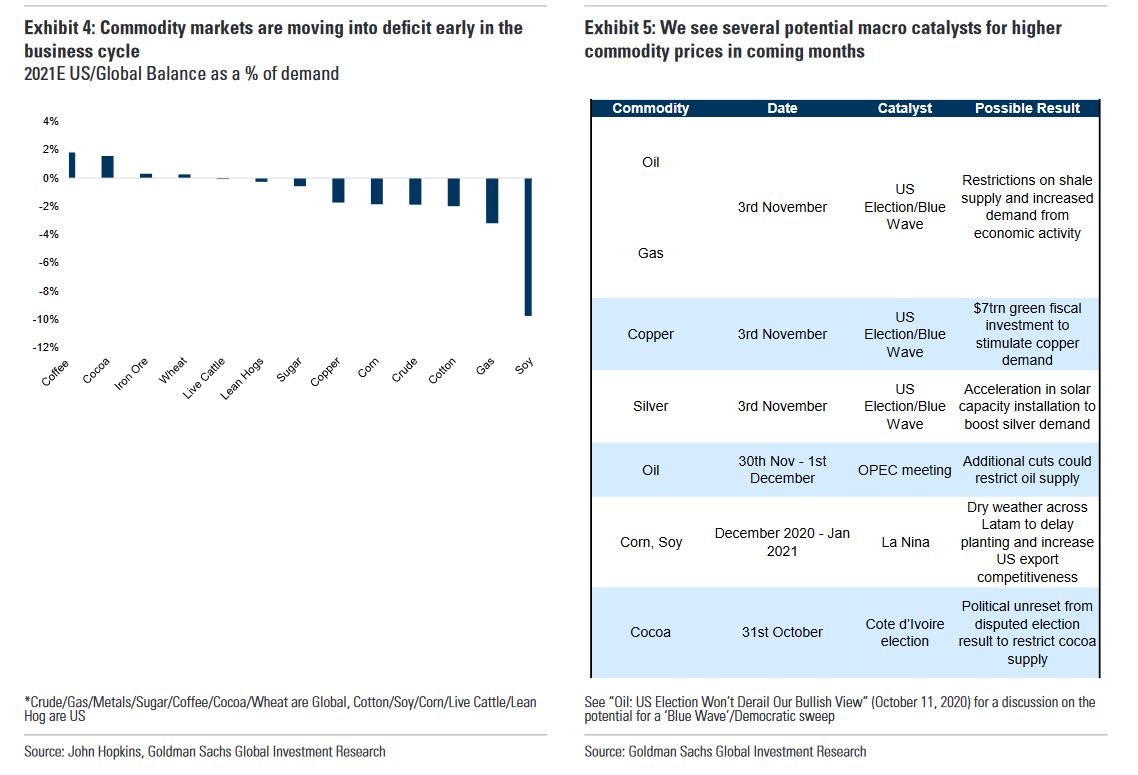
Hedging that even if demand falters in coming weeks as winter exacerbates COVID-19, Goldman still expect markets will continue to rebalance, "barring an outright collapse in demand." Goldman takes a more contained view on energy saying that while inventories of oil remain high, "upside in energy prices will likely come after winter." However, non-energy commodities face immediate upside as balances have tightened ahead of expectations, driven by large Chinese demand and adverse weather shocks, according to the Goldman strategist.
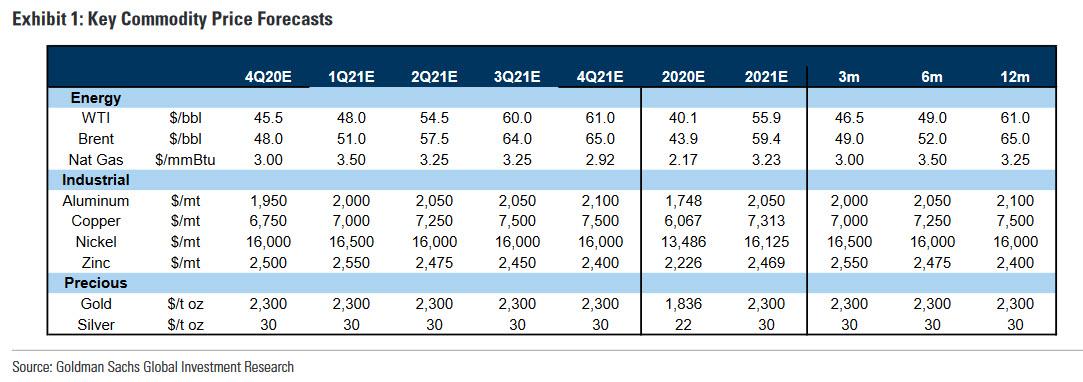
Focusing on Gold, Currie said that expansionary fiscal and monetary policies in developed market economies continue to drive interest rates lower and create demand for hedging the tail risks of inflation, lifting demand for precious metals. As a result, Goldman forecasts gold prices at an average of $1,836 per ounce in 2020 and $2,300 per ounce in 2021, and expects silver prices to be at around $22 per ounce in 2020 and $30 per ounce next year.
Non-energy commodities could see an “immediate upside” as the market balances tighten ahead of expectations on strong demand from China and weather-driven risks, the Goldman Sachs analysts said.
The bank maintained a “neutral” view on commodities in the near term and “overweight” in the medium term.
Goldman Sachs to Recoup, Cut Executives’ Pay After Costly 1MDB Fines
Wall Street firm will claw back money paid to CEO David Solomon, ex-CEO Lloyd Blankfein
Goldman Sachs GS +0.61% Group Inc. is seizing tens of millions of dollars from top executives after agreeing to a costly settlement to resolve multiple government investigations into its role in a Malaysian bribery scandal.
The Wall Street firm will recoup money from Chief Executive David Solomon, his predecessor Lloyd Blankfein, and other current and former executives, people familiar with the matter said, as it prepares to admit to compliance lapses in its dealings with a corrupt Malaysian investment fund, known as 1MDB.
Goldman has agreed to pay about $2.8 billion to the U.S. Justice Department and other global regulators to settle 1MDB allegations, The Wall Street Journal reported Tuesday. That is on top of the $2.5 billion it agreed in July to pay the government of Malaysia. The penalties amount to about eight months of profits for the Wall Street firm.
In Brooklyn federal court on Thursday, a Goldman subsidiary in Malaysia said it would plead guilty to conspiring to violate U.S. antibribery laws. The bank is expected later Thursday to finalize its settlement with the Justice Department and regulators in the U.K., Singapore and New York state.
The financial moves—a combination of clawbacks for departed executives and pay cuts for current ones—are a concession to shareholders who will shoulder the financial cost of the scandal and employees whose own bonuses this year are likely to shrink because of it.
They also are an admission of sorts that the crux of the government’s case against Goldman, that it failed to properly oversee its senior bankers and fostered a win-at-all-cost culture, has some merit. The exact amount at stake couldn’t be learned.
In 2012 and 2013, Goldman helped raise $6.5 billion for 1MDB by selling bonds to investors. Prosecutors say much of that money was stolen by an adviser to the fund named Jho Low, aided by two Goldman bankers and associates in the Malaysian and Emirati governments.
Goldman had long portrayed the bankers—Timothy Leissner, who has pleaded guilty, and Roger Ng, who has maintained his innocence—as rogue employees who hid their activities and Mr. Low’s involvement in the deals from their bosses. Mr. Low has denied the allegations against him.