-
Rheinmetall (RHM TH) +3.7%
- Rheinmetall Sees FY Operating Margin 6% to 6.5%
- Tryg (T2V1 TH) +3.2%
-
AMS (DQW1 TH) +2.8%
- AMS Maintains 4Q Adjusted Ebit Margin 24% to 27%
- Deutsche Telekom (DTE TH) +1.8%
- T-Mobile Rises After Beating Estimates and Boosting Forecast
-
Allianz (ALV TH) +1.5%
- Allianz 3Q Operating Profit Beats Estimates
- Glaxo (GS7 TH) +1.4%
- Siemens (SIE TH) -1.2%
- Evotec SE (EVT TH) -1.2%
- ASML (ASME TH) -1.2%
- Linde (LIN TH) -1.3%
- MTU Aero (MTX TH) -1.3%
- Adidas (ADS TH) -1.3%
- Prosus (1TY TH) -1.6%
- BNP Paribas (BNP TH) -1.7%
- Lufthansa (LHA TH) -1.7%
- United Internet (UTDI TH) -3.5%
- United Internet Sees FY Sales About +3%
A global equity rally showed signs of stalling on Friday, with Nasdaq futures unwinding some of this week’s surge amid the ongoing U.S. election count. The dollar edged up from its lowest in more than two years.
U.S. and European stock futures retreated, while a gauge of Asia-Pacific shares edged higher. The S&P 500 climbed almost 2% Thursday and is headed for its best week since April. The tech-heavy Nasdaq 100 is up over 9% this week.
Gold and crude oil declined and Treasuries were little changed. The yen steadied after rising past the closely watched 104 per dollar level. Federal Reserve officials kept interest rates near zero and made no change to asset purchases while stressing that the U.S. economy needs more fiscal and monetary policy support.
US After Hours TTD +12.5%, ZG +10.4%, SQ +5%, YELP +4.9%, ROKU +3%, TTWO +2.8% on upside; AYX -9.3%, STMP -7.7%, EA -7.3%, UBER -1.8% on downside
Nikkei +0.96% Hang Seng -0.32% CSI -0.53% Shanghai -0.66% Shenzen -1.35%
Eur$ 1.1818 CNH 6.6181 CNY 6.6273 JPY 103.51 GBP 1.3127 CHF 0.9034 RUB 77.5275 TRY 8.4352 WTI$ 37.70 -2.81%
S&P -0.55% Nasdaq -0.93% EuroStoxx -0.60% FTSE -0.30% Dax -0.57% SMI -0.14%
Macro :
- U.K. to Tell People Arriving From Germany, Sweden to Quarantine
- Fund Flows Left Cash, Bonds for Stocks Last Week, Jefferies Says
- U.S. Advances $2.9b Drone Sale to UAE: Reuters
Keep an eye on :
- ANA SM : Acciona 9M Net Income EU78M
- ADP FP : ADP Says Unions Won’t Sign Business Model Change Plans
- ALV GY : Allianz 3Q Operating Profit Beats Estimates
- AMS SM : Amadeus 3Q Adjusted Net Loss EU125M, Est. EU162.2M
- AML LN : Kuwaiti Investor Adeem Sells GBP1.79m of Aston Martin Shares
- AMS SW : AMS Maintains 4Q Adjusted Ebit Margin 24% to 27%
- AMBUB DC : Ambu Gets European Clearance to Sell New Single-Use Cystoscope
- BAMI IM : Banco BPM 3Q Net Income Beats Estimates
- GBF GY : Bilfinger Said to Explore Sale Amid Private Equity Interest
- BOKA NA : Boskalis 3Q Order Book EU4.4B
- BRAV SS : Bravida 3Q Net Income Misses Estimates
- CABK SM : Caixa Geral 9M Net Income EU392M
- CLNX SM : Cellnex Seeks EU1.5b in Convertible Bond Offering: Terms
- COR PL : C. Amorim 9M Net Income Falls as Virus Hits Wine Consumption
- COTN SW : Comet Sells Ebeam Lamps to Tetra Pak; No Price Disclosed
- CVAL IM : Credito Valtellinese 9m Net Income Almost Doubles to EU66M
- DRI GY : 1&1 Drillisch Cuts FY Sales Forecast
- ELIOR FP : Elior Posts FY Adj. Ebita Loss Due to Covid-19
- ENEL IM : Enel 9M Net Income EU2.92B
- ENX FP : Euronext 3Q Ebitda Beats Estimates
- RACE IM : Ferrari, Bentley Find Buyers in Singapore Despite Pandemic
- FNTN GY : Freenet Maintains FY Ebitda EU415M to EU435M, Est. EU424.9M
- GLPG NA : Galapagos 9M Revenue Meets Estimates
- HEX NO : Hexagon Composites 3Q Ebitda Beats Estimates
- INW IM : Inwit Updates 2020 Guidance; 3Q Rev. EU186.1m
- DEC FP : JCDecaux 3Q Adjusted Revenue Misses Estimates
- LDO IM : Leonardo 3Q Revenue Beats Estimates
- MS IM : Italy Could Seek Veto Power on Media Investments: Repubblica
- MCOVB SS : Medicover 3Q In Line With Preliminary Result, Maintains Guidance
- MEKO SS : Mekonomen 3Q Ebit Beats Estimates
- MEL SM : Melia Hotels 9M Net Loss EU469.6M Vs. Profit EU101M Y/y
- KN FP : Natixis In Talks to Break With H20 After String of Controversies
- KN FP : Natixis Has No Plan to Involve Third Party in Potential H2O Exit
- NETC DC : Netcompany Cuts FY Adjusted Ebita Margin Forecast
- NOVN SW : Novartis Canakinumab Trial Didn’t Meet Primary, Second. Endpoint
- NOVOB DC : Novo Nordisk to Buy Emisphere’s Outstanding Shares for $1.35b,
- RHM GY : Rheinmetall Sees FY Operating Margin 6% to 6.5%
- RHK GY : Rhoen Klinikum 9M Consolidated Net EU2.3M
- CFR SW : Richemont 1H Operating Profit Beats Estimates
- CFR SW : Farfetch, Alibaba Group and Richemont Form Global Partnership to Accelerate the Digitization of the Luxury Industry
- RR/ LN : Rolls-Royce to Cut 950 Mgmt, 420 Blue-Collar Jobs in Jet Engines
- RSA LN : RSA Gets Offer from Intact at 685p in Cash/Shr, Dividend
- RUI FP : Rubis 3Q Revenue -32%
- SQ US : Square 3Q Net Revenue Beats Estimates: Snapshot
- TEN IM : Tenaris Sees Capex Falling by ~15-20% in 2021, CEO Rocca Says
- UBER US : Uber 3Q Adjusted Net Revenue Misses Estimates: Snapshot Uber’s Delivery Sales Surpass Expectations, but Loss Widens
- UTDI GY : United Internet Sees FY Sales About +3%
- VIV FP : Italy Could Seek Veto Power on Media Investments: Repubblica
- VPK LN : Vopak 3Q Adjusted Ebitda EU200.1M
- VOW3 GY : VW’s Boss Warns the Troops: We Don’t Want to End Up Like Nokia
- WBD IM : Webuild Completes Acquisition of 65% Stake in Astaldi
>>> Up
* Accor Raised to Neutral at Citi; PT 23.50 euros
* Casino Raised to Equal-Weight at Morgan Stanley
* FCC Raised to Buy at SocGen; PT 10 euros
* Galp Raised to Neutral at Goldman; PT 10.60 euros
* HeidelbergCement Raised to Neutral from Buy at Oddo, PT 59 euros
* Iberdrola Raised to Neutral at Alantra Equities; PT 11.70 euros
* Intesa Sanpaolo Raised to Hold at Berenberg; PT 1.55 euros
* Lanxess Raised to Buy at SocGen; PT 56 euros
* Legrand Raised to Buy from Hold at Kepler Cheuvreux, PT 75 euros
* Loomis Raised to Buy at Handelsbanken; PT 255 kronor
* Mowi Raised to Hold at Berenberg; PT 150 kroner
* Plus500 Raised to Hold at Peel Hunt; PT 1,375 pence
* Reckitt Raised to Sector Perform at RBC; PT 6,700 pence
* Sacyr Raised to Buy at SocGen; PT 2.20 euros
* Skanska Raised to Hold at DNB Markets; PT 180 kronor
* Thales Raised to Outperform at Credit Suisse; PT 80 euros
>>> Down
* Horizon Discovery Cut to Market Perform at Cowen
* Lagardere Cut to Hold at SocGen; PT 19.50 euros
* Scandinavian Tobacco Cut to Hold at Handelsbanken
* Verbund cut to Neutral from Buy at Oddo, PT 55 Euros
>>> Initiation
* Advanced Medical Rated New Hold at Peel Hunt; PT 218 pence
* Codemasters Rated New Buy at HSBC; PT 500 pence
* DFV Deutsche Familienversicherung Rated New Buy at Berenberg
* Hammerson Resumed Equal-Weight at Morgan Stanley
* Staffline Reinstated Buy at Liberum; PT 40 pence
* Team17 Rated New Buy at HSBC; PT 960 pence
* TrenDevice Rated New Outperform at EnVent S.p.A.; PT 1.29 euros
>>> Call
* Reckitt in Best Shape for a Decade, RBC Raises to Sector Perform
* Tryg’s Joint Bid for RSA Is an ‘Ambitious Step,’ Citi Says
Biden Lead Shrinks in Arizona as Counting Continues
Fox News, Associated Press have put state in Biden’s column, which Republicans say was premature
Joe Biden’s lead continued to shrink in Arizona after more vote tallies were released Thursday evening in a state that the Associated Press and Fox News have already put in the former vice president’s column but that Republicans and some election experts say remains too close to call.
As of early Friday morning, Mr. Biden was ahead of President Trump by roughly 46,300 votes with about 90% of the state’s expected total vote counted, according to the AP.
Arizona released about 100,000 votes Thursday night but is expected to have roughly 350,000 more to tally. More than 200,000 of that is in Maricopa county, the state’s most populous. Maricopa county is set to release more tallies Friday at 11 a.m. and 7 p.m. EST.
Because the presidential election is so close, the stakes in Arizona are high for both candidates. If Mr. Biden carries the state, which hasn’t voted for a Democrat for president since 1996, he only needs one other state to give him the 270 electoral votes required to win the White House. Mr. Trump would need to take Pennsylvania, North Carolina, Georgia and Nevada to win without Arizona.
As more votes were counted, Mr. Biden’s lead over Mr. Trump shrank to 1.5 percentage points on Thursday evening from 3.4 percentage points on Wednesday night.
“This race is going to get pretty close. Either way it’s going to get close, but the question is: Can Trump pull off an election miracle?” said Mike Noble, chief of research at OH Predictive Insights, a Phoenix-based nonpartisan polling firm.
Experts believe Mr. Trump needs to win close to 60% of the remaining votes in the state to overtake Mr. Biden’s lead, a difficult but not impossible task.
Arizona has a history of taking days to count close races. The 2018 Arizona Senate race wasn’t called for six days.
Fox News declared Mr. Biden the winner in Arizona late Tuesday night, followed by the AP early Wednesday. In an article explaining its decision, the wire service, which is widely seen as a definitive source of election results, said its analysis of ballots cast statewide “concluded there were not enough outstanding to allow Trump to catch up.” The Wall Street Journal’s news coverage relies on the AP’s calls of races.
Other news outlets hadn’t called the race as of Thursday. Trump campaign officials, who complained in public and in private about the Fox News and AP decisions, said they believe the president will win the state and its 11 electoral votes.
“We think it’s completely irresponsible for anyone to call this state for Joe Biden,” Trump campaign senior adviser Jason Miller said.
Later Thursday, the Arizona Republican party and Trump campaign held a news conference in Phoenix in which they expressed confidence that when all votes were counted, they would win.
The Biden campaign, meanwhile, says it remains confident that Mr. Biden will win Arizona, though aides acknowledged the former vice president’s lead could continue to narrow.
Arnon Mishkin, director of the Fox News Decision Desk, said on the cable network on Wednesday night: “We strongly believe our call will stand.” Sally Buzbee, AP’s executive editor, said Thursday that the news agency “continues to watch and analyze vote count results from Arizona as they come in,” adding, “We will follow the facts in all cases.”
The ballots cast on Election Day in Maricopa County have all been reported. The remaining ballots were all received over the weekend and Monday, or dropped into ballot boxes.
In many other states, early and mail-in votes have favored Mr. Biden. However, Arizona could be different because the state has long had a robust mail-in voting program used by both parties. In 2016, mail-in votes accounted for 75% of all ballots cast. Mr. Trump won the state by 3.5 points that year.
The state has moved left in recent years as a result of a growing Latino population in Maricopa County and suburban residents moving away from the Republican Party.
Arizona on Tuesday elected its second Democrat to the Senate. The AP called the race for former astronaut Mark Kelly, who as of Thursday was ahead of GOP Sen. Martha McSally 52.1% to 47.9%. Arizona also voted to legalize marijuana.
This year, Mr. Trump visited Arizona seven times. Mr. Biden visited the state once during the general election.
By Wednesday evening, Republicans were using platforms including Facebook and Twitter to organize rallies in the state. About 150 people gathered that night in Maricopa County, including outside the county election office, according to local news reports.
On Tuesday evening, a video began circulating on Facebook, falsely alleging that ballots marked with a felt-tipped Sharpie pen in Maricopa County wouldn’t be counted. Facebook and other social-media companies took steps to reduce the sharing of the video.
“If you voted a regular ballot in-person, your ballot will be counted, no matter what kind of pen you used (even a Sharpie),” Katie Hobbs, Arizona’s Democratic the secretary of state, wrote in a Facebook post.
October Payrolls Preview: It's About To Get Ugly Again
With the nation transfixed by the bad game show that is the presidential election, now in its 3rd day and counting, it is safe to say that nobody, not even the algos will give a rat's ass what October jobs data the BLS reports on Friday morning. Still, as we do every month, we will preview what the market expects of the first jobs report after the election, even if it is still unclear who the next president is, and the first report expected to shock Wall Street by how bad it is since the Covid mini-depression.
As NewsSquawk reports, the recent data has been somewhat downbeat, with the rate of Initial Jobless Claims rising in the October survey week against expectations it would, while ADP payrolls rose in October, less than expected and a slower pace from the prior month, although it remains to be seen if it will correlate to the BLS following recent divergences.
Goldman (which expects a below consensus 500K NFP print) agrees, noting that High-frequency labor market information indicates further deceleration in job growth, consistent with a drag from the virus resurgence and fiscal fizzle. The bank also expects virtual schooling and the accelerating shift to e-commerce this holiday season to weigh on education and retail payrolls in tomorrow’s report,respectively. The wind-down of the 2020 Census is also set to reduce payrolls by around 125k in Friday's jobs report.
In addition to softer signals from Big Data sources, the smaller number of workers on temporary layoff (4.6mn in September, down from 18.1mn in April) reduces the scope for the rapid pace of gains seen in the summer. And while continuing claims declined sharply during the payroll month, much of the drop reflected the expiration of program eligibility as opposed to reemployment.
On the flipside, the manufacturing ISM survey saw employment return to expansionary territory at 53.2 after 14 months of contraction, a reading that is generally consistent with an increase in the BLS data on manufacturing employment. Philly Fed employment fell, although the report noted it still saw an overall increase on manufacturing employment. The ISM services employment report continued to grow in October, albeit at a slower pace than September. Challenger Job Cuts saw the best report in 7 months, with 80,666 layoffs, less than September’s 118k cuts.
With that out of the way, here is what consensus expects:
- Nonfarm Payrolls exp. +600,000 (range 0.300mln-1.221mln, prev. +0.661mln);
- Unemployment rate exp. 7.7% (range: 7.0-8.0%, prev. 7.9%);
- U6 unemployment (prev. 12.8%);
- Participation (prev. 61.4%);
- Private payrolls exp. 0.700mln (prev. 0.877mln);
- Manufacturing payrolls exp. 50k (prev. 66k);
- Government payrolls (prev.-216k);
- Average earnings m/m exp. 0.2% (prev. 0.1%);
- Average earnings y/y exp. 4.6% (prev. 4.7%);
- Average workweek hours exp. 34.7 (prev. 34.7).
Some more details courtesy of NewsSquawk
INITIAL JOBLESS CLAIMS:
Weekly initial jobless claims for the BLS survey period were above expectations (898k vs 825k expected, prior revised +5k to 845k). Continuing claims fell, however, to 10.02mln (expected 10.7mln from a revised up 11.18mln). Oxford Economics said the latest data was troubling, for a number of reasons: 1) Claims for regular initial state benefits rose to their highest level since late August and a decline in PUA claims seems largely a function of reporting issues in Arizona; 2) the positive trend in continuing claims is being offset by a rise in the number of individuals who have exhausted regular benefits, which OxEco says is further evidence of more long-lasting scarring effects from the pandemic. The situation in California, where there are a number of issues with its reporting, continue to cloud the picture, although these have since been resolved. OxEco warns that “failure to pass additional fiscal relief measures poses considerable downside risk to the economy, particularly as Covid-19 cases are on the rise and would likely lead to further job losses,” adding that a failure to provide more relief “raises the risk that some individuals will lose benefits altogether at the start of 2021.” As a caveat, it is worth noting that some analysts are questioning the usefulness of the initial jobless claims data series -- notable economists like Oregon University professor Tim Duy have struggled to reconcile the positive economic momentum seen in housing and auto sales with the notion that the economy is collapsing.
UNEMPLOYMENT RATE:
Goldman estimates the unemployment rate declined by two tenths to 7.7%, reflecting an increase in household employment partially offset by potentially higher labor force participation. The labor force participation rate probably increased in October as the recovering labor market encouraged job searches. In interpreting the report, pay close attention to the number of unemployed workers on temporary layoff, which spiked to a record high 18.1mn in April and had retraced to 4.6mn in September.
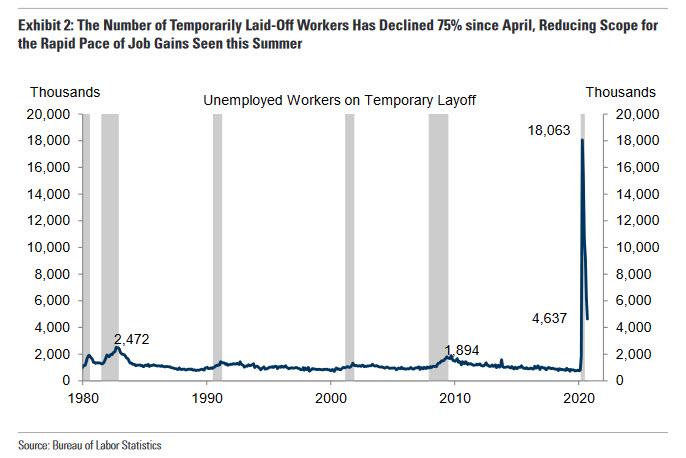
Over the last 50 years, the three recessions with the highest share of temporary layoffs were followed by the fastest labor market recoveries (both absolutely and relative to consensus forecasts at the time). However, the smaller number of workers on temporary layoff in September reduces the scope for the rapid pace of gains seen in the summer (though it remains a positive factor relative to the pre-corona paceof job gains)
ADP:
Headline national employment rose by 365k, albeit a slower pace from the previous 753k and cooler than the expected 650k rise, although it is worth noting the Homebase small business employment numbers were weak. Nonetheless, Pantheon Macroeconomics highlights that this is still a soft ADP print. The desk notes the Homebase numbers suggest a 500k-1mln drop due to the pressure on the services sector, while leisure and hospitality have taken a hit amid the rise in cases. Pantheon expects to see ADP slightly undershoot NFP again and thus are looking for a print of 400k on Friday’s BLS report.
SURVEYS:
The national ISM manufacturing survey saw the employment metric at 53.2, up from the prior month’s 49.6, seeing growth in October after 14 months of contraction. Note, an employment index above 50.8 is generally consistent with an increase in the BLS data on manufacturing employment, ISM says. The ISM services report saw growth for the second consecutive month, albeit at a slower rate than September, printing 50.1 from 51.8 in September. Comments from respondents included: “Minor increase, filling positions” and “Slowly bringing back employees and investing in some areas as business returns”. Philly Fed employment fell in October to 12.7 from 15.7, although the report noted on balance, firms reported increases in manufacturing employment.
JOB CUTS:
Challenger job cuts were encouraging, only seeing 80,666 job cuts, less than the prior months 118.8k, showing the best reading in 7 months. Challenger, Gray & Christmas write the lower number this month indicates “some companies impacted by shutdown orders were able to reopen and stave off cutting jobs”. However, the firm warns uncertainty is likely due to the rise in coronavirus cases, stricter restrictions and lack of stimulus funds. A downturn in demand was the reason for 25,281 job cuts, the primary reason for the layoffs, while market conditions, cost-cutting and restructuring were the reasons for the remainder of job cuts this month.
ARGUING FOR A WEAKER-THAN-EXPECTED REPORT:
Big Data: High-frequency data on the labor market softened on net, averaging +450k across six measures (median +160k), as shown in Exhibit 1. We also note that the Google Mobility data may have difficulty distinguishing between employees returning to work and those transitioning between work-from-home and in-office labor market activity. Such a deceleration would be directionally consistent with the resurgence of the coronavirus in the middle of the country in late September and early October—or alternatively with the impact of waning fiscal support on spending.

Education seasonality. We expect a second month of weakness in education categories related to the coronacrisis, with the effect worth anywhere from -50k to-250k (mom sa, public + private). Some of the janitors and other school staff who normally return to work in mid- or late-September did not this year due to virtual school reopenings in much of the country. Reflecting this, we note scope for education payrolls to rise by less than the BLS seasonal factors anticipate.
Census hiring. Census temporary workers are set to lower nonfarm job growth by around 125k in October, as field operations wound down further.
ADP. Private sector employment in the ADP report rose by 365k in October, wellnbelow consensus expectations. the ADP report was viewed as incrementally negative news.
ARGUING FOR A BETTER-THAN-EXPECTED REPORT:
Job availability. The Conference Board labor differential—the difference betweennthe percent of respondents saying jobs are plentiful and those saying jobs are hardto get — rose further into expansionary territory (to +6.6 in October from +3.3 inSeptember and -2.2 in August).Job cuts. Announced layoffs reported by Challenger, Gray & Christmas fell byn39.7% in October to 77k after increasing by 3.7% in September (mom, sa by GS).They remain 57% above their October 2019 levels.
German factories expect to churn out less in coming months: Ifo
BERLIN (Reuters) - Production expectations for the mighty industrial sector of Europe’s largest economy have weakened somewhat for the coming months, Germany’s Ifo institute said on Friday, adding that it was unclear what impact lockdown measures would have.
Its index for production prospects dropped to 17.4 points in October from 20.0 points in September, having previously risen for months.
The German statistics office is due to publish industrial output data for September at 0700 GMT, with economists expecting to see a 2.7% increase.
What the Farfetch-Alibaba-Richemont Tie Up Means for the Future of Online Luxury
Farfetch has raised $1.15 billion from three of the industry’s biggest players, including the owner of its greatest rival. Does the partnership foreshadow further consolidation — and where does Yoox Net-a-Porter fit into all of this?
NEW YORK, United States — Some of the luxury market’s biggest competitors are teaming up in a bid to dominate China’s booming online market for high-end watches, jewellery and apparel.
On Thursday, Farfetch announced that it will form a new joint venture in China with tech-giant Alibaba. As part of the deal, Alibaba and Swiss luxury group Richemont have invested $300 million each, plus $250 million each in a new joint venture, Farfetch China. They’ll own a combined 25 percent stake in the unit, with the option to acquire another 24 percent. The Pinault family, owner of French luxury conglomerate Kering, has also upped its current stake in Farfetch by an additional $50 million.
The deal is a major sign of support for Farfetch, cementing the marketplace’s status as the leading player in the online luxury market. It also could mark the start of a long-awaited consolidation in the space, where numerous small and mid-sized websites compete for the same pool of wealthy consumers. The biggest loser in the deal is Yoox Net-a-Porter Group, which has seen its owner (Richemont) and Chinese partner (Alibaba) invest in its biggest rival.
Farfetch has seen sales soar during the pandemic, reporting $721 million in sales in the second quarter, a 48 percent increase from the same period last year (the marketplace takes a cut of sales).
Farfetch stock hit an all-time high this week after media reports about the impending investment on Monday, as investors interpreted the deal as a vote of confidence in the platform, which has yet to turn a profit. Founder and Chief Executive José Neves has previously said Farfetch expects to break even next year.
“This is without a doubt excellent news for Farfetch,” Bernstein analyst Luca Solca wrote in a note, highlighting that Farfetch now has the backing of two Chinese internet giants, Alibaba and Tencent, and two luxury giants, the Pinaults’ Artemis and Richemont.
As part of the new investment, Farfetch will open shops on Alibaba’s luxury platform Tmall Luxury Pavilion, its luxury outlet platform Luxury Soho and its cross-border marketplace Tmall Global — quickly expanding its reach in Asia, the world’s fastest-growing luxury market. Farfetch previously gained inroads with Alibaba rivals Tencent and JD.com, an early investor.
In addition to a major leg up in China, Farfetch will also benefit from a closer partnership with Richemont and Kering (via Artemis) as luxury brands continue to invest more in mono-brand e-commerce to better control their client relationships and brand equity. It also sets Farfetch up as the go-to technology provider for luxury brands, a role Yoox previously held. Kering formed a joint venture with Yoox in 2013, and the company, which later merged with Net-a-Porter, operated its mono-brand websites until that partnership ended in 2018. Moncler also exited a similar deal in July.
The investment also brings together two luxury rivals, Richemont Chairman Johann Rupert and Kering Chairman and Chief Executive François-Henri Pinault, who will join Neves and Alibaba as representatives on a committee that will aim to “[lead] the digitisation of the global luxury retail industry,” according to a release from Farfetch, and explore new ways to incorporate digital into luxury retail.
Both Richemont and Kering are substantial in size but nowhere near the level of LVMH. Analysts have speculated about the advantages of closer ties – or even a merger – for years. While Kering has seen exceptional growth in recent years through Gucci and Saint Laurent, the group has also been on the hunt for new growth opportunities.
Richemont has underperformed Kering and LVMH. The company’s stock has dropped 15 percent over the last five years, while shares of LVMH and Kering have increased by 197 percent and 260 percent, respectively. The Swiss company’s problems stem from both YNAP and its fashion brand portfolio.
Its stable of hard luxury brands, including Cartier and Van Cleef & Arpels, represent 51 percent of revenue but drive the vast majority of its profit. That category dominance is now being threatened by LVMH, which has seen success with its 2011 Bulgari acquisition and will further establish its expertise in the space with its pending acquisition of Tiffany.
Richemont and Kering’s shared interest in Farfetch’s new initiative could indicate a sign of more conversations to come between the two rivals.
Richemont’s investment in a direct competitor of YNAP also calls into question its strategy for that business, which competes with Farfetch for customers. The business models are different, however: YNAP is a majority wholesale business known for its edit of products, while Farfetch acts as a middleman between luxury brands, boutiques and customers.
Alibaba and Richemont first formed a joint venture to expand YNAP’s reach in China in 2018, the same year Richemont fully acquired the luxury e-tailer. Since then, YNAP has struggled with botched technology investments, high customer acquisition costs and excess inventory. The challenges grew in 2020 when YNAP was forced to temporarily close some of its warehouses due to the pandemic. Losses in Richemont's online distributors group in the year ending March 2020 were €241 million ($285 million).
After a long string of upper management exits, YNAP Chief Executive Federico Marchetti announced his departure in March, but a replacement has yet to be named.
Back in 2015, Net-a-Porter Founder and then-Chief Executive Natalie Massenet proposed a merger with Farfetch to Richemont, according to sources familiar with the discussions, but Richemont partnered with Yoox without first seeking Massenet’s approval. The deal resulted in the exit of Massenet, who later joined Farfetch as a co-chairman in 2017. She stepped down from that role in August.
Could a strategic partnership between Farfetch, with its modern model, and Net-a-Porter, with its strong brand identity, be another step in the industry’s consolidation?
“It would be an ideal way out for all parties concerned,” said Solca in an email to BoF.
Farfetch, Alibaba, Richemont Join to Accelerate China Business
LONDON — In a landmark union of luxury digital titans, Farfetch, Alibaba Group and Richemont have unveiled a global strategic partnership to provide luxury brands with “enhanced access to the China market,” and to accelerate the digitization of the global luxury industry, the three companies said Thursday.
Leveraging each company’s respective expertise and extensive reach, the partners said they will bring luxury retail “to the next generation by seamlessly integrating the digital and physical realms.”
As part of the partnership, Farfetch will launch luxury shopping channels on Alibaba’s platforms, Tmall Luxury Pavilion and Luxury Soho, China’s premier luxury and luxury outlet destination within the Tmall marketplace, as well as Alibaba’s cross-border marketplace Tmall Global.
The channels expand the reach of Farfetch’s global luxury platform to Alibaba’s 757 million consumers, offering luxury labels a multibrand solution through a single integration with Farfetch.
This will provide luxury labels with a unique opportunity to elevate their brand awareness, according to the partners, while significantly expanding their addressable market of luxury consumers through their participation on Farfetch’s global marketplace.
For luxury consumers, this provides multiple ways to shop, either through the Farfetch integration, or through the already launched Net-a-porter integration on Tmall Luxury Pavilion, the new partners said.
As part of the global partnership, Alibaba and Richemont will invest $600 million, or $300 million each, in private convertible notes issued by Farfetch Ltd. Alibaba and Richemont will also invest $500 million, or $250 million each, in Farfetch China, taking a combined 25 percent stake in a new joint venture that will include Farfetch’s marketplace operations in the China region.
In addition, Alibaba and Richemont have an option to purchase a further combined 24 percent of Farfetch China after the third year of the venture’s formation. Alibaba and Richemont will explore additional opportunities to work closely with Farfetch to provide services to luxury brands.
The investments by Alibaba and Richemont in Farfetch China and the establishment of the joint venture are expected to be completed during the first half of calendar year 2021, subject to the satisfaction of closing conditions.
Separately, Artemis, an investment vehicle owned by the Pinault family that also owns Kering, has also agreed to increase its existing investment in Farfetch with a $50 million purchase of Farfetch’s Class A ordinary shares.
Postal Service Is Ordered by Judge to Search for Remaining Ballots
Tens of thousands of ballots were caught up in the U.S. mail system; some may be too late to be counted for election
A federal judge ordered the U.S. Postal Service to conduct rigorous sweeps of postal facilities serving states with looming election deadlines like Pennsylvania and North Carolina, so any ballots still in the mail system reach election officials in time to be included in election tallies.
The order came in the midst of a close presidential race and as the Postal Service submitted data to a federal court in Washington, D.C., showing that at least 150,000 ballots likely reached election officials on Wednesday—too late to meet deadlines for inclusion in election counts in as many as 28 states.
More than 600 of those ballots were processed in postal facilities serving Georgia, where President Trump and former Vice President Joe Biden’s vote tallies were extremely close, potentially making them too late for the state’s Election Day deadline. About 1,000 more were in other close states with Election Day deadlines, such as Arizona, Michigan and Wisconsin.
Around 15% of the ballots handled Wednesday at mail facilities servicing competitive states with Tuesday deadlines failed to meet Postal Service delivery on-time standards, which typically range between one and three business days for most first-class mail, the data show.
Meanwhile, more than 10,000 ballots were processed Wednesday in North Carolina, Pennsylvania and Nevada, the Postal Service data show, where they can still be counted. Nevada, for example, allows mail-in ballots postmarked by Election Day and received by election officials by Nov. 10 to be included in tallies.
It was impossible to say, based on the data released by the Postal Service on Thursday, how many races in how many states might have been affected by the late ballot deliveries.
The overall uncertainty casts a shadow over the handling of election mail by the Postal Service, which told the court and other federal courts that it was pulling out all the stops to speed election deliveries to its destinations in a year that saw record voting by mail.
During a hearing on Thursday before U.S. District Court Judge Emmet G. Sullivan, attorneys for public interest groups including Vote Forward and the National Association for the Advancement of Colored People asked the Postal Service to provide additional information on how it handled election mail and to explain why it lost visibility into thousands of ballots.
Lawyers representing the groups estimated—using data provided by the Postal Service—that somewhere between 8,000 to 9,000 ballots nationwide were mailed by Sunday but not delivered by Election Day.
The groups sued the Postal Service in Washington, D.C., federal court earlier this year. They accused the newly hired Postmaster General Louis DeJoy, a big donor to President Trump, of implementing changes in postal operations that, they said, posed a threat to voting by mail.
In testimony earlier this week, the Postal Service described special procedures it put in place to bypass normal mail handling and speed ballots to election officials. That meant, it said, that roughly 300,000 ballots entered the usual mail stream but were then handled differently from regular mail to eliminate delays.
But that special handling created challenges, with the Postal Service losing the ability to track the ballots as they moved through—or around—the mail-processing machines to final delivery points with election officials.
After questions were raised in federal court by the civil rights groups, Postal Service officials reviewed the agency’s internal data and said they had high confidence that many of those 300,000 ballots were delivered but some warranted further investigation.
In some cases, the Postal Service said it couldn’t say with confidence that all of the ballots given special handling were actually delivered. For example, it said 1,524 ballots destined for election officials in central Pennsylvania received initial scans in that same area but the Postal Service couldn’t say with certainty that 545 of them had been delivered.
That doesn’t mean they weren’t delivered, only that the Postal Service’s internal tracking system couldn’t definitively account for where they ended up.
It was the same situation in Greensboro, N.C., where the Postal Service said it lost track of 1,335 of 3,087 ballots that had been scanned. For Philadelphia, it said it wasn’t certain about the final destination of 814 ballots.
The Postal Service said it needs to do additional analysis to better understand how each postal plant handled the process.
In effect, the Postal Service’s attempt to use extraordinary means to get the mail out had the result of “making its numbers look bad,” said Joseph Borson, an attorney for the Department of Justice who is defending the Postal Service in the lawsuits.
Judge Sullivan ordered the special sweeps in all states with pending ballot deadlines after the Postal Service failed to follow his court order on Tuesday to sweep mail-processing facilities for any ballots before polling places closed.
The Postal Service said it was unable to adhere to the deadline because it couldn’t change the work schedules and duties of approximately 1,300 postal inspectors. It said it needed up to five people per shift to conduct the sweeps and did them later that day, but sometimes finished after polls had closed.
Union officials who represent postal police officers said it had scores of uniformed officers inside many facilities who could easily have assisted the sweeps under the timeline laid out by the court. Union officials said the officers were told not to help even though the court order specified actions were to be taken by inspectors or their “designees.”
For example, the Postal Police Officers Association said it had officers inside mail-sorting facilities in some battleground states at the time the sweeps were mandated, including eight in the Pittsburgh mail-processing plant, eight in the Philadelphia plant, 10 officers inside the Atlanta plant and four officers on duty at the Cleveland plant.
A spokesman for the Postal Service said inspectors were specially trained to do the sweeps, not the officers. He declined to elaborate.