Investors target French companies over lack of women in top jobs
Group of asset managers calls on 120 biggest businesses to make 30% of executive management teams female by 2025
Amundi, Axa Investment Managers and four other asset managers have joined forces to demand that big public companies in France appoint more women to executive jobs.
The group is calling on companies in the SBF 120, the index of the country’s 120 biggest companies, to hit a target that at least 30 per cent of their executive management teams are female by 2025.
It warned that if companies did not make enough progress, the asset managers could use their votes at annual meetings to punish them.
Although there are few in top jobs, women have made some progress in corporate France in the past decade. According to research firm Ethics & Boards, women made up 20.9 per cent of management ranks in companies in the CAC 40 — the 40 largest companies in the SBF 120 — in January 2020, compared with 7.3 per cent in 2009.
There is currently only one female chief executive in the CAC 40, Catherine MacGregor at energy group Engie, though cosmetics maker L'Oréal recently named Barbara Lavernos as its first female deputy CEO, a post that has traditionally led to that of chief executive.
Axa IM’s own executive team is 38 per cent female. At Amundi, the figure is 28 per cent.
The 30% Club France Investor Group is part of the 30% Club, which over the past decade has been a vocal advocate for the need to improve the gender balance in business.
The French group, which also includes La Banque Postale Asset Management, Sycomore Asset Management and two firms affiliated with Natixis Investment Managers, Mirova and Ostrum Asset Management, said: “As investors, we want to encourage the sustainable growth of the companies in which we invest, and we are convinced that this can come from a better representation of women in executive management teams.”
Marie Fromaget, co-chair of the group and an analyst at Axa IM, said that despite the introduction of a 40 per cent quota for women on boards in France in 2017, the number of women in executive roles remained disappointingly low.
“We want to have a discussion with companies about the diversity pipeline to the top, to really break the glass ceiling and allow women to get to the top naturally,” she said, adding that the 30 per cent target was “a minimum and not a ceiling”.
The asset managers, which between them have about €3tn under management, want French businesses to set goals to improve the number of women in top jobs and implement plans to achieve this.
Investors have become more outspoken about the need for diversity in companies in recent years, in response to research that suggests diverse businesses are better performing.
Ann Cairns, global chair of the 30% Club and executive vice-chair of Mastercard, said: “When companies are encouraged to prioritise diversity in their leadership, their financial results improve — something we see through the 30% Club time and time again.”
The 30% Club was founded in the UK in 2010 with the aim of increasing gender diversity on boards and in senior management teams. The first 30% Club Investor Group was launched in the UK in 2011 and focuses on co-ordinating the investment industry’s approach to diversity.
ECB set to expand bond-buying and cheap loans, Lagarde signals
Bank’s president says financing costs will remain ‘exceptionally favourable’ until economy recovers
Financing costs for governments, households and businesses in the eurozone will stay “exceptionally favourable” until the economy recovers from the pandemic, European Central Bank president Christine Lagarde has said.
The ECB will use its emergency bond-buying and ultra-cheap loans to banks as the main way of controlling financing costs, she told the ECB’s annual forum on central banking, which is being held online for the first time this year.
The ECB president welcomed the “encouraging” news of a potential Covid-19 vaccine breakthrough that fuelled a market rally this week, but said the second wave of the pandemic still presented “new challenges and risks” for the eurozone economy.
“The key challenge for policymakers will be to bridge the gap until vaccination is well advanced and the recovery can build its own momentum,” Ms Lagarde said. “The ECB was there for the first wave and the ECB will be there for the second wave.”
After her comments the yield on Germany’s 10-year Bund dipped 2.5 basis points to minus 0.51 per cent. Bond yields fall as their prices rise.
The recent resurgence of coronavirus infections in many European countries and the partial lockdowns imposed as a result could have an even bigger impact on consumer and business confidence than in the first wave of the virus during the spring, she warned.
“Even if this second wave of the virus proves to be less intense than the first, it poses no less danger to the economy,” she said. “In particular, if the public no longer sees the pandemic as a one-off event, we could see more lasting changes in behaviour than during the first wave.”
Last month, the ECB said it would carry out a “recalibration” of all its monetary policy instruments and announce the results next month — raising expectations that it will inject more stimulus to counter fears of a double-dip recession in the economy.
On Wednesday, Ms Lagarde sent the clearest signal yet that the central bank would expand its pandemic emergency purchase programme (PEPP), which has bought more than €640bn of bonds, and its targeted longer-term refinancing operations (TLTRO), which have lent almost €1.5tn to banks at rates as low as minus 1 per cent. Most analysts expect it to extend both until the end of next year, adding as much as €500bn to its €1.35tn bond-buying plan.
The ECB president said “all options are on the table”, but the PEPP and TLTRO had “proven their effectiveness in the current environment” and were “therefore likely to remain the main tools for adjusting our monetary policy”. That appears to rule out any further reduction in the ECB’s deposit rate, which is already at a record low of minus 0.5 per cent.
Stressing the importance of not only the level of financing costs, but also their duration, she said: “All sectors of the economy need to have confidence that financing conditions will remain exceptionally favourable for as long as needed, especially as the economic impact of the pandemic will now extend well into next year.”
“Demand weakness and economic slack are weighing on inflation, which is expected to remain in negative territory for longer than previously thought,” she added.
Some critics have argued that central banks and governments risk creating “zombie” companies by keeping unviable businesses alive. But Ms Lagarde said: “Concerns about ‘zombification’ or impeding creative destruction are misplaced, especially if a vaccine is now in sight.”
OPEC Deepens Forecast for Drop in Global Oil Demand
Weakening U.S. consumption means demand will take a larger hit in 2020 than previously expected
Coronavirus lockdown measures in Europe and weakening consumption in the Americas will result in global oil demand taking a larger hit in 2020 than previously expected, the Organization of the Petroleum Exporting Countries said Wednesday.
In its closely-scrutinized monthly report, OPEC deepened its forecast for a drop in global oil demand in 2020 by 300,000 barrels a day to 9.8 million barrels a day, a 10% drop from last year’s levels. The cartel also softened its forecast rebound in demand for 2021 by 300,000 barrels a day.
Those cuts, when combined with the Vienna-based organization’s resilient non-OPEC supply forecasts and its cut to its 2021 global growth rebound forecast—now 4.4% from 4.5% previously—present a dismal outlook for oil markets in the coming months.
OPEC hedged its forecasts, saying that “further [economic] support, currently unaccounted for, may come from an effective and widely distributable vaccine as soon as the first half of 2021.”
Oil prices and equities have shot up this week in the wake of the news that Pfizer’s and BioNTech’s coronavirus vaccine was 90% effective in early tests. That has sparked hope among investors that economic activity will normalize in 2021.
Brent crude oil, the global benchmark, hit $45 a barrel on Wednesday for the first time since September, before later giving up some of its daily gains. West Texas Intermediate futures, the U.S. benchmark, were last up 2.8% at $42.25 a barrel, with American Petroleum Institute data late Tuesday showing sharper-than-expected drops in U.S. crude inventories, aiding crude’s rally.
The two benchmarks are up 18% and 19% respectively in November so far, while shares in BP PLC and ConocoPhillips have climbed more than 20% since Monday’s open.
Even so, the short-term outlook for the oil market remains gloomy. Fresh lockdown measures aimed at slowing the spread of the virus in Europe and rising oil supply present two challenges in 2020’s final quarter, according to Giovanni Staunovo, commodity analyst at UBS Wealth Management.
Torpid transportation demand and a slower-than-hoped economic recovery in the U.S. added to shutdowns in Europe, prompting OPEC to cut its demand forecast for the wealthy countries of the Organization for Economic Cooperation and Development by 500,000 barrels a day. Meanwhile, non-OECD countries such as China are recovering faster than expected, with OPEC increasing its demand forecast for those nations by 200,000 barrels a day.
Chinese crude imports in September rebounded to their third-highest level on record, beaten only by June and July this year, although that figure is expected to fall again in October with independent refiners having reached their quotas for the year, the report said. Growing production inside and outside of the cartel’s membership has given investors cause for concern in recent weeks. A combination of secondary sources used by OPEC put Libya’s production increase in October at 299,000 barrels a day after the country’s government negotiated an end to an eight-month-long blockade of its oil exports.
Libya’s national oil corporation has since said production has hit a million barrels a day and that the country won’t join production cuts until production is at 1.7 million barrels a day.
U.S. production is also increasing, with data on Friday from Baker Hughes showing an increase in active rigs for the seventh straight week.
Those factors had prices looking shaky early last week before The Wall Street Journal reported that OPEC was considering reversing or delaying its plans to further relax production curbs by 2 million barrels a day starting in January. Saudi energy minister Prince Abdulaziz bin Salman made similar remarks when speaking at a conference in Dubai earlier this week, according to reports.
OPEC members are likely to be closely watching further developments on any vaccines, as well as the current virus infection rates, as they weigh up their options ahead of their meeting with non-OPEC allies such as Russia in early December.
The out of towners
New York City is an expensive place to live in. The rents, the taxes, the food and entertainment, they all add up. But New Yorkers, particularly in Manhattan, can typically save money on automobiles.
Between walking, biking, public transit, taxi use and rideshares most households have little need to keep a car. That avoids regularly shelling out for petrol, insurance and parking. On the occasion that a car is needed to leave the city, rental options make more sense.
The pandemic, as with so many things, has upended this conventional arrangement. Dyed-in-the- wool New Yorkers have, perhaps surprisingly, reached for cars as a way to escape the city at a time that they do not trust the subway or buses. Others have decided their getaways will be local rather than transcontinental or transatlantic.
Data from New York’s Metropolitan Transportation Authority show how toll collection, a proxy for auto traffic, has rebounded sharply in and around the city. Traffic jams have become more common recently.
In the wake of a pandemic lockdown, automakers were forced to shut down production. But since Michigan assembly lines were reopened in May, the American auto industry has enjoyed a mini-boom. Cheap petrol and cash from government stimulus checks have Americans racing to auto dealerships, or even online, to bargain for a set of wheels and literally ride out the contagion.
The widely watched auto SAAR figure — annualised auto sales — remains slightly lower than its level from January. But after a collapse this spring, the recovery has been breathtaking. More importantly for Detroit, Americans are pumped up enough to buy gas-guzzling trucks and sport utility vehicles, all highly profitable models. General Motors chief executive Mary Barra said last week of its Chevrolet Silverado and GMC Sierra pick-up trucks: “We simply can’t build enough.”
Market share data, based on vehicle registrations, from IHS Markit show how “non-luxury traditional compact” cars fell out of favour just as “full-size half ton pick-ups” have filled the void.
Ford and GM have never been stock market darlings, even when auto sales boomed in the mid-2010s. Their bloated cost structures and economic cyclicality, along with the fear that eventually the global auto industry would have to shrink, kept Wall Street unenthusiastic.
But there is always room for one high-flyer in any business. Shares of Carvana, which sells used cars online and even through vending machines, have more than doubled in value in the past year. Its market value exceeds $35bn, more than that of Ford or Fiat Chrysler. Used-car prices have rocketed in 2020 following the surge in consumer demand.
But even with all these new purchases moving on to the road, overall, Americans are still not venturing far. Data from the US Department of Transportation show that vehicle travel — measured in billions of miles — is still off sharply from 2019. Maybe Americans want the freedom to hit the open highway rather than the reality of travel at the moment.
Three Siberian health-care workers who received Russia’s so-called Sputnik V coronavirus vaccine have tested positive for the deadly bug, according to reports.
Officials in the Altai region reported that the three were among 42 medical workers who received the two-dose vaccine, which Russian health officials say is 92 percent effective, the Moscow Times reported.
“The sick doctors’ immunity likely didn’t have time to form by the time they encountered the COVID-19 pathogen,” according to the region’s administration. “Only that could have caused the doctors’ infection.”
The vaccine’s developer has suggested that infected recipients of the inoculation have received a placebo during final clinical trials, the news outlet reported.
And the developer also said that immunity only comes six weeks after the first of two injections, East2West News reported, citing health officials.
Dr. Irina Pereladova, the region’s chief infection physician, told a local news outlet that the three workers were likely infected in the 24 hours between having negative tests and the first shot, according to East2West.
But the health ministry’s regional branch later admitted they may have contracted the illness despite having received one or even two jabs.
“A person is considered vaccinated and, accordingly, protected from coronavirus infection only three weeks after the second vaccination,” the ministry said.
Authorities are administering the vaccine to a select group of health-care workers and teachers across the country, in parallel with Moscow, where it is undergoing trials with 40,000 volunteers, according to the Moscow Times.
The Altai region — which has the 18th-highest number of COVID-19 infections among Russia’s 85 regions — is expected to receive a second batch of 2,000 doses of the vaccine early next year, TASS reported.
News about the medical workers’ infections comes as Russia’s sovereign wealth fund said the Sputnik V vaccine is 92 percent effective, according to interim trial results, Reuters reported.
The results are based on data from the first 16,000 trial participants to receive both shots of the two-dose vaccine, according to the Russian Direct Investment Fund, which has been marketing it globally, the outlet reported.
“We are showing, based on the data, that we have a very effective vaccine,” RDIF chief Kirill Dmitriev said, adding that it was the kind of news Sputnik V’s developers would talk about with their grandchildren one day.
Russia’s announcement quickly followed results posted Monday by Pfizer and BioNTech, which said their shot was also more than 90 percent effective.
Scientists have voiced concerns about the speed at which Moscow has worked, giving the green light for the vaccine and launching a mass inoculation program before full trials to test its safety and efficacy had been completed.
Russia registered its jab – an homage to the Soviet Union’s first orbital satellite in 1957 — for public use in August, the first country to do so, though the approval came before the start of the large-scale trial in September.
How Ken Griffin Is Up 20% This Year
The hedge fund mogul bought bargains during the winter market crash, and they have delivered since.
Count Ken Griffin as one of the success stories of turbulent 2020. His hedge fund empire got pounded, as did most other investors, in the February–March market debacle. But its rebound has been spectacular.
His flagship Wellington fund gained just over 20% through October, more than double the S&P 500’s showing. Overall assets for the hedge funds expanded to $35 billion. About a fifth of that, some $6 billion, is Griffin’s, Bloomberg calculates. His estimated net worth is $15 billion, Forbes says, which makes him the 34th richest person in the United States.
The basis for the good showing was picking up good bargains in the late winter wreckage this year. Example: T-Mobile, which got slammed back then, and since has advanced 60% on account of its merger with Sprint. His hedge fund Citadel’s most recent position in the wireless carrier is $692 million, regulatory filings show. Griffin also has built strong positions in the top tech firms, whose prices have soared, such as Apple, which tanked too, eight months ago.
“It was a macro trader’s dream,” Griffin remarked at a recent event for the Robin Hood Foundation, the nonprofit anti-poverty charity he donates to. Citadel bought “when people are panicking,” he said. Citadel didn’t respond to a request for comment.
Throughout, Griffin balanced his forays with some sensible safeguards. For instance, at mid-year, he had put “collars” around two high-flying holding, in case of volatility, which has been abundant this year—for Tesla and Amazon. Consisting of a put and a call of close to equal amounts, this options maneuver protects on the downside if a stock plummets, although it does limit the upside.
Also helping his bottom line this year is his ownership of Citadel Securities, one of the biggest market-making firms, which handles 20% of US stock trades. This year’s prodigious trading has been a boon to this unit.
Citadel now has large gold holdings, a change for him, he said at the Robin Hood event. This in part is a buffer against inflation, which Griffin has long been expecting to resurge. He pointed to other inflation hedges to own, such as energy and real estate.
No doubt, Griffin is one colorful guy. He famously started out in finance by trading corporate bonds from his Harvard dorm room, contending they were mispriced.
And he has a thing for trophy real estate. He has plugged $800 million since 2019 buying properties in Manhattan; Palm Beach, Florida; and London. Earlier this year, he scored Calvin Klein’s seven-acre seaside compound in Southampton, New York.
Bill Ackman Shorts Over $20BN In Credit To Hedge Next Crash
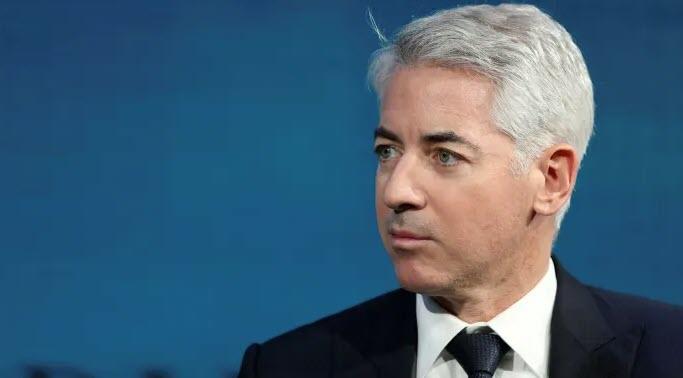
Having made many headlines earlier in the year with his rightly apocalyptic perspective on the pandemic, billionaire hedge fund manager Bill Ackman pocketed a tidy $2.6 billion in profits on a massive (credit) hedge he placed amid stock market complacency ahead of its March collapse.
On March 23rd, we completed the exit of our hedges generating proceeds of $2.6 billion for the Pershing Square funds ($2.1 billion for PSH), compared with premiums paid and commissions totaling $27 million, which offset the mark-to-market losses in our equity portfolio. Our hedges were in the form of purchases of credit protection on various global investment grade and high yield credit indices. Because we were able to purchase these instruments at near-all-time tight levels of credit spreads, the risk of loss from this investment was minimal at the time of purchase.
Well, the founder of hedge fund Pershing Square Holdings is at it again, telling The FT that he has put on another massive credit hedge against his long stock book where he sees complacency.
Pershing is up 44% year-to-date, so who can blame him for protecting some of that gain, but what appears to have catalyzed the action is a combination of the vaccine news (which he sees as bearish), the complacency of stocks (seemingly ignoring all possible risks), and the cheapness of the hedge.
The vaccine news "is actually bearish for the market because it will make the whole thing seem less of a threat, people will taker mask-wearing less seriously, and more people will die in the next few months than in the previous period."
"We're in a pretty treacherous time generally," the hedge fund manager warned, "and what's fascinating is that the same hedge we put on 8 months ago [which was extremely profitable] is available on the same, if not better, terms now... as if there had never been a 'fire' and that everything's going to be fine...""At 49bps, the market is saying the world is incredibly safe and everything that is expected to go right will go right..."
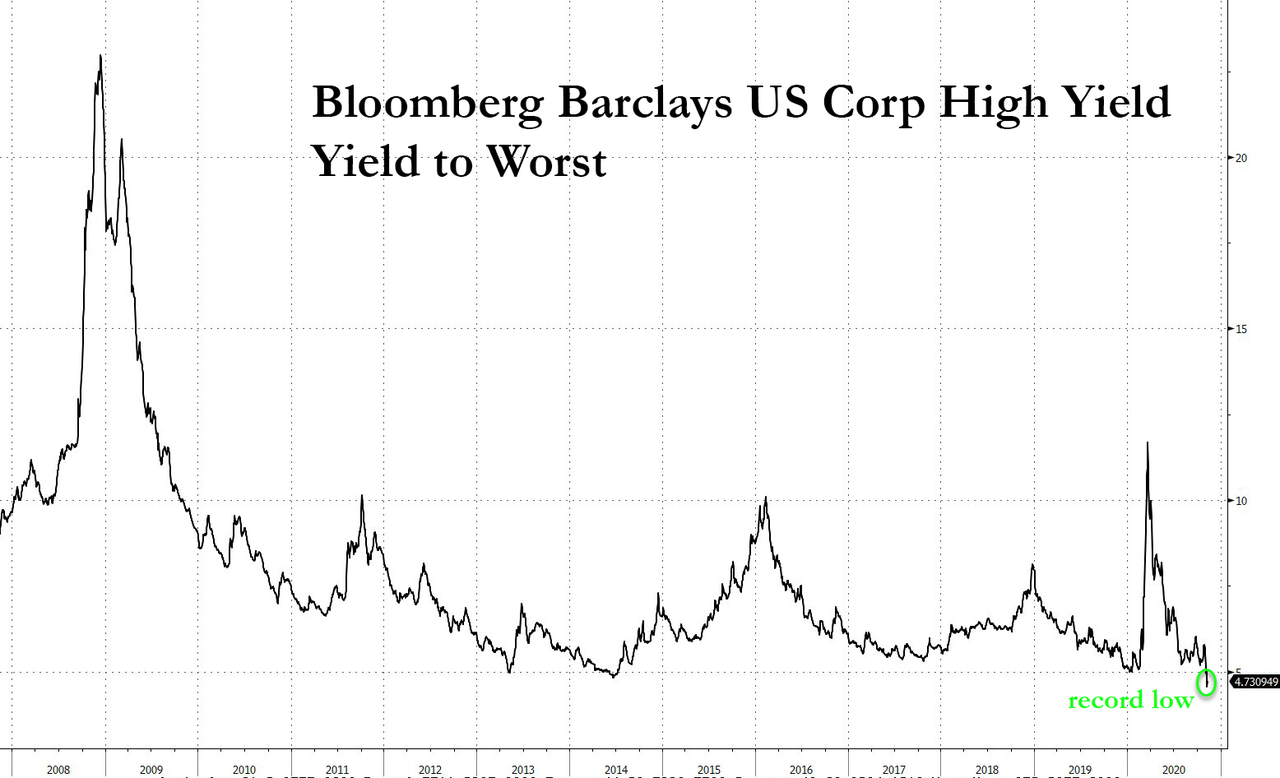
Indeed, US HY debt risk premia are now at record lows...
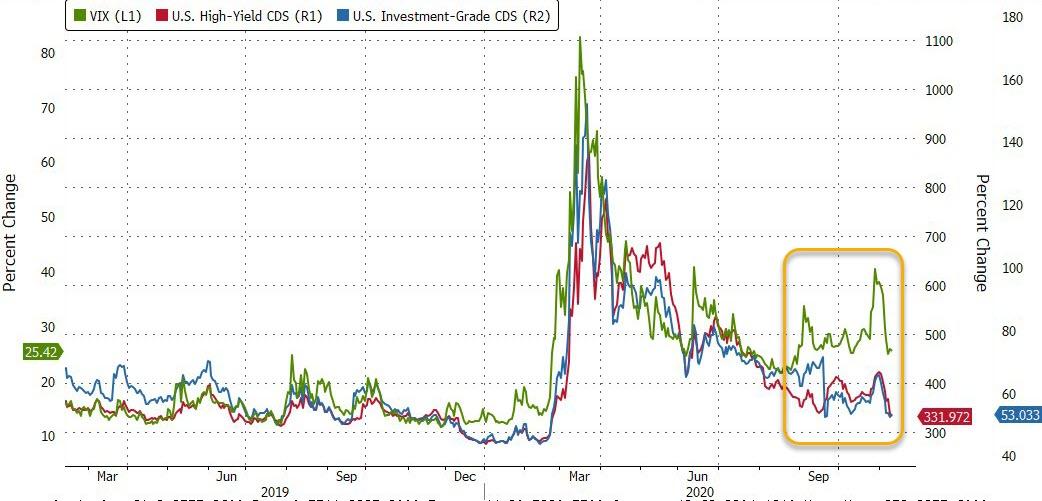
And the cost of credit protection is dramatically cheaper than equity protection...
Ackman said the new hedge is close to 30% the size of the bet he placed in late February, when he bought a set of huge insurance policies linked to $71bn of corporate debt.
Despite commenting that "it's going to be a depressing, challenging time," Ackman does offer some silver lining in that he notes "this is different from the hedge we put on in February when we thought it was a near certainty that things would get really, really ugly." This time, he is apparently more optimistic and still long stocks, adding that "I hope we lose money on this latest hedge."
We suspect that last sentence is not entirely true, especially given his comments on the asymmetric nature of the hedge payoff if the future doesn't turn out in the panglossian manner it is priced for.
Makor Group Continues Its Growth, Enters Into Strategic Alliance With Churchill Capital
NEW YORK, Nov. 11, 2020 /PRNewswire/ -- Makor Group "Makor" (www.makor-capital.com), an international agency brokerage group trading all asset classes, is excited to announce it has entered into a strategic alliance with Churchill Capital (www.churchillcap.com), a global firm specialized in trading and advisory services, as Makor continues its international growth.
Over the past few years, Makor has showcased rapid and successful growth on the global level increasing its product range, geographic and regulatory reach, as well as its proprietary development of FinTech solutions. This long-term strategic alliance marks the continued trend for Makor's ongoing expansion in expertise and global market presence, taking the firm's award-winning risk arb profile to the next level.
With the present addition of Churchill Capital's experienced team of equity analysts, traders and salespeople spread over its European, Asia-Pacific and North American locations to Makor Group's team of top professionals in the field, this strategic alliance empowers Makor to substantially expand its stellar reputation and share of the merger arbitrage market.
In addition to strengthening Makor's European and US influence, this alliance gives the firm greater exposure to Asian markets through Churchill's global networks and presence in Melbourne and Singapore, while benefiting both parties involved with operational efficiency for a better service delivery to their clients worldwide.
"We are very pleased to be joining forces with the team at Churchill," said Michael Halimi, Co-Founder of Makor Group. "In these historical times, achieving a strong performance in our new reality requires more than a rapid crisis response. Winning the future is a marathon and requires the combination of proactive management and dynamic action for sustained growth. For that reason, we continue to look for more acquisition opportunities."
"We are very proud of what we have built over the past 20 years. Churchill Capital was one of the first (and still few) independent brokerage firms to service institutional clients on a global scale, spanning 3 major regions worldwide. Today, we are excited to continue providing innovative ideas and products to our clients, while protecting client interests and privacy in our trading and execution," said Patrick Churchill, Co-Founder of Churchill Capital.
Justin Hilbert, Co-Founder Churchill Capital, added: "We look forward to growing our business with Makor's team, while maintaining Churchill Capital's unique DNA, which has served us and our clients since 2000. Though part of a larger team, we will be retaining independence in our products and services. Importantly, the synergy brought by this alliance between Churchill Capital and Makor's team members will allow us to expand our expertise and provide a stronger service to our valued clients worldwide."
Notes to editors:
About Makor Group (www.makor-capital.com)
Makor Group is an FCA-regulated international brokerage firm established in March 2011 by Michael Halimi and Avi Bouhadana, former Co-Heads of Global Equities at Cantor Fitzgerald Europe. Makor provides securities research and execution services to institutional investors across all asset classes.
With offices in New York, Chicago, London, Paris, Geneva, Gibraltar, Tel Aviv and Singapore, and over 150 group employees, Makor provides its clients with an around-the-clock single point of contact. Makor's reputation for original and innovative trading ideas in risk arbitrage, special situations, relative value, and event-driven opportunities is unparalleled. The firm has been widely recognized for its achievements, and for the past 4 years was ranked 1st in the Thomson Reuters EXTEL risk-arb research surveys.
Makor acts as agent-only and is therefore not susceptible to common industry conflicts of interest. The firm takes no proprietary positions and as such acts exclusively in the interests of its clients. Makor's understanding of local markets, and extensive global relationships, generate unique sources of liquidity for a diverse client base across all asset classes.
In addition to strong client relationships, Makor is a trusted partner for global custodians and prime brokers, understanding that both are integral to the smooth and effective execution of all client transactions. A focus on supporting prime brokerage services, including custody and trade settlement, has been essential to the growth and success of the Makor franchise.