Business of Fashion : Can Fashion Finally Crack the ‘Last Mile’?

Can Fashion Finally Crack the ‘Last Mile’?
Getting products to customers’ front doors has always been the most complex and expensive part of e-commerce logistics. Covid-19 and the ensuing boom in online sales have only upped the stakes.

LONDON, United Kingdom — For years, the “last mile” of the delivery process has been a pain point for fashion retailers who often struggle with the final link in the logistics chain needed to transport parcels from warehouses to customers’ front doors.

“You’re taking the part of the value chain that consumers used to absorb, which is getting in their car and driving somewhere and getting it off the shelf, and you’re transferring it to the retailer,” said Sucharita Kodali, principal analyst and e-commerce expert at Forrester. “The retailer has to absorb that expense or ask the customer to pay for it. That’s the reason last mile is something you have to consider very carefully.”

Not only does the last mile account for almost 50 percent of the total cost of delivery in terms of time and labour, it is also disproportionately costly in terms of its environmental impact. Adding to the pressure felt by retailers and their logistics providers to improve this leg of the journey are the growing expectations that consumers now have for next day delivery — or even speedier options — that they are less willing to pay for.

The stakes have only gotten higher as e-commerce became the only available shopping channel in the wake of Covid-19 lockdowns across the world. Global online sales were up 71 percent year-on-year during the second quarter, Salesforce data revealed. Now, with the holiday season right around the corner, logistics providers are feeling the heat.

Demand is not going to let up and this is going to be a very very challenging fourth quarter.

“This has been the year of all years when it comes to fashion and e-commerce,” said Brian Bourke, chief growth officer of Seko Logistics. “[Demand is] not going to let up and this is going to be a very very challenging fourth quarter. Whether it’s the US or Europe, there’s just not enough capacity.”

For retailers who have been investing long term in the streamlining of their last mile process, it has begun to pay off. Others are now having to play catch up or find creative ways of delivering merchandise to their growing consumer base.

As a new wave of lockdowns begin to bite across Europe and other markets, retailers ahead of the last mile curve will not only be well positioned to make the most of the current e-commerce boom, they’ll be primed to retain customers and adapt their operations for the long term as experts anticipate that many of the online shopping habits people picked up in 2020 will stick.

Going In-House

When Global Fashion Group (GFG) began looking for logistics partners for its e-commerce platforms in emerging markets and regions like Russia, Latin America and Southeast Asia years ago, CEO Christoph Barchewitz wasn’t spoilt for choice. In most places, there wasn’t a frontrunner when it came to last mile or returns, Barchewitz said. Instead, he set up operations locally and built those systems in-house.


Inside a Zalora warehouse | Source: Global Fashion Group

In Russia, where 80 percent of GFG-owned Lamoda’s deliveries are managed by its own delivery arm, the group set up a concierge shopping service: shoppers can try on their orders, immediately return items to the delivery employee waiting outside their doors and pay for what they want to keep. The move helped streamline its returns process: at the point of sale, the business often knows what is being returned to its fulfilment centre and can arrange to resell it. Retailers including Net-a-Porter and start-ups like Toshi and Harper Concierge have also launched concierge delivery services in their respective markets.

In Latin America, GFG-owned Dafiti operates its own biker fleet to beat the traffic in some of the world’s most congested cities across Brazil, Argentina, Colombia and Chile. Other e-tailers are also going down the in-house route: In Southeast Asia, Alibaba-owned Lazada’s fulfilment centres span over 300,000 square meters of land, more than 15 sortation centres and almost 400 first-mile pick-up and last-mile delivery hubs.

Last mile hurdles are even more complex in markets like Nigeria where players like pan-African e-commerce giant Jumia have been growing fast. “We didn't have the luxury of having big established logistics players that could reach every part of the country who were also willing to take cash on delivery,” said Jumia Nigeria Chairwoman Juliet Anammah. This meant Jumia had to build its own network of third-party logistics providers, allowing them to leverage data harvested to improve merchandising and other aspects of the business.

While going in-house can be very costly in the short-term, it can give retailers control over customer interactions, capacity planning and operational processes, driving efficiency and growth amid the pandemic. GFG operates ten fulfilment centres (in comparison, Asos operates three globally) and was better equipped to tailor responses for each of its markets. This last mile focus is one of the reasons Barchewitz believes the group has managed to grow 30 percent or more every month for the past six months.

The New Omnichannel

As online orders continue to soar, local physical delivery nodes — whether a partner’s or an e-tailer’s own— will become an increasingly important part of the logistics network, said retail futurist Doug Stephens.

Allowing consumers to pick up their items from parcel lockers and other touchpoints has long been a cost-efficient solution to last-mile conundrums for the likes of Amazon and Uniqlo, which in addition to in-store pick-ups has a years-long partnership with 7-11. Where Covid-19 has accelerated e-commerce penetration in emerging markets (places many shoppers are not only new to online shopping but do not own credit cards and poor road networks in fast growing cities can often lead to delays), drop-off points have become even more ubiquitous.

We’ve delivered to more parcel lockers in the past six months than we did any time before that.

In India, over 10 million kiranas (independent “mom and pop” general stores) are being tapped by e-commerce players like Geomart for fulfilment. In Indonesia, startup Kiosan found success by linking up warungs (roadside kiosks, and with them shoppers without credit cards) with major e-tailers like Tokopedia. Last year, Amazon inked a deal with Mexican convenience store operator Oxxo, adding over 20,000 mini delivery depots to the retail giant’s arsenal.

“We’ve delivered to more parcel lockers in the past six months than we did any time before that,” said Seko Logistics’ Bourke. Retailers with brick-and-mortar presences in markets like the US and Europe already have the space to position pick-up points. These stores may have been repurposed as logistics hubs during lockdown, a move Forrester’s Kodali said may have supported retailers in the short term, but makes less sense for brands with well-positioned stores in cities that are reopening.

Ultimately, using pick-up points comes at a cost for consumers and need to be chosen over regular delivery — which as countries like the UK re-enter lockdown, remains the most convenient option. But for businesses that can get shoppers to opt in, they’re a gamechanger. “Parcel lockers [are] changing the retail landscape overnight,” Bourke added, estimating that brands can save anywhere between $5 to $20, or even more, per delivery by opting for them over traditional doorstep delivery.


Shoppers can pick up their parcels at Uniqlo stores | Source: Shutterstock

In addition to its at-home concierge service, Lamoda currently operates 400 pick-up points in Russia (where customers can try on their orders and immediately return pieces they don’t want to keep). Barchewitz agreed that the savings are substantial. “We’re probably saving 10 to 20 percent on delivery when customers use pick up points,” he said.

Long Haul Solutions

When asked if GFG had cracked the last mile, Barchewitz replied that he had two obstacles to overcome: returns, which remain a major challenge in markets like Latin America, and keeping up with rising customer expectations, which show no signs of stopping.

Indeed, where consumers’ new e-commerce habits are expected to outlast Covid-19 and a significant number of them appear to be moving out of major metropoles like New York, even Amazon isn’t fully prepared. “It’s going to require a new level of infrastructure they don’t have,” said Stephens, pointing to the retail giant’s announcement of its plans to build around 1,500 micro-fulfilment centres across the US in the coming years to better reach customers in the suburbs. On November 2, media outlet The Information reported that the company is plotting to expand its last-mile distribution network in rural areas across the US, addresses previously handled by the US Postal Service.

Amazon’s investments into autonomous car makers Zoox and Aurora could also be a signal of what’s to come. By taking out the human cost of paying some delivery employees, this would have major implications. “If they’re able to pull off [autonomous delivery,] it’s going to open a completely new chapter in this space race,” Stephens added. In China, JD.com is already planning to deploy 100 autonomous delivery vans on public roads by the end of 2020.

However, automated delivery remains a long-term goal in the West. “There’s a much longer path to develop the right technology that accommodates the complexities of last mile delivery, including delivering and driving big vehicles down residential streets,” said Bourke. “Algorithms aren’t quite up there yet.”

Bourke added that drones could prove an exception for deliveries to rural areas. Indeed, the aerial vehicles have proven a buzzy topic for years, but legal and safety issues have tempered trials and deployment beyond markets like China, where JD.com began testing and using drones commercially since 2015. Beyond China, experts report that the technology will likely focus on getting products like medical supplies to far-flung locations as a first step.

Beyond its financial costs, last mile delivery is also environmentally costly but industry figures so far have markedly different views on how to address the issue. Barchewitz is working on encouraging customers to choose a slower delivery process, while Bourke believes that post-pandemic, shoppers will be more responsive to calls for action, including at checkout, where he forecasts that being offered carbon offset options will become the norm. Many, however, will take convincing. “The issue is that there’s so much greenwashing,” said Kodali. “We’re going to be very sceptical of it.”

For a glimpse of what the future of last mile delivery will look like, Stephens pointed to JD.com, which now serves upwards of 90 percent of the China market with same day delivery. According to Stephens, JD.com utilises data science to determine, based on the total number of clicks on a product, what customers will order before they have done so — meaning the e-tailer can pre-emptively send a number of SKUs to its warehouse before orders have even been placed.

This anticipatory technology has yet to arrive in most western markets, but retailers are racing towards it. “In the interim, we’ll see creative solutions cobbled together with alliance partners, acquisition partners,” said Stephens. “We’re really going to see a tough push for technology.”
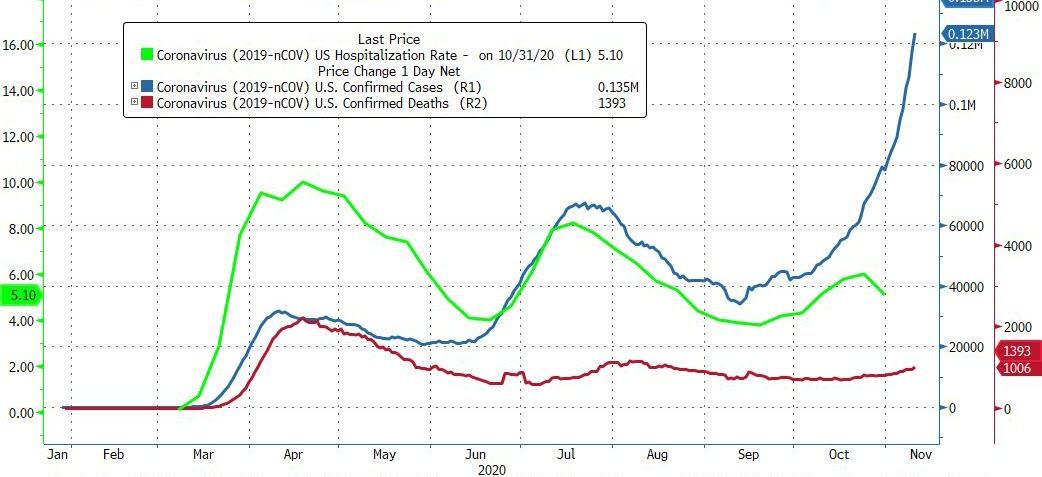
(ZH) Goldman Spots An "Early Indicator" US Economy Is Rolling Over Due To Covid

Goldman Spots An "Early Indicator" US Economy Is Rolling Over Due To Covid Resurgence

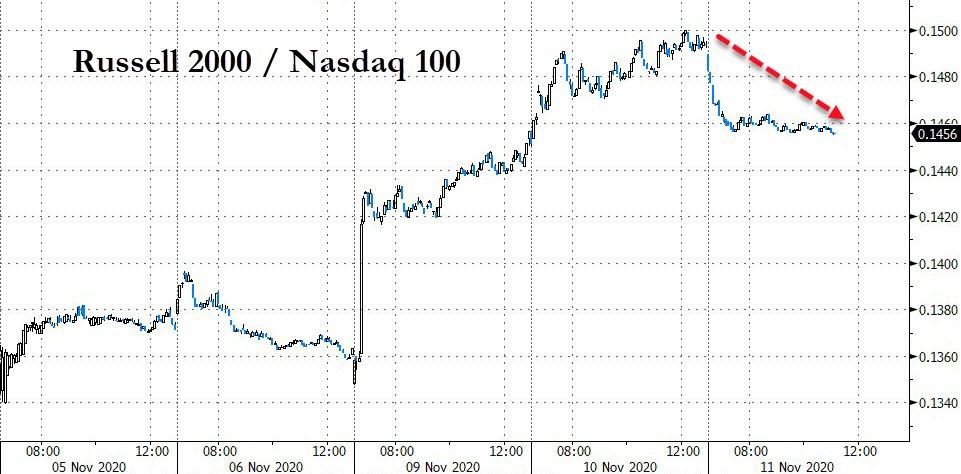
One day after a historic resurgence in value/growth/reflation stocks on the back of optimism the Pfizer vaccine could lead to a quick end to the covid pandemic, the reflation rotation appears to be rolling over with the Nasdaq surging even as the Dow and small caps are again rolling over.
While there has not been any one clear catalyst for the fizzle of the value rally, some have cited the realization that a Pfizer vaccine would take a long time to be disseminated and taken by a majority of the population. Another, more likely reason, is the concurrent realization that before we get to the hopeful 2021 we still have to get through the dismal winter and spring quarters. As a reminder, just yesterday Dallas Fed president Robert Kaplan said that while the U.S. economy is likely to have a strong recovery from the pandemic-induced slump in the second half of the 2021 though the resurgence of Covid-19 jeopardizes the next two quarters.
“We have a couple of very difficult quarters in front of us," Kaplan said Tuesday in a virtual interview at Bloomberg’s Future of Finance 2020 event. Citing business contacts, Kaplan said, "Over the horizon, the future looks bright and we’ll have a strong year next year but we have got to get through the next couple of quarters."

Then, moments ago, Goldman's economic team also published a note according to which while "consumer spending and continuing jobless claims have responded much less strongly to virus spread recently compared to the summer wave", real-time data from OpenTable through early November "show a significantly larger decline in indoor dining activity in states with higher case growth, suggesting that virus-sensitive industries could be showing early signs of a growing virus hit."
* * *
First, the good news. As Goldman's David Choi writes, overall consumer activity has held up remarkably well thus far, with high-frequency indicators of consumer spending suggesting continued recovery through October.
Yet in light of the recent virus resurgence across the US, Goldman also finds there has been a larger impact on economic activity in harder-hit states, "which could foreshadow a slowdown inoverall activity with a further rise in active cases and hospitalizations likely to come."

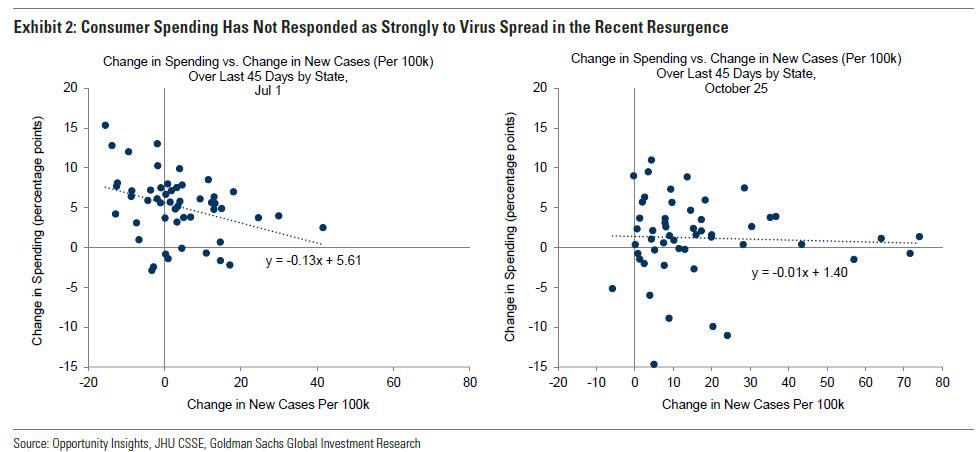
The bank first looked at state-level consumer spending data from Opportunity Insights through late October, where it had previously found that during the summer virus resurgence, overall consumer activity decelerated and states with more virus spread had correspondingly lower consumer spending growth. However, it finds a much smaller response of consumer spending to statewide virus spread in the recent resurgence, as shown in the chart below.
This finding holds across a wide range of specifications, such as using either the level or the change in new cases per capita, looking at the change in new cases across different time horizons, using deaths and hospitalizations instead of cases, and also controlling for state and time fixed effects in a panel regression.
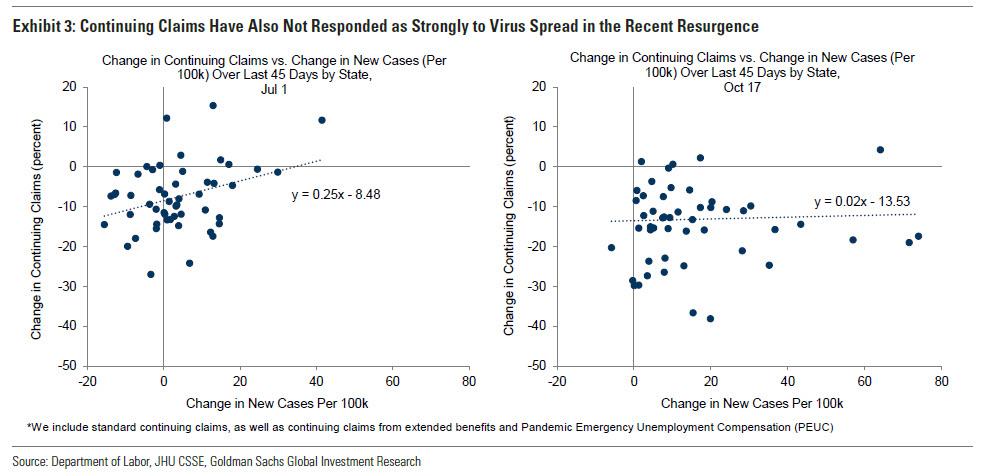
Goldman then looked to see whether the virus resurgence has had a large impact on employment, looking at changes in continuing jobless claims at the state level. As with consumer spending, here too the finding was a much smaller virus impact on continuing claims in the recent resurgence, with more virus spread associated with a slower decline in continuing claims in the summer, but essentially no statistical relationship so far in the recent resurgence through mid-October. This finding again holds across a wide range of specifications, including looking at changes in initial jobless claims instead of continuing claims.
What could explain the smaller virus impact on consumer spending and employment during the recent resurgence, despite the worse overall spread?
One partial explanation offered by the bank is that state and local governments have imposed limited virus-related restrictions so far, compared to the summer when many of the hardest-hit states imposed restrictions such as closing bars, restricting indoor dining, and limiting gatherings, with a pause or reversal in reopening in the vast majority of the country.
This, however, may soon change, with an increasing number of states and regions recently imposing or considering new restrictions, such as New Jersey and New York, both of which have capped outdoor dining to 10pm. While the data also suggest that voluntary consumer behavior has responded less strongly to increased virus risks during the recent resurgence, "this could change should perceived risks increase as case counts, hospitalizations, and fatalities rise" according to Goldman.
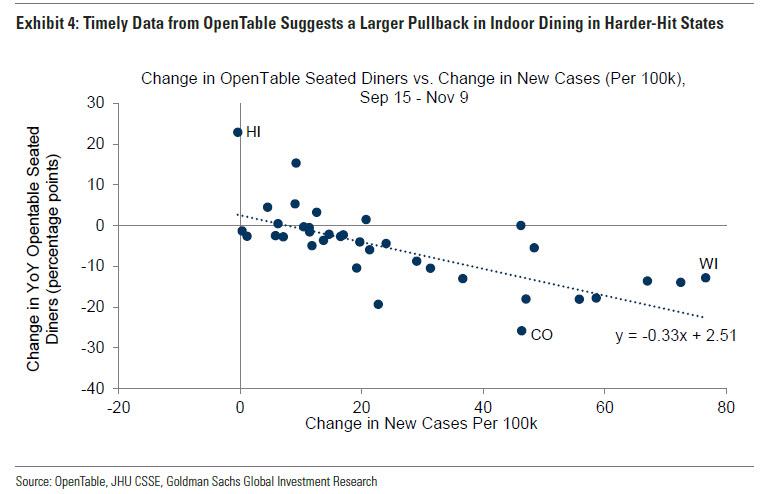
Confirming this assumption, Goldman then looks at indoor dining activity using data from OpenTable — which includes data through November 9, and thus also captures the acceleration in cases over the last several weeks — where one can already see signs of virus spread weighing on higher-risk activities, with a one standard deviation increase in new case growth associated with a 4 percentage point decline in year-over-year restaurant visits.
According to the bank's economists, while indoor dining may represent only a small share of overall consumer spending, it is a particularly useful indicator because its high virus-sensitivity means it will likely be one of the first sectors to show an impact from the virus. In other words, "OpenTable data could thus provide an early indication of growing risks to broader categories of services spending, especially given its timeliness."

Taken together, Goldman's analysis suggests a relatively limited impact of the deteriorating virus situation on economic activity so far, with the bank continuing to expect a smaller consumer spending and employment drag for a given amount of virus spread than in the summer months. However, the virus resurgence is still in early stages, and economists expect "significantly worse overall virus spread than the summer given the already higher case counts," and the correlation between colder weather and worse virus spread over the last few months.
In short, if indoor dining is a harbinger of what's to come, the US economy may be about to slide into a sharp double dip contraction, one which would explain the renewed weakness in value names and the gradual unwind of the reflation trade.

FT : GardaWorld clears competition hurdles in hostile bid for G4S

GardaWorld clears competition hurdles in hostile bid for G4S
Canadian group says there will be no regulatory investigations in US and Canada

GardaWorld has cleared competition hurdles in the US and Canada in its £3bn hostile takeover bid of UK security company G4S as it steps up attempts to persuade shareholders to back its offer.

The Montreal-based security group said there would be no further investigation of its 190p bid by the Federal Trade Commission and Department of Justice after regulatory deadlines had passed.

Stephan Crétier, founder and chief executive of GardaWorld, said the company was pleased to “have cleared North American antitrust reviews swiftly and without conditions” in its acrimonious battle for its UK rival, the world’s largest security group.

But he said any offer from Allied Universal, which has made a higher, tentative 210p-a-share offer, would raise competition issues because it would give the combined entity a 70 per cent share of US security contracts.

“We believe the antitrust challenges faced by an Allied/G4S combination will delay shareholders realising value if at all.”

Allied Universal, a US security group backed by Canadian pension fund Caisse de Dépôt et Placement du Québec and Warburg Pincus, declined to comment.

However, GardaWorld still has to convince G4S investors to support its offer after just 0.16 per cent of the UK’s group’s shareholders voted to accept its bid, a level the British company described as “derisory”.

The Canadian group, which is backed by private equity firm BC Partners, extended its offer period by three weeks from Sunday.

The Allied Universal bid has also been rejected by the UK security group, but the company has until December 9 to come back with a higher offer.

Mr Crétier added: “We cannot believe that Allied’s major shareholder, Caisse de Dépôt et Placement du Québec, would back a deal to buy a business blacklisted by other ESG-focused investors and accused of human rights violations and assisting the Taliban.” 

CDPQ said it was “surprised” by the comments as GardaWorld had approached it to help fund its bid for G4S in the summer. It said its board had agreed a $1bn deal but GardaWorld had then changed its mind. 

“There is something fundamentally inconsistent in Garda’s hostile and aggressive approach in the public sphere,” CDPQ said. “One day it wants to acquire G4S and the next it is criticising the ESG aspects of the company it wants to buy.”

Allied Universal employs 200,000 staff in the US, Mexico and Canada. It is the largest player in the $25.1bn US market, with a 33 per cent share, followed by Securitas at 18 per cent, G4S at 9 per cent and GardaWorld at 2 per cent, according to industry figures. The rest of the market is highly localised and fragmented.

Any market share above 35 per cent is viewed to be significant and to attract the attention of regulatory authorities in the US, advisers to GardaWorld said.

The latest moves follow weeks of bitter accusations between GardaWorld and G4S after the Montreal-based company first made its formal bid for the UK security company, which has annual revenues of £7bn and employs 530,000 people in 80 countries.

GardaWorld added that a deal with Allied would result in “higher prices for customers and poorer pay and conditions for employees”, as well as costing “millions of pounds in fees and delay payments to shareholders for six to nine months”.

However, offer documents from GardaWorld reveal that advisers to the company, including UBS and Barclays, stand to make £312m in fees if they are successful in clinching shareholder support for their hostile takeover.

GardaWorld has 102,000 staff and £2.1bn in revenue. It has been on a dealmaking spree, adding nine businesses in the year to January 2020.

FT : UK takes aim at China with revamp of takeover rules

UK takes aim at China with revamp of takeover rules
Boris Johnson wants greater powers to block deals on national security grounds

Former chancellor George Osborne in 2015 promised a “golden decade” of business relations between China and the UK, but that pledge was effectively ditched by prime minister Boris Johnson on Wednesday.

The government published legislation giving ministers sweeping new powers to block overseas companies from buying UK businesses on national security grounds, in a move that appeared squarely aimed at Beijing.

Lord Patten, former governor of Hong Kong and a leading China hawk, welcomed the government’s “sensible” national security and investment bill that outlines the biggest overhaul of UK takeover rules in almost 20 years.

“It’s important to stop the sort of predatory buying up of important security interests in the UK by China or anyone else,” said Lord Patten. “China is not a country which you want to contain but a country that you want to constrain.”

The detente Mr Osborne unleashed between London and Beijing has dissipated over several years: it was former prime minister Theresa May who in 2017 began the policymaking that paved the way for Mr Johnson’s overhaul of takeover rules.

Relations deteriorated further this year when UK ministers blocked an investor linked to China from taking control of the board of British chip designer Imagination Technologies. Mr Johnson also executed a major U-turn to ban Chinese telecoms equipment maker Huawei from supplying kit for the UK’s 5G mobile phone networks.

“The open, liberal common investor approach made sense up to 2012,” said Alex White, partner at Flint Global, a consulting firm. “Xi Jinping is the big change. It took time for people to realise that China was going to take a more aggressive approach.”

The shake-up of Britain’s takeover regime is consistent with changes introduced by western allies including partners in the Five Eyes network: the US, Australia, Canada and New Zealand.

Michele Davis, a partner at law firm Freshfields, said the UK was “late to the party”. “The UK regime has been a real outlier compared to what anyone else has been doing over the years,” she added.

Over the past decade, China has been busy acquiring British businesses, leading some bankers to warn that the UK’s new takeover rules might come too late in some strategic areas.

Jingye owns British Steel, while China Investment Corporation has taken stakes in Heathrow, National Grid and Thames Water. Other Beijing-backed bodies own large parts of UK North Sea oil production, and a stake in Hinkley Point C, a nuclear power plant under construction in south-west England.

Alok Sharma, business secretary, said he wanted to keep the UK “one of the most attractive investment destinations in the world” while also “shutting out those who could threaten our national security”.

Former business secretary Greg Clark, who worked with Mrs May on an early version of the revamped takeover rules, said investors should be reassured that the measures were not “draconian”. “The government has been meticulous in getting this right,” he added.

A Beijing foreign ministry spokesperson said the Chinese government expected countries to provide a “level playing field” for its companies, which would abide by host-nation laws when operating overseas.

“It’s not a friendly gesture but it’s also not an obvious provocation,” said Ding Chun, a European affairs expert at Fudan University in Shanghai, referring to the proposed new UK takeover regime.

However, any specific application of the revamped rules in a way that Chinese officials feel is discriminatory could prompt a backlash. After a rapid deterioration in relations between Beijing and Canberra this year, many Australian exporters have recently run up against a range of obstacles.

Under the UK plans, prospective overseas buyers of British companies, shareholdings or intellectual property in 17 sensitive industries will be required to alert a new government unit about the transactions.

British officials expect between about 1,000 and 1,800 transactions to be notified to the unit every year. Out of those, officials expect 70 to 100 to face “national security assessments”, with only a limited number being blocked or subjected to “remedies”.

That is a vastly more intrusive takeover regime than the current one, under which ministers only tend to intervene in acquisitions of UK companies with annual turnover of more than £70m, or where the merged business would have a market share of more than 25 per cent.

British officials acknowledged the cost of complying with the new regime could be as high as £330,000 for a single transaction involving a large company. A regulatory impact document published by the government suggested a total cost to businesses of about £40m a year.

Experts said the revamped takeover rules would raise questions about the UK’s hitherto open approach to inward investment, and those concerns are particularly acute given Britain is about to leave the EU single market at the end of December.

In dollar terms, the UK has the world’s second-largest stock of foreign direct investment after the US. Since 2007, and relative to gross domestic product, the UK’s FDI stock doubled to 73.6 per cent in 2019, with the US being the main acquirer of British companies.

However, the coronavirus pandemic has resulted in a sharp decline in all components of FDI. So far this year, there were 462 deals involving overseas companies buying UK businesses: 28 per cent fewer than in the same period in 2019.

“Post Brexit it is even more critical that we have to be open to trade and inward investment,” said Mike Rake, a City of London grandee who sits on the British board of Huawei and is chair of the International Chamber of Commerce’s UK arm.

“There will be countries whose political system or policies we don’t agree with but that doesn’t necessarily mean we don’t trade with them.”

Some business leaders complained of “mixed messages” from the government, noting how the new takeover regime came 48 hours after ministers launched a new office to woo inward investment.

But for Lord Patten, the revamped takeover rules are entirely logical. “If you tried to buy an artificial intelligence firm in China do you think you’d be allowed so? Certainly not,” he said.

FT : Investors target French companies over lack of women in top jobs

Investors target French companies over lack of women in top jobs
Group of asset managers calls on 120 biggest businesses to make 30% of executive management teams female by 2025

Amundi, Axa Investment Managers and four other asset managers have joined forces to demand that big public companies in France appoint more women to executive jobs.

The group is calling on companies in the SBF 120, the index of the country’s 120 biggest companies, to hit a target that at least 30 per cent of their executive management teams are female by 2025.

It warned that if companies did not make enough progress, the asset managers could use their votes at annual meetings to punish them.

Although there are few in top jobs, women have made some progress in corporate France in the past decade. According to research firm Ethics & Boards, women made up 20.9 per cent of management ranks in companies in the CAC 40 — the 40 largest companies in the SBF 120 — in January 2020, compared with 7.3 per cent in 2009.

There is currently only one female chief executive in the CAC 40, Catherine MacGregor at energy group Engie, though cosmetics maker L'Oréal recently named Barbara Lavernos as its first female deputy CEO, a post that has traditionally led to that of chief executive.

Axa IM’s own executive team is 38 per cent female. At Amundi, the figure is 28 per cent.

The 30% Club France Investor Group is part of the 30% Club, which over the past decade has been a vocal advocate for the need to improve the gender balance in business.

The French group, which also includes La Banque Postale Asset Management, Sycomore Asset Management and two firms affiliated with Natixis Investment Managers, Mirova and Ostrum Asset Management, said: “As investors, we want to encourage the sustainable growth of the companies in which we invest, and we are convinced that this can come from a better representation of women in executive management teams.”

Marie Fromaget, co-chair of the group and an analyst at Axa IM, said that despite the introduction of a 40 per cent quota for women on boards in France in 2017, the number of women in executive roles remained disappointingly low.

“We want to have a discussion with companies about the diversity pipeline to the top, to really break the glass ceiling and allow women to get to the top naturally,” she said, adding that the 30 per cent target was “a minimum and not a ceiling”.

The asset managers, which between them have about €3tn under management, want French businesses to set goals to improve the number of women in top jobs and implement plans to achieve this.

Investors have become more outspoken about the need for diversity in companies in recent years, in response to research that suggests diverse businesses are better performing.

Ann Cairns, global chair of the 30% Club and executive vice-chair of Mastercard, said: “When companies are encouraged to prioritise diversity in their leadership, their financial results improve — something we see through the 30% Club time and time again.”

The 30% Club was founded in the UK in 2010 with the aim of increasing gender diversity on boards and in senior management teams. The first 30% Club Investor Group was launched in the UK in 2011 and focuses on co-ordinating the investment industry’s approach to diversity.

FT : ECB set to expand bond-buying and cheap loans, Lagarde signals

ECB set to expand bond-buying and cheap loans, Lagarde signals
Bank’s president says financing costs will remain ‘exceptionally favourable’ until economy recovers

Financing costs for governments, households and businesses in the eurozone will stay “exceptionally favourable” until the economy recovers from the pandemic, European Central Bank president Christine Lagarde has said.

The ECB will use its emergency bond-buying and ultra-cheap loans to banks as the main way of controlling financing costs, she told the ECB’s annual forum on central banking, which is being held online for the first time this year.

The ECB president welcomed the “encouraging” news of a potential Covid-19 vaccine breakthrough that fuelled a market rally this week, but said the second wave of the pandemic still presented “new challenges and risks” for the eurozone economy. 

“The key challenge for policymakers will be to bridge the gap until vaccination is well advanced and the recovery can build its own momentum,” Ms Lagarde said. “The ECB was there for the first wave and the ECB will be there for the second wave.”

After her comments the yield on Germany’s 10-year Bund dipped 2.5 basis points to minus 0.51 per cent. Bond yields fall as their prices rise.

The recent resurgence of coronavirus infections in many European countries and the partial lockdowns imposed as a result could have an even bigger impact on consumer and business confidence than in the first wave of the virus during the spring, she warned.

“Even if this second wave of the virus proves to be less intense than the first, it poses no less danger to the economy,” she said. “In particular, if the public no longer sees the pandemic as a one-off event, we could see more lasting changes in behaviour than during the first wave.” 

Last month, the ECB said it would carry out a “recalibration” of all its monetary policy instruments and announce the results next month — raising expectations that it will inject more stimulus to counter fears of a double-dip recession in the economy.

On Wednesday, Ms Lagarde sent the clearest signal yet that the central bank would expand its pandemic emergency purchase programme (PEPP), which has bought more than €640bn of bonds, and its targeted longer-term refinancing operations (TLTRO), which have lent almost €1.5tn to banks at rates as low as minus 1 per cent. Most analysts expect it to extend both until the end of next year, adding as much as €500bn to its €1.35tn bond-buying plan.

The ECB president said “all options are on the table”, but the PEPP and TLTRO had “proven their effectiveness in the current environment” and were “therefore likely to remain the main tools for adjusting our monetary policy”. That appears to rule out any further reduction in the ECB’s deposit rate, which is already at a record low of minus 0.5 per cent.

Stressing the importance of not only the level of financing costs, but also their duration, she said: “All sectors of the economy need to have confidence that financing conditions will remain exceptionally favourable for as long as needed, especially as the economic impact of the pandemic will now extend well into next year.”

“Demand weakness and economic slack are weighing on inflation, which is expected to remain in negative territory for longer than previously thought,” she added.

Some critics have argued that central banks and governments risk creating “zombie” companies by keeping unviable businesses alive. But Ms Lagarde said: “Concerns about ‘zombification’ or impeding creative destruction are misplaced, especially if a vaccine is now in sight.”

WSJ : OPEC Deepens Forecast for Drop in Global Oil Demand

OPEC Deepens Forecast for Drop in Global Oil Demand
Weakening U.S. consumption means demand will take a larger hit in 2020 than previously expected

Coronavirus lockdown measures in Europe and weakening consumption in the Americas will result in global oil demand taking a larger hit in 2020 than previously expected, the Organization of the Petroleum Exporting Countries said Wednesday.

In its closely-scrutinized monthly report, OPEC deepened its forecast for a drop in global oil demand in 2020 by 300,000 barrels a day to 9.8 million barrels a day, a 10% drop from last year’s levels. The cartel also softened its forecast rebound in demand for 2021 by 300,000 barrels a day.

Those cuts, when combined with the Vienna-based organization’s resilient non-OPEC supply forecasts and its cut to its 2021 global growth rebound forecast—now 4.4% from 4.5% previously—present a dismal outlook for oil markets in the coming months.

OPEC hedged its forecasts, saying that “further [economic] support, currently unaccounted for, may come from an effective and widely distributable vaccine as soon as the first half of 2021.”

Oil prices and equities have shot up this week in the wake of the news that Pfizer’s and BioNTech’s coronavirus vaccine was 90% effective in early tests. That has sparked hope among investors that economic activity will normalize in 2021.

Brent crude oil, the global benchmark, hit $45 a barrel on Wednesday for the first time since September, before later giving up some of its daily gains. West Texas Intermediate futures, the U.S. benchmark, were last up 2.8% at $42.25 a barrel, with American Petroleum Institute data late Tuesday showing sharper-than-expected drops in U.S. crude inventories, aiding crude’s rally.

The two benchmarks are up 18% and 19% respectively in November so far, while shares in BP PLC and ConocoPhillips have climbed more than 20% since Monday’s open.

Even so, the short-term outlook for the oil market remains gloomy. Fresh lockdown measures aimed at slowing the spread of the virus in Europe and rising oil supply present two challenges in 2020’s final quarter, according to Giovanni Staunovo, commodity analyst at UBS Wealth Management.

Torpid transportation demand and a slower-than-hoped economic recovery in the U.S. added to shutdowns in Europe, prompting OPEC to cut its demand forecast for the wealthy countries of the Organization for Economic Cooperation and Development by 500,000 barrels a day. Meanwhile, non-OECD countries such as China are recovering faster than expected, with OPEC increasing its demand forecast for those nations by 200,000 barrels a day.

Chinese crude imports in September rebounded to their third-highest level on record, beaten only by June and July this year, although that figure is expected to fall again in October with independent refiners having reached their quotas for the year, the report said. Growing production inside and outside of the cartel’s membership has given investors cause for concern in recent weeks. A combination of secondary sources used by OPEC put Libya’s production increase in October at 299,000 barrels a day after the country’s government negotiated an end to an eight-month-long blockade of its oil exports.

Libya’s national oil corporation has since said production has hit a million barrels a day and that the country won’t join production cuts until production is at 1.7 million barrels a day.

U.S. production is also increasing, with data on Friday from Baker Hughes showing an increase in active rigs for the seventh straight week.

Those factors had prices looking shaky early last week before The Wall Street Journal reported that OPEC was considering reversing or delaying its plans to further relax production curbs by 2 million barrels a day starting in January. Saudi energy minister Prince Abdulaziz bin Salman made similar remarks when speaking at a conference in Dubai earlier this week, according to reports.

OPEC members are likely to be closely watching further developments on any vaccines, as well as the current virus infection rates, as they weigh up their options ahead of their meeting with non-OPEC allies such as Russia in early December.

FT Lex Auto : The out of towners

The out of towners

New York City is an expensive place to live in. The rents, the taxes, the food and entertainment, they all add up. But New Yorkers, particularly in Manhattan, can typically save money on automobiles.

Between walking, biking, public transit, taxi use and rideshares most households have little need to keep a car. That avoids regularly shelling out for petrol, insurance and parking. On the occasion that a car is needed to leave the city, rental options make more sense.

The pandemic, as with so many things, has upended this conventional arrangement. Dyed-in-the- wool New Yorkers have, perhaps surprisingly, reached for cars as a way to escape the city at a time that they do not trust the subway or buses. Others have decided their getaways will be local rather than transcontinental or transatlantic.

Data from New York’s Metropolitan Transportation Authority show how toll collection, a proxy for auto traffic, has rebounded sharply in and around the city. Traffic jams have become more common recently. 

In the wake of a pandemic lockdown, automakers were forced to shut down production. But since Michigan assembly lines were reopened in May, the American auto industry has enjoyed a mini-boom. Cheap petrol and cash from government stimulus checks have Americans racing to auto dealerships, or even online, to bargain for a set of wheels and literally ride out the contagion.


The widely watched auto SAAR figure — annualised auto sales — remains slightly lower than its level from January. But after a collapse this spring, the recovery has been breathtaking. More importantly for Detroit, Americans are pumped up enough to buy gas-guzzling trucks and sport utility vehicles, all highly profitable models. General Motors chief executive Mary Barra said last week of its Chevrolet Silverado and GMC Sierra pick-up trucks: “We simply can’t build enough.”

Market share data, based on vehicle registrations, from IHS Markit show how “non-luxury traditional compact” cars fell out of favour just as “full-size half ton pick-ups” have filled the void.


Ford and GM have never been stock market darlings, even when auto sales boomed in the mid-2010s. Their bloated cost structures and economic cyclicality, along with the fear that eventually the global auto industry would have to shrink, kept Wall Street unenthusiastic. 

But there is always room for one high-flyer in any business. Shares of Carvana, which sells used cars online and even through vending machines, have more than doubled in value in the past year. Its market value exceeds $35bn, more than that of Ford or Fiat Chrysler. Used-car prices have rocketed in 2020 following the surge in consumer demand.


But even with all these new purchases moving on to the road, overall, Americans are still not venturing far. Data from the US Department of Transportation show that vehicle travel — measured in billions of miles — is still off sharply from 2019. Maybe Americans want the freedom to hit the open highway rather than the reality of travel at the moment.