Gapping up
In reaction to earnings/guidance:
- LI +29%, FTCH +13.2%, DKNG +9.7%, VIPS +7.8%, CSCO +7.2% (also new CFO), SPB +7.1%, DDS +6.5%, DIS +4% (beats handily, Disney+ paid subs totaled 73.7 mln), ADSK +3.2% (sees Q3 results above guidance; also CFO departs) DLB +3.1%, AMAT +2.9%, JAMF +2.8%, AQN +1.7%
Other news:
- UROV +92.9% (Sumitovant Biopharma to acquire rest of UROV it does not already own)
- IPHA +13.1% (receives Prime Designation from the EMA for Lacutamab)
- FPRX +4.8% (prices offering of 7.2 mln shares of common stock at $21.00 per share)
- BCRX +4.5% (presents data showing sustained attack rate reductions, improved patient satisfaction and quality of life for HAE patients taking Berotralstat in APeX-2 Trial ) KPTI +4% (announces publication of XPOVIO Phase 3 BOSTON study)
- NKTX +3.1% (treats first patient in first-in-human Phase 1 clinical trial of NKX101)
- CAMT +3.1% (receives over $20 million in orders for inspection & metrology systems from several manufacturers; orders are expected to be delivered during the first half of 2021)
- AGIO +2.2% (receives FDA orphan drug designation for mitapivat)
- BBIO +2% (BridgeBio Pharma and affiliate navire pharma announce dosing of first patient in phase 1 clinical trial of SHP2 inhibitor BBP-398 for tumors driven by RAS and receptor tyrosine kinase mutations)
- TAL +1.6% (investment firm to purchase $1.5 bln of newly issued Class A shares)
- ENB +1.5% (Line 3 replacement project receives MPCA approvals)
- ORTX +1.5% (discloses new research program in ALS; to unveil details on new HSC gene therapy research)
- CAR +1.3% (S&P ratings affirmed on improved liquidity; outlook negative)
- SYY +1.1% (eliminates minimum delivery size requirements)
Analyst comments:
- UTZ +3.3% (upgraded to Overweight from Neutral at Piper Sandler)
- DLR +2% (upgraded to Buy from Neutral at Citigroup)
- TDOC +1.6% (upgraded to Outperform from Neutral at Robert W. Baird)
Turkey Pleads For US To Rethink F-35 Program Suspension Before Biden Enters White House
Despite Turkey facing immense Washington pressures over its acquirement and recent successful testing of the S-400 anti-air defense system from Russia, including its prior suspended participation in the F-35 program, President Trump has stopped short of allowing sanctions which have been advocated by Congressional hawks.
Critics of the White House have said it's due to Trump's "special relationship" with Recep Tayyip Erdoğan; however, with Joe Biden expected to enter the White House in January, Ankara is on edge given Biden's past charged rhetoric on Turkey.
For this reason Turkey is once again urging the US to reconsider, as Reuters reports "Turkey is ready to discuss U.S. concerns about the technical compatibility of Russian S-400 defenses and U.S.-made F-35 jets, Defense Minister Hulusi Akar said Thursday, repeating Ankara's proposal for a joint working group with Washington on the issue."

The US position has long been that the Russian missiles and radar systems being utilized by NATO's second largest military could compromise US weapons technology secrets, especially related to the F-35 stealth fighter program.
Ankara now hopes for an opening and softening of the US stance before the presidential transition:
"We are ready to address the U.S. concerns over the compatibility of the S-400s and F-35s," Akar said."The safety of the F-35 technology is as important for Turkey as it is for the United States," he said, adding the joint working group proposal was still on the table.Akar said Ankara continued the preparations and tests of the S-400 systems, which he said "will be used the same way as the (Russian) S-300 system is used by some other members of the NATO alliance."
Recall too that Biden had previously slammed Erdogan as an "autocrat" and is widely expected to take a harder line on Turkey than Trump.



Turkey's strategy appears to have been to make the Russian systems transfer a "done deal" in hopes it could simply "fix" and negotiate its way out of the breach with Washington later.
Is This The End For Hedge Funds: Retail Investors Outperform "Smart Money" Ten-To-One
After a dismal decade for hedge funds, 2020 was the year that may have sealed the fate of the (former) masters of the universe who once upon a time collected 2 and 20 to hedge against crashes and to outperform the market but now merely collect tens of million in fees to come up creative excuses for sucking.
Case in point: at the start of the year, the so-called "smart money" was massively long the same handful of stocks, only to watch mortified as their portfolios exploded in March with hedge funds forgetting to actually "hedge", and getting swept away with the market carnage. Then just as everyone flipped short in late March, the Fed launched the most batshit insane rescue of capital markets, which included injecting trillions in liquidity every single day and even buying junk bonds. Needless the say, the market ripped just as the hedge fund crew was short, leading to even more losses. Then around September, when hedge funds were doing what they do best - all jumping into the same handful of stocks - the rug was pulled from under them as the Nasdaq tumbled, quickly accumulating even more losses, and then, just two months later, the last nail in the coffin was hammered when momentum stocks - a perennial darling of those who supposedly collect millions to conduct in depth and extensive fundamental analysis but merely copycat each other's trades - suffered a 15 sigma crash, obliterating what little alpha hedge funds had generated in 2020.
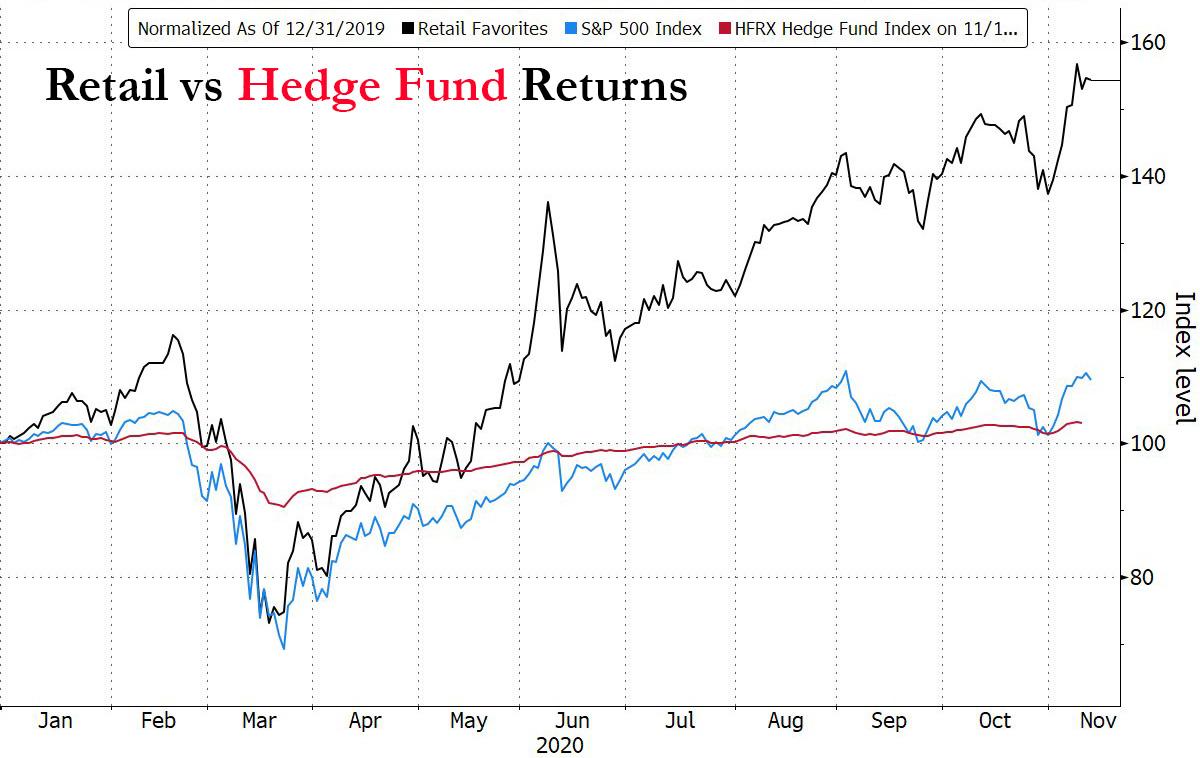
Unfortunately it wasn't much, because after all that, with the S&P managing to eek out a modest 10% return this year as the Fed threw everything at the market in hopes of propping it up and pushing it higher, the HFR hedge fund index is just barely above 0.
Yet not everyone is sucking this year. The winners? Those who clearly got to benefit from a market that long ago stopped making any sense thanks to the Fed flipping fundamentals on their head, and actively buying risk assets and who knows what else in the open market.
Yes, we are talking about retail investors who are having the time of their life: as shown in the chart below, while the S&P is up 10%, and the average hedge fund is barely in the green, a basket of 50 most popular stocks held by the retail investing community is up a whopping 55% YTD. This means that retail investors - some as young as 16 years old on Robinhood - are outperforming the best paid investors in the world ten to one!
And while retail investors may be delirious with their market profits this year, for hedge funds - especially those who are struggling to catch up to the S&P500 or worse, to turn green for the year - the drumbeat of death has never beat louder.
Why? Because in a year when volatility averaged well over 20, an amazing environment for professional traders, coupled with record wide dispersion between growth and value returns, hedge funds should be printing making money. Clearly, however, they are not and as Bloomberg reports, what few hedge fund clients remain are losing patience.
"This year separates the adults from the children," said Tim Ng, chief investment officer of Clearbrook Global Advisors, which invests in hedge funds. "If you are a fundamentally driven, bottoms-up securities manager across any asset class, this should have been the year when you did well. Everything you’ve wanted for years exists."
To be sure, there are the occasional winners, such as mega macro fund Brevan Howard Asset Management, tech-focused Coatue Management, and Boaz Weinstein's remarkable Saba Capital. But it is the losers such as Ray Dalio - who these days spends more time spewing trivial bullshit on twitter than investing - whose Bridgewater flagship fund fell 19% through Nov. 5, that are forcing investors to ask: If they couldn’t make money before and still can’t now, why keep them?
"It’s getting harder to have conviction in hedge funds," said Adam Taback, chief investment officer of Wells Fargo Private Wealth Management, another allocator. “Many have not protected enough on the downside and others haven’t provided enough upside.”
In short instead of hedging, "hedge funds" are doing precisely the opposite: they are losing money when stocks drop and barely making it when stocks surge. Then again, antihedge funds does not have quite that "fast-track to riches" sound to it, so we doubt it will be adopted.
"It’s survival of the fittest -a culling of the herd,” Ng said of the industry that counts more than 8,000 funds, and is about to be hit with a historic volley of redemption requests ahead of the new year.
Neil Datta, who runs the $10 billion multifamily office Forbes Family Trust, asks a question we have been asking since 2010: "Why pay 2-and-20 when they can’t produce returns when markets are volatile?" he said of the industry’s longtime fee standard, roughly 2% for management plus 20% of profits.
To this we would add what we first said in 2011: why pay any money manager when the Fed is now so deeply enmeshed with stocks, and so all-in risk assets, it has no choice but to step and bail out markets any time there is a modest correction.
And it does it for free, which is also why retail investors continue to blow out the "smart money."
Meanwhile, after complaining for a decade that either volatility or stock dispersion was too low, and that shorting was impossible in a market that only went up, hedge funds got just the environment they desired... and they imploded so spectacularly, when instead of single digit VIX, the "fear gauge" soared to Lehman levels. And a generation of millennial "traders" that had never seen a VIX above 20 was petrified, frozen for weeks, unsure what to do. Well, they won't have to worry much longer: soon they too will be out of a job.
That said, there is still some optimism for the hedge fund industry ahead, but it’s tempered: and hedge funds really need at least one year of outperforming the S&P unless they collectively throw in the towel on what has been the worst investment choice ever since this website triggered the expert network crackdown back in 2010.
"You should be moving back to a more security-selection-driven and less beta-driven environment,” said Taback, who expects the market tumult to persist. "It’s just hard because we all said the same thing last year and the year before that."
And while we wait (and wait, and wait) for hedge funds to prove they still need to exist in a centrally-planned, micromanaged world (and collected massive fees), here is the latest HSBC breakdown of the year's best (yes, there are still some) and worst performing hedge funds.

Early premarket gappers
- Gapping up:
- UROV +90.3%, LI +20.5%, FTCH +15.2%, IPHA +14.1%, VIPS +7.2%, CSCO +7.1%, JAMF +5.7%, KPTI +5.1%, ADSK +5%, DDS +4.5%, RIDE +4.4%, PLTR +4.3%, DIS +4.3%, NKTX +3.1%, DLB +3.1%, AMAT +3%, TAL +2.9%, SPB +2.8%, FPRX +2.4%, AGIO +2.2%, BSY +2%, TTD +1.5%, ORTX +1.5%, ETH +1.3%, U +1.1%, ENB +0.9%, MMM +0.9%
- Gapping down:
- SAVA -21%, GFF -10.4%, REV -8.5%, AMWL -5.3%, BLNK -5%, BIGC -4.5%, KROS -3.9%, OVID -3.7%, LSF -3.5%, TWNK -1.4%, VRT -1.1%, ROP -0.9%, NARI -0.9%, ACI -0.5%, ORGO -0.5%
U.K. Company Audits Need to Improve, Regulator Says
The Financial Reporting Council found that auditors often fail to provide enough evidence to verify companies’ accounting estimates
Audits of financial statements of Britain’s largest companies need to improve, the U.K. Financial Reporting Council said Thursday.
The country’s audit and accounting watchdog in recent months inspected 130 company audits. Most of the businesses are listed on the FTSE 350 index and largely have year-ends between July 2018 and June 2019. Forty-nine, or nearly 38%, required improvements, up from 25% in last year’s report, the FRC said.
In many instances, auditors failed to provide enough supporting evidence to assess companies’ accounting estimates and other judgments about the future. Auditors too often relied on assumptions their clients made, instead of challenging them, the FRC said.
“Despite there being examples of good auditing, auditors are still not delivering to a consistently high standard,” David Rule, the FRC’s executive director of supervision, said in a statement.
U.K. audit firms, including the Big Four—Deloitte, Ernst & Young, PricewaterhouseCoopers and KPMG—have come under pressure in recent years following a string of corporate scandals and failures, including the collapse of construction and outsourcing giant Carillion PLC in 2018.
The U.K. government and the FRC are currently working to overhaul regulation of the sector. As part of the changes, the FRC is set to become part of a new regulatory body, the Audit, Reporting and Governance Authority.
Thursday’s review did not capture the impact of the coronavirus pandemic on audit quality. Auditors have grappled with the added strain of verifying companies’ financial statements remotely amid the pandemic. Next year’s review of 2020 audits is set to cover part of the pandemic period, the FRC said.
The regulator for this year’s review expanded the scope of inspections to focus more on how auditors address fraud risk and assess financial disclosures related to companies’ overseas businesses.
The FRC said it examined fewer audits this year—down from 160 in 2019—due to constraints around resources and the wider scope of the inspections. It said it plans to inspect about 145 audits next year.
The regulator on Thursday also released a letter explaining its reporting expectations for companies in the year ahead, including additional disclosures on the impact that the pandemic and economic uncertainty have had on companies’ finances.
Google apologises to Thierry Breton over plan to target EU commissioner
Sundar Pichai says he was unaware of plan for ‘pushback’ against Mr Breton
The chief executive of Google’s parent company Alphabet has apologised to Thierry Breton after an internal document laid out a plan to attack the EU commissioner, and promised that such tactics were “not the way we operate”.
In a virtual meeting on Thursday, Sundar Pichai told Mr Breton, the internal market commissioner, that Google was a very large company and that the document “was never shown to me”. He added that he had not “sanctioned” the plan, according to two people familiar with the conversation.
The document set out Google’s response to landmark new legislation from the EU as the bloc reshapes how it regulates internet companies.
It contained a two-month strategy to remove “unreasonable constraints” to Google’s business model and “reset the narrative”. It singled out Mr Breton, listing one objective to “increase pushback” on the French commissioner in a bid to weaken support for the proposed plans in Brussels.
Mr Breton, who is leading the overhaul of digital rules in the bloc, told Mr Pichai that the EU had listened to Google’s feedback to public consultations on the new regulations.
“I want to hear and listen to everybody. You sent us two documents. I read them carefully,” Mr Breton said.
Referring to the leaked document, he said: “This is an old-century matter: pushing back a regulator, saying that we need to mobilise the US government, saying that [the new rules] could destroy the transatlantic alliance . . . not really.”
Mr Pichai said he also became aware of it when it became public in the media. He said: “I am sorry it happened that way.” But he said he took full responsibility for the leak and added: “This is not Google.”
Mr Pichai assured the commissioner that he would engage directly with him, adding that he understood there was a need for balanced regulation, saying that the company would be “direct and transparent”.
The revelations came at a particularly tense moment as EU regulators are expected to come up with draft proposals in weeks.
The draft legislation will mark two significant changes. First, Brussels will set out more responsibilities for large platforms over how they should police illegal content and counterfeit goods in the Digital Services Act.
Secondly, the EU will come up with new criteria on what constitutes a gatekeeper and will draw up a list of what is expected of big internet platforms, a move that is likely to result in tougher rules for companies such as Google and Facebook.
Google said Mr Pichai and Mr Breton “had a frank, but open conversation about plans to update digital policy in Europe”.
It added: “Our online tools have been a lifeline to many people and businesses through lockdown, and Google is committed to continuing to innovate and build services that can contribute to Europe’s economic recovery post Covid.”
Nice work: the latest tech for your home office
If ‘WFH’ is proving stressful, here are some accessories that might ease the way
WWD LIST: Supreme’s Place in Luxury Valuations
The coveted streetwear brand found its new corporate home at VF Corp., but the deal had a middle-of-the-pack valuation.
Everything about Supreme is exclusive and buzzy, but it’s not exactly expensive — and the same goes for the streetwear firm’s $2.1 billion-plus deal to be sold to VF Corp.
Chalk it up to Supreme’s world view, which has customers lining up to get into its store stocked with relatively small runs of products that could be sold for more, but aren’t.
Take the company’s collaboration with Nike on white Air Max Plus sneakers. The plain white versions of the shoe are sold on Nike’s web site for $160. And the collaboration (featuring a red swoosh and Supreme’s logo) was sold for $180 on Supreme’s site — but they’re sold out now and were going for $225 on StockX.
Somewhere in between all that — the scarcity value, the branding and the design tweaks — is the magic of Supreme. It’s a delicate magic that could be easily exploited for millions, but only at a cost to the brand.
So founder James Jebbia seems to have been looking for the right fit — and not only top dollar — by selling his company to VF, where he will continue to operate the business in a kind of walled off garden.
For now, at least, it seems Supreme can continue to be Supreme and that will last as long as the brand keeps up its performance.
“This brand will continue to operate as it always has, we do not look to come in and make any changes,” Steve Rendle, chairman, president and chief executive officer of VF, told WWD. “We’re here to help, support and enable.”
The particular dynamic between Supreme and VF, which were in talks since April 2019, and a world reshaped by the pandemic led to a deal that included the potential to expand to $2.4 billion based on performance and multiple of less than 15 times earnings before interest, taxes, depreciation and amortization.
Exactly how strong of a multiple that is isn’t exactly clear — there haven’t been enough pandemic-era deals to really gauge. But it falls somewhere in the middle of the pack in luxury dealmaking over the past five years, according to a tally by PJ Solomon, which crunched some recent numbers for WWD.
Some luxury-tech plays have seen sky-high valuations, including Apax Partners’ 2017 deal to buy Matchesfashion.com with an enterprise value of 42.1-times EBIDTA, but there are many companies that traded closer to the Supreme valuation, including Golden Goose (in three separate deals), Balmain and Christian Dior.
What any of them would go for mid-crisis is anyone’s guess.
David Shiffman, cohead of retail at PJ Solomon, described Supreme as “an iconic global luxury streetwear brand.”
“I would argue that this is a multiple paid for a global, highly profitable, fast-growing branded business,” he said. “There’s enormous growth potential, direct-to-consumer digital e-commerce and store base. It also enjoys a very high margin. James Jebbia is one of the great creative brand builder geniuses on the planet, he’s a unique asset.”
The Supreme deal could be a sign of things to come as businesses that spent the spring battening down the hatches and raising money are taking steps to prepare more for the future.
“You’re now seeing deals beginning to happen again as people have gotten more comfortable with the environment that we’re in,” Shiffman said.