China, 14 Asian partners sign world’s biggest trade pact
- Regional Comprehensive Economic Partnership, which covers about 30 per cent of global GDP, signed on sidelines of virtual Asean summit
- Agreement ‘solidifies China’s broader regional geopolitical ambitions around the Belt and Road Initiative’, trade expert says
China and 14 other countries on Sunday signed a sprawling Asian trade deal seen as a huge coup for Beijing in extending its influence.
The Regional Comprehensive Economic Partnership (RCEP) – which includes the 10 members of the Association of Southeast Asian Nations (Asean), Japan, South Korea, New Zealand and Australia – is the world’s largest trade pact in terms of GDP, analysts say.
First proposed in 2012, the deal was sealed on the sidelines of the Asean annual summit as leaders push to get their pandemic-hit economies back on track.
“I am happy that after eight years of complex discussions, today we officially end RCEP negotiations,” Vietnamese Prime Minister Nguyen Xuan Phuc said ahead of the virtual signing.
The agreement to lower tariffs and open up the services trade within the bloc does not include the United States and is viewed as a China-led alternative to a now-defunct Washington trade initiative.
The RCEP “solidifies China’s broader regional geopolitical ambitions around the Belt and Road Initiative”, said Alexander Capri, a trade expert at the National University of Singapore Business School, referring to Beijing’s signature investment project that envisions Chinese infrastructure and influence spanning the globe.
“It’s sort of a complementary element,” he said.
But many of the signatories are battling severe coronavirus outbreaks and they are also hoping the RCEP will help mitigate the crippling economic cost of the illness.
Indonesia recently tumbled into its first recession for two decades while the Philippine economy shrunk by 11.5 per cent year on year in the third quarter.
“Covid has reminded the region of why trade matters and governments are more eager than ever to have positive economic growth,” said Deborah Elms, executive director of the Asian Trade Centre, a Singapore-based consultancy.
“RCEP can help deliver it,” she said.
India pulled out of the agreement last year over concerns about cheap Chinese goods entering the country and was a notable absentee during Sunday’s virtual signing. It can join at a later date if it chooses.
Even without India, the deal covers 2.1 billion people, with RCEP’s members accounting for about 30 per cent of global GDP.
Crucially, it should help shrink costs and make life easier for companies by letting them export products anywhere within the bloc without meeting separate requirements for each country.
The agreement touches on intellectual property, but environmental protections and labour rights are not part of the pact.
The deal is also seen as a way for China to draft the rules of trade in the region, after years of US retreat under President Donald Trump which have seen Washington pull out of a trade pact of its own, the Trans-Pacific Partnership (TPP).
Though US multinationals will be able to benefit from the RCEP through subsidiaries within member countries, analysts said the deal might cause US president-elect Joe Biden to rethink Washington’s engagement in the region.
This could see the US eye the potential benefits of joining the TPP’s successor deal, the Comprehensive and Progressive Agreement for Trans-Pacific Partnership, said Rajiv Biswas, Asia-Pacific chief economist at IHS Markit.
“However, this is not expected to be an immediate priority issue … given the considerable negative response to the TPP negotiations from many segments of the US electorate due to concerns about US job losses to Asian countries,” he said.
Why the Pfizer-BioNTech vaccine is no cure for all coronavirus ills
- Amid the excitement, questions remain over virus mutations, people refusing to take it and the problem of storing it at -80 degrees
- In short, given the general public may face a wait of up to year before getting a shot, it’s worth thinking twice before booking that plane ticket
The coronavirus vaccine developed by Pfizer and BioNTech has raised hopes for the end of the pandemic after the interim result of trials showed 90 per cent effectiveness, but questions remain about safety, distribution and its precise effect on the virus.
Before the vaccine is approved for use by health authorities around the world, it will have to meet certain safety requirements that vary by jurisdiction.
In the United States, the Food and Drug Administration is requiring manufacturers to produce safety data on half of subjects for two months after their second dose of the vaccine before it can be approved for emergency use.
Pfizer has said it expects to reach this by the third week of November, and has reported no serious adverse reactions in the nearly 40,000 trial participants who have received two doses of the vaccine.
The US multinational believes it can produce 50 million vaccine doses this year and up to 1.3 billion doses in 2021.
Ian Frazer, a professor at the University of Queensland who co-invented the human papillomavirus vaccine, said there was still a “small risk of unexpected safety issues” and that some people might refuse to take it.
“It depends on their risk level – I’d have it if working in a hospital,” he said. “I’d guess that most young people will think twice in Australia where there’s now no virus.”
Terry Nolan, a vaccine expert at the University of Melbourne, said that while he found safety concerns about such a rapidly developed vaccine “understandable”, it would be vital for the public to get on board with mass immunisation.
“Unless there are very high levels of protection of the community there’s very little hope of getting anything near herd immunity,” Nolan said.
Apart from safety, potential complications could include virus mutations that could impact the vaccine’s effectiveness over time.
Health authorities across the world have indicated that the first doses of a successful vaccine will go to high-risk groups, such as frontline health care workers, employees in aged care facilities, and the elderly.
Frazer predicted the general public would have to wait a “year or longer” until they would have access to the vaccine.
Nolan suggested a less conservative time frame, saying he expected a vaccine to be available “well before” a year’s time.
He said Pfizer’s apparent breakthrough indicated that other vaccines based on the same principles would also be effective, which would be a “matter of comfort for the world that the supply from a number of manufacturers is very likely to be there”.
Nearly a dozen vaccines are in large-scale, human trials – known as phase 3 trials – including candidates developed in the US, China, Russia and Britain.
In August, Russia became the first country to announce the approval of a vaccine before the completion of extensive human trials, prompting widespread scepticism and criticism among scientists and medical professionals. The Russian government later said the approval of the vaccine, developed by the Moscow-affiliated Gamaleya Institute, was “conditional” on the results of phase 3 trials. Last month, Russian President Vladimir Putin announced the approval of a second vaccine before phase 3 trials had even begun.
China has approved the limited use of three vaccines for some groups such as the military, including the Sinovac Biotech vaccine, trials for which were briefly halted by Brazilian authorities on Monday following an “adverse event”. Brazil’s health authority restarted the trials on Wednesday after it was confirmed that a volunteer had died from suicide, not an adverse reaction to the vaccine. Chinese health officials have reported no adverse side effects from the hundreds of thousands of doses administered through the emergency use listing of the Sinovac vaccine and vaccines by CanSino Biologics and the Wuhan Institute of Biological Products.
Governments around the world have invested huge sums into securing multiple different vaccines ahead of time, with the cost per dose ranging from US$32-US$37 for the Moderna vaccine to a few dollars for AstraZeneca’s offering. The US government paid US$1.5 billion to Moderna alone to secure 100 million doses of its candidate.
The buying up of potential vaccines by rich countries has raised concerns about their availability in the developing world.
As of September, developed countries including the US, Britain, Australia and Japan had secured more than half of the 5.3 billion doses allocated in supply deals inked by AstraZeneca, the Gamaleya Institute, Moderna, Pfizer and Sinovac, according to an analysis by Ofxam.
In response to such concerns, the global collaboration Covax has raised more than US$2 billion from nearly 100 rich nations to purchase and distribute vaccines among poorer countries.
Distribution poses a major challenge due to the particular storage requirements of the vaccine, particularly in lower-income countries with less developed infrastructure. Unlike most vaccines which can be stored in a normal refrigerator, the Pfizer/BioNTech vaccine must be kept at -80 degrees Celsius. Freezers capable of maintaining such temperatures are uncommon even at major hospitals in developed countries. Pfizer has said it plans to use dry ice to transport the vaccine by land and air to distribution centres around the world, a daunting logistical feat.
“Are there sufficient ultra-low [temperature] refrigerators at vaccination sites?” asked John Siu Lun Tam, a vaccination expert at the Hong Kong Polytechnic University. “How would we know if the ‘ultra-low cold chain’ had been kept and that the vaccine you get is not inactivated?
“The complete vaccinations process requires two injections,” Tam said. “There will be a logistics issue about how to make sure people actually get two doses.”
A big unknown remains the vaccine’s effectiveness in stopping transmission of the virus. While the Pfizer/BioNTech candidate has shown major promise in preventing sickness, there is as yet little indication it is effective at stopping the spread of infection among people.
“The animal studies which have been done ahead of time so far, including some challenge studies in monkeys, suggest that this class of vaccine may not prevent transmission,” Nolan said.
That could result in authorities significantly prolonging their pandemic restrictions. Plans for unrestricted international travel for those with a “health passport” showing they have been vaccinated, for example, might have to wait.
“The whole quarantine business is very, very difficult,” Nolan said. “To have completely free travel for those who have, say, a passport, would be what we’re hoping to happen, but we can’t at the moment guarantee that would happen.”
Is Another "Crisis" Imminent: The Fed Must Double QE In 2021 But It Needs A Catalyst
One certainly can't blame the Fed for not doing enough to stabilize markets during the covid crisis: having expanded its balance sheet by over $3 trillion this year alone and injecting $120 billion in liquidity every month, the US central bank - which is also buying corporate bonds and junk bond ETFs - remains the first and last line of defense for any equity drawdown.
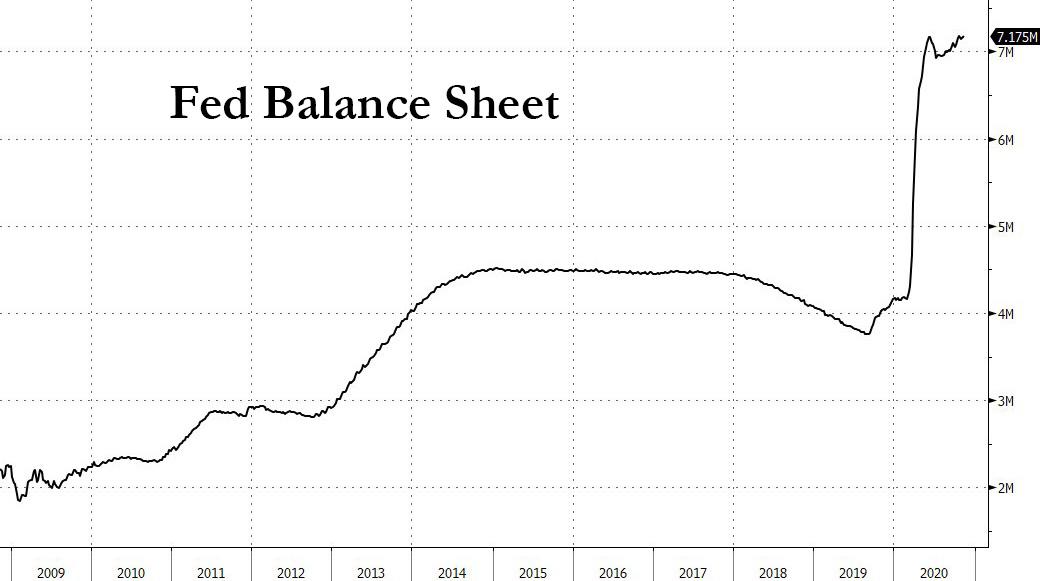
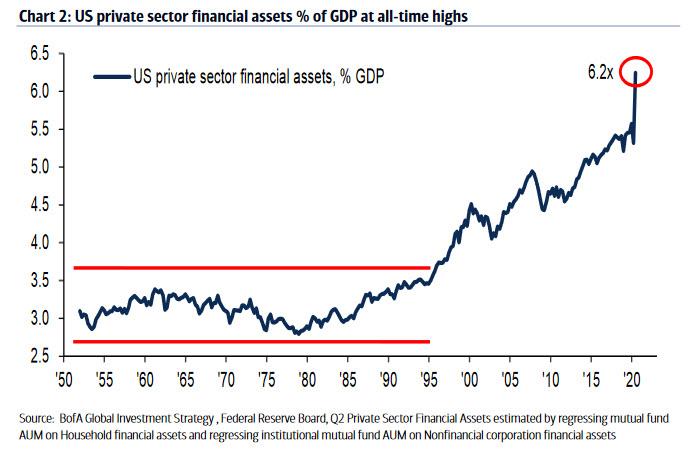
As an aside, and for those asking why the Fed continues to "confuse" markets with the economy, the answer is simple: since the value of financial assets in the US economy at a record 620%+ of GDP, for the Fed capital markets are the functional equivalent of the economy since a market crash would destroy the highly financialized US economy, and thus can never be allowed.
There is just one problem: after a year in which the US budget deficit hit a record $3.1 trillion, and with the US facing a deluge in new debt issuance in 2021 which has already led to the biggest October deficit on record and which at $284 billion suggests another full-year deficit of well over $3 trillion (assuming no further lockdowns)...
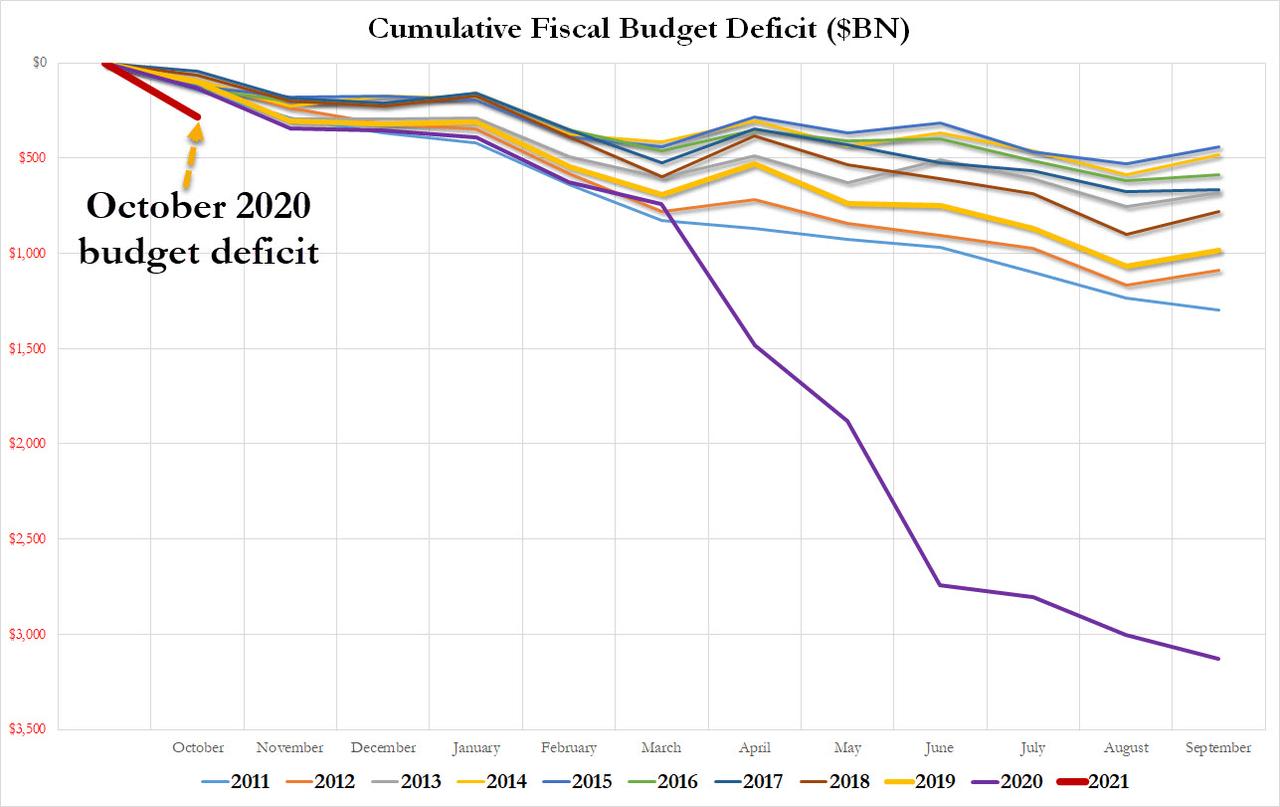
... the Fed's current rate of debt monetization - read QE - is simply not enough.
As Bank of America's Michael Hartnett calculated in his latest Flow Show report published on Friday, over the next year, "Treasury supply will significantly outstrip Fed purchases in Q4 & Q1", and this is even without factoring in the possibility of another major fiscal stimulus.
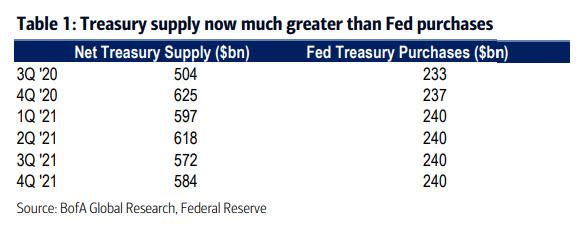
The problem: while the Treasury faces net Treasury issuance of roughly $2.4 trillion, the Fed is expect to monetize less than half of this total, or $960 billion. Considering that in 2020 under the auspices of "helicopter money" (from which we remind readers there is simply no coming back) the Fed will have monetized virtually every dollar of net issuance, this is a huge cliff and one which could lead to a shock drop in Treasury prices if the market reprices (lower) its expectations for Fed monetizations.
In short: the Fed needs to more than double its scheduled monthly QE in 2021 just to catch up to where it was in 2020.
Of course, other central banks are facing the same challenge of insufficient monetization and some have already taken appropriate steps: recently both the RBA and BoE announced an expansion in their QE.
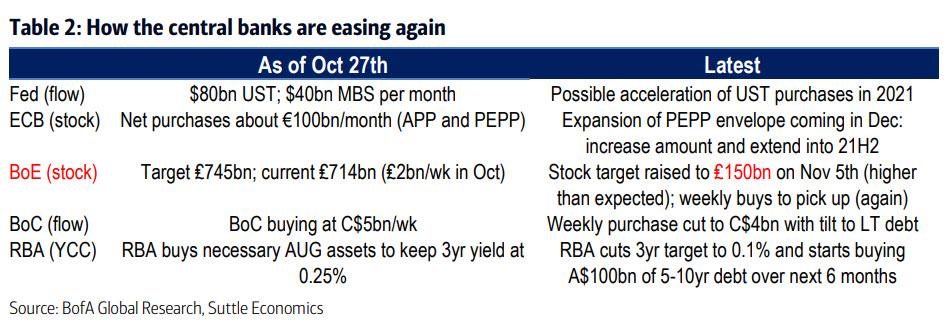
Just next month, the ECB is also expected to announce a dramatic expansion of its QE operations and as Variant Perception writes, the central bank "may end up absorbing all government supply in 2021":
The ECB has provided a clear indication that additional stimulus will come in December. A further expansion of PEPP could result in the ECB purchasing most, if not all, of the EGB supply in 2021.
Although the ECB left the monetary stance unchanged at their last Governing Council meeting, the press statement indicated that policy instruments will be recalibrated in line with new economic forecasts published in December – providing strong indication that fresh stimulus will be rolled out by year-end.Given the slowdown in the rate of PEPP purchases over the summer (in part reflecting seasonal effects), there is still more than half of the existing capacity remaining in the current expanded envelope. As such, adding further capacity to the PEPP facility could result in the ECB absorbing all of the EGB supply in 2021.

According to VP, "so far the ECB has purchased €617BN through the PEPP facility, leaving €733BN for future purchases" and adds that it assumes "that the ECB expands the envelope in December by €500BN (a lower amount would not be material, while a higher amount would perhaps not be justified for now given the existing capacity) and extends the purchasing window by six months to end-2021."
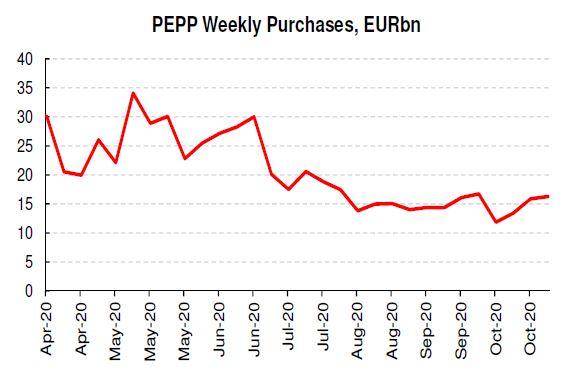
Putting this number in context, Eurozone governments have issued around €1.1 trillion of bonds YTD (including syndications), and even assuming a similar volume of issuance in 2021, this would fall in the ECB’s expanded PEPP envelope (at the current run rate, there would be €750bn in PEPP holdings by December, with a €500bn envelope expansion taking remaining capacity to ~ €1.1trn). d
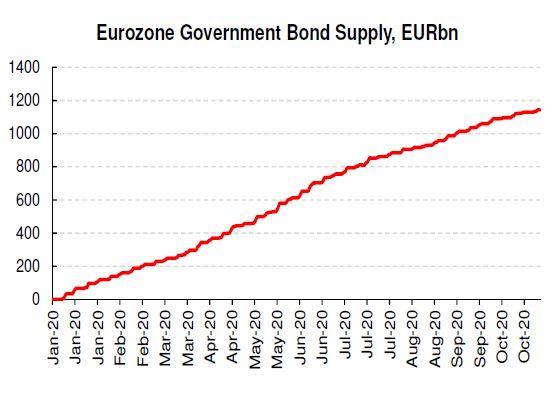
And now that German opposition to out of control debt-funded stimulus has effectively been neutered, it is only a matter of time before Lagarde announces an expansion to QE which will ensure that the ECB monetizes 100% (if not more) of all net issuance in Europe (one caveat made by Variant Perception here is that "the ECB has had to repeatedly fend off recent criticism from some quarters that it is engaged in monetary financing. This argument will become more difficult to make if the ECB finds itself buying up all of the EGB supply that comes to market" although we doubt this will be a major hindrance if Lagarde can sell the alternative as a doomsday scenario, something central bankers are quite good at).
Which brings us back to the Fed: with the RBA, BOE and ECB all set to monetize 100% of domestic net issuance - in other words, central banks will henceforth fund the entire sovereign budget deficit which is what MMT and helicopter money is all about - it's only a matter of time before Jerome Powell will join the club, and we expect that at some point in the next 3-4 months, the Fed will announce it too will double its monthly rate of debt purchases.
The only question is what crisis will be used as a scapegoat for the next massive QE expansion: as a reminder, the covid pandemic emerged in at a very convenient time for the central bank - just as the business cycle was set to go into contraction, with the Fed having launched "Not QE", and with rates at a tiny 1.50 (which are now back to zero). And thanks to the $3 trillion "covid" liquidity injection, the Fed has effectively reset the business cycle for the foreseeable future. It just needs to do so again, and we are completely confident that Powell and company will be completely successful in finding the right crisis to blame it on.
Furthermore, now that we have Congressional gridlock for at least 2 more years (absent a dramatic victory for Democrats in the Georgia Senate race runoffs in January), the Fed's much desired multi-trillion fiscal stimulus will simply not come, leaving it as the only source of potential stimulus for the foreseeable future, effectively ensuring that (much) more QE is just a matter of when not if.
In fact, one can argue that the creeping economic shutdowns, first at the state level and soon at the Federal, have just one purpose: to catalyze the next crash... and next bailout by the Fed.
Schwarzman defended Trump at CEO meeting on election results
Exclusive: Blackstone founder dismissed ‘coup’ fears and predicted legal process would take its course
Blackstone founder Stephen Schwarzman defended Donald Trump’s response to this year’s US poll results during an emergency meeting of senior business leaders alarmed by the president’s claims that the election is being stolen, according to several participants.
About 30 chief executives — of companies as large as Goldman Sachs, Johnson & Johnson and Walmart — agreed to the emergency Zoom meeting on the morning of November 6, only hours after Mr Trump said the night before that he had won several states that had voted for Mr Biden.
Jeffrey Sonnenfeld, the Yale management professor who organised the 7am call, declined to comment on Mr Schwarzman’s remarks, but three participants said the Blackstone founder took issue with suggestions made during the meeting that the US could be on the verge of a coup.
Mr Schwarzman, a Republican donor who has been one of Mr Trump’s most energetic supporters on Wall Street, sought to assuage such fears, saying the president was within his rights to challenge election results and predicting that the legal process would take its course.
He asked whether other participants did not find it surprising that early votes in Pennsylvania had favoured Mr Trump, only for later counts to tip the state in Mr Biden’s favour.
Mr Schwarzman said there had been news reports stating that ballots continued arriving days after the election and that some of them may not have been real — issues, he said, that needed to be resolved by the courts, as the president’s legal team has argued.
Participants in the call said Brian Roberts, Comcast’s Philadelphia-based chief executive, responded by explaining that the state’s Republican-led legislature had prevented mailed-in votes from being counted before election day, and that votes from Philadelphia, one of the later parts of the state to report its tally, had traditionally favoured Democrats.
Asked about Mr Schwarzman’s remarks, Blackstone told the Financial Times: “As an American, Steve believes the electoral system is sound and that the democratic process will play out in an orderly and legal manner, as it has throughout our nation’s history.”
Mr Schwarzman donated $3m to America First Action, a super-political action committee aligned with Mr Trump, in January, but support for down-ballot Republicans accounted for most of the $30m he has contributed to political causes this year.
The CEO call concluded with many of the business leaders resolving to extend congratulations to Mr Biden and encourage Republican congressional leaders to endorse his election victory in the hope of encouraging a smooth transfer of power.
The call was followed by statements from a few individual chief executives and several US industry groups. The Business Roundtable pointedly said it respected the Trump campaign’s right to call for investigations of alleged irregularities but saw “no indication that any of these would change the outcome”.
Prof Sonnenfeld said the anxiety of business leaders had eased since that “shot across the bow” as several of the Trump campaign’s legal challenges to the results had failed. Some CEOs on the call had pushed for the group to reconvene, he said, but “they feel they’ve said enough and it’s getting back on track”.
The session on November 6 had opened on a dark note, with a warning about the possibility of a “coup d’état” from Tim Snyder, the Yale historian and author of On Tyranny, who told the business leaders that democracies were almost always overthrown from the inside.
“To defeat a coup d’état, the early response of thought leaders, including of business leaders, is very important. Even if you think what Mr Trump is doing is not going to work, it is very important not to just wait around to see how others respond,” Prof Snyder told the group, according to Prof Sonnenfeld.
“Some thought that was overstating it,” Prof Sonnenfeld told the FT, but he said many CEOs had been “alarmed” by the president’s address and Prof Snyder’s warning left them resolved to speak up.
“There was great concern about the president’s words and the national reaction, that it was leading to more cleavage in the country rather than less. None of them wants a divided nation. They don’t want fractured communities. They don’t want hostile workplaces.”
Vulture funds buy up bonds of China state-owned enterprises
Default of two industrial groups triggers plunge in prices of corporate debt
Vulture funds are racing to buy bonds of troubled Chinese state-owned enterprises, after a sharp sell-off sparked by a large coal mining group’s default on a Rmb1bn ($156m) debt issue.
Yongcheng Coal & Electricity, a coal miner in central Henan province, one of China’s most populous provinces with more than 95m people, defaulted on Friday. This was just weeks after Brilliance Auto, a carmaker owned by the Liaoning provincial government, announced it would not be able to repay a three-year Rmb1bn bond.
The default of the two groups has triggered a plunge in prices of state-backed corporate debt as international and onshore investors grappled with the prospect of China’s central government stepping back from its traditional role as a safety net for local government businesses.
Beijing faces a challenge in trying to manage the stress on SOEs, particularly companies controlled by provincial and municipal governments that are struggling financially during the Covid-19 pandemic.
“The central government won’t allow the situation to deteriorate as that could lead to systemic risks,” said David Huang, a Shanghai-based bond fund manager who spent Rmb20m to buy a three-year note by Brilliance Auto for 20 cents on the dollar. “That creates an investment opportunity.”
Other investors, however, viewed the defaults as a sign that government bailouts of distressed state companies, once taken for granted by most investors, could no longer be guaranteed. “Our investment decision had been based on the belief that triple-A rated state firms are safe investments regardless of their fundamentals,” said the chief ratings officer at a Shanghai-based bond fund. “That’s no longer the case.”
Investors said they were alarmed by the defaults in part because many of the SOEs had previously boasted seemingly strong fundamentals. Both Yongcheng and Brilliance received triple A ratings and each had more than Rmb20bn cash on their balance sheet, according to their most recent financial statements.
Neither company replied to requests for comments.
“What else can we trust if both the rating agencies and financial statements aren’t credible?” asked the Shanghai fund manager.
Investors were also unnerved that Yongcheng and Brilliance have spun off profitable assets before defaulting, including Brilliance’s shares in the BMW joint venture.
“This has set a bad example, that the SOEs can be as irresponsible as private firms in avoiding debt payment,” one Yongcheng creditor said.
Managers of vulture funds, which specialise in distressed assets, told the Financial Times they had placed “significant” purchase orders for bonds issued by struggling SOEs.
Vulture investors still expect regional governments to step in. “If they let Yongcheng or Brilliance go under, no state firms in Henan or Liaoning will ever be able to tap the bond market again,” said Mr Huang. “The government won’t let that happen.”
Pres Trump: Pfizer vaccine will be provided free of charge, Pfizer's claim that it was not part of Operation Warp Speed was a misrepresentation
- Pfizer vaccine EUA will be coming soon - Other vaccines will arrive within a matter of weeks and they will soon start mass production
- After we deliver vaccine to front line workers and the elderly, we will make it available to the general population as soon as April; Will not deliver it to NY State until Gov Cuomo approves it
- The economy is rebounding far beyond any expectations and the stock market is ready to hit new highs
- "Time will tell" which Administration is in place next year, but this Administration will never go to a lockdown, we will be vigilant and careful
- Operation Warp Speed chief advisor Dr Slaoui: 2 vaccines and 2 EUAs could be granted by year end, a great achievement
Barron’s Weekend Summary: With a coronavirus vaccine on the horizon, small-cap stocks, which typically outperform over the long-term, are worth a look
* Cover Story: “Small companies typically outperform over the long-term, even more so at the beginning of an economic rebound. With a vaccine on the horizon, these stocks are worth a look,” partly because of their record-low valuations—Small-cap value is trading at a 60 percent discount to its average valuation in the postwar era, according to Leuthold Group, and it has been this inexpensive only one other time.
* Tech Trader: Positive on MU: With the global datasphere set to grow to 175 zettabytes (that is, 175 plus 21 zeros) in 2025 from 33 zettabytes in 2018, storage is an increasingly crucial element of the tech landscape; Investors have long viewed memory as a commodity, which explains the low valuation for Micron, the sector’s biggest pure-play bet—but the outlook for the company is brightening, and the stock could double from here.
* Trader: JPM’s Dubravko Lakos-Bujas believes that it’s now time to start gradually making the shift to value stocks—for growth stocks, the pandemic accelerated gains that should have come over two to three years and compressed them into one, and while growth will continue to be good, the rate of growth will almost certainly slow; Positive on TGT: News of the possible arrival of a Covid vaccine sent department store stocks such as M and KSS up, but Target—classified as a big box retailer but more like a department store—is the company to own; The company is booming during the pandemic, and the shares look undervalued.
* Profile: Mark Egan, lead manager of the Carillon Reams Core Plus Bond fund, says it can invest as much as 25 percent of its assets in below-investment-grade, high-yield debt; The fund can also hold cash—12 percent of assets now—when Egan can’t find enough opportunities, enabling him to pounce and buy when markets fall, and provide sufficient liquidity to process shareholders’ redemptions.
* Interview: C.J. Muse of Evercore ISI, the top-ranked semiconductor analyst in Institutional Investor’s annual survey, talks about trade issues and China’s headway in the sector, mergers and acquisitions, Moore’s Law—and why he likes NVDA, TER, AAPL, MU, and ASML.
* Features: 1) Positive on INTC: Though Intel has stumbled, lagging rival TSM, which makes chips for fabless players AMD and NVDA, and losing its role as a provider to AAPL, the company could announce a new hybrid manufacturing approach in January, one of a few signs of a rebound—and the stock is a rarity in the tech sector: cheap, with better days ahead; 2) Favorable news on PFE’s Covid-19 vaccine sparked a market rally and spurred a rotation into value-oriented stocks from growth stocks that could persist for months and years; Other reversals that might continue to play out are better showings by small stocks, compared with larger ones, and by international issues, relative to the S&P 500 index; 3) “The Consumer Financial Protection Bureau, under fire for its response to problems raised by the pandemic, will almost certainly have new leadership under Joe Biden’s administration. But those looking for it to rebuild protections for Covid-19-hit consumers may have a long wait”; 4) Positive on PFE: The efficiencies that enabled Pfizer to ready a Covid vaccine in months instead of years will help other vaccines it will launch in the next few years, including a successor to pneumonia preventive Prevnar, vaccines for teen meningitis and a virus called RSV that hospitalizes infants and the antibiotic-resistant c. difficile infection.
* European Trader: Positive on LOGI: The company “has been one of the big winners of the coronavirus crisis, raising guidance twice already this year thanks to strong sales of webcams, keyboards, and software to workers locked down at home,” and shares are set for further growth.
* Emerging Markets: “Turkey, the long-running train wreck of emerging markets, is reminding investors it can sometimes get back on track, lucratively” after president Recep Erdogan replaced his central bank governor and finance minister, but investors still need to remain cautious.
* Streetwise: Positive on V: The company, which has returned more than 1,000 percent to investors over the past decade, faces a host of electronic payment rivals, but winning over push transactions that use bank rails—like tuition, rent, and wages—and leveraging the tap-to-pay trend should help it continue its growth momentum.
Warren Buffett’s Berkshire Is Becoming Its Own
Warren Buffett has been quietly making a huge bet on a well-known conglomerate with thousands of employees around the world: Berkshire Hathaway Inc. BRK.B 1.20%
While Mr. Buffett has increasingly faced pressure this year to use his nearly $150 billion cash pile to purchase significant stakes in or the entire business of a company, the world’s most famous investor has seemingly made few acquisitions. Among the few deals he did make are Berkshire’s purchase of Dominion Energy Inc.’s midstream energy business and its investment of $6 billion in five Japanese companies.
Berkshire also made a $250 million investment in the initial public offering for the data-warehousing company Snowflake Inc.
But none of these 2020 investments have risen to the “elephant” scale, Mr. Buffett’s term for a big buy, relative to the conglomerate’s size and available cash.
In fact, the biggest purchase that the Omaha, Neb., company has made is to purchase its own stock. Berkshire bought $9 billion of its own shares in the third quarter, bringing total buybacks for the first three quarters of 2020 to $15.7 billion. These buybacks mean that Berkshire Hathaway stock is now one of Berkshire Hathaway’s biggest investments ever.
It is a contrast to decades of thinking from Mr. Buffett, who for years refused to buy back Berkshire stock.
Analysts said that one main reason Mr. Buffett has done a buyback is that big acquisitions are a taller order these days. For a corporation of Berkshire’s size and depth, with railroads, food manufacturers, insurers, furniture companies and jewelry retailers among the company’s varied subsidiaries, there are fewer companies that meet Mr. Buffett’s standards.
“Berkshire Hathaway has reached a size and maturity that it’s no longer a growth company; it’s a cash cow,” said Whitney Tilson, founder and chief executive of Empire Financial Research. “To move the needle, he needs to make investment decisions where he’s allocating, I would argue, $10 billion or up.”
Even after the billions in buybacks, Berkshire’s cash and Treasury bonds total $145.7 billion, as of the end of September. Mr. Buffett himself didn’t expect to be sitting on this much cash at this point.
At a 2017 annual meeting, he said, “There’s no way I can come back here three years from now and tell you that we hold $150 billion or so in cash or more, and we think we’re doing something brilliant by doing it.”
He added: “I would say that history is on our side, but it would be more fun if the phone would ring.”
When the phone has rung since then, the deal wasn’t the right price for Mr. Buffett.
Buybacks are Mr. Buffett’s last option for use of cash after reinvesting in Berkshire and buying other companies, said Stephen Biggar, director of financial-institutions research at Argus Research.
Indeed, Mr. Buffett eschewed buybacks until recent years.
“It’s a bit of a recognition that he doesn’t see any sizable acquisition,” Mr. Biggar said.
One surprise for some investors was that Mr. Buffett didn’t make any deals during the market selloff in March.
At the beginning of the 2008 financial crisis, Mr. Buffett invested more than $15 billion in blue-chip companies such as Goldman Sachs Group Inc. and General Electric Co. , when corporate debt was difficult to get.
This time, however, the Federal Reserve’s market interventions stabilized the markets more quickly, stymieing Mr. Buffett’s usual game plan.
“The Fed became a very rapid direct competitor to Berkshire,” Mr. Tilson said, adding that the Fed’s terms for debt were much better than Mr. Buffett’s were during the 2008 recession.
Lawrence Cunningham, a George Washington University law professor, sees the buybacks as a way to weed out fair-weather investors who would be willing to sell.
Mr. Buffett has fostered a culture of patient shareholders who hold their Berkshire investments for decades. A breakdown of that investor culture could cause disruption after Mr. Buffett leaves Berkshire, according to Mr. Cunningham.
“That will invite activists to clamor for breaking up Berkshire,” said Mr. Cunningham, director of the quality-shareholders initiative at the university. “If you do all that, Berkshire will lose its distinctiveness.”
By buying back shares from the short-term investors, Mr. Buffett is in effect narrowing the company’s investor pool to the longer-term investors.
“It’s a very helpful positive for a post-Buffett Berkshire,” said Mr. Cunningham. “You’re going to maintain the quality of the shareholder base.”
Johnson set to ban sale of new petrol and diesel cars from 2030
Prime minister to roll out measure to bolster electric car market as part of wider UK energy review
The sale of new petrol and diesel cars will be banned within a decade, Boris Johnson is expected to announce this week as part of a broader package of green initiatives.
In February, Mr Johnson announced that the existing ban on selling new petrol or diesel cars would be brought forward from 2040 to 2035.
Now the prime minister is expected to move the date forward to 2030 in an attempt to jump-start the market for electric cars in the UK and push Britain towards its climate goal, according to industry and Whitehall figures.
However, the government is expected to keep the less stringent date of 2035 for the phase-out of the sale of hybrid cars that plug in to charge.
While electric car sales are rising strongly, they are still below 7 per cent of all new vehicles bought across the UK last month, according to figures from the Society of Motor Manufacturers and Traders.
The car industry has long argued that significant funding for infrastructure is required to help convince the majority of motorists to switch to the new technology, which is currently more expensive than traditional petrol or diesel models.
Some £500m of government funding towards charging infrastructure is expected to be rolled out starting next year.
The money will help fund new grid connections to allow remote facilities such as motorway service stations to install a far higher number of fast-charging charging points.
There is still widespread consumer confusion about the differences between battery electric cars that have no engine, and various forms of hybrid that combine batteries and traditional motors.
Last week, the Department for International Trade wrote on Twitter that Nissan’s new Qashqai model would be an “electric” car, when the model is actually a hybrid.
The industry has lobbied hard for the sale of new hybrid cars to be phased out at a later date than traditional petrol and diesel models, arguing that they are a way of getting most consumers acquainted with the technology.
One in four cars sold in the UK contains some form of hybrid technology.
Toyota, which owns two UK facilities, previously warned that outlawing the hybrid models made at its Burnaston plant would jeopardise future investments in Britain.
Mr Johnson has long been planning to make a major green speech setting out his vision for switching to a low-carbon economy, which is at last expected to take place this week.
His predecessor Theresa May committed the UK to achieving “net zero carbon” by 2050, requiring the end of fossil fuel power for the electricity system, transport and household heat.
Mr Johnson is also keen to burnish Britain’s green credentials ahead of next year’s COP26 international climate summit in Glasgow.
This week’s speech is expected to feature pledges on hydrogen, carbon capture and storage, offshore wind and household insulation. Mr Johnson is also set to give the go-ahead to new nuclear power stations — such as Sizewell — and money for small modular reactors (SMRs).
Officials cautioned that Mr Johnson could still plump for the less ambitious target of 2032 for the ban on the sale of new petrol and diesel cars — but he is understood to be leaning towards 2030. The earlier target had been opposed by Dominic Cummings, who quit on Friday as the prime minister’s most senior aide.
Policy documents circulated across government included the date as “203X” in order to prevent the intended date from leaking.
Ed Miliband, the shadow business secretary, has long called for a 2030 cut-off point for the sale of petrol and diesel cars.
The UK government is also drawing up a long-delayed energy white paper which is expected to set out plans for decarbonising the energy sector in line with the 2050 target.