Moderna boss says COVID-19 vaccine not proven to stop spread of virus
Moderna’s coronavirus vaccine may not get life back to normal right away because it hasn’t yet been proven to prevent the deadly bug from spreading, the company’s top doctor says.
Research has shown that the biotech firm’s shot is effective at preventing people from getting sick with COVID-19, but there’s no hard evidence that it stops them from carrying the virus “transiently” and potentially infecting others who haven’t been vaccinated, according to Dr. Tal Zaks, Moderna’s chief medical officer.
“I think we need to be careful, as we get vaccinated, not to over-interpret the results,” Zaks told Axios in a TV interview released Monday. “When we start the deployment of this vaccine, we will not have sufficient concrete data to prove that this vaccine reduces transmission.”
“Do I believe that it reduces transmission? Absolutely yes, and I say this because of the science,” he added. “But absent proof, I think it’s important that we don’t change behaviors solely on the basis of vaccination.”
Zaks’ comments offer another sign that it will take time for a vaccine to bring an end to the global pandemic and help the economy recover even though drugmakers are working at a breakneck pace to produce a safe and effective inoculation.
Massachusetts-based Moderna revealed last week that its experimental vaccine was nearly 95 percent effective in a late-stage clinical trial. Pfizer and AstraZeneca have also reported that their shots are highly effective at warding off COVID-19.
Pfizer asked the US Food and Drug Administration to clear its vaccine for emergency use on Friday, and Moderna is expected to submit a similar request in the coming weeks. But all three companies will have to navigate the logistical challenge of distributing the vaccines around the world once regulators approve the shots.
While US officials say they plan to have millions of doses ready by the end of the year, a vaccine is not expected to be widely distributed until next spring.
Moderna’s stock price was roughly flat at $101 in premarket trading as of 7:57 a.m. Tuesday.
Google may be hit with second antitrust suit as soon as next month
Less than a month after being sued by the Department of Justice over maintaining “unlawful monopolies” in its search and advertising businesses, Google is staring down the barrel of a second antitrust lawsuit.
A bipartisan group of US states is gearing up to file suit against the search giant as soon as next month, Reuters reported on Tuesday. The coalition of states — comprised of Colorado, Iowa, Nebraska, New York, North Carolina, Tennessee and Utah — is conducting a broad inquiry into Google’s practices.
The group has said it plans to combine its case with the federal government’s and is expected to file its lawsuit in mid-December.
Google did not immediately respond to a request for comment.
The DOJ in October accused Google of breaking the law in its effort to remain the “gateway to the internet,” employing questionable tactics including signing a massive contract worth billions of dollars with Apple to make it the default search engine on the iPhone, as well as ensuring that its search engine is pre-loaded onto smartphones using Alphabet’s Android operating system — which runs the majority of phones around the world.
Google has broadly denied wrongdoing in response to the government’s lawsuit and other probes, responding with a snark-laden blog post in which chief legal officer Kent Walker denied claims that the company is forcing consumer to use its search engine — saying that even an idiot can figure out how to switch browsers.
The government’s lawsuit promises to be the biggest antitrust case in a generation, comparable to the lawsuit against Microsoft Corp filed in 1998 and the 1974 case against AT&T which led to the breakup of the Bell System.
The Microsoft lawsuit was credited with clearing the way for the explosive growth of the internet since the antitrust scrutiny prevented the company from attempting to thwart competitors.
Shares of Google were up slightly Tuesday morning, trading at $1,731.08.
Whale Accumulation Sends Bitcoin Above $19,000 As Gold Tumbles
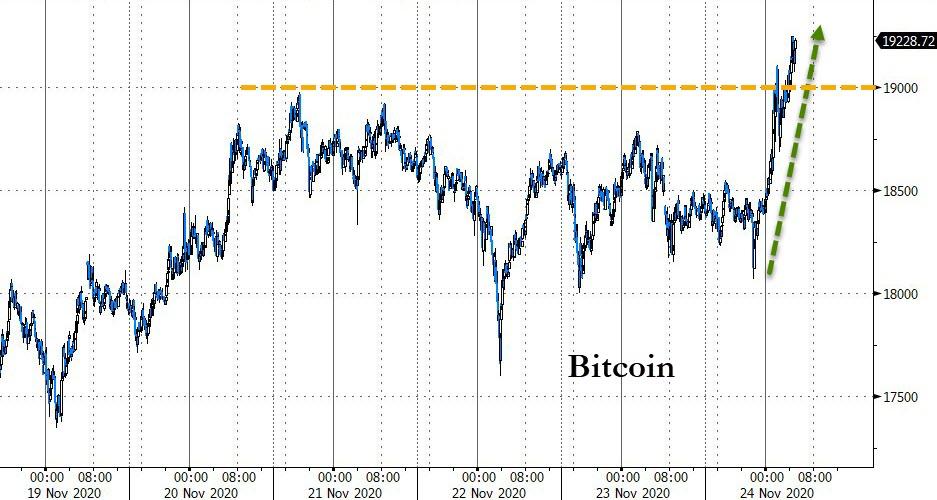
For the first time since 2017, Bitcoin price pushed above $19,000, and multiple indicators suggest the rally may continue. There's less good news for lovers of more traditional economic-curmudgeon plays with gold dropping for a second day to trade at $1,815
Source: Bloomberg
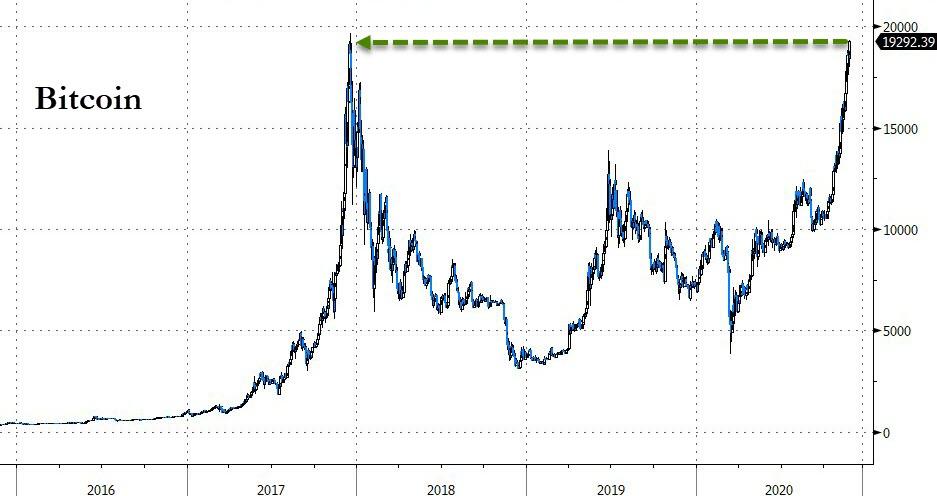
Within $400 of the record high from Dec 2017...
Source: Bloomberg
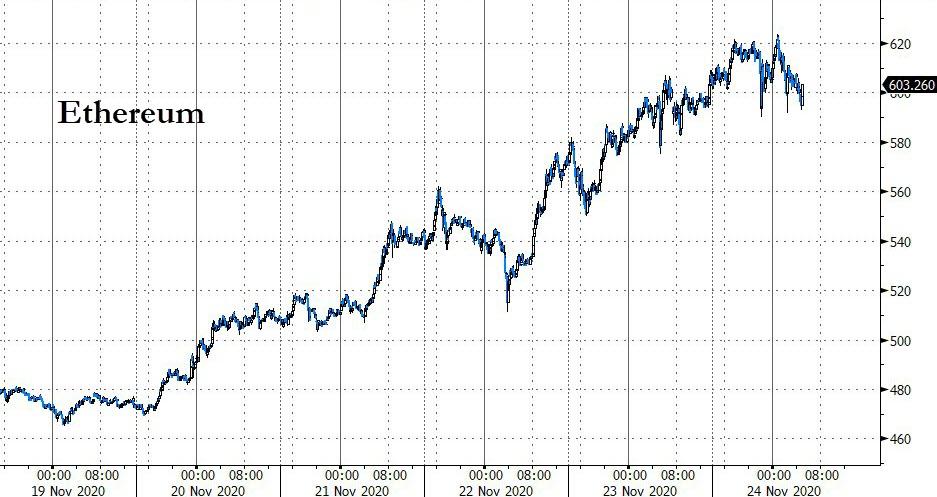
Ethereum is steady today after yesterday's surge as Eth2’s beacon chain genesis has been confirmed for Dec. 1 following the transfer of 524,288 Ether (ETH) from 16,384 validators into the Eth2 deposit contract since it went live on Nov. 4.
Source: Bloomberg
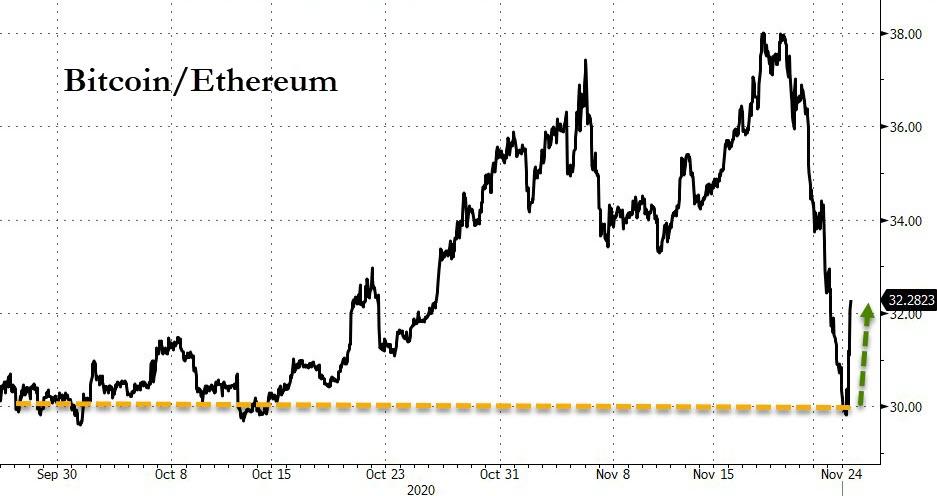
Bitcoin bounced off support versus Ethereum...
Source: Bloomberg
CoinTelegraph's Ray Salmond points out that the main factors buoying BTC’s ongoing rally is whale accumulation, decreasing exchange supply and explosive volume trends.
Whales are still accumulating Bitcoin
All throughout November, Cointelegraph reported that whale clusters were steadily forming as the price of Bitcoin rallied.
These clusters emerge when Bitcoin whales buy BTC at a certain price point and do not move them. Analysts have interpreted this as a signal that whales are accumulating and that they have no intention of selling in the near term.
The difference between the ongoing Bitcoin rally and previous price cycles is that the recent uptrend has proven to be more sustainable. In fact, each whale cluster shows that every major support level BTC reclaimed was accompanied by whale accumulation.
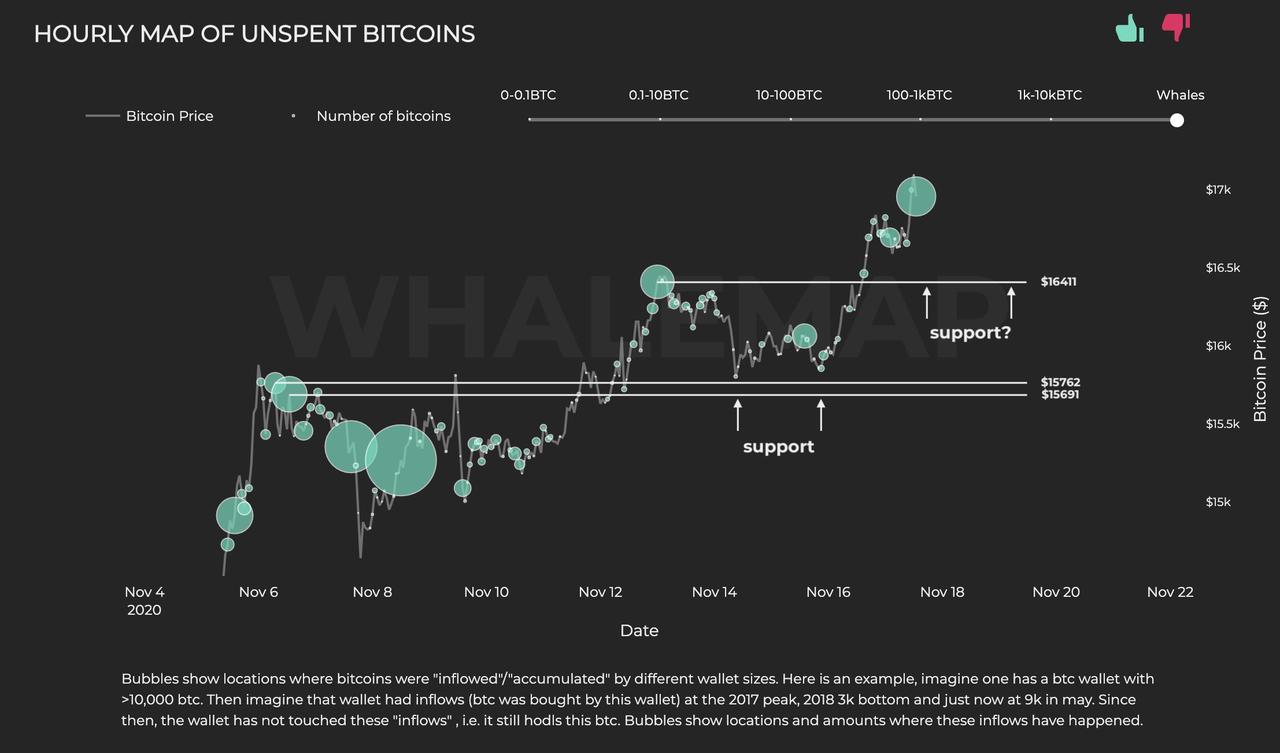
Unspent Bitcoins at each whale cluster. Source: Whalemap
On Nov. 18, when Bitcoin dropped to as low as $17,200, analysts at Whalemap said that the new whale support is located at $16,411. They said:
“Bubbles indicate prices at which whales have purchased BTC that they are currently holding. Bubbles also visualize support levels. Last time we bounced from $15,762 and had a 15% price increase. Is the new bubble at $16,411 going to hold this time as well?”
Since then, Bitcoin has seen several more dips below $18,000 but has since recovered above $18,800, sustaining its strong momentum.
Furthermore, data from Santiment, an on-chain market analysis platform, shows a similar trend. Santiment researchers found that the number of BTC whales significantly increased in recent months. They explained:
“The amount of #Bitcoin whales with at least 10,000 coins (currently $185M or more) has ballooned to 114 the past couple days as prices soared above $18k. Additionally, the amount of holders with at least 1,000 $BTC ($18.5M) has hit an ATH of 2,449!”
Additionally, as Reuters reports, investors like Stanley Druckenmiller, founder of hedge fund Duquesne Capital, and Rick Rieder, BlackRock Inc’s chief investment officer of global fixed income, have recently touted bitcoin.
Retail investors though are still mostly sidelined due to the pandemic’s effect on the economy. But with the entry of Square and PayPal, Lennard Neo, head of research at crypto index fund provider Stack Funds, expects a deluge of retail demand more intense than in 2017.
Neo forecasts bitcoin to reach $60,000-$80,000 by the end of 2021., but that pales compared to Tom Fitzpatrick, a strategist at Citigroup, who forecast earlier this month the token could potentially reach as high as $318,000.
Going from $18,000 to $100,000 in one year is not a stretch, Brian Estes, chief investment officer at hedge fund Off the Chain Capital, said.
“I have seen bitcoin go up 10X, 20X, 30X in a year. So going up 5X is not a big deal.”
Estes predicts bitcoin could hit between $100,000 and $288,000 by end-2021, based on a model that utilizes the stock-to-flow ratio measuring the scarcity of commodities like gold.
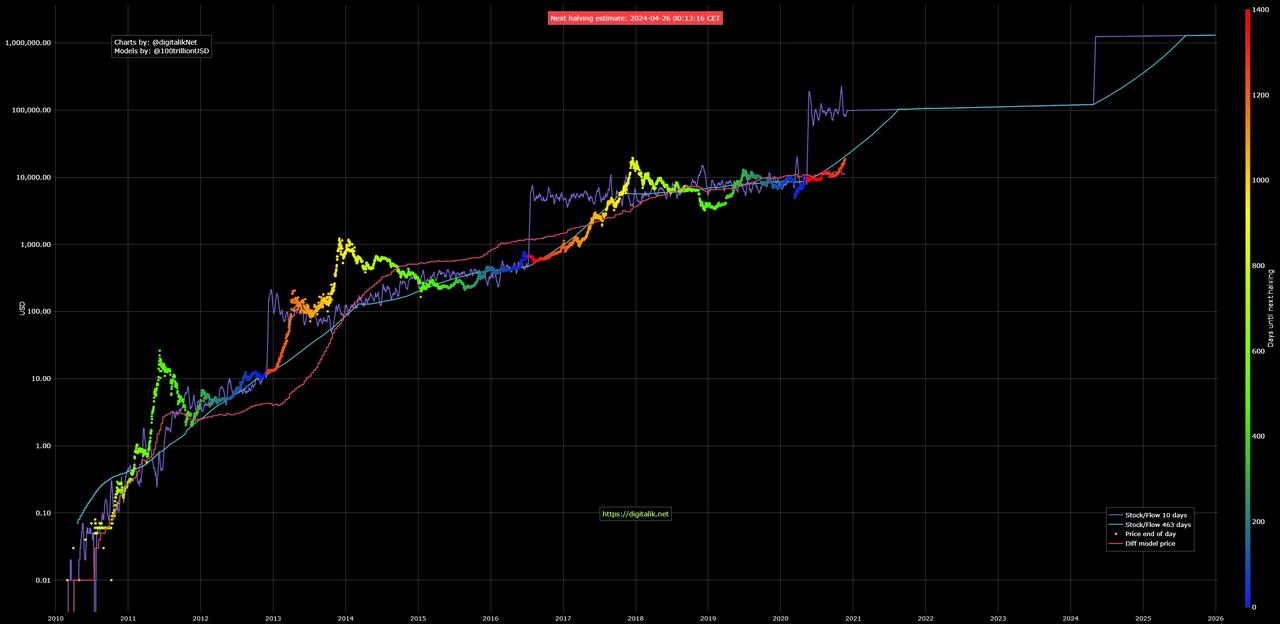
That model, he said, has a 94% correlation with the price of bitcoin.
Bitcoin's supply is drying up
One consistent trend throughout the 2020 bull cycle was the continuous drop in Bitcoin exchange reserves.
Investors and whales deposit BTC to exchanges when they want to sell BTC. Hence, the recent drop in exchange reserves means there are fewer sellers in the market.
A pseudonymous trader known as “Byzantine General” said that every time spot exchanges expand their BTC reserves, they get accumulated. He said:
“Everytime spot exchanges add to their $BTC reserves it gets depleted almost immediately. Don't you get it? There's literally not enough supply.”
Volume is surging
The volume of both institutional and spot exchanges has been increasing rapidly since September. Open interest on Bitcoin futures and options at CME surpassed $1 billion in November and Binance’s BTC/USDT pair has consistently delivered over $1.5 billion in daily volume.
Various data points also show that the spot market has been leading the rally, not derivatives or futures markets. This trend makes the rally more stable and reduces the risk of massive corrections.
When the futures market accounts for the majority of the volume during a Bitcoin uptrend, there is a large risk of cascading liquidations. This time, the spot market has been leading the rally, thus making it more sustainable.
'Digital' Gold
Finally, there is one more factor worth noting. It appears there is a preference for 'digital gold' over the barbarous relic as the correlation between the two crashes into negative territory..
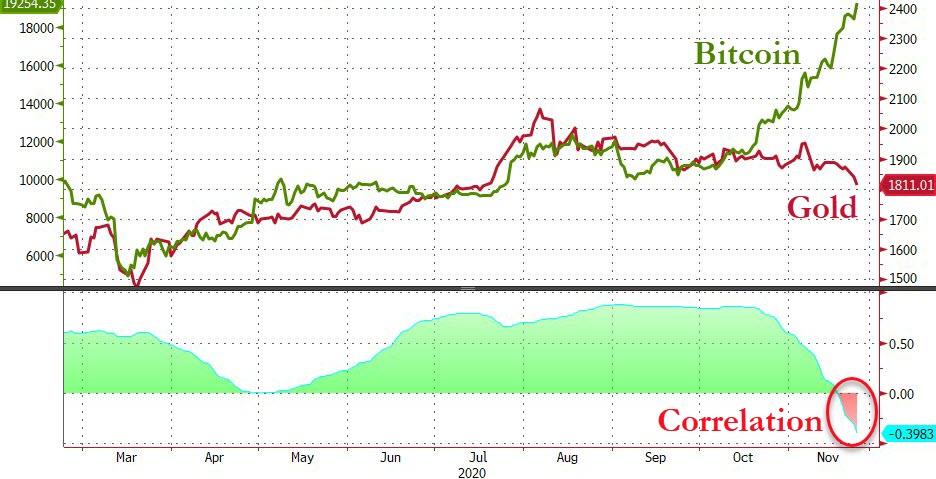
Source: Bloomberg
As Tom Luongo recently noted, the current rally in bitcoin is telling us clearly that there is a new premier store of value asset because of the current state of the world. Maybe that’s really what Schiff is decrying, a world that has passed him by.
What’s becoming clear even to me is that gold will only be valued in relation to bitcoin going forward, not the other way around.
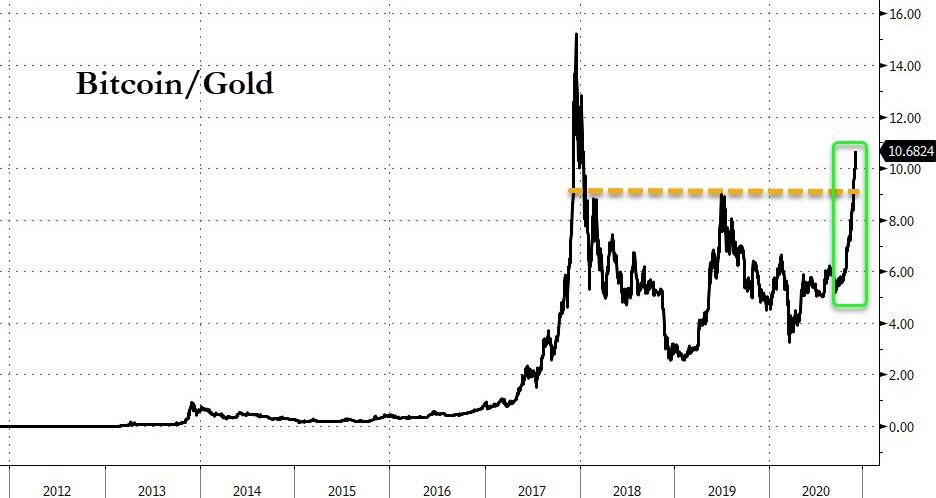
It’s sad but true. In my heart of hearts I wish it were different and not because of the structure of my portfolio or the name of my business.
It’s sad because it proves that we are moving into a different age where technology is depreciating the value of an asset which materially improved the life of billions for millennia towards its commodity extraction value limit.
And while many gold advocates don’t want to admit that they have stood by while the fortune of two lifetimes has passed them by. That’s the bad news.
Square and PayPal may be the new whales in the crypto market as clients flock to buy bitcoin- https://cnb.cx/3pUy0yZ
- PayPal and Square clients are buying most of the new bitcoin supply entering the market each day, according to analysis by Pantera Capital.
- The fintech companies’ moves into crypto makes it easier for new investors to casually buy, versus opening up a dedicated cryptocurrency exchange account.
- It adds to a number of factors helping bitcoin climb past $19,000 -- including big-name investors like Paul Tudor Jones publicly backing the cryptocurrency.
Fintech companies are helping fuel demand for bitcoin as they open the floodgates for millions of people to trade it.
By one firm’s analysis, PayPal and Square clients have been buying the majority of the new bitcoin supply entering the market each day. Hedge Fund Pantera Capital estimates that Square clients have accounted for 40% of bitcoin that enters the market in the two years since the product launched.
PayPal may be responsible for even more demand since launching just a few weeks ago. The payment company partnered with crypto firm Paxos for custody and trading. Volume on Paxos’ exchange, itBit, had been consistently in the same range since last September. But as PayPal went live recently, volumes on the exchange more than tripled, according to data from CoinGecko.
Pantera estimated that within three weeks of going live, PayPal clients are already buying roughly 70% of the new supply of bitcoin.
“It’s having a significant increase on price,” Dan Morehead, founder and chief investment officer of Pantera Capital and former CFO at Tiger Management, told CNBC in a phone interview. “You bring on two corporates that are already buying all of the newly issued bitcoins -- supply and demand says the price has to go up.”

Source: Pantera Capital
Between 800 and 900 bitcoin -- worth about $15 million at Monday’s price --- are added to the market on a daily basis, according to crypto data firm Messari. Only 21 million bitcoin can eventually be mined, which advocates say give it the same scarcity value as assets like gold. Its limited supply is one reason some investors are approaching it as an inflation hedge, and an alternative to the weakening U.S. dollar.
Between 800 and 900 bitcoin -- worth about $15 million at Monday’s price --- are added to the market on a daily basis, according to crypto data firm Messari. Only 21 million bitcoin can eventually be mined, which advocates say give it the same scarcity value as assets like gold. Its limited supply is one reason some investors are approaching it as an inflation hedge, and an alternative to the weakening U.S. dollar.
While fintechs companies may be taking up some of that fixed supply, Brian Kelly, founder and CEO of BKCM, said the larger fintech effect is about new demand. Square and PayPal are making it easier for first-time traders to buy through a mainstream app.
“It’s now easier to buy and transact with, and it’s opening up new demand by taking down a barrier to entry,” Kelly said.
Analysts also point to the confidence high-profile money managers have brought to the asset class in recent months. Hedge fund manager Paul Tudor Jones called it “the best inflation hedge,” while Stanley Druckenmiller and Bill Miller also told CNBC they were long bitcoin.
The cryptocurrency first climbed near the $20,000 mark around Christmas three years ago. It crashed soon after, and had not recovered to the $18,000 level until recent weeks. The cryptocurrency is up 260% since its March low and in the past month alone has climbed up 40%. On Tuesday morning, it topped $19,000.
Still, some are skeptical that bitcoin is a viable “replacement” for gold. Peter Boockvar, chief investment officer for Bleakley Advisory, called the idea that a cryptocurrency was in the process of replacing one of the world’s oldest safe-haven assets “absolute nonsense.”
“Something with a 10+ yr history is not replacing something with a 5,000 year track record,” Boockvar said in a note to clients Monday. “It can certainly complement it, but not replace it and I believe it will be that complement that has traction.”