This article appeared first in The State of Fashion 2021, an in-depth report on the global fashion industry, co-published by BoF and McKinsey & Company. To learn more and download a copy of the report, click here.
At the beginning of 2020, the luxury industry was at the precipice of a seismic shift. Consumers were increasingly choosing experiences over things, facilitating the rise of the
resale and
rental markets, and inspiring luxury brands to move further into hospitality. China, which accounted for the
lion’s share of growth in the market for personal luxury goods in 2019, had never been more important to the survival of old brands, and the development of new ones. E-commerce was steadily gaining market share and, while tourism remained a significant revenue-driver for luxury brands, growing government regulation was already making local customers more important.
Then the pandemic hit, and “seismic” took on a whole new meaning. The global Covid-19 crisis limited the mobility of even the wealthiest consumers because of lockdowns and other travel restrictions. In the 2019 fiscal year, EBITA (or earnings before interest, tax and amortisation) was down an average 3.2 percent, according to the McKinsey Global Fashion Index. Economic profit, which factors in both explicit and implicit costs, was up by 4 percent. Companies big and small, successful and struggling, streamlined operations in order to account for the sudden dip in sales.
But it’s not as if shopping halted altogether. Consumers, stuck at home worrying about their finances, were making buying decisions that would have been almost impossible to predict a year earlier. Years of online innovation and change happened in a matter of months, as brands focused on generating revenue from
the only channel available in many markets: e-commerce.
Brands were motivated to do whatever they could to recapture lost revenue online. Still, even the biggest companies in the most profitable market segments have been hit hard. The luxury and affordable luxury segments have proven marginally more resilient, with sales shrinking an average 30 percent and EBITA an average 20 percentage points during the quarters falling between February and June 2020, compared to the same period in 2019, according to McKinsey. Sales of mid-priced fashion brands were down 35 percent, with EBITA down 21 percentage points in the same period, while discount players experienced a 36 percent decline in sales, struggling under mountains of unsold inventory.
As executives look ahead to 2021 and beyond, it is important to consider the longer-term ramifications for everything that has already happened — and the further changes to come.
The Enduring, All-Important China Factor
Companies that already had a major foothold in China, including luxury’s power player conglomerates LVMH and Kering, got a head start in mitigating the pandemic, as the economic impact of lockdowns there were mild in comparison to that of the west — and mass testing made it easier to track and trace the spread of the virus. Brands that generate more than 30 percent of annual sales in the Asia-Pacific (APAC) region — including Mainland China, Japan, South Korea and Taiwan — achieved higher market valuations during the pandemic than their counterparts who did not have a strong presence in the region, according to analysis by McKinsey of 311 fashion companies that disclose regional sales figures. On average, APAC-focused companies boasted a market cap that was 18 percent higher.
Luxury brands have long relied on Chinese consumers to spend money abroad. But in recent years, as government officials put more restrictions on
daigou sellers of grey-market goods and brands worked to
harmonise their prices globally, it has become more important to win the local customer by offering site-specific exclusives and entry-price products that appeal to the country’s still-rapidly growing middle class. Even as consumers begin travelling again when the pandemic is behind us, the local customer will remain front of mind.
“Recovery is going to happen where businesses and retailers are not heavily tourist-dependent,” said Robert Burke, a New York-based retail consultant who works with clients across the globe, from China to South America to Europe. “That’s where we are seeing some of the best recoveries: where it’s a local shopper.”
Looking ahead, that means cultivating local shoppers in other regions too, like Europe, which is over-stored and heavily reliant on out-of-the-country visitors to drive sales. While local China customers will keep that market humming, brands must also look to cultivate local relationships in regions that have recently been more reliant on tourism to drive growth. “China is best placed, but one region can’t carry an entire industry,” said Philip Guarino, a Paris-based luxury advisor.
The coming years will also force brands to recalibrate their strategies in hard-hit regions like Brazil and India — and further ahead, make inroads on the African continent — where there are growing customer bases but also more barriers to entry and success. “The industry has an opportunity to reset its ‘rest of the world’ strategy,” said Nelli Kim, a New York-based advisor to luxury brands and retailers. “So many people rely on China as the growth engine, [but] there are other emerging markets that also need attention.”
From Experiences to Things, and Back Again
For decades, a luxury handbag was the ultimate status symbol, especially for the newly wealthy. But pre-pandemic, it was already becoming clear that customers were looking for something more experiential. That’s why luxury companies were hyper-focused on creating experiences, from
Louis Vuitton’s pop-up in Chicago’s West Loop to coincide with Virgil Abloh’s exhibit at the city’s Museum of Contemporary Art, to the influx of hotel residences emblazoned with names including Versace, Armani and Bulgari.
In 2019, market research firm Greenlight Insights projected that the global market for location-based entertainment would grow to $12 billion by 2023, at a compound annual growth rate of 32.2 percent. As consumers made it clear that they were prioritising experiences over things, new business models emerged to ensure they would keep buying clothes in one way or another — from rental to online. But when the pandemic hit, travelling, visiting stores and even going out to eat became impossible for almost everyone. So, curiously,
people started buying things again. Luxury handbags, shoes and jewellery fared better than expected in many cases, even if overall consumption was down on pre-pandemic levels.
By the third quarter of the 2020 fiscal year, certain areas of luxury were bouncing back. At LVMH, the fashion division — which includes the crucial leather goods category — was
up 12 percent year-on-year, even as overall sales decreased 7 percent (attributed to challenges in its duty-free business), as well as at Sephora, its global beauty store. At independent brand Hermès, sales were up 7 percent overall, with leather goods, apparel, watches, jewellery and home goods all returning to growth. At Kering, overall
sales fell just over 1 percent, beating analysts’ estimates by nearly 8 percentage points. While sales at Gucci fell almost 9 percent, hot label Bottega Veneta jumped 21 percent.
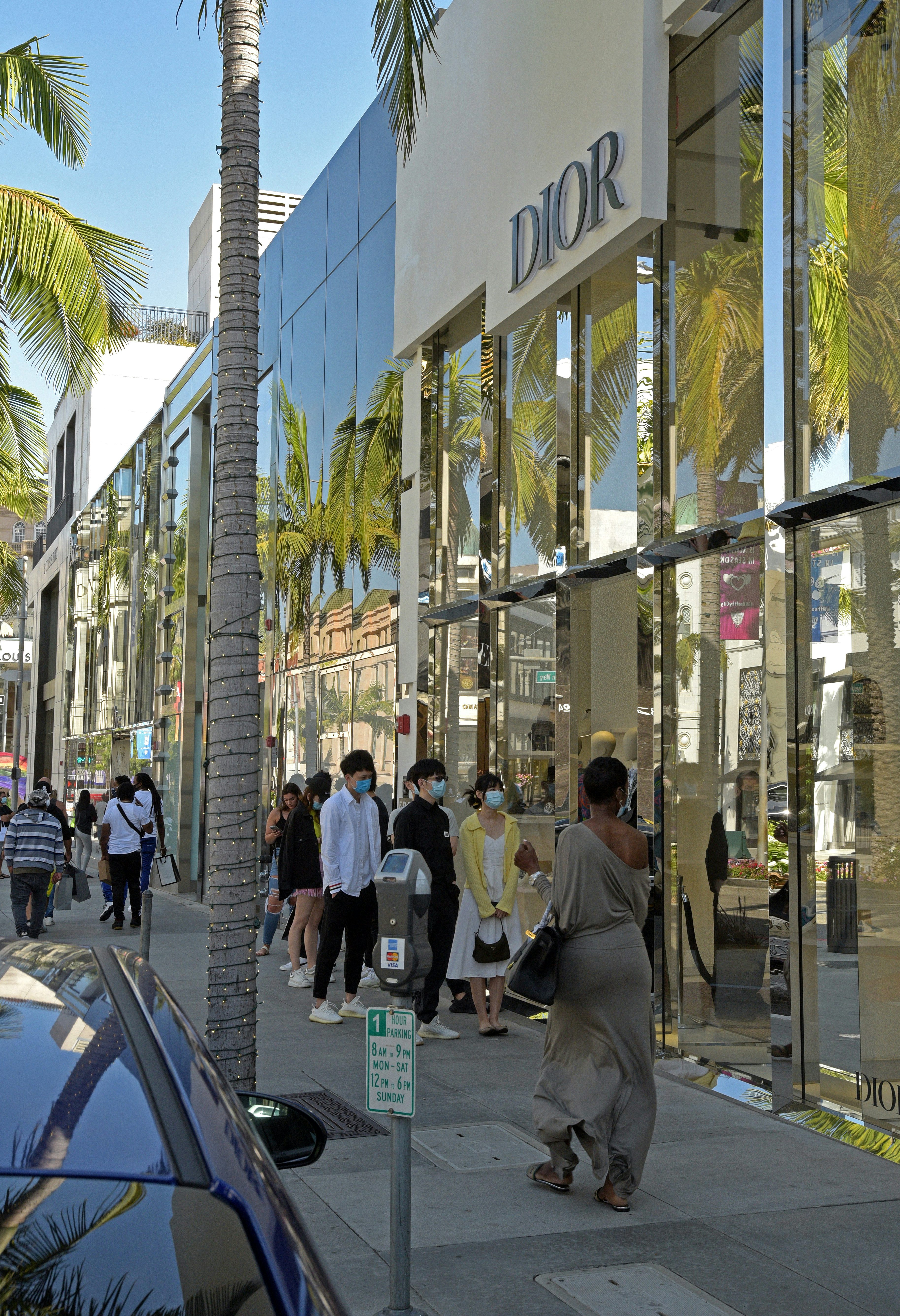
Shoppers at Christian Dior in Beverly Hills, California. Getty Images.
Has the culture regressed back to 2008, when “it bags” were en vogue? Probably not. It’s unlikely consumers will continue to prioritise “things” longer-term after the pandemic. Business travel may not bounce back as quickly, but tourism and experiences are poised to rise in popularity once there’s a proven vaccine. Brands must be prepared for another sudden shift back to pre-pandemic consumer trends. Resale has continued to flourish during the pandemic, rental will likely experience a comeback too.
Balancing Casual Luxury and Investment Pieces
Sales of
activewear and loungewear — anything with an elastic waist — have soared through the pandemic, as consumers prioritise comfort, work from home, and adopt new exercise routines in the hopes of remaining active, even in lockdown. While clothing and footwear brands suffered the biggest decline in value — their average market cap was down 18 percent and 19 percent respectively in October 2020 from December 2019 — the sportswear segment saw a strong recovery and increased by 7 percent.
But while the global casualisation of the wardrobe continues — even in China and other parts of the APAC region, where suiting has remained a typical work uniform for both men and women — it won’t be the end-all. “Men have felt the need to change up their wardrobes,” Burke said. “It’s about casual, not athleisure.”
In fact, most experts believe that the men’s high end ready-to-wear market will continue to expand, whatever the future business-casual wardrobe looks like. “There is more innovation there,” Kim said, noting the launch of the Air Jordan Dior collaboration as an exciting fashion moment that was also genderless in its appeal.
“The young people are shopping — and a lot of young men,” added Sharifa Murdock, co-owner of Liberty Fashion & Lifestyle Fairs, which includes Capsule. “They’re shaping the culture.”
But not every category is winning with these important cohorts. “Watches under 1,000 Swiss francs [approximately US $1,090] are doomed,” said Elsa Berry, founder of luxury M&A advisory firm Vendôme Global Partners, referencing the lower end of the market’s growing irrelevancy in the face of digitisation.
“High-end watches and solid luxury jewellery, however, are remarkable in several aspects.” Not only are one-off watches and fine jewellery considered investment pieces, they are all also benefiting from the general trend in self-gifting, including a “serious level of interest” in the Chinese market. “The Chinese consumer used to buy jewellery for the weight of gold; now they’re buying it because it’s beautiful. It’s a wonderful way to show their personality, their taste level and to discreetly stand out.”
Chinese group Fosun acquired a majority stake in French jewellery brand Djula in late March 2020 through its Yuyan subsidiary in the midst of the pandemic, which she said is evidence that there is market confidence in the category’s growth potential.
Personalising Retail Everywhere
In 2019, e-commerce made up between 10 and 15 percent of global luxury sales, with Europe and China at the lower end of the range and the US at the higher end. By 2020, the figure had risen by at least 50 percent across all three regions, according to McKinsey. At online luxury marketplace Farfetch, second-quarter sales were up nearly 75 percent from a year earlier to $365 million. Gross merchandise value — or the cost value of goods sold on the site — was up 48 percent. By October, the average market capitalisation of internet retailers was up 42 percent from December 2019.
Single brand retailers from Nike to Louis Vuitton also saw an uptick online, which they attributed in part to personalising the shopping experience in every channel.
In the past,
the “one to one” experience, as Nike calls it, has been reserved for only the top tier of customers. Now fashion brands must make every customer’s experience feel more unique through a mix of artificial intelligence, human recommendations and direct contact with salespeople using client communication apps and customer relationship management tools. This won’t be easy to scale, as it requires a mix of sophisticated technology and a savvy, well-educated salesperson. “It’ll be interesting to watch how they do it — and if they can do it,” Kim said.
One outcome may be fewer, larger transactions. “So many consumers have shifted to digital that an older demographic is now converting,” said Adam Freede, chief executive of US-based Madaluxe, a third-party distributor for fashion brands. “Customer acquisition costs per order have come down.”
Whatever happens, the physical retail store will be as important as ever — even if there are fewer of them overall. “Stores are really going to have a heyday,” Berry said. “[Changed consumer behaviour] is going to put pressure on the stores that do exist to be super interesting.”
Big Guns and Creative Independents
The luxury industry was already busy consolidating long before the pandemic, as giants squeezed out mid-sized brands unable to compete with the scale of strategic conglomerates. While each brand in a conglomerate’s portfolio commonly pursues independent strategies, synergies at the group level mean brands still benefit in just about every area across talent acquisition, marketing spend, retail footprint and supply chain. Those best positioned to prosper in the next phase of industry growth are conglomerates like LVMH and Kering and vertically integrated independents like Chanel and Hermès, companies that have the ability to directly manage inventory and can easily stop and start production.
“If you don’t have your supply chain, e-commerce, etc. up and running in all markets, then you’re a weakened player,” said Anne Line Hansen, founder of AH Advisory, a boutique European consulting firm. “Without the infrastructure, mid-sized brands are better off being consumed by a group.”
However, Berry believes there may be an opportunity now for mid-sized brands to come together and form new entities that are better positioned to go up against the giants. “The world has become very complicated… but [conglomerates] are going to get too big,” she said. “There is going to be some consolidation between mid-sized companies that are more family- and culture-driven and less corporate.”
And yet, industry consolidation does not mean upstarts will be edged out completely. During the pandemic, many young, independent brands have actually thrived. Some because they operate on such a lean budget — using the pre-order drop model to drive sales — and weren’t weighed down by excess from the spring season. Others managed to gain mindshare because they have been nimble enough to react rapidly to changing customer sentiments — either by creating relevant products or responding to cultural movements in a sensitive, authentic way.
While the conglomerates are certainly safer than most, a crop of independent brands in the accessible luxury space, including
Brooklyn-based Telfar, Los Angeles fashion collective Brain Dead and sweatpants connoisseur Entireworld, made waves and sold-out product, proving that there is still room for smart, original ideas that appeal to the next generation of luxury consumers, who are more attuned to false marketing. The luxury customer of 2020 is well-educated about the product and has high expectations, and they’re only going to become more knowledgeable in the years to come.
“Niche brands are willing to test and listen to what their consumers want,” Hansen said. “It has forced everyone to be more creative.”