Barron’s Weekend Summary: 28 investment recommendations from Barron’s Roundtable participants; NFLX is poised for success with its shift in strategy
* Cover story: A look at 28 investment recommendations from Barron’s Roundtable participants Rupal J. Bhansali, of Ariel Investments (Snam, Munich Re, VIV, PM, MSFT); Scott Black, of Delphi Management (ASIX, KE, WLKP, DHI, MGA, NOC); Mario Gabelli of Gamco Investors (NEP, AGR, GCP, HY, Deutsche Telekom, GPC, MSGS, Liberty Braves Group, FOX, SBGI, GAN); and Sonal Desai, chief investment officer of Franklin Templeton Fixed Income (MPACX, GLD, PYWEX, FVHIX, FAFTX, FHYVX).
* Tech Trader: NFLX’s announcement that it plans to break even on a free-cash-flow basis this year is a major shift in its strategy as worries that it would lose market share to new services such as Disney+, Peacock, and HBO Max seem to be fading—Rich Greenfield of Lightshed Partners says the conversation is has moved from “when it runs out of money” to “how it will spend all its cash.”
* Trader: “The sleeping giant that is Big Tech has awoken—and that’s been great news for a stock market that was starting to look a little tired”; Lori Calvasina of RBC Capital Markets, notes the S&P 500 has been following a pattern typical of recessions since 1990: an initial recovery, a period of consolidation, and a second rebound.
* Features: 1) Positive on CCI, SBAC, COR, EQIX: Cell towers, which rent space for antennas and other wireless equipment, should be long-term beneficiaries of the 5G rollout, while data centers are benefiting from a shift to cloud computing, digital storage, and other tech trends accelerated by the pandemic—and these stocks, structured like REITS, are well-positioned for the year ahead; 2) Barron’s looks back on 2020, noting that stocks highlighted in bullish articles had a total return of 24.7 percent from the last trading day before publication through the end of the year, versus 20.4 percent for the benchmarks they are tracked against; 3) Though China is on track to become the largest economy in the world, investors continue to remain wary of it, but while Beijing continues to carry out tough social restrictions—including crackdowns on democracy protesters in Hong Kong and Uighur Muslims in Xinjiang—it is making rapid progress on environmental actions; 4) Sustainable funds continued to shine last year despite the pandemic, mass unemployment, and social unrest—and those on Barron’s list of top sustainable funds have returned 14.6 percent on an annualized basis over three years, versus 14.1 percent for the S&P 500, with 52 percent beating the market; the top 10 are PMVAX, PRBLX, AMAGX, CMLIX, LGILX, MLAAX, VIGRX, BFGBX, USGLX, and SPY; 5) Positive on LKQ: The auto-parts supplier’s shares have seen little movement during the past several years, and there has been little synergy among the companies it acquired—but it is pulling back from M&A, unlocking free cash flow, and has reduced operating expenses by about six percent, paving the way for a turnaround this year, and upside for the stock; 6) Investors expect the Biden administration to continue Donald Trump’s tough stance on China, especially on human rights issues, which “could mean continued complexity for money managers in adjusting their portfolios for the changing relationship but less of the volatility as investors tried to digest a flurry of executive orders in the last weeks of the Trump administration.”
* European Trader: Positive on Polymetal International: The London-listed firm is a top-10 gold producer and a top-five silver producer, with assets in Russia and Kazakhstan—it predicts a 17 percent increase in gold volume over the next five years, and is well-positioned to benefit from the transfer to sustainable energy because it owns platinum metal mines.
* Emerging Markets: Investors don’t seem to care that India’s coronavirus vaccine rollout has had a rough start—many medical professionals are wary of Bharat Biotech’s version, which has no published trial results—such that “Life is all but back to normal in India’s cities, a V-shaped-looking recovery is under way, and markets are on fire.”
* Commodities: “Lumber prices more than doubled last year to touch a record high, but the rally has faded on the back of a rebound in supplies. With the value of the commodity down by 20 percent in the new year, prospects for fresh records have dimmed.”
* Streetwise: The videogame sector is thriving during the pandemic, says columnist Jack Hough, and while a coming wave of initial public offerings will generate excitement, it could also flood the market, giving bulls pause.
So You Missed Today's Epic Move In Gamestop: Here's How To Catch The Next One
Back in 2013, we first said that in a market as broken as this one, where no fundamental or technical analysis works, and where logic and rational thought have been flipped upside down thanks to the Fed, the best strategy is to merely go long the most shorted stocks... and wait for the epic short squeeze.
Well, a few days ago, something caught our eye: just as Gamestop's stock was starting to ramp higher, we pointed out that the open interest of Gamestop was higher than the float...
... potentially setting up an epic short squeeze, like that in Volkswagen which exploded ten-fold back in 2008 which found itself in a similar predicament with not enough physical share float to cover all outstanding shorts (whether or not these calculations are in fact 100% accurate doesn't matter: all that is needed is for the perception that there may be an epic short squeeze to spread, coupled with some upside catalyst).
Well, that catalyst today was Citron Research which, with the stock already rampaging in the past few days, announced at the open that it will stop commenting on the stock following the actions of “an angry mob.”
"We are investors who put safety and family first and when we believe this has been compromised, it is our duty to walk away from a stock," Citron managing partner Andrew Left wrote in a Friday letter.
Left's letter came a day after he said in a YouTube video that he’d “never seen such an exchange of ideas of people so angry about someone joining the other side of a trade,” referring to Reddit bulls who have been particularly "vocal" on the social media site in pushing their bullish opinions on the video-game retailer’s stock.
An army of Robinhood, Reddit and TicToc traders read the letter as capitulation on the fund's short position, recall that as recently as Tuesday Citron said that it saw the stock returning to $20 "quickly"...
... which in turn unleashed a historic pile up into Gamestop today as daytraders tired - and succeeded - in forcing a massive short squeeze. So furious was the ramp, that at one point, the video-game retailer was the most actively traded US company with a market value above $200 million, according to Bloomberg. It certainly was the most active day in company history: with more than 193 million shares traded on Friday, it was the most active day for the company since it went public in 2002.
The resulting surge in GME, which pushed the stock as much as 80% higher at one point, was an epic victory for all those Redditors - many of whom continued to pump up their bets with one user saying they relied on it to pay their student loans ...

... who followed our simple - yet favorite - market strategy of merely doing the opposite of what makes sense. And in this case a bunch of Gen-Zers and Millennials demonstrated how easy it is to steamroll one of the more respected shortsellers in the US.
To be sure, there were also some fundamental reasons for the surge: as Wedbush analyst Michael Pachter said, GameStop became a “cult stock because of Ryan Cohen’s success with Chewy” and retail investors “appear confident that he can implement omnichannel initiatives that will materially grow their earnings."
Maybe, but for the company to be worth $50 a share it would have to quickly double its growth, Pachter, who has a $16 price target which is the second highest among analyst tracked by Bloomberg, said.
Not that fundamentals matter: with a record 71 million shares short, or a whopping 142% of the float, it is unclear how many of the stubborn shorts have covered their position, especially since today's surge attracted a new generation of GME bears who may be next to get trampled by the Reddit stampede.
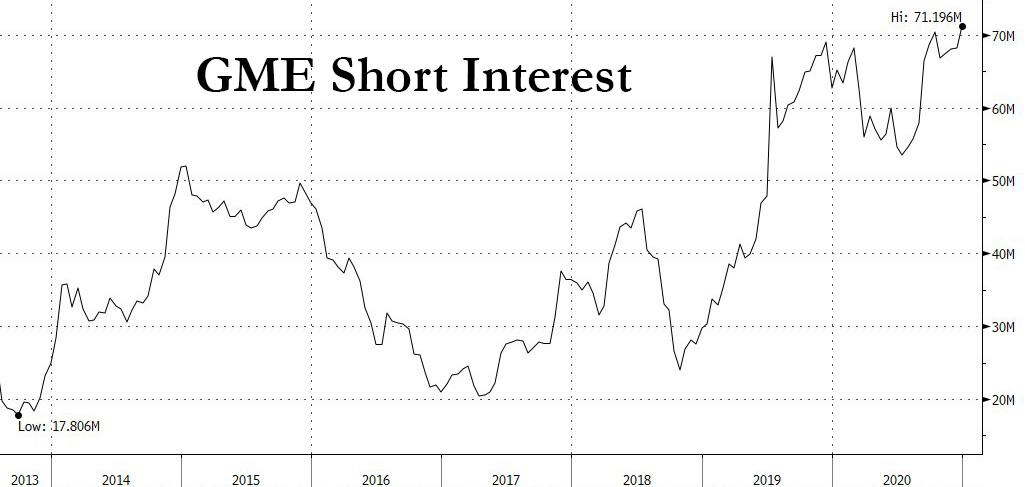
"While older existing shorts have been covering some of their positions due to a profit-loss based short squeeze, there is a queue of new short sellers wanting to get short exposure in GME after its recent run-up,” Ihor Dusaniwsky, S3’s managing director told Bloomberg.
One thing we do know is that the pain for the shorts has been immense, having suffered more than $3.3 billion mark-to-market losses this year (incidentally, Gamestop should immediately announce an equity offering and use the proceeds to pay down its $1.2 billion in debt, although since no institution would ever buy GME at this price, the company would have to pull at Tesla and announce an At The Money offering to the same redditors who pushed it to this level, and maybe to the stranded shorts).
And while it is unclear if the squeeze will continue - Reddit traders are known for having a relatively short attention span - one thing we do know is that the same strategy of going long, and ideally unleashing the Reddit herd, on the most shorted names will continue to make huge profits in this absolutely insane market.
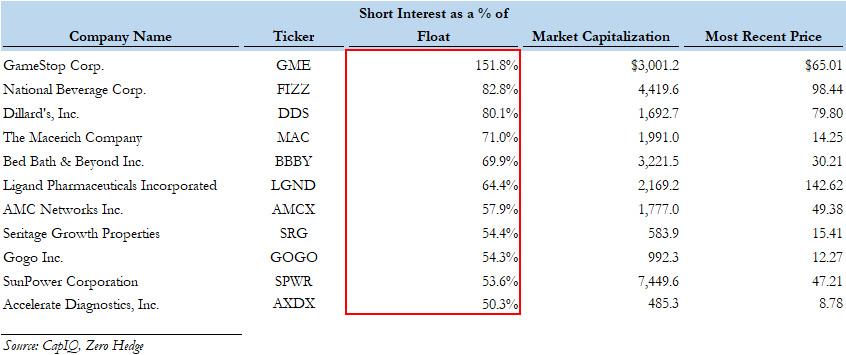
So for all those who wish to ride the next Gamespot to untold riches and force a massive squeeze, we have done a little homework for you. Specifically, we have screened through the Russell 3000 and picked the companies that are the top candidates for a (forced) short squeeze: those whose short interest at a % of the float is > 50%. The 11 "hjts", which are incidentally headed by GameStop, are shown below.
An equal-weighted basket of these 10 stocks has more than doubled off the March lows and is accelerating in the last few days...
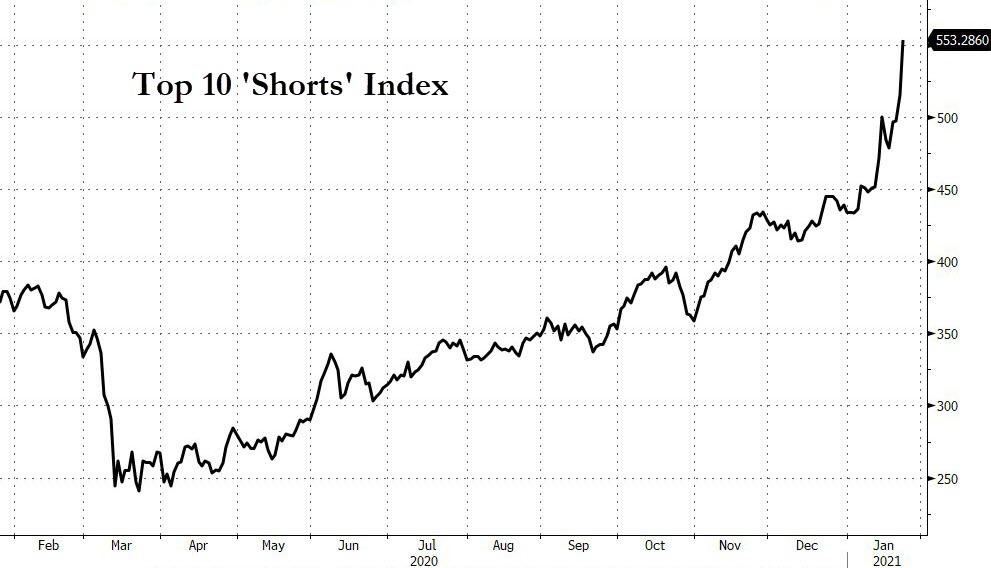
For those who wish to gamble their next stimmy check and frontrun the next reddit-raid, the best move would be to buy equal amounts of the 10 companies (ex GME) and just wait for the short squeeze panic to unroll. Yes, there is a risk that the entire stimmy will be lost, but that would require logic and fundamentals to matter again... and we just don't see that happening any time soon.
Investing Legend Sees "Spectacular" Crash In "The Next Few Months"
Two weeks ago, investing icon Jeremy Grantham turned apocalyptic and warned that the "Bursting Of This "Great, Epic Bubble" Will Be "Most Important Investing Event Of Your Lives." Since then the market has generally continued to melt up, yet Grantham's conviction that all this will end in tears has only grown, and in an interview with Bloomberg today, the co-founder of GMO who correctly called the last two crashes, now predicts that Joe Biden’s economic-recovery plan will propel stocks to perilous new heights, followed by an inevitable crash.
“We will have a few weeks of extra money and a few weeks of putting your last, desperate chips into the game, and then an even more spectacular bust,” the value-investing legend said in a Bloomberg “Front Row” interview.
“When you have reached this level of obvious super-enthusiasm, the bubble has always, without exception, broken in the next few months, not a few years.”
Amid market euphoria the likes of which have - literally - never been seen before as the following chart from Citi shows...
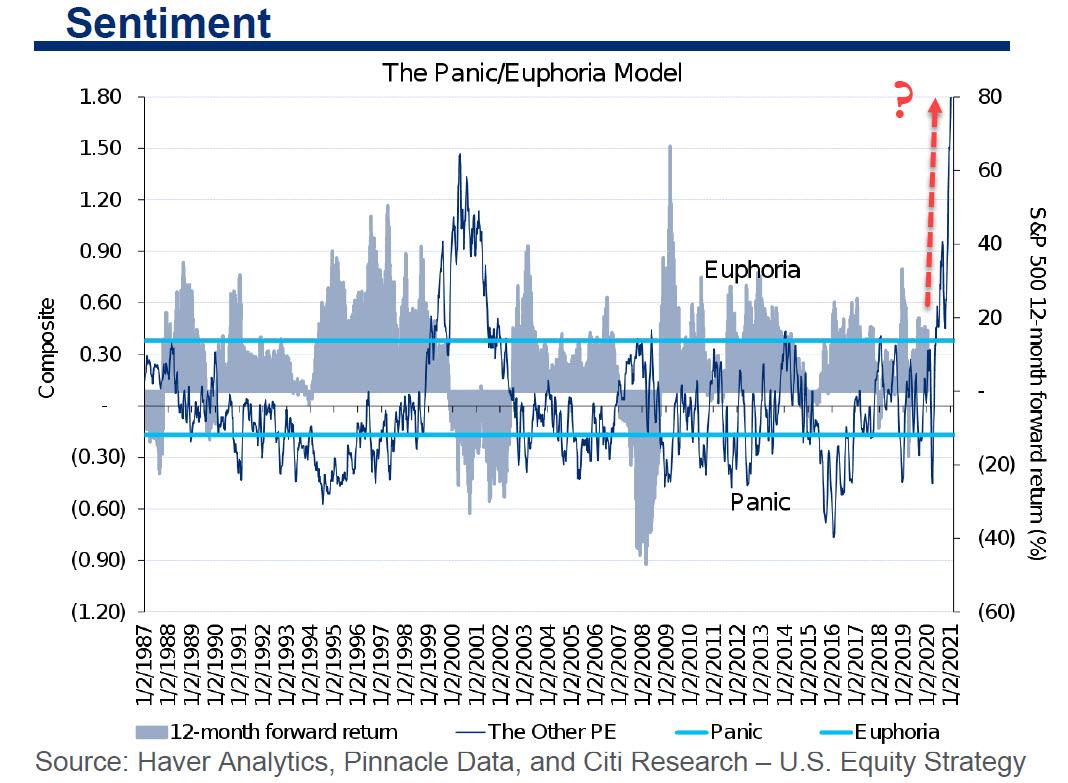
... and which prompted Citi, BofA and Goldman to all warn that a selloff appears imminent, and which was fueled by risk-taking behavior funded by the latest round of pandemic-relief checks, Grantham has “no doubt” at least some of the $1.9 trillion in federal aid Biden is seeking from Congress will end up being spent on stocks instead of food or shelter.
While that will help push stocks even higher, Grantham then sees it all ending in tears, or rather a collapse rivaling the 1929 crash or the dot-com bust of 2000, when the Nasdaq cratered 80% before recovering thanks to trillions more in Fed "stimmy" checks.
And while some (increasingly fewer) investors claim that today’s valuations are justified by the growth potential of transformative technologies and new business models, Grantham, 82, dismisses that argument as fanciful, and rejects the popular theory that the Federal Reserve can cushion or even the next crash with even more QE or easing.
“At the lowest rates in history, you don’t have a lot in the bank to throw on the table, do you?” he said.
Unfortunately for Grantham, and his now cemented reputation as a perma-bear who misses out on rallies, the stock market has sneered at all warnings it will crash and just keeps on rising.
To be sure, as we reported last year, GMO’s bearish stance has been costly as assets under management fell by tens of billions of dollars during the decade-long bull market, as the firm steered clear of growth stocks. Then in April, GMO doubled down, insulating its portfolios from directional bets on the market and largely missing out on the second leg of the 2020 rebound.
As Bloomberg notes, Grantham thought the economy was on shaky ground even before the pandemic and he was concerned about the steady decline in U.S. productivity, warning that the Fed had only succeeded in blowing out the inequality and income gap to record wides, amid worries that the profit-at-all-costs nature of American capitalism was destroying the environment and fraying the social fabric.
For Grantham, the combination of fiscal stimulus and emergency Fed programs led to “spectacular excesses” and pushed an already overvalued market into bubble territory.
Echoing BofA's earlier note, Grantham believes that the Fed's "Immoral hazard" will have other devastating consequences as well:
“If you think you live in a world where output doesn’t matter and you can just create paper, sooner or later you’re going to do the impossible, and that is bring back inflation,” Grantham said. “Interest rates are paper. Credit is paper. Real life is factories and workers and output, and we are not looking at increased output.”
As a reminder, earlier today, BofA's CIO Michael Hartnett - who is similarly concerned about the near-future - warned that asset price (hyper)inflation will eventually drag Main Street inflation higher, risking a disorderly rise in bond yields, which results in a taper tantrum, tighter financial conditions and "volatility events", i.e., a market crash.
Grantham agrees and warns that the threat of inflation is the biggest risk, which is why he also thinks that bonds are risky. He also has reservations about gold because it generates no income. And in his view Bitcoin is make-believe nonsense.
In short, he is an asset manager who sees no attractive assets, and who is prohibited from shorting because the Fed will just keep ramping prices ever higher.
While selling everything and holding cash is one option, Grantham said his best advice for long-term investors is to focus on low-growth stocks that are cheap relative to benchmark indexes, emerging markets and companies fighting climate change with renewable energy and electric-car technology.
“You will not make a handsome 10- or 20-year return from U.S. growth stocks,” he said. “If you could do emerging, low-growth and green, you might get the jackpot.”
All this and much more in his full 38 minute interview with Bloomberg's Erik Schatzker below:
d
The Big Short Squeeze - Did Michael Burry Just Make A Killing In Gamestop?

Update (1700ET): After today's debacle in Gamestop's share price, our memory was jogged of an article from late 2019: "Why 'Big Short' investor Michael Burry is going long on GameStop, the video-game retail titan that's been crashing all year "
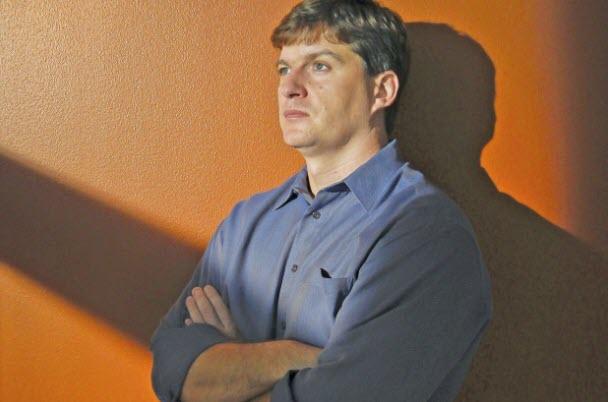
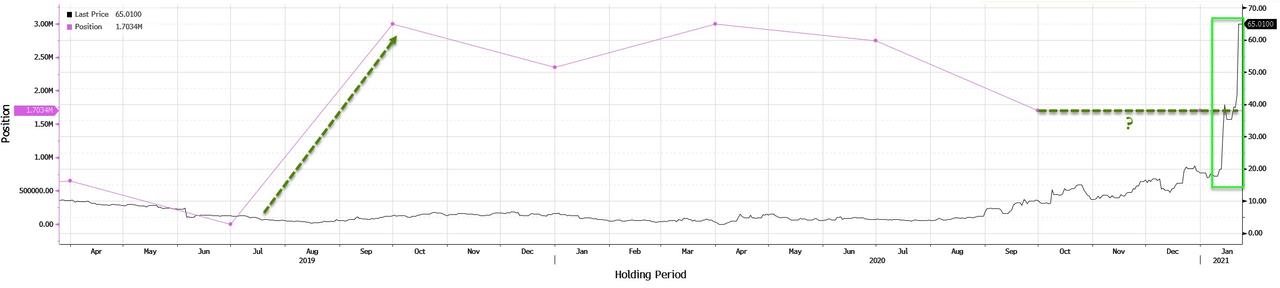
In August 2019, none other than Michael Burry, the famed "Big Short" investor who predicted (and profited greatly from) the subprime-mortgage crisis of 2008, had taken a massive 3 million share position in the video game retailer in his hedge fund Scion Asset Management.
His reasoning for the position at the time:
The beleaguered video-game retailer is getting an extension of life thanks to Sony and Microsoft, as both console makers are putting disc drives in their next-generation game consoles.
In an interview with Barron's around the same time, Burry said GameStop's position "looks worse than it really is."
With GameStop’s stock down so much this year, Burry thinks it is an opportune time for the company to buy back its shares.He noted there may be mechanical selling by quant-oriented funds because of new lease accounting guidelines that went into effect earlier this year. The new guidelines drove GameStop’s leverage ratios higher, he says, while nothing has changed fundamentally.“Technical factors driving the stock to lows has created an opportunity for substantial buybacks at below private market prices,” Burry said.“There is no better use of capital [than buybacks].”
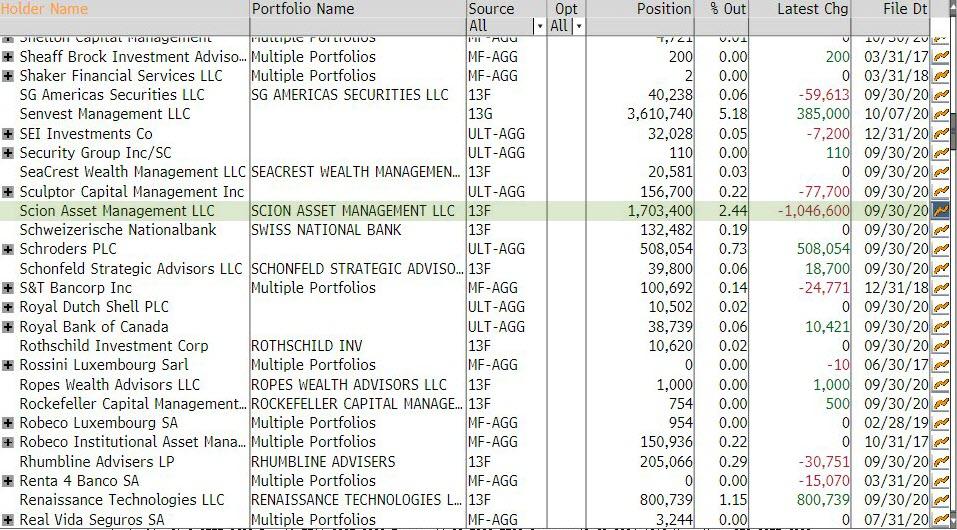
The latest data shows that as of Q3 2020 filings he still had 1.7mm shares...
Source: Bloomberg
So the question is - did Burry sell any more in Q4?
Source: Bloomberg
Or did he just make another killing on the back this market bubble's fantasy traders?
Rather ironically, and extremely presciently if he held on until today, Scion’s letter at the time noted the short interest for GameStop represented more than 60% of the shares outstanding.
* * *
Update (1600ET): The bell finally rang for the end of this monstrous day for GME shorts.
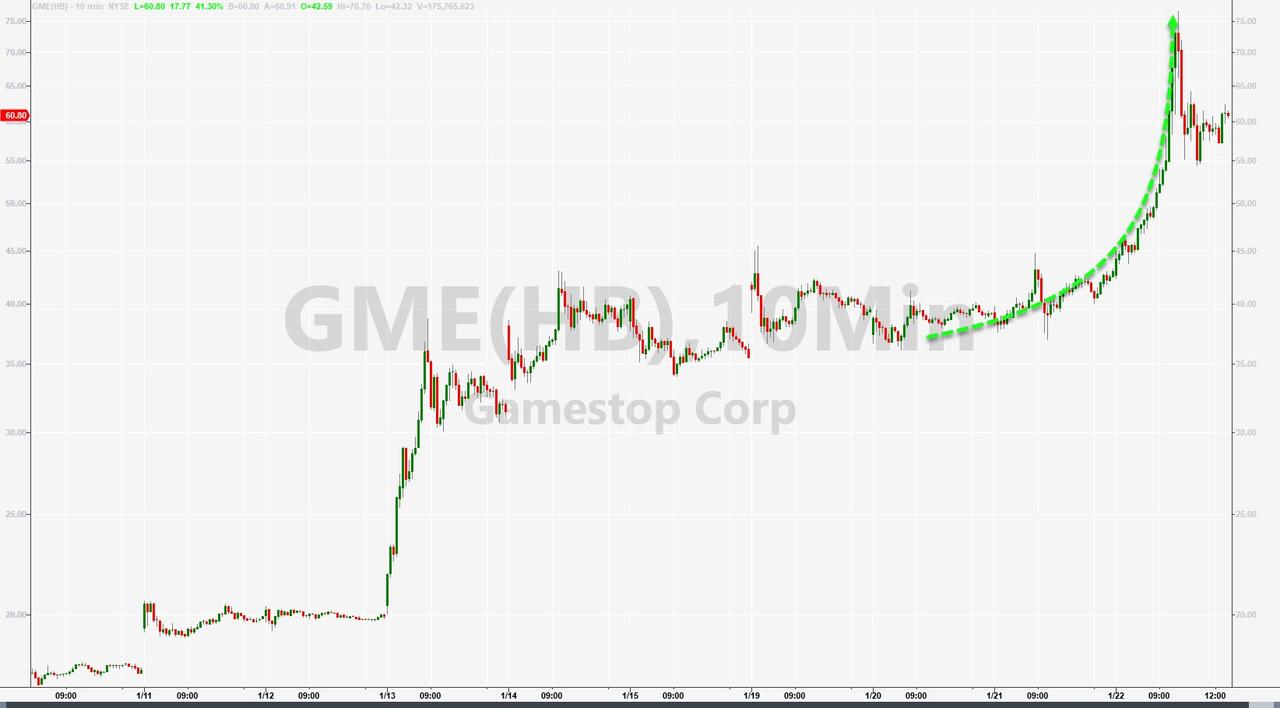
Which sent the stock to all-time-record highs...
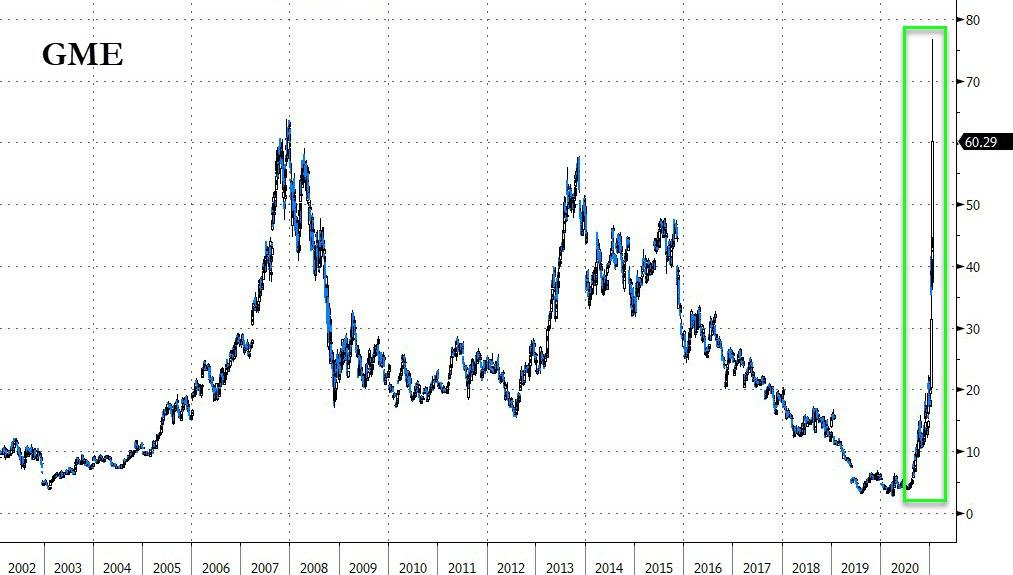
And that insane spike was triggered by one of the biggest general market short squeezes we have ever seen...

And levered up by an enormous - and just as insane - spike in call-buying!!
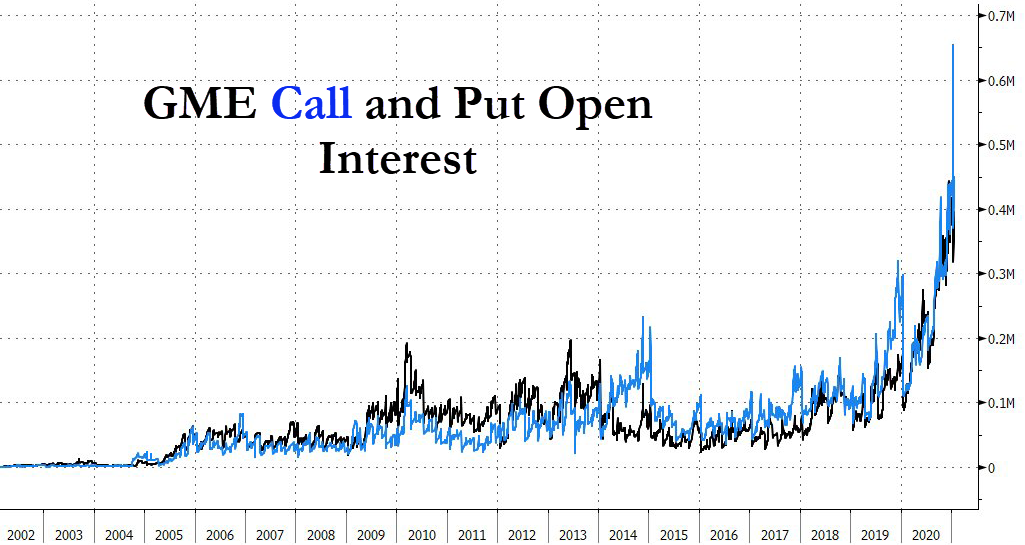
It appears to us that a certain group of investors is going to need the market to teach them an ugly lesson in reality... if The Fed will ever allow it!
* * *
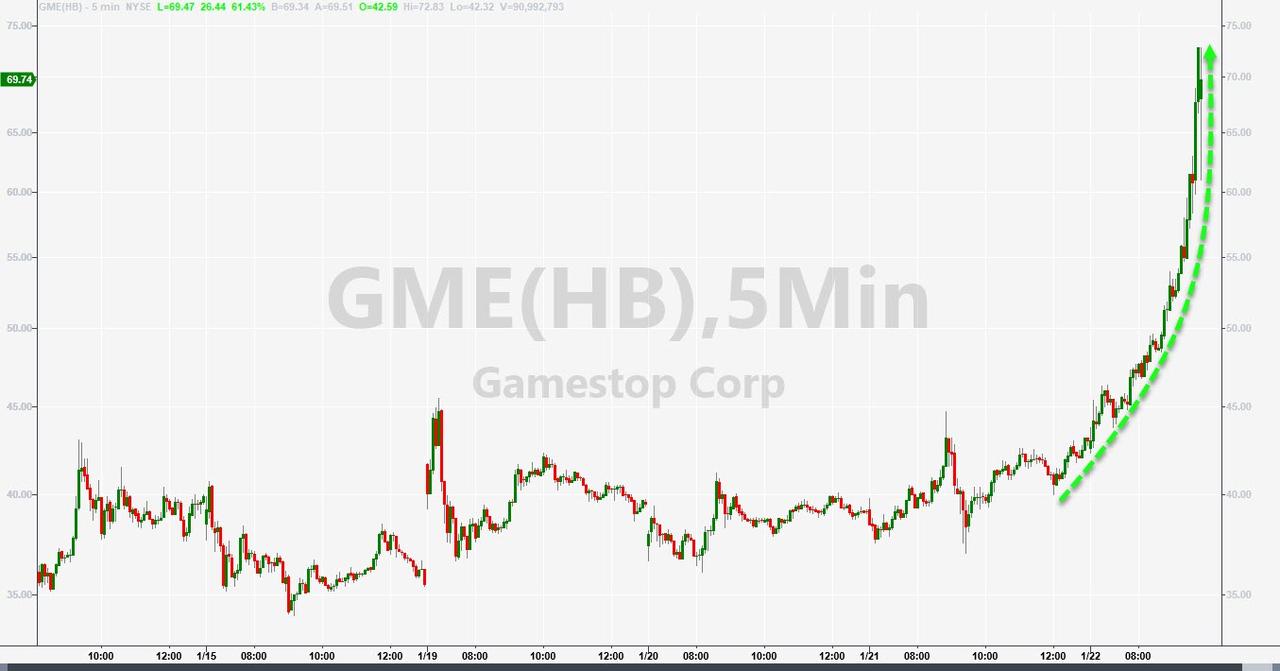
Update (1250ET): An hour later and things have gone just a little bit turbo. After being halted on volatility (twice) literally minutes after we suggested it...
... GME was trading up at almost $73, up over 70% on the day...
* * *
Update (1155ET): Gamestop is screaming higher again today, breaking $50 for the first time since 2013...

Until today, the last few squeezes had been sold...
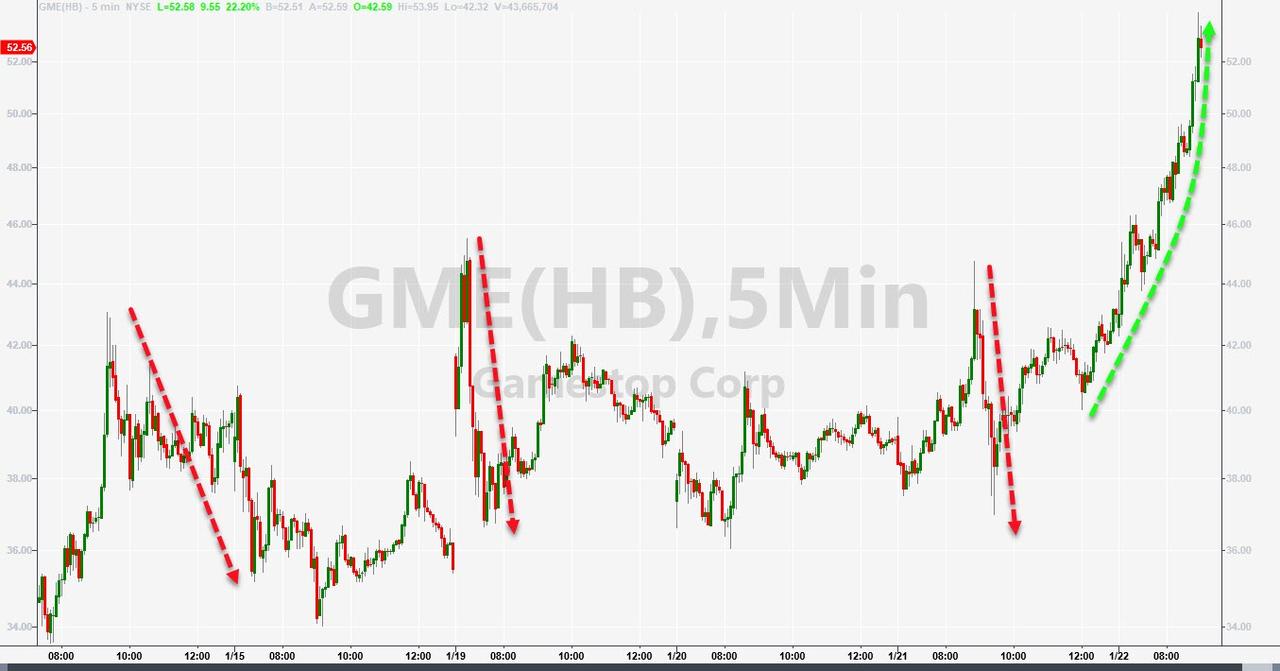
But as we noted on Jan 19th...
No one should be that surprised considering this farce...
...and the Hertz-style buying-power of a 'murder' (we believe that is the plural) of Reddit-Gen-Z'ers steamrolling hedge funds.
And with borrow running at 23%, we wonder, could this be the next Volkswagen?
Which incidentally reminds us of a simple trading rule we first presented back in 2013: the easiest way to generate alpha in this market - where nothing has made sense for the past decade - is just to go long the most shorted stocks.
* * *
Citron Research's Andrew Left released a brand new letter Friday morning from a new Twitter account, stating he will "no longer be commenting on GameStop" due to an "angry mob" that has "spent the past 48 hours committing multiple crimes that [he] will be turning over to the FBI, SEC, and other governmental agencies."
Left appears to be referring to harassment his family and friends have received since revealing his GameStop short thesis, just hours ago. Zero Hedge has confirmed the new Twitter account is run by Left.
Left starts his letter by saying: "What Citron has experienced in the past 48 hours is nothing short of shameful and a sad commentary on the state of the investment community."
"This is not just name-calling and hacking but includes serious crimes such as harassment of minor children. We are investors who put safety and family first and when we believe this has been compromised, it is our duty to walk away from a stock," he continues.
"We hope that government enforcement will eliminate this problem for all future market commentators whose families get terrorized by people who naively think they are anonymous. Family First," the letter ends.
Recall, earlier this morning, we posted a report about how Citron's streaming video regarding GameStop was suspended yesterday due to "hacking attempts".
Left was forced to stop his stream, explaining on Twitter that too many people were trying to access his Twitter account at the time. Twitter locked his account as a precaution, Bloomberg reported Thursday night, and eventually had to work with Left to get it reinstated.
"Too many people hacking Citron twitter, will record and post later today. $GME going to $20 buy at your own risk," Left tweeted mid-day on Thursday.
Left took to YouTube later in the day to finish the video he had started. “I’ve never seen such an exchange of ideas of people so angry about someone joining the other side of a trade,” he said.
"This is a failing mall based-retailer," Left starts by saying.
"You can get mad, you can hack my account, you can go to Twitter, you can sign on and call me every name - but if you wanna save the company, go out there and actually buy something from GameStop. That's the only way you're going to be able to save the company. Other than that, the more you buy, I'm sure there will be supply on the other side," Left concludes.
You can watch Left's full video explanation of his GME thesis here:
Chagall and the art of everyday enchantment
Lessons in finding delight from the great Russian-French artist
On Wednesday, I listened as President Biden gave his inaugural address, a message of unity and hope, of facing the “dark winter” ahead with perseverance. When he went through the litany of what we are still facing — “an attack on our democracy and on truth, a raging virus, growing inequity, the sting of systemic racism, a climate in crisis” — I felt moved, and was reminded of a quieter but persistent sadness that I’m finally able to name. A deepening sense that perhaps yet another side-effect of the current state of the world is that we are losing our habits of celebration and delight. Like a muscle weakened from lack of use, our capacity to celebrate our own lives on a regular basis has lessened. As though it is too risky to hold space for joy.
And this is why, in the grey afternoons and dark evenings of late, I have found myself continually thinking about the Russian-French artist Marc Chagall, whose colourful, whimsical work I have long loved.
Chagall’s entire oeuvre is an expression of a romantic imagination, and a commitment to celebrating a love of life, despite its inevitable sorrows. Not as a means of mindless or childish escape, but rather to reinvigorate in us a childlike wonder about the world. An effort that seemed to be at the heart of Chagall’s own considerations when he created those bold reds, deep blues and strokes of bright yellow and orange on tablecloths, canvases, walls, stained glass, paper and more.
One of the early pioneers of European modernist painting, Chagall’s work has been celebrated for more than 100 years. Since this time last year, there have been a dozen or more Chagall exhibitions shown across the world, some singularly themed and some featuring his work, whether live or online due to Covid-19. This winter alone, exhibitions are planned in Hebei and Paris, with others in Atlanta and Frankfurt already scheduled to open later this year and 2022, respectively.
Many years ago, in one of my previous homes, I had a framed print of Chagall’s painting “Birthday” (“L'anniversaire”) hanging on the wall above my bed. I distinctly remember choosing that place for the picture because I wanted to be reminded on a daily basis that life always holds the possibility for enchantment. In “Birthday”, Chagall uses verdant greens, brilliant reds, pops of blue, yellow and orange deftly contrasted with swaths of black, to depict a scene of two lovers.
The figures of a man and a woman float in the centre of a room. She is wearing a black, shapeless dress with a frilly white collar open around her pale neckline. Her feet in their black-heeled shoes hover just a few centimetres off the vibrant red carpet. Holding a bouquet of flowers, she faces an open window, from which we can see the road possibly leading into Chagall’s beloved Vitebsk. But the woman’s eyes are set on her love, the man who’s floating above her, his swanlike neck curved impossibly backwards to reach her pursed lips for a soft kiss.
The room that contains them is sparsely furnished. A modest bed is backed up against a tapestry on the wall. A narrow orange-brown desk is topped with a pretty blue runner and a cake waiting to be cut. The painting depicts the artist and his fiancée Bella Rosenfeld, a familiar face in many of his works, and the image was completed in 1915, after his return from Paris to his native Russia, and just a few weeks before their marriage.
Years later, when I saw the original painting for the first time, it was by mistake. I bumped into it while walking through the Museum of Modern Art in New York. I can still conjure up the emotion I felt as I took a few steps back to really see it. My smile was so large that I suspect it could have been audible.
Somewhere along the way, most of us accept the narrative that after a certain age, romance and enchantment is largely unrealistic and impractical in the midst of hard facts and responsibilities. But Chagall wanted to stir people to another plane of existence, one where the daily things we take for granted could be seen with a new light of reverence, infused by the ideal of love to which he was so committed.
Chagall understood himself as hovering somewhere “between Heaven and Earth”. He saw the world, and his life, with a mind tilted towards the mystical. His motifs — abstract floating figures, musical instruments, birds and smiling cows, goats and donkeys, winged angels in human scenes of marriage or birth — were ways for Chagall to depict in his work not only the sorrows the world had to offer, but also the beauty, nature, human connection and, yes, love, even in the midst of grief and pain.
The painter was no stranger to the vicissitudes of life. He was born in 1887 in a small Hasidic Jewish community near Vitebsk, in what is now Belarus, then part of the Russian Empire. He lived through two world wars, Nazi persecution, the ridicule and destruction of his work by those who once praised it, a time of exile, and the sudden death of his first wife. He understood the harshness of the world and, during the second world war, his work reflected this. Yet Chagall was able to maintain a sense of playful and vibrant delight, creating breathtaking and vivid work right up until his death in 1985 at 97 years old.
From the sheer expanse of his oeuvre, from paintings, to stained glass, to etchings and printmaking, to ceramics and stage set design, Chagall seemed to create with one eye wide open on the realities of the world, and the other constantly fluttering open against the realities of his own heart, a heart capable of meditating on joy and sorrow in equal measure.
In like manner, he wanted his work to appeal not only to the eyes, but to “the very heart of others”. In early images such as “Bathing of a Baby” (1916) or “Visit to Grandparents” (1915), Chagall pays homage to the ordinary, reminding us that to be able to do such simple things is a gift. Even in his years of deep sociopolitical reflection and grief, painting the horrors of war and the persecution of his people, the work was still undergirded by a deep love of his people, his country and the world.
To look at the span of Chagall’s work over the years is a reminder that to celebrate and to grieve often go hand-in-hand. More often than not, life gives us cause to do both at the same time. Yet maybe we are not well-trained in acknowledging the good of our lives without some sense of guilt or shame, knowing that so much is wrong with the world, and that life is never fair. Maybe it’s a discipline worth practising, to find ways to stir our imagination and to fan the fire of joy, even if on some days we are simply fanning embers.
President Biden said something in his speech, to the effect of not allowing this moment to harden our hearts. He was speaking about his vision of unity and healing for the American nation, but I heard it as a wider invitation beyond political strife and this country’s borders. I think about these days at hand, and imagine if there could be a Chagall clarion call of the current moment, it would be one resounding with an invitation to use love as a tuning fork for how we move to the cadence of our own lives, one eye on the world, and the other fluttering against the beat of our own heart.
Big Tech Stocks Are Back. What’s Behind the Nasdaq’s 4% Rally.
The sleeping giant that is Big Tech has awoken—and that’s been great news for a stock market that was starting to look a little tired.
It was only in our Jan. 18 column that we marveled at the S&P 500’s ability to gain nearly 8% since Aug. 31 despite the FAANGs plus Microsoft (ticker: MSFT) sitting out the rally. That all changed this past week as the tech titans found themselves suddenly back in fashion.
The Dow Jones Industrial Average rose just 182.72 points, or 0.6%, to 30,996.98 this past week, and the S&P 500 gained 1.9%, to 3841.47. The tech-heavy Nasdaq Composite jumped 4.2%, to 13,543.06, its biggest gain since the week ended Nov. 6.
Credit Netflix (NFLX), which soared 13% this past week after adding far more subscribers than Wall Street had been modeling, for helping the Nasdaq soar. But it wasn’t the only FAANG on the move, with the rest of the group— Facebook (FB), Amazon.com (AMZN), Apple (AAPL), and Google parent Alphabet (GOOGL)—averaging a gain of more than 8%. They were helped by earnings optimism following Netflix’s release and the fact that 10-year Treasury yields stopped going up. Rising yields point to a stronger economy and make fast-growing companies look less attractive on a valuation basis.
Of course, the Federal Reserve will have something to say about that following this coming week’s Federal Open Market Committee meeting. Fed Chairman Jerome Powell and his colleagues had to tamp down fears of an early end to their bond buying earlier this month, so don’t expect him to rock the boat. If anything, he will continue to call on the federal government to help bail out the economy with another round of stimulus—and he will promise to remain on hold for as long as the economy needs it.
“[We] expect Chair Jerome Powell will use his post-meeting press conference to reinforce the message that the Fed would be tightening policy ‘no time soon,’” writes Capital Economics economist Paul Ashworth. “The Fed clearly views its short-lived tightening several years ago as a mistake and is much more likely to err on the side of caution this time around—to avoid another ‘taper tantrum’ in the bond markets.”
But what’s really needed now is progress in combating Covid-19. As the virus goes, so goes the market. In 2020, that meant watching the change in the number of Covid cases for evidence that the reopening was continuing apace. Now, the market is taking its cues from the pace of vaccinations, in particular the percentage of the population that is vaccinated weekly, explains UBS strategist Keith Parker.
The small-company Russell 2000 has been especially responsive to accelerations in the pace of dosing—the number of people getting vaccinated is now over 900,000 a day—and could get a boost if that number continues to increase. By Parker’s math, a doubling in the rate could lift the index by an additional 6% to 9% by the middle of the second quarter, and the S&P 500 by 3% to 5%.
“The current number of allocated U.S. doses points to potential for the pace to double, though bottlenecks still remain,” he writes. “Removing bottlenecks for administering doses would present an upside case near-term in our view.”
That doesn’t mean we shouldn’t expect a correction—and perhaps soon. Lori Calvasina, chief U.S. equity strategist at RBC Capital Markets, notes the S&P 500 has been following a pattern typical of recessions since 1990, one that sees the recovery occur in three phases: an initial recovery, a period of consolidation, and a second rebound.
The initial recovery has lasted an average of 10 months, with an average return of 48%. That was followed by a period of consolidation that lasted from two to seven months and saw stocks sink an average of 17%. That was then followed by another rally that saw stocks gain an average of 19%.
The current bounce from the March lows has lasted about 10 months and produced gains of just over 71%. If the market follows the historical pattern, it should pull back by spring—but that will be a buying opportunity. “My assumption is that we’ll see a continuation of the recovery rather than a double-dip recession,” Calvasina says. “If you think that, you have to buy the dip.”
But it may also be time to add some protection to your portfolio. The market’s demand for risky, high-beta, cyclically oriented stocks has meant that stocks with low volatility have gotten left behind. The return differential between the MSCI USA Minimum Volatility Index, which owns a portfolio of low-volatility stocks, and the MSCI USA Index is now at its widest level since 1999, says John Kolovos, chief technical strategist at Macro Risk Advisors. Owning some of these left-behind companies could be the way to add some ballast to a portfolio in case of a drop, Kolovos says.
“Buy some utilities, buy some staples,” he explains. “Those are the most oversold in an environment of market froth and excess.”
Just be sure to sell them again once the correction is over.
It’s the Year of Digital Infrastructure. Here Are 4 Stocks to Buy.
Soaring demand for bandwidth and the rollout of 5G helped propel tech stocks higher in 2020. So it’s surprising that cell towers and data centers—two of the industries tied to those themes—aren’t winning much love with investors.
Rising interest rates are partly to blame, pressuring the economics of leasing tower space and financing new data centers. Investors have favored cyclical sectors more closely tied to an economic recovery. While the tech-heavy Nasdaq Composite index soared 44% in 2020, tower stocks returned an average of 11%, including dividends, while data centers returned an average of 8%. Both sectors could catch up and provide solid returns in the year to come.
Fifth-generation wireless is still in the early stages, with penetration at just 4% in North America. It’s expected to reach 17% in 2021 and 37% by 2022, according to Morgan Stanley. For data centers, information-technology budgets are expected to grow 1.4% in 2021 after contracting 2.5% in 2020. Mobile-data usage is rising at a 30% annualized clip, and telecom companies AT&T (ticker: T), Verizon Communications (VZ), and T-Mobile US (TMUS) are boosting their capital spending.
Cell towers, which rent space for antennas and other wireless equipment, should be long-term beneficiaries of the 5G rollout. Telecom companies just spent $95 billion on auctions for wireless spectrum known as C-band. They’ll need to upgrade antennas, radios, and other equipment, starting a new growth cycle for the tower companies.
At the same time, data centers are benefiting from a shift to cloud-computing, digital storage, and other tech trends accelerated by the pandemic.
Two tower companies are particularly well positioned in the year to come: Crown Castle International (CCI) and SBA Communications (SBAC). Among data centers, Equinix (EQIX) and CoreSite Realty (COR) look appealing. The stocks are all structured as real estate investment trusts, or REITs, with Crown Castle and CoreSite each yielding more than 3%.
The merger of T-Mobile US and Sprint temporarily clouded the picture for tower companies and weighed on their stocks in 2020. The consolidation removed an important customer from the market. T-Mobile, the No. 3 wireless player in the U.S., plans to decommission 35,000 legacy towers used by Sprint.
Most of the leasing losses are initially expected at American Tower (AMT), the largest tower player, although Crown Castle and SBA will also lose Sprint towers over time. Ultimately, less than a third of Sprint’s legacy towers are likely to survive, according to LightShed Partners analyst Walter Piecyk.
Those Sprint losses are now factored into Wall Street estimates. Crown is forecast to generate $6.71 a share in adjusted funds from operations, REITs’ preferred measure of operating earnings, in the coming year, up from $6.08. SBA’s AFFO is seen rising 9%, to $10.25 a share. Revenue could rise 5% for both companies, according to consensus estimate, as towers get C-band-related antennas and other equipment upgrades.
The three major wireless carriers are each adding about $2 billion to their capital-expenditure plans in 2021. T-Mobile is making the biggest relative boost, with spending forecast to hit $13.6 billion this year, up from $11.4 billion in 2020; it has to upgrade equipment to improve performance on its 2.5 GHz network, which was bolstered by its Sprint deal.
Despite losing Sprint, the wireless marketplace is actually getting more crowded, with satellite and cable companies angling to get into the business. Dish Network (DISH) plans to build a 5G network with 15,000 sites by June 2023. Comcast (CMCSA) and Charter Communications (CHTR) have been buying spectrum and may have spent billions on C-band; final results are expected to be released next month. They could start deploying some of it on towers over the next few years.
Overall, Piecyk estimates that the industry should get back to double-digit growth in AFFO.
While Crown and SBA are general beneficiaries of the 5G buildout, there are specific reasons to own each stock. Crown is a bet on small cells and the revival of its fiberoptic business.
The company invested more than $11 billion in fiber in recent years, mainly selling the service to enterprise customers, while adding small-cell nodes for wireless, which allow providers to fill in service gaps in dense population areas. It has been a controversial strategy; the returns and growth on fiber are much lower than on large-scale macro towers, and Crown has been under pressure by activist investor Elliott Management to stop investing in small cells and enterprise fiber.
The fiber business has weighed on Crown’s multiple, but it may be the value in the stock, says Cowen analyst Colby Synesael, who notes that Crown recently reshuffled the leadership of its fiber group in an effort to jump-start the turnaround. Since then, Dish has signed a contract to use Crown’s fiber along with up to 20,000 of its towers to help build out its new 5G network.
Morgan Stanley analyst Simon Flannery calls Crown his top pick in towers. He sees the stock hitting $187, based on a multiple of 26 times 2022 estimates of $7.10 a share in AFFO. Crown historically trades at an average 21 times, but strong tower-leasing trends warrant a higher multiple, he says.
SBA is a more traditional bet on domestic wireless towers, which have the best business model in telecom infrastructure, Flannery says. They account for 75% of SBA’s revenue; more than 60% of the company’s towers are in the top 100 domestic markets.
The C-band auctions should be a “significant driver” of leasing in the second half of 2021, Brendan Cavanagh, SBA’s chief financial officer, recently told investors.
“U.S. towers are the gold standard, and SBA has the most exposure to the business,” says MoffettNathanson analyst Nick Del Deo, who calls SBA his top tower pick. He expects the stock to hit $320 in the next 12 months, from a recent $272.
While tower companies are poised to benefit from our ever-growing wireless connectivity, data centers are the facilitators of our addiction to data. Tech trends such as cloud computing, outsourcing of corporate servers, and increased demand for data analytics are driving demand.
Cloud capex is expected to grow 16% in the first half of the year and 10% in the second half, according to Morgan Stanley.
CoreSite has actually missed potential business in recent years as the company ran short of inventory. But it’s now coming off a building spree in core markets such as the San Francisco Bay Area, Northern Virginia, and Los Angeles. AFFO growth is expected to jump from 5.4% this year to 7.3% in 2022.
“They generate the best returns on invested capital, but the stock trades in line with the group,” Del Deo says. At a recent $126, CoreSite trades at 23 times AFFO estimates for 2021. Del Deo has a price target of $142 on the stock.
Equinix trades at a premium to CoreSite, at 27 times Wall Street’s estimate for 2021 AFFO—but it’s the largest and arguably best-positioned data-center owner. Tenant turnover is low, and the company’s global portfolio of facilities in urban areas can’t be easily replicated. Equinix has a large development pipeline, including expansion plans in India, and it has built strategic alliances with several tech giants, including Microsoft (MSFT), Amazon.com (AMZN), and Cisco Systems (CSCO).
Credit Suisse analyst Sami Badri has Outperform ratings on Equinix and CoreSite. “Both companies have built highly connected ecosystems that offer key advantages to their customers versus other data centers,” he says.
Badri has a $915 target on Equinix, near the top of Wall Street estimates. That may be a stretch, and would require the stock to expand its already premium multiple. But earnings growth alone could drive gains in the year to come. At a consistent 27 times AFFO, the stock could hit $800 in a year, an 11% gain.
Towers and data centers may be the sleepy part of the technology market. But they could also be the least volatile part of tech in the coming year. In 2021, it’s worth paying up for some stability.
New Covid-19 Strains: What Scientists Know About Coronavirus Variants
New versions of the novel coronavirus are spreading across the globe. Researchers fear the new lineages may spread more easily—and one may be more deadly.
Scientists around the world are scrambling to learn more about previously unknown variants of the coronavirus that seem to spread from person to person more readily than other versions of the Covid-19-causing pathogen—including one variant that may also be more deadly.
A fast-spreading variant, known as B.1.1.7, was identified in December in the U.K., leading to travel restrictions and a widespread lockdown there. Since then, the U.K. variant has been detected in China and other countries, as well as in Colorado, California and Florida.
Now there’s preliminary evidence suggesting that the variant could lead to more deaths.
“We have been informed that, in addition to spreading more quickly, it also now appears that there is some evidence that the new variant—the variant that was first identified in London and the South East—may be associated with a higher degree of mortality,” British Prime Minister Boris Johnson said Friday.
In South Africa, meanwhile, doctors and researchers battling a second surge of Covid-19 cases are studying another new variant and what role it plays in the rising tide of cases there. The variant, known as B.1.351, has been identified in samples dating back to October. It hasn’t been detected in the U.S. Emerging data suggests that this variant could be better at evading antibodies, the protective immune-system proteins that keep viruses from entering cells, and that existing vaccines may need to be updated in order to be effective.
Here is what we know so far about the new variants and the genetic mutations that characterize them, as well as their potential impact on public health.
What is a viral variant?
Viral variants are new versions of a virus that arise as a result of small changes in its genetic code. Over the course of the pandemic, there have been several variants. Those that proved able to spread more efficiently have become more prevalent, while others fizzle out. “It’s just like natural selection, like evolution,” said Bettie Steinberg, a virologist and provost at Northwell Health’s Feinstein Institutes for Medical Research.
Why the concern about these particular variants?
Preliminary data from U.K researchers suggests that infection with the U.K. variant could cause more severe disease and potentially lead to more deaths. The data showed that patients infected with the variant had a higher risk of death than those infected with previous versions of the virus.
Britain’s top scientific adviser said preliminary studies show that the U.K. variant might be 30% to 40% deadlier than previous variants.
U.K scientists cautioned that a fuller understanding of the variant’s effects on health would emerge in coming weeks as more data on hospitalizations and mortality becomes available.
Some doctors were already worried that the new variants of the coronavirus could supercharge the spread of Covid-19, putting additional stress on hospitals and nursing homes when cases are near their historic highs.
Researchers from the London School of Hygiene and Tropical Medicine combined behavioral and epidemiological data on patterns of disease transmission with mathematical models to determine whether the U.K. variant is more transmissible than previously identified variants.
They found the new variant to be more transmissible than previous variants.
U.K. contact-tracing data show that patients infected with the new variant went on to infect more people than those infected with previous variants. Data also suggested that the viral load, or the amount of virus in the body, was higher among people infected with the new variant. The higher the viral load for individuals, the more infectious they tend to be.
Is it possible that the rapid spread of the new variants isn’t a result of increased infectiousness but instead of poor adherence to social distancing and other measures aimed at curbing contagion?
Scientists don’t think so, at least for the jump in cases in the U.K. As evidence, Prof. Neil Ferguson, an epidemiologist at Imperial College London and a member of a scientific panel that advises the British government on respiratory-virus threats, pointed to epidemiological data from November showing that cases of the new U.K. variant were exploding in the area southeast of London as coronavirus cases were falling in other parts of the country. The entire country was in lockdown during this period.
The situation may be different in South Africa, where researchers said human behavior might be playing a key role in the surge of cases. Millions of South Africans traveled widely in recent weeks, and tens of thousands had gathered in restaurants and bars and on beaches during the holiday season.
What gave rise to the new variants?
Like other viral pathogens, the coronavirus spreads by infecting cells and then reproducing within them, creating copies of itself that spread throughout the body and then are shed, potentially infecting other people.
The reproduction process involves copying the virus’s genetic code, which holds the instructions for building successive generations of virus particles, or virions. But the code isn’t always reproduced faithfully; sometimes the copying process yields mistakes that researchers have likened to typographical errors. This is what gives rise to new viral variants such as the ones that have emerged recently.
Some viruses have genetic codes of DNA, the same molecule that carries the genetic information in human cells. Other viruses, including the coronavirus, are based on a related molecule known as RNA.
Most RNA viruses lack a molecular proofreader, a protein that checks for mistakes and corrects them, so they “accumulate more typos more quickly,” said Bettie Steinberg, a virologist and provost at Northwell Health’s Feinstein Institutes for Medical Research. Coronaviruses, including the one that causes Covid-19, do have one and so tend to mutate more slowly.
Having a proofreader also makes coronaviruses three times the size of most RNA viruses, said Vineet Menachery, a coronavirus expert at the University of Texas Medical Branch. That gives them an advantage, he added: “It means they can encode more proteins to antagonize the immune response.”
Some scientists believe the new variants, which have a large number of mutations, arose in Covid-19 patients whose weakened immune systems allowed the virus to reproduce over long periods of time—giving it plenty of opportunities to accumulate multiple mutations.
High rates of infection in the population also add to the risk that new, potentially more harmful variants will emerge, infectious-disease experts say. And with the virus spreading quickly around the world, experts say they expect to see more variants crop up.
What about the mutations seen in the new variants?
The new variant that cropped up in the U.K. has about two dozen separate mutations, including some related to the prominent outcroppings that stud the coronavirus’s outer surface. It is this so-called spike protein that helps the virus infiltrate cells by binding to and then breaching their outer membranes.
In theory, a mutated form of the spike protein could boost the ability of a virus to attach to cells and thus enable it to infect with increased efficiency. Previous research has shown one mutation of note in the U.K. variant can make the virus more infectious, said Dr. Ravindra Gupta, a University of Cambridge virologist who ran the studies.
The South African variant has more than 20 mutations, including several affecting the spike protein. Some are in key spots where antibodies that prevent the virus from entering cells bind, scientists said, meaning they could potentially help the virus evade a person’s natural immune response.
The U.K. and South Africa variants share a spike-protein mutation that enables the spike to bind more tightly to the cell membranes, research suggests.
Do existing vaccines work against new variants?
While there is no final word yet on whether the existing vaccine made by Pfizer Inc. and BioNTech SE and the one from Moderna Inc. confer immunity to the new variants, scientists have expressed confidence that they do. For the U.K. variant, that confidence has been bolstered by recent preliminary studies, including one by BioNTech and Pfizer researchers showing that antibodies in the blood of vaccine-trial participants were effective at binding to the new variant’s mutated spike protein.
“Pfizer and BioNTech are encouraged by these early in vitro study findings,” Pfizer said in a Jan. 20 statement.
For the variants found in South Africa, which have a different constellation of mutations, scientists are more concerned.
The mutations “raise some questions about vaccine efficacy, but it’s important to note that the vaccines elicit a broad immune response…that targets several areas of the spike protein,” said Dr. Richard Lessells, an infectious-disease specialist at the University of KwaZulu-Natal in Durban, South Africa, and a member of the team that discovered the South African variant.
Pfizer and Moderna have conducted lab tests of their vaccines against several versions of the coronavirus and found that the vaccines were effective against all, according to the drugmakers.
The Centers for Disease Control and Prevention continues to urge people who are eligible for vaccination to get the shots. “Based on studies with other viruses containing similar mutations, CDC believes there will be little or no impact on immunity from natural infection or vaccination,” the agency said in December.
The agency said on Jan. 22 it had reached out to public-health agencies in the U.K. to learn more about the risks the variant poses and that it continues to closely monitor the situation.
How will scientists know for sure if these new variants spread more easily?
Scientists said that they had studied some of the new variants’ individual mutations but that it would be important to look at what happens when they appear together—as they do in the new variants. That research involves experiments in cells and in animals to test whether the new variants attach to and enter cells more efficiently; whether they replicate more readily; and, most important, whether they spread more easily. Scientists have begun to do some of that work already, with more experiments planned for the coming weeks.
Animal studies involving an earlier coronavirus variant convinced some scientists that its particular mutations made it more infectious, said William Hanage, a Harvard T.H. Chan School of Public Health biologist who specializes in infectious disease. That version of the virus also had a mutated spike protein.
What can be done to stay safe from the new variants?
Infectious-disease experts and public-health officials say it is important to continue to adhere to the familiar strategies for avoiding contagion, including social distancing, masking and hand-washing, as well as avoiding exposure to others indoors, especially where ventilation is poor. Extra care might be required in indoor gatherings if experiments confirm that the new variants are more infectious.
When SPACs Attack! A New Force Is Invading Wall Street.
‘Blank check’ firms known as SPACs are in pursuit of America’s hottest startups. Is the invasion a sign of a market euphoria that can’t last?
The hottest thing in finance is four letters long. Former NBA star Shaquille O’Neal has one. So does former House Speaker Paul Ryan. Same goes for silver-haired hedge-fund billionaire William Ackman.
It’s called a SPAC, and increasingly it is the favorite source of financing for private companies looking to go public. Richard Branson’s space-exploration firm Virgin Galactic Holdings Inc. SPCE 3.04% went public through a SPAC in 2019, and sports-wagering firm DraftKings Inc. DKNG -1.92% did so last year. Nearly 300 SPACs are now seeking deals, armed with about $90 billion in cash. And more are rolling out at a furious clip—so far this year, an average of five new SPACs launched each business day.
“If you don’t have your own SPAC, you’re nobody,” said Peter Atwater, founder of research firm Financial Insyghts.
SPACs—which stands for special-purpose acquisition companies—are essentially big pools of cash listed on an exchange. Their purpose is to find a private company, buy it and take it public quickly. Some on Wall Street call them “blank-check companies’’ because the investors backing the SPAC put up their money months before an acquisition target is identified, trusting the people running the show to find a good deal.
These deals are generating a lot of interest because they produce big paydays for their creators, make it easier for startups in hot industries such as electric vehicles to capitalize on a frothy run-up in the stock market and offer everyday investors a new path to a hot stock. When a SPAC buys a firm, it merges with it in a sort of accelerated IPO process—a so-called “reverse merger”—while bypassing the normal scrutiny an IPO receives.
But even some of the people getting rich off the blank-check boom caution that the euphoria could be part of a bubble that overvalues nascent companies. If it bursts, it could leave a few insiders as winners while saddling individual investors who got in late with big losses. Goldman Sachs Group Inc. Chief Executive Officer David Solomon warned on the company’s earnings call Tuesday that the flurry of activity isn’t sustainable. Goldman is one of the biggest banks benefiting from the SPAC boom.
For now there is no end in sight to the SPAC attack, which coincides with a vast run-up in risky investments that has everything from U.S. technology stocks to bitcoin soaring. The SPACs are pulling in more than 70% of all money raised through initial public offerings this month, up from nearly half last year and about 20% the year before, according to Dealogic data through Thursday. The 67 SPACs created this year have already raked in nearly $20 billion from investors. That is well above the total from all of 2019, which was a record before last year’s historic haul of $82 billion.
On Wednesday alone, six new SPACs launched: Queen’s Gambit Growth Capital —a company led entirely by women that shares a name with an opening sequence in chess and a popular show on Netflix —Legato Merger, Gores Metropoulos II, Oyster Enterprises Acquisition, TZP Strategies Acquisition and FoxWayne Enterprises Acquisition. Eight more went public on Friday.
Many of the 287 SPACs currently hunting for targets are looking for deals in hot sectors such as technology or electric vehicles, according to figures from data provider SPAC Research. Blank-check firms often seek deals valued at least five times as large as they are when including debt. That means deals adding up to several hundred billion dollars are likely to be completed in the coming months, analysts say, setting SPACs up to be a powerful force in markets. When a SPAC is launched, it has to merge with a target within two years, so the effects of this wave will continue for a while.
“When you have everybody talking about SPACs, it raises the issue as to whether or not there is an element of speculative mania,” said Roy Behren, managing member at Westchester Capital Management and a SPAC investor.
Blind pool beginnings
SPACS have actually been around for decades. Their predecessors—known as “blind pools”—had a shady reputation on Wall Street in the 1980s because they were tied to penny-stock fraud.
The first special-purpose acquisition company was created in 1993 by investment banker David Nussbaum and lawyer David Miller. SPACs turned hot for brief periods in the ‘90s, then again in the 2000s, only to fade with market crashes or a surge in traditional IPOs. New laws and regulations helped bolster their reputation, as did changes that made it easier for investors to get their money back before a deal went through.
The basic structure is the same now as it was then. A typical SPAC goes public on a U.S. exchange having raised money from investors with the promise of buying a company. The target, often a startup, then takes the SPAC’s place on the exchange, allowing public investors to buy its shares. If the blank-check firm doesn’t complete an acquisition, investors get their money back.
What some don’t like is that SPACs and the mergers they produce are negotiated behind closed doors and prices are less dependent on real-time demand from investors. In a traditional IPO, pricing can change until the night before shares start trading. Another concern is that companies going public through SPACs are allowed to more easily tout their long-term growth forecasts in splashy presentations on YouTube instead of staying silent as they would during a traditional IPO.
Former Securities and Exchange Commission Chairman Jay Clayton said last year that the agency is examining how blank-check company creators disclose their ownership and how any of their compensation is tied to an acquisition. Mr. Clayton’s replacement, Gary Gensler, is known for being a strict regulator.
Blank-check company proponents, meanwhile, note that traditional IPOs also often give unprofitable companies lofty valuations and tout the flexibility and speed that SPACs provide. The average time it takes for a SPAC to find a merger deal dropped from 17 months in 2018 to five in 2020, and many lately have needed less than that.
Telehealth startup Hims & Hers Health Inc. negotiated with SPAC Oaktree Acquisition Corp. for about four months before reaching a $1.6 billion deal in October that closed this week, the company’s co-founder and CEO Andrew Dudum said. That compares with the roughly 12 to 18 months he expected a traditional IPO to take.
“I’ve seen the benefit of my management team being ruthlessly focused on operations rather than fundraising,” he said. “That time has been valuable to the company.”
The creators of these blank-check vehicles can emerge as big winners thanks to how the deals are typically structured. They initially put up a small amount to cover expenses before the SPAC goes public and then are typically allowed to buy 20% of the company at a deep discount after the SPAC combines with another firm. This allows them to generate returns several times their original investment.
That is what happened to former Facebook Inc. executive and venture capitalist Chamath Palihapitiya, who created his first SPAC in 2017. He and the company he created to back the blank-check firm put in $112 million through the 20% rule and other investments, New York University School of Law Professor Michael Ohlrogge found as part of a recent study.
In 2019, the SPAC merged with Virgin Galactic to take it public. Virgin Galactic shares have surged, giving the company that had $238,000 in sales during the first nine months of 2020 a market value north of $8 billion. That means those shares and warrants today would be worth about $920 million, though filings show Mr. Palihapitiya recently sold some of his stock, potentially capturing some of the returns earlier. He declined to comment.
Some do the same with even less money up front. By writing relatively small checks of less than $10 million up front on average, SPAC founders have generated average returns of more than eight times their investment, according to Kristi Marvin, creator of data provider SPACInsider.com, who looked at figures from the past year.
The gold rush
The rush began last March when the coronavirus pandemic hit, prompting concerns the IPO market would be hampered for months. Some tech companies and venture capitalists saw SPACs as a way to raise money without being subjected to the whims of the suddenly volatile stock market.
“The SPAC market has moved from Wall Street to Silicon Valley,” said Tyler Dickson, co-head of Citigroup Inc.’s banking, capital markets and advisory unit.
DraftKings, an unprofitable sports-betting company that generated $292 million in revenue during the first nine months of 2020, merged with a blank-check firm in April 2020. It is now valued at $42 billion, making it roughly the same size as companies that churn profits such as Ford Motor Co. and Walgreens Boots Alliance Inc. Those gains encouraged others to consider SPACs, as did a successful push by Mr. Ackman’s Pershing Square Tontine Holdings Ltd. to raise $4 billion last summer. It is by far the largest SPAC ever.
Electric-vehicle startups and SPACs trying to buy them are also attracting a lot of interest as investors vie to identify the next Tesla Inc. EV makers QuantumScape Corp. and Lordstown Motors Corp. are part of a large cohort that became worth billions seemingly overnight.
In total, 26 companies tied to mobility and technology merged with SPACs in 2020 and recently had a combined market value of more than $100 billion, according to data provider PitchBook. Many of them have little to no revenue. An index of those companies posted a total return of nearly 80% in the second half of last year.
Another deal tied to the sector was announced Friday morning, with Climate Change Crisis Real Impact I Acquisition combining with EV charging-station company EVGo Services LLC in a deal that values the company at $2.6 billion. The SPAC’s shares rose 65%.
Warren Fixmer, a managing director in equity capital markets at Bank of America Corp. , said SPACs are now a factor in every conversation about IPOs and fundraising. “You can’t ignore them,” he said.
Cracks emerge
Not all of the popular startups that merge with SPACs maintain early gains. Shares of electric-truck company Nikola Corp. and health-care firm MultiPlan Inc. tumbled after both companies were targeted by investors called short sellers who bet that a firm’s value will drop. Nikola currently trades around $20, well below its earlier high of around $80. It still has a market value of nearly $8 billion even after its founder resigned and the company fell short of objectives it set.
For a brief window during the fall, the SPAC market started to show cracks. Some SPAC stock prices started falling below the raw amount of cash the SPACs held per share—an odd phenomenon given that investors can ask for their cash back if they don’t like the deal a SPAC makes. With demand drying up, banks even pushed SPAC creators to hold off on going to market.
But then stocks took off after the November election and a few SPACs pulled off successful merger deals. The craze fueled a new string of tie-ups between blank-check firms and private companies. A SPAC set up by former Hearst Magazines executive Joanna Coles and New York Islanders hockey team majority owner and investor Jon Ledecky needed just five weeks to sign a $1.6 billion agreement in December to take pet retailer BarkBox Inc. public.
Another example came earlier this month, when another SPAC created by Mr. Palihapitiya unveiled an $8.65 billion deal to take financial-technology firm Social Finance Inc. public. The SPAC’s shares have nearly doubled since then, with the deal expected to close in the coming months.
Some still predict this frenzy will end badly. “People will look at the proliferation of these vehicles very similarly to the way they look at the craziest ideas that were being thrown around at the peak of the dot-com bubble,” said Mr. Atwater, the founder of Financial Insyghts.