(ZH) Crypto Carnage Continues As 'Whale Wars' Rage

Crypto Carnage Continues As 'Whale Wars' Rage

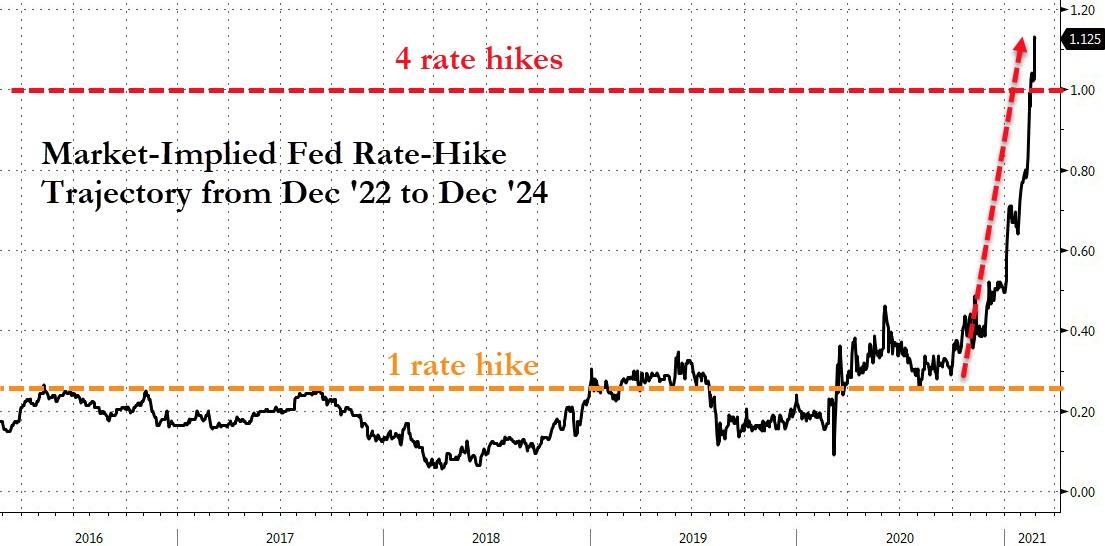
The crypto market is continuing to suffer significant losses this weekend as rate-hike-anxiety in the stock market, driving big-tech/growth stocks into the ground, is spilling over into other high momentum markets. But a 'whale war' may be the biggest immediate driver as institutions, HODL Whales, and miners battle one another.
As market expectations for rate-hikes (amid soaring inflation) have soared...
Source: Bloomberg
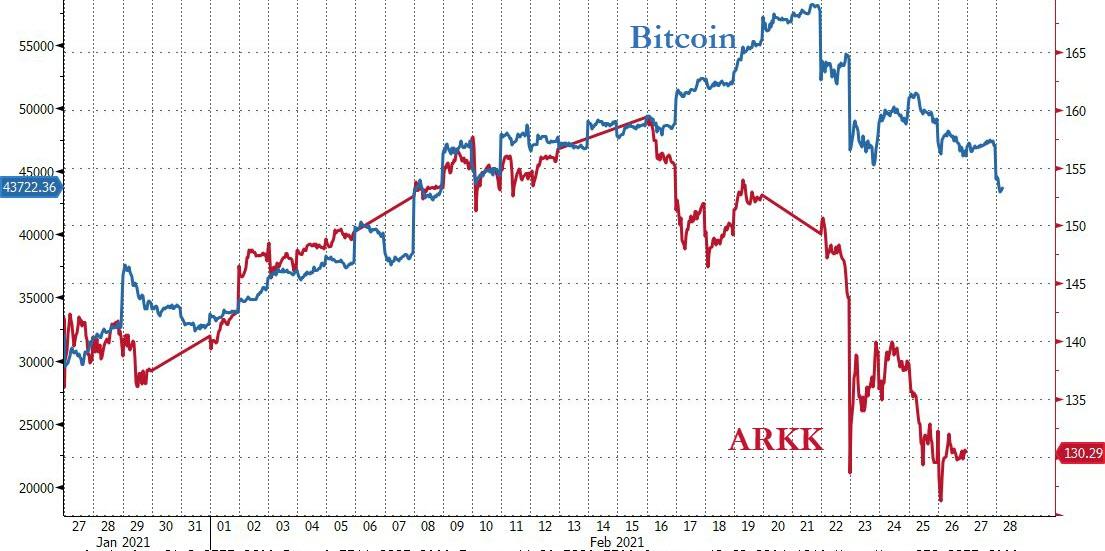
That has hit high growth, high momentum stocks...
Source: Bloomberg
And Cathie Wood's recent demise is not helping...
Source: Bloomberg
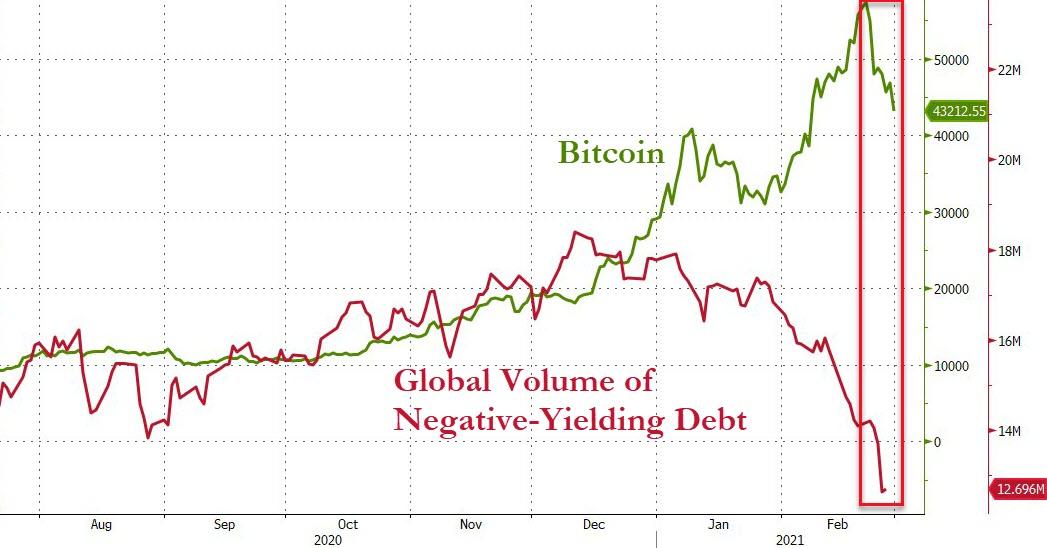
And reduced the size of global negative-yielding debt (reducing the attractiveness of zero-yielding crypto)...
Source: Bloomberg
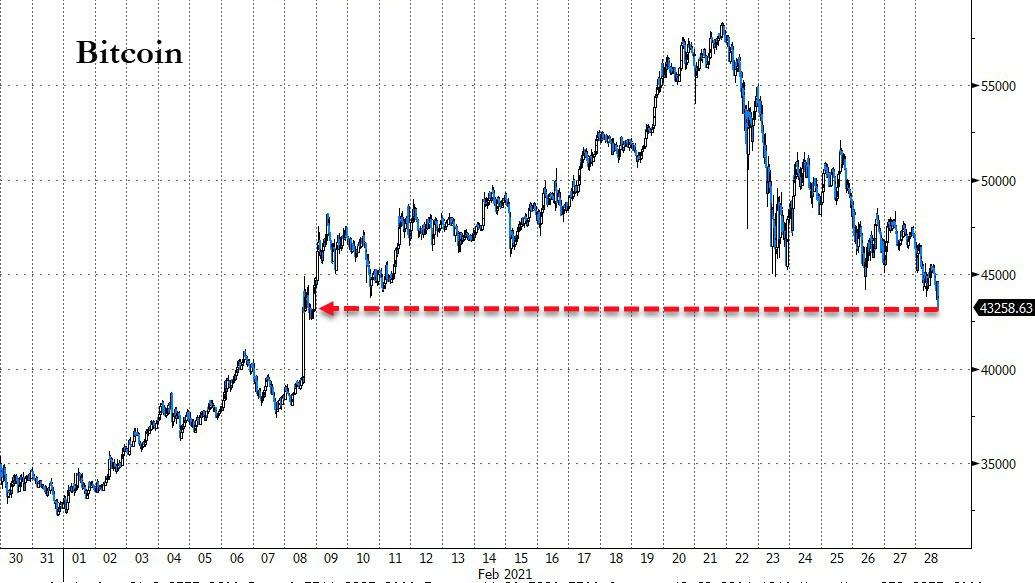
That anxiety has weighed directly on crypto with bitcoin back below $45,000 for the 3rd time in the last week (back to levels seen when Elon Musk announced Tesla's big BTC holdings)...
Source: Bloomberg
But Ethereum is getting monkey-hammered, back below $1300 for the first time since January...
Source: Bloomberg
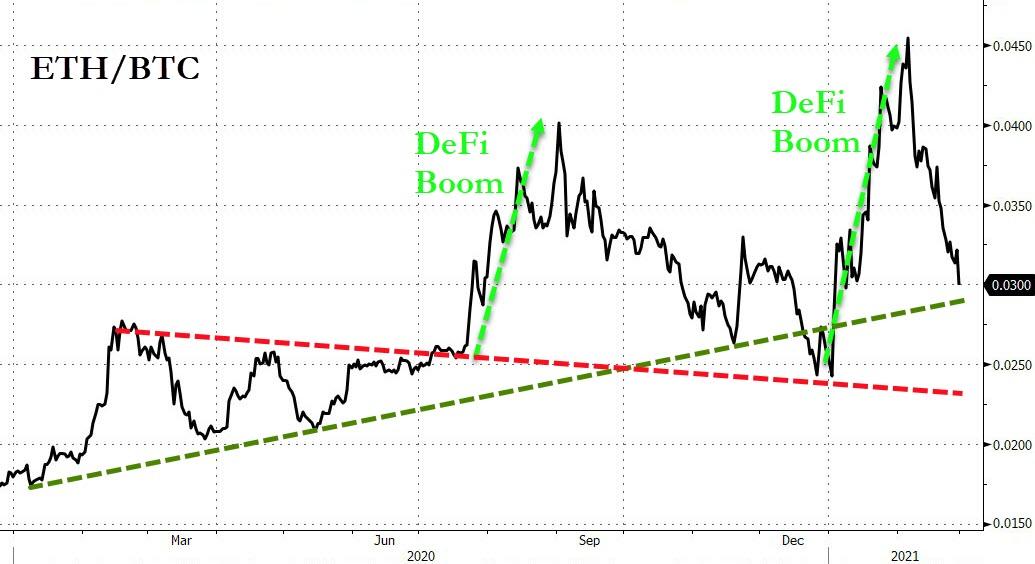
But the relative underperformance of ETH has erased all of the 2021 'DeFi Boom' gains over BTC...
So it’s all red today. But we’re all in it for the technology, right?
Source: Bloomberg
But, away from the inter-market spillovers, Crypto-news-flash.com reports that as CryptoQuant CEO Ki Young Ju discussed, a whale war is currently raging between US institutional investors, BTC whales, and miners over “who got the real power.”
US institutional investors are giving a clear “buy” signal through Coinbase outflows as well as the Coinbase price premium.
BTC whales are also in a buying mood at current levels as evidenced by BTC reserve and stablecoin inflow transactions.
However, once again the mining sector seems to have a different opinion. As Ju elicited, miner outflows and miner to exchange flows are giving a clear “Sell” signal.
Mining pool owners, such as F2Pool, who have been the focus of attention in recent weeks, are not to blame, however, as Ju points out. The outflows come “from affiliated miners who have participated in the mining pool at least once.”
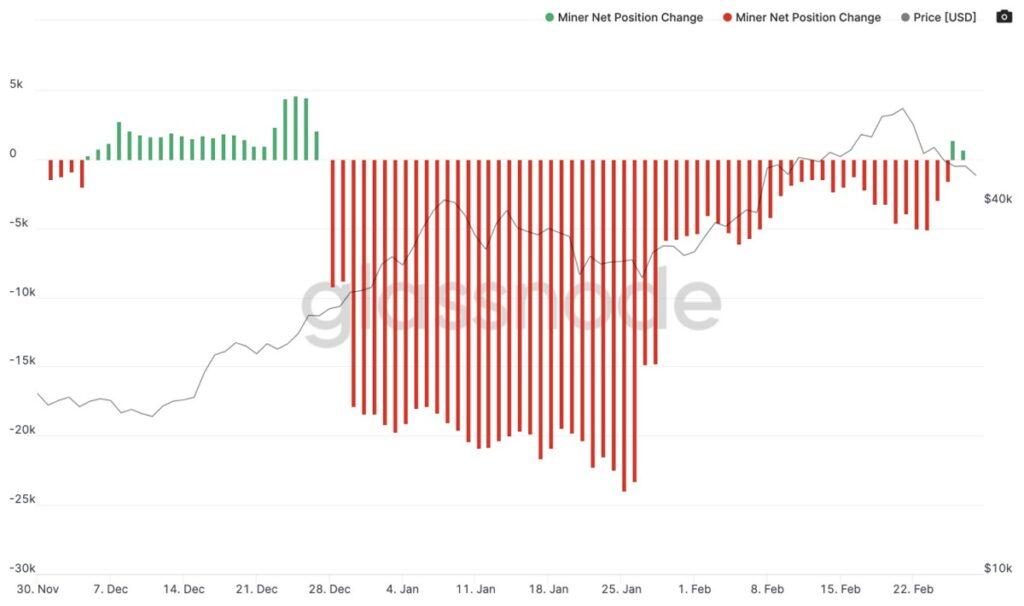
But as Moskovski Capital analyst and CEO Lex Moskovski first observed yesterday, the trend may be turning. After Friday became the first day in two months (since December 27) when miners’ position change turned positive, the trend was confirmed yesterday (Saturday) as well. Moskovski shared the chart below from Glassnode and stated:
Miner pools are still accumulating on aggregate. Yesterday there was another positive MNPC. Despite some selling pressure today the outlook is still positive.
Source:
Even though it seems that the war conjured up by Ju could end, this is not yet reflected in the Bitcoin price at the moment. Therefore, all eyes could possibly be on tomorrow, Monday, when institutional investors return. As technical analyst Josh Rager noted, Sunday and Monday are notorious for large price moves.
So it’s all red today. But we’re all in it for the technology, right?
48,558

FT : Pandemic pressures push US banks towards consolidation

Pandemic pressures push US banks towards consolidation
Foreign lenders with weak returns and smaller US groups are seen as most likely sellers

The pressures of the pandemic and a warm investor reception for recent acquisitions have increased the appetite of midsized US banks for more deals such as last week’s $7.6bn sale of People’s United Financial to M & T Bank, industry dealmakers and analysts say.

Likely buyers include such US regional lenders as US Bank and Citizens Financial, as well as Canada’s TD Bank and Bank of Montreal, they say. Smaller US banks and foreign lenders with weak returns and less reason to remain in the US, such as Spain’s Santander, are seen as more likely to sell.

“Everybody wants to do a deal,” said one veteran dealmaker who advises banks and other financial groups. “That’s the difference now from the past.”

Bankers warn that not all prospective deals will be easy to execute. HSBC, which confirmed this month that it was exploring a sale of its 150-branch US retail bank, might simply wind down the operation, said one company insider.

But the pandemic has highlighted the advantages of size in banking. With branches closed or customers wary of visiting them, digital banking has become more important, putting pressure on banks to invest.

At the same time, low interest rates and lacklustre demand for loans have made it more difficult for lenders to profit from their swollen deposit bases. Greater economies of scale represent a way to increase returns.

“Any bank that’s below the top four or five, especially in retail banking, has to be asking itself some very serious strategic questions,” said a senior figure at one midsized US bank. “It’s not foreign versus domestic, it’s all about scale.” 

The biggest US banks are JPMorgan Chase, with more than $3tn in assets, Bank of America at $2.3tn, Wells Fargo at $1.8tn and Citigroup at $1.7tn. PNC would become the fifth-biggest if it completes its $11.6bn announced takeover of BBVA’s US operations. Truist and US Bank come next.

The investor reaction to recent bank deals has increased their likelihood. North Carolina’s First Citizens’ share price has more than doubled since it announced its $2.2bn acquisition of CIT Group on October 16. PNC is up more than 40 per cent since its BBVA deal a month later, beating the 33.5 per cent rise in the KBW Nasdaq Bank Index over the same period. 

“With respect to bank deals, the market tends to be cyclical — they like deals or they don’t like deals,” Rodgin Cohen, the Wall Street lawyer and bank adviser. “Starting with the rapturous response to First Citizens, the market has been quite receptive.” 

Scott Siefers, an analyst at Piper Sandler, said that banks’ appetite for deals had also improved in the past six months because the “credit cycle is sort of melting away” and banks no longer fear unknowable Covid-related loan losses on their books or the books of rivals. 

One factor that could hold back bank deals is that several big players are digesting recent acquisitions — and regulators balk at simultaneous acquisitions because they carry operational risks. For that reason, PNC, M & T, and Huntington, which announced a $5.9bn deal to buy TCF Financial last year, are in effect out of the game for the next few years. 

“I don’t think we’re going to see a bonanza, but I don’t think it’s going to go back to the point where it’s one or two deals a year either,” said the veteran financial dealmaker.

Canada’s top banks, which have a sizeable presence in the US, are seen as more likely acquirers.

“They have the large balance sheet in Canada, and they have limited market share in the US, which is a secular growth opportunity,” said Ebrahim Poonawala, Canadian banks analyst for Bank of America.

TD Bank, which has just over $400bn in assets, is described by bankers as a potential acquirer of HSBC’s US network. HSBC has a strong presence in the eastern US and Florida, which compliments TD’s footprint. 

However, a person familiar with HSBC’s business said it could prove difficult to sell because of the way its costs are entangled with its parent, which makes it hard to value, and because it has no unique selling proposition once it is stripped out of HSBC’s global network. 

HSBC also has a smaller universe of potential buyers because foreign banks tend to favour cash deals, rather than receiving stock in the acquiring company, which they would have to retain for a lock-up period and whose value could fluctuate. 

PNC was able to pay cash for BBVA because it had built up a $17bn war chest by selling its stake in asset manager BlackRock last summer. M & T also paid cash for People’s. Such deals are rare, bankers say, since acquiring banks typically do not have much cash on their balance sheet. 

Shareholders in US banks would have no such qualms about accepting stock as payment and their managements could find it hard to turn down offers.

“The vaccine is out there, there’s a big fiscal stimulus plan, there’s massive monetary accommodation,” said a financial industry dealmaker. “A year ago, there were some pretty good excuses not to do something. Those exogenous factors have really disappeared.”

WSJ : How Europe Became the World’s Biggest Electric-Car Market—and Why It Might

How Europe Became the World’s Biggest Electric-Car Market—and Why It Might Not Last
Subsidies and more choices have helped spur consumer demand, but China serves as a warning that such momentum can be fleeting

European consumers are buying electric cars at a faster pace than ever, encouraged by government subsidies and the availability for the first time of models built by their favorite brands.

The boom is so strong that Europe passed China as the world’s largest electric-vehicle market last year. Its share of new electric-car sales nearly doubled to 43%, while China and the U.S. lost market share.

But Europe’s surge relies heavily on government incentives doled out during the pandemic, and analysts warn the momentum could be reversed if and when that support is withdrawn. Most government EV subsidies are limited in scope and due to expire by the end of this year.

“The market is extremely sensitive to government and company discounts,” said Arndt Ellinghorst, auto analyst at Bernstein Research. “Once subsidies are taken away EV sales will collapse by 30-40% at least for one or two quarters.”


Without the subsidies, EVs are still considerably more expensive than equivalent combustion-engine vehicles. This isn’t likely to change until later this decade, analysts say, as battery prices come down because of new technology, greater scale and competition.

Europe’s approach started with more sticks than carrots. The European Union in particular has steadily tightened emissions requirements, prompting the industry to roll out more electric cars and hybrids, or face hefty fines.

When the pandemic hit, governments looking to cushion the economic shock began targeting aid at industries on the front line of the battle with climate change. A big part of this assistance went into incentives for consumers to buy EVs, creating a surge in demand.

The moves changed the perception among industry leaders that there wasn’t a market to justify the huge investments needed to build electric cars.

“We have an incentive to build these cars…It helps make the EV very attractive for the consumer,” said Hakan Samuelsson, chief executive of Volvo Cars, the Swedish car maker owned by China’s Zhejiang Geely Holding Group. “But long term these incentives and tax breaks are not sustainable.”

Car makers began rolling out new models in earnest last year. Volkswagen AG, Europe’s biggest auto maker, unveiled its ID.3 and ID.4 models. Premium car makers such as BMW AG, Mercedes and Audi launched high-end EVs. This year, Mercedes is set to launch the EQS, which will be an electric and highly automated successor to the flagship S-Class.

Around 65 new EV models launched in Europe last year—twice as many as in China—and another 99 are slated to come to market this year. That compares with 15 launches in North America last year and a planned 64 this year.

Manufacturers say the incentives and an explosion in the number of new EV models came together at the right time, energizing both supply and demand.

“You have to have the right product on offer…That’s what we saw last year in Europe,” said Britta Seeger, board member at Daimler AG in charge of global sales. “The offer is better, and subsidies are supporting sales.”

The availability of EVs with familiar brand names is also pushing sales. Hallgeir Langeland, a 65-year-old Norwegian environmentalist and former politician, hasn’t owned a car for 25 years, but when Ford Motor Co. rolled out a fully electric version of its Mustang last year, he didn’t think twice.

“I had to have it,” he said, recalling the Mustang he drove in his youth. Now he can’t wait for it to arrive in March. “It’s cherry red.”

The purchase was made easier by subsidies that have made Norway the world’s biggest EV market per capita, prompting a tongue-in-cheek Super Bowl ad by General Motors Co. starring Will Ferrell, who called on American consumers to buy EVs and crush Norway.

Christian Burg, who runs a business building energy-efficient houses in Germany, had driven a diesel BMW X3 SUV for years. When the government boosted subsidies for electric cars last summer, he applied for a small-business grant and switched to the new iX3 plug-in hybrid version of the car.

“We received 3,750 euros [equivalent to $4,500] in cash incentives,” he said.

Sales of plug-in electric vehicles in Europe rose 137% to 1.4 million vehicles last year, outpacing China, which recorded a 12% increase to 1.3 million, and the U.S., where sales rose 4% to 328,000, according to ev-volumes.com, a research group.

The state of Europe’s market is reminiscent of China’s electric-vehicle trajectory years ago. Determined to leapfrog Western markets, Beijing provided hefty subsidies for purchases and required manufacturers to ensure that a certain percentage of new cars produced each year were electric.

The effort helped spawn hundreds of startups and boosted the share of EVs to more than 8% of new-car sales by mid-2019. Then Beijing slashed incentives in June 2019 and sales plunged, with the share of EVs falling below 5% by the end of the year. When the pandemic hit, China’s EV sales slumped further, raising doubts about Beijing’s ability to reach its goal of having them account for 20% of new-car sales by 2025.

Beijing reinstated EV subsidies early last year but slashed them again in January in a renewed effort to wean consumers off them.

In Europe, national governments are reconsidering plans to phase out the current regime of EV subsidies at the end of the year. Analysts suggest that governments in countries that produce a lot of autos, such as Germany and France, could extend aid beyond this year.

While most industry leaders welcome government efforts to jump-start new technology markets such as electric vehicles, auto makers worry that subsidies will only have a short-term impact and without broader structural changes won’t create a self-sustaining market.

Instead, they urge governments to focus more on developing infrastructure such as charging stations, providing support for building battery plants, and taxing carbon-dioxide emissions.

(ZH) These Are The 4 Things That Can Stop The Panic In The Bond Market

These Are The 4 Things That Can Stop The Panic In The Bond Market

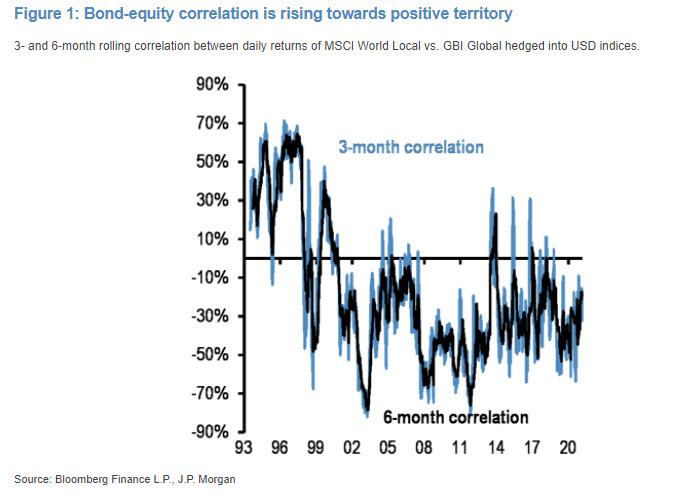
It was just last Tuesday when he presented our readers with the latest observations from JPM quant Nicholas Panaigrtzoglou, who warned that the rapid rise in bond-equity correlations...
... was bringing memories of previous violent bond tantrum episodes, including Bernanke's famous Taper Tantrum from May-June 2013, the Bill Gross-inspired Bund tantrum of May-June 2015, the period into the US election Oct-Nov 2016, Feb 2018 and Q4 2018. All of those ended with pain for both bond and equity longs, and certainly risk parity and 60/40 balanced funds who were crushed on both long legs.
Well, just two days later this warning was realized as we saw a surge in bond volatility as global bond prices plunged and yields soared as the latest inflation scare finally came to the fore (catalyzed by the catastrophic 7Y auction which sparked massive liquidation volumes across the curve).
And, as Panigrtzoglou writes today, the surge in the bond-equity correlation together with the increase in volatility is putting even more pressure on multi-asset investors, such as risk parity funds and balanced mutual funds to de-risk (something we also discussed last Thursday in "Vol, Correlation Massacre Means Capitulation Is Just Starting").
And though we now know what catalyzed last week's furious liquidation in rates, the question everyone is asking is whether the puke is over. And while some, such as the Nomura quant who correctly called both the early CTA liquidation and shorting that sparked last week's rout now believe that the worst is over and CTAs are are now covering their shorts, Friday's action which saw stocks closely sharply at their lows suggests that few are convinced.
Which brings us to the key question posed by JPM's Panigirtzoglou, namely "what conditions are needed for the current episode to subside and for equity and risk markets to resume their uptrend?"
He then proceeds to answer his own question, the lesson from the previous positive bond-equity correlation episodes of May-June 2013, the Bund tantrum of May-June 2015, the period into the US election Oct-Nov 2016, Feb 2018 and Q4 2018, is that there are two main conditions:
  1. Rate vol needs to decline from its current very high level
  2. Bond yields need to subside and unwind a decent portion of most recent increases, in particular at the 5yr UST tenor.
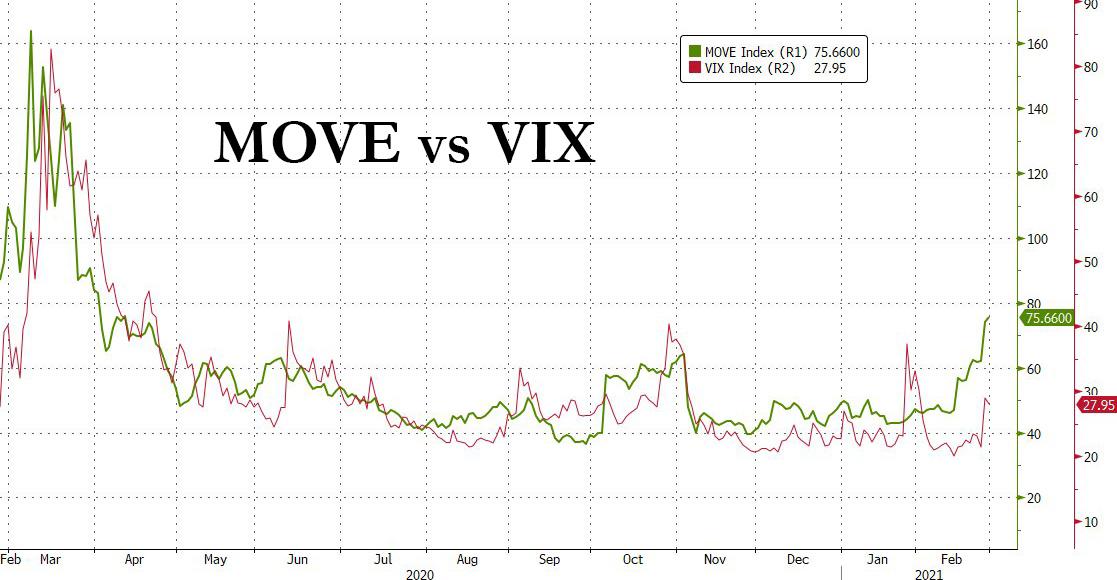
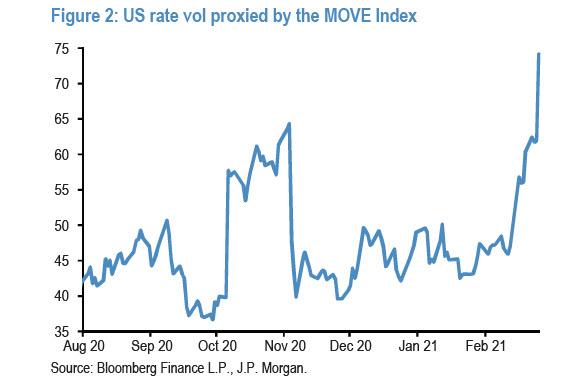
Neither of these should come as a surprise to our readers. After all just last Sunday we laid out the week's events clearly, when we proposed the opposite question, i.e., "Are Yields About To Blast-Off: Here Are The 3 Things To Watch", concluding that "the aptly named MOVE index is the best real-time measure of potential runaway yields." And sure enough, just days later the MOVE exploded to the highest level since last March's bond crash.
So now that what the two critical conditions that must be present for a return to normalcy, the next question is "how could these conditions be achieved." Here JPM envisages four scenarios.
A) The Fed intervenes by raising its bond buying pace in a similar fashion to March 2020. At the time, the Fed justified its intervention by seeking to restore functioning in rate markets. Thus far at least, this argument does not yet appear justified at the current level of market stress according to JPM, although as we noted earlier, BofA is already convinced that the Fed may address nervous markets as soon as this week.
Here JPM notes that while its market depth metrics for 10y UST futures and cash bonds have deteriorated, they still appear well above levels during March 2020 and this is true for both the 5y and 10yr tenor. And, as JPM claims, without further deterioration in UST liquidity it would be difficult to envisage a Fed intervention a la March 2020, especially if one views the recent bond selloff as a function of investors embracing the reflation trade. At the same time, Fed Chair Powell and Governor Brainard are scheduled to speak next week, and it will be important to watch for signs of how it views the bond market correction.
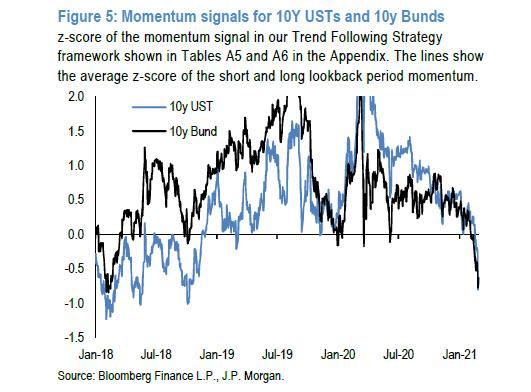
B) CTAs and other momentum traders hit oversold levels as mean reversion signals kick in. This, JPM writes, would provide at least some temporary relief (and it sure would especially if Nomura is right that the CTA shorting has now reversed). But back to JPM's own calculations, the bank asks how far are we from oversold conditions on our momentum traders framework? The sell-off in 10y USTs to close just above 1.5% on Feb 25th has seen the bank's shorter-term momentum signal for 10y USTs reach extreme bearish territory at -1.7 standard deviations, below even its early 2018 low of -1.5 standard deviations. The average of the shorter and longer-term signals reached a level of -0.8, still some way from its early 2018 low of - 1.2 standard deviations, but it would only take a further extension of the sell-off for 10y yields to 1.6% for this to reach its early 2018 low, while for the average of the shorter-term and longer-term signals to reach its 2018 low would take a further sell-off of just 5bp to around -0.2%.
Long story short, JPM agrees with Nomura that at 10y maturities, it appears the shorter-term signals for USTs have reached levels where mean reversion or profit taking signals by CTAs should start kicking in, while the average of shorter-term and longer-term signals are approaching those levels. That said, while there are signs that the shorter-term signal for 10y USTs and Bunds reaching extreme levels has triggered some CTAs to reduce short duration exposure, for the signals to more decisively reach oversold conditions for CTAs could take 10y UST yields reaching 1.6% and for 5y to reach 1.0%. This means that more yield momentum chasing higher could be in store in the coming days.
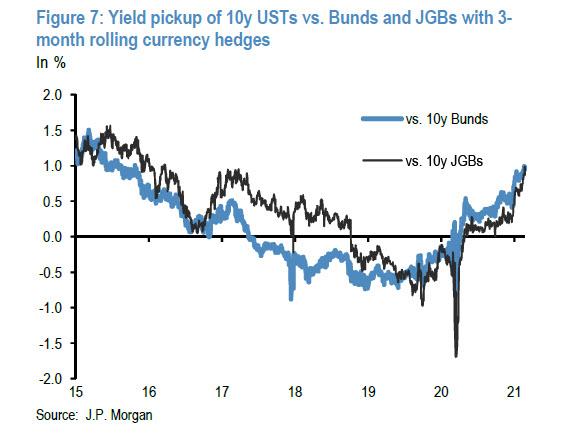
C) Japanese and Euro area investors step in to buy USTs to take advantage of the large yield pickup on a currency hedge basis relative to their domestic bonds. As the chart below shows, the recent TSY sell-off has seen the attractiveness of US Treasury yields rise on a currency-hedged basis, particularly for Japanese investors, and yet the probability of this flow materializing at current levels of UST vol is low as these investors and in particular banks tend to be averse to high levels of rate volatility.
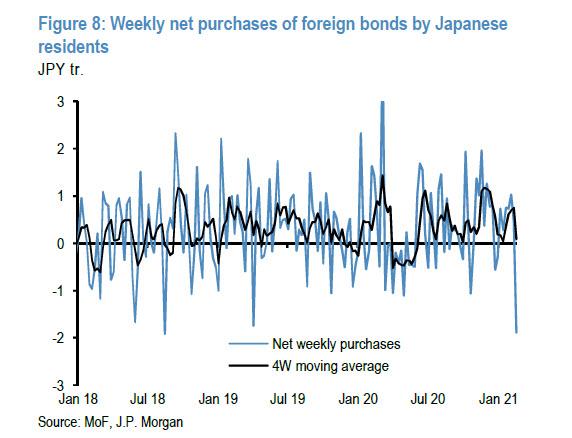
Indeed, the latest weekly data on Japanese residents’ net purchases of foreign bonds for the week ending Feb 19th already saw net sales of around $18bn amid last week’s sell-off.
Before these investors step in, JPM suggests that first other flows or central bank actions are need to materialize first to induce a decline in volatility.
D) Finally, rebalancing flows by balanced mutual funds and/or pension funds would help bond markets to stabilize and bond yields to subside. Unlike foreign flows, the chance of these flows materializing is high during the current quarter according to JPM, though the timing is harder to predict and could happen. In the event it materializes more towards the end rather the beginning of March, it could create a flow vacuum for rate markets over the next two weeks. One potential risk: if and when these rebalancing flows emerge, they are unlikely to be supportive of equities, as they combine bond buying with equity selling.
* * *
Putting it all together, when thinking about the above four scenarios JPM finds that the conditions needed for this week’s market stress - which is reminiscent of the previous positive bond-equity correlation episode of Q4 2018 - to subside "may not yet be fully in place" which is a surprisingly bearish assessment, especially if as Nomura (correctly) observes, the CTA unwind of shorts has already begun and the next stop is likely to be 1.20%. Of the four scenarios, Panigirtzoglou concludes that there are some signs at least of the second starting to take shape as shorter-term momentum signals for 10y reached oversold conditions. In any event, if urgent stabilization is required and does not emerge, dragging equities lower, BofA will be right and the Fed will have to address the ongoing liquidation wave... although what the Fed will say is unclear.
After all, as we said earlier, the Fed is in a very big bind - the reason we have the current tantrum is precisely due to the massive liquidity injections from central banks who have been desperate for more inflation. Well, they have their inflation and to reverse it they plan to do what - inject even more liquidity? At some point even our broken markets will have to concede that what is going on is complete and terminal idiocy.

NYP : Nevada Gov. Steve Sisolak wants to build crypto-run private cities in the

Nevada Gov. Steve Sisolak wants to build crypto-run private cities in the desert

Nevada, the state of legalized gambling, prostitution and marijuana, is about to add another layer to its Wild West reputation: Desert cities formed by companies and run entirely on blockchain technology.

Nevada Gov. Steve Sisolak held a press conference on Friday to lay out his futuristic plan to open “Innovation Zones” on thousands of acres of privately owned desert that would allow private corporations specializing in emerging technology to form local governments complete with the right to impose taxes and create school districts or even courts.

It was Sisolak’s most detailed discussion of the plan, which has not yet been introduced to the legislature. He said the cities would be run entirely on blockchain technology, the digital ledger primarily used to transfer cryptocurrencies, allowing residents to buy goods, pay bills, transfer property deeds and obtain marriage licenses all using cyber coins.

One big winner would be Jeffrey Berns, the founder and CEO Blockchains LLC, who purchased almost 70,000 acres of Nevada desert east of Reno in 2018 and said he wants to found a blockchain-based community.

Elon Musk’s massive Tesla battery gigafactory is also located in the same county as Berns’ recent landgrab. While there’s no indication billionaire electric car tycoon wants in on the plan, he would seem to be an ideal candidate given Tesla’s surprise and market-moving $1.5 billion investment in Bitcoin earlier this month.

Of course, for Tesla to build its own autonomous zone, Musk would need to add almost 48,000 acres to meet the 50,000 acres of contiguous, uninhabited land required for a company to meet the rules of the proposed legislation. The rules would also require a $1 billion investment over 10 years.

During a Friday afternoon press conference addressing the plan, Sissolak said Nevada needs a bold new vision to recover from the ravages of the pandemic on the state’s tourism-centric economy.

“This is different than anything that’s ever been proposed before,” he said, hammering home the vision of interconnected modern communities bringing jobs and commerce to unused land. “Companies can collaborate on a future together that would make Nevada not just a national but global leader in Blockchain technology.

While short on some details, like how a so-called Stablecoin would be designed to facilitate a fully Blockchain economy within a US state, and who would pay for roads in and out of what would be essentially private cities, the governor asked Nevadans to think big.

“There’s gonna be a lot of naysayers,” he said at the end of the presser. “I get that, but take a moment to look at the proposal.”

NYT : Billionaire Bill Ackman tells investors to follow him on Twitter

Billionaire Bill Ackman appears to be taking a page from Elon Musk with plans to start announcing market-moving news on Twitter.

The billionaire investor’s blank check company, Pershing Square Tontine Holdings, issued a press release on Friday highlighting Ackman’s Twitter feed and saying it may be used as a venue for official announcements.

“Investors should follow this account for information about the company,” the release said.

Ackman’s #FollowFriday campaign comes as retail traders wage their second campaign on “meme stocks” like GameStop, prizing sentiment and social media posts over fundamentals and pumping so-called “stonks” unloved by mainstream Wall Street investors.

Ackman was up late Thursday night engaging with Twitter users who asked him about a second Pershing Square blank check company, aslo known as a SPAC. His terse answers thrilled some followers who seemed to read into the ambiguous responses.

When asked if investors in the first SPAC could be given priority to invest in the second, Ackman tweeted “We have the technology” leading users on Twitter and Reddit to proclaim that Ackman was about to acquire payment platforms Stripe, Plaid, or even trading app Robinhood, with dozens of users posting that Ackman’s tweets indicate he would announce a merger on Friday, on Twitter.

Despite Ackman appearing to have gained more than 1,000 new followers in a matter of hours, shares in Pershing Square Tontine were trading slightly down at midday after spiking in early trading.

FT : New approach to data is a great opportunity for the UK post-Brexit

New approach to data is a great opportunity for the UK post-Brexit
Economy and society can benefit from lessons learned in the pandemic

The writer is secretary of state for Digital, Culture, Media and Sport

As you read this, thousands of people are receiving a message that will change their lives: a simple email or text, inviting them to book their Covid jab. But what has powered the UK’s remarkable vaccine rollout isn’t just our NHS, but the data that sits underneath it — from the genetic data used to develop the vaccine right through to the personal health data enabling that “ping” on their smartphone.

After years of seeing data solely through the lens of risk, Covid-19 has taught us just how much we have to lose when we don’t use it.

As I launch the competition to find the next Information Commissioner, I want to set a bold new approach that capitalises on all we’ve learnt during the pandemic, which forced us to share data quickly, efficiently and responsibly for the public good. It is one that no longer sees data as a threat, but as the great opportunity of our time.

Until now, the conversation about data has revolved around privacy — and with good reason. A person’s digital footprint can tell you not just vital statistics like age and gender, but their personal habits.

Our first priority is securing this valuable personal information. The UK has a long and proud tradition of defending privacy, and a commitment to maintaining world-class data protection standards now that we’re outside the EU. That was recognised last week in the bloc’s draft decisions on the ‘adequacy’ of our data protection rules — the agreement that data can keep flowing freely between the EU and UK.

We fully intend to maintain those world-class standards. But to do so, we do not need to copy and paste the EU’s rule book, the General Data Protection Regulation (GDPR), word-for-word. Countries as diverse as Israel and Uruguay have successfully secured adequacy with Brussels despite having their own data regimes. Not all of those were identical to GDPR, but equal doesn’t have to mean the same. The EU doesn’t hold the monopoly on data protection.

So, having come a long way in learning how to manage data’s risks, the UK is going to start making more of its opportunities.

Right now, too many businesses and organisations are reluctant to use data — either because they don’t understand the rules, or are afraid of inadvertently breaking them. That has hampered innovation and the improvement of public services, and prevented scientists from making new discoveries. Clearly, not using data has real-life costs.

The next Information Commissioner will not just be asked to focus on privacy, but also empowered to ensure people can use data to achieve economic and social goals. The pandemic was full of such examples, like hospital trusts sharing lung scans to improve coronavirus treatment methods. Data has many such wider societal benefits, and as we emerge from the pandemic, the UK has an opportunity to be at the forefront of global, data-driven growth.

Now we’ve left the EU, we have the freedom to strike our own international data partnerships with some of the world’s fastest growing economies. There is a huge prize to be won here: according to initial government estimates, £11bn of UK service exports currently go unrealised due to barriers to international data transfers. The EU has been slow to act on this, declaring only 12 countries “adequate” in the past few decades. By being more agile, the UK can capitalise on a multibillion-pound opportunity to boost trade in sectors where physical distance is no object. I will shortly announce our priority countries for data adequacy agreements.

Appointing a new Information Commissioner is just the first stage in this process. But it will mark the beginning of a new era in the UK — one where we start asking ourselves not just whether we have the right to use data, but whether, given its potential for good, we have the right not to.

FT : Staying private: the booming market for shares in the hottest start-ups

Staying private: the booming market for shares in the hottest start-ups
New exchanges aim to boost trade in promising businesses, but more regulation of an opaque sector may be needed

In 2014, an Austrian entrepreneur offered investors a rare chance to purchase shares in Jumio, his fast-growing and profitable payments company. The deal was not a typical venture capital transaction. Instead of purchasing new shares, investors could buy out earlier shareholders, in what are known as private secondary transactions.

Daniel Mattes, who calls himself a “visionary” on his Instagram page and has been a judge on the Austrian version of Shark Tank, the American reality TV series for entrepreneurs, told at least one prospective buyer he had no plans to reduce his own stake in the business, according to a US Securities and Exchange Commission complaint filed in 2019. Mattes also signed off on documents that, according to the complaint, claimed Jumio made a small profit and revenues of more than $100m in 2013 — a significant sum for a three-year-old company.

Two years later, Jumio filed for bankruptcy, and the company’s shares became worthless. In reality, according to the SEC, Jumio had only made one-tenth of the revenues it claimed, and Mattes had bypassed his board of directors to sell about $14m of his own shares.

Jumio’s case highlighted the risks of an opaque but fast-growing corner of finance: the global market for shares in private start-ups such as TikTok owner ByteDance, Elon Musk’s SpaceX and payments company Stripe. In 2019, the market was estimated to host almost $40bn in lightly regulated trades, according to one participant, more than doubling its volume from 2014.

Recently, the market has been hotter than ever. Though private companies have largely tried to restrict trading, brokers say hedge funds, mutual funds and other institutional investors have begun pouring in, buying large blocks of existing shares in start-ups that are nearing initial public offerings or big acquisitions. Often, the investors receive scant rights to information on financial performance.

Technology upstarts and financial institutions including big banks have rushed to capitalise on the interest by brokering deals and forming trading venues, setting up a battle that could fundamentally alter the market’s structure and potentially allow companies to stay private indefinitely.

The boom reflects how cash-flush investors are clamouring for stakes in fast-growing businesses, with low interest rates pushing non-traditional funds deeper into private markets. To meet the demand, brokers now face two key challenges: increasing the supply of shares in desirable companies while preventing fraud and manipulation in a competitive market.

Until recently, private secondary markets resembled “that guy with a trenchcoat that’s selling you watches in Times Square”, says Inderpal Singh, who leads a private secondary market project at the start-up marketplace AngelList. “In the last year, there’s been a big shift.”


In addition to AngelList, JPMorgan and the software start-up Carta have begun facilitating trades in private companies. They compete with established players like Nasdaq and Forge Global, which purchased the rival marketplace SharesPost in a $160m deal last year, as well as scores of smaller independent brokers.

Carta and some other intermediaries have advocated that the SEC relax restrictions on who can purchase shares in private companies, potentially opening up the market to a broader swath of investors.

But some observers remain sceptical that the growing market can protect investors against bad actors. Mattes, who paid $17m to settle the charges, did not admit or deny the SEC’s allegations, though he resigned from Jumio in 2015 following an internal investigation. The entrepreneur did not respond to questions sent to his personal website.

The rush to expand trading could lead to fraud and manipulation, says Stephen Diamond, a professor of law at Santa Clara University who has studied private secondary transactions.

“All too often in Silicon Valley, people want to basically ignore the consequences of unhealthy market structures,” Diamond says.

The Facebook episode
The debates reflect a decade-long shift in capital markets as companies grow larger than ever in private — securing billion-dollar valuations and “unicorn” status while pushing back their public debuts. As a consequence, start-ups, investors and employees have accumulated trillions of dollars’ worth of shares that cannot easily be bought and sold, barring a public listing or acquisition.

Private secondary markets grew in importance in the lead-up to Facebook’s initial public offering in 2012. Investors rushed to buy the social media company’s shares, creating a frenzied market where independent brokers facilitated thousands of trades with little oversight from the company.

The trades created headaches. One Facebook executive left the company after he reportedly purchased stock ahead of a big funding announcement. Facebook sometimes lost track of who owned its shares, complicating preparations for its IPO.

Facebook’s struggles caused many start-ups to adopt strict clauses in their legal documents that prevented employees from trading shares without company approval. Some companies have gone even further, requiring sellers to receive approval from boards of directors months in advance of any transaction.

Though the restrictions have made trading difficult, brokers say the market has been busier than ever in the past 12 months, with big investors such as Tiger Global Management hunting for shares in start-ups that look like sure bets for blockbuster public listings.

Tiger Global has used secondary sales to gain stakes in companies such as China’s ByteDance and the software group Snowflake, according to fund documents and people familiar with the trades. Other hedge funds and mutual funds routinely purchase new stakes in companies worth tens of millions of dollars, brokers say.

On the other side of the trades, existing shareholders such as venture capitalists have sought to unload stakes in highly-valued companies as they delay public listings. The market can also be an important source of cash for start-up employees, who receive a large portion of their pay in stock options.

Several new entrants, such as Carta’s private stock exchange CartaX, now hope to formalise the market and capture trading fees that have been spread between dozens of independent brokers.

“There is now, in the past few years, not a push to go all the way back to the days of strict prohibitions on secondary trading, but a push to have more avenues for organised liquidity,” says Cameron Contizano, a partner at law firm Goodwin Procter who works on secondary transactions.

Meanwhile, investor demand has pushed up prices for companies such as ByteDance, SpaceX and Stripe. Barrett Cohn, chief executive of the private securities broker Scenic Advisement, says he advised companies on twice as many secondary transactions in 2020 compared with the previous year. Of the last dozen deals Scenic worked on in the past few quarters, only one resulted in shares being sold at a discount to a company’s most recent stock price, he says.

Competing for business
The rise in trading volumes and the rush to capture the market will shape the way private shares change hands. San Francisco-based Carta, a company best known for selling shareholder management software to start-ups, has become a lightning rod in debates about the market’s direction. Its 45-year-old chief executive, Henry Ward, has set out an ambitious goal to build the “private stock exchange” for tech start-ups.

Ward wants the CartaX marketplace to compete with the Nasdaq exchange, providing a listing venue where companies could potentially stay private indefinitely. The exchange uses an auction model that Ward says will result in superior prices for sellers.

But the project has already drawn strong responses from rivals and market participants. Some brokers and start-ups say CartaX amounted to an attempt to monopolise the market, and the company is naive to think it could unseat public exchanges. Scenic’s Cohn says Carta has made it increasingly difficult for its clients to export their shareholder data for use in other kinds of secondary transactions, such as tender offers.

“We’re not trying to make the New York Stock Exchange go away,” says Kelly Rodrigues, chief executive of the brokerage Forge, which has begun offering software that companies can use to manage secondary transactions. Forge also bills itself as the “stock market for private companies”.

Others say the most desirable start-ups would not want to use CartaX because few private companies want to subject their shares to monthly or quarterly auctions marketed by the exchange.

Eric Folkemer, head of Nasdaq Private Markets, says it has already set up a similar marketplace with price discovery tools for companies such as the workplace collaboration company Asana that want to facilitate trading in their shares before going public.

“We have it,” says Folkemer. “The question is, does the market want it?”

JPMorgan has put its money behind Zanbato, a private share trading system that is taking a different approach from Carta, acting as a central matchmaker for more than 100 banks and brokers executing orders on behalf of clients.

Nico Sand, chief executive of Zanbato, says the exchange has made a conscious choice to focus on trades between large, qualified buyers with more than $100m in assets, who regulators assume have high amounts of financial expertise and require less oversight.

Zanbato has applied for a patent for a trading system with “firm orders”, a legal contract that forces buyers and sellers to transact shares in a private company after they have submitted orders with desired prices and quantities, says Sand.

He says the concept, which is standard in public markets, is necessary for creating efficient trading in private shares. “At the end of the day, it comes down to formalising the market structure in a way it’s not currently formalised.”


‘The third configuration’
So far, Carta is the only company that is listed for trading on CartaX. This month, investors purchased almost $100m in shares following the company’s first auctions on the exchange, in trades that valued the company at $6.9bn — more than double the valuation it received from venture capitalists less than one year ago.

Marc Andreessen, the Netscape co-founder and Carta board member, said in a blog post that he would encourage start-ups backed by his venture capital firm Andreessen Horowitz to consider listing on the exchange. He also said the firm would buy shares in companies on the exchange.

“The third configuration — beyond the false binary of simply private or public — is here,” Andreessen wrote.

But Ward has set targets for the exchange that some people familiar with its workings described as overly ambitious

Ward told investors he expected CartaX to generate about $1.1bn in annual revenues by 2024, according to a presentation viewed by the Financial Times. Under the most optimistic scenario, the marketplace would bring in $3.9bn in revenues that year, the presentation said. Carta declined to comment for this article.

CartaX charges 1 per cent fees to both buyers and sellers, implying it would need to facilitate about $55bn in trades a year to reach Ward’s expectations.

Those volumes would require about 3 per cent of the shares in all billion-dollar start-ups to change hands every year, according to Financial Times analysis of data from CB Insights, which estimates that 546 “unicorns” hold a collective value of $1.8tn.

Platforms like CartaX may struggle to meet their targets if private companies remain selective about who owns their shares. SpaceX, one of the most active companies in secondary trading, already hosts an internal marketplace where employees and venture capitalists can sell stock to invited investors.

“They have a lot of demand from buyers,” says Hans Swildens, chief executive of Industry Ventures, which has invested in Carta. “The question, like all the other marketplaces, is supply.”

Venture capitalists say the new exchange could also face competition from an unlikely source — special purpose acquisition companies (Spacs), which have recently lured relatively young start-ups to public markets.

CartaX would force companies to share two years of financial statements prepared using generally accepted accounting principles, in order to comply with a securities exemption the exchange is using to allow participation from an unlimited number of accredited investors.

Lawyers and governance experts say the requirement could help solve inconsistencies in information disclosure in private markets. But others say it would be a burden for young companies, which often remain private to avoid sharing their financial information to a broad audience of investors, reflecting a central tension in the market as brokers and traders attempt to capitalise on the surge of interest in secondary transactions.

“The ‘move fast and break things’ culture of start-ups militates precisely against this,” says Diamond at Santa Clara University. “That, to me, is the fundamental paradox here.”