Closing Stock Market SummaryThe S&P 500 (-0.8%), Nasdaq Composite (-1.1%), and Dow Jones Industrial Average (-0.9%) declined about 1% on Tuesday in a defensive session. The small-cap Russell 2000 dropped 3.6% to close below its 50-day moving average (2217) for the first time since the end of October.
Eight of the 11 S&P 500 sectors closed lower, with the cyclical materials (-2.1%), industrials (-1.8%), financials (-1.4%), and energy (-1.4%) sectors pacing the laggards. The defensive-oriented utilities (+1.5%), consumer staples (+0.4%), and real estate (+0.4%) sectors closed higher alongside some of the mega-caps and longer-dated Treasuries.
Cyclical stocks underperformed throughout the day after Germany and the Netherlands extended their Covid lockdowns, the Data and Safety Monitoring Board expressed concern that AstraZeneca's (AZN 49.40, -1.80, -3.5%) U.S. vaccine trial data may have included outdated information, and new home sales fell 18.2% m/m in February to a seasonally adjusted annual rate of 775,000 (Briefing.com consensus 867,000).
Profit-taking/rebalancing interest appeared to be an underlying factor, too, considering small-caps and cyclical/reopening stocks were among the best performers this quarter. Another quarterly winner in the iShares Micro-Cap ETF (IWC 146.03, -6.88, -4.5%) dropped 4.5% today after entering the session with a 29% gain for the first quarter.
Interestingly, the large-cap indices had traded relatively unchanged up until the last 75 minutes of action. Selling accelerated on no specific news, even as long-term interest rates continued to decline, accentuating the defensive qualities of the session and some nervousness for the remaining sessions of the quarter.
The 10-yr yield declined five basis points to 1.64%, while the 2-yr yield remained unchanged at 0.15%. The U.S. Dollar Index advanced 0.7% to 92.38. WTI crude futures ($57.75/bbl, -3.72, -6.1%) dropped 6%, revisiting a six-week low.
Separately, Fed Chair Powell and Treasury Secretary Yellen testified before the House Services Financial Committee in a non-event for the market. Fed Chair Powell reiterated the Fed's commitment to using its tools to support the economic recovery and reaffirmed the Fed's view that inflation pressure is likely to be transient this year. Their two-day hearing will conclude tomorrow.
Reviewing Tuesday's economic data:
- New home sales declined 18.2% m/m in February to a seasonally adjusted annual rate of 775,000 (consensus 867,000) from an upwardly revised 948,000 (from 923,000) in January. On a yr/yr basis, new home sales were up 8.2%.
- The key takeaway from the report is that new home sales, which are counted when contracts are signed, were curtailed by the deep freeze in the Midwest and South during the month; however, the sizable drop in new home sales m/m in the West (-16.4%), and the higher proportion of new homes sold for $399,999 or less, also speaks to the increased affordability pressures being applied by high prices and rising mortgage rates.
- The current account deficit for the fourth quarter totaled $188.5 billion (consensus -$190.0 billion). The third quarter deficit was revised to $196.1 billion from $178.5 billion.
Looking ahead, investors will receive Durable Goods Orders for February, the final IHS Markit Manufacturing and Services PMIs for March, and the weekly MBA Mortgage Applications Index on Wednesday.
- Russell 2000 +10.7% YTD
- Dow Jones Industrial Average +5.9% YTD
- S&P 500 +4.1% YTD
- Nasdaq Composite +2.6% YTD
After Hours Summary: INTC sharply higher +7.1% on new factory news and guidance; semi equipment names up in sympathy KLAC +5%, AMAT +4.3%, LRCX +3.4%; GME -10.3% falls on earningsAfter Hours Gainers:
Companies trading higher in after hours in reaction to earnings/guidance: PLBY +16.2%, HOME +6.2%, BNGO +5.1%, AIR +1.8%, VNET +1.6%
Companies trading higher in after hours in reaction to news: HOFV +75.4% (HOFV signs partnership with DLPN for non-fungible tokens offerings), DLPN +43.3% (HOFV signs partnership with DLPN for non-fungible tokens offerings), INTC +7.1% (announces "IDM 2.0" strategy; to invest $20 bln on two new factories in Arizona; also expects Q1 results to be better than prior guidance but guides FY21 EPS below consensus), IPHI +7% (MRVL's proposed acquisition of IPHI gets Chinese regulatory approval), LH +2.8% (provides business update; announces review of co's structure and capital allocation strategy), MRVL +1.1% (MRVL's proposed acquisition of IPHI gets Chinese regulatory approval), MOS +0.8% (announces a strategic collaboration with AgBiome), LMT +0.3% (awarded $3.7 bln Missile Defense Agency contract), AMZN +0.2% (selects Adam Selipsky to head AWS unit), AZO +0.1% (announces $1.5 bln stock repurchase authorization), KAMN +0.1% (awarded manufacturing contract by Boeing), MO +0.1% (chairman to retire)
Semi equipment names moving higher on Intel building two new plants: KLAC +5%, AMAT +4.3%, LRCX +3.4%, KLIC +1.8%
After Hours Losers:
Companies trading lower in after hours in reaction to earnings/guidance: GME -10.3% (also names new COO), SCS -4.7%, ACCD -1.3% (also convertible notes offering), ADBE -0.2% (also CFO to retire), TPB -0.2% (also names new CFO)
Companies trading lower in after hours in reaction to news: CASI -11.8% (stock offering), PRTA -3.4% (stock offering), NEE -2.1% (files mixed securities shelf offering), AMD -1.6% (Intel news), TMO -0.4% (launches COVID testing program for schools), OI -0.1% (to expand Columbia facility), CDXC -0.1% (stock offering)
The Best 12 Months Since 1936
By Jim Reid, chief credit strategist at Deutsche Bank
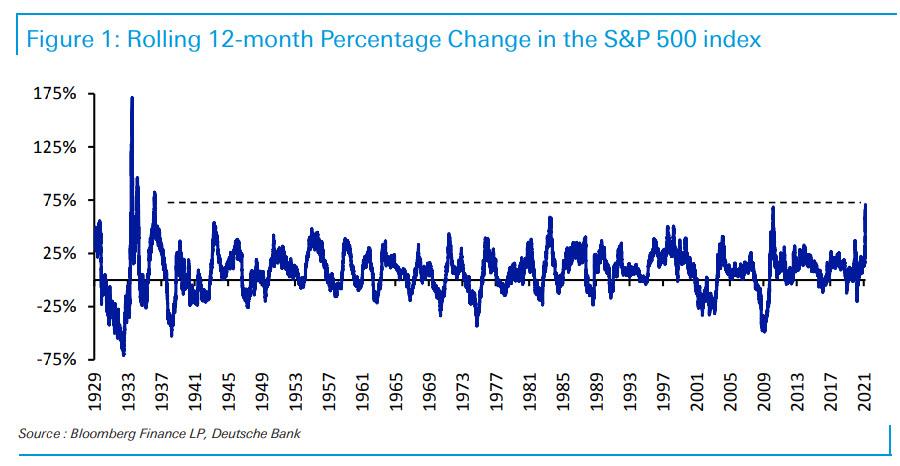
Today is the one-year anniversary of the pandemic lows in markets and the S&P 500 has now seen its largest 12-month gain since 1936, exceeding that seen in 2010 after the GFC.
The turnaround started 2 days after the Fed’s momentous March 22, 2020 meeting where amongst other things they offered to buy corporate bonds for the first time in their history.
In our monthly survey, 40% scored the Fed an “A” and 38% scored them a “B” for their pandemic response. So high marks which market performance totally supports.
However it’s fair to say that they’ll be still dealing with the fall-out from Covid for years.
Have their actions helped create bubbles and future inflation? Have they helped main street enough? Have they helped perpetuate the debt super-cycle?
If they are still scoring As and Bs for their pandemic response in 3-5 years then that will be an even more remarkable achievement.
Morgan Stanley Identifies The Source Of Massive Treasury Selling
In recent weeks we have been pointing out the stark divergence between markets in various geographic time zones, most notably the variance in equity "moods" between the Europe and US, where it often appears that there are two regimes: one ending when Europe closes and another starting, with both usually mirror images.
But while we mostly focused on how geography impacts stock markets, a far more interesting observation was made this week by Morgan Stanley's chief rates strategist Matthew Hornbach, who over the weekend identified the origin, if not quite the identity, of the persistent seller of Treasurys over the past few months, who has sparked such a violent rout across not just the US rates space but also stocks and other core assets.
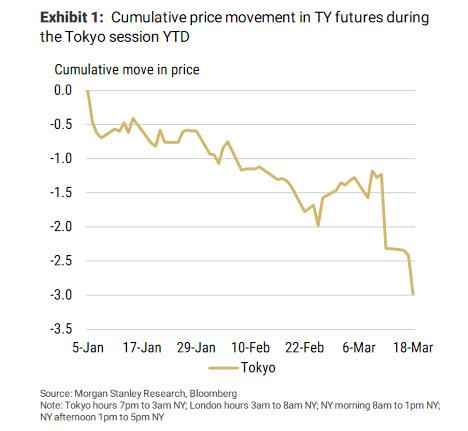
As the following remarkable chart from Hornbach makes very clear, the cumulative downward price movement in Treasury futures has been concentrated in the Tokyo session. Furthermore, after a brief respite in the first week of March, selling in the Tokyo session accelerated dramatically ahead of the FOMC meeting and it continued afterward.
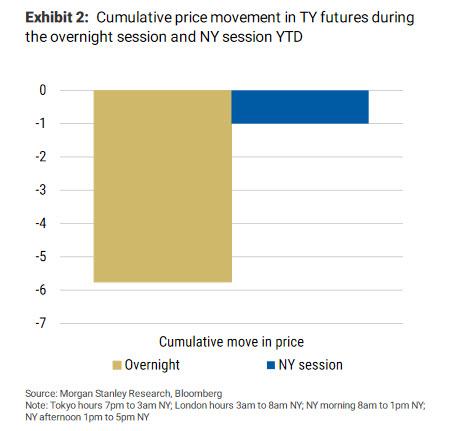
Of course, the initial burst of Treasury futures selling - which appears to have originated out of Japan every time - would then have a domino effect on the rest of the world, and as Morgan Stanley notes, "weak price action during the Tokyo session led to additional selling during the London session" although to a lesser extent. As the next chart shows, since the start of the year, 85% of the cumulative decline in TY futures prices occurred in the overnight session, i.e., Japan is almost single-handedly responsible for the dump surge in yields this year!
Why does this matter?
Because if Morgan Stanley is right, and if the seemingly daily Treasury selling indeed originates out of Tokyo, there is finally good news for bond bulls: Hornbach writes that "we have good reason to believe the selling from Japan won't last... into April." That's because the fiscal year in Japan ends on March 31. "At that point, liquidation of non-yen bond holdings should stop, if not reverse at some point in the April-June quarter."
But why did Japan sell non-yen bonds in the first place?
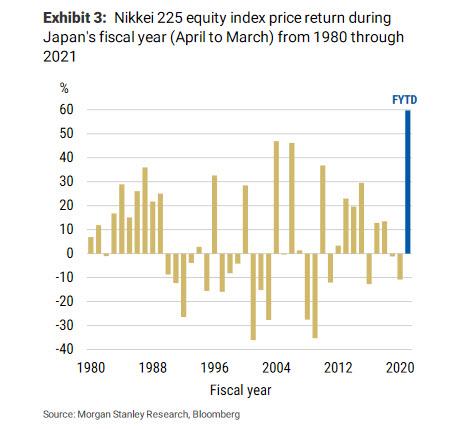
According to Morgan Stanley, Japanese commercial banks hold a large number of equity shares, and the Nikkei 225 equity index put in its best fiscal year performance in decades. In other words, for the commercial banks, the income from bond holdings wasn't necessary to make the year a successful one. Consider it one massive pension rebalance ahead of the March 31 fiscal year end... only this one was among commercial banks.
In addition, Hornbach adds that it was no longer necessary to take the risk that bond yields would keep rising, thereby subjecting their bond portfolios to capital losses in the last quarter of their fiscal year. At the same time, with a new fiscal year comes new revenue targets. And unless the banks have confidence in the Nikkei 225 index continuing to rise, the much more attractive carry and expected rolldown in the Treasury market will seem very appealing, according to the Morgan Stanley strategist.
In addition, the ability to realize that expected rolldown has been greatly enhanced by the higher bar the Fed set for tapering asset purchases and hiking rates.
Summary: Japan's persistent year-end selling led to an adverse domino effect around the globe, which eventually sparked a global bond - and stock - market turmoil. However, that's now over, and Japanese banks are about to start buying massive amounts of US TSYs again once the fiscal year is over. And while it remains to be seen where stocks will trade in the coming week (see "Month-End Set For Epic Clash Between Forced Pension Selling And Quant Buying"), it now appears that Q2 is set to start with a bang, as between sliding yields and stimmy checks, the S&P is set to finally rise above the mythical 4,000 level.