Actor Zachary Horwitz Arrested Over Alleged $690 Million Hollywood Ponzi Scheme
Also known as Zach Avery, he faces fraud charges in what prosecutors say were illegal efforts to capitalize on fake film-licensing deals
WASHINGTON—A Los Angeles actor was the mastermind of a $690 million Ponzi scheme that bilked investors who thought their money would finance distribution rights for movies that would run on HBO and Netflix, according to authorities.
Zachary Joseph Horwitz, who went by Zach Avery as an actor, was arrested Monday and charged with wire fraud, according to the Los Angeles U.S. attorney’s office. The Securities and Exchange Commission also sued Mr. Horwitz and his firm, 1inMM Capital LLC, in civil court over the alleged scam, which it says involved an elaborate plan to portray efforts to sell film-licensing rights, primarily in Latin American markets.
Mr. Horwitz’s LinkedIn profile states he is managing partner of 1inMM. He didn’t respond to a request for comment sent through LinkedIn. Court records on Wednesday didn’t list a lawyer for him.
The 34-year-old actor has a profile on IMDb, the online movie database, where he is credited for roles in a handful of low-budget films. His most recent credits include a still-unreleased, higher-profile movie called “Gateway,” starring Olivia Munn and Frank Grillo. Hollywood studio Lions Gate Entertainment Corp.’s specialty label Grindstone Entertainment is set as distributor.
Netflix declined to comment. HBO and Lions Gate didn’t immediately respond to requests for comment.
Mr. Horwitz told investors that he had acquired and distributed dozens of films including titles such as “Active Measures,” “Lucia’s Grace” and “Blood Quantum.” He doctored fake contracts signed by fictional HBO or Netflix executives, which made it look like he was doing business with the streaming platforms, according to a Federal Bureau of Investigation affidavit. For a while, Mr. Horwitz paid investors their purported returns using proceeds generated by new investors, the hallmark of a Ponzi scheme, according to authorities.
But in late 2019, he began defaulting on nearly every payment due to investors and blamed the problem on HBO and Netflix Inc. refusing to pay for movies they had licensed from his company, according to the SEC. Mr. Horwitz even sent emails to investors that supposedly showed him discussing the status of his agreements with employees of Netflix and HBO, the FBI said.
In total, he defaulted on about $227 million in payments anticipated by investors, according to the FBI. He also used investor funds to pay in cash for a $5.7 million home in Los Angeles’s Beverlywood neighborhood, the SEC said.
Mr. Horwitz’s investors included personal contacts and people who knew other investors who had given him money. He promised returns in excess of 35% on the movie projects, according to the SEC’s federal-court complaint.
The alleged scheme victimized five main groups of investors, according to an FBI affidavit. The largest source of funds came from a private firm whose principals live in the Chicago area, JJMT Capital LLC, which received an annual report that portrayed Mr. Horwitz’s success in the film-distribution business, along with a bottle of Johnnie Walker Blue Label scotch, according to the FBI affidavit.
Hollywood publicist Nedda Soltani said she was once assigned by the company Entertainment Fusion Group to help boost Mr. Horwitz’s profile as an actor but knew nothing of any alleged efforts to defraud investors. Ms. Soltani said she was aware that her client, whom she said she knew only as Zach Avery, split his time between acting and a “financial startup situation where he invests in emerging brands and companies.”
Entertainment Fusion Group didn’t immediately respond to a request for comment.
According to IMDB, Mr. Horwitz appears to have got his start appearing in a handful of short films, including 2009’s “G.E.D.,” where he is credited as playing the character called “Thug.”
Ivan Parron, a lawyer for Cess Silvera, the director of “G.E.D.” said by e-mail that his client has never heard of the actor Zach Avery and doesn’t understand “why this individual claims he was in this film and appears on the IMDB profile.”
Bain nears $8bn deal to buy Hitachi Metals
Potential sale is latest sign of rising global private equity interest in Japanese groups
Bain Capital is closing in on an $8bn deal to acquire Hitachi Metals after a consortium led by the US private equity group was granted exclusive negotiating rights for the Tokyo-listed materials group, according to people with direct knowledge of the discussions.
The expected deal, which has been under discussion since last August, will involve Hitachi selling its approximately 53 per cent stake in Hitachi Metals, which has historically been one of the Japanese conglomerate’s most important subsidiaries.
The sale of its majority shareholding in Hitachi Metals would take the parent company one step closer to clearing its books of stakes in its listed subsidiaries. Investors have identified that goal as a metric of corporate governance progress.
The sale also comes on the heels of Hitachi’s $9.5bn deal to buy US software engineering group GlobalLogic, which is expected to be the Japanese company’s biggest ever acquisition and will increase its interest-bearing debt to $28bn.
“If the company monetises some of the stakes in its remaining listed subsidiaries, Hitachi Construction Machinery and Hitachi Metals . . . it would have additional liquidity to manage its total debt and leverage,” Motoki Yanase, senior credit officer at rating agency Moody’s, said in a report on Monday.
The Bain-led consortium includes Japan Industrial Partners (JIP) and Japan Industrial Solutions (JIS). JIP was set up almost 20 years ago with investments from lender Mizuho and Bain. It has been involved in the acquisition of a range of Japanese industrial gems, including Sony’s Vaio laptop business and the defence equipment subsidiary of NEC. JIS is a private equity asset manager set up in 2010 with capital from Japan’s largest megabanks.
Bain’s exclusive negotiating rights for Hitachi Metals come as global private equity firms, including KKR, Carlyle, Blackstone and Apollo are stepping up their presence in Japan, as large conglomerates jettison non-core businesses and property.
In a sign of the surging ambitions of private equity in Japan, Toshiba said on Wednesday that it had received a formal approach from the European fund CVC. People familiar with the situation said the mooted $20bn deal could become the largest leveraged buyout in Japanese history.
Bain has put together a string of deals in recent years. The largest was the 2018 acquisition of Toshiba Memory, which it bought for $18bn as part of a consortium that included South Korea’s SK Hynix. Last May, Bain also bought Showa Aircraft Industry in a deal that gave the Boston-based fund a 1.25m sq m bank of land outside Tokyo.
Hitachi said no formal decision on the sale has been made. Hitachi Metals declined to comment.
SPAC Bubble Pops: Flood Of New SPAC IPOs Hits A Brick Wall
"3 SPAC IPOs this week after 2 last week after 276 in Q1 (vs 228 all of last yr vs 170 from 2013 – 2019 combined)" - Goldman Sachs trader John Flood, April 7, 2021
As Bloomberg's Drew Singer writes, the days of special purpose acquisition companies debuting by the dozens on public exchanges appear to have come and gone, "spelling trouble for the broader market for initial public offerings."
After fueling a record first quarter for IPOs, SPACs have suddenly stopped going public at anything close to the same scale, as if they hit a brick wall in the second quarter.

The plunge in deal making follows weak trading in these vehicles, slow progress in their search for acquisitions and outperformance by traditional listings, not to mention various warnings by the SEC itself.
Just three SPACs have listed this week, including two on Wednesday. This follows just a pair of IPOs by SPACs last week and compares to more than 20 deals a week during most of the year.
Worse, according to Bloomberg data, public SPAC offerings are poised for their slowest two-week stretch since the end of 2020. While a reversal remains possible as we get further from Easter weekend, investors have been signaling a growing distaste for these deals. More than 100 or about a third of SPACs that went public this year are trading below their IPO price as investors wait for news of an acquisition. In all, 2021’s SPACs are trading 0.8% above their debut levels, compared with an average 6.0% gain by the year’s traditional IPOs.
The trouble in SPACs comes alongside other signs of weakness in the global IPO market even as the S&P 500 continues to trade near record highs. Stocks rose on Wednesday amid a surge in the Nasdaq 100.
Is Another Family Office Blowing Up: JPM Dumps 9MM Share Block Of ASO After Hours
In the aftermath of the Archegos blow up, the biggest nightmare on Wall Street - where there is never just one cockroach - is that (many) more Archegos-style, highly levered "family office" blow ups are waiting just around the corner.
Well, in a transaction after the close that is sure to spark much heated controversy tonight and tomorrow morning, Bloomberg announced that JPMorgan was offering a 9 million block of Academy Sports and Outdoors (ASO) stock. Since this is virtually identical to what happened two Fridays ago when similar public BWICs by Goldman and other banks proceeded to unwind the Archegos portfolio, the immediate question on everyone's lips is whether a second highly levered family office has blown up.
There are more similarities: the block offered by JPM is massive: the 9MM shares represents almost a quarter of ASO's float and roughly 10% of ASO's total outstanding shares.
In a notable tangent, it worth noting that ASO, which was IPOed by PE firm KKR in October, has Tiger Global as one of its top holders. Granted, nobody but KKR has a public stake worth 9 million shares.

Furthermore, in what may have been an Archegos-style levered attempt to squeeze the shorts using billions in TRS leverage, ASO stock - whose market cap is $2.8 billion - had surged 25% in the past month... only to tumble 6% after hours.
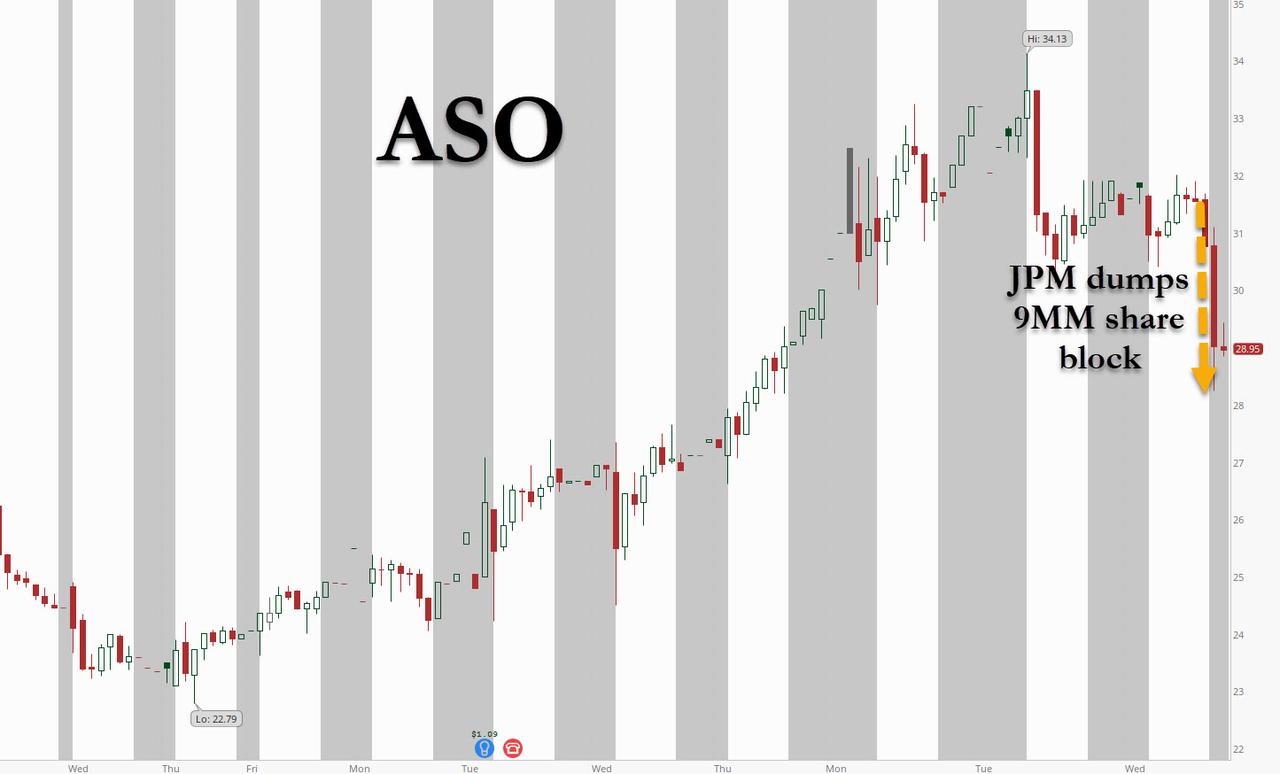
While there are no clear catalysts that could have forced a margin call on the yet-unknown fund (if indeed this is another Archegos), on Tuesday, the stock did drop sharply at the open from $34 to $31, although if that modest drop alone was enough to force margin calls we dread to imagine just how much leverage this fund was using...
We leave readers with the following observation from Bear Traps report author Larry McDonald:
As the calendar turns to April, the words we have lived by for nearly twenty years come to mind. “Higher prices bring out buyers, lower prices bring out sellers - size opens eyes.”Over the last week, it was the size of the losses inflicted on Wall St. banks - all delivered from one SINGLE family office that has caught our attention. Eight days after the Archegos hit - the scared rabbits across the Street have only been able to quantify a $10B to $12B loss, this fact gives the word “insult” new meaning.Of course, the pain inflicted comes after the Robinhood blowup, the Melvin Capital collapse and the Greensill implosion in Europe, all idiosyncratic, NOT. The Nasdaq bulls talk up “one offs” - but the these events are piling up which points to a classic, systemic leverage breaking point. The size and breadth of today’s bull camp incentivizes market participants to downplay encroaching risk.Almost everyone is fully invested and using leverage for more juiced returns. This crowd will go out of their way to tell the bartender it’s only midnight - when a glance toward the watch says it’s half past 2AM. Just think about how long it takes Wall St. banks to come clean to leverage losses. History tells us - the lonely truth will join us one drop at a time.Bull markets never, EVER die of valuation old age, its the leverage blow-up which triggers the deleveraging and takes the madness out of the crowd. Just look at the ARK ETFs, the marginal - over the top buyer is taking the sword as we speak.Every hedge fund compliance officer across the Street is now in search of the next Archegos, and they have as much trust in their prime broker as the lovely Marylin Monroe had in the playboy that was JFK. There are times to take on more risk and other inflection points which whisper into the wise man’s ear, “reach across the velvet and pull some chips off the table.” This is one of them, let the mad mob chase.For much of the last six months we have been in the growth to value camp, pounding the table on the migration of capital running out of Big Tech over to equities in the commodity sector. As most of our long term clients know, we have never been more bullish. Our focus has been on rotation - NOT a drawdown leaking across asset classes. Today, we must make a stand. It’s time to take down risk positions across the board and let the fools chase.The fundamental, bottom line problem with extreme frothy priced assets, any meaningful risk threat will deliver sharp drawdowns. We are far better off raising dry powder to deploy into more attractive price points.
Axa IM places €800m bet on return to the office in Europe
Asset manager to focus on UK, France and Germany as well as demand for low-carbon workspaces
One of the world’s largest asset managers has raised almost €1bn to develop offices in Europe, betting that demand for modern workspaces will bounce back after the pandemic.
Axa IM Alts, part of French fund house Axa Investment Managers, has raised €799m to deploy in Europe, with a focus on the UK, Germany and France. The bulk of the investment will finance offices in major cities, with the remainder going towards residential development.
“To launch this kind of development strategy you have to believe there’s a future for offices,” said Ian Chappell, head of development and value-added funds at Axa IM Alts.
The company is aiming to develop “high quality, flexible office space aligned with future working habits” and to cater to growing demand for offices with low-carbon emissions. The investment will expand a portfolio that also includes 22 Bishopsgate, the City of London’s largest office block.
“Occupiers are far more concerned about how buildings of the future will meet ESG [environmental, social and governance] requirements . . . those will be the building that investors will want to buy first,” said Chappell.
High-spec, city centre offices have tended to attract institutional investors in the aftermath of economic crises because long leases and well-capitalised tenants represent a steady and stable income stream.
But there are fears among developers that this time round might be different given that the pandemic has upended the way people work, severing employees’ attachments to the workplace.
Mat Oakley, head of European commercial property research at real estate company Savills, said: “I haven’t had a discussion with any real estate investor this year that hasn’t touched on whether offices are quite as core now [as a result of coronavirus]”.
A slew of employee surveys conducted over the past year have shown an increased appetite for homeworking even once it is safe to return to work, raising doubts about the viability of some older, less desirable office stock.
“This whole 12 months has really put obsolescence in the spotlight . . . Inevitably there will be more pressure to repurpose offices,” said Chappell.
Chappell and Oakley both predict a polarisation in major European cities, with office rents falling in older, less desirable workplaces but staying firm in newer developments.
Investors are also willing to bet that modern, high-end offices will remain attractive. According to global real estate company CBRE, as much as £45bn of global capital is targeting the London office market — the largest volume since the company stared tracking investment in 2012.
That represents far more than the amount of available stock, according to James Beckham, managing director of central London investment at CBRE. Demand has built up as lockdowns have sidelined investors, who are now targeting “best in class” offices, he said.
London’s attraction has been burnished by the UK’s vaccine rollout, which has outpaced European peers, according to Oakley. “Take Brexit out of the equation and the emergence from lockdown is pretty much the only factor driving investors at the moment,” he said.
Buyout Firms Team Up on More Than $15 Billion KPN Bid
Funds prepare to conduct due diligence with goal of submitting formal offer for Dutch communications-services provider this spring
A pair of private-equity firms have teamed up to make a bid for Royal KPN KKPNY -0.29% NV that could value the Dutch communications-services provider at more than $15 billion, according to people familiar with the matter.
New York-based Stonepeak Infrastructure Partners and Sweden’s EQT EQT -0.73% AB are working on a bid that could be valued at more than €3 a share, equivalent to $3.56, some of the people said. KPN shares closed Wednesday at €2.88 in European trading. The funds are preparing to conduct due diligence with the goal of submitting a formal bid this spring. It is possible that they could take on another partner and that they will face competition, these people said.
There are no guarantees that the parties will follow through, and if they do, that they will reach an agreement. Adding a layer of complication, the Dutch government would need to sign off on any deal.
KPN is the largest telecommunications operator in the Netherlands, offering mobile-telephony, data and television services to customers across the country. KPN’s business also includes a wholesale operation that leases fixed and mobile networks to other carriers that don’t operate their own networks.
Bloomberg in November reported that EQT had made an approach to KPN.
KPN faces stiff competition from rivals such as VodafoneZiggo, a joint venture of Liberty Global PLC and Vodafone Group PLC, and has suffered from declining revenue since at least 2014, according to FactSet. Last year, the Rotterdam company’s adjusted revenue fell 2.4% to €5.28 billion.
KPN recently struck a €440 million deal to sell a 50% stake in a new joint venture to the Dutch pension fund APG Group to accelerate the rollout of fiber connections to an additional 685,000 households and 225,000 companies.
Stonepeak oversees more than $31 billion of assets. It counts the $3.6 billion acquisition of Astound Broadband, the sixth-largest U.S. cable-TV provider, as being among its latest announced investments.
EQT, one of the best-performing publicly traded buyout firms, manages about €52.5 billion. The Stockholm firm knows the Dutch telecom market through its ownership of Delta Fiber Netherlands, a provider of high-speed broadband, TV and fixed-telephony services.
StockX Valued at $3.8 Billion and Lets Employees Sell Shares
The online marketplace sold $60 million worth of new stock in its latest fundraising round
StockX LLC, an online marketplace that sells sneakers, streetwear, collectibles and other items, said it has notched a $3.8 billion valuation by selling $60 million of new stock and letting some employees sell $195 million of their own shares to investors at that price point.
The 35% jump in valuation comes ahead of the company’s expected public listing that is likely to happen as soon as the second half of this year, according to people familiar with the company’s plans. The funding also comes quickly on the heels of its previous round, when StockX raised $275 million of new capital in December, valuing it at $2.8 billion. The company first eclipsed the $1 billion valuation mark in mid-2019.
Altimeter Capital, an existing investor, is leading this round and Dragoneer Investment Group will join the round as a new investor.
“By any metrics, these valuations are very reasonable when you look at their growth rate and their unit economics and their geographic and product expansion,” said Brad Gerstner, founder and CEO of Altimeter, referring to the company’s two most recent rounds of fundraising. “StockX is really on fire as an e-commerce platform.”
Altimeter and Dragoneer both recently benefited from another dizzying valuation jump. Earlier this year, they led a new round of financing for the videogame platform Roblox Corp. , putting $520 million at $45 a share into the company in January. Roblox made its debut through a direct listing in March, and its shares have recently traded around $70.
StockX Chief Executive Scott Cutler, a former executive at eBay Inc. and the New York Stock Exchange, previously told The Wall Street Journal that the company was profitable for the first time in the third quarter of 2020, with revenue rising 75% year over year.
The company hasn’t yet filed confidentially for a public offering, people familiar with the potential listing said. It is unclear what path to the public markets StockX might take, the people said.
The Detroit-based company started in 2016 as an online platform to buy and sell rare sneaker models, before expanding into streetwear, handbags, accessories and electronics. StockX emulates a stock exchange by providing market data for items, including a 52-week high and volatility. It generates revenue by keeping a percentage of each transaction.
StockX has raised more than $500 million in the private markets. For the year ended Dec. 31, the company closed more than 7.5 million trades and reached $1.8 billion in gross merchandise value, resulting in revenue topping $400 million, the company has said.
Closing Stock Market SummaryThe S&P 500 (+0.2%) eked out a closing record high on Wednesday in another narrow trading session that reflected consolidation activity. The Nasdaq Composite (-0.1%) and Dow Jones Industrial Average (+0.1%) finished within 0.1% of their flat lines, while the Russell 2000 underperformed with a 1.6% decline.
One of the bigger headlines today came out of JPMorgan Chase (JPM 154.93, +2.39, +1.6%) CEO Jamie Dimon's annual shareholder letter. Mr. Dimon said that an economic boom could easily run into 2023 but also cautioned about the "the not-unreasonable possibility that an increase in inflation will not be just temporary."
Jamie Dimon is one of the more influential voices in the market, but his words didn't appear to strike much trading conviction today. The cyclical materials (-1.8%) and industrials (-0.4%) sectors finished as laggards, and the 10-yr Treasury note yield was unchanged at 1.65%.
Declining issues also outnumbered advancing issues at the NYSE and Nasdaq, but JPM, Amazon (AMZN 3279.39, +55.57, +1.7%), and the mega-caps within the information technology (+0.5%) and communication services (+0.7%) sectors provided influential support.
The market saw a brief uptick after the FOMC Minutes from the March 16-17 meeting highlighted the known view that it would likely take some more time until substantial further progress toward the Fed's maximum-employment and price-stability goals are realized. This view suggested that the current accommodative monetary policy will remain appropriate until the Fed signals otherwise.
Prior to the minutes, Dallas Fed President Kaplan said the Fed can start withdrawing emergency measures once the country has moved on from the pandemic. Note, Mr. Kaplan won't be a voting FOMC participant until 2023.
In other developments, President Biden said he is open to compromising on the $2.3 trillion infrastructure package, consumer credit increased by $27.6 billion in February -- its largest increase since November 2017, and the CDC will reportedly allow U.S. cruises to resume operations by mid-summer with restrictions.
The 2-yr yield was unchanged at 0.16%. The U.S. Dollar Index increased 0.1% to 92.41. WTI crude futures increased 0.6%, or $0.37, to $59.71/bbl.
Reviewing Wednesday's economic data:
- The February Trade Balance report showed a widening in the deficit to $71.1 billion (consensus -$70.5 billion) from an upwardly revised -$67.8 billion (from -$68.2 billion) in January. The widening was the result of exports being $5.0 billion less than January exports, and imports being $1.7 billion less than January imports.
- The key takeaway from the report is that the impact of the semiconductor shortage was apparent in the $3.4 billion decrease in imports of automotive vehicles, parts, and engines.
- Consumer credit increased by $27.6 bln in February after increasing by an upwardly revised $0.1 bln (from -$1.3 bln) in January. This was the largest monthly increase in consumer credit since November 2017.
- The key takeaway from the report is that revolving credit expanded for only the second time in the last 12 months and was the largest increase in revolving credit since July 2019.
- The weekly MBA Mortgage Applications Index fell 5.1% following a 2.2% decline in the prior week.
Looking ahead, investors will receive the weekly Initial and Continuing Claims report on Thursday.
- Russell 2000 +12.6% YTD
- Dow Jones Industrial Average +9.3% YTD
- S&P 500 +8.6% YTD
- Nasdaq Composite +6.2% YTD