>>> Europe : Brokers Upgrades & Downgrades - 13th of April 2021

>>> Up
* CRH PT Raised to 53.10 euros from 45.80 euros at Jefferies
* eQ Raised to Accumulate at OP Corporate Bank
* FedEx Raised to Overweight at KeyBanc; PT $350
* Getinge Raised to Buy at DNB Markets; PT 305 kronor
* Grieg Seafood Raised to Buy at Arctic Securities; PT 110 kroner
* Outokumpu Raised to Reduce at AlphaValue
* Repsol Raised to Neutral at JPMorgan
* Total ADRs Raised to Overweight at JPMorgan
* Vivendi SE Raised to Outperform at Oddo BHF; PT 34 euros

>>> Down
* Equinor Cut to Neutral at JPMorgan
* Yara Cut to Hold at Berenberg; PT 465 kroner

>>> Initiation
* AF Gruppen Rated New Buy at Pareto Securities; PT 230 kroner
* Aker Carbon Capture Rated New Equal-Weight at Morgan Stanley
* LLN SM Rated New Buy at Litchfield Hills; PT 10.07 euros
* Norsk Hydro Reinstated Buy at Goldman; PT 72 kroner
* Philogen Rated New Buy at Stifel; PT 26.30 euros
* Virgin Wines UK Rated New Buy at Liberum; PT 280 pence

>>> Call
* Earnings Recovery Is in Motion for Europe Energy: Morgan Stanley
* Mosaic Preferred as Berenberg Sees Good 2021 Sector Outlook
* Total Is ‘Hard to Ignore’ as JPMorgan Rerates Oil, Gas Stocks
* Virgin Wines Gets Buy at Liberum on ‘Compelling’ Investment Case

>>> What to look at today - 13th of April 2021

Asian equities erased gains Tuesday and U.S. stock futures slipped as traders await inflation data, a Treasury auction and corporate earnings to assess the market outlook. Bond yields and the dollar climbed.
Shares retreated in China, where export growth missed forecasts in March and concern about the financial health of one of the nation’s largest bad-debt managers soured the mood. U.S. equity futures dipped following a slight pullback in the S&P 500 Index from a record. European contracts were steady.
The cost of insuring Asia’s investment-grade bonds rose after a record spike in yields on the debt of the state-owned bad debt manager China Huarong Asset Management Co. In Treasuries, the focus turns to Tuesday’s 30-year auction after sales of three- and 10-year notes attracted decent demand.
US After Hours Pretty quiet after hours session; RILY +10.1% jumps on news it'll join S&P SmallCap 600; ANGI +3.4% higher on March data

Nikkei +0.94% Hang Seng +0.96% CSI +0.51% Shanghai -0.01% Shenzen

Eur$ 1.1894 CNH 6.5563 CNY 6.5513 JPY 109.69 GBP 1.3743 CHF 0.9243 RUB 77.3830 TRY 8.1602 WTI$ 59.98 +0.47% GOLD 1,727.30 -0.30% BTC 60,700 +760

S&P -0.08% Nasdaq -0.15% EuroStoxx +0.03% FTSE -0.11% Dax +0.00% SMI -0.01%

Macro :
- Yellen Plans to Spare China From Currency Manipulator Label (1)
- China’s March Exports +20.7% Y/y in Yuan; Est. +28.6%
- China’s March Exports +30.6% Y/y in Dollar; Est. +38%
- Biden Discussed Approaches to Address Chip Shortage at Summit

Spacs :
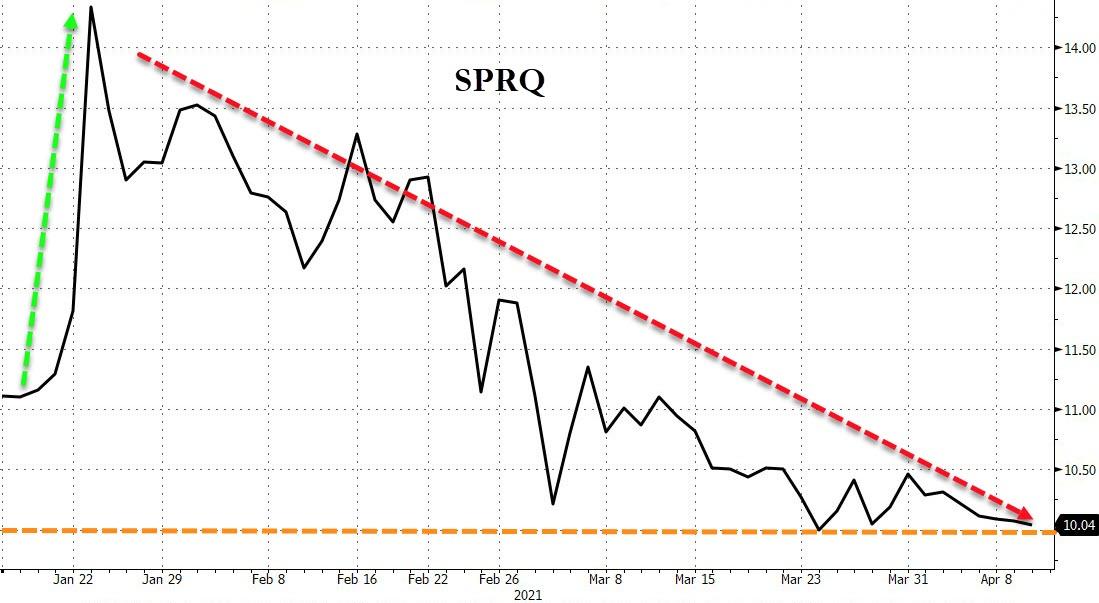
- Apollo SPAC Tied to Solar Lender Sinks to Palihapitiya’s Price
- SPAC Boom Faces Latest Threat From SEC in Accounting Discussions
- Mudrick Said to Mull Third SPAC Focused on Distressed Companies

Keep an eye on :
- ADES LN : ADES Says Some Conditions Now Satisfied on Buyout Offer
- AIR FP : Airbus Shakeup Sees Technology, Defense Chiefs Leave Company
- AF FP : Air France-KLM Seeks Up to EU988 Million From Capital Increase
- ALO FP : Alstom and Paris Metro Operator Reach Agreement: Figaro
- AZA SS : Avanza Prelim 1Q Net Income Beats Estimates
- CO FP : Casino Weighs Raising Capital for GreenYellow, Cdiscount Units
- CSGN SW ; Credit Suisse Sees 1Q Underlying Pretax Income Over $3.7b: FT
- DMP GY : Dermapharm Sees 2021 Sales +24% to +26%
- DBAN GY : Deutsche Beteiligungs to Raise Gross Proceeds of ~105M Euros
- DNO NO : DNO Gets $54m Net From Kurdistan Regional Government
- FAGR BB : Fagron 1Q Revenue EU134.8M Vs. EU141.6M Y/y
- FAST NA : Fastned 1Q Revenue Related to Charging EU2M
- GIVN SW : Givaudan 1Q Like-for-like Sales Beat Estimates
- IRE IM : City of Turin Completes Purchase of 2.5% of Iren at EU2.53/Share
- TKWY NA : Just Eat Takeaway 1Q U.K. Orders Beats Estimates
- LEO GY : Pierer Industrie Boosts Position in Leoni to More Than 15%
- MC FP : Dior Owner LVMH Seen Shining Even Brighter With Tiffany: Chart
- MAERSKB DC : Maersk Sees Rail Transport Use Soar Amid Covid, Borsen Reports
- NXI FP : Nexity: NEXITY LAUNCHES AN ISSUANCE OF BONDS CONVERTIBLE INTO NEW SHARES AND/OR EXCHANGEABLE FOR EXISTING SHARES (OCEANES) DUE
- NDX1 GY : Nordex Supplies VSB Group Turbines Totalling 42 MW to Poland
- ORSTED DC : Orsted CEO Targets European Acquisitions in Onshore Bet: Borsen
- PHIA NA : Philips Loses Patent Case Against Garmin and Fitbit at ITC
- PMAG AV : Pierer Mobility FY Revenue Forecast Beats Estimates
- REP SM : Repsol to Carry out Share Capital Reduction Through Redemption
- SAN FP : Sanofi Says 95.03% of Kiadis Shares Committed Under Offer
- SEM PL : Semapa’s Board Says Sodim’s Revised Offer Is ‘Adequate’
- SHL GY : Siemens Healthineers Said to Weigh $1 Billion Ultrasound Sale
- SEV FP : How France’s Warring Corporate Giants Stepped Back From Brink
- TGS NO : TGS 1Q Net Revenue $75M
- VLA FP : Valneva Ends Recruitment for Chikungunya Vaccine Phase 3 Trial

FT : Bonds of China’s largest bad debt investor plunge to record low

Bonds of China’s largest bad debt investor plunge to record low
Concerns grow over assets linked to executed former chair of state-owned group

The prices of bonds issued by China’s largest manager of distressed debt tumbled to record lows as global investor fears mounted over its financial health following the execution of its former chair for bribery.

Concerns surrounding state-owned Huarong Asset Management, a conglomerate with about Rmb1.7tn ($260bn) of assets and $22bn in outstanding offshore debt, have been growing since it said it would delay the release of its financial results at the start of April.

Lai Xiaomin, Huarong’s former chair, was executed in January after being found guilty of taking Rmb1.8bn in bribes over a 10-year period. The sell-off in the company’s bonds reflected uncertainty among investors, which include global fund managers, over assets that were originated during his leadership.

His execution represented a relatively rare instance of China applying the death penalty for financial crimes, which included abusing the power to allocate credit. Lai was arrested during his tenure in 2018 and convicted of other crimes including corruption and bigamy.

“No one really knows officially what the amount of these legacy assets [is],” said Harry Hu, senior director at S&P Global Ratings. He added that the company was believed to have made loans that were not in line with its business strategy.

Among those holding Huarong debt are BlackRock and Goldman Sachs Asset Management, with the latter having $116m of exposure as of late February to a $350m bond maturing in 2030, according to Bloomberg data. That security dropped 9 per cent to 77 cents on the dollar on Tuesday morning, while another $1.5bn perpetual bond fell 7 per cent to 81 cents on the dollar.

S&P on Friday issued a warning over Huarong’s credit profile, reflecting uncertainty stemming from the hold up in the release of its results. Huarong’s debt is rated investment grade by S&P.

Huarong has said the delay in its results was required so that an auditor could finalise a transaction, without providing specific details. Huarong’s Hong Kong-traded shares have been suspended at the group’s request since early April.

The company is majority-owned by China’s finance ministry. S&P believes there is a “very high likelihood” that Huarong has benefited from “extraordinary government support”, which has helped it borrow at low yields on international markets. In 2015, it launched an initial public offering in Hong Kong following strategic investments by foreign investors including Warburg Pincus and Goldman Sachs.

Huarong was the latest in a line of Chinese companies to come under pressure in dollar bond markets. In March, China Fortune Land Development, a property developer, defaulted on $530m of bonds in which BlackRock and HSBC were investors.

Huarong, along with three of China’s other big distressed debt managers, was set up in the response to the Asian financial crisis of the late 1990s. It originally handled the bad debts of Chinese state-owned lender ICBC, but in recent years transitioned to a more commercial model and acquired financial businesses in addition to its portfolio of loans.

WWD : Gucci, Balenciaga Said to Team Up

Gucci, Balenciaga Said to Team Up
Gucci will unveil its new collection on April 15 and rumors spread on Monday that the brand will present a collaboration with Balenciaga on that occasion.

ALL IN THE FAMILY: Gucci will unveil its new collection, called Aria, on Thursday, and details have been tightly kept under wraps. But on Monday speculation spread online and on social media that creative director Alessandro Michele has an ace collaboration up his sleeve with Balenciaga — a sister label under the Kering umbrella under the creative direction of Demna Gvasalia.

Gucci declined to comment and Balenciaga did not immediately respond to a request for comment.

The Italian fashion brand is not new to cooking up hot collaborations, most recently with The North Face and with the likes of Liberty and Ken Scott, for example.

The team-up is sure to spark additional attention. As reported earlier this year, data released by online shopping platform Lyst revealed that in the last three months of the year Gucci retained its top spot in the ranking. It generated big online buzz with its online fashion and film festival #GucciFest and dressing Harry Styles for American Vogue. Balenciaga returned to second place, as it continued to invest in digital-first initiatives and launched its fall 2021 collection in an online video game.

Gucci will present its next fashion collection through a short film on several digital platforms around the world. This is the first collection to be unveiled in 2021, which marks the brand’s centenary year.

The name Aria is in sync with the brand’s new strategy presented last May and also points to its singularity as the collection is presented outside of any fashion week calendar. In music, an aria is a self-contained piece for one voice.

Last year through his manifesto “Notes From the Silence,” Michele revealed he was crafting a new course for the brand, abandoning what he has called “the worn-out ritual of seasonalities and shows to regain a new cadence, closer to my expressive call. We will meet just twice a year, to share the chapters of a new story.”

Conceiving new names for the collections and inspired by the music world, Michele in July presented what would have traditionally been called a cruise collection and that was dubbed “Epilogue,” worn by the team from his office instead of models in a project that included a 12-hour livestream.

The designer in November presented a seven-part film series he co-directed with Gus Van Sant. The collection appeared throughout seven episodes running from Nov. 16 to 22, screened during a new digital fashion and film festival called GucciFest. The collection and the series were called “Ouverture of Something That Never Ended.”

FT : Deutsche Bank dodges bullets and goes mainstream

Deutsche Bank dodges bullets and goes mainstream
Germany’s biggest lender outperforms rivals and is no longer ‘sick bank of Europe’

It is a striking paradox that postwar Germany has achieved sustained success as an economy, even with a flailing banking sector, headed by the flag-carrying Deutsche Bank, to underpin it. But there are signs the contradiction may be resolving.

Over the past three years, Deutsche has beaten its European rivals in share price terms — sketchy evidence, perhaps, especially as that share price has actually fallen and Deutsche has paid next to no dividends. But it is a notable outperformance nonetheless.

Not so long ago, this was the “sick bank of Europe” — it was racked by scandal, trading losses and management infighting that at times looked existential. Now, with an accident-prone Credit Suisse having taken on that mantle, Deutsche has emerged as the surprise best of a bad bunch.

The relative recovery of Germany’s biggest bank has been particularly strong over the past year: the share price has doubled, albeit to a still low level. (Even now, the bank’s stock is worth barely a third of the book value of its assets, compared with a price-to-book ratio for US rival JPMorgan of 1.9 times.) For chief executive Christian Sewing, who last week celebrated three years in charge, it is a vindication of sorts.

Almost more important than the stock price recovery, both in terms of stability and the resultant financial benefits, is the sharp decline in the cost of insuring against a default in Deutsche Bank bonds. Deutsche’s credit default swap spreads are now narrower than those for some big US banks, thanks partly to a technical change in German bond rules, but also an easing of market nervousness around Deutsche. Talk of a rescue merger or a government bailout, frequently heard a couple of years ago, has all but evaporated.

Sewing can also point to more fundamental improvements. Unwanted assets have been shed and jobs cut, as pledged in a July 2019 strategy review. Progress has been choppy — so far only a third of the promised 18,000 jobs have gone; and its non-core division, or “capital release unit”, has barely released any net capital, despite cutting an initial €72bn risk-weighted asset portfolio to €34bn by the end of last year.


At the same time, Deutsche appears to have done a better job than rivals, notably Credit Suisse, in dodging bullets. It lent large sums to the now defunct Wirecard and the recently blown-up Archegos family office, but by hedging and offloading exposures it minimised losses and burnished its reputation in credit risk management.

Scandals still persist. In Spain, Deutsche has been accused of mis-selling complex currency derivatives to unsophisticated small businesses. Insiders admit the bank’s record in operational risk management must be improved. Over the past six years it has been the subject of more than $10bn of penalties and settlements related to historic accusations of money laundering, sanctions breaches, market manipulation and toxic asset sales.

Large chunks of the core business, though, are faring better than many expected. The bank is now seeking to rebrand itself as a “financing powerhouse”, playing on its traditional strength as a fixed-income house, with a big corporate lending franchise.

In some ways, that is evidenced in better performance at the investment bank. The bulk of Deutsche’s below-par equities unit has been offloaded to BNP Paribas, eliminating a slug of losses. And the boom in debt issuance by governments and companies has boosted revenue. One unwelcome side-effect, given the undermining impact of negative interest rates in other parts of the business, is that investment banking now looks more important than ever for Deutsche. (Sewing had wanted to de-emphasise it, given concerns about the inherent volatility of trading income.) In 2020, the investment bank accounted for €3.2bn of pre-tax profits compared with a group total of €1bn after losses elsewhere in the group.

For all the progress, and the tougher travails of European rivals, Deutsche’s shares remain slightly below where they were when Sewing took the reins three years ago. Many big shareholders will still be nursing losses.

But the investor mood is shifting. Aggressive private equity firm Cerberus, a top-five shareholder, has been less critical and Matt Zames, who had taken a personal interest in the Deutsche turnround, left his job as president of Cerberus last month. And last year, Capital Group, a more mainstream value investor, took a stake of more than 3 per cent.

After a decade as a distressed asset play, mainstream is big progress for Deutsche Bank.

(ZH) SEC Drops Accounting Bomb, Blows Up SPAC Boom

SEC Drops Accounting Bomb, Blows Up SPAC Boom

Having dropped their first major warning that something was coming last week with a subtle tweet suggesting "it is never a good idea to invest in a SPAC just because someone famous sponsors or invests in it," The Securities and Exchange Commission (SEC) just turned up the SPAC bubble-busting amplifier to '11' by signaling changes for how accounting rules apply to a key element of blank-check companies.
That was followed the tsunami of newly launched SPACs suddenly and dramatically hitting a brick wall. As we noted here, just three SPACs listed last week (including 2 on Wednesday), compared to more than 20 deals per week on average for most of the year.
Tonight we found out why as Bloomberg reports, citing people familiar with the matter, that The SEC last week began privately telling accountants that warrants, which are issued to early investors in the deals, might not be considered equity instruments. Bloomberg explains:
In a SPAC, early investors buy units, which typically includes a share of common stock and a fraction of a warrant to purchase more stock at a later date. They’re considered a sweetener for backers and have thus far been considered equity instruments for accounting purposes.
The proposed changes could result in warrants being considered a liability for accounting purposes, according to the Marcum note. The shift would spell a massive nuisance for accountants and lawyers, who are hired to ensured SPACs are in compliance with the agency.
Shortly after the Bloomberg story dropped, exposing the 'private' conversations, the SEC was forced to come clean and releases a press release detailing the accounting changes. For those so inclined, the full briefing is here, but this was a section we found notable...
We recently evaluated a fact pattern involving warrants issued by a SPAC. The terms of those warrants included a provision that in the event of a tender or exchange offer made to and accepted by holders of more than 50% of the outstanding shares of a single class of common stock, all holders of the warrants would be entitled to receive cash for their warrants. In other words, in the event of a qualifying cash tender offer (which could be outside the control of the entity), all warrant holders would be entitled to cash, while only certain of the holders of the underlying shares of common stock would be entitled to cash. OCA staff concluded that, in this fact pattern, the tender offer provision would require the warrants to be classified as a liability measured at fair value, with changes in fair value reported each period in earnings.
Simply put, as Bloomberg notes, the communications mean that filings for new SPACs may not go forward until the warrants issue is addressed.
Perhaps worst still, SPACs that are already public and that have struck mergers with targets may have to restate their financial results.
And the 'fervor' behind the SPAC bubble is bursting...
Which leaves Chamath Palihapitiya looking for the next asset bubble to be 'early' in.

WSJ : Regulators Step Up Scrutiny of SPACs With New View on Warrants

Regulators Step Up Scrutiny of SPACs With New View on Warrants
Blank-check companies may have to reclassify the instruments as liabilities, SEC says

WASHINGTON—Some special-purpose acquisition companies have improperly accounted for warrants sold or given to investors, securities regulators said Monday, stepping up scrutiny of the popular vehicles.

Warrants are a standard part of how SPACs raise money, including from hedge funds and other private investors. The potential return for early investors in SPACs is huge if the company’s shares rise because of various features of the structure, including warrants that give some investors the right to buy more shares at a preset price in the future.

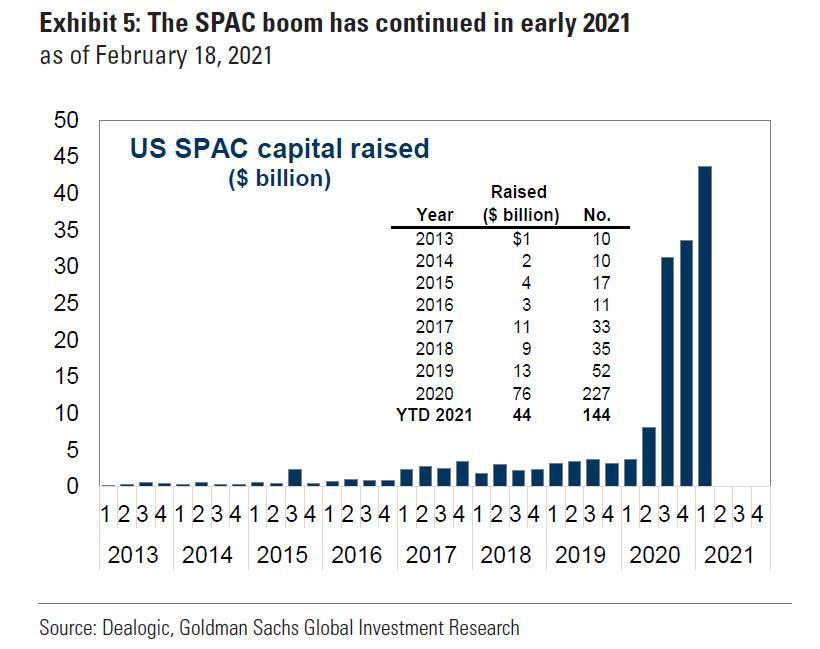
SPACs are blank-check companies that raise money from the public with a goal of buying a business and taking it public. If the deal happens, the target company takes the SPAC’s place on a stock exchange, in a transaction that resembles an initial public offering. SPACs have boomed over the past year as many deal makers rushed to start them and take advantage of investors’ thirst for the structure.

SPACs have typically classified the warrants on their balance sheets as equity. Under certain circumstances, they should be classified as liabilities, which would require the company to periodically account for changes in the warrants’ value, the Securities and Exchange Commission said in a statement released late Monday. One impact of the SEC’s announcement: SPACs that are affected would have to restate their financial results if the fluctuations are deemed to be material, the SEC said.

The Wall Street watchdog has started examining the market more closely as SPACs proliferated this year, raising nearly $100 billion. A senior SEC official said last week that SPACs might not have any regulatory advantages over the standard public offering, signaling the agency would scrutinize the failings the same way they do IPOs.

The SEC didn’t say in its statement how it had come to review the accounting treatment for warrants, which have been a part of SPACs for decades. A person familiar with the matter said the agency received questions from one SPAC about how generally accepted accounting principles require valuing the warrants, and regulators dug in from there. SPACs’ financial statements have typically been audited by smaller accounting firms, and not the Big Four firms that review the books of most large public companies.

The SEC didn’t say on Monday how many SPACs would be affected by its view on the warrants. But it suggested that more than a handful will have to reckon with its statement.

Not all SPACs will be affected, but many will, the SEC suggested in its statement. “While the specific terms of such warrants can vary, we understand that certain features of warrants issued in SPAC transactions may be common across many entities,” the SEC’s acting director of corporation finance and acting chief accountant wrote.

Those features include warrants that can be settled differently for some holders, such as warrants that can be exchanged for cash rather than shares. They also include warrants with a payoff that varies depending on who the holder is—such as giving a richer return to the SPAC’s founders or early investors than to public shareholders.

FT : Towercos signal the prospect of healthy returns

Towercos signal the prospect of healthy returns
Digital infrastructure Reits have high valuations, but serve a sector with accelerating demand

I’m fairly sure that adventurous investing types don’t need much cajoling to recognise that we live in a world of exponential growth in online data traffic.

Those charts showing ever-accelerating demand because of (choose your preferred option) the “internet of things”, video, virtual working or the rise of ecommerce have become de rigueur as analysts breathlessly outline a digital future.

As online gluttons we require a digital hardware infrastructure spanning everything from broadband fibre to the home and data centres in big cities to transcontinental cable lines and towers full of antennas that connect 3G, 4G or 5G traffic.

Inevitably, the word “infrastructure” also implies a more specific investment opportunity — assets that generate a steady income, which will hopefully grow over time as all that demand kicks in. The hitch is that for most private investors the options have been fairly limited, especially in Europe.

In the US there has long been an established subsector of real estate investment trusts (Reits) which invest in the towers and base stations that enable mobile internet, many listed in the table below.

These towercos, as they are called, are structured (like Reits) as tax-efficient income vehicles, although the yields on them tend to be rather puny. That weakness is not because of meagre cash flows — it’s a profitable business jamming all that equipment on a tower — but because valuations are quite literally reaching for the sky. Many of these vehicles trade on insane multiples and their shares have doubled or trebled over the past few years.

But that doesn’t mean that they are not still interesting. If I had to choose, I’d suggest that Switch Inc and CyrusOne sometimes look a bit unloved, particularly by comparison with the giants such as CrownCastle.

From a slightly different angle, I’d also pay close attention to Colony Capital, a large hedge fund now turning into a dedicated digital infrastructure specialist called Digital Colony. Once the transformation is complete, it will manage its own assets as well as a suite of funds for other investors focused on this space. The shares have shot up in value in recent months, but in my view the asset management possibilities are huge.

In Europe there are businesses equivalent to those e-Reits, with outfits such as Helios Towers trading in London and Cellnex Telecom in Spain. In a typically adventurous way, I like Helios because of its strong market position in the ultimate data growth market: Africa. If it hits analysts’ estimates for earnings growth, then its shares are not outrageously overpriced.

To that list of European towercos we can add Vantage Towers, trading in Germany. This is a new spin-off consisting of European towerco assets owned by Vodafone. It is not cheap by most metrics but it’s a damn sight cheaper than many of the US towercos in the table below, and I think it will appeal to the cautious institutional infrastructure investor who wants to spice up their portfolio with some digital action.


For my money, though, I’d prefer to own shares in its largest shareholder Vodafone, which look a bargain — and, for the record, I do.

Arguably the simplest and most elegant way into this niche is via one of two listed digital infrastructure funds which floated in the past few months on the London market. The first and still the biggest by assets under management is Cordiant Digital Infrastructure, which is overseen by Cordiant Capital, an experienced Canadian investment adviser which surprised everyone in the market by raising over £350m.

Then in March came D9 Digital Infrastructure, a vehicle managed by Triple Point, which raised £300m on a very similar mandate. I invested in both at IPO. They share common characteristics, investing in a combination of towers, base stations, data centres and fibre broadband businesses, though D9 is more focused on oceanic cables linking North America and Europe.

They both aim to provide investors with a total return of about 9 to 10 per cent with 4 per cent (Cordiant) to 6 per cent (D9) in dividends, which should grow over time.

Given the sky-high valuations on equivalent US assets, I’d point out that in the case of D9 at least, many of its seed assets came into the portfolio at between 10 and 15 times earnings. I’m slightly more biased towards D9 given that it has a big seed portfolio of assets already in the fund and producing cash now — but both funds tick the box for me.

Like many growth-oriented asset classes today this is one of those spaces with eye-watering valuations. But I suspect many adventurous types will still find a good reason to own them.

FT : Virgin Atlantic boss warns on long-term hit to business travel

Virgin Atlantic boss warns on long-term hit to business travel
Shai Weiss questions whether corporate trips will ever fully recover from pandemic

Virgin Atlantic’s chief executive is planning for a long-term reduction in business travel, in one of the clearest warnings yet on the hit to this part of the airline industry once the pandemic ends and people can move freely again.

The airline expects corporate travel will be 20 per cent lower over the next two years compared with pre-pandemic levels, with questions over whether business class will ever make a complete recovery, Shai Weiss said in a Financial Times interview.

“Will business travel return in the same way? No, I don’t think so. But do I think there will be a return to business travel? Absolutely,” he said.

Airlines have reported strong demand for leisure trips when borders open and people can travel, but one of the biggest questions facing the industry is how many lucrative corporate clients will be lost forever to remote working and the successful rollout of video conferencing technology.

Weiss believes the majority of people are tired of platforms such as Zoom and Microsoft Teams, but said the industry will inevitably take a hit from the changes to the way people work.

With lockdowns and travel restrictions still in place in many countries, the aviation industry is scrambling to predict the future of business travel, which can account for 75 per cent of revenue on some flights, according to PwC.

Jeffrey Goh, chief executive of Star Alliance, the world’s largest airline group, has told the FT he expects up to a third of trips to disappear, but airlines including Lufthansa and Delta have been more bullish over a snapback in demand once the crisis is over.

Four in 10 European business travellers say they will fly less often as a result of video conferencing technology once travel restrictions are lifted, according to a YouGov survey of 1,400 people, commissioned by the European Climate Foundation and published on Monday.

Virgin Atlantic is insulated by its traditionally strong showing in the premium leisure market, which Weiss expects to be boosted by consumer savings built up over the past year.

“We will maybe have to reduce prices if we are to attract [more people] into premium leisure, but we will. The demand is there,” he said. British Airways has also said it expects more leisure travellers willing to pay to sit in premium seats in the future.

Virgin Atlantic was left fighting for survival after the UK government refused it financial support when the pandemic grounded aviation one year ago. The airline has since cut costs and secured private funding, including a £100m loan from Richard Branson’s Virgin Group last month.

The balance sheet has also been boosted by $500m in revenue over the past year from flying cargo while passengers have been grounded, leaving Weiss “absolutely” confident the business will be able to survive the pandemic.

About 60 per cent of Virgin Atlantic’s fleet is still working thanks to the surge in cargo work, meaning cash burn, the key financial metric in the industry at the moment, is “extremely low”, according to Weiss. But he warned the situation remains “existential” for all airlines until travel resumes at scale.

“Cargo is good. But you know, cargo alone will not do it. We do need to continue passenger operations, we do need the resumption of travel in the summer,” he said.

Like many in his industry, Weiss is frustrated at the UK government’s cautious plan to reopen travel, which is banned for non-essential purposes until mid-May at the earliest.

“We’ve got to understand that international travel for an island nation post-pandemic, post-Brexit is key to our economy. It’s not about just holidays in Majorca,” he said.