>>> What to look at today - 4th of May 2021

U.S. equity futures retreated and Asian stocks were mixed Tuesday following weakness among the technology giants on Wall Street. The dollar rallied.
Taiwan’s benchmark bore the brunt of a sell-off, shedding as much as 3.3%, after beating all other major gauges globally in April. South Korean shares edged down while Hong Kong and Australia rose modestly. Trading will be limited with Japan and China among markets closed for holidays. U.S. contracts fell after the S&P 500 ended near session lows and shares such as Tesla Inc.and Amazon.com Inc. weighed on the Nasdaq 100.
Ten-year Treasury yields dropped back to around 1.6% in U.S. trade amid comments from Federal Reserve Chair Jerome Powell that the economic recovery is patchy.
A gauge of commodity prices is at the highest level since 2012. Silver is among the precious metals that have rallied as the prospect of near-zero rates for longer boosts demand. Oil was steady after climbing over 1%. Digital token Ether extended its surge to set another record.
US After Hours IRBT -8.6%, MAXR -8.2%, FRPT -6.5% fall on earnings; REGI +8.9%, RMBS +1.2% higher on earnings; VXRT +23.6% jumps on vaccine data

Nikkei -0.83% Hang Seng +0.35% CSI -0.79% Shanghai -0.81% Shenzen -0.29%

Eur$ 1.2037 CNH 6.4776 CNY 6.4749 JPY 109.34 GBP 1.3874 CHF 0.9144 RUB 75.0765 TRY 8.2676 WTI$ 64.30 -0.29% Gold 1,786.21 -0.37% BTC 55,930 -1,800

S&P -0.20% Nasdaq -0.23% EuroStoxx +0.10% FTSE +0.32% Dax -0.06% SMI

Macro :
- Fed’s Williams: Current Data ‘Not Nearly Enough’ for Policy Move
- KKR Raises $18.5 Billion for Latest North America Buyout Fund

Keep an eye on :
- ARL GY : ISS Against Petrus Proposal to Remove Three Aareal Board Members
- ADEN SW : Adecco 1Q Revenue Meets Estimates
- AIR FP : Lufthansa Buys 5 Airbus A350-900 and 5 Boeing 787-9 Aircraft
- AIR FP : KKR and Altavair Close Sale and Leaseback of Four Airbus A350-900 Aircraft With Singapore Airlines
- AOX GY : Alstria Office FY Revenue Forecast Meets Estimates
- AMBEA SS : Ambea 1Q Operating Profit SEK125M Vs. SEK144M Y/y
- AMS SW : AMS 2Q Revenue Forecast Misses Estimates
- AMS SW : Ams to Launch Delisting Offer for Remaining 28% Osram Shares
- ATL IM : CDP May Hold Autostrade IPO if It Buys Company, MF Says
- B2H NO : B2Holding Prelim 1Q Operating Profit NOK330M
- BAB LN : Babcock Prepares Rail Business Sale as Overhaul Continues: FT
- BCART BB : Biocartis Reports New Biomarker Collaboration With AstraZeneca
- CTM SS : Catena Media Buys Lineups.com for $39.6m in Cash
- DEMANT DC : Demant Raises FY Ebit Forecast; Sees More Share Buybacks
- DBK GY : Deutsche Bank Wants to Close More Postbank Branches: FAZ
- EUCAR FP : Rental Companies Buy Up Used Cars as Chip Crisis Get Worse
- EUCAR FP : Avis Budget Drops as It Warns of Uncertainty in Fleet Supply
- GEBN SW : Geberit 1Q Sales Beat Estimates
- HFG GY : HelloFresh 1Q Adjusted Ebitda Meets Estimates
- IFX GY : Infineon Sees 3Q Segment Result Margin About 18%, Est. 17.2%
- SKB GY : Koenig & Bauer 1Q Ebit Loss EU8.9M Vs. EU17M Loss
- SDF GY : Mosaic 1Q Adjusted EPS Beats Estimates
- LHA GY : Lufthansa Group to Buy Five Additional 787 Dreamliners
- MS IM : Berlusconi’s Mediaset Said to End Five-Year Fight with Vivendi
- MONTN SW : Montana Aerospace Sets IPO Price Range CHF24.15-CHF25.65/Share
- NEL NO : Nel 1Q Ebitda Loss NOK74.3M, Est. Loss NOK66.2M
- NOVN SW : Novartis Ends Bid to Block Imports of Regeneron’s Eye Syringes
- NOFI NO : Nordax Bank Boosts Offer for Norwegian Finans to NOK100/Share
- OERL SW : Oerlikon 1Q Sales Beat Estimates; Confirms 2021 Guidance
- PNDORA DC : Pandora 1Q Ebit Beats Estimates; Plans Dividends, Buyback
- PSH NA : Pershing Square Holdings Apr. Net Performance +4.2%
- PFE US : White House Backs Pfizer’s Move to Begin U.S. Vaccine Exports
- QIA GY : Qiagen FY Adjusted EPS Forecast Misses Estimates
- RLF SW : Relief, APR Sign Binding Term Sheet for Relief’s Purchase of APR
- SANN SW : Santhera Settles Bond Exchange Offer, Issues New Convertibles
- SIGN SW : SIG Combibloc Sees FY Core Revenue Growth Low End Of +4% to +6%
- TMV GY : TeamViewer 1Q Adjusted Ebitda Beats Estimates
- TEL NO :Telenor 1Q Ebitda Meets Ests; NOK6.5b Myanmar Impairment Loss
- TKA GY : Germany Ready to Spend $6 Billion to Clean Up Steel Production
- TRI FP : Trigano 1H Net Income EU114.3M Vs. EU65.6M Y/y
- TWTR US : Elliott Said to Buy More Than $200 Million Twitter Shares on Dip
- VIV FP : Berlusconi’s Mediaset Said to End Five-Year Fight with Vivendi
- VNA GY : Vonovia 1Q Adjusted Ebitda EU506.1M

>>> Europe : Brokers Upgrades & Downgrades - 4th of May 2021

>>> Up
* Boeing Raised to Market Perform at Bernstein; PT $229
* Novozymes Raised to Neutral at JPMorgan; PT 420 kroner
* Siemens Healthineers Raised to Buy at Deutsche Bank; PT 56 euros
* Spire Healthcare PT Raised to 233 pence at Peel Hunt
* Swedbank Raised to Buy at AlphaValue

>>> Down
* Greencoat Renewables Cut to Sector Perform at RBC; PT 1.15 euros
* INWIT Cut to Equal-Weight at Barclays; PT 11.50 euros
* Saipem Cut to Add at AlphaValue

>>> Initiation
* dotdigital Rated New Buy at Jefferies; PT 220 pence
* H-Farm Rated New Outperform at EnVent S.p.A.; PT 31 euro cents
* Friedrich Vorwerk Group Rated New Buy at Berenberg; PT 61 euros
* QinetiQ Rated New Equal-Weight at Morgan Stanley; PT 387 pence
* Sitowise Group Rated New Buy at Danske Bank Markets
* Trustpilot Rated New Buy at Berenberg; PT 385 pence
* Trustpilot Rated New Equal-Weight at Morgan Stanley
* Trustpilot Rated New Overweight at JPMorgan; PT 350 pence
* Trustpilot Rated New Buy at Danske Bank Markets; PT 393 pence
* Ultra Electronics Rated New Equal-Weight at Morgan Stanley
* Vantage Towers Rated New Buy at Citi; PT 30 euros

>>> Call
* Oil Service Sector Rallies as Barclays Says ‘Time to Own’
* U.K. Defense Firms’ Good Outlooks Priced In: Morgan Stanley

FT : A reckoning for Spacs: will regulators deflate the boom?

A reckoning for Spacs: will regulators deflate the boom?
The SEC is concerned about the market for ‘blank-cheque’ companies, including optimistic projections and celebrity endorsements

At the beginning of this year, the space transportation start-up Momentus thought it would be well on its way towards its stated mission of “revolutionising space infrastructure and the space economy”. Instead, regulators intervened.

Three months after Momentus announced a $1.2bn merger with a special purpose acquisition company, Stable Road Acquisition Corp, the Securities and Exchange Commission told the companies they were under investigation for statements made about the transaction, according to filings made public last month.

The merger, which would make Momentus one of the few publicly traded space companies, had been billed in October as a “unique and compelling opportunity” for investors. Momentus projected it would reach more than $4bn in revenues in 2027, including almost $670m in sales from a fleet of robotic vehicles designed to serve large spacecraft.

Those plans are on hold. Because of the ongoing investigation, the SEC has yet to approve filings for the merger proposal. Shareholders will vote on Thursday on whether to give the Spac a three-month extension to complete the transaction, failing which the merger will probably fall through. Momentus declined to comment and Stable Road did not respond to a request for comment.

Momentus could soon be joined in limbo. Spacs, which raise money from investors to search for a company, complete a merger and take it public, have suddenly lost their lustre — not least in the eyes of regulators.

Over the past year, Spacs, once considered a flaky sideshow in the finance world, have become the driving force of capital markets and dealmaking. “Blank-cheque” companies backed by well known figures on Wall Street, as well as celebrities and sports stars, have raised eye-watering sums of money, creating a $142bn pool of capital looking for merger targets. 

However, the boom has recently begun to attract the attention of regulators just as fundraising and dealmaking start to slow from a heady pace earlier this year. People familiar with the thinking of the SEC say it is concerned about multiple facets of Spacs, including their attractiveness to retail investors who may not be well versed in how the companies work, or the lucrative rewards earned by insiders. 

In a series of escalating statements, US securities regulators have raised sharply worded concerns about the recent boom in Spacs, questioning everything from optimistic revenue projections to the involvement of celebrities such as Jennifer Lopez and Alex Rodriguez in the companies. 

The SEC has not brought any cases against Spacs over the past year. But the appointment of Gary Gensler, the former head of the Commodity Futures Trading Commission, to lead the regulator has put the market on edge, with bankers and lawyers anticipating that blank-cheque companies will be a top priority for the new administration. 

“There has not been as much activity as you would have thought in terms of investigations related to Spacs,” says Luke Cadigan, a partner at law firm Cooley and former prosecutor in the SEC’s enforcement division. “That’s going to change dramatically in the weeks and months to come.”

One recent statement written by John Coates, acting director of the SEC’s division of corporation finance, suggested that the rosy financial projections associated with Spacs rested on shaky legal ground. Immature technology companies, including a bevy of electric vehicle makers, have relied on the projections to drum up interest from large institutional buyers and ordinary investors who have helped fuel the boom.

Other challenges loom as well. In New York, Spacs face a rising number of shareholder lawsuits, largely alleging that directors breached their fiduciary duty by providing inadequate disclosures at the time of the transactions. Short sellers, who bet on share prices to fall, have also taken aim, alleging fraud at multiple companies that went public through Spacs.

The threats, combined with increased regulatory scrutiny, have contributed to a slowdown in the Spac market, discomfiting a cottage industry of dealmakers, advisers and investors who have benefited from the boom.

In April, fewer than a dozen Spacs completed initial public offerings, the slowest month for Spac issuance since June 2020, according to Refinitiv. Spac mergers, known as de-Spac transactions, have also slowed, as investors pull back from the so-called “Pipe” privately arranged financings that add extra firepower to the deals. 

Those who advocate reform think the reckoning is overdue, having raised concerns to the SEC as early as last year under Trump appointee Jay Clayton, who appeared to take little action until days before his departure.

“I think what we saw with Spacs is a clear recognition that they could get away with this,” says Tyler Gellasch, executive director of the investor trade group Healthy Markets. “The SEC didn’t respond immediately, and so they kept going and pushing the boundaries ever further.”


Institutional focus
Spacs began booming last year as the stock market recovered from an early pandemic downturn, offering a quick and easy route for promising companies to go public. Spac founders, known as sponsors, latched on to what appeared to be an easy moneymaking opportunity, thanks to the share rewards they received for a nominal price.

The growing market also appealed to large public investors such as BlackRock and Fidelity, which had grown hungry for a new crop of fast-growing companies. By the end of April, nearly 500 Spacs with more than $140bn in assets raised through IPOs were searching for deals, according to Refinitiv data.

However, just as quickly as Spacs raised billions of dollars from eager investors, the market cratered. Two-thirds of blank-cheque companies without an announced deal are now trading below the $10 price at which investors purchase shares during IPOs, in stark contrast to the market’s peak, when Spacs largely traded at premiums.

Spac sponsors and advisers say multiple factors contributed to the downturn. Retail enthusiasm for speculative ventures has largely waned, sending shares in some popular companies such as electric truckmaker Nikola and battery developer QuantumScape down by as much as 80 per cent from their previous highs.

Even large institutional investors that helped lend legitimacy to the deal frenzy are taking stock after a record breaking quarter for dealmaking. Some companies have had to settle for a significant reduction in their targeted valuations to secure private financing in recent weeks, people involved in the transactions say.

The SEC’s statements have also had a chilling effect, say market experts. One recent declaration forced Spacs to change how they account for warrants, a key feature that rewards early investors with a cheap option to purchase shares in the merged company. Instead of qualifying as equity, the SEC says warrants should be considered liabilities in certain circumstances, punching a hole into the balance sheets of some Spacs.

Investigations into conflict of interest disclosures could be coming next, according to people familiar with the SEC’s thinking. Once Spacs have identified a target company, a select group of investors are made privy to market-sensitive information about the deal. 

Regulatory gap
Though Spac founders promised to improve the market’s shady reputation, investor advocates question whether they have any incentive to clean up the bad behaviour. In the US, Spacs exploit what critics view as “regulatory arbitrage” to provide financial projections that companies launching IPOs and direct listings would normally avoid. 

Because de-Spac transactions qualify as mergers, lawyers advise companies that they can present forward-looking statements and be protected from lawsuits under an exemption contained in the Private Securities Litigation Reform Act of 1995.

“That is one of the benefits of going public via a Spac, particularly for pre-revenue and pre-commercialisation companies, because it allows them to tell their story in a forward-looking way,” says Andrea Merediz Basham, partner at the law firm Freshfields. “That doesn’t mean that companies have a licence to say whatever they want.”

However, the statement by Coates, the SEC official, questioned whether lawyers had relied on a limited definition of “initial public offering” when advising Spac clients on making projections. If the distinction were erased, Spacs could be subject to lawsuits for forward-looking statements.

Paul Taubman, chief executive of the investment bank PJT Partners, said on a recent earnings call that the Spac market has benefited partly from regulatory arbitrage and he expected activity to decrease as the government intervened. “We’ve always said that we expect over time those benefits — many of them — to be taken away as the playing field becomes levelled,” he said.

When flying taxi start-up Archer announced a February deal to go public in a $3.8bn deal with a Spac backed by US investment banker Ken Moelis, it projected that its revenue would increase by more than $12bn in just six years. The company does not yet have a commercial product and expects to post its first year of revenue in 2024.

UK electric vehicle group Arrival, which became a public listed company this year following a merger with CIIG Merger Corp announced in November, has projected that its revenue will go from $1bn in 2022 to just over $14bn in 2024. None of the company’s vehicles have hit the market yet. 

The company’s president Avinash Rugoobur, said last year that the technology is now “mature”. “We have had prototypes on the road for two years, and we understand the challenges that are ahead of us,” he said.

Spacs have also managed to skirt regulations for blank-cheque companies, which US securities laws define as companies issuing penny stocks. A law signed by George HW Bush in 1990 expanded the SEC’s oversight of the market but exempted companies selling shares at above $5, giving Spacs a workaround. Under blank-cheque regulations, Spacs would be forced to provide information on the names and addresses of investors in the vehicles, a measure reformers say would help identify who stands to profit or lose money from the vehicles.

In February, a letter sent to the House Financial Services Committee by the progressive non-profit Americans for Financial Reform called on Congress to expand the blank-cheque company definition and amend securities law to exclude Spac mergers from liability protections. The committee did not respond to a request for comment.

“As long as there’s money to be made in every part of the Spac issuance process, I don’t expect to see changes unless you start to see some more scrutiny,” says Andrew Park, senior policy analyst at AFR. 

Activist opportunities
The Spac market has provided easy targets for short sellers, who say the vehicles allow dealmakers to more easily foist poorly run companies on the investing public.

Three companies targeted by the short seller Hindenburg Research — Nikola, electric-vehicle maker Lordstown and insurance group Clover Health — have drawn attention from regulators.

Lordstown said in March it was responding to an SEC request for information on its Spac transaction and vehicle pre-orders. The insurance company Clover Health, which is backed by Chamath Palihapitiya, also said in February it had received a letter from the SEC. Meanwhile, both the SEC and the Department of Justice have made inquiries into claims levelled against Nikola in the short seller’s report.

Lordstown has yet to issue a formal response to the claims in the report, while Clover and Nikola have both disputed some of Hindenburg’s allegations

Short sellers and other market watchers say the speed and ease of Spacs can lead to insufficient due diligence on the part of sponsors, who are incentivised to strike any deal before a two-year deadline or risk losing the cash they invested to set up the shell company.

“The activist short sellers have never had a more robust opportunity set,” says one hedge fund analyst.

Momentus, the satellite company, faces more than just an SEC investigation. The company has told shareholders that the Department of Defense views it as a risk to national security because its co-founders Mikhail Kokorich and Lev Khasis are Russian nationals.

Kokorich, who ran into national security issues with a previous space start-up, stepped down as chief executive two days after Momentus became aware of the issues with the DoD, the company says. Momentus says it voluntarily submitted a notice to the Committee on Foreign Investment in the United States, which has begun a review of the company’s ownership that is expected to conclude by mid-June.

Shareholders now have to weigh Kokorich’s importance to the company as it tries to execute a lofty vision. One Momentus investor presentation cited, as a “long-term growth opportunity”, the possibility of mining water and precious metals from asteroids.

In a statement, Kokorich said Momentus does not raise national security concerns. He said he plans to divest his shares, which have been placed in an irrevocable trust.

SEC’s move
Bankers and lawyers are watching for signals from Gensler, President Joe Biden’s choice for SEC chair. The former Goldman Sachs banker developed a reputation as being tough on Wall Street during his post-financial crisis tenure at the CTFC, taking aim at the opaque swaps market.

The SEC has not brought any enforcement actions against Spacs since 2019, when it settled charges against the former chief executive of Cambridge Capital Acquisition Corp. Officials alleged the executive failed to conduct proper due diligence on a company that manufactured cellular interception products, depriving shareholders of sufficient information about the business. The executive agreed to a cease-and-desist order and a $100,000 civil penalty, without admitting or denying the allegations.

One person familiar with the SEC’s thinking says it is concerned about the way that Spacs present financial projections, with growth targets that appear out of line with business fundamentals. At the same time, the SEC is also considering how it could allow companies going through traditional IPOs to more easily make projections, the person adds.

Some academics and market reformers have asked that the SEC consider more severe changes to the Spac market, calling for bankers to face the same liability risks as they would on underwritten IPOs for their work on Spac transactions. The SEC has sent letters to banks asking for more information on their work with Spacs, say people briefed on the correspondence.

Others think the SEC should focus on structural changes to improve the disclosures Spacs make to shareholders, rather than punishing bad actors after they have already harmed ordinary investors. 

The amount of capital sitting in Spacs has drawn worries that sponsors will not be able to find suitable targets, pushing them towards companies of questionable value.

“We need to really focus on disclosure,” says Anat Alon-Beck, assistant professor of law at Case Western Reserve University in Cleveland, Ohio. “We want to prevent bad transactions from happening in the first place.”

>>> US After Hours Summary: IRBT -8.6%, MAXR -8.2%, FRPT -6.5% fall on earnings; REGI +8.9%, RMBS +1.2% higher on earnings; VXRT +23.6% jumps on vaccine data


After Hours Summary: IRBT -8.6%, MAXR -8.2%, FRPT -6.5% fall on earnings; REGI +8.9%, RMBS +1.2% higher on earnings; VXRT +23.6% jumps on vaccine data

After Hours Gainers:

Companies trading higher in after hours in reaction to earnings/guidance: REGI +8.9%, CHGG +6%, RILY +4.4% (also declares $3 dividend, includes $0.50 regular and $2.50 special), KFRC +2.6%, CC +2.5%, LEG +1.6%, ZI +1.4%, QGEN +1.3%, RMBS +1.2%, WMB +1%, LTHM +0.7%, OHI +0.6%, O +0.4%, FN +0.3%, AGR +0.2%, AWK +0.1%, BWXT +0.1% (also initiates new $500 mln share repurchase authorization), PLOW +0.1%, SCI +0.1%, WWD +0.1%

Companies trading higher in after hours in reaction to news: VXRT +23.6% (reports data from oral COVID-19 vaccine Phase 1 study), UFS +17.1% (Paper Excellence said to weigh potential acquisition bid for Domtar, according to Bloomberg), TBBK +12.3% (to be added to S&P SmallCap 600), KYMR +6.9% (to present new pre-clinical data for KT0474), GAIA +4.2% (stock offering), BNTX +2.4% (PFE/BNTX: FDA to authorize vaccine in adolescents 12-15 yrs old by early next week, according to NY Times), OLLI +1.1% (new COO), BAX +0.7% (increases dividend), ETTX +0.5% (INVA and ETTX close $20 mln private placement), PFE +0.5% (PFE/BNTX: FDA to authorize vaccine in adolescents 12-15 yrs old by early next week, according to NY Times), UAA +0.2% (announces settlement with the SEC), SWBI +0.1% (to divest Thompson/Center Arms brand), ARI +0.1% (files for mixed securities shelf offering), EVTC +0.1% (stock offering), GVA +0.1% (awarded $160 mln contract for Texas dam project)

After Hours Losers:

Companies trading lower in after hours in reaction to earnings/guidance: IRBT -8.6%, MAXR -8.2%, FRPT -6.5%, SHO -6% (also suspends dividend on common shares), SDC -5.4% (also experienced a systems outage caused by a cybersecurity incident), LGND -4.3%, MOS -4.2%, VNOM -3.6%, VRNS -2.9%, RIG -2.7%, CAR -2.5%, ATCO -2.5%, SANM -2.2%, ADUS -2%, SEDG -1.8%, HLIT -1.5%, IAG -1.5%, XPO -1.5%, BLDP -1.1%, SU -0.6%, FANG -0.5%, VNO -0.3%, NTR -0.2%, RBC -0.2%, CBT -0.1%, NSP -0.1%

Companies trading lower in after hours in reaction to news: RCM -4.5% (to be added to S&P MidCap 400), SYNH -3.5% (stock offering), BTU -2.4% (new CEO), ASO -1.8% (stock offering), FANG -0.5% (OAS to acquire Williston Basin assets from FANG for $745 mln; also stock offering), GLOB -0.2% (announces senior mgmt updates; names Patricia Pomies as COO), MARA -0.1% (provides bitcoin production and miner installation update), COO -0.1% (announces acquisition of obp Medical for $60 mln), INTC -0.1% (to invest $3.5 bln to equip its New Mexico operations)

(ZH) Liquidity Tsunami Ends With A Bang: Treasury Expects Just $100BN In Cash In

Liquidity Tsunami Ends With A Bang: Treasury Expects Just $100BN In Cash Injections Next 2 Months

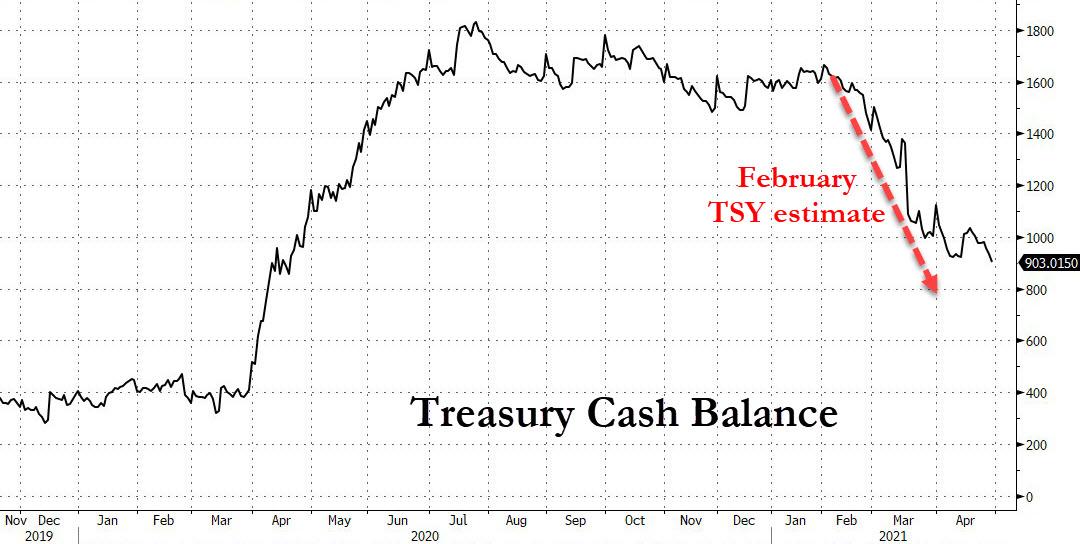
Three months ago, the Treasury surprised markets when in its quarterly borrowing forecast, it revealed that in the first calendar quarter of 2021, it wouldn't need to borrow as much debt as it had recently because the Treasury's cash balance (held in the Treasury General Account, or TGA, which is simply the Treasury's cash balance held at the Fed) would plunge to just $800 billion, down a record $929BN from $1.729 trillion at Dec 31, 2020.
This forecast for a flood of liquidity emanating from the Treasury prompted us (and subsequently others) to predict that as a result of the "mind-boggling liquidity" of just under $1 trillion in cash set to be unleashed by the Biden admin, stocks would soar as the Treasury's monetary injection would be far bigger than the $120BN in liquidity injected by the Fed every month.
And while stocks indeed surged to new all time highs, the Treasury's cash flood plan stumbled as the latest, just released Treasury Marketable Borrowing Estimates have revealed.
According to the Treasury, during the January – March 2021 quarter, Treasury borrowed $401 billion in privately-held net marketable debt - $126 billion more than the $274 billion originally forecast - and ended the quarter with a cash balance of $1.122 trillion, some $322 trillion more than the $800 billion it had forecast back in February (red arrow below), although as shown in the chart below, the actual TGA cash balance is indeed sliding fast, if not quite as fast as expected three months ago.
According to the Treasury, the $126 billion increase in borrowing resulted primarily from the increase in the end-of-March cash balance somewhat offset by lower net expenditures.
So what does the Treasury expect will happen in the current and coming quarter? Here is the summary from the latest Sources and Uses:
  • During the April - June 2021 quarter, Treasury expects to borrow $463 billion in privately- held net marketable debt, assuming an end-of-June cash balance of $800 billion. The borrowing estimate is $368 billion higher than announced in February 2021, primarily due to the government’s additional response to the COVID-19 pandemic.
  • The Treasury now expects $800BN in cash at June 30, just $100BN less than the latest print of $903BN as of the end of April. This means that the Cash flood which saw the TGA balance decline by $700BN since the start of the year is about to slow to a tricke.
  • Treasury is assuming a cash balance of approximately $450 billion at the expiration of the debt limit suspension on July 31 based on expected outflows under its cash management policies and consistent with its authorities and obligations, including the Bipartisan Budget Act of 2019. It notes that "the actual cash balance on July 31 may vary from this assumption based on changes to expected outflows in that period."
  • During the July - September 2021 quarter, Treasury expects to borrow $821 billion in privately-held net marketable debt, assuming an end-of-September cash balance of $750 billion.
In summary, instead of dropping by $929BN through March 31 as it had expected in February, the Treasury cash balance declined by "only" $607BN, a difference of $322BN. And in the current quarter, the Treasury now expects a similar decline in cash as last quarter, a drop of $322BN (vs $300BN previously), although since it is starting from a higher base, the June 30 cash balance will be $800BN instead of $500BN. This is summarized in the table below:
Finally, here is the full Sources and Uses Reconciliation, showing changes to not only cash, but financing needs and actual debt balances.
We will have more to say on this in a subsequent post, but for now the TL/DR is that the liquidity tsunami is over, and the Treasury now expects to release just $100BN in cash for the next two months, from the $903BN currently to $800BN at the end of June, and then just another $50BN lower three months later, or $750BN at the end of Sept.
This slowdown in the Treasury's cash injection, together with the possible announcement of a QE taper some time around the June FOMC meeting, means that the market melt up is about to end with a bang as investors start freaking out about the risk of a hard liquidity stop - one without the liquidity buffer of Treasury cash injections - some time in mid/late-summer and start frontrunning said event.

>>> US Close Dow +0.70% S&P +0.27% Nasdaq -0.48% Russell +0.49%

Closing Stock Market Summary

The S&P 500 increased 0.3% on Monday in a session marked by various narratives and consolidation activity. The Dow Jones Industrial Average (+0.7%) and Russell 2000 (+0.5%) outpaced the benchmark index, while the Nasdaq Composite declined 0.5% despite a positive open. 

To start, the ISM Manufacturing Index for April decelerated to 60.7% (consensus 65.3%) from 64.7% in March, supporting the "peak growth" narrative that partially explained last Friday's decline. The Prices component within the index, meanwhile, reached its highest level since 2008 at 89.6%, corroborating inflation expectations and an observation from Warren Buffett. 

Neither of these narratives, however, were completely supported by the market today. For example, the cyclical energy (+2.9%), materials (+1.5%), and industrials (+1.0%) sectors were among the top performers today, reflecting growth/reopening optimism. Inflation concerns, and conversely growth optimism, were dismissed by the gains in longer-dated Treasuries. 

Growth stocks underperformed, particularly those within the S&P 500 information technology (-0.2%), consumer discretionary (-0.7%), and communication services (-0.4%) sectors. The Philadelphia Semiconductor Index declined 1.2%. 

Specifying Warren Buffett's observation, he said in Berkshire Hathaway's (BRK.B 279.18, +4.23, +1.5%) annual shareholder meeting over the weekend that his businesses are seeing "substantial inflation" and that they're raising prices in response to the higher costs they are incurring. On a related note, Fed Chair Powell said in a speech today that inflation remained under control.

Evidently, it was easy to cherry pick data to support certain claims while using other data to refute such claims. One could even have pointed to the negative performance in the Nasdaq as early evidence for the "sell in May, go away" mantra. 

From a broader viewpoint, Monday's price action remained consistent with consolidation activity. The S&P 500 has essentially made no progress since the close on April 16. 

In the Treasury market, the 10-yr yield decreased two basis points to 1.61%, and the 2-yr yield decreased one basis point to 0.15%. The U.S. Dollar Index decreased 0.4% to 90.96. WTI crude futures rose 1.5%, or $0.98, to $64.49/bbl.

Reviewing Monday's economic data:

  • The ISM Manufacturing Index for April decelerated to 60.7% (consensus 65.3%) from 64.7% in March. A number above 50.0% connotes an expansion in manufacturing activity. April marked the eleventh straight month of expansion.
    • The key takeaway from the report for many will be the understanding that the Prices component jumped to 89.6% from 85.9% and sits at its highest level since 2008. All 18 industries reported paying higher prices for raw materials for the fourth straight month.
  • Total construction spending increased by 0.2% m/m in March (consensus 1.6%) after declining an upwardly revised 0.6% (from 0.8%) in February. Total private construction rose 0.7% m/m while total public construction spending decreased 1.5%.
    • The key takeaway from the report is the ongoing strength in private residential construction spending, which is a byproduct of strong demand driven by a scarce supply of existing homes for sale.
  • The final IHS Market Manufacturing PMI for April checked in at 60.5%, fractionally lower from the 60.6% preliminary reading.

Looking ahead, investors will receive the Trade Balance Report for March and Factory Orders for March on Tuesday. 

  • Russell 2000 +15.3% YTD
  • S&P 500 +11.6% YTD
  • Dow Jones Industrial Average +11.5% YTD
  • Nasdaq Composite +7.8% YTD
