(ZH) Highlights From Gensler's Talk On Crypto Regulation, And All Key Crypto Dev

Highlights From Gensler's Talk On Crypto Regulation, And All Key Crypto Developments This Week

It was a busy week for cryptos on both the regulatory and corporate adoption front, but the highlight was the talk delivered on August 3 by SEC Chairman Gary Gensler who laid out his views on crypto at the Aspen Security Forum. Below, are the top takeaways (from JPM's Steven Alexopoulos):
  • Gensler highlighted that the crypto space is currently the “Wild West” where we don’t have enough investor protection. Gensler said the SEC is looking to maximize regulatory protection in the crypto markets and called on Congress to grant the agency more scope and resources to oversee the crypto sector.
  • Gensler placed a heavy emphasis on a need for more regulatory oversight around crypto platforms including crypto trading platforms, lending platforms, as well as other decentralized finance (DeFi) platforms.
  • A key test used to determine whether something will fall under the SEC’s regulation is the “Howey Test.” The test evaluates an asset with the following: “the investment of money in a common enterprise with a reasonable expectation of profits to be derived from the efforts of others.
  • Gensler anticipates that there will be more filings with regard to crypto ETFs under the Investment Company Act, which provides significant investor protections. He looks forward to the staff’s review of such crypto ETF filings, particularly if those are limited to CME-traded bitcoin futures (Bloomberg had a follow up to this "Gensler Gets Wish as Bitcoin Futures ETF Filings Land").
  • On stablecoins, Gensler maintains a similar stance and noted how they may also be securities and investment companies. Gensler said that the SEC will apply the full investor protections of the Investment Company Act and the other federal securities laws to stablecoins.
  • The SEC is also seeking comment on crypto custody arrangements by brokerdealers and relating to investment advisers.

Paul Brody, Global Blockchain Leader at Ernst & Young, responded to Gensler's speech saying it signals bullish momentum for DeFi on the blockchain ecosystem. Some more takeaways here.
Besides Gensler, some other notable developments included recent moves at the OCC, a comprhensive bill to regulate the crypto market, an interesting decision by the Singapore central bank and of course, the tax treatment of crypto as envision in the Biden Infrastructure bill:
  • US Infrastructure Bill, August 2: The US Infrastructure Bill includes language that will have impact on the cryptocurrency industry. The bill would require 'brokers' to report to the IRS information about a digital asset transaction such as specific prices. As defined in the bill, a broker is someone who is "responsible for regularly providing any service effectuating transfers of digital assets on behalf of another person". Adding to developments in the infrastructure bill, a bipartisan group of lawmakers introduced an amendment that would explicitly exempt crypto miners, developers, and custodians from the IRS provision (for more see "#DontKillCrypto Trends As Ted Cruz Warns Of 'Dangerous' Provisions In Infrastructure Bill")
  • Digital Asset Market Structure and Investor, Protection Act, August 2: US Lawmaker Don Beyer (D-VA) has recently introduced a comprehensive bill to regulate the crypto market The "Digital Asset Market Structure and Investor Protection Act" would allow the Treasury Secretary to veto the creation of stablecoins, direct regulators to define rules for decentralized finance, and possibly create a charter tor crypto exchanges, among other measures. It would also define which sorts of cryptocurrencies might be securities, which can be treated as commodities, and bolster tax data collecting for reporting purposes. The support for the bill and its timeline of passage are unclear.
  • Monetary Authority (Central Bank) of Singapore, August 3: The Monetary Authority of Singapore (MAS) has granted its first "in-principle" approval to a virtual asset service provider for a Major Payment Institution License under the Payment Services Act Independent Reserve, the recipient of the approval, is a cryptocurrency exchange and the approval will allow it to operate as a regulated provider for digital payment token services. Several applicants were in the final stages of review for getting a license to operate as digital payment token service providers, the MAS said in the parliament.
  • Office of the Comptroller of the Currency, August 5: The New York Times reported that the Biden Administration is Vetting Saule Omarova to run the Office of the Comptroller of the Currency. If appointed, Ms. Omarova could seek increased oversight over crypto and the banking sector. She has previously expressed that crypto allows banks to conduct activity outside the view of regulators.
  • Fed Governor Waller on Stablecoins, August 5: In a speech before the AEI discussing the practical use of Central Bank Digital Coins, Fed Governor Christopher Waller said he favors stablecoins over CBDCs. He believes central bank digital currencies (CBDC) are “highly unnecessary” and reduce the market power of banks.
On the corporate side, it was a busy week as well, with JPM launching a bitcoin fund for private bank clients, ETF giant Invesco filing for a bitcoin strategy ETF with the SEC that will invest primarily in bitcoin futures - in compliance with Gary Gensler's stated vision - as well as having exposure to other bitcoin funds such as the Grayscale Bitcoin Trust; there were also news out of Grayscale which hired David LaValle, former CEO of custom index provider Alerian to be its global head of ETFs, as it attempts to convert its $22BN bitcoin trust into an ETF, and finally Valkyre Digital Assets - an asset manager - is offering a trust denominated in Dash that offers exposure to Dash as well as yield from staking; the closed-end fund will be offered on OTC markets available to retail investors.
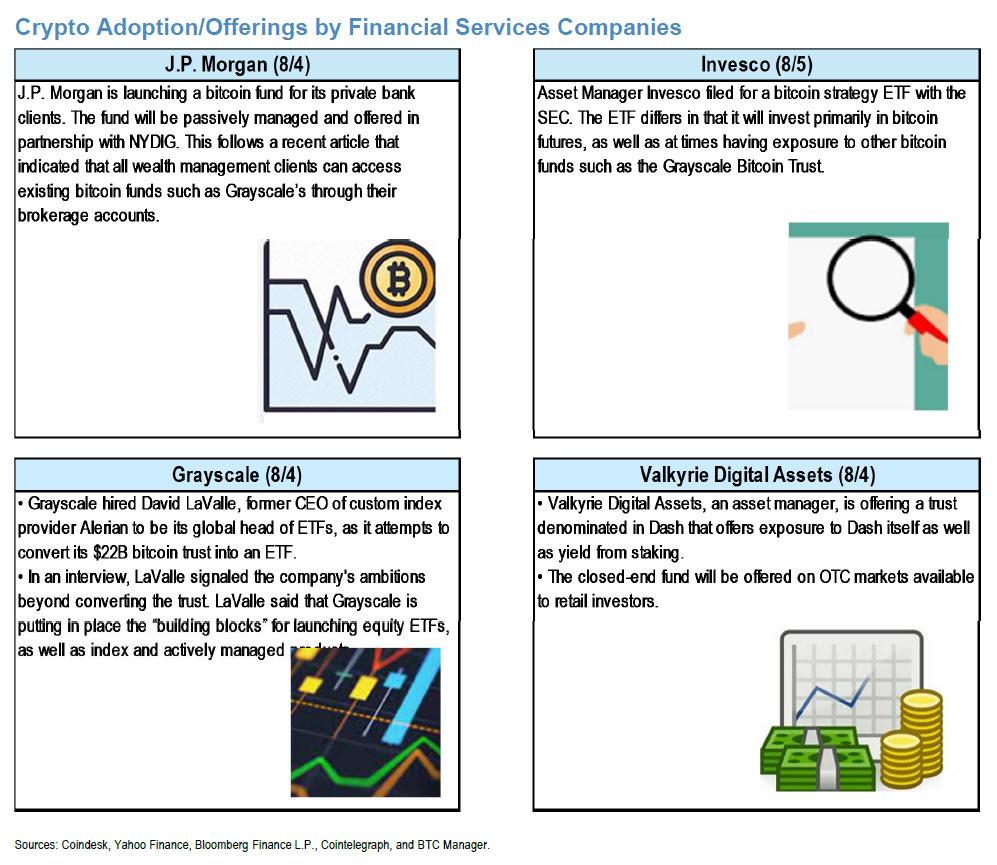
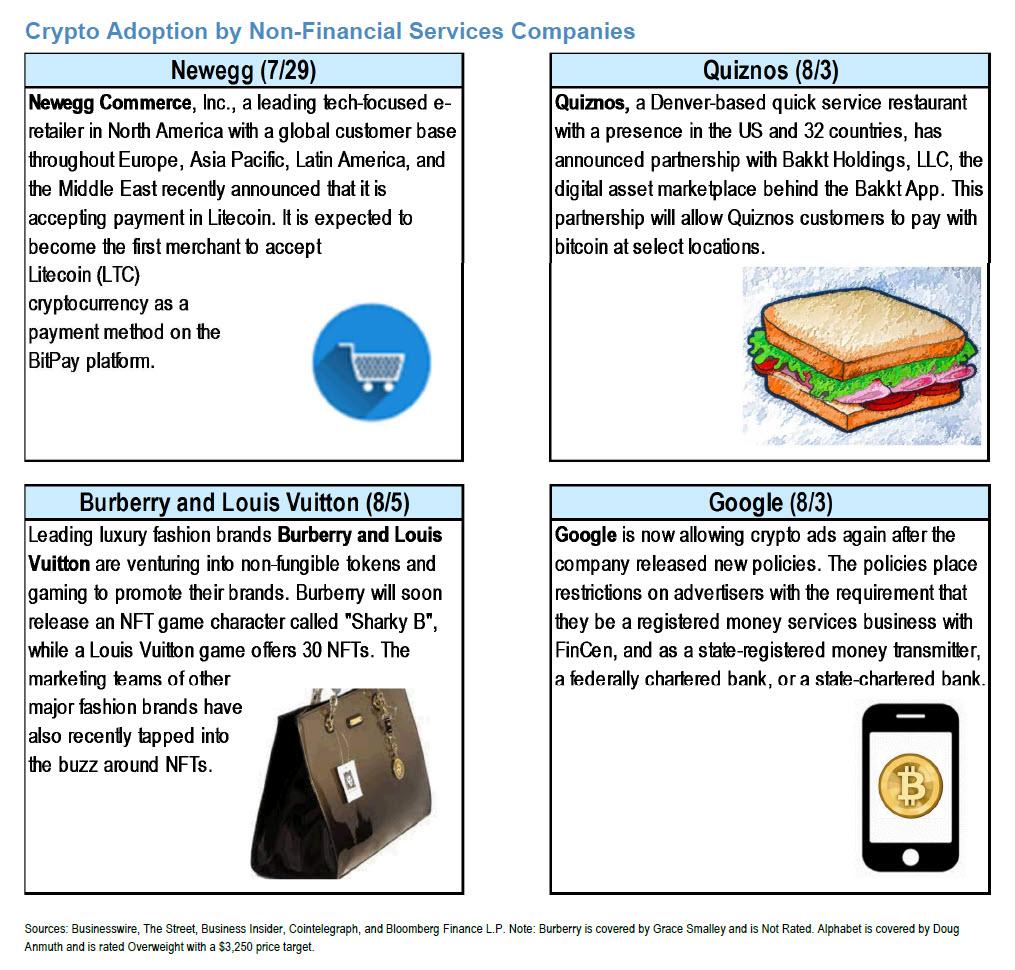
Finally, in terms of the latest crypto adoption news, we learn that tech-focused e-tailer Newegg Commerce will accept payment in Litecoin,becoming the first merchant to accept Litecoin as a payment method on the BitPay platform; restaurant chain Quiznos announced that it has partenered with Bakkt Holdings, which is the digital marketplace behind the Bakkt App, which will allow Quiznos customers to pay with bitcoin at select locations; Burberry and Louis Vuitton also made the news: Burberry will soon release an NFT game characters called "Sharky B" while a Louis Vuitton game will offer 30 NFTs; the marketing teams around other major fashion brands have also tapped into the buzz around NFTs; Last but not least, Google is again allowing crypto ads after the company released new policies. The policies place restrictions on advertisers with the requirement that they be registered money service business with FinCen, and as a state-registered money transmitter, a federally-chartered bank or a state-chartered bank.
WSJ : Gold as an Inflation Hedge: What the Past 50 Years Teaches Us

Gold as an Inflation Hedge: What the Past 50 Years Teaches Us
On the anniversary of the metal’s unleashing by Nixon, gold’s believers may be disappointed by the record

On a Sunday evening 50 years ago—on Aug. 15, 1971, to be exact—then-President Nixon interrupted “Bonanza,” one of the most popular TV shows of that era, to announce that he was ending the convertibility of the U.S. dollar into gold. Many consider it to be one of the most consequential decisions he made.

Up until this “closing of the gold window,” foreign central banks had been able to convert U.S. dollars into gold bullion at the fixed price of $35 an ounce. In theory, this had imposed a strict monetary discipline on the Federal Reserve, since inflating the money supply could have caused a run on Fort Knox, where the U.S. stored its supply of gold. And inflation did indeed jump in the years following Nixon’s decision to remove that restraint. So did the price of gold, which today is 50 times as high as it was that day.

This apparent correlation between gold and inflation has led many to believe that gold is a good inflation hedge. This belief isn’t supported by the data, however. If gold were a good and consistent hedge, the ratio of its price to the consumer-price index would have been relatively steady over the years. But that hasn’t been the case, as you can see from the accompanying chart: Over the past 50 years, the ratio has fluctuated from a low of 1.0 to a high of 8.4.

Gold is only a good inflation hedge over time frames far longer than any of our investment horizons, according to research conducted by Duke University professor Campbell Harvey and Claude Erb, a former commodities portfolio manager at TCW Group. They found that it’s only when measured over very long periods—a century or more—that gold has done a relatively good job maintaining its purchasing power. Over shorter periods its real, or inflation-adjusted, price fluctuates no less than that of any other asset.

Gold’s weakness as an inflation hedge may be even more pronounced today, Prof. Harvey says, because “gold is currently very expensive compared to its history.” The current gold-to-CPI ratio stands at 6.5, for example, nearly double its 50-year average of 3.6.

Light metal
Even though the price of gold is 50 times as high as in 1971, stocks have performed even better. The S&P 500 has produced an annualized return of 11.2% since August 1971, assuming dividends were reinvested along the way. That compares with 8.2% annualized for gold.

The Wall Street Journal, Aug. 16, 1971
Furthermore, the only reason gold came even this close to matching stocks over the past 50 years was its huge return during the first decade following Nixon’s announcement. Take away that decade, and gold has lagged behind even intermediate-term Treasury notes. Over the past 40 years, gold has risen at a 3.6% annualized rate, compared with 12.2% for the S&P 500 and 8.2% for the Treasurys.

This doesn’t mean gold has no role to play in a diversified portfolio, however, even assuming the future will be like the past. Because the correlation of its returns with those of either equities or bonds has often been low or even negative, its presence in a portfolio can reduce volatility. Over the past 50 years, a stock-and-bond portfolio could have improved its risk-adjusted performance by adding a small allocation to gold—around 5% or so.

Still, even gold’s volatility-reducing potential isn’t guaranteed, since gold’s correlation with stocks has varied widely over the years. In fact, there have been occasions in which gold’s correlation to the stock market has been positive, which is just the opposite of what it should be to reduce a portfolio’s risk. One such recent occasion came during the stock market’s waterfall decline in February and March last year: Stocks of gold-mining shares dropped 39%, as measured by VanEck Vectors Gold Miners GDX -2.98% ETF (GDX)—even more than the 34% drop in the S&P 500. “What kind of safe haven is that?” Prof. Harvey asks.

The next 50 years
Gold’s inconsistent correlation with both stocks and inflation makes it difficult to project how it will perform over the next 50 years. An additional wild card, according to Prof. Harvey, is that gold now faces “competition it’s never had before” because of the advent of cryptocurrencies.

It is always possible that gold will be a more consistent inflation hedge in coming years. It’s just that you will have to look elsewhere than history to find support for such a possibility. Mr. Erb is cynical whether this will pose much of an obstacle to gold’s true believers, however: “The past can always be brushed aside when dreaming about how gold and inflation might move in tandem in the future.”

Mr. Hulbert is a columnist whose Hulbert Ratings tracks investment newsletters that pay a flat fee to be audited. He can be reached

WSJ : A Gold Mine Takeover Highlights Increasing Mining-Sector Risk

A Gold Mine Takeover Highlights Increasing Mining-Sector Risk
In Kyrgyzstan, the government seized a large mine owned by Canada’s Centerra Gold; the company now faces an uphill battle to get it back

Canada’s Centerra Gold Inc. CG -1.78% invested more than $3 billion over nearly three decades to turn a remote gold prospect in Kyrgyzstan into a prosperous gold mine. Then in May, the mine was taken over by authorities in the former Soviet republic.

Officials from Kyrgyzstan’s secret police arrived at homes of local mine managers to obtain computer passwords, confidential documents and keys to the mine and the head office of Centerra’s wholly owned subsidiary Kumtor Gold Co., people familiar with the matter and court documents said.

Mining and legal experts say the expropriation of one of Central Asia’s largest gold mines—which had accounted for about a tenth of Kyrgyzstan’s economic output—is one of the most brazen moves in recent years by a country to assert control over valuable natural resources.

Centerra is far from the only mining company that has tangled with governments in recent years. Gold or copper mines in Tanzania, Papua New Guinea, Mongolia, Indonesia, Greece and South America have been stalled or threatened as local governments pushed for more taxes, royalties or larger stakes.

Mining giant Barrick Gold Corp. , for example, settled a standoff with Tanzania in 2019 by paying the African country $300 million and sharing ownership at three local gold mines. Tanzania’s president at the time said he was waging “economic war” against miners who weren’t paying sufficient royalties and taxes.

Many of the moves have been driven by a rise in commodity prices and, in the case of the Kyrgyzstan mine, rising

Robert Cohen, vice president and portfolio manager at Canada-based 1832 Asset Management LP, said he is avoiding stocks in Latin American countries such as Peru and Chile for the first time in decades, because governments are demanding higher taxes and royalties from miners.

“I don’t think it’s worth the risk until the smoke clears,” he said.

Mr. Cohen had steered clear of Centerra’s stock before the seizure because “a stomach of steel” was needed given past tactics used by Kyrgyzstan against the miner, he said. A former Centerra executive was detained in Bulgaria for about three months several years ago after the Kyrgyzstan government issued an Interpol notice alleging he was involved in corrupt activities. The executive was released when Kyrgyzstan failed to produce documentation to support its extradition request, Centerra’s lawyer told a New York judge last month.

Four months before the Kumtor mine was seized, Sadyr Japarov, a nationalist politician and advocate of its nationalization, was elected president. His government said it took control of the mine after alleging Kumtor failed to follow local environmental laws to protect mountainous terrain near the property.

Scott Perry, Centerra’s chief executive officer, disputed that laws were breached. He said the mine expropriation was instead motivated by rising gold prices.

“Clearly this is all about economics. You have a high gold-price environment, and they want a better economic deal. The playbook here is a premeditated seizure,” Mr. Perry said.

Salavat Ashirbekov, director of the Center for Court Representation of the Kyrgyz Republic, said in a statement that Centerra’s accusations “were stated in the absence of evidence, are far-fetched and do not correspond to reality.”

The expropriation of Centerra’s mining subsidiary is one of a number of recent unorthodox moves in Kyrgyzstan. These include an alleged attempt to divert a payment owed by a London trading company, a unit of StoneX Group Inc., to Kumtor Gold. In another instance, a court in Kyrgyzstan issued an order forbidding U.S. and Canadian lawyers from representing the mine in North American court proceedings.

In May, the same month the Kumtor mine was seized, a state-owned refinery failed to deliver about half a metric ton of gold to StoneX and allegedly tried to divert about $29 million that the trader owed to Kumtor, according to people familiar with the matter and court documents in cases brought by Centerra and StoneX. The refiner, Kyrgyzaltyn OJSC, processes gold produced by the mine into bars and is also Centerra’s biggest shareholder.

Kyrgyzaltyn is alleged by StoneX to have sent an invoice to the trader asking for the money to be sent to an account at “Well Fargo,” an apparent misspelling of Wells Fargo & Co., according to some of the people and one of the court documents. StoneX has sued the refiner for over $1 million in a London court to cover losses it says it incurred on trades it had placed to hedge the gold deal.

The London Bullion Market Association is examining the allegations against the refiner and takes any breach of its rules and principles seriously, said Sakhila Mirza, executive board director and general counsel at the authority, which oversees London’s gold market. If the LBMA finds against the company, it could be struck off the market’s list of acceptable refiners, a rare move that would restrict it from trading in international gold hubs.

Phone and email requests for comment from Kyrgyzaltyn, the refiner, weren’t returned.

Mark Bristow, CEO of Barrick, said after years of operating mines in Africa and elsewhere, he favors giving nations a fairer stake in local resource production so the interests of governments and foreign operators are more closely aligned in mining operations that can continue for decades.

Earlier this year Barrick agreed to give Papua New Guinea and local entities a 51% equity stake in a gold mine that was shut last year when the country refused to renew its mining license in a push for more benefits. The country’s prime minister, James Marape, described the deal in April as a historic step that would set a precedent for future projects.

When countries take such extreme steps as Kyrgyzstan, Mr. Bristow said, the local economy suffers in the long run because foreigners are less willing to invest or share technology and expertise.

“It is disturbing to witness this kind of behavior,” Mr. Bristow said. “This clearly isn’t about sharing, this is about taking the whole thing.”

Once mining assets are seized or stalled in politically volatile countries it typically takes years to resolve the standoff through negotiations or legal battles. Centerra is seeking to defend its rights through courts and arbitration in the U.S., Canada and Sweden.

Shortly after the mine seizure in May, Centerra’s Kumtor mine was granted bankruptcy protection in New York, effectively freezing the Kumtor mine’s assets while Centerra seeks a solution. Centerra’s operating agreement with Kyrgyzstan requires the mine to adhere to U.S. laws.

Following the move for bankruptcy protection, a Kyrgyzstan court took the unusual step in July of forbidding some directors and lawyers in New York and Toronto from representing Centerra’s Kumtor subsidiary in the court case. The Kyrgyzstan court said anyone violating the order could be prosecuted. A New York judge overseeing the bankruptcy case issued a contempt order against the country for interfering with the case.

James Bromley, a Sullivan and Cromwell LLP lawyer representing Centerra, told the New York bankruptcy court judge in July that Kyrgyzstan’s threats against lawyers seeking to recover assets for a client are “like something out of the Bourne Ultimatum,” the Hollywood espionage thriller.

“The mine has been stolen from my client,” he said.

WSJ : No U.S. Subsidies for Dirty Solar Panels Made in China

No U.S. Subsidies for Dirty Solar Panels Made in China
The policy has failed American workers and the environment.

American policy, which incentivizes our consumers to purchase China-made solar panels manufactured with inexpensive coal power by low-wage workers, has decimated the U.S. solar industry, made us dependent on an adversary for critical energy infrastructure, and failed as climate policy, given that China is increasing carbon emissions faster than we can reduce them (“Coal Plays Key Role in Making Chinese Panels,” U.S. News, Aug. 2). I will soon introduce legislation to restrict generous federal solar tax credits to panels manufactured at each stage with majority-U.S. inputs. My bill also will require disclosing to consumers the percentage of fossil fuels used to manufacture each brand of solar modules, so environmentally conscious buyers don’t become unwitting subsidizers of fossil fuels.

Rep. Rick Crawford (R., Ark.)

Washington

If solar cells were truly renewable and giving us free energy, one logical use would be to make more of their kind. That no one makes solar cells with solar cells should tell you this is a fraud. Only those solar cells created and commissioned from solar-cell electricity should be eligible for favorable treatment. If a cell comes from a factory with a utility meter or a strip mine that gets diesel-fuel deliveries, then it doesn’t qualify. See what happens to all those solar-panel factories.

Bruce Anderson

Houston

Copyright ©2021 Dow Jones & Company, Inc. All Rights Reserved. 87990cbe856818d5eddac44c7b1cdeb8

WSJ : Biden’s Electric-Car Ambitions Face Real-World Roadblocks

Biden’s Electric-Car Ambitions Face Real-World Roadblocks
Auto makers want congressional moves on charging stations and tax incentives; consumer support also is needed

WASHINGTON—President Biden wants to convert American motorists to electric cars as a linchpin of his plan to address climate change. Success heavily depends on factors outside his control.

The executive order that Mr. Biden signed Thursday—calling on sales of electric, fuel-cell and plug-in hybrids to account for 50% of car and light truck sales by 2030—has no binding authority.

Auto makers say they could meet a target of somewhere between 40% and 50% of sales, but only if Congress spends billions of dollars to build out a network of EV charging stations and provides tax incentives to consumers, among other measures.

Beyond that, consumers must buy in. EVs currently account for about 3% of sales, reflecting in part generally higher upfront costs and limits on their range.

“Possibly the biggest hurdle ahead is consumer acceptance,” said Jessica Caldwell, an analyst at auto-data firm Edmunds. “What will it take for Americans to be willing to change their car ownership habits to go electric?”

Supporters of Mr. Biden’s plan acknowledge the magnitude of the task ahead but insist the goal is achievable.

Tax incentives can help bridge the price difference between gasoline and electric vehicles at the dealership, these people say. Once purchased, electric vehicles offer continued savings in fuel and maintenance costs compared with gas vehicles, and often a better ride.

A bigger national network of charging stations is also seen as key to alleviating fears of range anxiety, or running out of charge on the highway.

Providing those solutions will require balancing a long list of interests, from industry, political parties, unions, environmentalists, regulators and local governments, among others.

“That’s a Rubik’s cube of complexity,” said Larry Burns, a former GM executive and adviser to Alphabet Inc.’s self-driving affiliate Waymo. “And this scale is massive. So we have to have collective will to make this happen.”

But Mr. Burns and others say the industry is ready to make the transition, spurred by government and international competition.

Mr. Biden has made transportation a central part of his agenda on climate change. The sector is the country’s top source of greenhouse-gas emissions, contributing more than a quarter of the country’s planet-warming gases. And China has become a world leader in batteries and electric vehicles, a long-term threat to U.S. manufacturing.

Mr. Biden’s most immediate impact will be through using the authority he does have at the Environmental Protection Agency. It is proposing new rules that would require auto makers to raise average fleetwide fuel efficiency to the equivalent of 52 miles per gallon by the 2026 model year, using an industry measure that takes both fuel efficiency and emissions reductions into account.

That compares with the current requirement of 43.3 mpg for that model year under rules set last year by the Trump administration.

Under the agency’s proposal, which is now subject to a public-comment period, auto makers would be allowed some increased flexibility to comply by using credits they banked in past years when they surpassed their sales goals under the fuel-efficiency requirements.

That is likely to spur opposition from the left, with some environmentalists already saying the president is caving in to the auto industry. The EPA’s proposal would produce just 75% of efficiency gains that would have come from the original Obama-era rules, according to an analysis from Consumer Reports Inc., a nonprofit membership organization known for its product reviews.

“There’s no doubt [the EPA proposal] is a big improvement over where we were,” said David Friedman, Consumer Reports’ vice president of advocacy. “But it doesn’t go as far as our technology can go, and both where consumers and the climate need us to go.”

And the regulations themselves aren’t set in stone, said Mary Nichols, a former chairwoman of the California Air Resources Board and a pioneer of fuel-economy regulation.

Mr. Biden is taking action now to toughen fuel-efficiency standards in large part because former President Donald Trump drastically relaxed standards first imposed by former President Barack Obama.

“An administration that is determined to dismantle them can quickly shift course,” Ms. Nichols said.

That makes Mr. Biden’s deal making with the auto makers important as an attempt to bulletproof his plan for the auto industry. The former GM executive Mr. Burns and other industry experts note that the major auto makers are already spending big to transform themselves, a major reason Mr. Biden’s plan might succeed.

But it faces risks, too. Because it is voluntary, auto makers could still backtrack on their commitments, as they have done before. Congress has taken some of the tax credits and spending that the industry says it needs out of a pending bipartisan infrastructure package, leaving it for Democrats to consider for another spending bill that faces high hurdles to passage.

There has been pushback from auto dealers fearful of the loss of lucrative maintenance work on traditional engines.

Unions are fearful of job losses if the transition moves too quickly.

Mr. Biden voiced his support for union workers throughout an event at the White House on Thursday where he signed the executive order, with executives from Ford Motor Co. , General Motors Co. and Stellantis NV (formerly Fiat Chrysler)—all union shops—looking on.

The White House left out foreign auto makers, including Toyota Motor Corp. or Hyundai Motor Co. , whose U.S. workforces aren’t union-represented, as well as Tesla Inc., the company that has led the way in building a market for EVs.

The exclusion led to a rebuke from the American International Automobile Dealers Association, which noted that any policies that “prioritize some American auto workers above others…politicize what should be a shared mission,” making reaching the EV sales target more difficult.

Bob Lutz, a former senior executive at Ford, Chrysler, BMW and GM, where he was vice chairman, said Mr. Biden has now put himself at the center of what could be a messy transition process, one that will upend the status quo as auto manufacturing shifts to EV technology.

“There is going to be a massive dislocation,” especially for workers, Mr. Lutz said. “He has to navigate through it and enforce the compromise. If everybody is a little unhappy but willing to accept it, that’s what he’s shooting for.”

FT : BT taps Adam Crozier as new chair

BT taps Adam Crozier as new chair
Former ITV chief to replace Jan du Plessis as telecom group reshapes its business around digital services

BT is set to appoint Adam Crozier, the former ITV and Football Association chief executive, as its new chair.

BT started its search for a new chair in March after the surprise resignation of Jan du Plessis, which came after Philip Jansen, the company’s chief executive, threatened to resign unless the South African boardroom veteran moved on.

Crozier, 57, has won the race to succeed Du Plessis according to a person with direct knowledge of the appointment. BT said the process was not yet complete “and we do not comment on ongoing board matters”.

The decision means that a former chief executive of Royal Mail will take the helm of BT’s board forty years after the telecoms company was formally split from the Post Office.

The appointment was first reported by The Times which said that Crozier would stand down from fashion retailer Asos as a result of the BT move.

Crozier, a Scot who built his career in advertising at Saatchi & Saatchi, joins BT at a turning point in its recovery under Jansen’s leadership.

The company is only part way through a £15bn upgrade of its broadband network to full fibre and is reshaping the business to focus on developing digital services.

It has cleared a number of hurdles in recent months. Regulator Ofcom set a new regime designed to encourage heavy network investment, while the company has struck agreements with its pension trustees and unions. The share price has recovered 80 per cent since it hit an 11-year low last year.

However, the emergence of billionaire Patrick Drahi as BT’s largest shareholder in June has created uncertainty about the future structure of the business. Drahi’s strategy has been to take over telecoms assets using debt. His 12.1 per cent stake is seen by some within the company as a potential foothold for a future attempt to try to acquire BT or break it up.

FT : Entain boss builds technology army to expand digital products

Entain boss builds technology army to expand digital products
Despite becoming CEO of the gambling group in the middle of a takeover bid, Jette Nygaard-Andersen seems unfazed

Many of us started new jobs during the pandemic. But few, if any, took over a company during lockdown, in the middle of a takeover bid, weeks after the business had announced a strategic overhaul and rebrand, in an industry under heavy pressure from regulators.

When Jette Nygaard-Andersen was appointed chief executive of Entain, the London-listed gambling group, she had the added challenge of succeeding the company founder’s chosen successor, Shay Segev, who had only been in the role seven months.

Yet the 52-year-old Dane seems unfazed by what others might view as a turbulent appointment.

“Certainly I wasn’t expecting that Shay would resign . . . [but] when you get that call from the chair you certainly say yes, let’s sit down and have that chat,” she says.

Nygaard-Andersen had served on Entain’s board for just over a year. Segev resigned to take the top job at sports streaming platform DAZN with a much higher salary, people close to the company have said. “That call” came in the middle of the Christmas break, just days before the US casino group MGM made public an £8bn offer for Entain, which the company’s board rejected.

By the time Nygaard-Andersen took up her role in January, MGM, which runs a joint venture with Entain in the US, had withdrawn their offer. “I knew the circumstance but I also knew what a fantastic future we had as a company,” Nygaard-Andersen says, hinting that there was a measure of relief that MGM’s retreat allowed her to focus on broadening Entain’s traditional sports betting business into new markets and different forms of virtual entertainment.

If MGM returns with another takeover attempt in the second half of this year, as many suspect it will, it is “a discussion for the board and up to the shareholders”, she says.

Nygaard-Andersen joined Entain, which owns bookmakers Ladbrokes and Coral as well as the online gambling brand Bwin, in December 2019 as a non-executive director after an approach from a headhunter. With 25 years experience in the media industry under her belt, she was brought in to shape the company’s strategy and its rebrand from GVC to Entain — an effort to refresh the group after its founder Kenny Alexander, a racehorse-owning gambling executive of the old school, stepped down in 2020.

The company identified “four pillars” for growth: its core sports betting and gambling business, the newly regulated US market, countries set soon to legalise betting and new digital products, such as esports.

Nygaard-Andersen picked up where Segev left off but without the luxury of being able to meet colleagues in each of the company’s 27 territories.

“I had to use what I had, which was my platform, the same platform I am speaking to you, so in that way I had to think differently,” she says over a video call from her home in Copenhagen. She decided the most important things were good communication and picking her targets. “When you only have a virtual platform you need to be very focused. I chose two things. One thing was around the customer and the other was around interactive entertainment.”

Historically, gambling companies have not been renowned for customer service. In the UK, an overhaul of the gambling laws is under way following campaigns chastising companies for pursuing and profiting from addicted customers. She hopes pressure to show regulators that the industry can provide technological solutions to gambling addiction through one-on-one interventions while customers are playing will change how the sector is perceived.

“If you really start to think about . . . how we are using our technology to enable that personalised protection for each single player then you will realise that we are more advanced than many other industries are,” she says.

Entain has developed a programme called “Advance Responsibility and Care”. It uses artificial intelligence to flag problematic gambling behaviour and send prompts to gamblers to stop once they reach certain thresholds. The company has put £20m towards responsible gambling, though campaigners say this is little for a company that reported earnings before tax, interest, depreciation and amortisation of £843m last year.

Nygaard-Andersen says the investment is more than that when the time that has gone into improving Entain’s platform is included. She admits she learnt the hard way about putting the customer first. In 2012, she launched a streaming platform called Viaplay while working at MTG, a Swedish media company. Then Netflix came along. While Viaplay had “a huge suite” of content and good technology, it lacked the US company’s “deep understanding of the consumer experience”.

Nygaard-Andersen argues that after 22 consecutive quarters of double digit online growth, Entain could be classed along with “the Netflixes and the Pelotons and the Facebooks of the world”, but she says in order to remain there it must stay ahead of technological change and its impact on consumer behaviour.

The Entain boss uses streaming as an analogy for her reason to push the gambling company into other areas of entertainment. The move from the late 1990s when phone-in gameshows were the extent of interactive TV to on-demand streaming has been rapid, she points out. “We need to think about how am I relevant in five years and how will I continue to be relevant in 10 years, and that is what is driving the thinking around interactive entertainment and new areas.”

Entain has recruited 2,000 people into its technology team over the past 14 months, tripling it in size, and is piloting a virtual reality “sports club” with Verizon Media later in the year. The company is also working to combine statistics and analysis of sports matches into its live video streams and is exploring an entry into the fast-growing esports sector, which Nygaard-Andersen has been involved with since 2015.

This week, Entain will hold a capital markets day, allowing its chief executive to flesh out her plans. As one of only two women at the head of a large sports betting group — the other is Denise Coates, founder of Bet365 — Nygaard-Andersen says she also wants to push the gambling industry into another unfamiliar area: recruiting and educating more women.

Entain’s technology workforce is 30 per cent female, roughly double the sector average and it has donated $250,000 to Girls Who Code, a not-for-profit organisation that supports women into the tech industries. In February, the company launched a training scheme through the University of Nevada to encourage more women to work in the sector.

There is an element of self-interest, of course: “I firmly believe to be the best in our industry and achieve our ambitions we need to have the best talent, period,” Nygaard-Andersen says.

And being the best is not something the Danish executive, who gave up playing the video game Counter Strike because she was not fast enough, takes lightly. “I like to win,” she says. “I really like to win.”

FT : Maersk sets sights on a big land-based acquisition

Maersk sets sights on a big land-based acquisition
Chief executive of world’s largest container shipping business also keen to build on recent ecommerce deals

Maersk has both the means and the desire to do a large land-based acquisition to balance the dominance of the world’s largest container shipping business, according to the Danish group’s chief executive.

Soren Skou told the Financial Times that four recent acquisitions — including two on Friday of ecommerce logistics groups in the US and Europe for more than $900m — gave Maersk the possibility to acquire new capabilities and then “supercharge” the growth of these companies.

“It is a cheaper way to grow than a mega-deal. But we have the financial resources and the appetite for bigger deals. We don’t have any mega deals in sight currently though, so to speak,” Skou added.

Maersk is known as a bellwether for global trade, carrying one in five containers across the seas bearing goods from Asia to Europe and the US.

Business is booming after years of sluggish growth following the 2008 global financial crisis as the economic recovery from the Covid-19 pandemic combines with manufacturers trying to rebuild stock levels.

“We believe that the situation right now is that there is unmet demand. Global capacity is not enough to carry all of the demand. Our customers are both trying to serve very strong basic demand, driven up by the stimuli packages, but also trying to build up inventories again,” Skou said.

The Danish group last week lifted its full-year profit guidance by about 50 per cent and said its results for the current third quarter were likely to be even better than bumper figures for the second three months of this year.

Skou said the boom for container shipping lines was likely to continue throughout 2021 but refused to be drawn on an outlook for next year. “None of us have been in this situation before, frankly,” said Skou, who has been at Maersk for the past 38 years, almost since the start of global container shipping.

Skou has radically transformed Maersk in his five years in charge, jettisoning its oil and other energy businesses and focusing on shipping and logistics. His aim is to provide customers, such as sporting goods group Puma and furniture retailer Ikea, with end-to-end services for transporting products from factories to shops via sea and land.

Maersk is increasing the amount of logistics services it sells to its main customers but many still only use it for container shipping, something Skou is trying to change. Revenues for logistics increased 38 per cent in the second quarter, almost all due to organic growth rather than acquisitions. Maersk’s last big acquisition was the 2017 purchase of Hamburg Süd for €3.7bn, consolidating its position in container shipping.

Other container shipping companies have begun ordering new vessels again, hoping for the current surge in demand to continue. But Maersk has eschewed big orders and is instead looking more at expanding in warehousing, distribution and air freight. It soon hopes to have $10bn in annual revenues in logistics, compared with $25bn last year for its Ocean business, mostly container shipping.

Skou said manufacturers were trying to make their supply chains more resilient by ending their reliance on single suppliers and building up more inventory but Maersk saw little evidence of so-called “near-shoring”, where companies move production back from Asia to Europe or the US.

He said he thought just-in-time supply chains were largely a thing of the past as they were “invented in the ’80s when interest rates were much higher than today” while now, with rates close to zero, “customers can afford to have more inventory”.

>>> Barron’s Weekend Summary: Many workers have come to enjoy working at home, a

Barron’s Weekend Summary:

* Cover Story : Many workers have come to enjoy working at home, and companies are under pressure to offer more perks to lure them back to the office as pandemic restrictions ease: “The labor market is likely to stay tight as the economy picks up, and companies may need to ramp up pay or perks to lure workers back. More than nine million postings are on the market, double the level in April 2020. Companies will need to get creative with benefits beyond flex time or working from home, says Tim Glowa, a human-resources consultant with Grant Thornton.” Accordingly, Barrons has picked eight stocks that could benefit from the post-pandemic back-to-the office trend, including HPP, BXP, ROST, WW, SBUX, RUTH, MSFT, CSCO.

* Tech Trader: The latest tech earnings reports have shown that “the economy is moving on from the pandemic. This isn’t to minimize the risks from the Covid-19 Delta variant. But mask mandates or not, Americans have had enough sheltering in place. The rush to leave home is having a material impact on a diverse set of tech businesses.” People “are leaving the counch” and this bodes well for companies such as Uber or Lyft and Yelp. And it bodes badly for companies that benefited from lockdowns such as Roku or Amazon.com

* Trader:There is a counterintuitive process that investors should observe closely. Even as the coronavirus “Delta variant is spreading. Economic growth may be peaking, and lots of people expect a pullback in stocks. It just may be time to bet on reopening stocks once again.” Covid cases in the US have doubled in in the past two weeks alone, and related deaths are also on the rise. Yet, the stock market is going “the other way”: “with consumer-discretionary stocks starting to outperform consumer staples.”

* Interview:This week, Barron’s interviews Whitney Baker founder of Totem Macro. Baker “managed long-only money in Asia, long/short financials, and global macro portfolios for investment firms including Soros Fund Management and Bridgewater Associates, where she was head of emerging markets.” Her goal is to interpret what she calls “the huge amount of confetti in the markets.” In the interview she talks about China, emerging markets, the dollar, and other topics.

* Features: 1. Gary Black has strong opinions about electric vehicle maker Tesla. He talks about various new electric vehicles being offered by legacy auto makers such as Ford ‘s coming electric F-150 and the increasing risks that Tesla will face, stressing the possible mistakes that Tesla bulls such as ARK Invest’s Cathie Wood, are making. Black is a Wall Street analyst and fund manager. Currently, he’s the managing partner and CIO of investment advisor The Future Fund. His ETF, The Future Fund, will launch at the end of August with stock symbol “FFND.” Tesla (TSLA) stock is down 1% year to date. 2. Arguing with insurance companies over a claim is not most people’s idea of fun. But, skilled advisors have ways of negotiating their way into bigger payouts. “When a client shops for insurance or files a claim, some advisors step up. They give tips on selecting the best carriers, how and when to report a claim and pointers to negotiate bigger claim settlements.”

* Europe: Royal Dutch Shell (RDS) might be the best big oil stock now: “it’s the one best positioned to deliver a gusher.”The British-Dutch company pays a safe 5% dividend yield and it “is the most profitable of the major international energy companies, ”even as it offers more value than competitors such as Exxon Mobil (XOM) and Chevron (CVX). Shell also offers investors a safe dividend yield of nearly 5%. Essentially, Barron’s says that Shell is undervalued.

* Emerging Markets: China’s market regulators continue to crack down on some of the country’s biggest companies. According to reports, regulators are getting ready to levy a roughly $1 billion fine on online food-delivery giant Meituan. And investors expect more such actions. The iShares MSCI China exchange-traded fund (ticker: MCHI) was down 1.2%, at $70.69, in Friday trading. To assess what’s next, Ariel Investments’ Micky Jagirdar advises looking “at regulatory risk through the prism of complaints. Small and medium enterprises, for example, had complained about Alibaba Group Holding’s (BABA) exclusivity demands, while employees of ride-sharing giant DiDi Global (DIDI) and Meituan (3690.Hong Kong) had complained about pay and hours. Parents had complained about children getting addicted to online games.” All of these sectors have been targeted by regulators in recent months.

* Commodities: Silver prices are looking bullish and Barron’s suggests they could see as much as a “double-digit percentage rally in the fall.” Still, experts still urge caution or patience: “investors should wait for a likely dip in prices over the next few weeks before snapping up a stash of the metal.” Silver remains vulnerable to selling in August and September. Jeff Christian, managing partner of New York–based commodities consulting firm CPM Group says: “If you see $24 an ounce prices, then buy it because the probability is that we’ll see $28 soon. And ultimately, it will move higher over the next several months.”

* Streetwise: “Plastic Has Gone GoldenProfits in polymers are piling.” Jack Hough talks about plastic. He reminds readers that plastic is ubiquitous-especially the rigid variety, or more technically known as HDPE, or high-density polyethylene. The important thing to know about plastic in 2021 is that “The price of that stuff has doubled in a year. I’m leaving my pig where it stands on my shoe rack—let your winners run, momentum investors say.”