>>> What to look at today - 27th of September 2021

Asian stocks fluctuated Monday as investors weighed the implications of surging energy prices and risks from China. The dollar dipped.
MSCI Inc.’s index of Asian shares pared gains. Hong Kong came off its highs, while gains were also trimmed in Japan and Australia. Shares in Shanghai declined as materials stocks dropped on worries that power curbs are hurting manufacturing. U.S. futures climbed. The S&P 500 edged up on Friday to eke out the first weekly gain in three.
Commodities such as iron ore and commodity-linked currencies like the Australian dollar jumped. West Texas Intermediate extended a rally to top $75 a barrel, while Brent hit the highest level since October 2018 on signs that the crude market is tightening because of a global energy crunch. Ten-year Treasury yields broke through the top of a range that’s held since mid-July, surpassing 1.4% after hawkish messages last week from the Federal Reserve and the Bank of England. 
Bitcoin traded around $44,000. Digital currencies plunged Friday as China intensified its push to rein in crypto speculation and mining, but recovered much of the drop over the weekend. 

Nikkei -0.11% Hang Seng +0.28% CSI +0.25% Shanghai -1.30% Shenzen -1.75%

Eur$ 1.1723 CNH 6.4599 CNY 6.4600 JPY 110.58 GBP 1.3678 CHF 0.9257 RUB 72.6152 TRY 8.8731 WTI$ 74.94 +1.30% GOLD 1,759.29 +0.51% BTC 44,150 +1.10% ETH 3,150 +1.55%

S&P +0.46% Nasdaq +0.41% EuroStoxx +0.72% FTSE +0.64% Dax +0.84% SMI

Macro :
- SPD's Scholz Seeks Coalition Talks as Soon as Possible: TOPLive
- PBOC Protecting Turf Won’t Hurt Bitcoin as Store Of Value
- Elon Musk Takes Part in China Event Led by Xi Cooperation Pledge

Spac :
- EV Maker Polestar Is Said to Be Going Public Via Gores SPAC

Keep an eye on :
- A2A IM : A2A Group Says Public Prosecutor Notified Some Warrants
- ALM SM : Almirall Sues Aleor to Block Copies of Aczone Acne Treatment
- ALV GY : Allianz Is Said Planning to Offload Large U.S. Life Portfolio
- AMGO LN : Amigo Holdings Says Securitization Facility Fully Repaid
- AAPL US : China Power Crunch Hits iPhone, Tesla Production, Nikkei Reports
- CS FP : AXA CEO Calls for Public-Private Cyber-Risk Partnership: Figaro
- ACA FP : Credit Agricole Is in Talks to Buy Olinn, Les Echos Reports
- DAI GY : Daimler Hopes Microchip Shortage Low Point be Passed in 3Q: FAZ
- DIS US : Disney Sues Comic Book Artists Over Marvel Superhero Rights
- DIS US : ‘Shang-Chi’ Becomes Biggest Domestic Box Office Hit in Covid Era
- ENI IM : Europe Needs New Energy Security Plan, Eni CEO Tells Repubblica
- EQT SS : Energy Provider G+E Getec To Be Sold for Around EU4 Bln: Welt
- IWG LN : IWG Explores Breakup, U.S. Listing for Worka, Sky News Reports
- LPK GY : LPKF Cuts 3Q Ebit Forecast
- LUN DC : Lundbeck Backs Canadian Study of Trintellix for Covid: Borsen
- MAERSKB DC : Maersk Sees Strong Container Demand, 4Q Seasonal Volume Rushes
- NAKD US : Naked Brand Gains After Disclosing Possible Clean Tech Deal
- NHOA FP : NHOA Boosts Planned Capital Increase to EU140m From EU130m
- POM FP : Plastic Omnium Sees FY Oper Margin 4% to 5%, Saw At Least 6%
- PRU LN : Prudential Raises $2.4 Billion From Hong Kong Offering (Correct)
- RR/ LN : *ROLLS-ROYCE WINS PENTAGON CONTRACT TO BUILD NEW B-52 ENGINES
- SISAL IPO : Italy’s Sisal Picks Banks for IPO in Early 2022: Reuters
- TSLA US : China Power Crunch Hits iPhone, Tesla Production, Nikkei Reports
- TSLA US : Tesla Shanghai Jan.-Sept Car Production Seen at 300,000: Reuters
- UBSG SW : Paris Judges Set to Delay EU4.5b UBS Ruling to Dec.: Echos
- Z01 GY : Pet Bidco Makes Voluntary Public Takeover Offer for Zooplus
(ZH) The Key Market Flows Behind "Yet Another Quick Selloff"

The Key Market Flows Behind "Yet Another Quick Selloff"

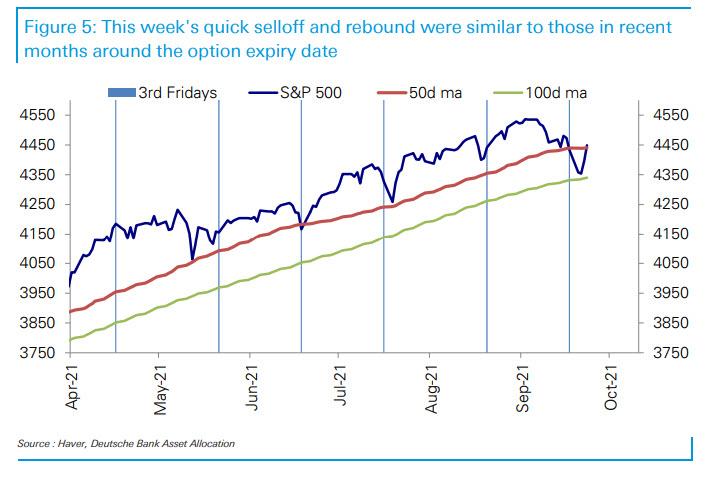
As has been the case for much of the past 6 months, equities saw another modest selloff (-4%) around the option expiry date similar to those in recent months (2-3% selloffs in the last 3 months), albeit exacerbated this time by fears around an Evergrande default.
Similar to the previous occasions, equities rebounded almost instantly as market technicals took over (as discussed in "Nomura Reveals 'The Flow To Know' As Markets Reverse From Selling To "Big Rally") with the 50DMA proving once again to be stalwart support, and are now barely 2% below record highs.
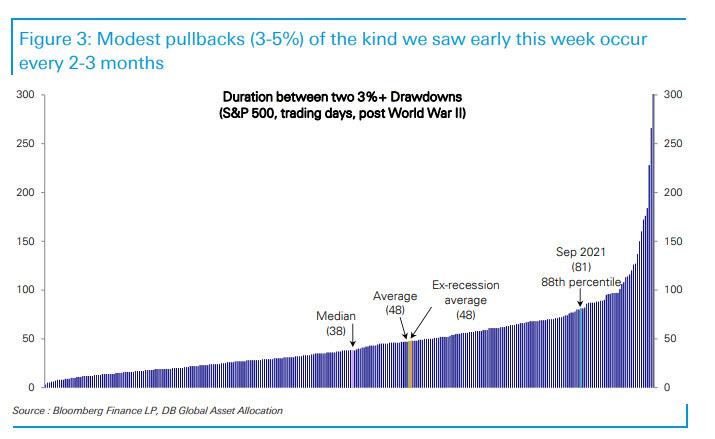
Moreover, US equities have historically seen modest sell-offs of 3-5% every 2-3 months on average. In that context, the selloff this week was fairly typical.
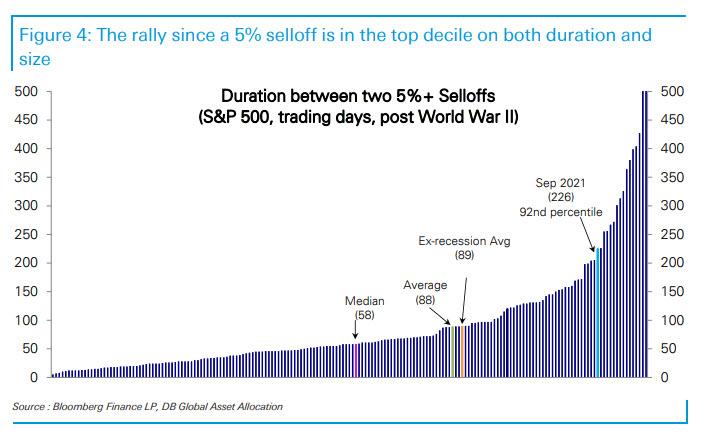
We have yet to see a more substantive selloff (5%+) since October of last year - although we did very briefly see a 5% drawdown last Monday which however faded just as quickly - putting the duration (92nd percentile) as well as the size (93rd percentile) of this rally in the top decile.
Courtesy of Deutsche Bank, here are some notable positioning indicators:
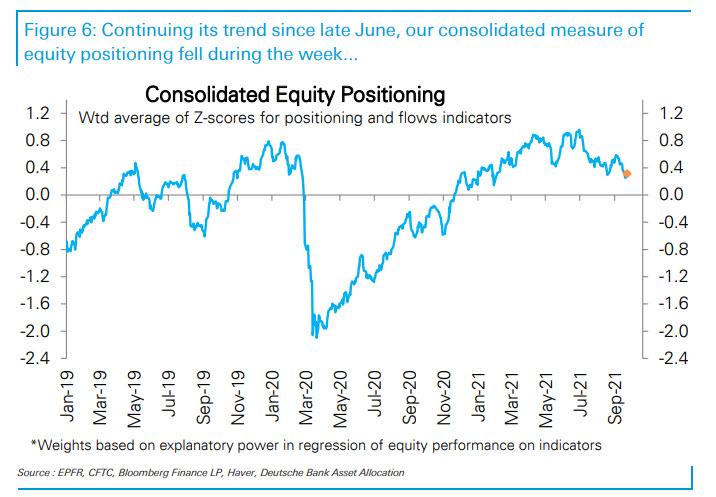
  • The consolidated measure of equity positioning has been falling since late June (from the 97th to the 60th percentile).
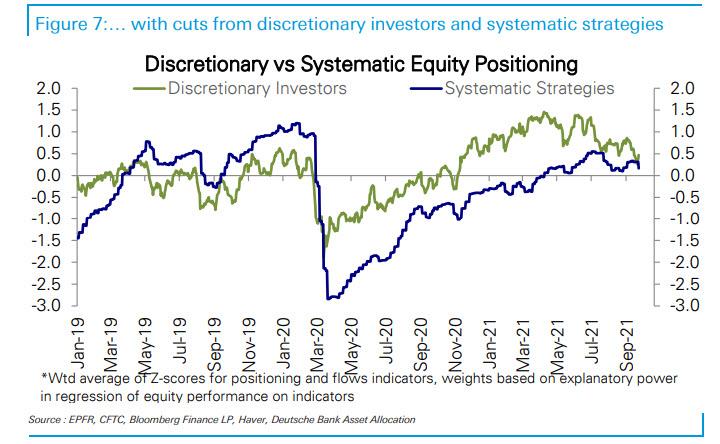
  • Both discretionary investors (72nd percentile) and systematic strategies (46th percentile) have cut exposure, with discretionary positioning now at the lowest since the post-election rally, while systematic positioning is at the lowest since May.
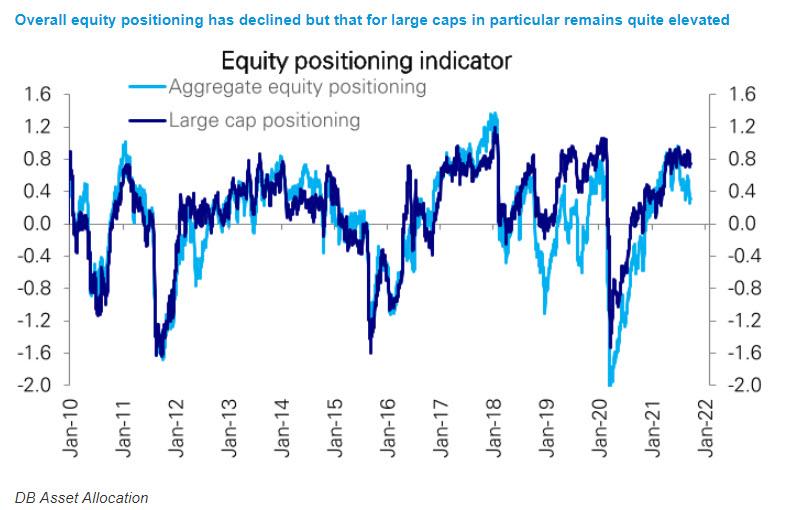
  • However, there is a divergence between equity positioning for US large caps (read giga tech names), which has remained very robust, and that for others which has declined.
  • A subset of positioning indicators specifically tracking large-caps has remained at the higher end since mid-July even as our aggregate measure has steadily moved lower.
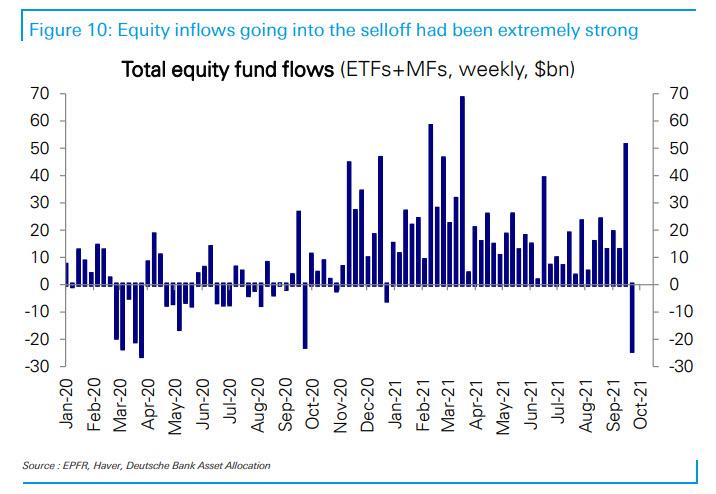
  • Equity inflows had been extremely strong going into the selloff, clocking in at over $50bn last week, the largest since March, and primarily benefiting US large caps. A significant proportion of last week’s huge flows then reversed over Friday (-$20bn) and Monday (-$16bn) but inflows have resumed since.
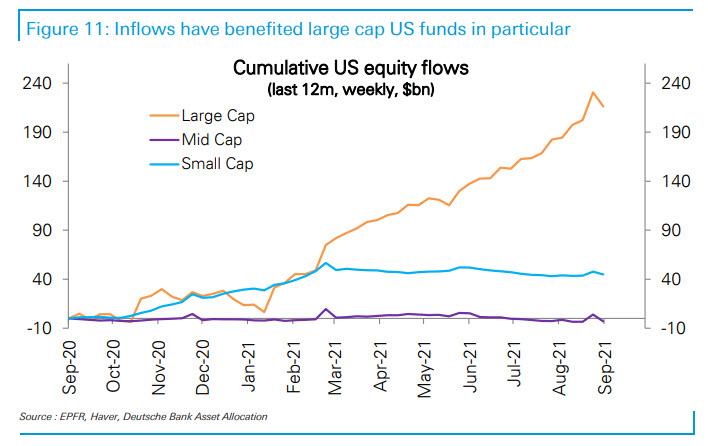
  • Here, it's worth noting that most inflows have benefited almost exclusively large cap US funds, with mid caps hugging the flatline for the last year, and small caps barely higher.
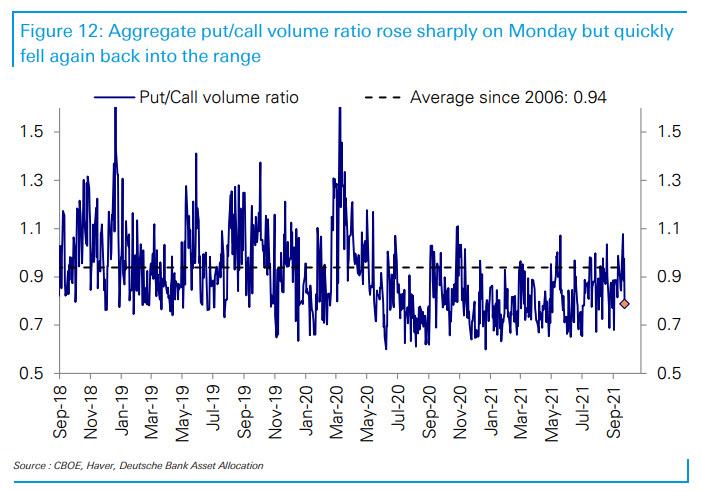
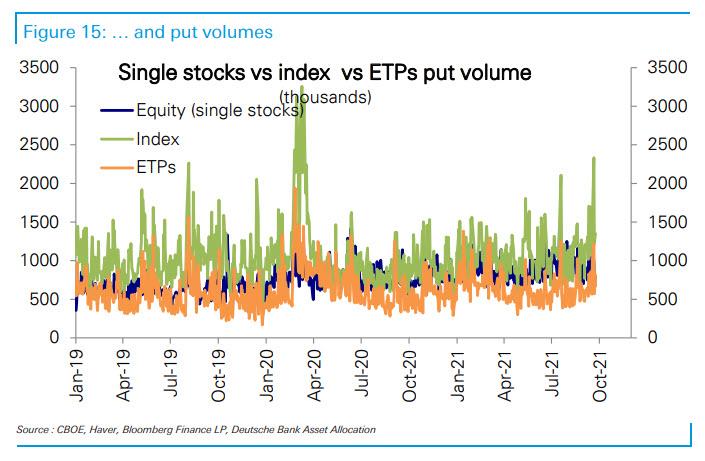
  • The aggregate put/call volume ratio rose sharply on Monday as equities sold off, but over the week quickly fell back again into the low range that it has been in since last June. Both put and call volumes had spiked on Monday, but have normalized quickly.
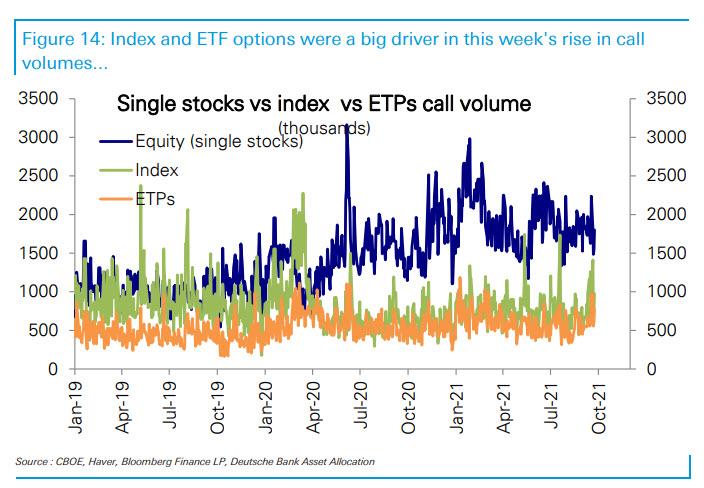
  • Most of the pickup in option volumes came from index and ETF options.
Within single stocks, puts and calls volumes fell last week across both large and small caps.
Vol Control funds, which had already cut their equity allocations (mostly large-cap) last Friday (67% to 65%), accelerated their selling on Monday (to 62%, 27th percentile), but quickly started buying back over the next three days, and their allocations are now back to 67% (43rd percentile). A spike and subsequent reversal in implied vol was the primary driver of the round
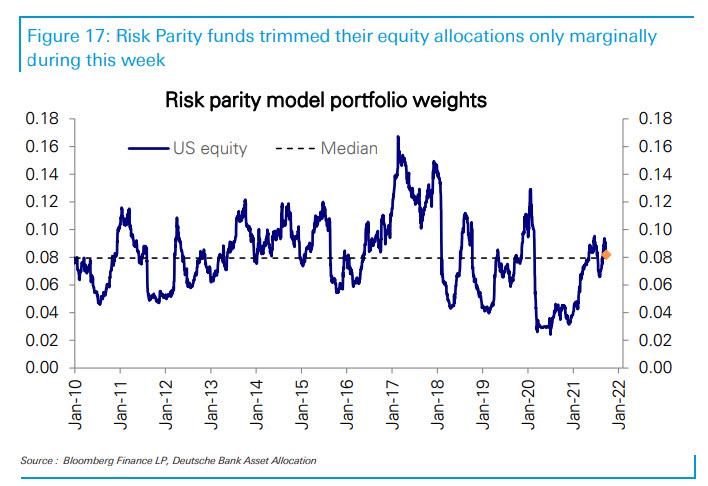
Meanwhile, Risk Parity funds trimmed their equity allocations only marginally during this week
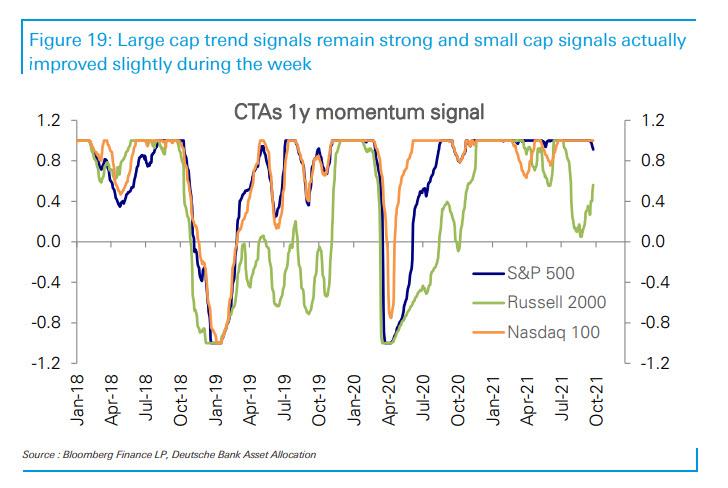
Curiously, large cap trend signals remain strong and small cap signals actually improved slightly during the week.
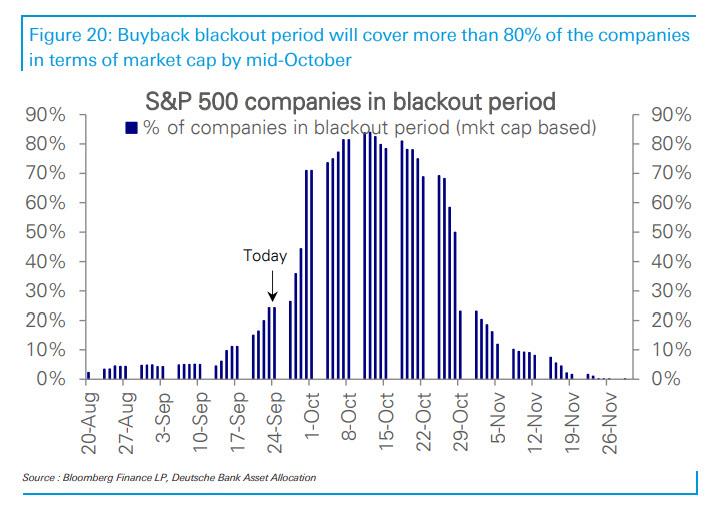
One final observation: with Q3 earnings season coming on deck, some 25% of companies have now entered their buyback blackout period. This will peak in 2-3 weeks when 80% of companies will be in their blackout period.
The full DB report with much more details can be found in the usual place for pro subs.

WSJ : Bitcoin Miners Eye Nuclear Power as Environmental Criticism Mounts

Bitcoin Miners Eye Nuclear Power as Environmental Criticism Mounts
Some cryptocurrency miners are striking deals with operators of struggling nuclear plants, which are carbon-free and have excess power capacity to spare

Bitcoin miners, under fire for their sizable environmental footprint, are forging partnerships with owners of struggling nuclear-power plants with electricity to spare.

The matchups have the potential to solve key issues facing each industry, executives and analysts say: Electricity-hungry bitcoin miners want stable and carbon-free power, while nuclear plants facing competition from cheaper power sources need new customers.

Talen Energy Corp. has entered into a joint venture with bitcoin-mining company TeraWulf Inc., which has started land development for a mining facility the size of four football fields next to its Pennsylvania nuclear plant. Nuclear generator Energy Harbor Corp. will provide power to a Standard Power mining center in Ohio starting in December.

“We are building demand adjacent to the existing nuclear plant,” said Talen Energy President Alex Hernandez, who heads the subsidiary jointly developing the mining project near the Susquehanna Steam Electric Station.

New nuclear projects are eyeing cryptocurrency miners as well: Startup Oklo Inc., which plans to build a small-scale fission power plant that can run on used nuclear fuel, has signed a 20-year supply deal with hardware and hosting firm Compass Mining.

“Both industry’s challenges are the other industry’s positives,” said Sean Lawrie, partner at consulting firm ScottMadden Inc.

Mining bitcoin is an energy-intensive process. To unlock more of the currency, miners must solve mathematical puzzles that become increasingly complex, which means they require more computing power—and electricity. Mining a decade ago required only a person with a PC, but rising bitcoin prices and a limited supply have created a race. The way to boost the odds of figuring out the puzzle is to put more machines to work.

“At the core of bitcoin mining is energy and energy infrastructure,” said Paul Prager, chief executive of TeraWulf.

The rise of vast mining operations has fueled criticism from environmentalists and others that growing use of fossil-fuel electricity for cryptocurrency could waste resources and worsen climate change. A tweet from Tesla Inc. Chief Executive Elon Musk expressing concern over the environmental impact of mining operations briefly caused bitcoin prices to fall in May.

Nuclear power, meanwhile, has lost public favor in the wake of accidents such as Japan’s 2011 Fukushima disaster and has struggled to compete economically in the U.S.

Nuclear plants provide a steady source of emissions-free power, but like coal-fired power plants, many face a daunting challenge selling their output in wholesale power markets amid stiff competition from wind and solar power—and natural-gas generation, which became cheaper after the fracking boom led to huge new discoveries of the fuel.

“They’re still making money because they’re still running, but it’s very hard for them in the current power markets to recover a fair return on their maintenance investments,” said Travis Miller, energy and utilities strategist for Morningstar.

Numerous nuclear plants have been retired in the U.S. in recent years, including the Indian Point facility outside of New York City formerly owned by Entergy Corp. With retirements likely to outpace new projects, nuclear is poised to decrease in the U.S. electricity mix in coming years, according to the Energy Information Administration.

Exelon Corp. EXC -0.83% in June said that it would shut two of three Illinois nuclear plants that failed to sell their electricity during the most recent wholesale power auction for PJM Interconnection, which operates a market serving 13 states and Washington, D.C. That led state lawmakers to approve a bailout this month to keep the plants running.

Talen’s Susquehanna plant also had fewer megawatts clear the same PJM auction than the previous one in 2018. The outlook for Talen subsidiary Talen Energy Supply LLC was revised to negative by Fitch Ratings and Moody’s Investors Service. The upshot will be a decline in auction revenue of $209 million over 2022 and 2023, according to Fitch.

“We find ourselves in a place where the power markets continue to be oversupplied, and in general with a few exceptions, pretty weak,” said Mr. Hernandez, Talen’s president. The company sees the bitcoin facility as key in building out a carbon-free digital infrastructure business, he added. It also plans a data center next to Susquehanna, and on Tuesday said it had secured another $175 million in capital for the projects.

While more nuclear-bitcoin tie-ups are expected, they aren’t likely to be large enough or happen quickly enough to save nuclear plants teetering on the edge of closure, said Bill Dugan, a director at Customized Energy Solutions, an energy advisory firm.

“It would have to be a lot of them aggregated together,” Mr. Dugan said.

For bitcoin miners, the partnerships allow them to promote projects as having an environmentally friendly source of power.

“That was a big differentiator for us,” said Maxim Serezhin, chief executive at Standard Power, which is building a nuclear-powered bitcoin-mining facility at a former paper mill in Coshocton, Ohio. Standard Power’s formal name is 500 N 4th Street LLC.

Energy Harbor declined to comment and referred questions to Mr. Serezhin.

The Compass Mining deal with startup Oklo doesn’t include a set price for power, but Whit Gibbs, chief executive of Compass, said he is confident that the companies will agree on a price that allows for profitable cryptocurrency mining.

Jacob DeWitte, co-founder and chief executive at Oklo, said he had received inquiries from other bitcoin miners interested in the company’s 1.5-megawatt project using small modular reactors. It still needs federal approval, however, and isn’t likely to happen until sometime between 2023 and 2025, he said.

In Miami, Mayor Francis Suarez has been touting his hometown as a destination for cryptocurrency miners, exchanges and investment firms. Part of his pitch includes the nearby nuclear-power plant owned by Florida Power & Light Co., a subsidiary of NextEra Energy Inc. NEE -0.70%

Many environmental, social and governance, or ESG, concerns about bitcoin mining “come from the fact that a lot of the mining was being done in coal-producing countries,” said Mr. Suarez.

Talks with Florida Power & Light officials have included whether mining facilities might be located near the nuclear plant, and challenges such as the lack of cheap land to build big warehouses for mining gear, Mr. Suarez said.

Florida Power & Light declined to comment on the discussions, but spokesman Bill Orlove said South Florida has become a relocation destination for the tech industry. “We look forward to supporting the continued innovation and growth those companies bring,” Mr. Orlove said.

WWD : Donatella Versace, Kim Jones on Why Swapping Brands Is Brave

Donatella Versace, Kim Jones on Why Swapping Brands Is Brave
In a new project unveiled at the tail end of Milan Fashion Week, Donatella Versace designed a Fendi collection and Kim Jones, Fendi's artistic director, created a Versace lineup, both for pre-fall 2022 and available starting in May.

MILAN — It was a milestone moment — and “something that’s never been done before,” underscored Donatella Versace.
Guests attending the private event held at the Versace headquarters in Via Gesù on Sunday evening were in for a surprise — a full-on creative swap presented on the runway.
Donatella Versace designed a Fendi collection and Kim Jones, Fendi’s artistic director, created a Versace lineup. Both collections are for pre-fall 2022 and will be available starting in May at Fendi and Versace boutiques exclusively.
Ahead of Milan Fashion Week and the event that closed the season here, Versace and Jones met with WWD to reveal the project — and to say the mood was cheerful would be an understatement. Versace, dressed in an orange top under a bright pink pantsuit and wearing supersized platforms, and Jones, in a black top and Bermuda pants, were in great spirits, clearly relishing working together over the past few months and anxious to see the reaction to the collections.

“I love Donatella and I love Versace,” Jones stressed. “I’ve always looked up to Donatella, and Versace is part of the culture I grew up in; it’s a cultural phenomenon. And when things in fashion become cultural, they last for a very long time and that’s very interesting. With Donatella, I don’t know a single person in the world that doesn’t know her and doesn’t fall in love with her when they meet her — that’s Donatella’s magic.”
Versace was equally appreciative, hugging Jones from time to time on the sofa they shared in an office at her Milan headquarters, and even comparing him to a “younger brother.”
“I watch everything around me, especially the new generation of designers, and there are a lot and not everyone is amazing, in my opinion, but some you can see, they jump out of the crowd, and the first one [to do so] was Kim,” said Versace, who’s known for championing young designers for years. “They all have ideas, they see fashion in different ways from other generations, which is normal, but Kim has this background of luxury. He knows what luxury is, he knows how to make it young and accessible to younger crowds, which is not something I find in anybody else, honestly. Maybe there are [others], but I didn’t see them. Kim has a big heart and when he is friends with somebody, he gives everything.”
“Like you,” chimed in Jones.
“Me, I’m the same, that’s why I have few friends, not too many, you have to be careful who you surround yourself with,” Versace said.
The idea of the project was first tossed around in February, at a dinner at Donatella’s house with Jones, Silvia Venturini Fendi and her daughter Delfina Delettrez — laughingly she checks herself for still calling it her brother “Gianni’s house” on Via Gesù. “They never had a proper conversation before then and they just clicked,” Jones recalled.
A Fendi by Versace look.
PIER NICOLA BRUNO -COURTESY IMAGE
“Here are two Italian dynasties joining together, Karl [Lagerfeld] was Gianni’s best friend and Karl didn’t have many friends; you could count them on the fingers of one hand. I remember them laughing and talking and making jokes. What I have in my eyes is a moment of happiness,” Versace reminisced, speaking of the longtime Chanel and Fendi designer, who died in 2019. “Everything came naturally. I love Kim’s creativity and his work, it’s young, cool and new and there is quality. He knows how to cut a suit; ideas are one thing, but knowing how to make these ideas become real fashion and special is another thing. He has both.


“Saying that, can you do all of my collections?” she said with a big laugh.
Aware of the rumors circulating a few seasons ago about Jones joining Versace, before he was tapped first by Dior as its artistic director of men’s wear and then by Fendi last year, they moved on to discuss the new project — while not disclosing details about the clothes. “Sorry, we want to keep it as a surprise,” Jones said.
“Everybody is doing collaborations, but this is the brave thing to do, swapping,” chimed in Versace.
The swapping goes as far as Fendi producing the Versace collection and vice versa. “It’s part of our strategy, a surprise — we want people to say ‘What?’”
The project meant each designer dived into the other brand’s archives. “We looked at the codes and at the present,” Jones explained. “This is our interpretation of what we see. Fendi and Versace have this legacy, and young people are getting into them finding their parents’ clothes. Young girls are going to go completely wild over it,” he predicted.
“I was so proud when he came to [the Italian city] Novara to see the archives, all of Gianni’s work,” Versace said. “I really wanted to show him. So many people see the pictures but not the real clothes.”
Jones agreed. “This was a big, big thing for me, I had only ever seen pictures. It was an honor for me. I did a lot or research on Gianni’s work since that’s where it all started, and I thought of ways to interpret it.”
Asked to elaborate, shrugging, he added: “It speaks to you, that’s all I can say. I don’t know how to describe my work in progress. I just do it, I think about it, then it evolves.”
“And it was the same for me, I went to Fendi and [metaphorically] Karl, the Fendi family were there,” Versace said. “The craftsmanship is incredible and that’s what fashion really is. Karl knew that. If you think fashion is a T-shirt with some writing on top of it, it’s not true. But it’s not only about looking at the archives and the clothes, it’s about having a conversation between us. It’s inspiring to talk to him.”
A Versace by Fendi look.
PIER NICOLA BRUNO- COURTESY IMAGE
“Fendi is very much about craftsmanship and what I saw in the Versace archives was about craftsmanship,” Jones said. “Here are two really amazing brands working with each other, two companies that are not owned by the same group, it’s not about money; we all love each other and Silvia feels exactly the same way I do about Donatella.”


Both designers bristled at the idea that anyone could compare this project to the Gucci-Balenciaga hacking last spring, waving away the suggestion.
“It’s a new way to do things, and it means trust and honesty,” Versace said. “I always want to move forward and this was a dream for me.”
“We are both very open, we know things have to change and adapt, we are realistic about what things can happen and this was done pretty quickly. We wanted to do it fast in case someone else came up with the concept,” said Jones, marveling at how production is much faster in Italy than in France given the proximity to the pipeline.
Asked if more collections would follow, Jones demurred from giving a definitive answer. “We don’t know; let’s see how it goes.”
“I’m gonna miss him,” Versace said with a giggle.
Was she surprised by the final result? “I never expected anything he did for Versace,” she said laughing. “I was so happy when I saw the collection. It was a dream.”
“It was done out of love, and Silvia also was really enjoying working with the codes of Versace on the accessories because she’s been Fendi all her life,” Jones said.
“She is amazing; Silvia’s mother was best friends with Gianni — this is a long love story,” offered Versace.
“It’s nice to celebrate, we’ve all gone through very challenging times recently. Paris dominates a lot of fashion so it’s nice to bring [the attention] back to Milan,” Jones said. “It was a pure joy experience, having the best time. I love my job, love coming to Italy to be able to experience it, and the food — which is dangerous,” he concluded with a smile.

WWD : Style Capital Acquires 40 Percent of E-tailer LuisaViaRoma

Style Capital Acquires 40 Percent of E-tailer LuisaViaRoma
Italian private equity firm Style Capital is investing 130 million euros supporting the growth of the luxury shopping digital platform. A new CEO will be announced soon.

MILAN — One of the most anticipated M&A deals in the Milanese fashion industry has finally happened.

Italian private equity firm Style Capital invested 130 million euros to acquire a 40 percent stake in Florence-based multibrand e-tailer LuisaViaRoma, one of the four leading luxury online shopping destinations in Europe and the U.S.

The operation was mainly made through a capital increase, aimed at supporting the future growth of the e-commerce platform, which has a turnover of around 230 million euros.

Following the acquisition, which will be finalized by the end of 2021, Andrea Panconesi, whose grandmother Luisa Jaquin in 1929 opened a small boutique on Florence’s Via Roma, the first seed of the family company’s success, will become chairman, while the appointment of a new chief executive officer will be announced soon.

“I think the pandemic gave a boost and accelerated the change in the way people buy luxury goods that was already happening before. This process will have a long tail and this is a crucial moment to determine the real leaders of the market of the future,” said Style Capital founder and CEO Roberta Benaglia. “I believe that Andrea has been smart in understanding the importance of opening the capital of his company to a financial partner that can help [in] consolidating and further expanding its role in the international e-commerce business.”

“We were the only big player in our sector that was not public or participated by a big group. Nowadays, to grow you need big investments, especially because the e-commerce scenario has very much changed from 10 years ago, when small investments could guarantee big returns,” said Panconesi. “To make this big step, we looked around and we found Style Capital’s proposal very attractive, since they share with us the same vision of the future.”

Benaglia highlighted that Style Capital got the better of its competitors because “we have the mentality of a luxury brand that uses technology to reach its goals, and not of a tech company that operates in the fashion industry.” Over the years, Style Capital built great credibility in the fashion arena through high-level M&A operations involving a range of prestigious brands, including Golden Goose, MSGM, Forte Forte and Zimmermann.

According to Benaglia, the new CEO, who has already been chosen, will act as “Andrea’s sparring partner,” adding that LuisaViaRoma doesn’t require a reorganization, but a “reinforcement of the existing executive management.”

Asked about the future goals of the company, Panconesi said significant investments will be made mainly in two areas, CRM and the IT platform, that is directly operated by the company.

Strengthening the e-tailer’s role in the international markets is also in the company’s pipeline. As Benaglia explained, if LuisaViaRoma is a leader in Italy, where its sales increased 80 percent over the past three years, the company has huge potential to grow in Europe and in the U.S. In particular, Panconesi said the U.S. is traditionally a key market for LuisaViaRoma, not only online, but also at its Florentine brick-and-mortar location. “Traditionally, the biggest spenders at our store in Florence are Americans.”

As part of the internationalization process, the company will rely not only on digital and performance marketing investments, but will also try to boost its brand awareness through physical events across the globe.

LuisaViaRoma has an ongoing partnership with UNICEF and was involved in four charity gala events hosted on Italy’s Sardinia and Capri islands; they are hosting a North American iteration of the format on Dec. 29 at St. Barth’s Eden Rock five-star resort. “There will be around 400 guests and Dua Lipa will perform live,” said Panconesi. “I think that especially the young generations are very attentive to social issues and they appreciate the company embracing good causes.”

Discussing future strategies, Benaglia also stressed it will be key for LuisaViaRoma to continue investing in emerging, niche brands, and, at the same time, keep developing special partnerships and collaborations with established luxury brands.

FT : Peloton bike loans peddled to eager Wall Street buyers

Peloton bike loans peddled to eager Wall Street buyers
Home fitness craze generates debt packages for institutional investors

Wall Street has found a way to tap in to some of the safest consumers in the US: slices of debt backed by bundles of loans for people buying the popular Peloton fitness bike.

Affirm, a market leader in “buy now, pay later” services where customers pay for products in instalments, has sold hundreds of millions of dollars in loans made for Peloton equipment like indoor bikes, bike shoes and weights, according to people familiar with the transactions. 

Since 2020, the company has raised more than $2.2bn through six deals; three that roughly mirror Affirm’s broader loan portfolio and three that batched up unsecured, zero interest loans, predominantly to Peloton customers, these people said. They come to a total of $845m. 

The senior tranche of Affirm’s latest Peloton-backed deal, most protected from the default of the underlying borrowers, offers a coupon of just over 1 per cent, only around 0.2 percentage points more than an equivalent US government bond at the time the deal was priced in April. 

The deals highlight some of the financial wizardry that has helped fuel the buy-now-pay-later boom during the pandemic-driven surge in online shopping, while the low yields suggest investors are keen for exposure to some of the highest-rated individual borrowers in the US.


Peloton had benefited during the pandemic from a surge in at-home fitness. Its static bikes are some of the most expensive on the market, with prices starting at $1,495 and rising to almost $3,000 with accessories. Customers tend to be affluent with very high FICO scores, a measure of US consumer credit quality, and the loans have a history of very low default rates. 

Affirm offers zero interest loans on Peloton purchases, from 12 to 43 months. Peloton provided around 20 per cent of the online lender’s $870.5m in revenue during the fiscal year to June 30, 2021. 

Some of the loans are passed through Wall Street’s securitisation machine, packaged up to underpin payments on fresh slices of debt bought by investors, including asset managers like DoubleLine Capital, and insurance companies like MetLife, fund filings show. 

Francisco Paez, head of structured products research at MetLife, said the products were particularly popular with insurers who were in search of “safe, predictable cash flows”.

“Given the current pricing environment, we view these particular securitisations as attractive because they deliver strong value relative to the amount of risk,” Paez added.

The deals are part of a broader strategy by Affirm to raise additional capital by securitising loans it has made — not just to customers of Peloton, its largest partner, but a host of consumers at more than 11,000 merchants, according to ratings documents from DBRS Morningstar. 

Affirm does not disclose publicly the loan make-up of the securitisations it sells, with even less information disclosed for the deals backed by Peloton loans because they were privately placed with investors.

However, according to ratings documents from DBRS for the latest $500m deal from Affirm that included loans from both Peloton and other merchants, the securitisation included more than 1m individual loans with an average original balance of $585. Because of the short-term nature of the loans, averaging less than a year, the deals are replenished with new loans Affirm will issue up to the maturity of the deal, which is set at 2026 but could come earlier. 

“Ultimately, the performance is so good because of the underwriting,” said Imran Ansari, who led the ratings for the deal at DBRS Morningstar. “The loans are low balance with low monthly payments, reducing the payment stress for borrowers.” 

Representatives for Affirm and Peloton declined to comment. DoubleLine declined to comment.

FT : Chinese cities seize Evergrande presales to block potential misuse of funds

Chinese cities seize Evergrande presales to block potential misuse of funds
State intervention gathers pace as second bond deadline looms for indebted property developer

At least two local governments in China have taken control of sales revenue from Evergrande properties, even as Beijing remained silent about the unfolding liquidity crisis at the world’s most indebted developer and investors braced for more missed bond payments

In a circular issued on Wednesday and seen by the Financial Times, the Nansha District housing and urban-rural construction bureau in the southern city of Guangzhou asked an Evergrande subsidiary to put presale revenue from Sunshine Peninsula, a stalled residential development, into a state-controlled custodial account so that “homebuyers’ interest can be protected and project construction continues”.

Another district housing bureau in Zhuhai, a southern city neighbouring Macau, asked an Evergrande residential project this month to transfer sale proceeds into a government account, according to people with knowledge of the matter.

The moves marked an escalating effort to curb the impact of Evergrande’s debt crisis, which rocked global financial markets last week and has sparked protests from suppliers and investors, who fear they will not be repaid in the event of a default. The developer has struggled to access credit in the wake of Beijing’s crackdown on spiralling property sector leverage amid a post-pandemic housing bubble.

Fears of wider contagion deepened after investors in an Evergrande offshore bond did not receive an interest payment ahead of a closely watched deadline last week.

Evergrande, which has not made a statement on the $83.5m coupon, has a 30-day grace period before triggering a default.

As many as eight other provinces have made requests since August for Evergrande to place presales revenue into custodial accounts as the cash-strapped developer put hundreds of unfinished projects on hold, according to Caixin, a Chinese financial magazine.

“It is common for Chinese developers to allocate sales proceeds earmarked for particular projects for other uses, ranging from debt payments to land purchases,” said Bo Zhuang, a Singapore-based economist at Loomis Sayles, an asset manager. “That is no longer an option,” he added.

Evergrande did not respond to a request for comment on Sunday. 

The project delays and construction suspensions clouded expectations of what could become China’s biggest-ever corporate debt restructuring. Evergrande faces a total of Rmb1.97tn ($305bn) of liabilities, including $20bn of outstanding debt on offshore markets.

As of earlier this month, progress had stalled at hundreds of Evergrande’s ongoing projects across China, most of which have been fully sold, according to people close to the company. The suspended developments have prompted a flood of online complaints as well as public protests by anxious homebuyers and retail investors.

“I have spent my life savings on the apartment,” said a Guangzhou resident surnamed Zhu who bought a two-bedroom flat at Sunshine Peninsula for Rmb2.1m ($325,000). “My life will be ruined if the project can’t be finished.”

Zhu added that his payments for the apartment did not appear on the account earmarked for the project. “I have no idea where the money has gone,” he said.

Beijing has made project completion a top priority in tackling the Evergrande debacle, indicating authorities’ concern that public dissatisfaction with the company could threaten social stability, a chief concern for China’s leadership.

This has prompted local authorities to put the developer’s presale proceeds under their watch so that project funding would not go elsewhere.

“There is no way our headquarters can transfer the money now that it is in a government account,” said an official at Sunshine Peninsula, which is expected to resume construction following a five-month suspension.

But how much the government interventions will kickstart stalled projects where sales proceeds had already been reallocated remains an open question.

The financial woes have rippled across the sprawling group: in a regulatory filing on Friday, Evergrande New Energy, its electric vehicles unit, warned that it was facing a “serious shortage of funds” and would be forced to suspend operations and possibly employees’ salaries without “further capital injection”.

One Evergrande executive noted that local governments were also providing policy incentives, such as greenlighting property sales on projects that failed to pass zoning requirements, to help improve Evergrande’s cash flow.

The developer faces more upcoming deadlines, including a $45m payment due on Wednesday on a bond maturing in 2024.

“The idea is to employ whatever policy tools to help us sell faster within the existing legal framework,” said the executive.

Still, the measures would not fully bridge the funding gap needed to complete the projects, the executive added.

“We simply don’t have enough resources to complete all the projects on time. We need more external assistance.”

Barrons : Volkswagen Is Pulling Ahead With Its Electric Vehicles. That Could Boo

Volkswagen Is Pulling Ahead With Its Electric Vehicles. That Could Boost the Stock.

Shares of German car giant Volkswagen tumbled in the past three months over fears that production will be hurt by the global shortage in semiconductors that control the electronic brains of its vehicles, and by supply-chain problems that will delay its parts.

The company behind Audi, Bentley, Porsche, Skoda, and Seat has seen its stock (ticker: VOW3.Germany) decline 16.2%, to 189.30 euros ($222.07), worse than rival Ford Motor (F), down 10%, and Mercedes-Benz owner Daimler (DAI.Germany), off 9.3%.

This dip could be a good buying opportunity because optimism over VW’s advances in manufacturing electric vehicles could boost sales and trim costs.

Its Volkswagen ID.4 GTX—an electric sport-utility vehicle with a €50,000 price tag—is seen as an effective rival to Tesla (TSLA). At the Munich motor show this month, the Frankfurt-listed company unveiled a fully electric small car aimed at bringing these vehicles to the masses at affordable prices.

These advances will help VW reach about 20% of its group sales from battery electric vehicles, or BEVs, by 2025 and about 50% by 2030, according to the company’s own targets. Its plan to build six gigafactories—set up with partners such as Northvolt and Gotion—before 2030 will secure its battery supply and cut costs.

Tim Rokossa, an analyst at Deutsche Bank, has a Buy rating on the stock and says that “efficiency gains in the battery production through economies of scale should help to lower cell costs by over 50%.” He has a target price of €270.

Daniel Schwarz, an analyst at Stifel Nicolaus, says shares could rise 66%, to €312. VW “is on track to become the largest producer of electric vehicles in 2021,” he says.

VW plans by 2023 to reduce its fixed costs from 2020 levels by 5%, slicing €2 billion off €40 billion, and it aims to reduce purchasing costs by 7% over the same period, according to Stephen Reitman, an analyst at Société Générale.

The automotive market leader in Europe and China, VW operates 118 production plants in 30 countries. It has 662,000 employees and a market value of €122 billion. It fetches a low multiple of 6.2 times this year’s expected earnings and is valued in line to its peers.

Strong demand for VW’s premium brands—the company successfully navigated the chip shortages by directing supplies to its higher-profit-margin vehicles—and solid performance at its financial-services division helped deliver record results for the first half of the year. VW also increased its outlook for 2021.

Earnings before taxes for the first half of the year were €11.2 billion on sales of €130 billion, up from a €1.4 billion loss and €96 billion in sales for the same period the previous year.

“We’re keeping up our high pace, both operationally and strategically,” said CEO Herbert Diess in the half-year earnings statement.

While deliveries of its electric cars have almost tripled over the past year, sales of the ID.4 in China, VW’s most important market, have disappointed. “The ID.4 ramp-up is going well in Europe and the U.S. while the start in China was rather slow,” says Deutsche Bank’s Rokossa.

Stifel’s Schwarz attributes this to poor presentation in showrooms compared with more-plush efforts by rivals Tesla and Nio (NIO), rather than fundamental problems with the vehicle.

Arno Antlitz, chief financial officer of Volkswagen, told Barron’s in a statement that the company is “committed to developing a leading automotive software stack and will continue to invest in autonomous driving and mobility services.”

Barrons : Bank Mergers Will Continue Ramping Up. Here’s Why.

Bank Mergers Will Continue Ramping Up. Here’s Why.

The era of bank consolidation shows little sign of petering out.

There have been 149 bank mergers announced so far this year, easily eclipsing the 119 deals announced in the whole of 2020, according to data compiled by Truist. And there are plenty more banks—particularly in the Southeast and Texas—that appear to be willing targets.

Bank mergers took a brief pause at the onset of the pandemic last year but have strongly rebounded. Regional and community-size banks alike realized they needed to boost their digital capabilities and are expanding their geographic footprint to compete with larger banks.

This year, U.S. Bancorp (ticker: USB) announced plans to buy MUFG Union Bank, M&T Bank (MTB) and People’s United Financial (PBCT) are merging, and Citizens Financial Group (CFG) has been on an acquisitive streak, snatching up both Investors Bancorp and the East Coast branches of HSBC Holdings (HSBC) in recent months. Goldman Sachs Group (GS), meanwhile, agreed to buy GreenSky (GSKY).

The pace of deal making—at least among the smaller banks—should continue even amid a tougher climate for mergers under the Biden administration. Much of the increased scrutiny surrounds so-called megadeals, or those in excess of $5 billion, according to a recent report from Deloitte. But when it comes to bank deals, there are several potential sellers in the sub-$1 billion range, according to Jennifer H. Demba, an analyst at Truist.

Expect to see more marriages—and you can take that to the bank.