FT : German regulator files criminal complaint against Northern Data staff

German regulator files criminal complaint against Northern Data staff
BaFin acts after Frankfurt-listed IT company misses 2020 guidance by large margin

Germany’s financial regulator has filed a criminal complaint against senior staff at Northern Data, accusing it of potential market manipulation.

BaFin’s move on Friday came a day after the Frankfurt-listed IT company, which operates racks of high-powered servers and provides services to Bitcoin miners, published financial results for 2020.

The unaudited numbers, which came after months of delays, were far worse than the company’s previous guidance. Northern Data reported an operating loss of €12.3m, against previous expectations of operating profit of €45m-€60m. Revenues came in at €16.4m, against guidance of €140m-€160m.

BaFin told the FT that the watchdog had flagged potential market manipulation “in the context of Northern Data” to criminal authorities but declined to comment further. Frankfurt criminal prosecutors, to whom the complaint was filed, did not respond to requests for comment.

A lawyer for Northern Data told the FT on Sunday its client was looking into the matter.

Northern Data’s shares dropped 43 per cent immediately after the news of the criminal complaint, first reported by Wirtschaftswoche, but recovered half their losses in late trading to close 21 per cent down on Friday.

German financier Christian Angermayer, an influential investor in Northern Data, declined to comment.

At its peak in February 2021, Northern Data was valued at €1.7bn on the Frankfurt stock exchange. Since then, it has lost 60 per cent of its market capitalisation.

The company was accused last year of misleading investors in an anonymous article on Medium.com that said Northern Data was overstating its prowess in “high performance computing” and understating its reliance on bitcoin miners. The article argued that Northern Data’s hosting services seemed so strangely profitable that the company was either “cooking the books” or it had “found the dumbest customers in the crypto industry”.

Northern Data at the time denied any wrongdoing. The Medium.com post has since been taken offline as it is “is under investigation or was found in violation of the Medium Rules”, the website says.

In a presentation published on Thursday, Northern Data said the huge gap between guidance and reported numbers was caused by the fact it was “unable to realise the revenues with our two major customers” as those dealings “haven‘t led to the essential revenue recognition in FY 2020”.

Because Northern Data remained in the process of acquiring the erstwhile clients, it said, its dealings with them were “not expected to lead to the recognition of revenue in the financial year 2021”.

(ZH) German Power Plant Halted After It Runs Out Of Coal

German Power Plant Halted After It Runs Out Of Coal

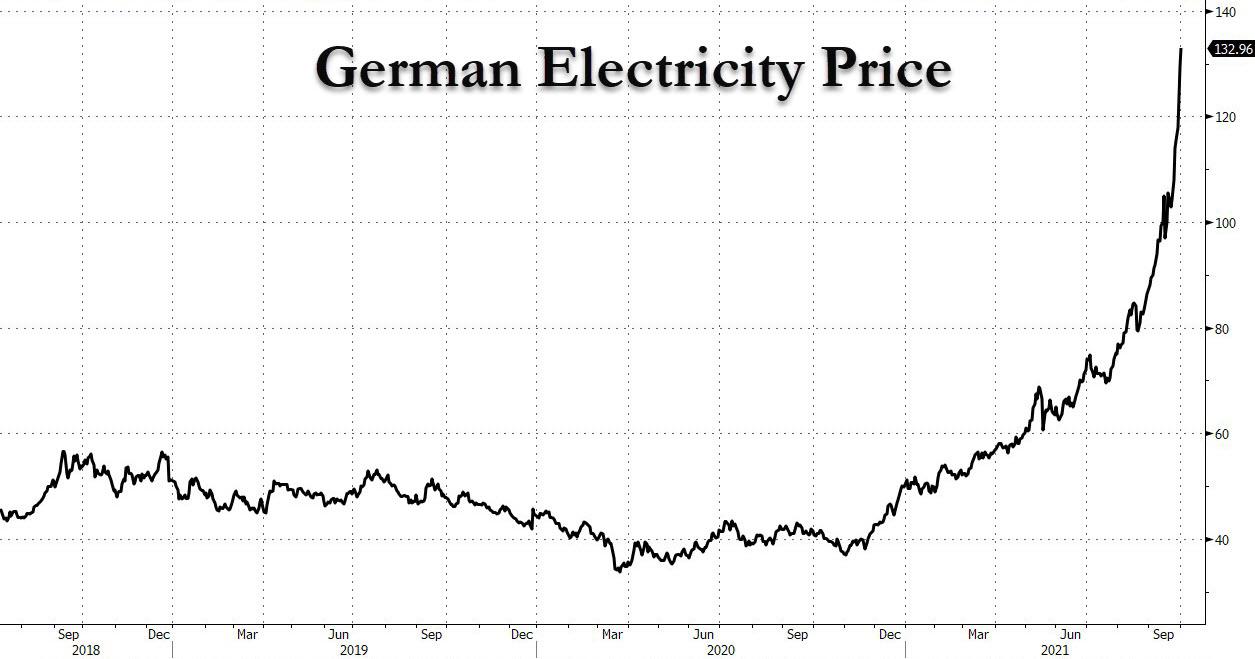
In the history of the world, German electricity prices have never been higher...
... and if what just happened at the Steag Bergkamen-A electric plant is any indication, they are about to get a whole lot higher.
According to Bloomberg, the global energy crisis has forced a German electricity producer to halt a power plant after it ran out of coal.
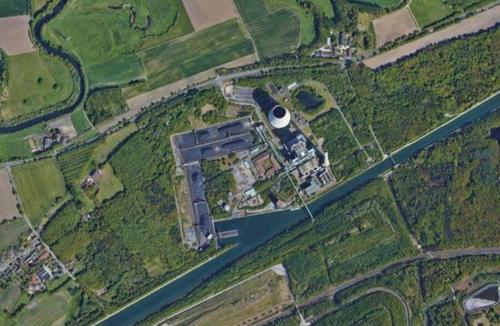
Steag GmbH - which operates six large-scale hard coal plants in Germany with an installed capacity of more than 4,000 MW - closed its Bergkamen-A plant in the western part of the country this week due to shortages of hard coal, it said by email.
The Bergkamen power station. Source: Google Maps
“We are short of hard coal,” said Daniel Muhlenfeld, a Steag spokesman. “There is a strong demand for coal per se and secondly, there is a strong demand for transport by barge. And since Bergkamen has no rail connection, there are no logistical alternatives available here.”
Steag is also facing logistical challenges as the recovery of Europe’s biggest economy fuels demand for river transport. Still the utility is optimistic that the plant will come back online “quite soon.” The Bergkamen-A plant was halted four times in September for as many as six days at a time due to external factors, according to filings. Three other German coal plants were halted on Friday for maintenance.
“We are dealing with a double bottleneck.” Muhlenfeld said. “This is not a specific problem for Steag but a common problem for nearly all owners of hard coal-based power plants these days.”
That explanation won't make it any easier for millions of European residents to pay as much as 10x more than they are used when their next electricity bill comes in.
The closure, similar to what we have observed over the past two weeks in China, is the first sign that Europe may need to count on mild and windy weather to keep the lights on as the continent faces shortages of natural gas and coal is unlikely to come to rescue. Alas, as Bloomberg also notes, that is unlikely, at least in the near-term:
  • *GERMAN MONDAY BASELOAD POWER TRADES AT 179 EUR/MWH TRDEBD3, UP 88.4% FROM FRIDAY DELIVERY AS WIND AND SOLAR SUPPLY EXPECTED TO HALVE
As a reminder, amid soaring gas and coal prices across the globe which have resulted in widespread fossil fuel (read nat gas and coal) shortages, China ordered its state-owned companies to secure supplies at all costs and Europe is burning more of its already depleted stocks of the dirtiest of fossil fuel, a move that may complicate climate talks next month.
As a result of the failure of "green" renewable sources of energy to fill the demand gap, European utilities have turned to coal due to shortages of natural gas, recently stepping in to the spot market to secure cargoes and even asking Russia for more supplies. China’s move to secure more supplies is likely to make matters worse, with Europe set to scramble to secure fuel this winter.
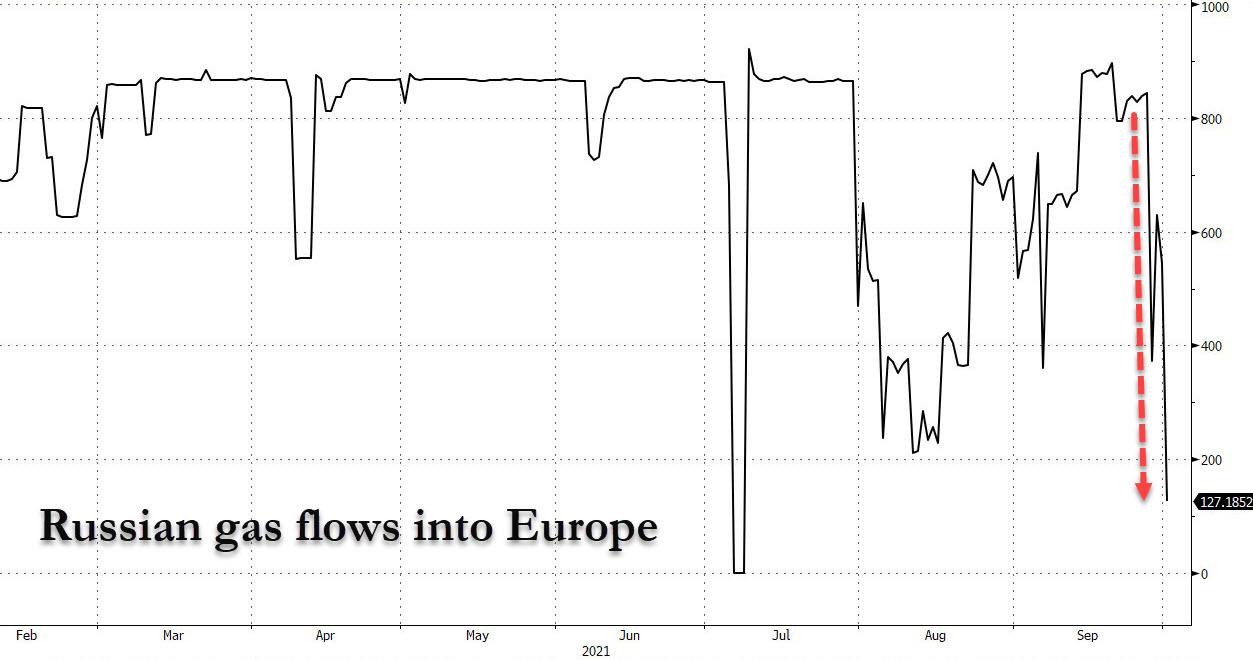
However, the more Europe telgraphs its glaring weakness, the more Moscow tightens the screws, and overnight nat gas flows via the Yamal-Europe pipeline plunged by 77% from Thursday, leading to new record high prices across the continent, where stockpiles of nat gas are at the lowest level in a decade.
As Bloomberg adds, coal is already trading at sky-high levels, putting an industry benchmark on track to break on Friday the previous record of $192.50 set in July 2008. Several cargoes of Australian coal changed hands above $200 a metric ton on Tuesday, according to traders who saw the transactions on the globalCOAL platform.
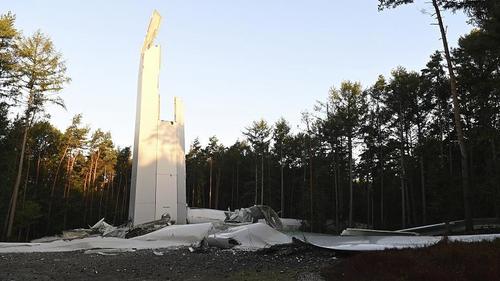
As for Germany's alternative energy source, well, here's a little story on where we stand there. As BBC reports, a huge wind turbine collapsed just hours before it was due to be officially inaugurated. The turbine, which reached a height of 239 metres, toppled over late on Wednesday without warning. No one was injured.
Remains of the wind turbine remain in the forest in Haltern
Remains of the structure are littered in a forest near the western town of Haltern am See in North Rhine-Westphalia. Police were not initially suspecting sabotage, according to the German DPA news agency.
Costing around €2 million, the wind turbine was scheduled to be officially launched on Thursday, although it was connected to the power grid six months ago.
Germany is trying to ramp up its use of renewable energy such as wind and solar as part of a transition away from fossil fuels and nuclear power. Unfortunately, as incidents such as this one demonstrate, it will take decades before base alternative energy is even remotely a viable alternative to fossil fuels. Until then, Europe faces many long, freezing winters, and while Europe's virtue signalers can always say they are "green" they will also be very cold and perhaps broke too.

WSJ : China’s Evergrande Debt Crisis: Sizing Up a Big Mess

China’s Evergrande Debt Crisis: Sizing Up a Big Mess
The property behemoth’s potential default stands to be one of the largest ever

China Evergrande Group EGRNF -6.10% last month missed a scheduled interest payment to overseas bondholders, raising the prospect that October could bring one of the largest defaults in years.

Investors have been grappling with unknowns including what the Chinese government might do in response. Beijing has signaled it is preparing to cushion the blow to national interests. That could include potential aid to Chinese investors, banks, Evergrande’s suppliers and home buyers who committed financially to homes that have yet to be completed.

Evergrande and the real-estate sector in general are important cogs in China’s economy, and the overheated housing market was already showing signs of a downturn. At the same time, few analysts expect good news for the foreign owners of the company’s dollar bonds.

Evergrande last month said it had hired financial advisers and has said that default was a risk.

China’s housing bubble
Analysts have generally indicated an Evergrande default wouldn’t spur a crisis of confidence like the one that followed the Lehman Brothers collapse. But Evergrande is the largest property developer in a Chinese real-estate bubble that has been expanding for years. Investment over the past decade in China’s residential-property market has dwarfed the U.S. housing bubble of the 2000s, at least in terms of its share of domestic economic output.


Building boom
The scale of Evergrande’s ambitions was staggering. As of the end of last year, the property developer had more than 700 projects under construction, covering 132 million square meters of total floor area. For comparison, the total floor area of the Empire State Building is about 257,000 square meters.
Part of the uncertainty around Evergrande’s struggles stems from its sales practices. Evergrande sold many homes before they were completed. As of the middle of this year, the company had presold roughly 1.4 million individual properties worth about $200 billion combined.

Soaring demand
Another sign of the scale of China’s housing boom: home price-to-income ratios in China’s big cities make New York, London and Paris look cheap.

Bills to pay
At the core of this crisis is Evergrande’s mountain of liabilities, which stood at roughly $304 billion as of the middle of this year. That included $89 billion in debt outstanding, 42% of which was due in less than a year.

The company’s borrowings include nearly $20 billion in dollar-denominated bonds. On Sept. 23, it failed to pay $83.5 million in interest on that offshore debt, leaving foreign investors to weigh their options for recourse. Evergrande has a 30-day grace period before its nonpayment constitutes a default on its bonds.
Evergrande said Wednesday it struck a deal with a Chinese state-owned enterprise to sell most of its stake in a commercial bank for $1.5 billion, a sign that the country’s authorities are trying to help the property developer manage its debt crisis.

FT : French defence groups turn to Macron to redress submarine reputation hit

French defence groups turn to Macron to redress submarine reputation hit
Scrapping of ‘transformational deal’ with Australia marks a setback for Naval Group and Thales

On September 15 Pierre-Eric Pommellet’s Naval Group colleagues were rejoicing over a long-awaited letter from an Australian government official saying the company had completed an important phase of its multibillion-euro submarine contract when he received a phone call telling him the whole deal was dead.

An Indo-Pacific security alliance signed between the US, UK and Australia whereby Washington would supply nuclear-powered submarines made the French vessels redundant, the chief executive of the state-owned defence company was informed.

The Franco-Australian submarine deal “was not just a programme, it was a transformation for the company, we were projecting Naval Group into a new world,” Pommellet told the Financial Times. “It was a transformation for France also. And so everything that is happening today is hard. It’s hard for the team.”

Some parts of the Australian government had apparently not been in the loop — hence the unfortunate letter, Pommellet said.

The ruptured contract will be a painful financial hit for Naval Group, and to a much lesser extent Thales, which owns a 35 per cent stake in the state-controlled defence company and had its own agreement to supply electronic systems. Safran, France’s third-biggest defence company, which had been assigned research and development work, said it was “analysing the effects” of the termination on its business.

The loss is bad news for French defence exports. Though they have increased in recent years thanks in large part to Dassault Aviation and Naval Group, irrespective of the Australian deal, orders have declined to an eight-year low last year, according to data from the defence ministry. It also comes two months after the Swiss government chose Lockheed Martin’s F-35 against competition from Dassault’s Rafale and Eurofighter.


Sash Tusa, an aerospace and defence analyst at Agency Partners in London, said people fall into two camps when it comes to what caused the contract’s failure: those who believe it is the product of “an Anglo-US stitch up”, and those who say it was caused by Naval Group’s operational faults. “It’s probably somewhere in between,” Tusa said.

In the Normandy port of Cherbourg, where the French submarines were to be built, the debate has hit morale and piqued workers’ pride. “We know this could have an impact on Naval Group’s reputation,” said union member José Baptista. “That’s why we’re making a big effort to say that this has nothing to do with the quality of our work and we are doing everything we can to make sure that we compensate for the loss of the Australian business with new contracts.”

Beyond the €840m Naval Group received for the portions of work it already completed, the deal would have generated about €500m in annual revenues, or 10 per cent of total revenues, for the “years to come”, according to Pommellet. “It’s a huge crisis,” he said. “But . . . the world is vast and there are many people interested in what we’re doing.”

President Emmanuel Macron has taken on the mission to show precisely that: on Tuesday he announced a $3bn contract for the delivery of three Belharra frigates to Greece. The ships will be built in France by Naval Group. The Greek deal represented a “vote of confidence as well as a demonstration of the quality offered by France”, he said.

France also announced this week that it would sell 52 Caesar artillery guns to the Czech Republic in a deal worth €257m.

Thales too needs to preserve its reputation. The day after the so-called Aukus deal, the group told investors it would have no material impact and confirmed its 2021 profit targets.

The company received about €65m in annual earnings before interest and tax from its stake in Naval Group pre-pandemic. Thales said that the maximum it stood to gain in any one year from the submarine contract via its stake in Naval Group was €30m, which still represents a fraction of its €2bn annual earnings in 2019.

Thales could also still sell electronic components to Lockheed Martin. Although the US defence giant had been due to make the submarines’ combat systems under the French agreement, some analysts believe it could yet become a supplier as part of the Aukus deal.

However, the slow pace at which the Naval Group submarine contract progressed, and a potential loss of credibility in France’s defence operations, could limit Thales’s growth in Australia, which has become a key market to the company in recent years, some said.

“Whether they like it or not, this is a black mark for Naval Group,” Tusa said. And, for Thales it represents a “loss of momentum in the Australian market, which takes the wind out of its sails”.

However Thales said that this was a “misunderstanding”. 

“We have to keep in mind that Thales Australia, with its 3,800 employees across 12 major sites, is an Australian company, an industrial defence leader in the country” and has been a “trusted partner serving the Australian Defence Force for more than 30 years”, a spokesperson said.

As the financial details of a compensation agreement are ironed out by lawyers in Paris and Canberra, French defence companies will look for closer European co-operation, mirroring a push by Macron for a more coherent EU strategy. Defence experts have long called for greater consolidation of Europe’s fragmented defence industry, in part to help boost national budgets but issues of sovereignty have proven too difficult to overcome.

“Europe needs to pull closer together,” one French executive said.

As he announced an €8bn investment in EU defence initiatives over the next six years, Hervé Grandjean, spokesperson for France’s defence ministry, said the ruptured agreement should “lead us to . . . strengthen our partnerships with European countries”.

But some EU partners are sceptical. Christian Mölling, research director with the Berlin-based German Council on Foreign Relations, pointed out discussions about prospective industrial consolidation have been “going on for 30 years and nobody has consolidated”. 

The French, he added, will never be “willing to integrate what they see as the crown jewels of their defence industry”.
FT : Biden official says protecting US steel a national security issue

Biden official says protecting US steel a national security issue
Commerce secretary Gina Raimondo’s use of Trump’s language on trade is warning shot to EU

Joe Biden’s commerce secretary has warned that protecting American steel is a matter of national security, adopting predecessor Donald Trump’s position as European and US officials race to avoid an escalation in tariffs later this year.

Trump imposed hefty duties on imports of steel and aluminium from Europe and other countries in 2018, controversially justifying the measure on national security grounds.

The EU retaliated with its own tariffs on a range of US imports, but shelved plans to increase those tariffs in May in a gesture aimed at settling the dispute. The tariffs are set to be applied in early December.

“We would like to come to a resolution,” Gina Raimondo told The Financial Times. “Having said that, we need to protect the US steel industry. For every year in the 10 years before the tariffs were imposed, we never got above 80 per cent capacity. That is a national security risk, it’s an economic risk.” 

Valdis Dombrovskis, the EU trade commissioner, held meetings with Raimondo and US trade representative Katherine Tai earlier this week as the two sides tried to thrash out a deal.

Tai said the countries were talking “intensively” to reach an agreement.

European officials have insisted that the EU does not present a national security threat to the US, although they have acknowledged that global excess capacity threatens both the European and US steel industries.

Negotiators have given themselves until the beginning of December to find a settlement, which is also meant to address the oversupply of steel resulting from production in countries including China. However, Dombrovskis said this week that the EU would need to reach an agreement with the US by early November to allow it time to prepare to either waive or reimpose tariffs on American goods. EU officials say that it is impossible to suspend the tariffs for a second time.

Removing the tariffs will be politically painful for the US president because they are popular within the politically powerful steel industry and in mill states, including Indiana, Ohio and Pennsylvania, that will be heavily contested in the next elections.

While EU officials initially hoped for a removal of the tariffs with nothing to replace them, Dombrovskis has said Europe was “ready to look [at] other solutions, understanding the fact that the US also is interested in protecting its steel industry”.

The US could also propose some form of export quota, though the EU has already ruled that out. Or it could opt for converting the tariffs into “safeguards” designed to deal with a sudden flood of imports, though those would be hard to square with World Trade Organization rules.

The discussions over the tariffs are part of a broader effort by the US and EU to strengthen transatlantic ties following the bitterness of the Trump years.

Earlier this year, the EU and US agreed to suspend a 17-year dispute over aircraft subsidies, lifting the threat of billions of dollars in punitive tariffs on their economies in a boost to transatlantic relations.

The deal takes the form of a five-year accord to suspend punitive tariffs linked to the original disagreement. Coupled with that is the creation of a ministerial-level working group to discuss subsidy limits and overcome any issues that may arise between the two sides.

FT : Africa-dedicated private equity firm raises $900m funding

Africa-dedicated private equity firm raises $900m funding
DPI will look to invest in companies that are benefiting from an emerging middle class

Africa-focused private equity firm Development Partners International has raised $900m in its third round of funding, closing a deal that will give an important boost to an investment ecosystem hard hit by Covid-19.

DPI’s African Development Partners III Fund exceeded its target of $800m and has secured an extra $250m to co-invest in specific companies.

Runa Alam, co-founder and chief executive of DPI, said the fundraising showed that investors recognised there was money to be made on the continent in investments that also had social impact.

“Our strategy is to invest in companies that are benefiting from an emerging middle class,” she said, arguing that about 300m of Africa’s 1.3bn people met this broad definition.

While she acknowledged that the economic aftershocks from the pandemic had almost certainly dented middle class incomes in Africa, rapid digitalisation meant that companies were finding new ways to connect with consumers. Some were offering “value” propositions for the less well-off, she said.

“We haven’t seen growth in our companies coming down,” she said, referring to revenue at businesses ranging from a pan-African generic drug manufacturer to a Nigerian fast-food chain and a private west African university offering distance-learning.

Abi Mustapha-Maduakor, chief executive of the African Private Equity and Venture Capital Association (AVCA), said: “It’s really great to see when large fund managers are able to close. There are opportunities, particularly in tech-enabled businesses.”

She admitted that the industry had been struggling to raise fresh money in a tough economic environment and at a time when face-to-face meetings between potential investors and new businesses had been difficult.

Private equity funds investing in Africa raised $1.2bn in 2020, down from $3.9bn in 2019, according to AVCA. Its report for the first half of 2021, due to be published this week, will show a fairly flat start to the year with about $500m in final closes.

KKR and Carlyle, which once had big plans for Africa, have scaled back, citing the small number of investment opportunities of the right size.

Souleymane Ba, partner at Helios Investments, which has invested $4bn in African companies since 2004, said: “The market is active but you have to be very specialist and very few general partners in Africa have the experience and the track record.”

Hendrik du Toit, chief executive at Ninety One, an Anglo-South African asset manager, said investor interest in Africa was limited. “Unfortunately most African policymakers have not delivered on the promising ‘Africa Rising’ narrative that did the rounds 10 to 15 years ago,” he said.

Alam said this view was too negative. None of the 23 companies DPI had invested in over 14 years had failed and DPI had consistently been a top quartile performer, she said.

“We give good returns in dollars,” she added. “Despite all the gloom and doom out there about Africa, our macro thesis still holds. There are 1.3bn people, the youngest demographic in the world, which means that, while other regions will have fewer people, Africa is still growing. It is a continent that cannot be ignored.”

The $900m invested in the DPI fund came from pension and sovereign wealth funds, development finance institutions, insurance companies, asset managers, and impact investors, with about half from Europe, a third from the US and the rest from the Middle East and Africa.

In addition to existing investors in DPI, which has $2.8bn in assets under management, some 25 new limited partners (LPs) had invested at least $5m each, Alam said.

Previous DPI investments include Eaton Towers, an African telecoms masts business that was sold to American Towers for $1.85bn, and Mansard, a Nigerian insurer, which was bought by Axa.

WWD : ‘The Simpsons’ Meet Balenciaga at Paris Fashion Week

‘The Simpsons’ Meet Balenciaga at Paris Fashion Week
The bespoke 10-minute episode premiered after an elaborate photocall.

Balenciaga’s “Red Carpet Collection” for spring 2022 was set up like a film premiere – with fashion professionals and celebrities including Cardi B., Lewis Hamilton and Elliot Page filing into the Théâtre du Châtelet.
But when the lights went down, the audience was treated to a bespoke 10-minute episode of “The Simpsons” in which Homer treats Marge to a Balenciaga birthday gift, unleashing hilarious scenes that climax with the town of Springfield flown to Paris by Demna Gvasalia to model in his show.
The fashion pack roared with approval as Homer Simpson attempts to pronounce the fashion brand – “Balun, Balloon, Baleen” – and ultimately ends up wearing a supersized red parka and serenading his wife in French.


The episode featured cameos by Vogue’s Anna Wintour along with grouchy bartender Moe in a big-shouldered camel coat.

Link to Video :

According to the house, the bespoke cartoon “is the latest in a progression of activations that push certain boundaries set up between fashion and other forms of entertainment, culture, and technology, shifting the brand away from an easily definable category.”
To be sure, the entire production was highly entertaining, with guests filing into the venue with an expansive photo call, all of which was broadcast inside as if it was the Oscars.
Everyone from fashion critic Cathy Horyn to acclaimed French actress Isabelle Huppert vamped it up for the camera.
Eventually, models dressed in Balenciaga’s latest collection began filtering in, turning the tables and letting the audience be part of the fashion show.
Gvasalia also invited members of his design team to walk the red carpet, eliciting thunderous applause from the Balenciage employees seated in the upper balconies.
The star-studded event attracted hundreds of curiosity seekers outside the venue, and added a frisson of Hollywood glamor to Paris Fashion Week, which continues in the French capital until Oct. 5.

FT : China sends record number of warplanes towards Taiwan

China sends record number of warplanes towards Taiwan
Beijing steps up intimidation ahead of a visit by French politicians to Taipei

China sent a record number of warplanes into Taiwan’s air defence identification zone on Friday and Saturday ahead of a visit to Taipei by French lawmakers.

The escalation of Beijing’s intimidation against Taipei comes as China endures growing economic pressures while stepping up domestic regulatory and political crackdowns.

According to Taiwan’s defence ministry, 38 military aircraft entered Taiwan’s air defence identification zone on Friday, including 28 J-16 fighters, four SU-30 fighters, four H-6 bombers, an anti-submarine plane and an early warning aircraft.

On Saturday, the Chinese Air Force sent 39 aircraft, including 26 J-16 fighters, 10 SU-30 fighters, two anti-aircraft planes and one early-warning aircraft, Taiwan’s defence ministry said. On both days, the numbers markedly exceeded the daily record of 28 planes, which was set in June.

Military experts define the incursions as grey zone tactics, operations aimed at eroding Taiwan’s security but stopping short of war. China claims Taiwan as its territory and threatens to invade it if Taipei refuses to submit to its control indefinitely.

The Taiwanese government on Saturday denounced the latest incursions. “China has been wantonly engaged in military aggression, damaging regional peace,” said Su Tseng-chang, the premier.

Last week, Beijing described Joseph Wu, the Taiwanese foreign minister as a “shrilling fly” in an unusual verbal attack that Taipei described as “slander and abuse”.

October is traditionally a politically charged season because both China and Taiwan celebrate their national days this month. On Friday, Beijing marked the establishment of the People’s Republic of China in 1949. On October 10, Taiwan celebrates the Republic of China, the state that was overthrown in mainland China by the PRC but continues to exist in Taiwan, where the ROC government fled in 1949.

Last year, however, there was no marked increase in air incursions by China’s People’s Liberation Army.

Some observers in Taiwan said the PLA’s increased harassment could be an attempt to intimidate Taiwan ahead of planned exchanges with Europe. Next week, a delegation of French lawmakers is due to visit Taipei. Later this month, Taiwan’s chief economic planner is scheduled to lead a 65-strong delegation to several central and eastern European countries.

However, military experts noted that the level of PLA air activity near Taiwan had been at a heightened level for weeks. Since Taiwan conducted its regular annual military exercise in early September, PLA air incursions frequently included fighter jets, a pattern rarely seen until now.

The PLA has been sending aircraft into Taiwan’s ADIZ on an average of 20 days per month since September 2020, when Taipei made the incursions public for the first time.

Often only one or two anti-submarine warfare or early-warning aircraft a day enter the zone for extended periods. Large numbers of fighters and bombers, like this weekend, have in the past appeared when Taiwan has enjoyed international attention or engaged in foreign exchanges.

The warplanes do not enter Taiwan’s sovereign airspace, which begins 12 miles off the coast of its territory. But by frequently entering the ADIZ, they force Taiwan’s military to continuously scramble fighter jets, exhausting its resources and gathering intelligence in the process.

FT : ‘Fat finger’ $24m charge exposes fragility in crypto market

‘Fat finger’ $24m charge exposes fragility in crypto market
Erroneous fee is refunded, in proof to DeFi proponents of shared community values

A small crypto asset trading platform called DeversiFi received a shock last week when it erroneously paid out a $24m fee.

A glitch in some little-tested software code left the London-based exchange wearing the charge when a user made an unremarkable $100,000 deposit.

On the blockchain, transactions are instantaneous, irreversible and anonymous. Market participants have no recourse to a deposit scheme or regulator to try to recoup funds. This incident highlights the vulnerabilities that implies.

But within days, the recipient paid it all back. To true believers in the emerging arena of decentralised finance - or DeFi - the return of the fee shows a generous ethos a world away from Wall Street and the City.

“In the decentralised finance space there is a real desire across teams and communities to build and co-operate for mutual benefit,” said Will Harborne, chief executive of DeversiFi. “But having survived Monday I wouldn’t personally recommend to anyone else that they rely on the goodwill of strangers on the internet to return their $24m.

“If we had not been able to recover the funds [that] would have presented a major challenge for us as a company,” he added.

Numerical flubs and human errors -- collectively known as ‘fat fingers’ -- are a fact of life in all areas of old and new finance. In traditional markets, some errors are reversed over a handshake; some are not.

Infamous past examples include the transaction that wiped 80 per cent off the value of conglomerate Jardine Matheson in Singapore in 2019. Deutsche Bank once wired $6bn to a hedge fund client by mistake. More recently, Citigroup sent $900m of its own money to creditors of cosmetics group Revlon.

DeversiFi’s faulty bill shows crypto, where “code is law”, is equally vulnerable to costly slip-ups that have no formal resolution mechanism.

“Right now, most of the users of DeFi are true believers in the technology and its potential, and so confidence may persist regardless of these events,” said Hilary Allen, professor of law at the American University Washington College of Law.

“But if DeFi is more broadly adopted by people less committed to the technology, confidence will become more vulnerable - and the potential for panics that can come with damaged confidence should give us pause,” she added.

Harborne’s company acts as a network for buyers and sellers to trade digital tokens automatically without going through a centralised exchange. It aims to skip intermediaries like banks and exchanges and also perform checks and reconciliation on transactions.

Transferring deposits generates a fee, known in industry jargon as a “gas fee”, because users must compensate miners for the amount of computing energy they need to verify a transaction on blockchain. But this particular transaction, through a wallet controlled by exchange Bitfinex, generated gas fees of $23.7m, six orders of magnitude larger than intended.

The only option was to persuade the miner to pay it back.

In its analysis of the incident, DeversiFi disclosed that it could see, through the blockchain, that the recipient was one of the top 10 miners of the cryptocurrency ethereum and had periodically deposited Ether tokens at another exchange, Binance.

“This led us to hope that although they were anonymous they might have significant holdings and not be tempted to keep the funds of someone who had been the victim of extreme misfortune,” said Harborne.

DeversiFi said it contacted Binance, which it said passed on the platform’s email addresses to the miner. Within hours the money was on its way back to DeversiFi.

Tim Swanson, founder of technology advisory firm Post Oak Labs, said the refund suggests miners are generally inclined to help with rebates. “Miners want to be perceived as good actors so they can earn more on other investments,” he said.

That ethos may not endure. Allen pointed out that the consequences for losing are money much greater. “This is why finance is so highly regulated. At a minimum, regulatory structures that require developers to test for bugs in their DeFi applications are needed.”

Without a safeguard, a polite request is one of the few options available. Compound, another DeFi project, said on Friday that it had accidentally handed tokens worth $90m to its users. With the assets gone and without the option to track down a single miner, its owner publicly threatened to report the new owners to the US tax authorities, before realising the shortcomings of the plan.

“This was a bone-headed approach,” chief executive Robert Leshner tweeted. “That’s on me . . . I appreciate your ridicule and support.”

FT : Israelis face losing vaccine passport without Covid boosters

Israelis face losing vaccine passport without Covid boosters
More than million could be barred from restaurants and cinemas for not getting third jab

Israel will strip more than a million citizens of their vaccine passports on Sunday, becoming the first country to regulate booster shots as evidence of fully immunised status.

The decision, which has prompted tens of thousands to rush to get a third shot of the BioNTech/Pfizer vaccine in the past week, is a final push to pull Israel out of its fourth wave of Covid-19 infections.

“I believe the fourth wave is coming to an end,” the health ministry’s director general Nachman Ash said in a radio speech, attributing the success to the booster campaign. “We are on our way, but I say this with caution.”

Simultaneously, the health ministry released data saying common side effects like fatigue or pain in the arm were all measurably lower after the third jab than after the first or the second.


Israel, which was the first nation to use the Pfizer vaccine, used boosters to avert an August lockdown as the vaccine’s efficacy waned and infections soared, especially among the elderly, who started filling up Israeli hospitals with severe illness.

Faced with the possibility that its hospitals could be overrun, Israel offered to give third shots, first to the immune-compromised, then to the elderly, and eventually, to the entire adult population before either Pfizer or other international health bodies like the US Food & Drug Administration (FDA) had fully studied the subject.

Prime minister Naftali Bennett outlined the virtues of booster shots, first to US President Joe Biden in late August, then at the UN General Assembly two weeks ago. Faced with the choice of another lockdown or doubling down on vaccines, “we chose the latter - we pioneer the booster shot,” Bennett told world leaders. “Two months later, I can report that it works.”


So far, Israel is the outlier in offering boosters to the entirety of its population over 12, not just the clinically vulnerable. After fierce debate, and strong suggestions from the White House that the US would soon follow suit, the FDA limited Pfizer booster shots to people over 65, those at severe risk and to those in jobs where they are likely to be exposed to a lot of virus in their daily interactions.

In all cases, their second shots had to be at least six months ago, as in France, which was the first European country to start administering booster jabs to its over 65 years old last month. In the UK, booster shots are being offered to those above 50.

For Israeli health officials, the proof is in the pudding. Serious cases are now at a five week low, the number of tests returning positive is at a seven week-low and the prospect of a lockdown has evaporated. Schools are open, children above 12 are getting jabs of the vaccine and the unvaccinated make the majority of the severely ill and the deaths.


“It’s good that the US and UK are giving boosters to their elderly,” said a health official, asking for anonymity to speak freely. “But it’s a political decision not to follow Israel’s lead, not a medical one. That the vaccine is not good after six-eight months is no longer a secret.”

In Israel, the booster is now an imperative - those double-jabbed more than six months earlier must get a third jab to qualify for the green health passports that regulate entry into bars, restaurants, public venues like museums and to a large number of offices.

Some 3.4m have taken their third jabs, although nearly 2m and counting are eligible. “It’s terrible, forcing us to get more and more vaccine,” said Etai Maltz, 38, waiting outside a clinic with his wife to get a shot. “If they want to give it to the old or the unhealthy, that’s one thing — next they will want me to take a shot every month?”