FT : Climate change could bring near-unliveable conditions for 3bn people, say s

Climate change could bring near-unliveable conditions for 3bn people, say scientists
Each degree of warming above present levels corresponds to roughly 1bn people falling outside of ‘human niche’


Up to 3bn out of the projected world population of about 9bn could be exposed to temperatures on a par with the hottest parts of the Sahara by 2070, according to research by scientists from China, US and Europe.

However, rapid reductions in greenhouse gas emissions could halve the number of people exposed to such hot conditions. “The good news is that these impacts can be greatly reduced if humanity succeeds in curbing global warming,” said study co-author Tim Lenton, climate specialist and director of the Global Systems Institute at Exeter university.

The report highlights how the majority of humans live in a very narrow temperature band of 11C-15C (52F-59F). Researchers noted that despite all innovations and migrations, people had mostly lived in these climate conditions for several thousand years.

“This strikingly constant climate niche likely represents fundamental constraints on what humans need to survive and thrive,” said Professor Marten Scheffer of Wageningen university, who co-ordinated the research with his Chinese colleague Xu Chi, of Nanjing university.

Global warming has resulted in a 1.1C rise in temperatures since pre-industrial times, according to scientists. This is expected to reach 1.5C within 20 years, even in the best-case scenario of deep cuts in greenhouse gas emissions.

“Each degree of warming above present levels corresponds to roughly 1bn people falling outside of the climate niche,” Lenton notes.

At present, only 0.8 per cent of the global land surface experiences mean annual temperatures greater than 29C (84.2F).

If emissions continue to rise, this could spread to 19 per cent of the planet’s land area by 2070, under the worst-case scenario set out by the Intergovernmental Panel on Climate Change, the UN scientific body.

What are the scenarios?
Three different climate scenarios and three population projections are set down by the IPCC in its landmark report assessing climate change (see table below).

To visualise how liveable the earth will be in 2070 under these scenarios, the FT has paired the population projections with each climate model and mapped them across six continents.

The respective models “are developed without accounting for feedback between each other,” explained Dr Jing Gao, assistant professor of geospatial data science at the University of Delaware.

In the so-called shared socio-economic pathways (SSPs), “we talk about different societal trends, including population, economic development, governance, and other related aspects — but they do not already account for how people will react to climate change,” Gao added.

All the scenarios are idealised futures, she noted, but this is a common practice with scenario analysis. “They are all possible while sometimes reflecting extreme cases. Using several widely diverging scenarios together help capture the range of uncertainty.”


Under the most extreme scenario, the US southern states would become much hotter by 2070, particularly those that border the Gulf of Mexico. Central America would bear the brunt of the increased temperatures, with up to 20m people living in mean annual temperatures of 29C.

Large parts of Canada and Alaska below the Arctic Circle would experience warmer conditions by 2070. These areas are now largely uninhabited and projected to remain that way without factoring in migration.


Europe is predicted to be the only continent to avoid mean annual temperatures exceeding 29C.

However, large areas of Scandinavia, eastern Russia and countries bordering the Mediterranean could still expect to see temperatures increase by up to 5C by 2070 under the worst-case scenario (RCP 8.5).

Large areas of the Amazon rainforest in Brazil, along with surrounding countries Peru, Colombia and Venezuela, would be virtually unliveable because of extreme heat by 2070. About 59m people would be affected by these conditions — or about 12 per cent of the continent’s projected population under the most extreme scenario.

Africa’s population is predicted to experience a population explosion in all the shared socio-economic pathway scenarios, doubling from 1.2bn to almost 2.4bn people. Sub-Saharan country Nigeria, is likely to become the world’s third-most populous country by the middle of this century, surpassing the US. Its largest city, Lagos, would be on course to be the largest city in the world by population in 2075 with 61.5m inhabitants based on a middle scenario (SSP 2).

About 81 per cent of Nigeria’s predicted population of about 477m would suffer from these extreme temperatures. This might force huge numbers to migrate but is very difficult to predict. “Foreseeing the actual magnitude of climate-driven migration remains challenging,” said Scheffer. “People prefer not to migrate. Also, there is scope for local adaptation in part of the world within limits, but in the global south this will require boosting human development rapidly.”


Asia’s population is predicted to swell to more than 5bn by 2070, and a large number of countries would experience mean annual temperatures in excess of 29C. Worst affected would be India, with a population that could reach 1.6bn, more than half of whom would experience this extreme heat.

Almost all of the United Arab Emirates and Cambodia would become nearly unliveable, including the heavily populated areas of South Vietnam and eastern Pakistan.


Oceania’s extreme heat would be confined to the largely unpopulated areas of Papua New Guinea and northern Australia, with the majority of Australia’s population remaining predominantly situated along the south and eastern coastline.

While Scheffer drew parallels in the need to tackle climate change with the unprecedented response to the pandemic, he noted that there would be no relief once large areas of the planet heat to barely survivable levels.

“Not only would this have devastating direct effects, it leaves societies less able to cope with future crises like new pandemics. The only thing that can stop this happening is a rapid cut in carbon emissions.”
FT : HNA’s $170bn restructuring plan approved as focus turns to Evergrande

HNA’s $170bn restructuring plan approved as focus turns to Evergrande
Group that was China’s biggest overseas dealmaker to be split in potential model for property company

A Chinese court has approved the $170bn restructuring of HNA Group, a victory for the conglomerate’s state controllers that could prove instructive for how Beijing deals with indebted property group Evergrande.

Formerly China’s most aggressive offshore dealmaker, HNA said on Sunday that a court in Hainan, the southern island where it is based, had backed a plan to revamp more than 300 group companies into four new entities.

The approval came after tens of thousands of HNA’s Chinese creditors voted on the plan on October 20, with about 90 per cent backing the proposal.

Ahead of the vote, a number of frustrated creditors had called for the Central Commission for Discipline Inspection, the Communist party’s internal oversight group, to investigate the process amid allegations of misconduct by the administrators. Some were stunned to see the overwhelming support in the official voting results.

“I really don’t know where the 90 per cent affirmative votes came from . . . less than one-tenth of the money will be returned, for the rest we really don’t know detail of the plan,” one creditor told the Financial Times, adding that there appeared to be no options. “Whatever they want, we have no choice.”

Gu Gang, head of the HNA joint working group that is leading the restructuring, said in September the group had received a total of Rmb2tn ($313bn) in creditor claims and Rmb1.1tn ($170bn) had been confirmed.

The overhaul will hand control of HNA’s aviation, airport, financial and commercial divisions into separate units with new state and private shareholders.

The restructuring has been closely watched by investors against a backdrop of the problems embroiling Evergrande, a company saddled with liabilities of $300bn and whose travails have rattled markets.

Evergrande has been widely expected to require state intervention. No formal announcement has been made and the exact role of the government in such a process remains unclear.

Evergrande missed several interest payments on its offshore bonds in late September but transferred the funds just before 30-day grace periods expired, narrowly avoiding default.

David Yu, a finance industry expert at NYU Shanghai, said Beijing viewed the process of splitting up HNA into “bite-sized chunks” as successful and would probably take a similar approach on a regional basis if a rescue of Evergrande was needed.

But Yu added that it was becoming clear that many smaller HNA creditors — including current and former staff who had wealth management products sold by the company — would never “be made whole”.

Progress in the HNA restructuring is the latest step in a years-long unravelling of the once powerful and politically connected Chinese conglomerate.

The group spearheaded an unparalleled spree of outbound Chinese investment in the mid-2010s. Acquisitions ranged from the core airline business and marquee properties such as New York’s 245 Park Avenue to investment in Deutsche Bank, in which HNA was the biggest shareholder, as well as in US electronics group Ingram Micro and the Hilton hotel group.

But financial regulators stepped up scrutiny of HNA over its leveraged acquisitions and opaque ownership. In late January, Chinese creditors launched official bankruptcy proceedings. Days later HNA subsidiaries said billions of dollars in funds had been misused.

Adam Tan, chief executive, and chair Chen Feng were taken into custody in September for unspecified crimes. No further details have been released about the pair.

Wang Jian, their co-founder, fell to his death in France in 2018.

(ZH) Why Goldman Sees Ethereum Soaring To $8,000 By Year End

Why Goldman Sees Ethereum Soaring To $8,000 By Year End

Are cryptocurrencies an inflation hedge?
Few questions in the financial universe prompt a more forceful, vigorous, polarizing - and often angry - response than what may well be the simplest, if most far-reaching one: are cryptos truly digital gold, and do they offer protection against inflation during times of soaring prices? Needless to say, an affirmative answer would have huge consequences in a time when the US is experiencing the highest inflation since the 1970s.
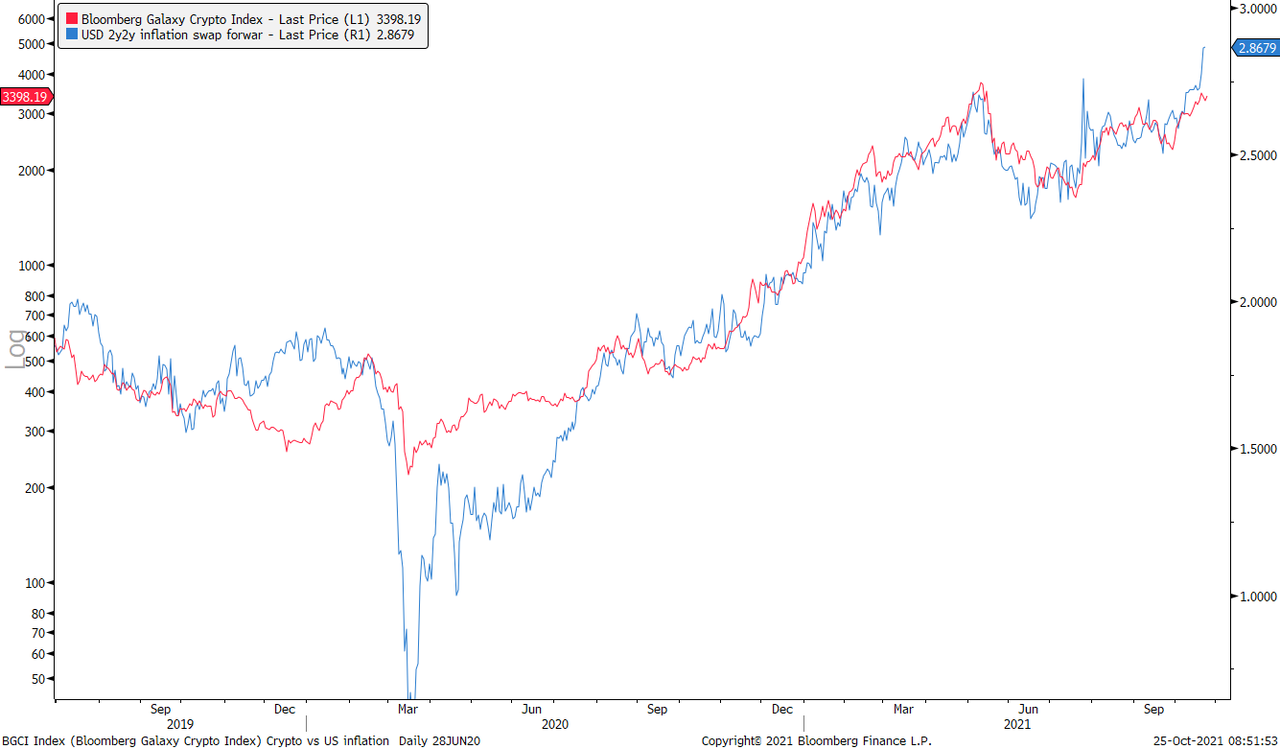
Now, Goldman appears to have finally found the answer: in a note from the bank's Global Markets managing director Bernhard Rzymelka, the bank shows that crypto assets have traded in line with inflation breakevens since 2019. Specifically, he charts the Bloomberg Galaxy Crypto Index (red) on a log axis, versus the USD 2y forward 2y inflation swap (blue). While correlation may no be causation, the chart below is clear enough to indicate that inflation certainly is a driving force behind the relentless crypto meltup to all time highs (which is delightfully ironic as some of crypto's biggest detractors are also some of the biggest Fed fanboys, who habitually cheer on the Fed's catastrophic monetary policy; little did they know that the record surge in cryptos would be most direct outcome of said policy).
What does this mean practically?
Well, if market-based views of inflationary pressures persist, we may soon see a meltup across the crypto universe and especially one token.
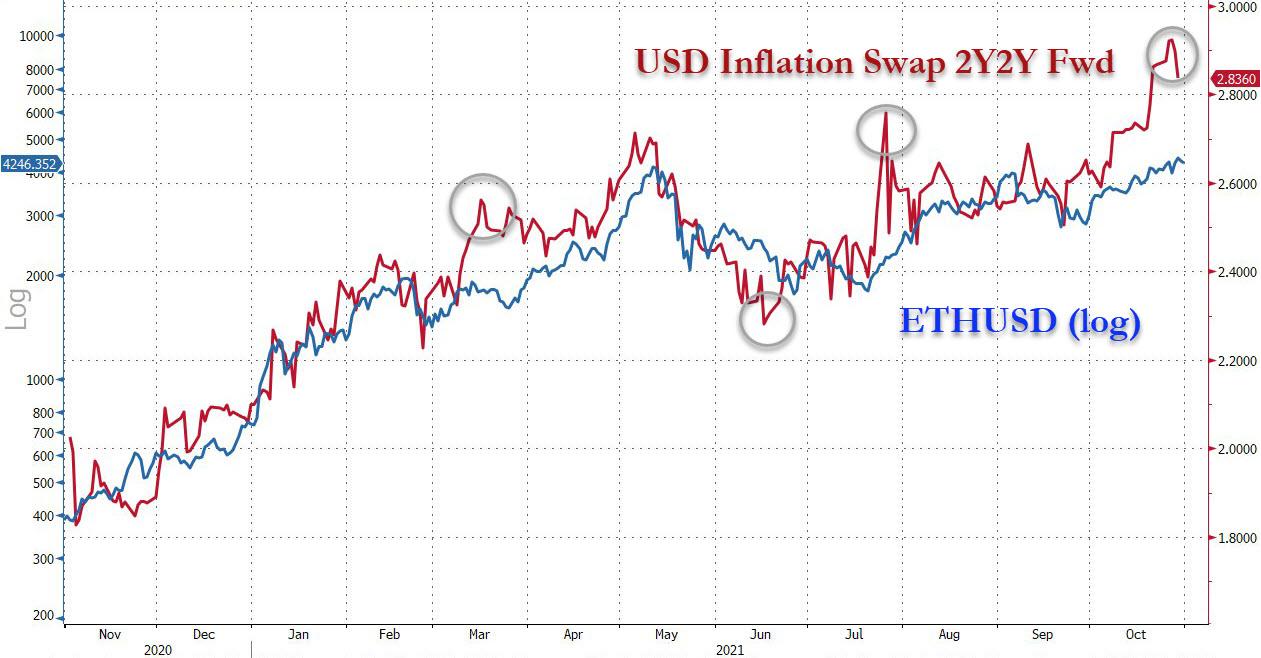
As the Goldman strategist writes, the local backdrop looks supportive for Ethereum as "it has tracked inflation markets particularly closely, likely reflecting the pro-cyclical nature as "network based" asset." And, as Rzymelka notes, "the latest spike in inflation breakevens suggests upside risk if the leading relationship of recent episodes was to hold (grey circles below)."
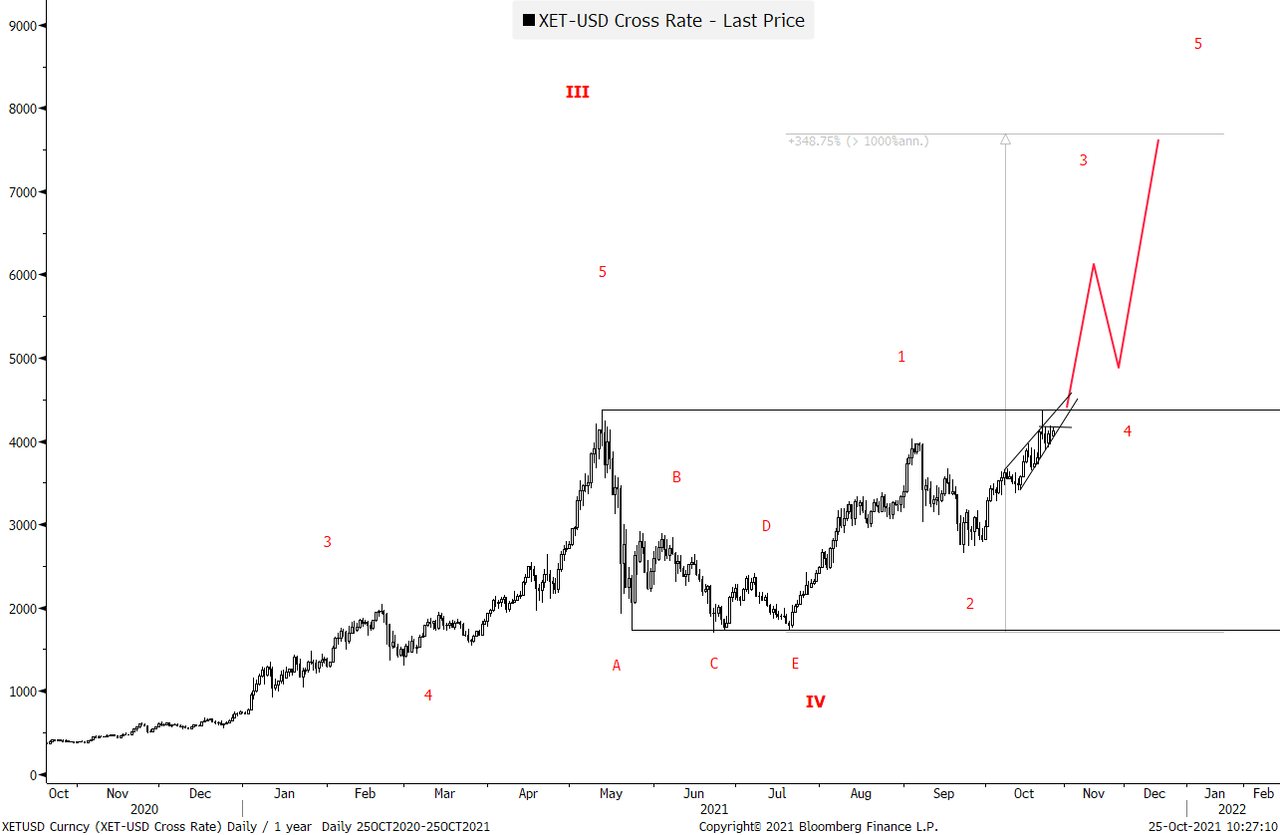
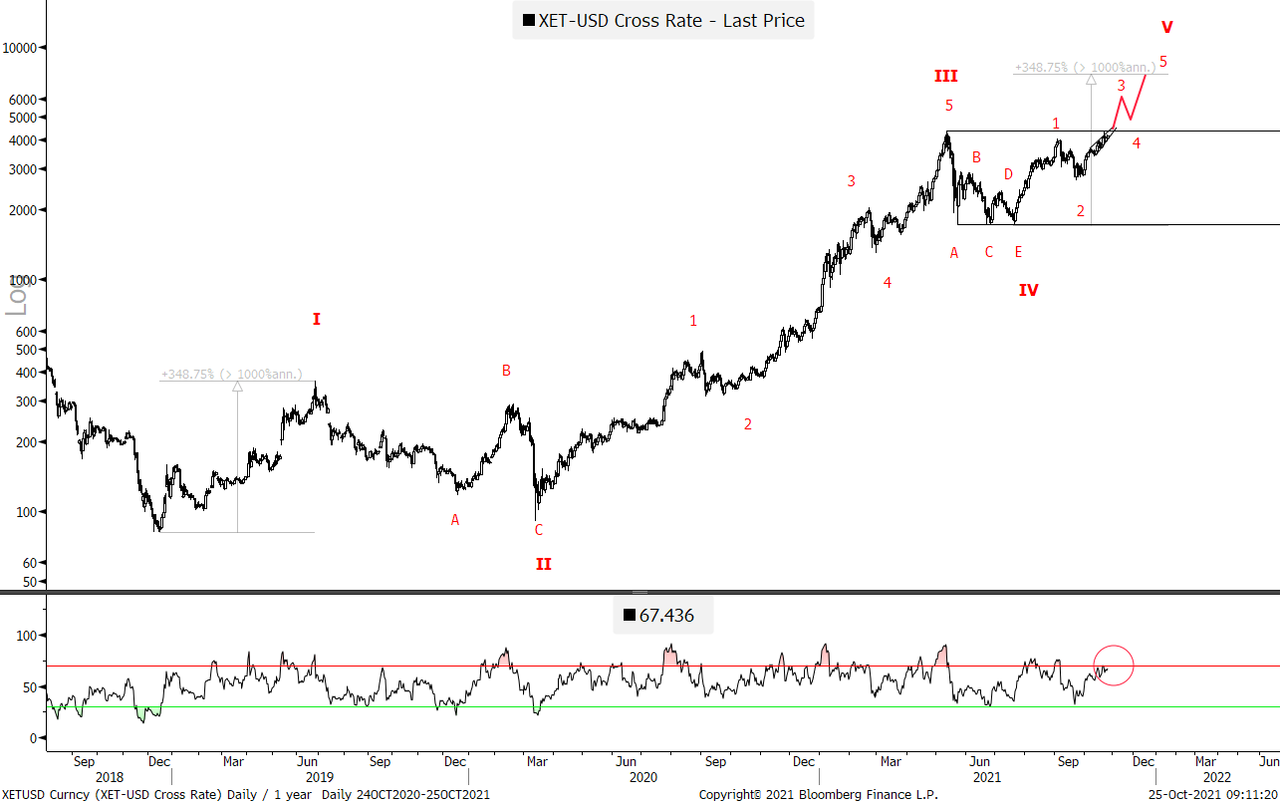
This, according to Goldman, lines up well with the Ethereum chart. In the past few days, the price of the crypto broke out to new all time highs, rising just shy of $4,500 with a narrowing wedge, which to Goldman is "either a sign of exhaustion and peaking... or a starting point of an accelerating rally upon a break higher." To Goldman, the answer to this rhetorical question is easy, and the bank hints that ethereum could surge as high as $8000 in the next two months if the historical correlation with inflation fwds persists.
And while some could argue that ETH is due for a pullback, Goldman counters that while the recent surge may appear stretched, "the RSI has yet to hit the overbought levels seen at past market highs."
One final word of caution. As the Goldman traders notes, US inflation swaps imply core PCE inflation at or above 2.50% for the next 5 years. That's a lot of overheating, and current market levels hence price a rather aggressive interpretation of the Fed's AIT framework of "moderately above 2% for some time" already.
On one hand, the upside to inflation markets - and possibly crypto assets - hence looks limited unless the market starts doubting the FOMC's inflation credibility (much) more fundamentally. In other words, as we have been saying since 2014, cryptos have emerged as the asset class that will benefit the most if we have another major inflationary/stagflationary scare.
As Goldman concludes, "this lines up rather well with the Ethereum chart, suggesting a late stage rally with longer term market top ahead."

WSJ : Coke to Pay $5.6 Billion for Full Control of BodyArmor

Coke to Pay $5.6 Billion for Full Control of BodyArmor
Gatorade rival, backed by athletes, on track for $1.4 billion in retail sales this year

Coca-Cola Co. is buying full control of BodyArmor for $5.6 billion in a deal that values the sports drink brand at about $8 billion, according to people familiar with the matter, amping up a rivalry with Gatorade.

Coke, which already owns 30% of BodyArmor, is buying the remaining 70% from the company’s founders and investors, as well as a group of professional athletes including the NBA’s James Harden and MLB’s Mike Trout who invested and helped market the drink.

The estate of Kobe Bryant, an early backer of BodyArmor, stands to collect more than $400 million for its greater-than-5% stake, one of the people familiar with the matter said. Mr. Bryant invested roughly $10 million in several rounds and had served on the BodyArmor board before he died in 2020, the person said.

Gatorade still dominates the sports drink market, though BodyArmor sales have been climbing quickly. BodyArmor expects to generate about $1.4 billion in retail sales this year, according to some of the people familiar with the matter. BodyArmor’s sales were about $250 million in 2018 when Coke first invested in the startup.

Earlier this year, Coke disclosed that it was in talks to take a controlling stake in BodyArmor. The transaction is expected to be announced as soon as Monday, the people said. Beverage Digest earlier reported that the valuation could top $7 billion and Bloomberg News reported that Coke was nearing a deal for a controlling stake.

FT : US energy secretary blames Opec ‘cartel’ for high petrol prices

US energy secretary blames Opec ‘cartel’ for high petrol prices
Costs at the pump have risen 40 per cent since Biden came to power, fuelling inflation anxiety

The Biden administration’s senior energy official on Sunday blamed the Opec oil “cartel” for soaring petrol prices in the US, putting more pressure on the group to increase crude output ahead of a meeting later this week.

“Gas prices of course are based on a global oil market. That oil market is controlled by a cartel. That cartel is Opec,” said Jennifer Granholm, the US energy secretary, on NBC’s Meet the Press. “So that cartel has more say about what is going on.”

US petrol prices have risen almost 40 per cent since Joe Biden entered the White House, adding to anxieties about inflation. The federal Energy Information Administration recently forecast winter household heating bills would also surge this year.

The US president told reporters after the G20 meeting in Rome on Sunday: “I do think that the idea that Russia and Saudi Arabia and other major producers are not gonna pump more oil so people can have gasoline to get to and from work for example is . . . not right.”

Earlier, a senior administration official said Biden would raise the “short-term imbalance in supply and demand in the global energy markets” in talks at the G20, whose members include Opec linchpin Saudi Arabia.

“What’s important is that global energy supplies keep up with global energy demand,” said the official. “Global energy demand has returned almost back to pre-pandemic levels. Global energy supplies have not.”

The White House’s calls in recent weeks for more fossil fuel production by Opec and Russia sit awkwardly with the administration’s efforts to lead a global fight against climate change and its tightening of regulation in the US oil sector, where production remains well below pre-pandemic peaks.

“Let me just say one thing,” Granholm said, speaking just ahead of the start of the Glasgow climate summit. “These rising fuel prices in fossil fuels tell us why we’ve got to double down on diversifying our fuel supply to go for clean.”

At seven-year highs of more than $80 a barrel, international and US oil prices have more than doubled in the past year, as the coronavirus pandemic eased the global economy burnt more oil again.

Deep supply cuts by Opec producers and partners such as Russia have also helped push up oil prices, which during the depths of last year’s price collapse briefly crashed below zero.

Those huge supply cuts were agreed last year under pressure from former US president Donald Trump, who sought to restore oil prices to protect the country’s oil industry. Opec and allies have been gradually winding down the cuts — but not quickly enough, believe some consumer countries.

While world leaders discuss climate change in Glasgow next week, Saudi Arabia, Russia and other oil producers will meet on November 4 to decide whether to increase more oil supply to the global market.

On Sunday, Chinese authorities announced the release of some stored gasoline and diesel “in response to the need to maintain supply and price stability in some regions”, amid a deepening energy crisis in the country.

Opec did not respond to a request for comment.

Analysts including Goldman Sachs expect Brent, the global oil benchmark, to rise above $90 by the end of the year, boosted by an unexpected rise in Asian demand, as power generators stung by soaring natural gas prices switch to burning oil for electricity.

Granholm indicated the US also still considered a release from the country’s strategic oil stockpile to be among the “tools” it could use to reduce prices — a prospect she first raised in an interview with the Financial Times earlier this month.

“I’ll let the president make that decision, make that announcement,” Granholm said.

WSJ : Shell Is the Greenest Big Oil Company. Look What That Got It.

Shell Is the Greenest Big Oil Company. Look What That Got It.
Activist proposal to split into ‘green’ Shell and ‘brown’ Shell shows the pitfalls of ESG

Royal Dutch Shell RDS.A -3.20% PLC shows much that is wrong with environmental, social and governance investing. The Anglo-Dutch company was the first to target reduced carbon emissions from customers, has gone further than any of the other oil supermajors to shift its direction away from fossil fuels and is closest of any of them to meeting the Paris carbon target. It even has a better ESG score than electric-car leader Tesla or hydrogen wonder stock Plug Power.

The result? Shell has been rewarded with a stubbornly low market valuation, is shunned by the increasing number of big money managers that have rejected oil investment outright and was the target of a successful lawsuit ordering it to reduce emissions.

Now hedge fund Third Point has an answer that makes perfect sense from a theoretical perspective: split it in two. The “green” and transition business it has built up should attract shareholders who want heavy investment in growth, and trade at a premium valuation. The “brown” oil operations should appeal to investors who just want a fat dividend from a dying business, and while it might trade at a discount it would throw off huge amounts of cash. Third Point founder Daniel Loeb, in a letter to investors, argued that this would be better for ESG and better for shareholders than the current hodgepodge of businesses that satisfies no one.

The Third Point theory is already being put into practice on the quiet by big dirty companies as they try to reduce emissions. Shell recently signed a $9.5 billion deal to sell its U.S. shale-oil business to ConocoPhillips, the big miners have been selling their coal businesses to private equity, and Anglo-Australian miner BHP Group this summer exited from oil and gas by selling the business to Australia’s Woodside Petroleum for $28 billion, although it took a big stake in Woodside in return.

The practical problem for both shareholders and the environmentally minded is shown by the sales of oil wells and coal mines. In themselves they did nothing to reduce emissions, merely changed the ownership. To the extent that the buyers have to sell the assets on the cheap because ESG pressure means buyers are scarce, those willing to buy get a bargain and so higher future returns from the dirty business. Any shareholder pushing for a sale for environmental reasons needs to think through what they are up to.

Third Point’s argument is that this is better for the environment because the new dirty business would have a higher cost of capital, visible as a lower valuation, and so should invest less in production. If true, the existing oil wells would be tapped to pay dividends, but less new production will be brought on stream, speeding the transition to cleaner forms of energy.

The environmental risks are twofold: Management might not care much about what are fairly small shifts in the cost of capital, and anyway the new brown business might end up with a higher value on its own than it does within Shell.

Paul Chandler, director of stewardship at the Principles for Responsible Investment, a United Nations-supported investor group, says shareholder engagement with executives and carbon taxes are far more effective than the share price at pushing change.

“The cost of capital associated with an increase or decrease in their share price isn’t likely to be a major driver of their activity,” he says.

If Shell is really doing what it says and extracting cash from the oil business to invest in clean-energy projects, then it might internally be giving the oil business a higher cost of capital than the market would—especially at a time when soaring oil prices have made the dirty industry financially attractive.

The practical problems come from the large number of investors who refuse to invest in oil and gas altogether. Shell is rated AA by MSCI for ESG, better than the other supermajors of Exxon Mobil, Chevron, Conoco and Europe’s BP, TotalEnergies and Eni. MSCI estimates that Shell’s carbon plans are compatible with a temperature rise slightly above the Paris agreement of at most 2 degrees Celsius over preindustrial levels. Of the others, only Italy’s Eni has plans that MSCI thinks are compatible with a rise below the catastrophic level of 4 degrees. In principle, ESG investors ought to ascribe a higher value to Shell as a result, but perhaps they don’t because so many steer clear of all oil stocks.

Environmental campaigners often dismiss all oil-industry ESG activity as greenwashing, and certainly Shell still produces and sells a lot of oil and gas.

But as more big investors such as endowments and pension funds are pressured by their members to avoid fossil fuels altogether, it makes sense for the market to split, and perhaps for Shell to follow.

A plausible future market will have a choice of green or brown energy companies, with green investors paying a premium for their beliefs, and so having a lower long-term return. Brown investors would pick up a bargain from fossil-fuel stocks servicing the continued demand—including from the members of those pension funds—for oil. If ESG takes over public markets altogether, those brown businesses will go private. Whether this ends up being better for the environment remains an open question, but I doubt it will make a lot of difference.

(ZH) Large-Scale Russian Troop Movements Along Ukraine Border Spark Alarm In US

Large-Scale Russian Troop Movements Along Ukraine Border Spark Alarm In US & Europe

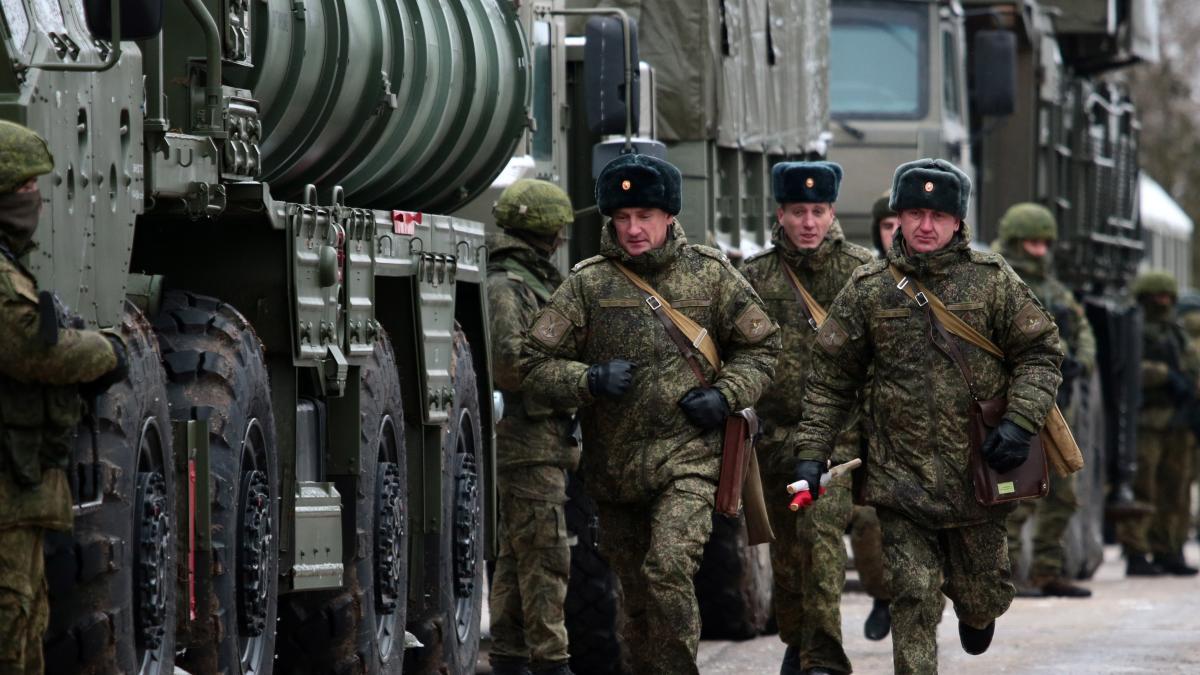
There's new allegations of a Russian troop build-up along the Ukrainian border, and Western leaders are sounding the alarm over what's perhaps becoming another brewing showdown near Donbass and the Crimea region.
The Washington Post reported Saturday that "A renewed buildup of Russian troops near the Ukrainian border has raised concern among some officials in the United States and Europe who are tracking what they consider irregular movements of equipment and personnel on Russia’s western flank."
Illustrative: Getty Images
The fresh allegations of Russian muscle-flexing aimed at Kiev come after last April's West-Russia showdown and tensions due to large-scale Russian drills along the border wherein tens of thousands of additional troops were deployed from their home bases to border areas near Ukraine. However, the Kremlin pointed out at the time that it's free to move troops anywhere within its sovereign borders that it wants.
The new weekend Washington Post report admits that the purpose of this current troop build-up remains "unclear" - while detailing the following:
Videos have surfaced on social media in recent days showing Russian military trains and convoys moving large quantities of military hardware, including tanks and missiles, in southern and western Russia.
"The point is: It is not a drill. It doesn’t appear to be a training exercise. Something is happening. What is it?" said Michael Kofman, director of the Russia studies program at the Virginia-based nonprofit analysis group CNA.
The concern comes just after the conclusion of the major 'Zapad 2021' military drills primarily held between Russian and Belarusian forces in September, including a handful of other allies. Analysts say large units never returned to their 'home' bases after the drills, but instead went to outposts near the Ukrainian border.
Ukraine's government is now suggesting as much as well, according to WaPo:
Oleksiy Danilov, secretary of Ukraine’s national security and defense council, said in a statement that after the conclusion of the Zapad 2021 exercises, Russia left military equipment, as well as control and communications centers, at training sites along the Ukrainian border.
Danilov estimated that the number of Russian troops deployed around the Ukrainian border at 80,000 to 90,000, not including the tens of thousands stationed in Crimea.
In recent months the Kremlin has accused Kiev of renewed aggression against pro-Russia separatist forces in eastern Ukraine, resulting in new casualties, while Ukrainian officials have charged that it's the Russian state that's fueling renewed fighting on stalemated front lines, especially by secretly transferring arms.
This as Vladimir Putin and other Russian leaders continue to warn Ukraine and NATO over Russian "red lines" of NATO military and base expansion into Ukraine. Russia has said it will be forced to act if in observes NATO military expansion in Ukrainian territory.
Putin last summer charged that the West, especially the United States, exercises de fact control over Ukraine's top leadership.
"We will never allow our historical territories and people close to us living there to be used against Russia," Putin stated previously. "And to those who will undertake such an attempt, I would like to say that this way they will destroy their own country."