FT : Third Point blasts Shell’s efforts to walk the green tightrope

Third Point blasts Shell’s efforts to walk the green tightrope
Lumbering oil companies have never seemed like ideal hotbeds of innovation

Trust us to ride two horses at once, say the big western energy companies. We will drill enough oil and natural gas to keep the lights on while shovelling the profits into renewables and electric vehicle charging stations to save the planet at the same time.

Shell, TotalEnergies and BP have all been touting more or less aggressive versions of this strategy for a while. Similar lines have also started to appear at ExxonMobil and Chevron amid pressure from climate activists.

Now Third Point is calling them out. Last week, the activist hedge fund run by Dan Loeb took aim at Shell, arguing that it should break itself up into a legacy oil and chemicals business and a green arm focused firmly on the future.

Legacy Shell would drill the oil it already has while handing most of its free cash back to investors. Future Shell wouldn’t be entirely green: it would use the existing natural gasfields to fund investment in renewables and its service stations.

“You can’t be all things to all people,” is how Third Point puts it. It argues that future Shell would attract growth-oriented investors who value environmental, social and governance factors, while legacy Shell would be optimised for those who value steady streams of cash. The climate would gain because total new investment in fossil fuel would fall.

It is easy to see the attraction of Third Point’s argument. Lumbering oil companies are not ideal hotbeds of green innovation and they have been linked to decades of climate misinformation. They are also clearly more comfortable with drilling than renewables: Shell’s 2021 capital expenditure strategy called for putting $2bn-$3bn into renewables, and $12bn in oil and gas.

Royal Bank of Canada analysts estimate that Shell’s parts could be worth $250bn, well above its current market capitalisation of $178bn. And five months after Anglo American tried a similar trick by spinning out its South African thermal coal assets, shares in the new company have doubled.

No wonder opinions are split. Just last week, ABP, the huge Dutch pension fund, said it was dumping €15bn in fossil fuel holdings including Shell, because it no longer sees the point of working with such companies on decarbonisation. But Blackstone’s Steve Schwarzman warned that failure to invest in oil and gas would lead to social unrest.

Shell counters that there are significant synergies among its various businesses and that keeping them together allows it to help its 30m daily retail customers and 1m corporate customers decarbonise. “These are complete, new value chains that need to be created,” Jessica Uhl, Shell’s chief financial officer, said last week. “We can leverage the assets . . . and the people that we have, and the understanding of the energy system.”

Many investors seem to be coming around to this point of view. Enthusiasm for funds that exclude fossil fuel companies and others that do poorly on ESG criteria appears to have peaked. Assets, which topped $19tn in 2018, dropped back to $15tn last year, Bernstein analysts calculated. Instead, money is flooding into funds that engage with companies or integrate ESG criteria into their financial analysis: combined assets under management hit $35.7tn last year.

More than any other oil chief, BP’s Bernard Looney is trying to catch this wave. He has boldly promised the company would cut oil and production by 40 per cent by 2030 while boosting renewable generation 20-fold.

Yet BP has devoted just 16 per cent of its $9.2bn in 2021 capital expenditure to low carbon, compared to 39 per cent for oil and 24 per cent for gas. Gas arguably makes sense as a transition fuel to help wean the world off even dirtier coal, but the company is still devoting more than half of its long-term investment to fossil fuels.

Adding to the disconnect, BP said on Tuesday that it plans to use the extra profits it has gained from rising energy prices to buy back $1.25bn more of its shares. That’s on top of boosting the company’s dividend and repurchasing $1.4bn in shares last quarter.

Before excoriating Looney for failing to live up to his green rhetoric, it is worth remembering why he feels the need to keep investors sweet. Shortly after he unveiled his transition plans last year, the share price fell to a 25-year low, and it continues to lag behind the other oil majors.

He remains convinced that the plan is the right one, and returning cash to investors gives them a reason to stick around while he shows that BP can execute it. “We call it performing while transforming. Our job is to do less talking and more delivering,” Looney says. “We’ve just got to keep at it.”
FT : Airbus charts ambitious course but risks Boeing backlash

Airbus charts ambitious course but risks Boeing backlash
Aircraft manufacturer faces opposition over big increase in production

John Leahy, Airbus’s legendary ex-chief salesman, was known as the trillion dollar man because, by the time he retired in 2018, he had notched up sales worth that amount. His hard driving, “win the deal at all costs” approach helped to propel Airbus ahead of Boeing in the global market for single-aisle aircraft. 

But his approach had limits. “John always used to say that when you get to 60 per cent market share that is the tipping point,” says a former colleague. “After that the whole market will get trashed and people start acting irrationally.”

If so, then the market is due a bit of irrational behaviour. According to consultancy Ascend by Cirium, Airbus will end this year with 67 per cent of single-aisle deliveries vs Boeing’s 33 per cent. If orders won in previous years, but not yet delivered, are counted, the Airbus share falls to 60 per cent.

But Guillaume Faury, Airbus chief executive, may be aiming to extend that gap. He wants to increase production of the A320 aircraft family beyond the 65 a month planned for 2023 to 75 a month from 2025. Never before has any aircraft manufacturer produced at such a rate — at least in peacetime, say old hands.

Faury has not formally committed to 75 but he is already facing opposition. The Financial Times reported last week that leasing giants AerCap and Avolon have warned Airbus its bullish stance is unjustified. Engine makers and system suppliers have also piled in over recent days to protest.

To some extent these warnings are self-serving. Lessors do not want a wave of new aircraft to depress the value of their own fleets. Engine makers, too, want existing engines to stay in the air for longer, as they make their money from maintaining them.

But there are other reasons to ask whether Airbus may be pushing too hard, too fast, before the industry even knows whether it can produce 65 a month without hiccups. 

The supply chain has been severely weakened by Covid-19. Moody’s in May suggested that many suppliers could face “financial distress” in the near term. Not only are prices for raw materials soaring, but, having drastically cut workforces, suppliers are struggling to find staff to meet the near-term goal. 

But what really worries many is whether they will be investing merely to help Airbus run down its order backlog for a few years, after which production rates will fall back again. 

Airbus has a backlog of 5,657 A320 family aircraft, against Boeing’s 3,334 orders for the 737. Any carrier wanting a single aisle from Airbus will have to wait years, giving Boeing an immediate advantage. So it makes sense for Airbus to free up delivery slots for new sales campaigns.

But by the time Airbus wants to produce 75 single aisles, Boeing will be delivering 50 737 Max airliners a month. And China’s Comac also hopes to start delivering its C919 next year. 

This makes no sense, say suppliers, when Airbus’s own pre-pandemic estimate of global demand to 2038 averages out at roughly 124 single aisles a month in production terms — including Airbus’s smaller A220. 

Under Faury’s scenario, Boeing and Airbus alone would be producing more bigger single aisles than market demand. Suppliers fear the higher rate will be unsustainable, especially if the post-pandemic aviation market is likely to be smaller for longer due to the lost years of growth.

Faury is adamant that his scenario is not fanciful and that the aviation market will snap back. “We know that there are a lot of views on this,” he said at Airbus results last week. “But . . . our view is that demand supports the rate 75.”

That may be true. But there may also be an element of useful gamesmanship at play. By urging suppliers to go faster than ever before, Airbus reinforces the image that it is more fleet of foot than Boeing, which seems to stumble from one production challenge to another. It could also sting Boeing into accelerating production too quickly for its own supply chain.

But there are risks in goading Airbus’s US rival. An even more aggressive price war is good for neither player. More significantly, if the balance swings too far in Airbus’s favour, there may be a political backlash. It is worth remembering that the US launched its WTO battle against Airbus subsidies in 2004, the year after the European company’s deliveries overtook Boeing’s for the first time.

Leahy was mindful of that 60/40 split for good reason. Faury should be too. 

WSJ : Goldman Sachs Promotes 643 Managing Directors, Its Largest Class Ever

Goldman Sachs Promotes 643 Managing Directors, Its Largest Class Ever
Bank says bigger class reflects investments in its asset-management and consumer arms

Goldman Sachs GS 1.72% Group Inc. on Tuesday named its largest-ever class of managing directors, the final role before a coveted partnership.

The Wall Street bank promoted 643 employees to managing directors, a 38% increase from the previous selection in 2019. New classes of managing directors and partners are chosen in alternating years.

Goldman named just 465 new managing directors two years ago, part of a bid to cut costs and renew the luster of its highest ranks.

The bank said the much-bigger 2021 class reflects the firm’s rising head count and investments in its asset-management and consumer arms. Goldman has about 43,000 employees, up from 37,800 two years ago.

New managing directors are granted access to the bank’s leadership-training program, private investment funds and a personal wealth adviser.

About 11% of the newly minted directors are based in areas the firm has identified as strategic locations, including Salt Lake City, Dallas and Bengaluru, India.

Goldman said the class is the most diverse in its history. It includes 30% women, up slightly from 29% in 2019. Close to 5% of the promoted directors are Black, up from 4% in 2019.

Goldman last month reported a big jump in third-quarter earnings, fueled by deal making.

WSJ : ByteDance CFO Is Stepping Down to Focus on TikTok

ByteDance CFO Is Stepping Down to Focus on TikTok
The Chinese technology giant will reorganize its business into six segments

TikTok owner ByteDance Ltd. said Chief Financial Officer Shou Zi Chew will step down from that role to focus on his position as chief executive of the popular video-sharing platform, a move that comes as ByteDance is reorganizing its business.

Mr. Chew was appointed to the top finance position at ByteDance in March after the company poached him from Beijing-based Xiaomi Corp. , where he served as CFO from 2015 to 2020. He took on the additional role as TikTok CEO about two months later.

ByteDance co-founder Liang Rubo in an internal memo said the company’s finance department would report to him. Mr. Liang is succeeding founder Zhang Yiming as chief executive, as the company in May said Mr. Zhang would step out of that role this year.

Mr. Liang announced a restructuring of ByteDance into six business segments: TikTok, its Chinese version Douyin, work-collaboration platform Lark, business-services unit BytePlus, gaming unit Nuverse and education-technology unit Dali Education.

Its Chinese services Toutiao, Xigua, Search, Baike and other vertical offerings will be grouped under the Douyin business unit, while the TikTok business will support the development of extended business lines such as global e-commerce, according to Mr. Liang.

“As the company’s business evolves and the team grows, each business faces different opportunities and challenges,” Mr. Liang said in the memo, adding that the heads of the different business sectors would report to him. A spokeswoman for the company declined to comment further.

ByteDance lists Carlyle Group and Sequoia Capital among its investors. It was valued at $360 billion at the end of February, according to data provider PitchBook.

Privately held ByteDance has faced regulatory hurdles and government pressure in recent months.

In April, ByteDance was among 34 of China’s biggest tech companies that made public pledges to comply with the country’s antimonopoly laws, shortly after e-commerce giant Alibaba Group Holding Ltd. was hit with $2.8 billion in antitrust fines. ByteDance was also among 13 companies ordered by the Chinese central bank and other regulators to adhere to tighter regulation of their data and lending practices.

Earlier this year, the company put on hold indefinitely its intentions to list offshore after Chinese government officials told the company to focus on addressing data-security risks, The Wall Street Journal reported in July.

ByteDance’s challenges come after the U.S. government investigated whether the TikTok app poses a risk to national security amid concerns that the Chinese government could have access to the personal data of millions of American users.

The Trump administration issued an executive order last year that would have banned the app unless it found an American buyer. Oracle Corp. and Walmart Inc. were in a group engaged in talks to buy TikTok’s U.S. operations, which ByteDance opposed with legal challenges. Federal court rulings blocked former President Donald Trump’s orders from ever taking effect.

The Biden administration in February shelved plans to require the sale amid a broader review of potential security risks from Chinese tech companies.

(ZH) 'Falsified Data': Pfizer Vaccine Trial Had Major Flaws, Whistleblower Tells

'Falsified Data': Pfizer Vaccine Trial Had Major Flaws, Whistleblower Tells Peer-Reviewed Journal

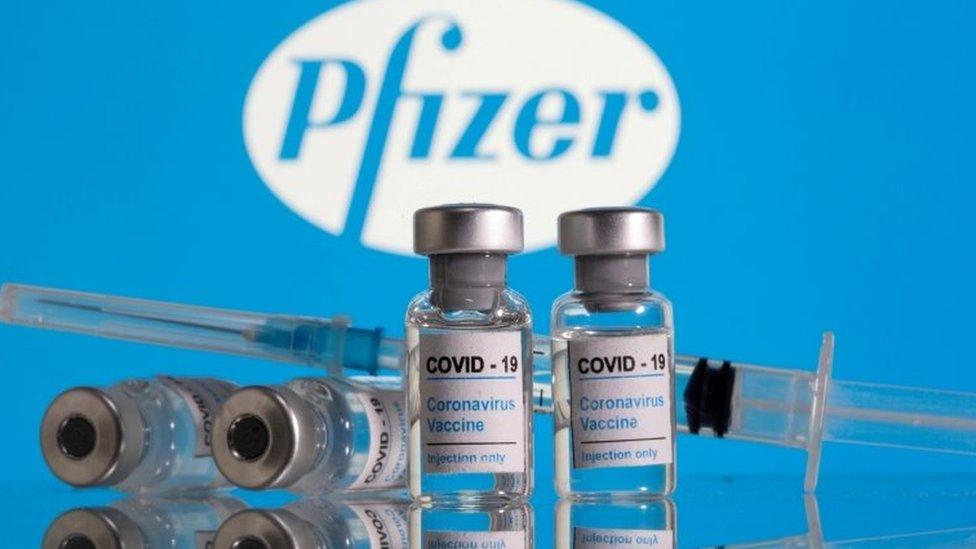
A whistleblower involved in Pfizer's pivotal phase III Covid-19 vaccine trial has leaked evidence to a notable peer-reviewed medical publication that poor practices at the contract research company she worked for raise questions about data integrity and regulatory oversight.
Brook Jackson, a now-fired regional director at Ventavia Research Group, revealed to The BMJ that vaccine trials at several sites in Texas last year had major problems - including falsified data, broke fundamental rules, and were 'slow' to report adverse reactions.
When she notified superiors of the issues she found, they fired her.
A regional director who was employed at the research organisation Ventavia Research Group has told The BMJ that the company falsified data, unblinded patients, employed inadequately trained vaccinators, and was slow to follow up on adverse events reported in Pfizer’s pivotal phase III trial. Staff who conducted quality control checks were overwhelmed by the volume of problems they were finding. After repeatedly notifying Ventavia of these problems, the regional director, Brook Jackson, emailed a complaint to the US Food and Drug Administration (FDA). Ventavia fired her later the same day. Jackson has provided The BMJ with dozens of internal company documents, photos, audio recordings, and emails. -The BMJ
Poor laboratory management
Jackson, a trained clinical trial auditor with more than 15 years' experience, says she repeatedly warned her superiors of poor laboratory management, patient safety concerns, and data integrity issues. After she was ignored, she started documenting problems with the camera on her mobile phone.
One photo, provided to The BMJ, showed needles discarded in a plastic biohazard bag instead of a sharps container box. Another showed vaccine packaging materials with trial participants’ identification numbers written on them left out in the open, potentially unblinding participants. Ventavia executives later questioned Jackson for taking the photos.
The unblinding was potentially far more severe as well. Per the trial's design, unblinded staff prepared and administered either Pfizer's Covid-19 vaccine or a placebo. This was done to preserve the blinding of trial participants and other staff - including the principal investigator. At Ventavia, however, Jackson says that drug assignments were left in participants' charts and accessible to blinded personnel. The breach was corrected last September, two months into the trial at which point there were around 1,000 participants already enrolled.
Jackson recorded a September 2020 meeting with two Ventavia directors, at which an executive can be heard saying that the company couldn't quantify the types and number of errors with their testing.
"In my mind, it's something new every day," they said, adding "We know that it's significant."
According to the report, Ventavia also failed to keep up with data entry - as a Sept. 2020 email from Pfizer partner ICON reveals.
"The expectation for this study is that all queries are addressed within 24hrs.” ICON then highlighted over 100 outstanding queries older than three days in yellow. Examples included two individuals for which “Subject has reported with Severe symptoms/reactions … Per protocol, subjects experiencing Grade 3 local reactions should be contacted. Please confirm if an UNPLANNED CONTACT was made and update the corresponding form as appropriate.” According to the trial protocol a telephone contact should have occurred “to ascertain further details and determine whether a site visit is clinically indicated.”
FDA Inspection woes
Other documents provided to The BMJ reveal that Ventavia officials were worried about three employees . In an email in early August 2020, an executive identified three site staff members with whom they need to "Go over e-diary issue/falsifying data, etc."
One of the employees was "verbally counseled for changing data and not noting late entry," a note reveals.
During the September meeting, Ventavia executives and Jackson discussed the potential for the FDA to show up for an inspection. On former Ventavia employee told The BMJ that the company was petrified over the potential for an FDA audit, and were in fact expecting one over the Pfizer vaccine trial.
"People working in clinical research are terrified of FDA audits," Jill Fisher told the journal, adding however that the agency rarely does anything except review paperwork - usually months after a trial is over. "I don’t know why they’re so afraid of them," she added - saying that she was surprised that the agency failed to inspect Ventavia following an employee complaint.
"You would think if there’s a specific and credible complaint that they would have to investigate that."
FDA notified
Jackson sent a Sept. 25 email to the FDA in which she wrote that Ventavia had enrolled over 1,000 participants at three sites, out of the full trial's 44,000 participants across 153 sites which included various academic institutions and commercial companies. She raised concerns over issues she had witnessed, including:
  • Participants placed in a hallway after injection and not being monitored by clinical staff
  • Lack of timely follow-up of patients who experienced adverse events
  • Protocol deviations not being reported
  • Vaccines not being stored at proper temperatures
  • Mislabelled laboratory specimens, and
  • Targeting of Ventavia staff for reporting these types of problems.
Hours later, the FDA emailed her back, thanking her for her input but notifying her that they would not comment on any investigation which may result.
That said, in August of this year, the FDA published a summary of its inspections of Pfizer's pivotal phase III trial. They looked at just nine out of the trial's 153 sites, and did not look at any of Ventavia's operations. Further, no inspections were conducted following the December 2020 emergency authorization of the vaccine.
Other employees corroborate Jackson's complaints
Two former Ventavia employees spoke with The BMJ anonymously, and confirmed 'broad aspects' of Jackson's account.
One said that she had worked on over four dozen clinical trials in her career, including many large trials, but had never experienced such a “helter skelter” work environment as with Ventavia on Pfizer’s trial.
I’ve never had to do what they were asking me to do, ever,” she told The BMJ. “It just seemed like something a little different from normal—the things that were allowed and expected.
She added that during her time at Ventavia the company expected a federal audit but that this never came.
After Jackson left the company problems persisted at Ventavia, this employee said. In several cases Ventavia lacked enough employees to swab all trial participants who reported covid-like symptoms, to test for infection. Laboratory confirmed symptomatic covid-19 was the trial’s primary endpoint, the employee noted. (An FDA review memorandum released in August this year states that across the full trial swabs were not taken from 477 people with suspected cases of symptomatic covid-19.)
I don’t think it was good clean data,” the employee said of the data Ventavia generated for the Pfizer trial. “It’s a crazy mess.” -The BMJ
The second employee told The BMJ that working at Ventavia was unlike any environment she had experienced in 20 years of research.
Since her firing, Jackson has reconnected with several Ventavia employees who either left or were fired themselves. One of them sent her a text message, which reads "everything that you complained about was spot on."
Meanwhile, since Jackson reported issues with Ventavia to the FDA in September 2020, Pfizer has contracted with the company for four other vaccine clinical trials.
One has to wonder - if the FDA is auditing less than 10% of trials, how many more potential whistleblowers could there be?

WWD : Nike Trademarks for Virtual Clothing Sparks Metaverse Rumors

Nike Trademarks for Virtual Clothing Sparks Metaverse Rumors
The sportswear giant filed trademarks for seven symbols, names and phrases to be used for downloadable goods in virtual worlds

Is Nike entering the metaverse?

The Beaverton, Ore.-based sportswear giant has filed trademarks for seven names, symbols and phrases “for use online and in online virtual worlds,” according to the filing from the United States Patent and Trademark Office.

Late last month, Nike Inc. filed trademarks for two forms of the company’s “Swoosh” logo; the Jordan “Jumpman” and “Air Jordan” wings logo; the brand names Nike and Jordan, and the phrase “Just Do It” for downloadable goods in computer programs featuring footwear, clothing, headwear, eyewear, bags, sports bags, backpacks, sports equipment, art, toys and accessories for online use.

Nike and Jordan could not be reached for comment.

The new trademarks are Nike’s latest effort in exploring the metaverse, cryptocurrencies and NFT worlds. The sportswear company in 2019 secured a patent for “Cryptokicks,” or virtual collectible shoes stored on a blockchain. The patent says that when a particular sneaker is purchased, a token is unlocked and 10-digit code will then be linked to the sneaker’s owner. The owner could also “breed” custom sneakers, which then could be produced as a physical product.

But the Cryptokicks and newly filed trademarks serve different aspects of the vast metaverse. On one hand, Cryptokicks serve the NFT community, while the new trademarks for virtual goods are similar to Jordan’s past partnership with Fortnite, for instance, where the Air Jordan 1 sneakers were available to be purchased in game.

Other fashion brands have made similar efforts, including Louis Vuitton which is partnering with League of Legends on a capsule collection and in-game skins; Gucci and The North Face taking their collaboration into Pokemon Go!; Gucci and Vans entering the Roblox world along with Nike for Air Max Day; and Balenciaga appearing in Fortnite. Brands Awake, Rhude and Misbhv have appeared in Madden, NBA 2K and Grand Theft Auto, respectively.

(ZH) "Markets Are Just Going To Break In Some Parts" - One Bank Sees Bond Market

"Markets Are Just Going To Break In Some Parts" - One Bank Sees Bond Market Turmoil Shifting To Stocks

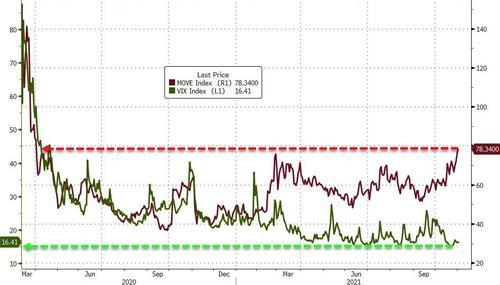
As we noted earlier today, a huge divergence has opened up between stock and bond market volatility, the former measured by the absurdly calm VIX index, the latter by the surging MOVE...
... whose spike pushed it to the highest levels since April 2020, suggesting bond traders are increasingly on edge over how the Fed's taper announcement could impact bond prices even as equity markets continue to ignore any and all potential risks.
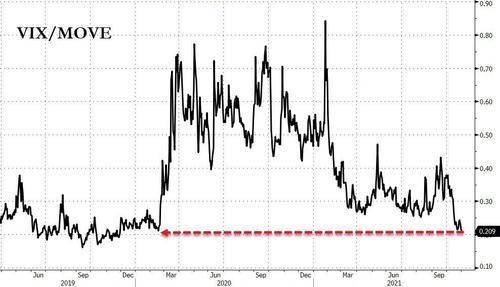
As the next chart shows, we haven't seen a divergence this wide between the two since before the covid crisis:
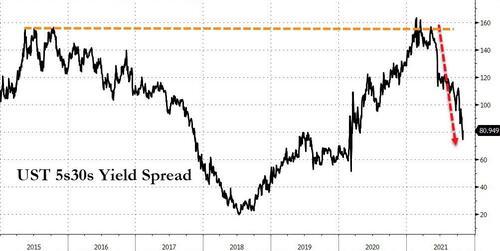
We discussed some of the reasons behind the turmoil in bonds in ""10 To 20 Asset Managers Are Being Liquidated" - Rate Vol Exploding Just As Funds Pile Into Repo Trade That Blew Up Market" and earlier today we showed the ominous collapse in the 5s30s curve, one of the most credible early indicators that not all is well in the economy...
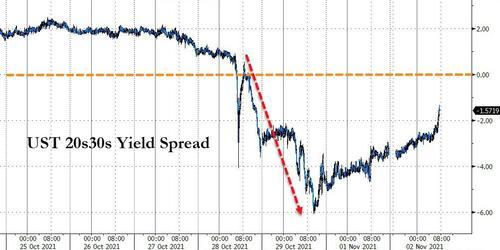
... a signal that was further reinforced by the first ever inversion in the 20s30s curve.
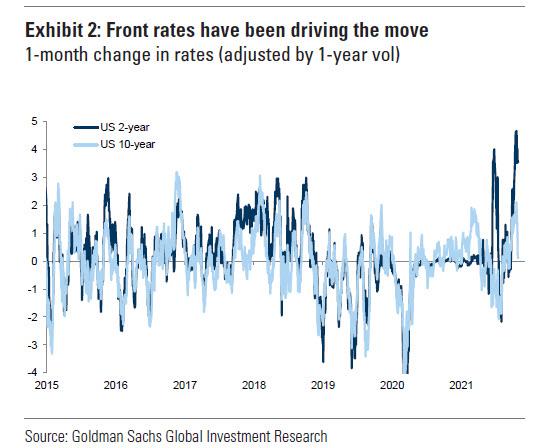
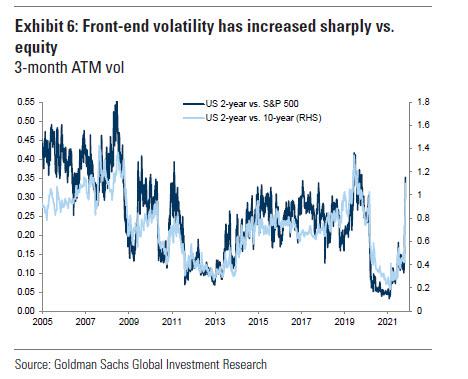
Commenting on the wild moves in the yield curve, Goldman's Christian Mueller-Glissman writes that front-end rates have been the main driver of the move with 2-year rates recording a roughly 5 standard deviation move in October...
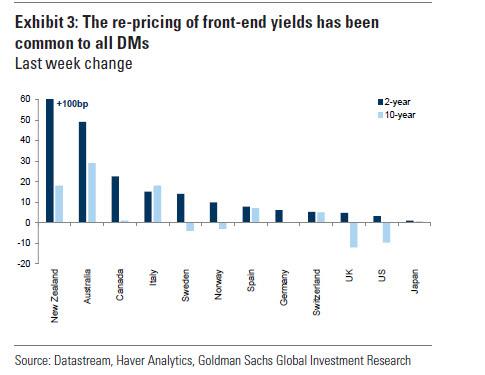
... as investors increasingly fear central banks will have to tighten policy faster due to inflationary pressures. At the same time, little confidence on the long-term growth outlook, excess savings and fears of slowdown risk due to excessive tightening has likely limited sell-offs further out in the curve although as DB's George Saravelos notes, this flattening confirms the market's view that the Fed is about to do a policy error by announcing a taper during tomorrow's FOMC meeting. Meanwhile, outside the US, a mix of hawkish pivots and technical factors have triggered an even sharper front-end sell-off in Canada, Australia and New Zealand.
In Europe, sovereign spreads have been widening post-ECB last week, in part as the market might have been pricing a too bullish QE outlook.
And here the $64 trillion question emerges: why despite the recurring, P&L-crushing VaR shocks in bond land, has the equity market ignored the turmoil below the surface?
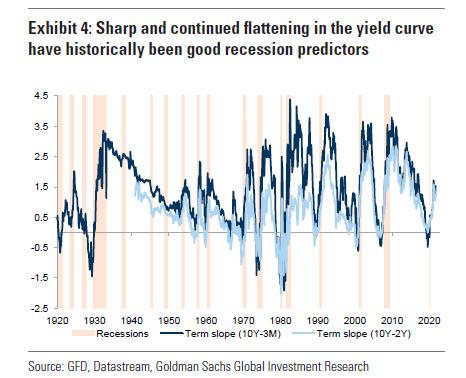
One theory comes from Goldman which notes that stocks have "digested the global rates re-pricing surprisingly well" and the bank speculates that this is "likely on the back of another good earnings season and longer-dated real yields continuing to be anchored at very low levels, which continued to support the current high valuation regime." Yet even Goldman admits that historically, continued flattening of the yield curve can point to rising recession risk and equity International market peaks...
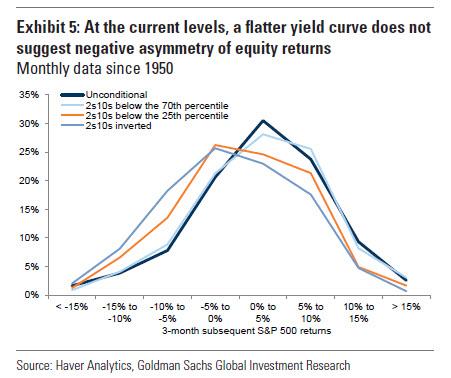
...but absolute levels of the 2s10s also matter. In fact, according to Goldman only levels below the 25th percentile (i.e., closer to an inversion in the yield curve) suggest more negative asymmetry in equity returns.
Instead, Goldman notes that from levels around the 70th percentile as we are seeing now, equities have delivered positive returns on average, especially in front-end led flattening episodes (bear flattenings). Additionally, one key feature of the current recovery is that the curve steepened much less than usual, which can distort the yield curve signals.
There is another, far simpler reason why stocks are ignoring the bond market turmoil: Goldman believes that continued low rates ensure a regime of TINA and as long as the shorter-dated rates volatility does not spill over to the back end...
... and the macro backdrop remains supportive, "equities might remain relatively insulated and equity vol might stay anchored."
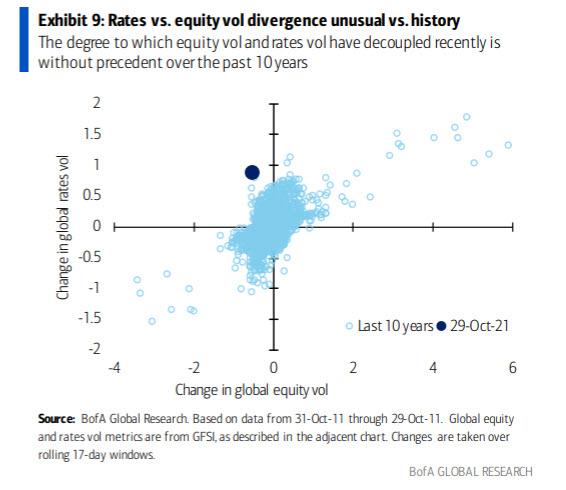
Others, however, disagree, and according to Bank of America strategists, the "end of an era" of abundant liquidity means that stock markets trading at record highs won’t be able to stay immune for much longer to the multiple-sigma moves in bonds.
Showing just how unusual the latest divergence between equity and bond vol is in a historical context...
... Asis writes that “this divergence is unlikely to sustain and the risk is equities are forced to price in the increasingly unfavorable policy environment."
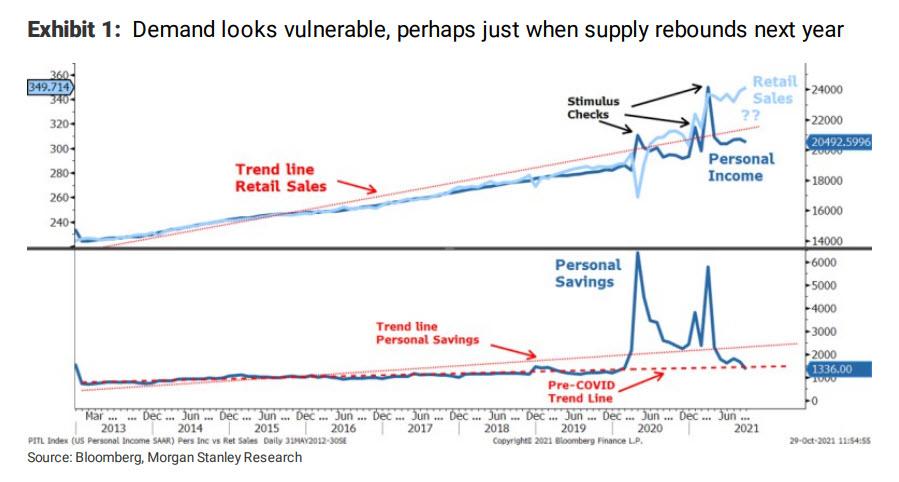
Wall Street's biggest bear, Michael Wilson agrees, and as he wrote over the weekend, “the fundamental picture for stocks is deteriorating as the Fed starts to tighten monetary policy and earnings growth slows further into next year, turning outright negative for some companies." His argument is one based on fundamentals: the strategist warns that the earnings growth slowdown will be worse and last longer than expected as the payback in consumer demand arrives early next year with a sharp year-over-year decline in personal disposable income. As he writes, "while many have argued that the large increase in personal savings will keep consumption well above trend, it looks to us as if personal savings have already been depleted to pre-COVID-19 levels."
Alas, none of that matters to a generation of traders who have been trained like obedient Pavlovian dogs to buy each and every dip. According to Wilson, stocks are "continuing to rise as retail investors keep plowing excess cash into these same investments. Meanwhile, with strong seasonal trends and pressure to perform high at this time of year, many institutional investors we speak with are staying fully invested for these technical reasons. If our analysis is correct, we think that this bullish trend can continue into Thanksgiving, but not much longer."
So who will be right: Goldman, which expects the recent fireworks to be contained to bonds, or Morgan Stanley, which sees the bond turmoil spilling over into stocks by the end of November. We may get the answer as soon as tomorrow when Powell announces the start of tapering.
Then again, with a market as cynical as this one, we may well end up with an outcome where a collapse in bonds leads to an accelerated meltup in stocks simply because even a hypothetical market crash would merely lead to even more intervention by the Fed which will have no choice but to undo its upcoming tightening (and with apologies to all the macrotourists out there, but tapering is tightening, as Michael Wilson explained one month ago). And yes, this is a paradox, because investors will have to sell to trigger panic at the Fed... and yet after the bazooka example of March 2020 where we saw to what lengths the Powell Fed will go to stabilize equities, absolutely no one wants to be the first to dump stocks in a world where equity downside is all but outlawed.

FT : New York hedge fund stands to make $5bn on Avis Budget share surge

New York hedge fund stands to make $5bn on Avis Budget share surge
SRS Investment Management holds 27.7 per cent stake in car rental company

A New York hedge fund stands to make billions of dollars on a sudden leap in the shares of Avis Budget, the once ailing rental car company that catapulted like a meme stock after executives discussed adding electric vehicles to their fleet.

SRS Investment Management, which is headed by Karthik Ramakrishna Sarma, is sitting on well over $5bn in potential gains from Tuesday’s share move, according to calculations by the Financial Times. Sarma is an alumnus of Chase Coleman’s hedge fund Tiger Global Management.

Avis’s stock initially surged by more than 200 per cent after executives told analysts on Tuesday that they were considering electric offerings. Joe Ferraro, chief executive, said the company would “be much more active” in electric vehicles.

The discussion came after rental car company Hertz last week said it ordered 100,000 Tesla Model 3 electric sedans, in what was seen as a bellwether announcement for the industry. Late on Monday, Elon Musk, Tesla chief executive, cast doubt on the deal, however.


SRS, a little-known hedge fund founded by Sarma in 2006, is Avis’ largest shareholder with a 27.7 per cent stake. That position was worth as much as about $10bn on Tuesday morning after shares in the rental car company topped $545 in early trading.

In addition to the 18.4m shares it holds, SRS has exposure to another 11.3m shares through cash-settled equity swaps that are equivalent to a 16.3 per cent stake, according to filings. The fund has used prime brokers including Nomura, Jefferies and UBS on recent swap deals.

The fund first bought Avis shares in 2010 and became an activist in 2016, using aggressive purchases of swaps to build a large stake and seek representation on the company’s board. When SRS started increasing its position in January 2016, Avis’ stock price was trading at about $28.

Equity swaps allow investors to have stock exposure without owning it directly. These derivative contracts have come under scrutiny since Bill Hwang’s investment firm Archegos Capital Management made and lost billions of dollars on swaps tied to a small group of companies.

As car rental stocks plunged during the coronavirus pandemic, SRS made several purchases of Avis stock, regulatory filings show. In February 2020 the fund reached a standstill agreement that put three of its nominees on Avis’s board of directors.

Because of its board representation, the standstill agreement between SRS and Avis prevents the hedge fund from selling its shares during blackout periods, which are typically lifted shortly after earnings are released.

Avis did not immediately respond to an email seeking comment, while SRS declined to comment when reached by phone.

Bernardo Hees, Avis chair and the former chief executive of Kraft Heinz, said in a 2020 press release: “SRS has been a valuable long-term partner to Avis. We are pleased to have reached a new co-operation agreement with them that we believe is in the best interests of the company and our shareholders.”

Hees owned almost $300m worth of shares in Avis at Tuesday’s high.

Shares in Avis had already risen more than 300 per cent this year amid investor enthusiasm about a resurgence in travel and a global shortage of new vehicles. The company on Monday reported a 96 per cent year-on-year increase in third-quarter revenues and a sharp rise in net income from $45m to $674m. By Tuesday afternoon Avis was 95 per cent higher on the day at $335.05.

While Avis executives said they were pursuing electric vehicles, the company has not announced any large orders. “We at Avis realised that the electrification of vehicles is where not just our industry, but the entire mobility ecosystem is eventually headed,” Brian Choi, chief financial officer, said on Tuesday’s call.

>>> US Close Dow +0.39% S&P +0.37% Nasdaq +0.34% Russell +0.16%

Closing Stock Market Summary

The S&P 500 (+0.4%), Dow Jones Industrial Average (+0.5%), Nasdaq Composite (+0.3%), and Russell 2000 (+0.2%) set intraday and closing record highs on Tuesday. The market drew support from bullish earnings reactions, positive momentum, and some mega-cap support. 

Avis Budget (CAR 357.17, +185.71, +108.3%) stole the earnings show, with the stock more than doubling in a short squeeze after the company beat top and bottom-line estimates. Avis shares were up as much as 218%, exemplifying the intense spirit of this bull market, and the intraday retracement didn't deter overall risk sentiment. 

To be fair, the breadth of the market was more mixed in front of the FOMC policy announcement tomorrow. While nine of the 11 S&P 500 sectors closed higher, declining issues outpaced advancing issues at the NYSE and were roughly even at the Nasdaq.

The materials sector (+1.1%) was the only sector that gained more than 1.0%, but Apple (AAPL 150.02, +1.06, +0.7%), Microsoft (MSFT 333.13, +3.76, +1.1%), Alphabet (GOOG 2917.26, +41.78, +1.5%), and NVIDIA (NVDA 264.01, +5.74, +2.2%) provided individual leadership.

Conversely, the energy (-1.0%) and consumer discretionary (-0.6%) sectors lower. Tesla (TSLA 1171.97, -36.62, -3.0%) held back the latter after CEO Elon Musk said there has yet to be a signed contract with Hertz Global (HTZZ 35.06, +0.91, +2.7%) and that the deal would have no economic impact on Tesla. 

Back to earnings, Pfizer (PFE 45.45, +1.81, +4.2%), Estee Lauder (EL 338.62, +13.47, +4.1%), Arista Networks (ANET 491.87, +83.30, +20.4%), Zebra Technologies (ZBRA 585.55, +42.96, +7.9%), and Under Armour (UA 21.68, +2.65, +13.9%) also saw sizable gains following their earnings reports, although not to the same extent as Avis Budget. 

Elsewhere, Treasuries saw increased demand ahead of the Fed decision tomorrow, driving yields lower in a curve-steepening trade. The 2-yr yield fell six basis points to 0.45%, and the 10-yr yield fell three basis points to 1.55%. The U.S. Dollar Index gained 0.2% to 94.10. WTI crude futures decreased 0.2%, or $0.19, to $83.86/bbl.

Hedging interest remained muted amid the resolve in the major indices. The CBOE Volatility Index (16.03, -0.38, -2.3%) closed near the 16.00 level. 

Investors did not receive any economic data on Tuesday. Looking ahead to Wednesday, investors will receive the ISM Non-Manufacturing Index for October, the ADP Employment Change report for October, Factory Orders for September, the weekly MBA Mortgage Applications Index, and the final IHS Markit Serfices PMI for October. 

  • S&P 500 +23.3% YTD
  • Nasdaq Composite +21.4% YTD
  • Russell 2000 +19.5% YTD
  • Dow Jones Industrial Average +17.8% YTD