Gapping down
In reaction to earnings/guidance:
- ERIC -14.8%, AA -10.7%, ALL -10.5% (estimates Q3 catastrophe losses; provides preliminary Q3 results), SSL -6.6% (Q3 update), NOK -5.7%, WDFC -5.2%, KNX -4.9%, TSLA -4.9%, PPG -4.1% (also names new CEO), WSO -3.3%, KEY -3%, HPE -2.9% (reiterates FY22 earnings and sales outlook; guides FY23 earnings in-line with consensus), EFX -2.7%, RLI -2.4%, TCBI -1.8%, KMI -1.8%, DHR -1%, FITB -0.9%, STLD -0.8%
Other news:
- TALS -25.2% (announces a status update on its Phase 3 FREEDOM-1 study in living donor kidney transplant recipients)
- BCLI -4.6% (Presents NurOwn Phase 2 Progressive MS Biomarker Data at the 38th ECTRIMS Congress)
- CENX -3.8% (in sympathy with AA earnings)
- DNLI -2.9% (prices offering of 10377359 shares of its common stock at $26.50 per share)
- RIVN -0.9% (fixes significant majority of its 12000+ recalled vehicles according to TechCrunch)
- RNR -0.9% (estimates 2022 catastrophe losses)
Analyst comments:
- COUP -3.2% (downgraded to Underweight from Neutral at Piper Sandler)
- ALLY -2.2% (downgraded to Equal-Weight from Overweight at Morgan Stanley; downgraded to Underweight from Equal Weight at Wells Fargo)
Gapping up
In reaction to earnings/guidance:
- SMCI +18.7% (increases guidance for EPS and revs for SepQ), BANC +5%, HRI +5%, LBRT +4.6%, MAN +3.8%, UMPQ +3.5%, IBM +3.4%, AAL +2.6%, T +2.3%, LVS +2%, PACW +1.8%, PM +1.6%, SNA +1.5%, TSCO +1.4%, SLG +1.1%, DGX +1.1%, WU +1.1%, IRDM +1.1%, POOL +1%, LSTR +0.9%, CVBF +0.8%
Other news:
- XERS +8.1% (announced topline results from its Phase 1 study of subcutaneous (SC) levothyroxine)
- CE +3.9% (increases dividend)
- MO +1.2% (Altria reaches agreement with Philip Morris International (PM) for IQOS Transition)
- NOG +0.8% (to acquire interest in Core Midland Basin development project for $330 mln)
Analyst comments:
- TNGX +3.9% (upgraded to Buy from Neutral at H.C. Wainwright)
- WWW +2.2% (upgraded to Buy from Hold at Williams Trading)
- ASML +1.6% (upgraded to Buy from Hold at Deutsche Bank)
Brunello Cucinelli Forecasts Record Year, Relying on Strong Pipeline to Drive Revenues
Cucinelli is expecting to double sales ahead of its 10-year plan as his company posted a 27.7 percent increase in nine-month revenues.
MILAN — Merchandise demand is exceeding supply, according to Brunello Cucinelli.
Relying on a strong manufacturing pipeline is a key added value that has caused the entrepreneur to expect a 25 percent increase in revenues for the year and a 10 percent gain in the top line for 2023 based on the order intake for the men’s and women’s spring 2023 collections.
“During and despite the pandemic over the past two years, we did not lay off anyone and having our production and sales facilities at full capacity is giving us a competitive advantage to cope with the large quantity of goods requested by the market where, in general, demand exceeds supply,” remarked Cucinelli, marveling at the general speed of the recovery after the pandemic. “There is no way you can rebuild a pipeline in a short time, you need those skills built over years.”
Cucinelli was speaking to analysts during a call on Wednesday evening to comment on a 27.7 percent increase in revenues of his namesake company in the first nine months of the year, which reached 642 million euros.
“The results of the first nine months of 2022 are really splendid: we are indeed achieving great results thanks to the image that the brand enjoys worldwide for its style, way of working and humanistic idea of business,” he observed.
Cucinelli said he had also stocked raw materials in time, which also allows the company to respond to the market and catch business opportunities. He pointed to the weakness of the euro and the short production chains that are also benefiting the entire Italian fine manufacturing sector.
“This shows how strong our welfare state is. We are one of the countries that best handled the pandemic,” he asserted.
Cucinelli then proceeded to highlight a key project for the future, called “Universal working conditions for human beings,” elevating not only the moral dignity of work, but also the economic conditions of artisans, raising their salaries to close to 2,000 euros a month. This will help ensure the future of Made in Italy production.
“To work in a plant where you can see the sky and use natural light will improve the well-being of the artisans and their creativity. But they also need to be paid well, or this could be a dying art.”
Analysts remarked on the likely possibility that Cucinelli will double sales ahead of his 10-year plan revealed in 2019 and he introduced a new five-year plan beginning in 2023, considering 2022 a “non-linear year.”
Growth in all markets and in the company’s retail and wholesale channels, as well as increases in both the women’s and men’s divisions, now representing almost a 50/50 balance, contributed to the strong nine-month performance.
In the period ended Sept. 30, sales in Europe climbed 21.6 percent to 184.2 million euros, representing 28.7 percent of the total. Resort towns benefited from the rapid and robust recovery of international tourism, especially from North America.
Revenues in Italy were up 10.2 percent to 78 million euros, accounting for 12.2 percent of the total. Wholeasalers increased their requests for the fall 2022 collections in June to meet the demand in the face of limited market supply, boosting the performance in the first six months of the year.
Sales in the Americas jumped 45 percent to 233.8 million euros, accounting for 36.4 percent of the total, boosted both at retail and wholesale and benefiting from the comparison with last year as a base, in which the weight of sales was proportionately higher in the second half than in the first.
Revenues in Asia grew 22.6 percent to 146 million euros, accounting for 22.7 percent of sales. Cucinelli expressed satisfaction with the business in China and a growing interest in the brand. Japan reported an increase in line with the trend of the first six months of the year; the Middle East and South Korea confirmed the strong results of the first half of the year.
Retail sales rose 43.2 percent to 379.4 million euros, accounting for 59.1 percent of sales. With the opening of the boutique in Palo Alto, California, in the third quarter, the number of stores increased to 118 compared with 113 boutiques as of Sept. 30 last year.
Wholesale revenues rose 10.5 percent to 262.6 million euros.
The digital channel was up 25 percent.
Cucinelli said he expects 2022 to be a record year with revenues growing close to 25 percent. “We consider 2022 to be the year of ‘total rebalancing,’ and along with the strong advancement in revenue after the pandemic period, we expect margins to completely rebalance, returning to ‘normal’ levels pre-pandemic.”
Cucinelli also said he is not running after the youngest generations, “who easily jump onto other brands after a couple of years,” saying that the brand’s “solid clientele” is aged at between 35 and 50.
Louis Vuitton, Chanel, Hermès Bags Hit Amazon Through Secondhand Distributor
Amazon has entered a partnership with What Goes Around Comes Around to sell pre-owned items from many of the luxury brands that declined to sell on the site.
The many luxury brands that have declined Amazon’s requests to sell on their platform are in for a surprise.
On Thursday, the e-commerce giant is unveiling its latest Amazon Luxury Store: A partnership with reseller What Goes Around Comes Around that places pre-owned and vintage bags from some of luxury’s biggest players — like Louis Vuitton, Hermès, Chanel, Prada, Gucci and Rolex — on Amazon’s site.
The new shop sees some 500 items available for purchase on Amazon. Over the next two months that number will increase to an inventory exceeding 2,000 bags — as well as select small accessories and jewelry. Pre-owned Rolex watches are also now for sale on Amazon through WGACA.
The move is clever for both involved parties. It gives What Goes Around Comes Around a much-expanded client base. But it also gives Amazon the goods it has been looking to carry for years, as well as a partner that is responsible for authenticating pre-owned luxury products. One could take it as a simultaneous run at companies like LVMH Moët Hennessy Louis Vuitton, who have repeatedly turned Amazon down, as well as resale start-ups like The RealReal.
WGACA cofounder Seth Weisser, who started the business with partner Gerard Maione in 1993, said their partnership with Amazon has been slowly building to this moment.
“We have had a longtime partnership with [Amazon subsidiary] Shopbop, it was one of the first accounts we began distribution with in 2009. So through that we have always been on Amazon’s radar. In late 2020, Amazon started putting some of Shopbop’s products from us onto the main Amazon platform, and then Amazon approached us earlier this year about being part of the Luxury Shops,” Weisser said.
In addition to its e-commerce site, WGACA operates two stores in New York City and one store in Los Angeles.
Amazon Fashion president Muge Erdirik Dogan said of the partnership: “We continuously expand our product offering. Our customers, especially Millennial and Gen-Z customers, have been sharing their interest in vintage and pre-loved luxury. We are excited to bring Amazon’s joyful shopping experience, convenience, and fast shipping to pre-loved luxury product shopping.” In a head-spinning moment for those who have been dressing in vintage clothes for decades, Amazon’s site heralds WGACA as “The finest luxury vintage.”
Interestingly enough, the Amazon Luxury Stores designer directory does not only list What Goes Around Comes Around as a brand to shop from. Each individual brand offered through WGACA, including Chanel Pre-Loved, Dior Pre-Loved, Fendi Pre-Loved and more also have their own landing pages — adding 10 of luxury’s most high-profile brands to Amazon’s roster of labels. The brands’ reaction has yet to be seen.
When Weisser and Maione opened, vintage shopping was still a rarity and they wanted to elevate thrifting into the luxury sphere. As that idea became more and more mainstream, the duo pivoted to selling luxury vintage and pre-owned handbags — recognizing that the category would soon become a commodity trade of its own.
Throughout, they have avoided selling product on second-party websites like Vestaire Collective and Tradesy (which recently merged) — an anomaly among its competitors like Rebag, which often use those sites to increase visibility and client base.
This sweetened the deal for Amazon, which — for the time being — has agreed for WGACA to be the sole vendor of luxury pre-owned goods on their site.
“As opposed to other people in our market, we don’t have product on other marketplaces. One of the elements they were looking for was our reputation because the customer understands they are protected [in terms of authenticity],” Weisser said.
What Goes Around Comes Around is responsible for holding all of Amazon’s inventory and drop ships as orders come in. Currently, the site is stocking what WGACA considers “tried and true” bestsellers, like Chanel quilted bags and gold costume jewelry, Louis Vuitton monogram fare, Prada saffiano leather totes, and Hermès scarves and classic bags like Birkins and Kellys. As inventory expands, the company will introduce more specialty items, as well as high-value ready-to-wear.
When asked if WGACA is nervous about potential blowback from the brands they are selling on Amazon, Weisser said: “We have always been a distributor of brands that don’t want to be distributed.”
He added: “In fact, we provide access to Louis Vuitton, Chanel and Gucci to amazing customers. We make this kind of luxury a little more accessible and available to people that don’t have it in their own town. This is still a little bit of the Wild West, in terms of authenticity there are so many unknowns for the consumer, so we continue to put luxury and vintage on the pedestal it deserves.”
Julian Guevara, WGACA’s vice president of retail and client services, added that Amazon’s legal department had fully reviewed and considered the risks involved and felt that the endeavor was fully above board.
When asked the same question, Dogan said: “Luxury Stores at Amazon is in regular touch with all luxury brands on various ways to collaborate with Amazon’s technology, operations, innovations and more.”
In recent years Amazon’s hunger to enter the luxury space has been among the company’s worst-kept secrets. But none of those players obliged and Amazon has since appeared to refocus on smaller, U.S.-based luxury labels, like Christopher John Rogers, Theophilio, Sergio Hudson and Rodarte, along with long-established ones like Oscar de la Renta.
In January 2020, LVMH head Bernard Arnault scoffed at the idea of selling on Amazon and even alleged that marketplace sites like this lead to the sale of counterfeits that fund terrorism.
“We’ve been asked several times to participate in these businesses, and I’ve always said no.…They use their database to connect customers to sellers and they take a percentage, which leads them — and we’re going to try to fight this on their site and on others — to sell counterfeit products and therefore in a certain way to be linked to organized crime, because the sites that sell counterfeit products are financed by organized crime or even by terrorism,” he said.
Arnault even lobbed at the time: “Is it normal for prestigious, highly successful global sites to make money by being associated with organized crime? I don’t know what you think, but it’s a bit shocking, so I think there is a lot to do in this domain if you want to limit the sale of counterfeit products.”
For now, though, Amazon appears to be leaving the door open for larger brands to join its platform. When asked what Amazon’s outlook is for the pre-owned luxury bag market in the next five years, Dogan said: “Our strategy is to simply offer customers more choice in how they shop.”
Traders Raise Bets Against Energy Stocks, Fearing Rally Will Fade
Short interest in the S&P 500’s best-performing sector rises to its highest level since 2020
More traders are betting that energy stocks’ big 2022 rally won’t last.
Short interest in U.S. energy stocks has risen to 3.9%, the highest level since October 2020, according to S&P Global Market Intelligence. That means that 3.9% of energy shares available for trading are being held by short sellers. Such traders profit off a stock’s decline by borrowing shares from a brokerage for a fee, selling the stock and then buying the stock and returning it to the brokerage to close out the position. Within the energy sector, traders are the most short on drillers and companies refining and marketing oil and gas and the least short on transportation and storage companies.
In comparison, the average short interest across the entire S&P 500 sits at 2%, according to S&P Global Market Intelligence.
The simplest explanation of traders’ growing pessimism regarding energy shares is a belief that a group of stocks is generally due for a pullback after a big rally. Energy stocks have run up more than any other sector in the S&P 500 this year, thanks to oil prices surging after Russia’s invasion of Ukraine. Even after giving up some of its gains, the S&P 500 energy sector is up 53% this year, compared with the S&P 500, which has fallen 22%. It remains the only sector in positive territory for the year—a stark reversal after years of underperformance. Some traders believe that kind of dominance can’t last.
Energy stocks’ naysayers note that oil prices have fallen well below their highs of the year. Many investors have grown increasingly worried that the global economy, which is facing strains from rising interest rates and slowing consumer spending, will fall into recession next year. That has kept a lid on oil prices over the past couple of months because demand for oil tends to wane when business activity cools down. Brent crude settled at $92.41 a barrel Wednesday, down 28% from its March high of $127.98.
Despite a dimming economic outlook, many on Wall Street still believe that energy stocks have more room to run.
Goldman Sachs is recommending that investors keep a larger-than-average position in energy stocks in their portfolios.
A team at the bank led by chief U.S. equity strategist David Kostin noted that energy stocks’ performance has typically been closely correlated with the price of oil. With Goldman projecting that Brent crude will climb to $115 a barrel over the next six months, in part because the Organization of the Petroleum Exporting Countries and its Russia-led allies agreed to significant production cuts earlier this month, energy companies should be able to keep generating above-average earnings growth, the analysts said.
Major oil producers including Chevron Corp. and Exxon Mobil Corp. reported record profits last earnings season and are expected to keep posting strong results through the rest of the year.
Goldman said energy stocks have historically been the biggest outperformers in the stock market when economic growth has been below average and inflation has been higher than expected. Those are the exact conditions many investors fear they might be grappling with next year—which would likely put a damper on the broader stock market, but possibly keep energy stocks’ dominant run going in 2023.
Early premarket gappers
- Gapping up:
- SMCI +12.8%, LBRT +4.1%, CE +3.9%, UMPQ +3.5%, IBM +2.8%, DHR +2.8%, PACW +1.8%, T +1.7%, ALK +1.7%, PM +1.5%, ROCC +1.5%, SLG +1.2%, LSTR +0.9%, XERS +0.8%, CVBF +0.8%
- Gapping down:
- ERIC -15.1%, TSCO -10.9%, AA -10.1%, ALL -9.7%, SSL -9.6%, NOK -6.4%, TSLA -5.8%, WDFC -5%, KNX -4.9%, BCLI -4.6%, EFX -3.3%, DNLI -2.8%, HPE -2.6%, RLI -2.4%, CENX -1.9%, KMI -1.9%, TCBI -1.8%, PPG -1.7%, GT -1.3%, LRCX -1.2%, RIVN -1%, BMY -0.8%, ABB -0.8%, BC -0.7%, DOW -0.6%
Gold As Natural Money
“The Earth speaks to us through the elements of nature. In every natural thing, we can find a hidden, powerful message.”- Ralph Waldo Emerson
Every natural element with which the earth has been endowed has a usefulness—a purpose. If we listen to gold, its message is loud and clear—gold is money. To serve as natural money is gold’s highest purpose.
The advance of civilization demonstrates that nature throughout the ages, to our good fortune, has provided everything humanity needs to progress, including money. Few today, however, understand money as it has existed from prehistory and as it was perceived up until the dawn of the twentieth century. Since the commencement of the First World War in 1914, time-honored principles have been abandoned. Humanity has become enthralled with money substitutes like national currencies and, more recently, cryptocurrencies circulating in place of money, and people have subsequently lost sight of natural money itself.

Gold Is Natural Money
Although gold these days rarely circulates as currency because of government imposed restrictions and impediments, gold still retains all the features that explain why humanity in prehistory chose it to be money. Gold is natural money, or stated another way, nature’s money is gold, which is well illustrated by the following chart that presents the price of crude oil measured in four different currencies from a base of 100.

A gram or an ounce of gold buys essentially the same amount of crude oil today as it has at any time over the past seven decades. I have purposefully chosen oil because the energy it provides is essential to our standard of living.
Using gold to measure the price of other commodities has a similar result, but not the price of manufactured products. They tend to fall over time because advances in technology lead to increasing production efficiencies. An obvious example is computer chips, whose price has fallen dramatically in recent decades, yet which are still profitable to the companies that make and sell them.
Gold preserves purchasing power, which is one of the key requisites of money. As illustrated by the above chart, it is an outcome that no national currency can match.
Another requisite of money is the enablement of sound economic calculation, which is only possible when using a consistent, unchanging unit of account to measure prices over time. Gold serves this role perfectly because it is the only element in the known universe that is eternal and not subject to decay or degradation. A gram of gold today is identical to a gram of gold mined by the Romans.
Gold’s natural features that fulfil the two requisites of money stated above explain why gold is accumulated. Commodities are consumed and disappear, but because it is money, all the gold mined throughout history still exists in its aboveground stock, except for the inconsequential weight lost in shipwrecks and from coin abrasion.
The Gold Stock
A gold stock of 297 tons is estimated to have existed in 1492, when generally reliable record keeping of production and stocks began. That weight of gold when visualized comprises a cube of 4.3 feet (131cm) per side for a total of 79.5 cubic feet, which equals the volume of space encompassed by a small kitchen table. Today’s cube would just about slide under the arches of the Eiffel Tower.
Gold is not valuable because it is rare. Plenty of gold exists that has yet to be mined on land, under the oceans, and even extracted from ocean water when the technologies become available to make that mining possible. Gold is valuable because it is useful but mined—produced—only when it is profitable to do so, which depends on how gold has been dispersed in the earth’s crust when combined with humanity’s ability, financial capacity, and available technology needed to discover, mine, and refine it.
Growth of the Gold Stock Compared to the Stock of Dollars
Over the centuries gold becomes harder to find and mine, yet its aboveground stock has grown about the same annual rate. The average annual rate over the last 529 years is 1.2 percent. Since 1960 it is 1.8 percent, ranging from 1.4 percent to 2.2 percent.
The annual growth rates of the stock—the total quantity—of dollars since 1960 varies from a low of 1 percent in 1993 to a high of 19.1 percent in 2020. This inconsistency results in swings in the dollar stock that in turn causes volatility in prices expressed in dollars because there are not enough or too many dollars circulating relative to the prevailing level of economic activity.
Gold comes closer than any central bank managed currency in achieving Milton Friedman’s k-percent rule that the quantity of currency should increase by a constant percentage rate every year, irrespective of bank credit cycles. The gold stock grows at approximately the same rate as world population and new wealth creation. Consequently, the purchasing power arising from the interaction of gold’s supply—its aboveground stock—and the unfailing inelastic demand for gold that exists because it is money, make gold uniquely useful to accurately calculate the price of goods and services throughout time. It is a feature that the dollar and other national currencies fail to match because their annual growth rates are not consistent, causing fluctuations in their “aboveground” stock. Since 1950 the weight of the gold stock has grown 3.5 times, but a gram of gold still purchases the same amount of crude oil.
What is more, the growth rate of the dollar stock since 1960 has averaged 7.1 percent, which is four times greater than the average growth rate of the gold stock over this period. This more rapid increase in the dollar stock is debasing the dollar relative to gold, a reality clearly illustrated in the above chart of crude oil prices, which raises an important point.
The stock of dollars is controlled by the managers of the banking system. Recurring bank and currency crises throughout history result from human error and other human frailties that inevitably destroy fiat currency, like the unwillingness to “take away the punchbowl” after a period of prolonged credit expansion. Gold is different.
Gold does not need management by a central bank or government. Gold is money that manages itself because growth in the gold stock is controlled by two immutable forces—nature and profitable mining. Together they impose discipline on the production of gold that prevents the money punchbowl from overflowing, which is a key factor explaining why gold preserves purchasing power over time.
The Essential Nature of Honest Money
The timeless reliability in the interconnection of gold’s supply and demand sets gold apart from national currencies as does its essential nature. Gold is tangible; national currencies are an intangible financial promise with counterparty risk. This risk arises because promises do get broken, as was demonstrated in the 2008 financial crisis and countless other banking and fiat currency crises.
Gold is natural money that has served humanity well throughout history by enabling people to achieve an ever-higher standard of living. We can ponder whether this outcome results from fortuitous chance or from the intelligent design of a creator endowing the earth’s resources providentially to equip humanity with natural money. Regardless of gold’s origin, which is unknowable, it cannot be denied that gold is money and is as useful today as any time in history
Global "Value Retailers" Set Sights On The U.S. As Consumers Are Desperate For Lower Prices
So it turns out that lower prices lure in shoppers...would could have figured? Certainly we don't expect economists to...
But one group that definitely does have it figured out are retail chains constantly working to drum up business. Lately, they have been using inflationary pressures to make the point that they can offer goods at lower prices, driving more traffic into their stores.
Names like Primark and H&M are already popular with U.S. consumers because of their low prices. Now, brands like GU - who offers $30 sweaters and $60 coats - are also trying to use inflation to their advantage and drop into the U.S. market, according to the Wall Street Journal.
They are part of a group of retailers that offer "everyday" low prices, instead of making consumers wait for sales. GU Chief Executive Osamu Yunoki told The Journal this week: “This is the perfect time for GU to enter the U.S. because of the value we offer.”
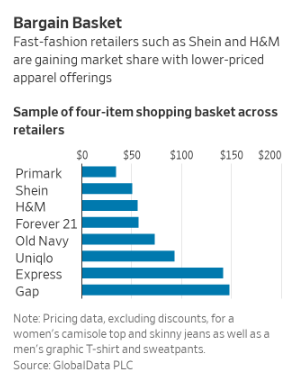
The report notes that low price retailers like Walmart, TJ Maxx and Ross have been consistently winning customers from full priced stores in recent years. Value stores captured 22.4% of U.S. apparel spending in 2021, up from 19.1% in 2014, the report notes.
Retailers are taking notice. Primark, for example, is planning on having 60 U.S. locations by October 2026, up from the 13 it has now. Another value retailer, China's Shein, is making a push to the U.S. by opening distribution centers in the country.
Some retailers are even rising from the dead to take advantage of the opportunity. For example, the once bankrupt Forever 21 said this week that it is planning on opening up 14 new stores in the U.S. through June 2023.
“When you can get a T-shirt for $5 at Shein, why would I pay $24.99 at Gap?” one consumer commented to WSJ, noting that even though the shirts are of lower quality, they are good enough. "With inflation, price is taking precedence over quality for me right now,” they continued.
Yunoki continued: “Price competition in the U.S. is severe.”
LME’s Russian metal dilemma threatens market turmoil
Users urge exchange to bar Russian commodities from warehouses
Traders are pushing the London Metal Exchange to stop accepting Russian metal, fearing its warehouses will become a stockpile for unwanted material that distorts global prices for commodities like aluminium and copper.
The push has pitted users of the world’s largest metals exchange against each other and comes at a critical time, as metal producers and buyers gather in London next week to finalise their contracts for supplies for the year ahead.
For the exchange, the dilemma constitutes another problem in a challenging year in which it has enraged some of its biggest users. It is already facing lawsuits from hedge fund Elliott Management and market maker Jane Street over its decision to cancel several hours’ worth of nickel contracts during a historic surge in prices in March.
Its latest difficulty comes as large trading houses like Glencore are deciding whether to renew their long-term contracts with Russian producers. With the industry preparing for next week’s annual LME Week get-together, the uncertainty over a ban means that many purchasers are deliberately staying away from deals that may involve Russian metals.
“Consumers are saying to the LME, ‘Your contract is not fit for us at the moment, we are self-sanctioning Russian material, we don’t want to dip into the LME warrant pool and pull out a warrant for Russian material’,” said Colin Hamilton, commodities analyst at BMO Capital Markets.
Traders said that puts the LME into a difficult position that needs urgent resolution. It plays a critical role in the daily functioning of the market, supplying metals when there is a shortfall or accepting it into its warehouses when there is an excess. Russia produces 6 per cent of the world’s aluminium, 5 per cent of copper, and 7 per cent of nickel.
If it continues to accept unwanted Russian material into its warehouses but many of its users shun it, it will create a stockpile.
The exchange is worried that the price on its market would reflect the glut of cheap, unwanted Russian metal it holds and not the price charged in deals that are cut directly between producers and consumers.
Many of the private deals are already including a premium on the price for transactions that do not include metal supplied from Russia. Chile’s Codelco, the world’s top producer of copper, has offered to sell its metal for $235 per tonne above the LME benchmark three-month contract, which trades at almost $7,450 per tonne, according to a person familiar with the matter.
A mismatch would undermine the LME’s role as a marketplace that set a fair and accurate market price.
Moreover there are signs that Russian producers are trying to get ahead of any future restrictions by increasing their deliveries to LME warehouses.
Since Friday about 200,000 tonnes of aluminium have entered LME warehouses — an unusually high level. While much of the material appeared to come from India, it has stoked fears about a build-up of Russian material.
“The market is clearly nervous that there is a big delivery of Russian material coming,” said Hamilton.
In an effort to resolve the problem, the LME set out three options for its users in a discussion paper this month, after it became apparent to the exchange that more users might be shunning Russian metal than it had previously believed.
According to the LME’s three possible scenarios, it can continue as usual, implement a ban or set volume limits on the amount of Russian material that can be accepted into warehouses. Traders conceded that the third route would technically be the most difficult to implement. Market participants have been given until October 28 to provide feedback.
Companies like US aluminium producer Alcoa have led calls for a ban but Russian rival Rusal has warned the move would fuel volatility in the market.
An LME ban could jeopardise Russian producers’ supply contracts with buyers and their financing arrangements with lenders, given that both often require metal to be able to be deposited to LME warehouses.
Other LME users bristle at the principle of a private company moving ahead of any formal government sanctions.
“The pattern of sanctions should be owned by governments. It would be wrong personally for an institution to decide,” said one trading executive.
The LME declined to comment but noted in its discussion paper that finding the appropriate balance of action is “paramount”.
To date western governments have avoided comprehensive sanctions on Russian metal, in part because its supply of crucial industrial metals would be difficult to replace and the effect would spill over into western economies.
Two market sources said Joe Biden’s administration was considering whether to target Russian aluminium through a US ban, raising tariffs, or putting sanctions on Rusal, the largest producer of the metal in Russia. But a US official cautioned that no decision was close. “We are always considering options but nothing is moving on this imminently,” a US official said.
Any US sanction on Russian exports of aluminium, which is used in aircraft, weaponry, cars and drink cans, would have far-reaching implications for global metals trading.
The price of the benchmark aluminium contract on the LME gained sharply last week on reports of the US considering sanctions before paring back to $2,171 per tonne. That is well above its average price over the previous decade but down by almost half from its peak in March.
“The LME discussion paper sends the ball back into governments’ side of the court,” said Tommy Bain, Marex’s head warrant trader and chair of the LME warehousing committee. “Without sanctions by the US, the LME is caught between a rock and a hard place.”